Creativity and Innovation
2
On completion of this topic, you should be able to:
 Discuss the nature of creativity and innovation and their
role in entrepreneurship
 Describe the steps in the creative process
 Explain how entrepreneurs can enhance their own
creativity
 Identify the four major types of innovation
 Discuss some of the sources of innovation for
entrepreneurs, and identify some of the major myths and
discuss the principles of innovation.
Objectives
3
Creativity is thinking new things, and innovation is doing new things
 Creativity is the ability to develop new ideas and to discover new
ways of looking at problems and opportunities.
 Innovation is the ability to apply creative solutions to those
problems and opportunities in order to enhance people’s lives or
to enrich society
Entrepreneurship = creativity + innovation
Creativity, innovation and entrepreneurs
4
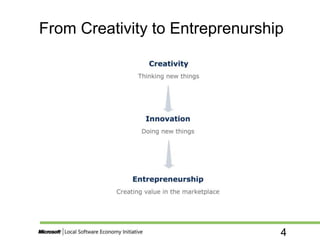
From Creativity to Entreprenurship
5
 Creativity is the ability to develop new ideas and to discover new
ways of looking at problems and opportunities.
 Innovation is the ability to apply creative solutions to those
problems and opportunities in order to enhance people’s lives or
to enrich society.
 Researchers believe that entrepreneurs succeed by thinking and
doing new things or old things in new ways .
Creativity, innovation and entrepreneurs
6
 Entrepreneurship is the result of a disciplined, systematic
process of applying creativity and innovation to needs and
opportunities in the marketplace.
 New ideas are much more than just random, disjointed tinkerings
with a new gadget.
 Entrepreneurs are those who marry their creative ideas with the
purposeful action and structure of a business.
Creativity, innovation and entrepreneurs
7
There are four phases which can help to remove ‘idea blocks’ to
and enhance creative thinking.
The four phases with their important activities are as follows:
 1: background or knowledge accumulation e.g. reading,
professional conferences, talking, visit to library
 2: incubation process e.g. ‘sleep on it’, exercise,
 3: idea or ‘eureka’ experience, usually this phase slowly but
surely formulates the solution
 4: evaluation and implementation e.g. prototypes, advice.
Creativity
8
 Characteristics of successful entrepreneurs generally include a
positive self-image, being motivated by challenging problems,
being sensitive to the world around them, and being good at
gathering different ideas in a short amount of time.
 It is not necessary to possess all of these characteristics to be
successful.
 Developing creativity is a process of changing the way you look
at things. To do this you must look for different or unorthodox
relationships between people and things.
 Another way to be more creative is to view people and things in
terms of how they can be used to satisfy needs (both as
resources and problem solvers).
Creativity
9
The following questions are designed to spur the imagination and
can help develop creativity:
 1. Is there a new way to do it?
 2. Can you borrow or adapt it?
 3. Can you give it a new twist?
 4. Do you merely need more of the same?
 5. Do you just need less of the same?
 6. Is there a substitute?
 7. Can the parts be rearranged?
 8. What if we do just the opposite?
 9. Can ideas be combined?
 10. Can we put it to other uses?
 11. What else could we make from this?
 12. Are there other markets for it?
Creativity
10
Be aware that there are numerous barriers to creativity,
including:
 1. searching for the one ‘right’ answer
 2. focusing on being logical
 3. blindly following the rules
 4. constantly being practical
 5. viewing play as frivolous
 6. becoming overly specialised
 7. avoiding ambiguity
 8. fearing looking foolish
 9. fearing mistakes and failure
 10. believing that ‘I’m not creative’.
Creativity
11
Schumpeter (1934) was first to point out the importance of new
value created by entrepreneurs.
More recently, Carland, Hoy, Boulton and Carland (1984) extended
and specified Schumpeter’s idea, saying that entrepreneurs:
 introduce new goods
 introduce new services
 introduce new methods of production
 open new markets
 open new sources of supply
 re-organise industry.
Innovation
12
There are four distinct types of innovation, these are as follows:
 Invention - described as the creation of a new product, service
or process
 Extension - the expansion of a product, service or process
 Duplication - defined as replication of an already existing
product, service or process
 Synthesis - the combination of existing concepts and factors into
a new formulation
Innovation
13
Five Myths
There are several myths associated with innovation that are
covered in the literature.
 Five myths are presented:
 innovation is planned and predictable
 technical specifications should be thoroughly prepared in
advance
 creativity relies on dreams and blue-sky ideas
 big projects will develop better innovations than smaller ones,
and
 technology is the driving force of innovation and success.
Innovation
14
Five Myths...cont
Whilst Innovation encompasses a large area, it is pertinent
to point out that there are a number of principles of
innovation. An important message here is that entrepreneurs
must realise that these principles exist and that they can be
learned.
 One of the principles is to be action-oriented. The
entrepreneur must always be looking for new ideas.
 Making the product, process or service simple and
understandable is another example of a principle of
innovation.
Innovation
15
Entrepreneurship has been described as an action-oriented way
of thinking, the focus of which is creativity, innovation and
change. Therefore, it is not surprising to see that entrepreneurs
are among the more creative and innovative players of
organizational change.
It is the entrepreneurs’ business to generate or add value as they
venture, introducing new forms, new organisations, new products
and new language to the world at large.
SUMMARY
16
In this topic we looked at the more creative side of
entrepreneurship – the value adding, innovative and organisation-
creating aspects, recognising that creativity requires someone
(like an entrepreneur) to add value in the marketplace through the
innovation process.
From the idea generation to the successful product development
and launch, innovation is the seed-bed for change. Charged with
the coordination of the innovation process are the entrepreneurs.
Their role is to nurture creative vision through development and
testing on to successful commercialisation. It is their vision that
sees not only the product or the process but also the opportunity
to market it.
SUMMARY…cont

4234141795-Creativity-and-Innovation.ppt

  • 1.
  • 2.
    2 On completion ofthis topic, you should be able to:  Discuss the nature of creativity and innovation and their role in entrepreneurship  Describe the steps in the creative process  Explain how entrepreneurs can enhance their own creativity  Identify the four major types of innovation  Discuss some of the sources of innovation for entrepreneurs, and identify some of the major myths and discuss the principles of innovation. Objectives
  • 3.
    3 Creativity is thinkingnew things, and innovation is doing new things  Creativity is the ability to develop new ideas and to discover new ways of looking at problems and opportunities.  Innovation is the ability to apply creative solutions to those problems and opportunities in order to enhance people’s lives or to enrich society Entrepreneurship = creativity + innovation Creativity, innovation and entrepreneurs
  • 4.
    4 From Creativity toEntreprenurship
  • 5.
    5  Creativity isthe ability to develop new ideas and to discover new ways of looking at problems and opportunities.  Innovation is the ability to apply creative solutions to those problems and opportunities in order to enhance people’s lives or to enrich society.  Researchers believe that entrepreneurs succeed by thinking and doing new things or old things in new ways . Creativity, innovation and entrepreneurs
  • 6.
    6  Entrepreneurship isthe result of a disciplined, systematic process of applying creativity and innovation to needs and opportunities in the marketplace.  New ideas are much more than just random, disjointed tinkerings with a new gadget.  Entrepreneurs are those who marry their creative ideas with the purposeful action and structure of a business. Creativity, innovation and entrepreneurs
  • 7.
    7 There are fourphases which can help to remove ‘idea blocks’ to and enhance creative thinking. The four phases with their important activities are as follows:  1: background or knowledge accumulation e.g. reading, professional conferences, talking, visit to library  2: incubation process e.g. ‘sleep on it’, exercise,  3: idea or ‘eureka’ experience, usually this phase slowly but surely formulates the solution  4: evaluation and implementation e.g. prototypes, advice. Creativity
  • 8.
    8  Characteristics ofsuccessful entrepreneurs generally include a positive self-image, being motivated by challenging problems, being sensitive to the world around them, and being good at gathering different ideas in a short amount of time.  It is not necessary to possess all of these characteristics to be successful.  Developing creativity is a process of changing the way you look at things. To do this you must look for different or unorthodox relationships between people and things.  Another way to be more creative is to view people and things in terms of how they can be used to satisfy needs (both as resources and problem solvers). Creativity
  • 9.
    9 The following questionsare designed to spur the imagination and can help develop creativity:  1. Is there a new way to do it?  2. Can you borrow or adapt it?  3. Can you give it a new twist?  4. Do you merely need more of the same?  5. Do you just need less of the same?  6. Is there a substitute?  7. Can the parts be rearranged?  8. What if we do just the opposite?  9. Can ideas be combined?  10. Can we put it to other uses?  11. What else could we make from this?  12. Are there other markets for it? Creativity
  • 10.
    10 Be aware thatthere are numerous barriers to creativity, including:  1. searching for the one ‘right’ answer  2. focusing on being logical  3. blindly following the rules  4. constantly being practical  5. viewing play as frivolous  6. becoming overly specialised  7. avoiding ambiguity  8. fearing looking foolish  9. fearing mistakes and failure  10. believing that ‘I’m not creative’. Creativity
  • 11.
    11 Schumpeter (1934) wasfirst to point out the importance of new value created by entrepreneurs. More recently, Carland, Hoy, Boulton and Carland (1984) extended and specified Schumpeter’s idea, saying that entrepreneurs:  introduce new goods  introduce new services  introduce new methods of production  open new markets  open new sources of supply  re-organise industry. Innovation
  • 12.
    12 There are fourdistinct types of innovation, these are as follows:  Invention - described as the creation of a new product, service or process  Extension - the expansion of a product, service or process  Duplication - defined as replication of an already existing product, service or process  Synthesis - the combination of existing concepts and factors into a new formulation Innovation
  • 13.
    13 Five Myths There areseveral myths associated with innovation that are covered in the literature.  Five myths are presented:  innovation is planned and predictable  technical specifications should be thoroughly prepared in advance  creativity relies on dreams and blue-sky ideas  big projects will develop better innovations than smaller ones, and  technology is the driving force of innovation and success. Innovation
  • 14.
    14 Five Myths...cont Whilst Innovationencompasses a large area, it is pertinent to point out that there are a number of principles of innovation. An important message here is that entrepreneurs must realise that these principles exist and that they can be learned.  One of the principles is to be action-oriented. The entrepreneur must always be looking for new ideas.  Making the product, process or service simple and understandable is another example of a principle of innovation. Innovation
  • 15.
    15 Entrepreneurship has beendescribed as an action-oriented way of thinking, the focus of which is creativity, innovation and change. Therefore, it is not surprising to see that entrepreneurs are among the more creative and innovative players of organizational change. It is the entrepreneurs’ business to generate or add value as they venture, introducing new forms, new organisations, new products and new language to the world at large. SUMMARY
  • 16.
    16 In this topicwe looked at the more creative side of entrepreneurship – the value adding, innovative and organisation- creating aspects, recognising that creativity requires someone (like an entrepreneur) to add value in the marketplace through the innovation process. From the idea generation to the successful product development and launch, innovation is the seed-bed for change. Charged with the coordination of the innovation process are the entrepreneurs. Their role is to nurture creative vision through development and testing on to successful commercialisation. It is their vision that sees not only the product or the process but also the opportunity to market it. SUMMARY…cont