Human Relation

  Code of Ethics
Human Relation
• Human - intellectual people
• Relation / Relationship - an abstraction
  belonging to or characteristic of two entities
  or parts together
• Human Relation – The way people interact
  and behave toward each other
The 7 Habits of Highly Effective People
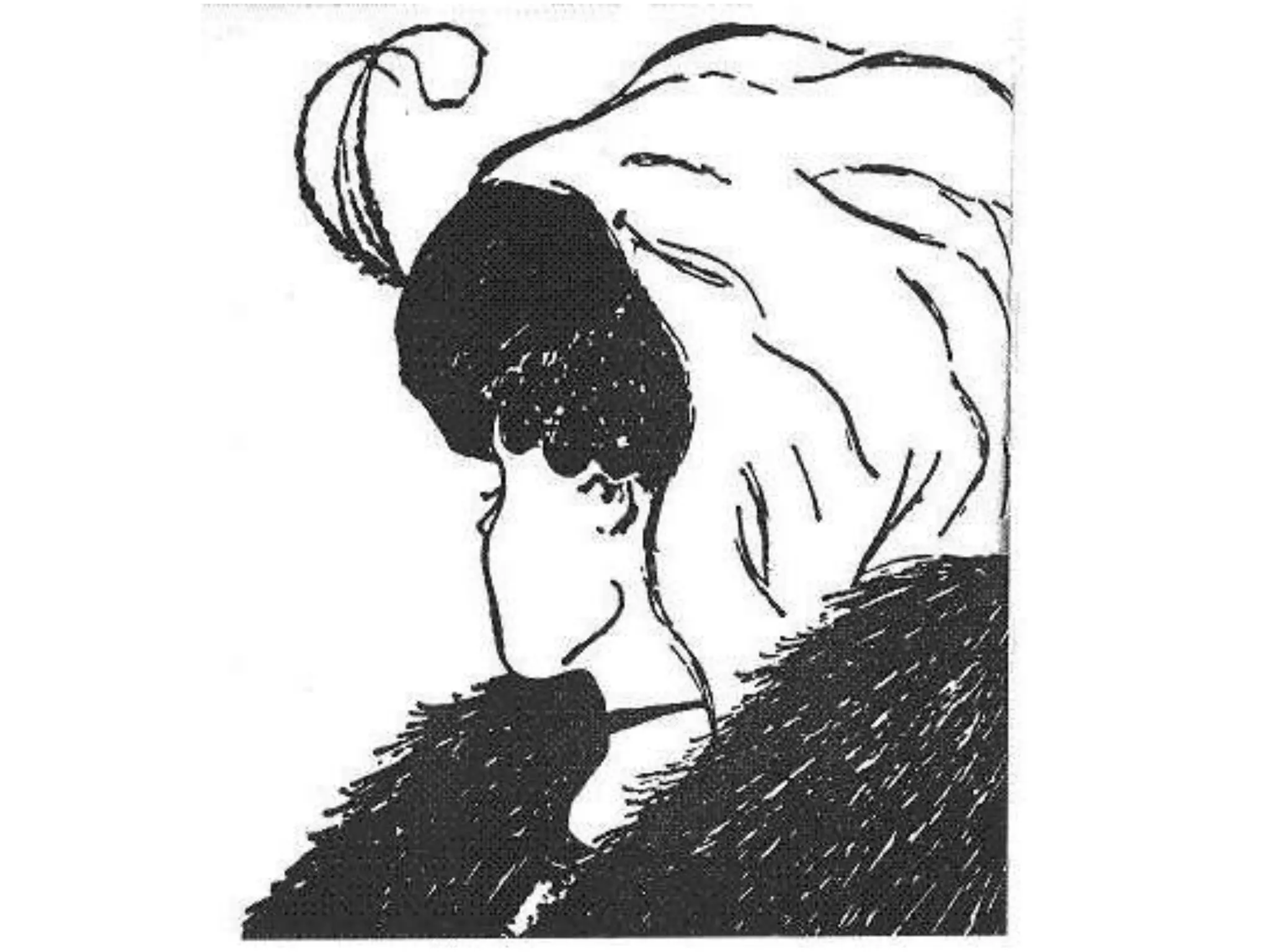
• Paradigm
   – Model, a perception or understanding.
   – Map on how to get somewhere

Example:
• Work on your behaviour – Try harder and work faster.
  RESULT: You get nowhere faster.
• Change your attitude – Think positive and be happy.
  RESULT – You are happy but still aren’t going to find
  your destination.
• SOLUTION – YOU NEED THE CORRECT MAP!
• Paradigm shift is a change in the way you
  perceive something.
• You can become aware of other people’s
  perceptions by listening to their explanation
  of their ‘map’. You may decide that you will
  adopt their map, you may adopt parts of it or
  you may disregard it completely, but unless
  you consider that a better alternative
  exists, you can never improve your map.
• Principle is a natural law that governs human
  growth and happiness.
  – fairness, integrity, honesty, dignity, service, excelle
    nce, potential, growth, patience, nurturance and
    encouragement.
• These are guidelines for achievement.
• Principles are your landmarks that confirm
  that you are on the right track and that you
  have the correct map.
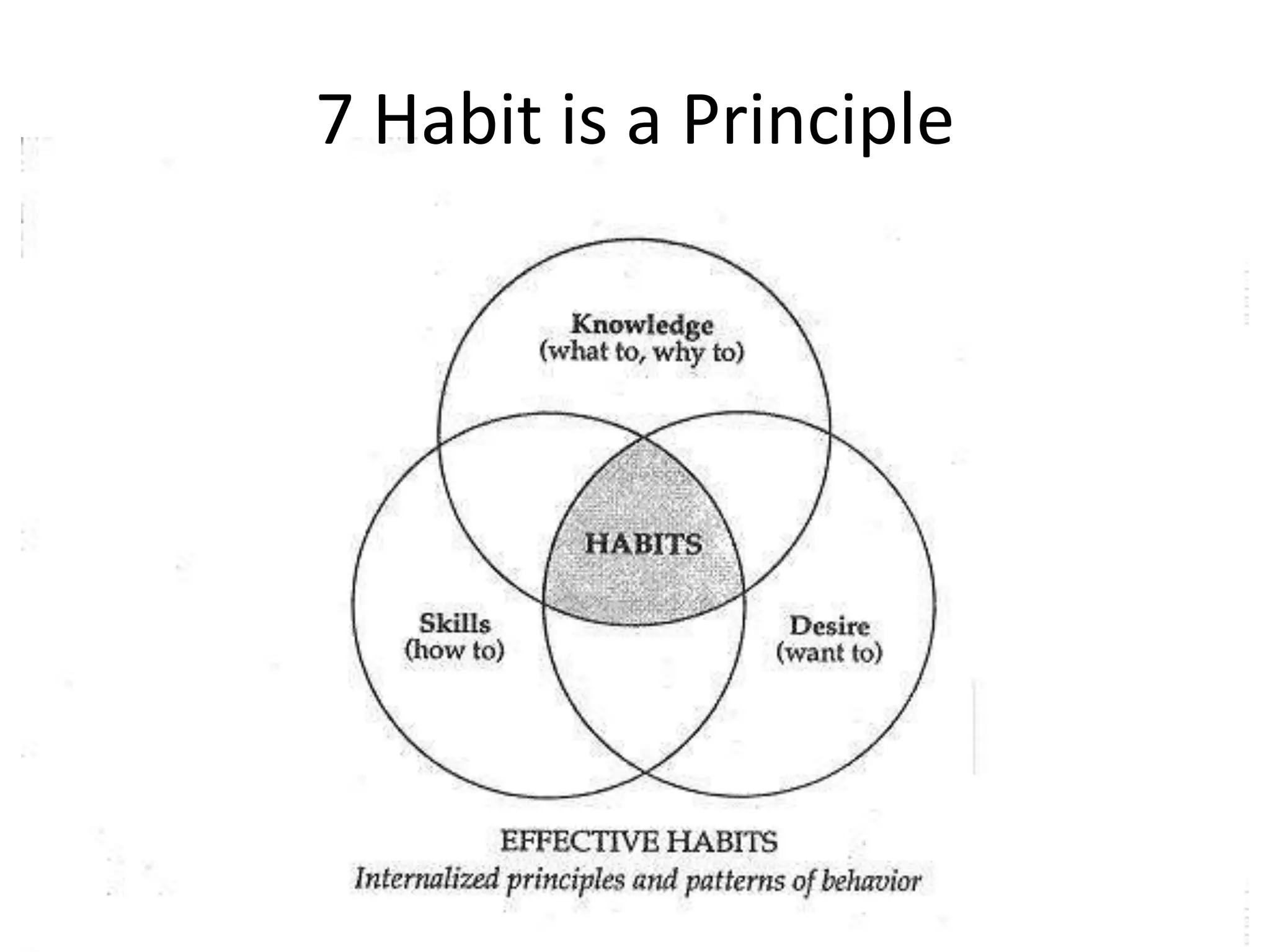
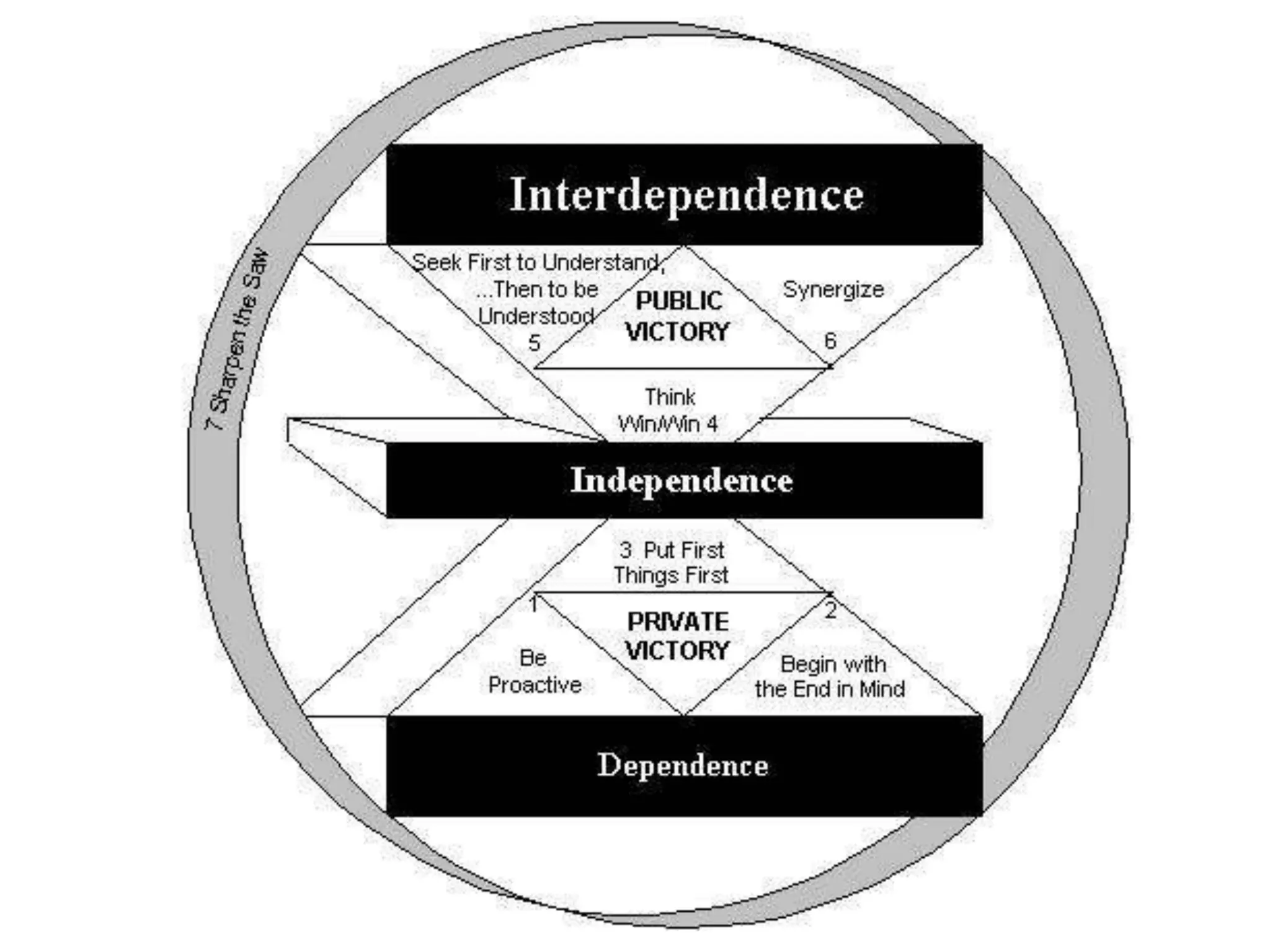
7 Habit is a Principle
7 Habits Paradigm
• The 7 habits paradigm - based on the concept of the
  maturity. This is the natural law of growth, an
  incremental, sequential progression to personal and
  interpersonal effectiveness and is the cornerstone of
  the seven habits
• There are 3 levels which are:
   – Dependence – The concept that YOU take care of me. I
     depend on you to survive and to achieve things.
   – Independence – The concept that I can look after myself. I
     rely solely on myself, I no longer need assistance.
   – Interdependence – The concept that WE can do things.
     That our talents and abilities combined create something
     greater.
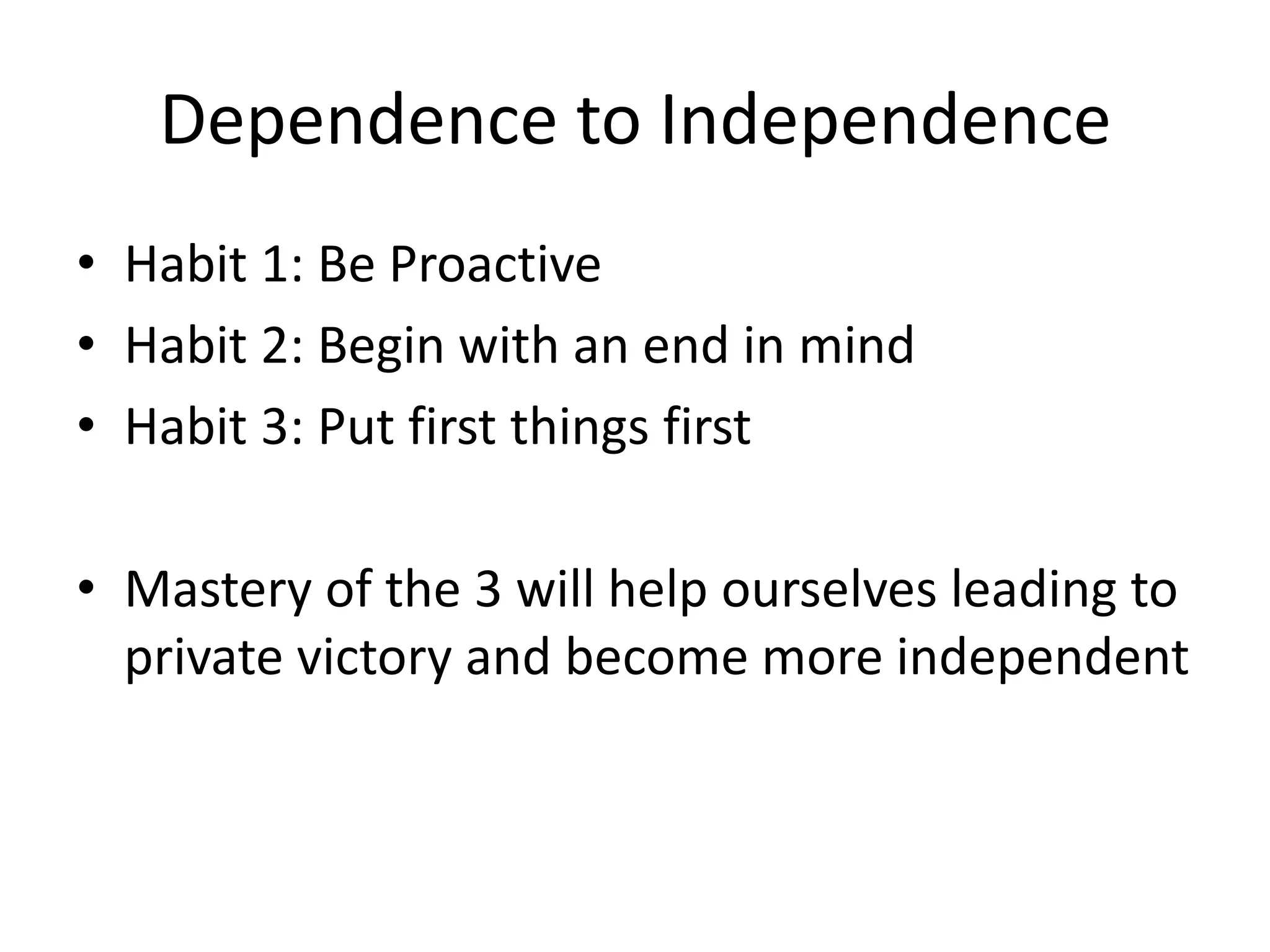
Dependence to Independence
• Habit 1: Be Proactive
• Habit 2: Begin with an end in mind
• Habit 3: Put first things first

• Mastery of the 3 will help ourselves leading to
  private victory and become more independent
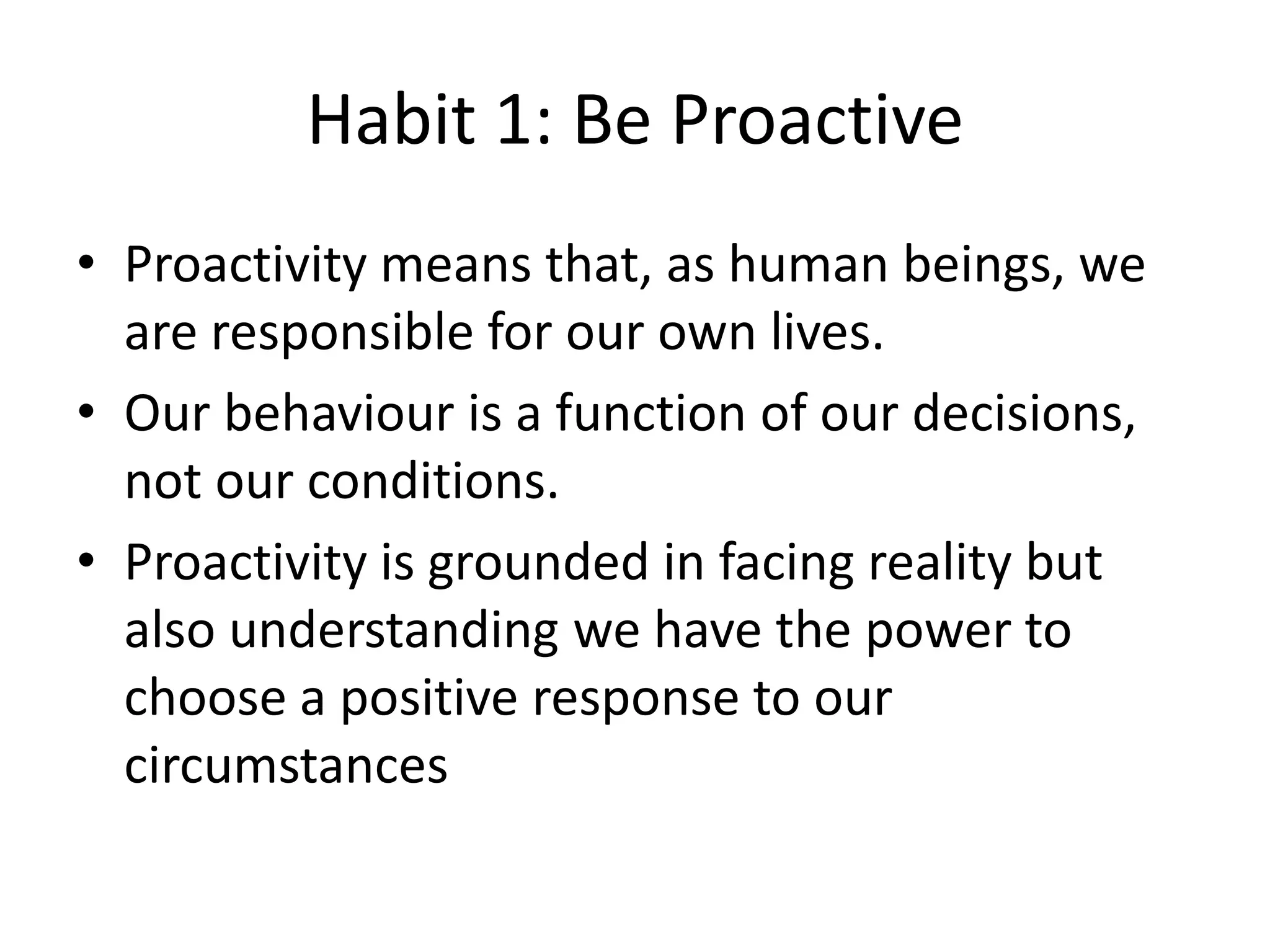
Habit 1: Be Proactive
• Proactivity means that, as human beings, we
  are responsible for our own lives.
• Our behaviour is a function of our decisions,
  not our conditions.
• Proactivity is grounded in facing reality but
  also understanding we have the power to
  choose a positive response to our
  circumstances
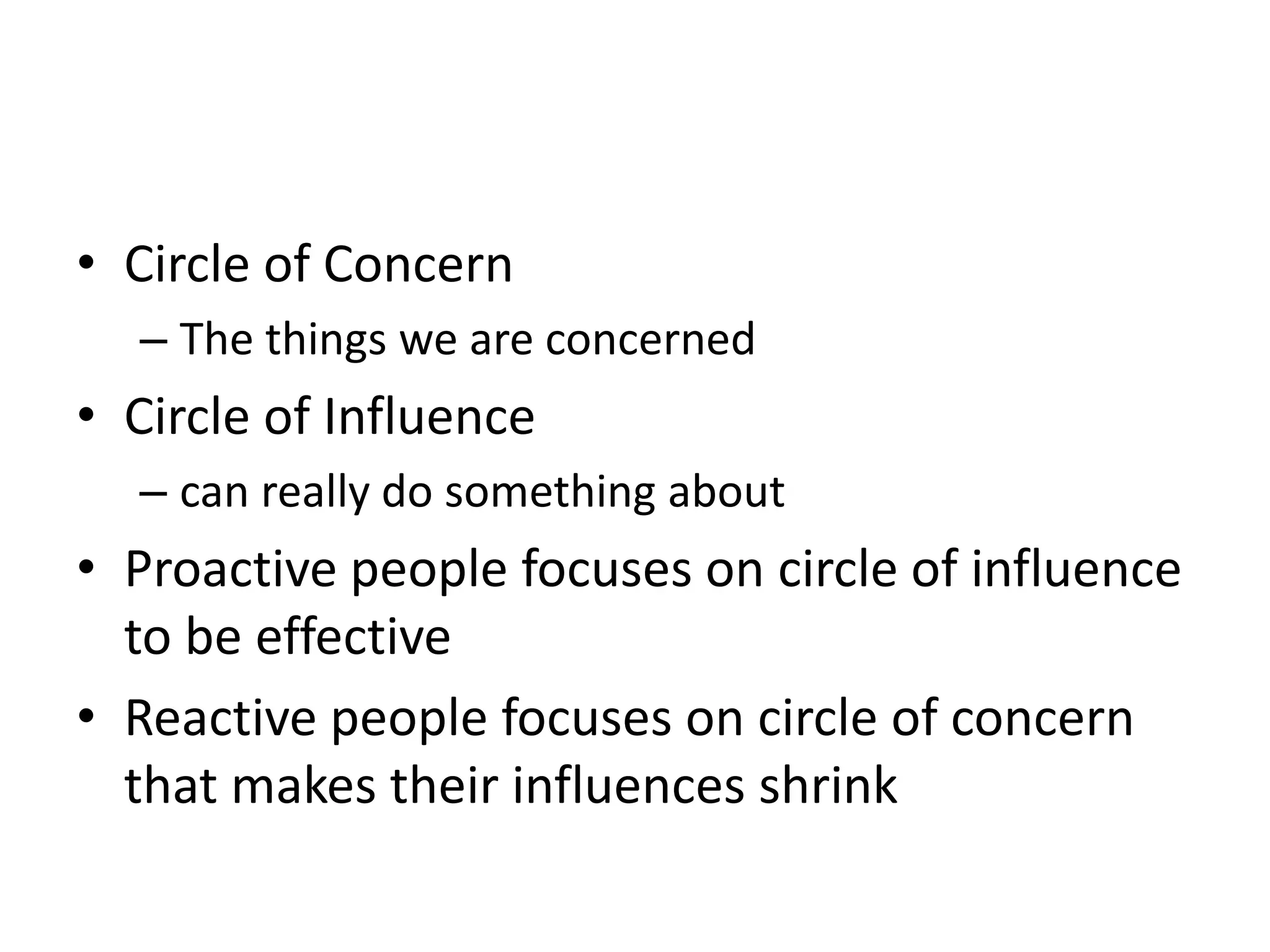
• Circle of Concern
  – The things we are concerned
• Circle of Influence
  – can really do something about
• Proactive people focuses on circle of influence
  to be effective
• Reactive people focuses on circle of concern
  that makes their influences shrink
Habit 2: Begin with an end in mind
• leadership what do I/we want to accomplish?
  Second is management how can I best
  accomplish it? Third is productivity doing it
• "Management is doing things right;
  Leadership is doing the right things.“
• the ability to envision in your mind what you
  cannot at present see with your eyes. It is
  based on the principle that all things are
  created twice.
Habit 3: Put first things first
• “Habit 1 I am the Programmer. Habit 2 Write
  the Program. Habit 3 Execute the Program.”
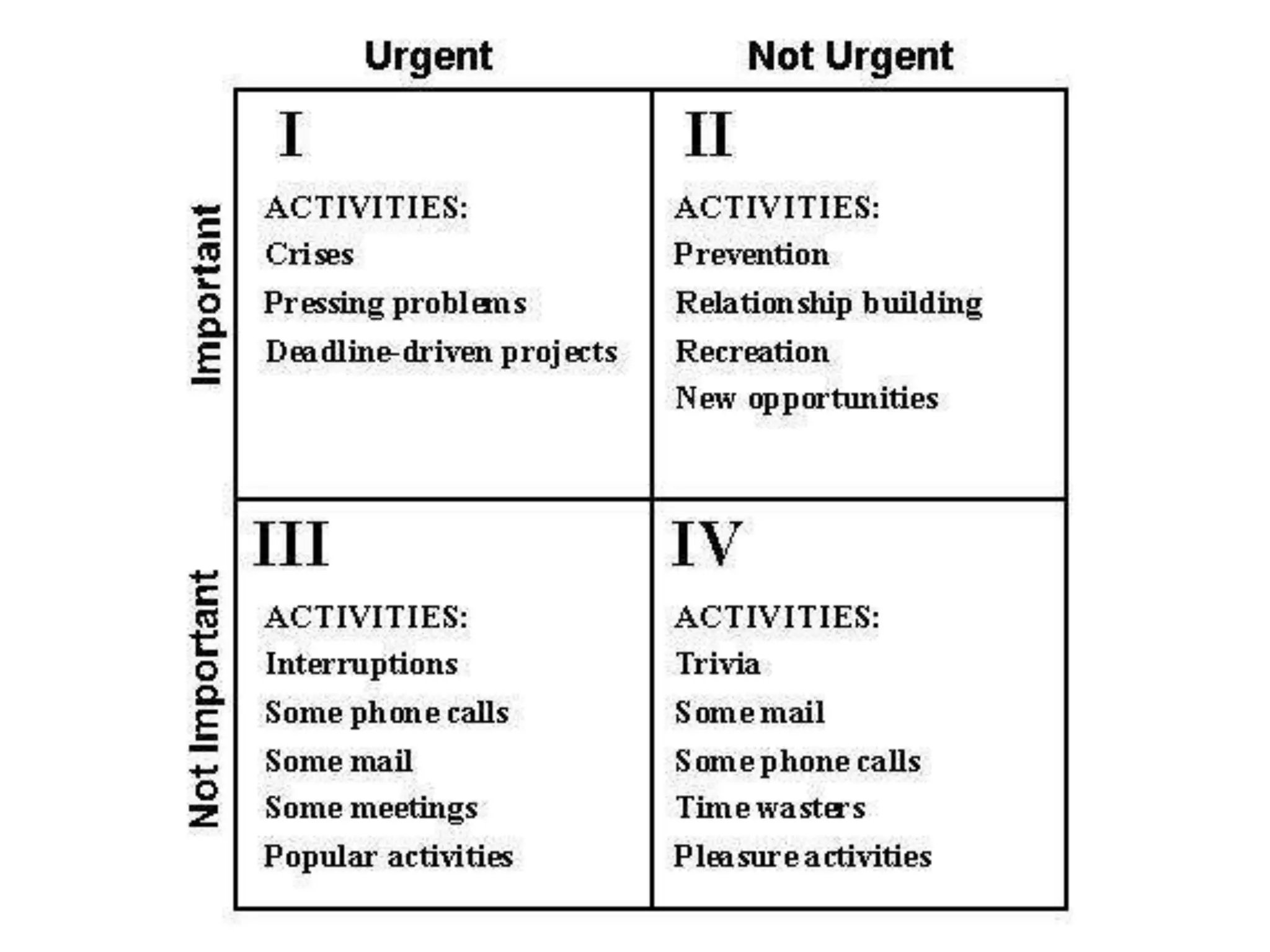
• Important Vs. Urgent
• Quadrant I activities are urgent and important
  called problems or crises. Focusing on
  Quadrant I results in it getting bigger and
  bigger until it dominates you.
• Quadrant III activities are urgent and not
  important, and often misclassified as
  Quadrant I.
• Quadrant IV is the escape Quadrant activities
  that are not urgent and not important.
• Effective people stay out of Quadrants III and
  IV because they aren't important. They shrink
  Quadrant I down to size by spending more
  time in Quadrant II.
Independence to Interdependence
• Habit 4: Think Win Win
• Habit 5: Seek first to understand then to be
  understood
• Habit 6: Synergy

• Mastery of 3 will lead ourselves towards
  Public Victory and become enable of
  interdependence
Habit 4: Think Win Win
• Win/Win People
  – can seek mutual benefit in all human interactions.
    Principle based behavior.
• Win/Lose The competitive paradigm:
  – if I win, you lose. The leadership style is authoritarian.
    In relationships, if both people aren't winning, both
    are losing.
• Lose/Win The "Doormat" paradigm.
  – The individual seeks strength from popularity based
    on acceptance. The leadership style is permissiveness.
• Lose/Lose
  – When people become obsessed with making the
    other person lose, even at their own expense.
• Win
  – Focusing solely on getting what one wants, regardless
    of the needs of others.
• Win/Win or No Deal
  – If we can't find a mutually beneficial solution, we
    agree to disagree agreeably no deal. This approach is
    most realistic at the beginning of a business
    relationship or enterprise. In a continuing
    relationship, it's no longer an option
Habit 5: Seek first to understand then
          to be understood
• Unless we understand them, we can't help or
  influence the situation
• Types of listening
  – Ignoring – not listening to what you hear
  – Pretending – not listening but responding
  – Selective Hearing – listening to the part that you
    want to hear
  – Attentive Listening –listening to the words
• Types of responding
  – Evaluate - Do we agree or not?
  – Probing - Asking questions
  – Advising - Giving advice based on our own
    experiences
  – Interpreting - Interpret their motives based on our
    own
• Responding like those means that we listen
  through our point of reference not theirs
• Empathic Listening – understanding what you
  are listening through their paradigm
  – 4 Stages:
     • Mimic - Repeat what the other person said
     • Rephrase - Rephrase their comments to show that
       you've understood
     • Reflect - Put their feelings into words for them
     • Rephrase and Reflect - Combine steps 2 and 3
Please Listen

           When I ask you to listen to me
          And you start giving me advice,
          You have not done what I asked.
           When I ask you to listen to me
And you begin to tell me why I shouldn’t feel that way,
         You are trampling on my feelings.
           When I ask you to listen to me
 And you feel you have to do something To solve my
                        problem,
                  You have failed me,
         Strange as that may seem. Listen!
              All I ask is that you listen.
           Don’t talk or do – just hear me.
Habit 6: Synergy
• The interaction of two or more agents so that
  their combined effect is greater than the sum
  of their individual effects
• Valuing each other differences
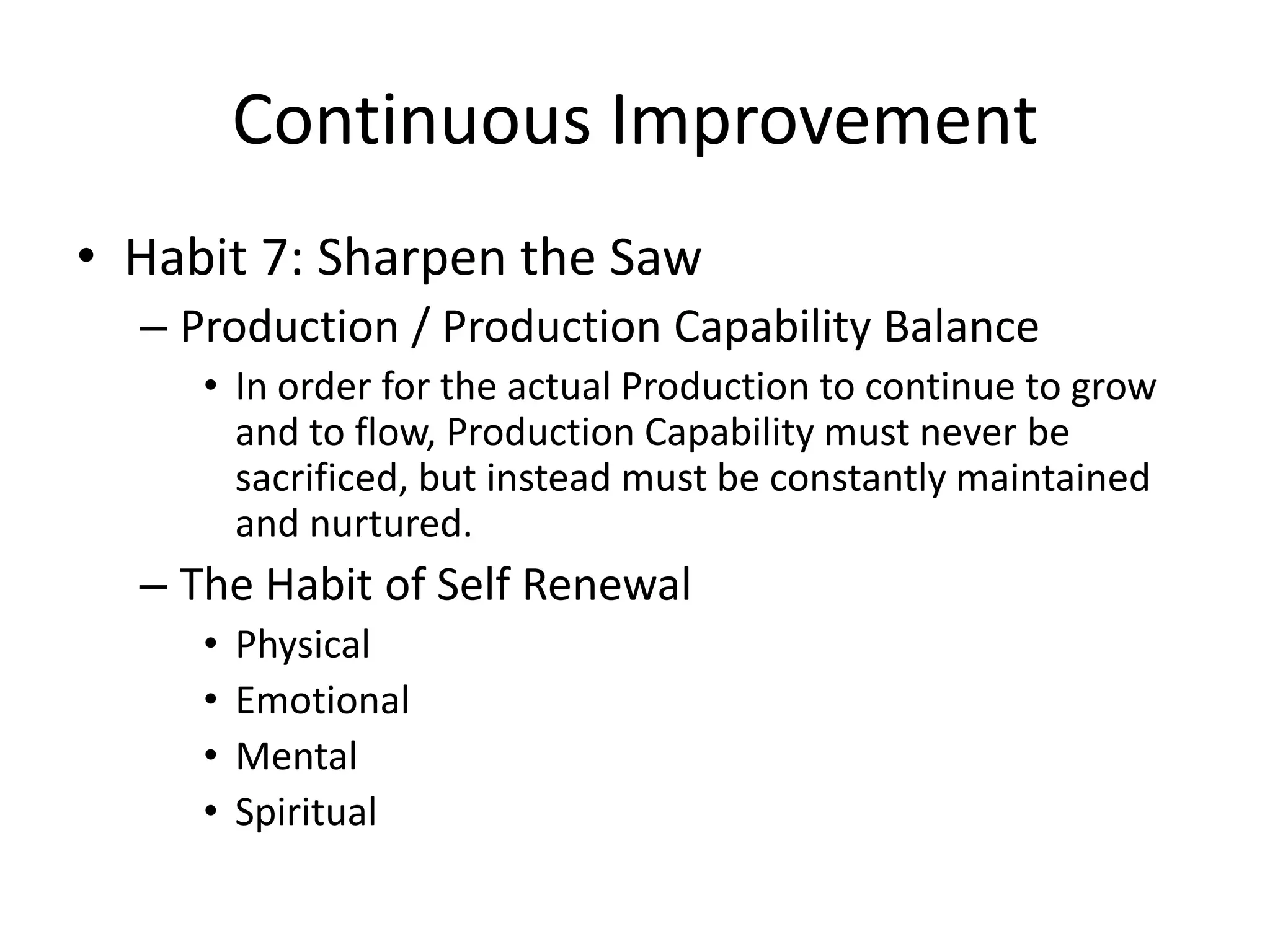
Continuous Improvement
• Habit 7: Sharpen the Saw
  – Production / Production Capability Balance
     • In order for the actual Production to continue to grow
       and to flow, Production Capability must never be
       sacrificed, but instead must be constantly maintained
       and nurtured.
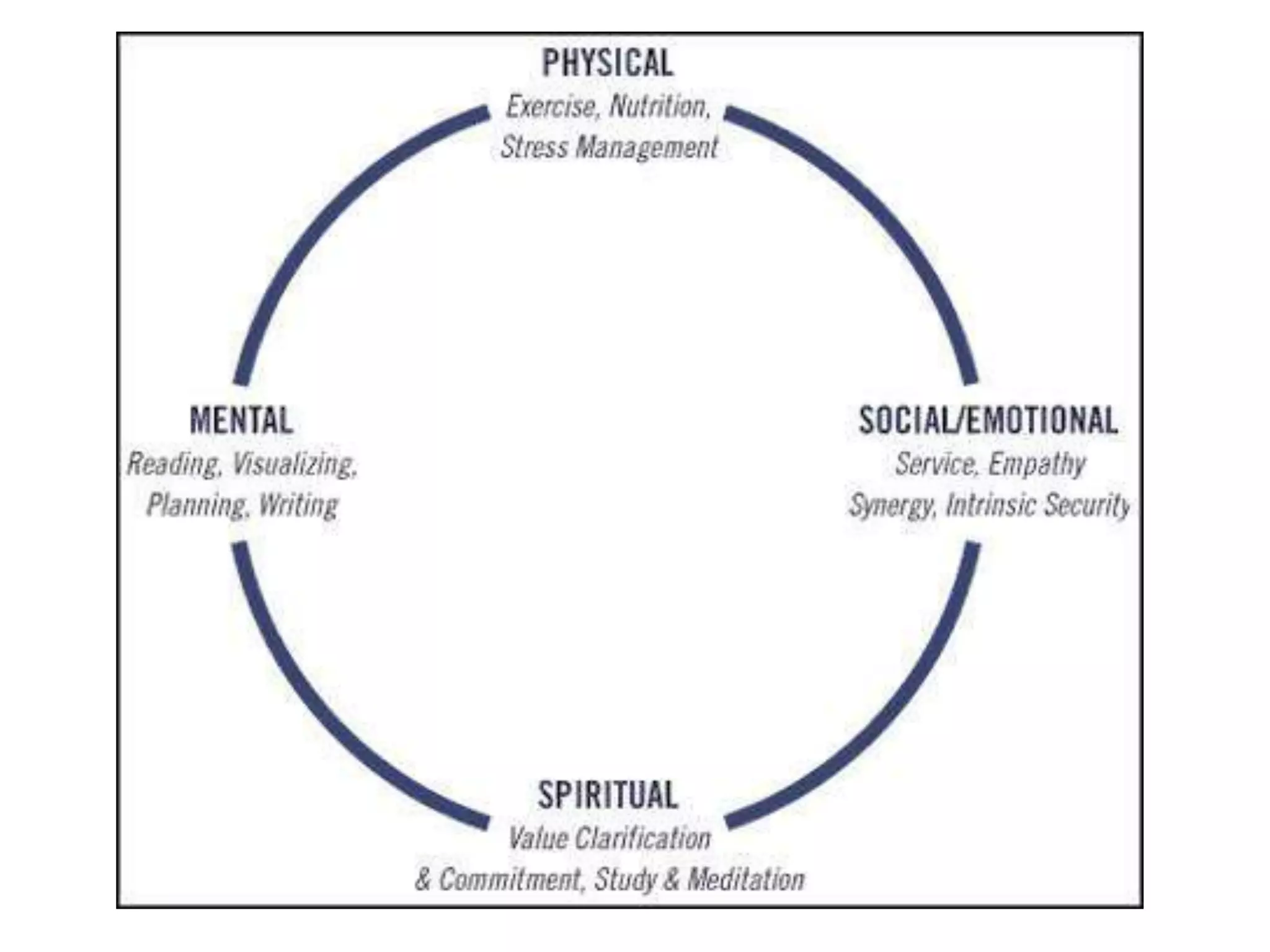
  – The Habit of Self Renewal
     •   Physical
     •   Emotional
     •   Mental
     •   Spiritual
4 human relation

4 human relation

  • 1.
    Human Relation Code of Ethics
  • 2.
    Human Relation • Human- intellectual people • Relation / Relationship - an abstraction belonging to or characteristic of two entities or parts together • Human Relation – The way people interact and behave toward each other
  • 3.
    The 7 Habitsof Highly Effective People • Paradigm – Model, a perception or understanding. – Map on how to get somewhere Example: • Work on your behaviour – Try harder and work faster. RESULT: You get nowhere faster. • Change your attitude – Think positive and be happy. RESULT – You are happy but still aren’t going to find your destination. • SOLUTION – YOU NEED THE CORRECT MAP!
  • 4.
    • Paradigm shiftis a change in the way you perceive something. • You can become aware of other people’s perceptions by listening to their explanation of their ‘map’. You may decide that you will adopt their map, you may adopt parts of it or you may disregard it completely, but unless you consider that a better alternative exists, you can never improve your map.
  • 6.
    • Principle isa natural law that governs human growth and happiness. – fairness, integrity, honesty, dignity, service, excelle nce, potential, growth, patience, nurturance and encouragement. • These are guidelines for achievement. • Principles are your landmarks that confirm that you are on the right track and that you have the correct map.
  • 7.
    7 Habit isa Principle
  • 8.
    7 Habits Paradigm •The 7 habits paradigm - based on the concept of the maturity. This is the natural law of growth, an incremental, sequential progression to personal and interpersonal effectiveness and is the cornerstone of the seven habits • There are 3 levels which are: – Dependence – The concept that YOU take care of me. I depend on you to survive and to achieve things. – Independence – The concept that I can look after myself. I rely solely on myself, I no longer need assistance. – Interdependence – The concept that WE can do things. That our talents and abilities combined create something greater.
  • 10.
    Dependence to Independence •Habit 1: Be Proactive • Habit 2: Begin with an end in mind • Habit 3: Put first things first • Mastery of the 3 will help ourselves leading to private victory and become more independent
  • 11.
    Habit 1: BeProactive • Proactivity means that, as human beings, we are responsible for our own lives. • Our behaviour is a function of our decisions, not our conditions. • Proactivity is grounded in facing reality but also understanding we have the power to choose a positive response to our circumstances
  • 12.
    • Circle ofConcern – The things we are concerned • Circle of Influence – can really do something about • Proactive people focuses on circle of influence to be effective • Reactive people focuses on circle of concern that makes their influences shrink
  • 13.
    Habit 2: Beginwith an end in mind • leadership what do I/we want to accomplish? Second is management how can I best accomplish it? Third is productivity doing it • "Management is doing things right; Leadership is doing the right things.“ • the ability to envision in your mind what you cannot at present see with your eyes. It is based on the principle that all things are created twice.
  • 14.
    Habit 3: Putfirst things first • “Habit 1 I am the Programmer. Habit 2 Write the Program. Habit 3 Execute the Program.” • Important Vs. Urgent • Quadrant I activities are urgent and important called problems or crises. Focusing on Quadrant I results in it getting bigger and bigger until it dominates you.
  • 15.
    • Quadrant IIIactivities are urgent and not important, and often misclassified as Quadrant I. • Quadrant IV is the escape Quadrant activities that are not urgent and not important. • Effective people stay out of Quadrants III and IV because they aren't important. They shrink Quadrant I down to size by spending more time in Quadrant II.
  • 17.
    Independence to Interdependence •Habit 4: Think Win Win • Habit 5: Seek first to understand then to be understood • Habit 6: Synergy • Mastery of 3 will lead ourselves towards Public Victory and become enable of interdependence
  • 18.
    Habit 4: ThinkWin Win • Win/Win People – can seek mutual benefit in all human interactions. Principle based behavior. • Win/Lose The competitive paradigm: – if I win, you lose. The leadership style is authoritarian. In relationships, if both people aren't winning, both are losing. • Lose/Win The "Doormat" paradigm. – The individual seeks strength from popularity based on acceptance. The leadership style is permissiveness.
  • 19.
    • Lose/Lose – When people become obsessed with making the other person lose, even at their own expense. • Win – Focusing solely on getting what one wants, regardless of the needs of others. • Win/Win or No Deal – If we can't find a mutually beneficial solution, we agree to disagree agreeably no deal. This approach is most realistic at the beginning of a business relationship or enterprise. In a continuing relationship, it's no longer an option
  • 20.
    Habit 5: Seekfirst to understand then to be understood • Unless we understand them, we can't help or influence the situation • Types of listening – Ignoring – not listening to what you hear – Pretending – not listening but responding – Selective Hearing – listening to the part that you want to hear – Attentive Listening –listening to the words
  • 21.
    • Types ofresponding – Evaluate - Do we agree or not? – Probing - Asking questions – Advising - Giving advice based on our own experiences – Interpreting - Interpret their motives based on our own • Responding like those means that we listen through our point of reference not theirs
  • 22.
    • Empathic Listening– understanding what you are listening through their paradigm – 4 Stages: • Mimic - Repeat what the other person said • Rephrase - Rephrase their comments to show that you've understood • Reflect - Put their feelings into words for them • Rephrase and Reflect - Combine steps 2 and 3
  • 23.
    Please Listen When I ask you to listen to me And you start giving me advice, You have not done what I asked. When I ask you to listen to me And you begin to tell me why I shouldn’t feel that way, You are trampling on my feelings. When I ask you to listen to me And you feel you have to do something To solve my problem, You have failed me, Strange as that may seem. Listen! All I ask is that you listen. Don’t talk or do – just hear me.
  • 24.
    Habit 6: Synergy •The interaction of two or more agents so that their combined effect is greater than the sum of their individual effects • Valuing each other differences
  • 25.
    Continuous Improvement • Habit7: Sharpen the Saw – Production / Production Capability Balance • In order for the actual Production to continue to grow and to flow, Production Capability must never be sacrificed, but instead must be constantly maintained and nurtured. – The Habit of Self Renewal • Physical • Emotional • Mental • Spiritual