Organisation, Work and Technology 221People in OrganisationsThe Human Relations MovementDr. Simon Burnett(s.burnett1@lancaster.ac.uk)Lent Term 20091
Introducing Human Relations.There is presently a widespread, unitaristic and humanistic beliefprevalent in management thinking, that being happy and productiveat work are necessarily connectedAn interdisciplinary study of the social relations in the workplace Presents a counterpoint to the preceding scientific management hegemonyAssumes workers inherently want to engage with others in socially supportive relationshipsEmphasises: motivation, communication, participation and leadership2
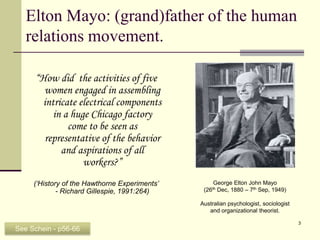
Elton Mayo: (grand)father of the human relations movement.“How did  the activities of five women engaged in assembling intricate electrical components in a huge Chicago factory come to be seen as representative of the behavior and aspirations of all workers?”(‘History of the Hawthorne Experiments’  - Richard Gillespie, 1991:264)3George Elton John Mayo (26th Dec, 1880 – 7th Sep, 1949)Australian psychologist, sociologist and organizational theorist.See Schein - p56-66
From Bethlehem Steel to Western Electric: the Hawthorne Experiments (i).Reviewing Taylor’s principles:Separation of conception and executionReduce all tasks to simplest movementsPhysical matching of workers to work4“Researchers had empirically  discovered that one may organize, and apparently scientifically, a carefully contrived enquiry into a human industrial problem and yet failed completely to elucidate the problem in any particular”(‘The Human Problems of an Industrial Civilization’ – Elton Mayo, 1946:53)
Ironically – the Hawthorne Experiments were intended to determine which physical and technical factors led to improved production and workplace attitude.  But, after far from conclusive results, the very act of focusing on the employees directly, regardless of the changes implemented, became attributed to causing the desired outcomes witnessed.Thus, Mayo and his team sought to reframe the management of culture rather than process5From Bethlehem Steel to Western Electric:  the Hawthorne Experiments (ii).“Comment after comment from the girls indicates that...they have a feeling that their increased production is in some way related to the distinctly freer, happier and more pleasant working environment”(‘The Human Problems of an Industrial Civilization’ – Elton Mayo, 1946:74-7)
Abraham Maslow: father of humanistic psychology.‘Motivation and Personality’ (1970)The organismic viewpointUnity, integration and organisation are the natural state of the normal personality“...disorganization is pathological, usually brought about by an oppressive or threatening environment” (Theories of Personality’ – Hall & Lindzey, 1960:296)Embraced a number of concepts emerging from Hawthorne experimentsAttacked psychology’s prevailing negativity and  ‘pessimism’Mankind strives continuously to realise inherent potentialHumanity is ‘essentially good’6Abraham Harold Maslow  (1st Apr, 1908 – 8th June, 1970 )American clinical psychologist.
The humanists’ approach.Maslow et al wished to study ‘transcendent and transpersonal’  psychological phenomenaThey considered it ‘closed off’ in principle to the schools of behaviorism [cf. Skinner and Pavlov] and FreudianismSupremacy of the individualHeld a distrust for mechanical models and ‘customary analytical techniques’ (Hall & Lindzey 1960:257)7“Whilst most of the best minds in psychology were pushing relentlessly towards increasing rigor and quantification; [humanists] serenely pursued [their] own way, advocating the importance of the qualitative study of the individual case”(‘Theories of Personality’ – Hall & Lindzey , 1960: xxvii).
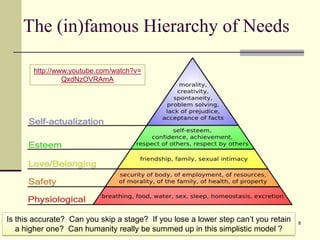
The (in)famous Hierarchy of Needs8http://www.youtube.com/watch?v=QxdNzOVRAmAIs this accurate?  Can you skip a stage?  If you lose a lower step can’t you retain a higher one?  Can humanity really be summed up in this simplistic model ?
In his own words...Positivity, wellness and normalityHuman happiness can be harnessed towards mutual employee/employer benefit
Reduces environmental 	agencyHolistic study of humanity
Mankind’s limitless power 	and potentialDesire to make life better and happier“A musician must make music, an artist must paint, a poet must write, if he is to be ultimately at peace with himself”“Classic economic theory, based as it is on an inadequate theory of human motivation, could be revolutionized by accepting the reality of higher human needs, including the impulse to self actualization and the love for the highest values”9
‘Hearts and minds’: the modern embracement.It is easy to see where and why these ideas have been assimilated in to contemporary management culture...http://www.bnet.com/2422-13724_23-182940.htmlHOWEVER: despite appearances, all these theories still rely on rational and instrumental assumptions, that place primacy upon the goals of the capitalist enterprise by re-aligning employee action and attitudes to those of the employers (cf. ’Minding the Workers’ - O’Connor, 1999a:223)10
Conclusion: HRM’s shaky modern incantation from a curiously misanthropic humanist.Much of modern day HRM has stayed loyal to Human Relation’s original core notions (see Mayo and Maslow et al).However, Mayo believed World War 1 had demonstrated “man’s fundamental rottenness” and that this innate rotten nature needed sublimating.  So, as opposed to a sympathetic, moral obligation, he hence aspired to appeal to the human factor as he saw mankind’s emotionality as posing “the foremost danger to civilization”.He had visions of management becoming reified to the position of “guardian of social order” able to save “humanity from its naturally dire state”.For if the human agent could be sufficiently manipulated by workplace initiatives: “this would grant managers the genuine capacity to make people not only do – but also be – what was wanted by the organization”.11See O’Connor, E. (1999a; 1999b).
References.Burnett, S.B. (2008), The Happiness Agenda: the sources, sites and protagonists of a modern obsession, PhD Thesis, University of Lancaster.Bolton, S.C. (2000), ‘Emotion Here, Emotion There, Emotional Organisations Everywhere’ in Critical Perspectives on Accounting, 11: pp155-171.Bolton, S.C. & Boyd, C. (2003), ‘Trolley Dolly or Skilled Emotion Manager?  Moving on from Hochchild’s Managed Heart’ in Work, Employment and Society, 17: pp289-308.Fisher, C.D. (1980), ‘On the Dubious Wisdom of Expecting Job Satisfaction to Correlate with Performance’ in The Academy of Management Review, 5(4): pp607-612.Fisher, C.D. (2003), ‘Why do Lay People Believe that Satisfaction and Performance are Correlated? Possible Sources of a Commonsense Theory’ in Journal of Organizational Behavior, 24: pp753-777.Gillespie, R. (1991), Manufacturing Knowledge: A History of the Hawthorne Experiments, Cambridge University Press: Cambridge and New York.Goldsmith, B. (2003), ‘Fun Adds Up’ in Successful Meetings, 52(7): p26.Goleman, D. (1996), Emotional Intelligence: Why it Can Matter More Than IQ, London: Bloomsbury.Hall, C.S. & Lindzey, G. (1960), Theories of Personality (6th edition), New York: John Wiley & Sons Inc. 12

221 Human Relations

  • 1.
    Organisation, Work andTechnology 221People in OrganisationsThe Human Relations MovementDr. Simon Burnett(s.burnett1@lancaster.ac.uk)Lent Term 20091
  • 2.
    Introducing Human Relations.Thereis presently a widespread, unitaristic and humanistic beliefprevalent in management thinking, that being happy and productiveat work are necessarily connectedAn interdisciplinary study of the social relations in the workplace Presents a counterpoint to the preceding scientific management hegemonyAssumes workers inherently want to engage with others in socially supportive relationshipsEmphasises: motivation, communication, participation and leadership2
  • 3.
    Elton Mayo: (grand)fatherof the human relations movement.“How did the activities of five women engaged in assembling intricate electrical components in a huge Chicago factory come to be seen as representative of the behavior and aspirations of all workers?”(‘History of the Hawthorne Experiments’ - Richard Gillespie, 1991:264)3George Elton John Mayo (26th Dec, 1880 – 7th Sep, 1949)Australian psychologist, sociologist and organizational theorist.See Schein - p56-66
  • 4.
    From Bethlehem Steelto Western Electric: the Hawthorne Experiments (i).Reviewing Taylor’s principles:Separation of conception and executionReduce all tasks to simplest movementsPhysical matching of workers to work4“Researchers had empirically discovered that one may organize, and apparently scientifically, a carefully contrived enquiry into a human industrial problem and yet failed completely to elucidate the problem in any particular”(‘The Human Problems of an Industrial Civilization’ – Elton Mayo, 1946:53)
  • 5.
    Ironically – theHawthorne Experiments were intended to determine which physical and technical factors led to improved production and workplace attitude. But, after far from conclusive results, the very act of focusing on the employees directly, regardless of the changes implemented, became attributed to causing the desired outcomes witnessed.Thus, Mayo and his team sought to reframe the management of culture rather than process5From Bethlehem Steel to Western Electric: the Hawthorne Experiments (ii).“Comment after comment from the girls indicates that...they have a feeling that their increased production is in some way related to the distinctly freer, happier and more pleasant working environment”(‘The Human Problems of an Industrial Civilization’ – Elton Mayo, 1946:74-7)
  • 6.
    Abraham Maslow: fatherof humanistic psychology.‘Motivation and Personality’ (1970)The organismic viewpointUnity, integration and organisation are the natural state of the normal personality“...disorganization is pathological, usually brought about by an oppressive or threatening environment” (Theories of Personality’ – Hall & Lindzey, 1960:296)Embraced a number of concepts emerging from Hawthorne experimentsAttacked psychology’s prevailing negativity and ‘pessimism’Mankind strives continuously to realise inherent potentialHumanity is ‘essentially good’6Abraham Harold Maslow (1st Apr, 1908 – 8th June, 1970 )American clinical psychologist.
  • 7.
    The humanists’ approach.Maslowet al wished to study ‘transcendent and transpersonal’ psychological phenomenaThey considered it ‘closed off’ in principle to the schools of behaviorism [cf. Skinner and Pavlov] and FreudianismSupremacy of the individualHeld a distrust for mechanical models and ‘customary analytical techniques’ (Hall & Lindzey 1960:257)7“Whilst most of the best minds in psychology were pushing relentlessly towards increasing rigor and quantification; [humanists] serenely pursued [their] own way, advocating the importance of the qualitative study of the individual case”(‘Theories of Personality’ – Hall & Lindzey , 1960: xxvii).
  • 8.
    The (in)famous Hierarchyof Needs8http://www.youtube.com/watch?v=QxdNzOVRAmAIs this accurate? Can you skip a stage? If you lose a lower step can’t you retain a higher one? Can humanity really be summed up in this simplistic model ?
  • 9.
    In his ownwords...Positivity, wellness and normalityHuman happiness can be harnessed towards mutual employee/employer benefit
  • 10.
  • 11.
    Mankind’s limitless power and potentialDesire to make life better and happier“A musician must make music, an artist must paint, a poet must write, if he is to be ultimately at peace with himself”“Classic economic theory, based as it is on an inadequate theory of human motivation, could be revolutionized by accepting the reality of higher human needs, including the impulse to self actualization and the love for the highest values”9
  • 12.
    ‘Hearts and minds’:the modern embracement.It is easy to see where and why these ideas have been assimilated in to contemporary management culture...http://www.bnet.com/2422-13724_23-182940.htmlHOWEVER: despite appearances, all these theories still rely on rational and instrumental assumptions, that place primacy upon the goals of the capitalist enterprise by re-aligning employee action and attitudes to those of the employers (cf. ’Minding the Workers’ - O’Connor, 1999a:223)10
  • 13.
    Conclusion: HRM’s shakymodern incantation from a curiously misanthropic humanist.Much of modern day HRM has stayed loyal to Human Relation’s original core notions (see Mayo and Maslow et al).However, Mayo believed World War 1 had demonstrated “man’s fundamental rottenness” and that this innate rotten nature needed sublimating. So, as opposed to a sympathetic, moral obligation, he hence aspired to appeal to the human factor as he saw mankind’s emotionality as posing “the foremost danger to civilization”.He had visions of management becoming reified to the position of “guardian of social order” able to save “humanity from its naturally dire state”.For if the human agent could be sufficiently manipulated by workplace initiatives: “this would grant managers the genuine capacity to make people not only do – but also be – what was wanted by the organization”.11See O’Connor, E. (1999a; 1999b).
  • 14.
    References.Burnett, S.B. (2008),The Happiness Agenda: the sources, sites and protagonists of a modern obsession, PhD Thesis, University of Lancaster.Bolton, S.C. (2000), ‘Emotion Here, Emotion There, Emotional Organisations Everywhere’ in Critical Perspectives on Accounting, 11: pp155-171.Bolton, S.C. & Boyd, C. (2003), ‘Trolley Dolly or Skilled Emotion Manager? Moving on from Hochchild’s Managed Heart’ in Work, Employment and Society, 17: pp289-308.Fisher, C.D. (1980), ‘On the Dubious Wisdom of Expecting Job Satisfaction to Correlate with Performance’ in The Academy of Management Review, 5(4): pp607-612.Fisher, C.D. (2003), ‘Why do Lay People Believe that Satisfaction and Performance are Correlated? Possible Sources of a Commonsense Theory’ in Journal of Organizational Behavior, 24: pp753-777.Gillespie, R. (1991), Manufacturing Knowledge: A History of the Hawthorne Experiments, Cambridge University Press: Cambridge and New York.Goldsmith, B. (2003), ‘Fun Adds Up’ in Successful Meetings, 52(7): p26.Goleman, D. (1996), Emotional Intelligence: Why it Can Matter More Than IQ, London: Bloomsbury.Hall, C.S. & Lindzey, G. (1960), Theories of Personality (6th edition), New York: John Wiley & Sons Inc. 12