Introduction to the 7 Habits of Highly Effective People Sanjeev Sahgal
Overview Stephen Covey’s brainchild Seven Habits compose his “system” Think of the most influential person in your life (past or present).  Why does this person stand out in your mind?
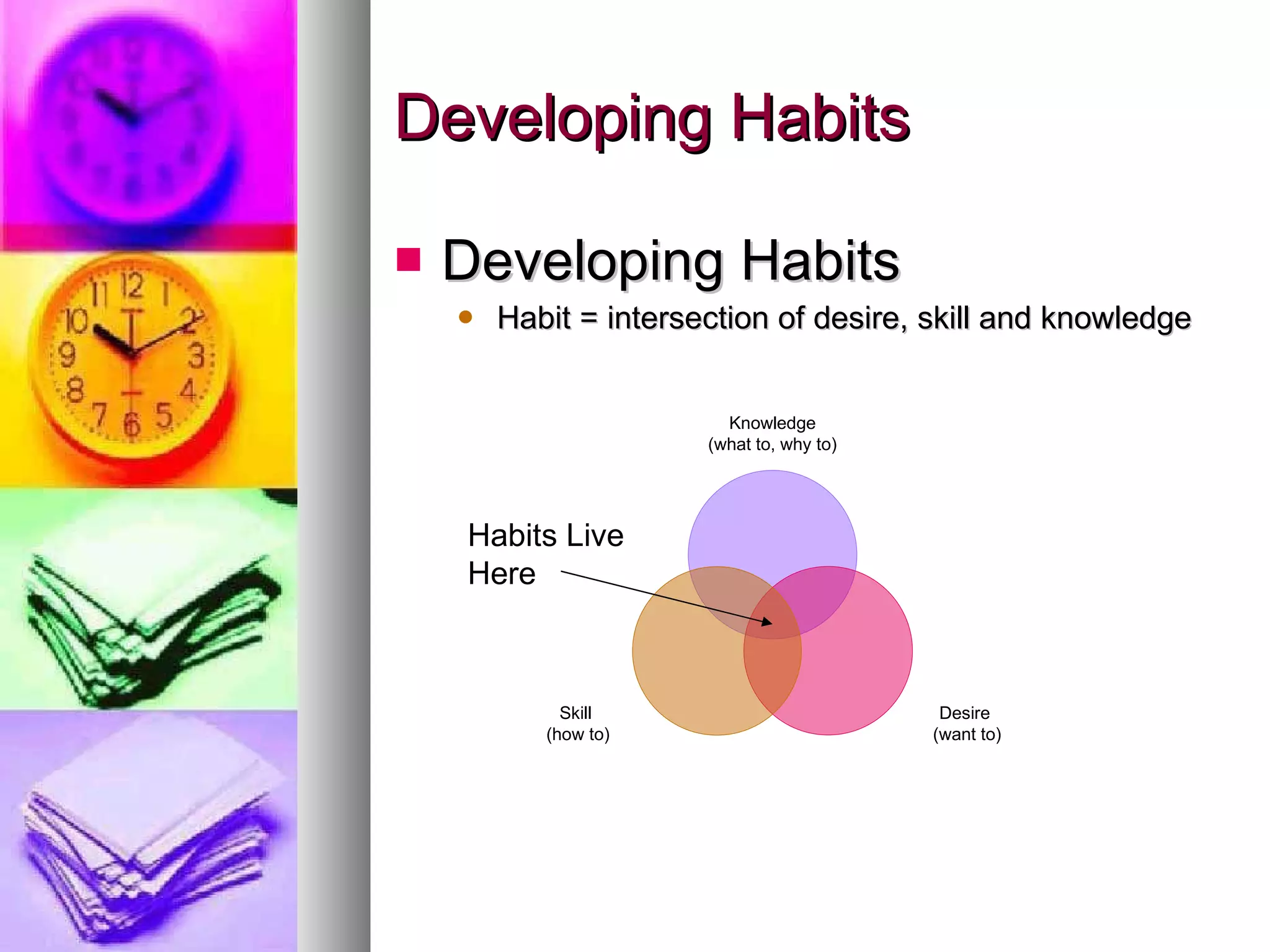
Developing Habits Developing Habits Habit = intersection of desire, skill and knowledge Habits Live Here Knowledge (what to, why to) Desire  (want to) Skill  (how to)
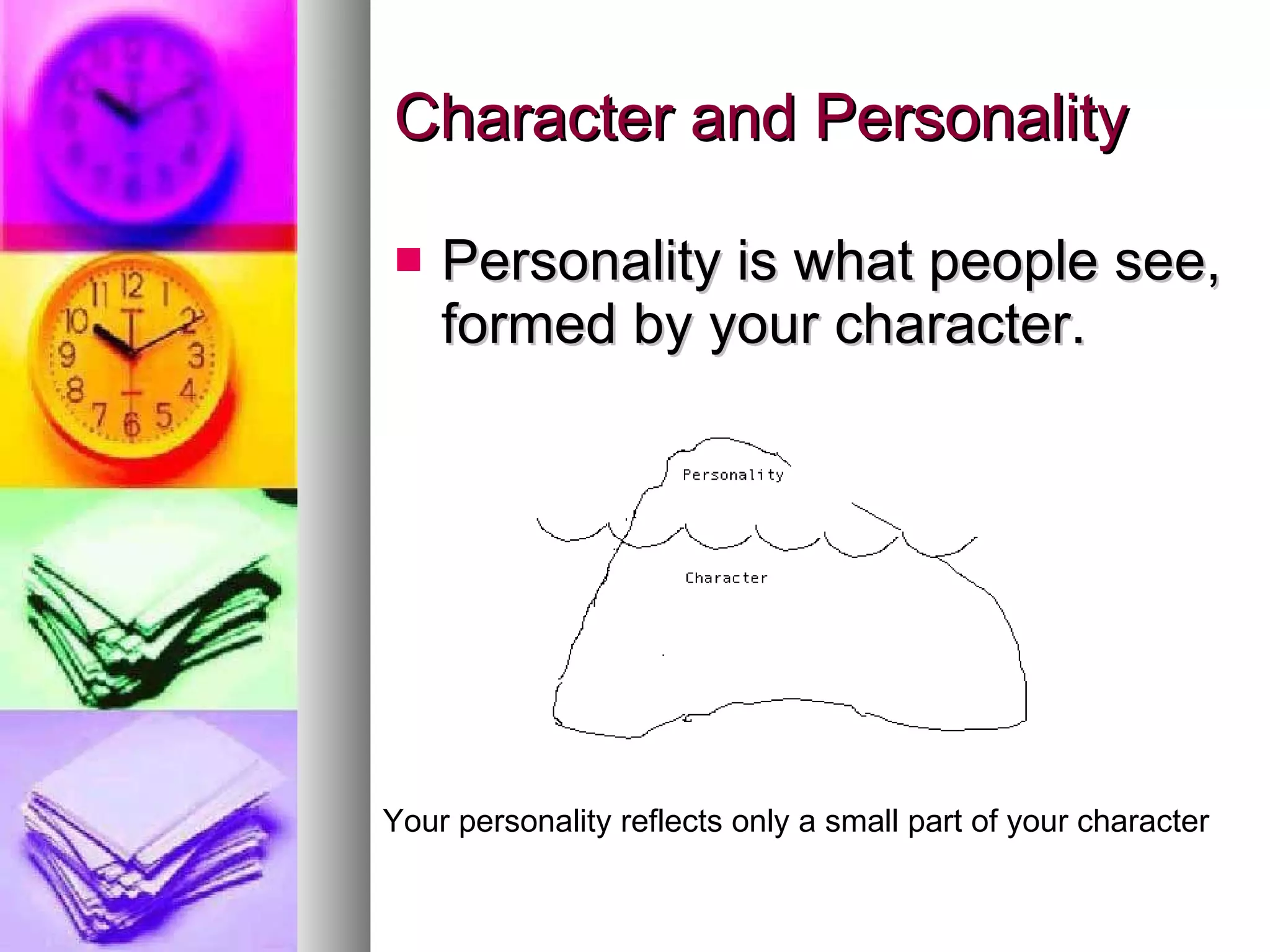
Character and Personality Personality is what people see, formed by your character. Your personality reflects only a small part of your character
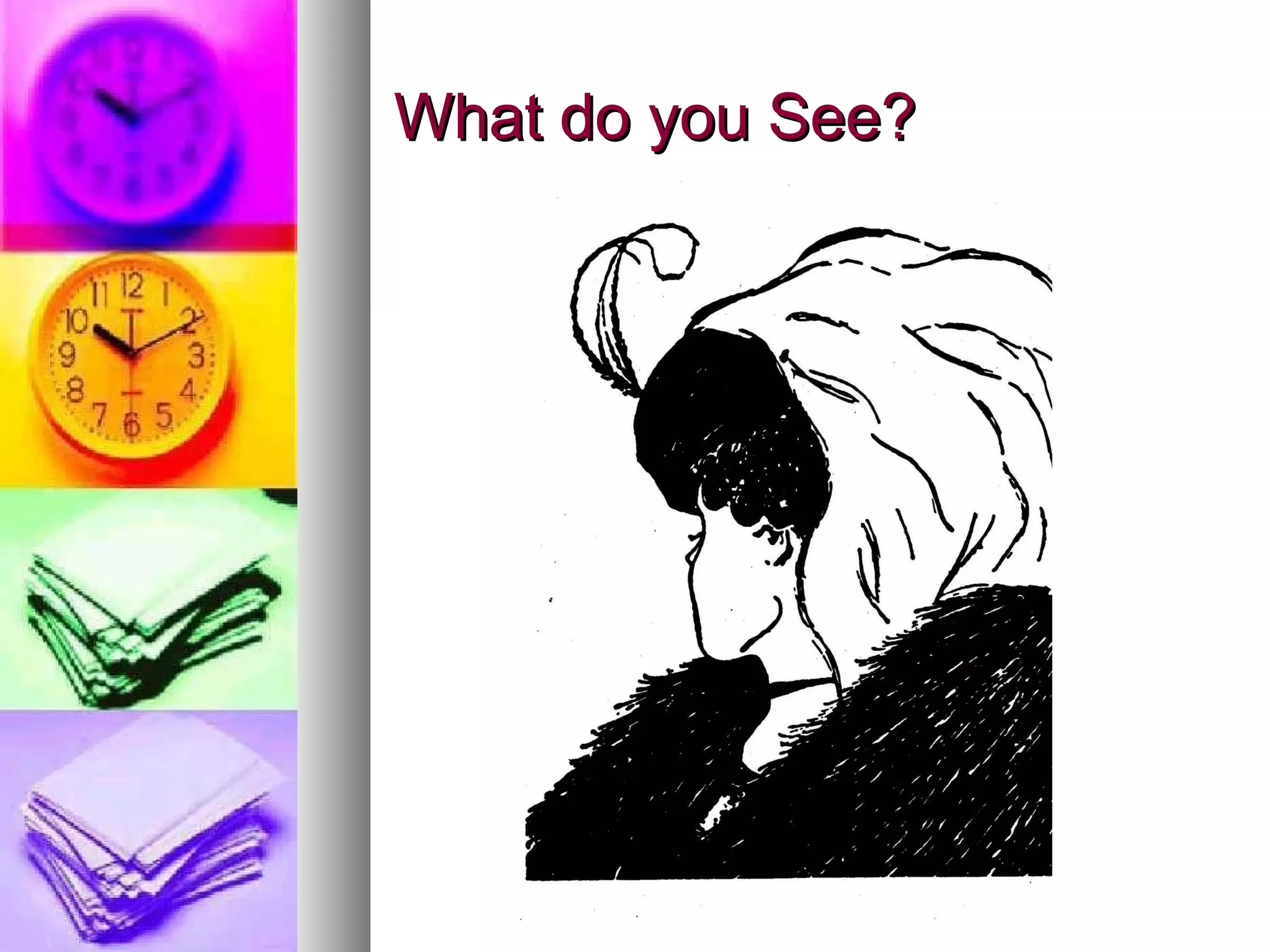
How do you see things? How do you see the world? How do you want to see the world?
What do you See?
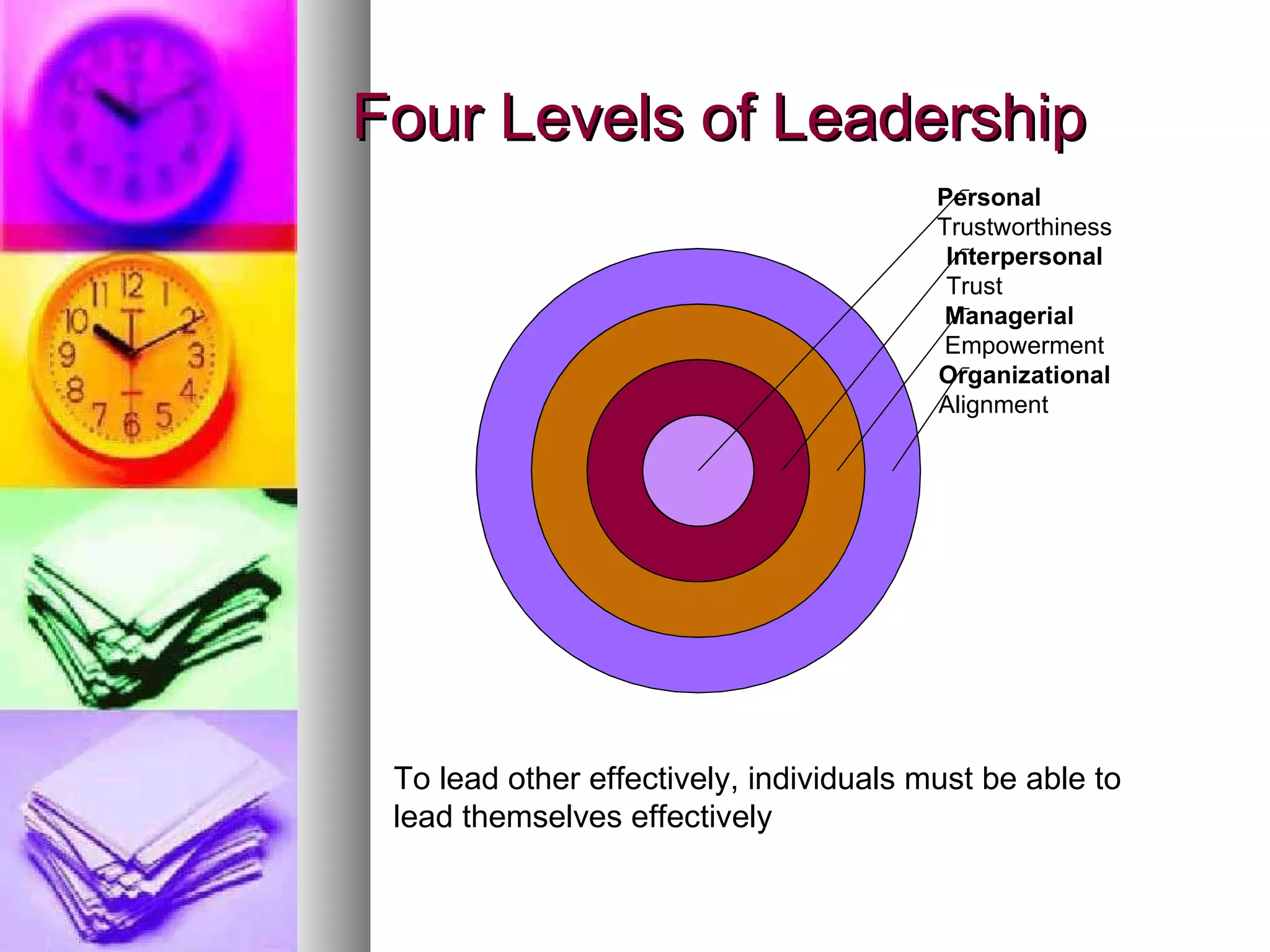
Four Levels of Leadership To lead other effectively, individuals must be able to lead themselves effectively Organizational Alignment Managerial Empowerment Interpersonal Trust Personal Trustworthiness
Character and Competence Character  – A person with high character exhibits integrity, maturity and an Abundance Mentality Competence  – A person with high competence has a knowledge and ability in a given area To be truly effective, a person  must  have a balance of these 2 items.
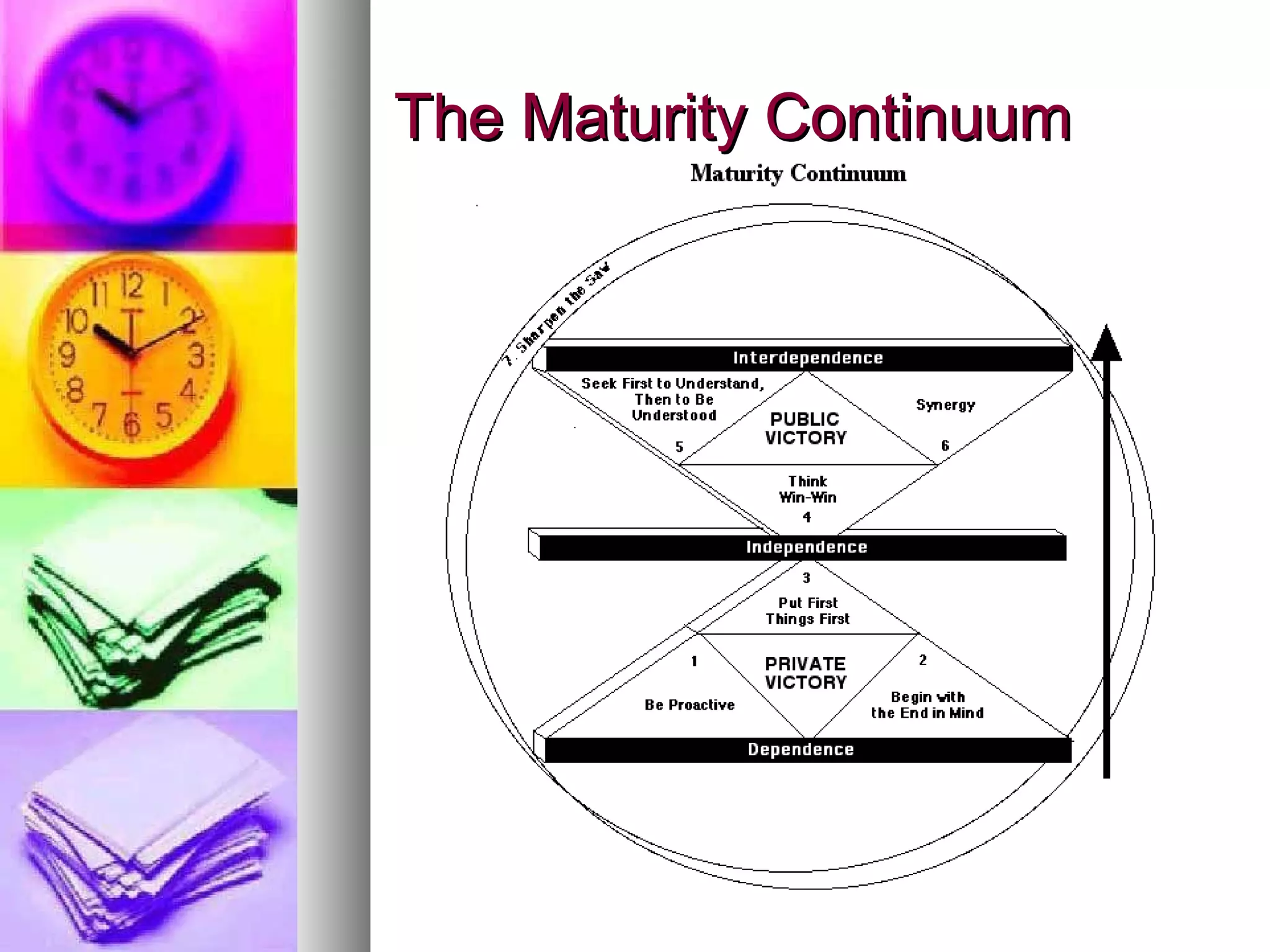
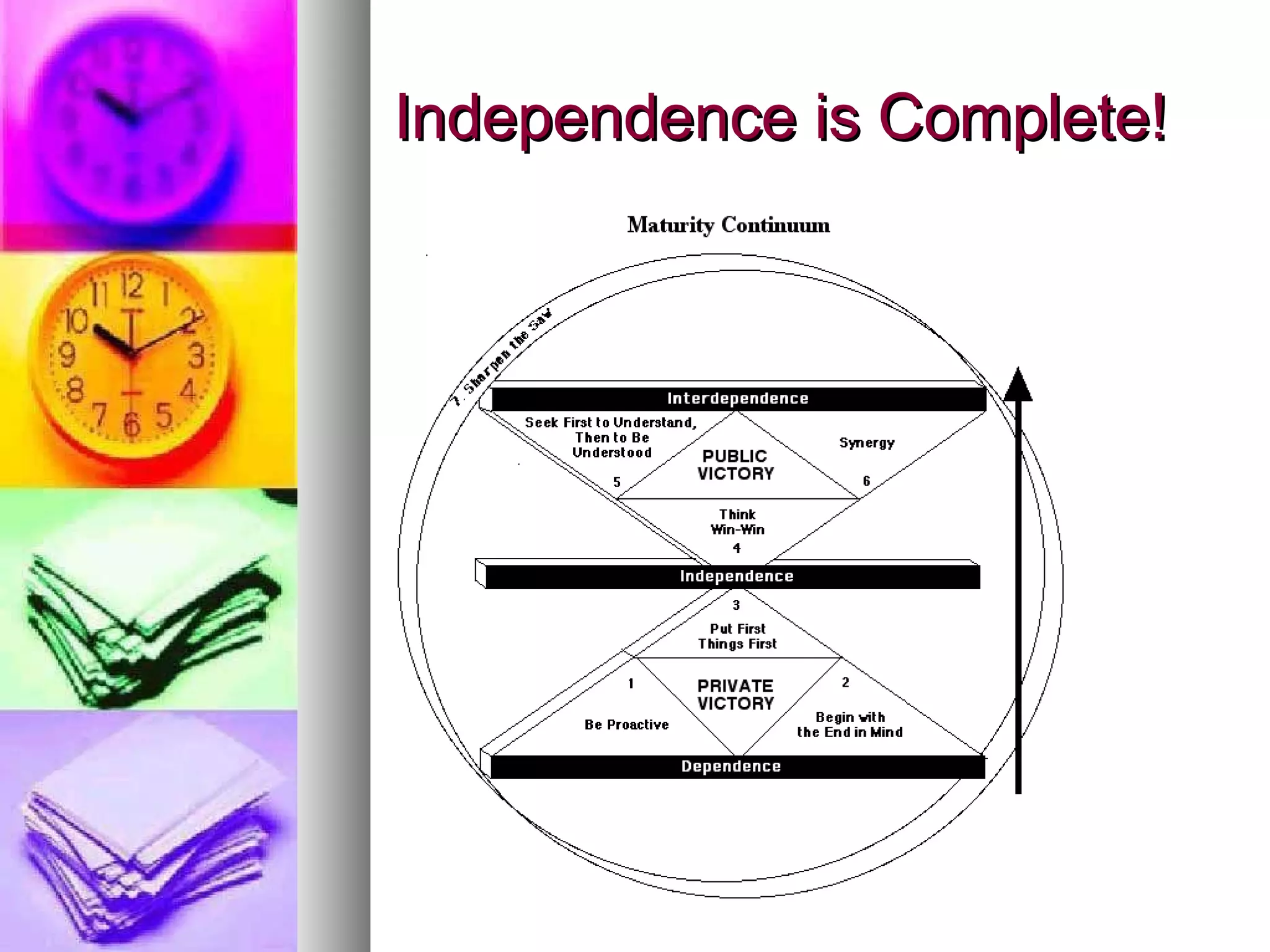
The Maturity Continuum
Emotional Bank Account Metaphor for amount of trust in a relationship. A Deposit is something that builds and repairs trust in your relationships A Withdrawal is something which lessens trust in relationships “ You cannot talk your way out of problems you behaved into”
Emotional Bank Account Exercise Rate the following as Withdrawal, Deposit or Neutral You receive verbal thanks for working 3 weekends in a row You are asked to cover shift for an engineer who is taking the afternoon off You give a late birthday card You get a dinner for two and tickets to the movies for the extra hours you have been putting in You respond sarcastically to a co-workers genuine question
Emotional Bank Account  Rate Chart Deposits Kindness and courtesy Keeping promises Honoring expectations Loyalty to the absent Making apologies Withdrawals Unkindness and discourtesy Breaking promises Violating expectations Disloyalty, Duplicity Pride, Conceit, Arrogance
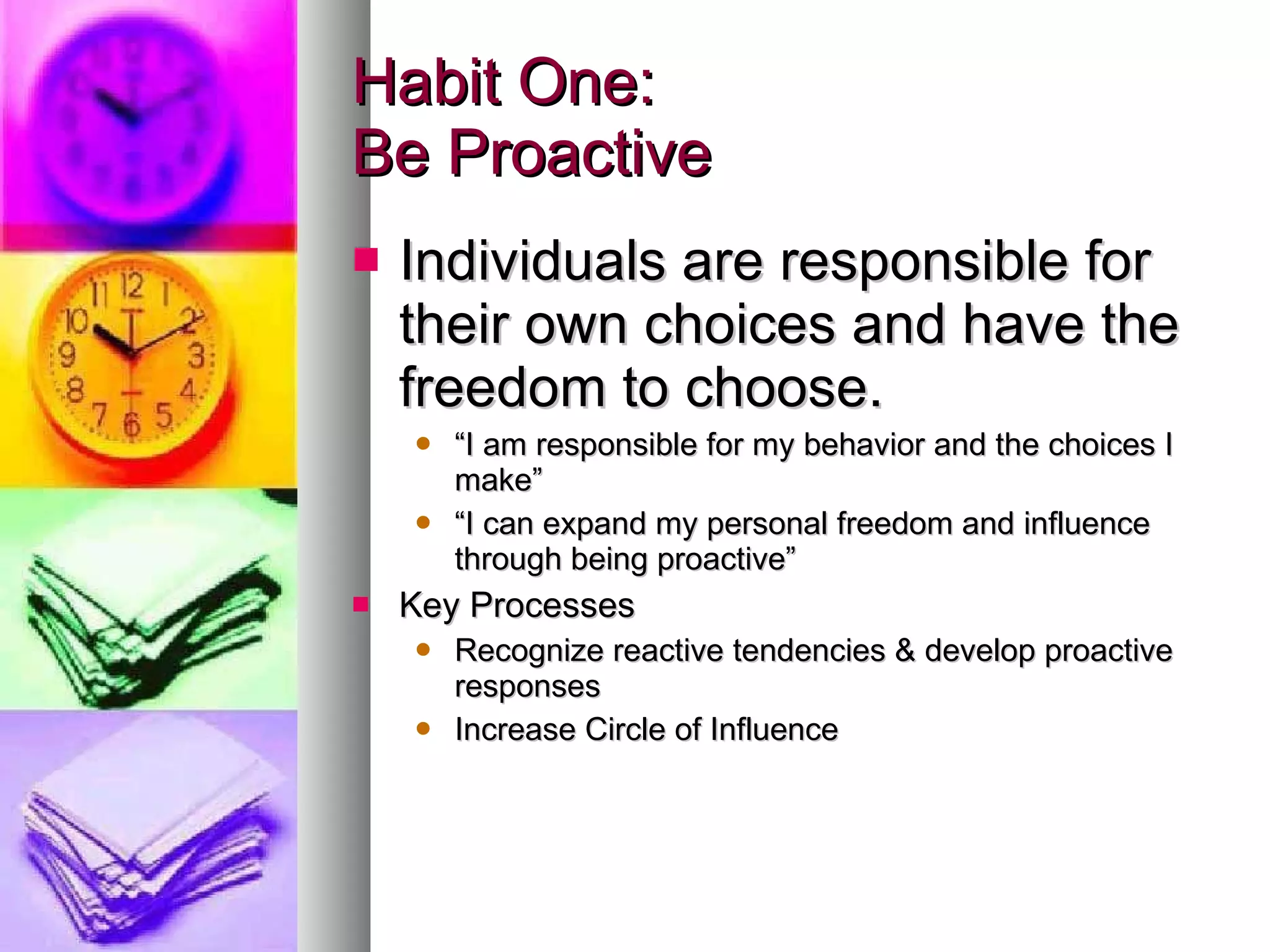
Habit One:  Be Proactive Individuals are responsible for their own choices and have the freedom to choose. “ I am responsible for my behavior and the choices I make” “ I can expand my personal freedom and influence through being proactive” Key Processes Recognize reactive tendencies & develop proactive responses Increase Circle of Influence
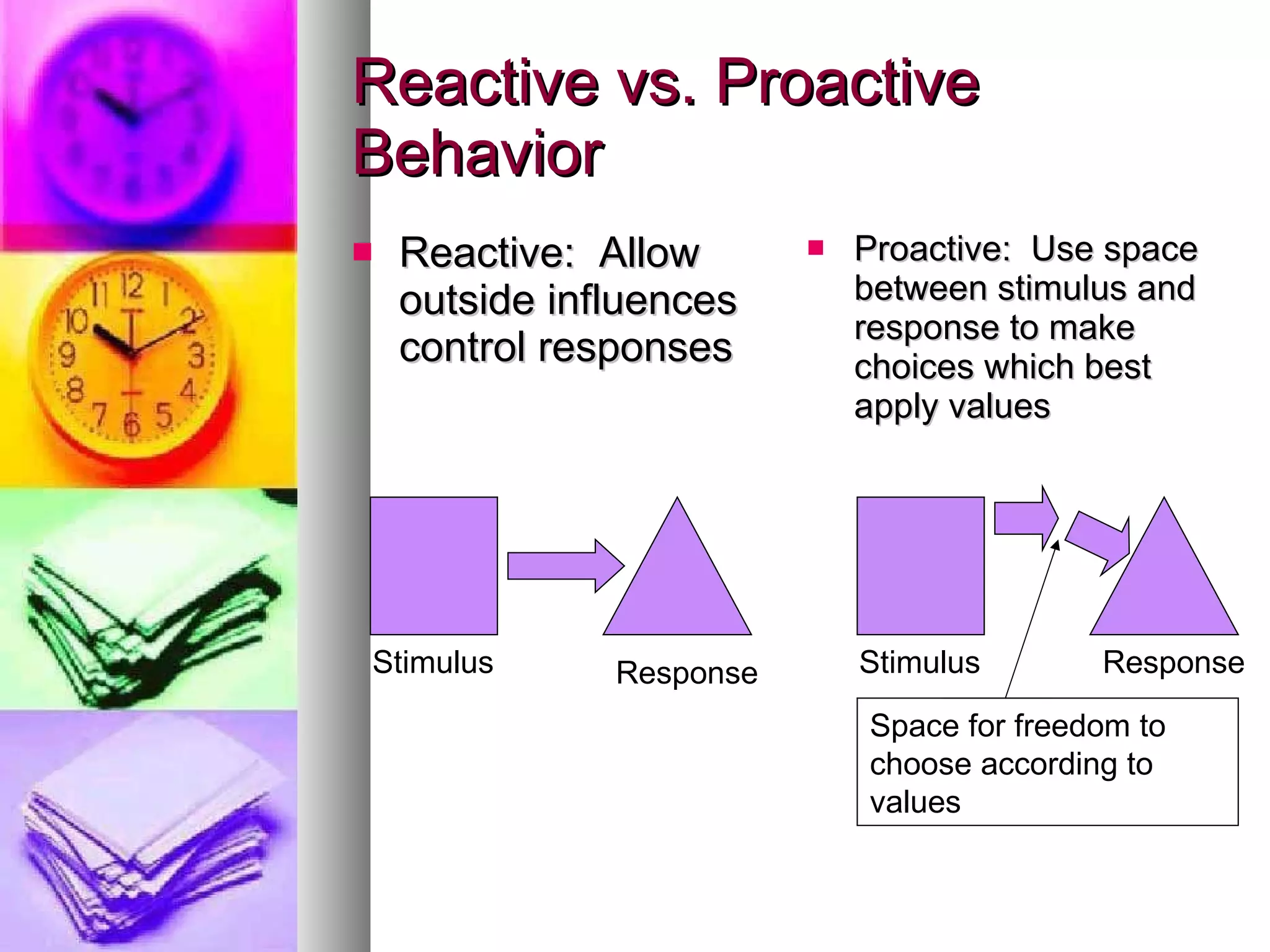
Reactive vs. Proactive Behavior Reactive:  Allow outside influences control responses Proactive:  Use space between stimulus and response to make choices which best apply values Stimulus Response Response Stimulus Space for freedom to choose according to values
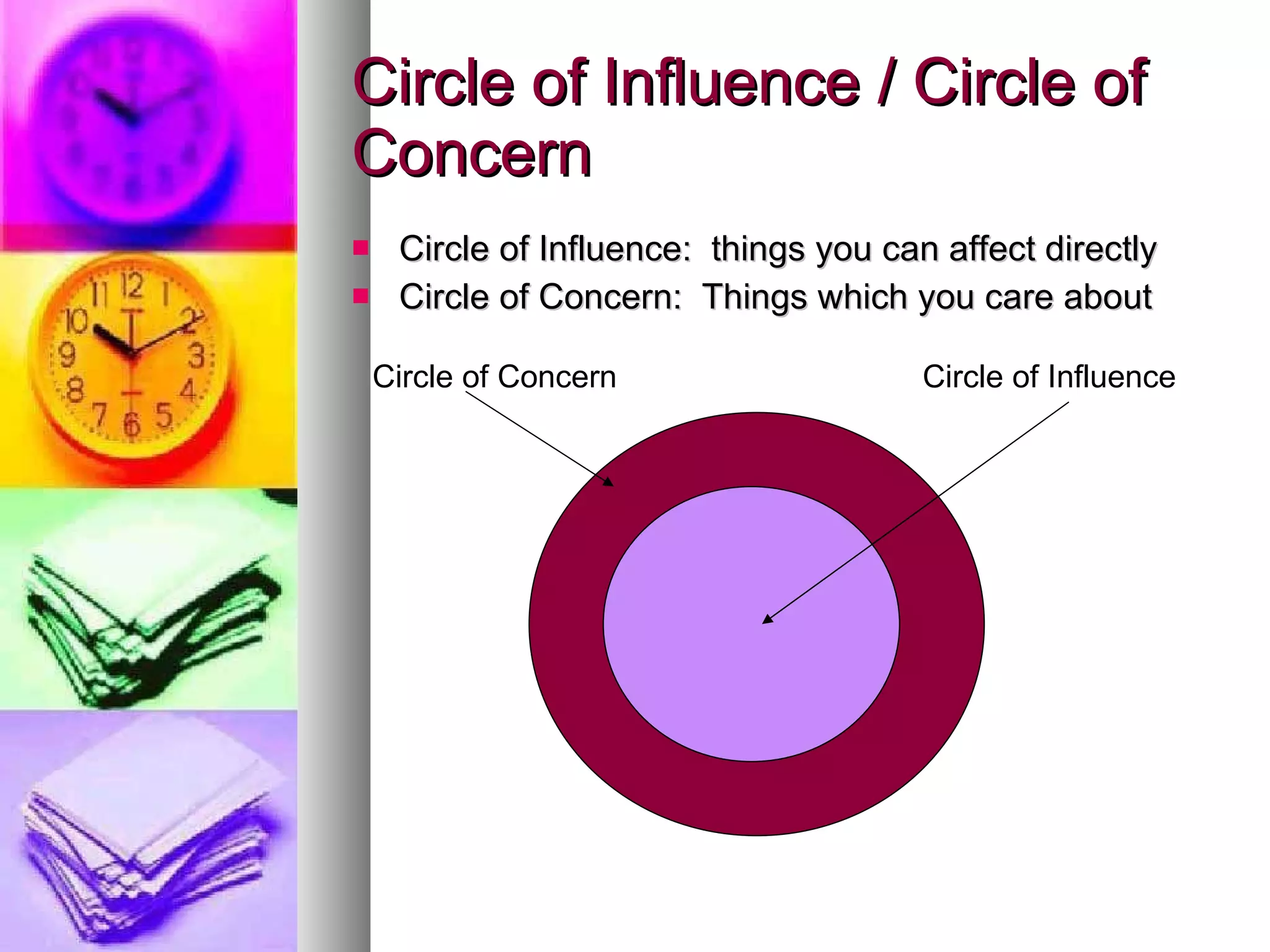
Circle of Influence / Circle of Concern Circle of Influence:  things you can affect directly Circle of Concern:  Things which you care about Circle of Concern Circle of Influence
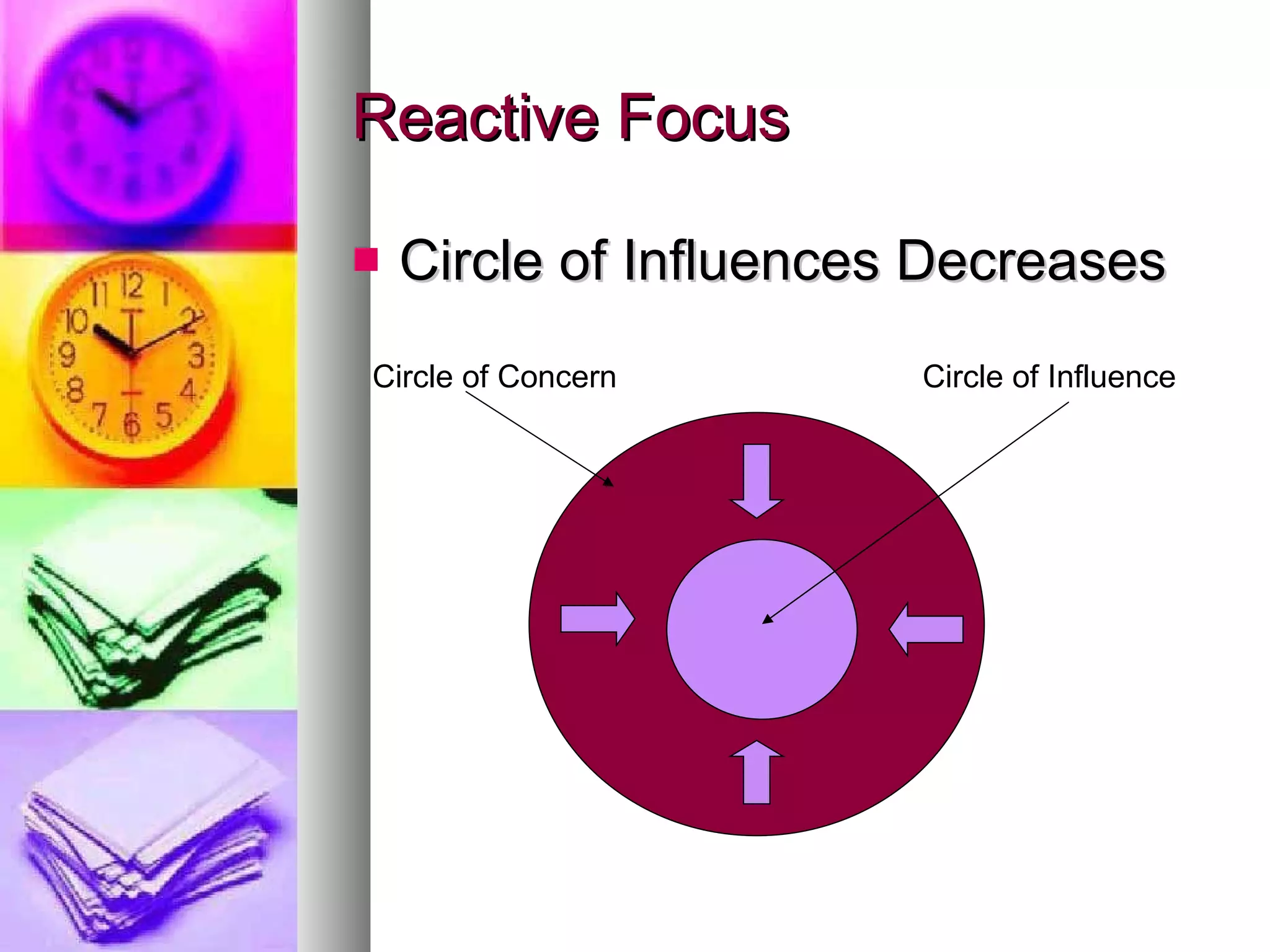
Reactive Focus Circle of Influences Decreases Circle of Concern Circle of Influence
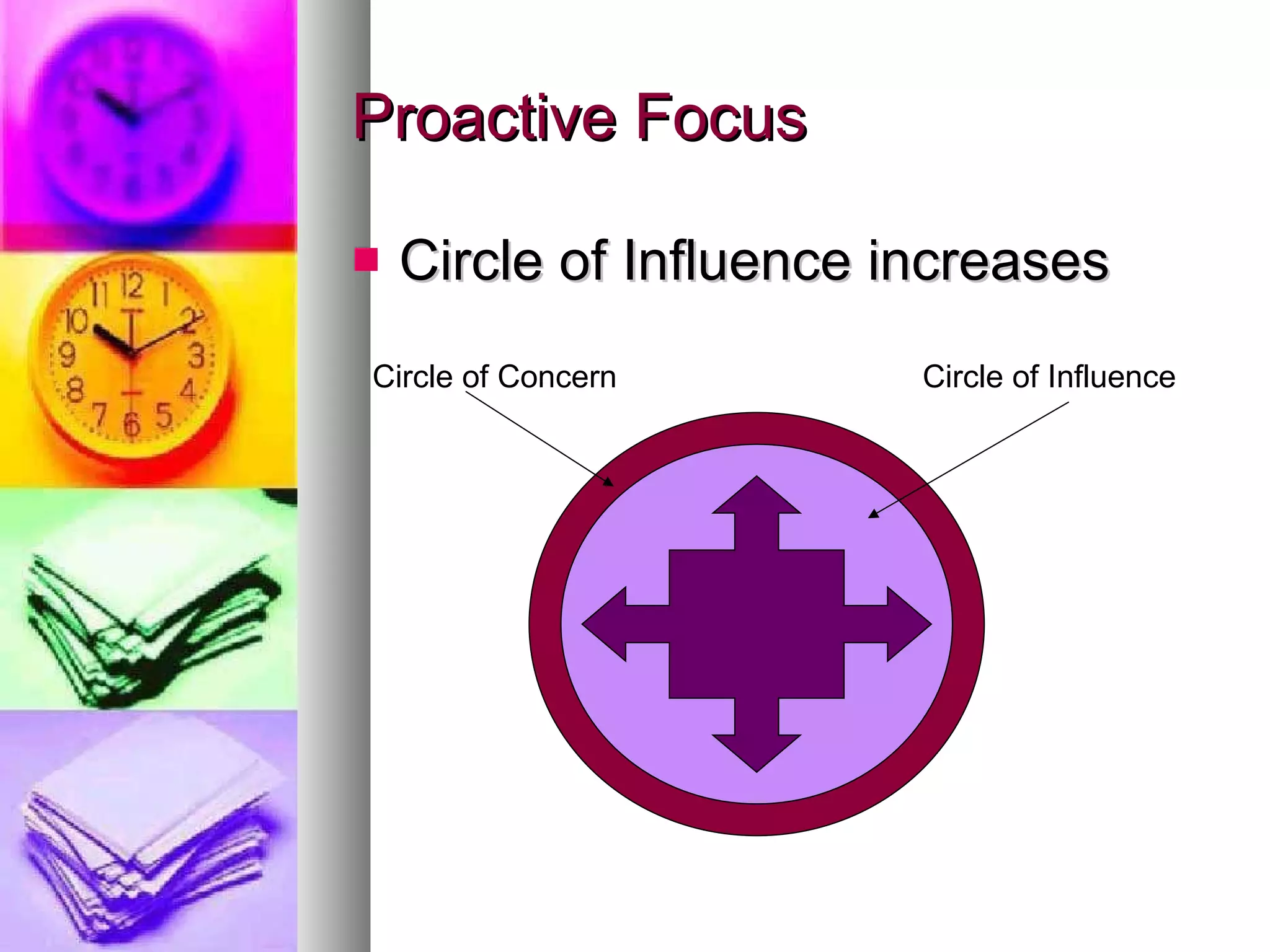
Proactive Focus Circle of Influence increases Circle of Concern Circle of Influence
Proactive and Reactive Language Proactive I choose to go I control my own feelings Let’s explore alternatives I can… Reactive I have to go He makes me so mad There’s nothing I can do If only….
Habit Two: Begin With The End In Mind Mental creation precedes physical creation “ I can choose my own future and create a vision of it” “ I will create my results mentally before beginning any activity” Key Processes Create and apply personal and organizational mission statements in daily life Envision desired results to guide activities
Personal Mission Statement Powerful document that expresses your personal sense of purpose and meaning in life; it acts as a governing constitution by which you evaluate decisions and choose behaviors
Benefits of Mission Statement Encourages you to think deeply about life Helps you examine your innermost thoughts and feelings Clarifies what is really important to you Expands your perspective Imprints self-determined values and purposes firmly in your mind Provides direction and commitment to values Enables you to make daily progress toward your goals Provides the first or mental creation of your desired results in your life
Intro to Mission Statement Creation Answer the following questions honestly What things do I want to have that I feel are important? What am I about? What are the qualities of character I would like to emulate? What legacy do I want to leave?
Principle-Centered Living Mission statement is the gateway to Principle-Centered living What am I about? What principles do I operate in my life?
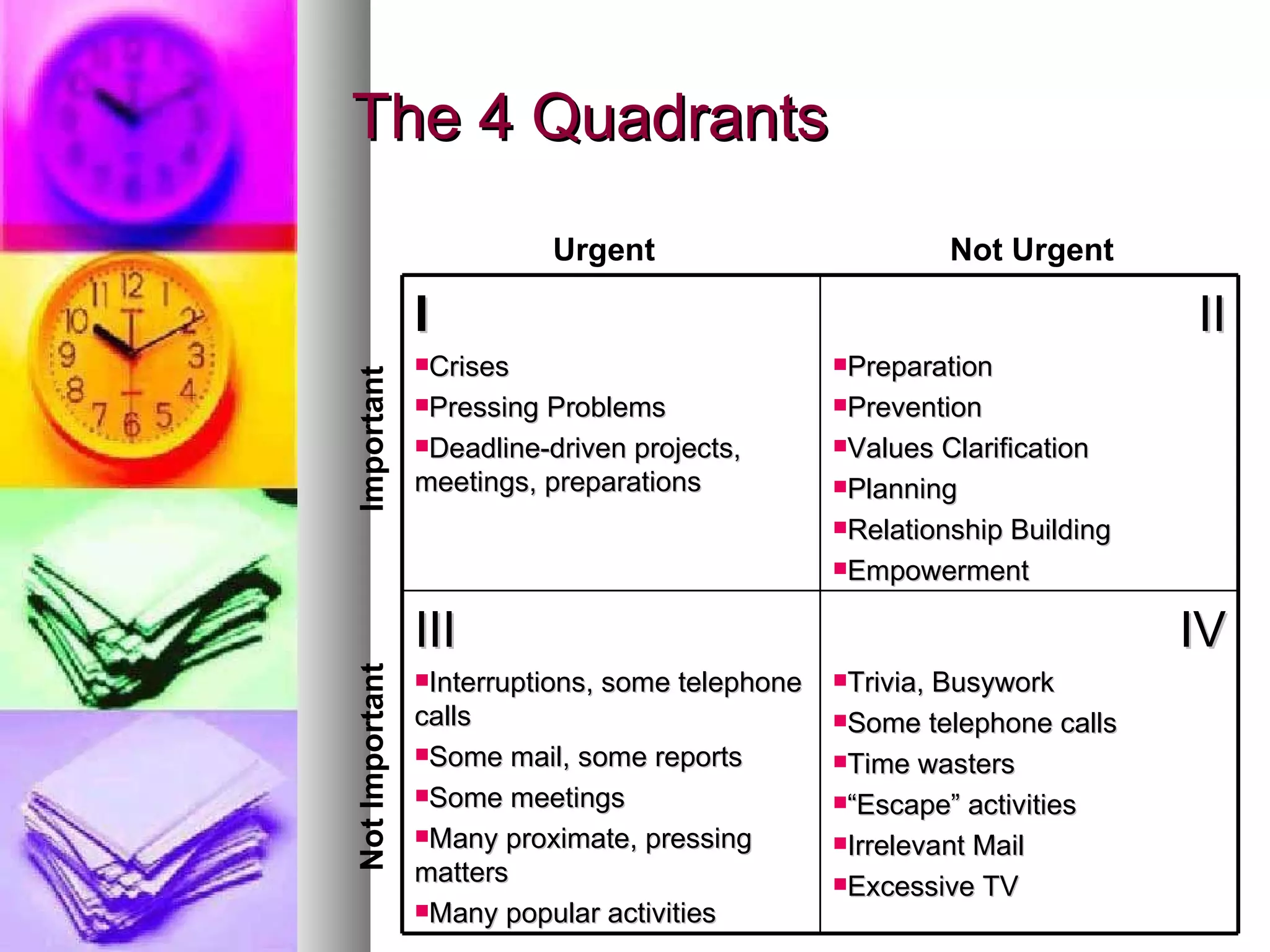
Habit Three: Put First things First Effectiveness requires balancing important relationships, roles and activities “ Things which matter most should never be at the mercy of things which matter least” “ I will focus on importance rather than urgency” Key Processes Focus on the truly important and say no to the unimportant.
The 4 Quadrants Important Not   Important Urgent  Not Urgent I Crises Pressing Problems Deadline-driven projects, meetings, preparations II Preparation Prevention Values Clarification Planning Relationship Building Empowerment III Interruptions, some telephone calls Some mail, some reports Some meetings Many proximate, pressing matters Many popular activities IV Trivia, Busywork Some telephone calls Time wasters “ Escape” activities Irrelevant Mail Excessive TV
Hands-on Demonstration Rock Exercise
Independence is Complete!
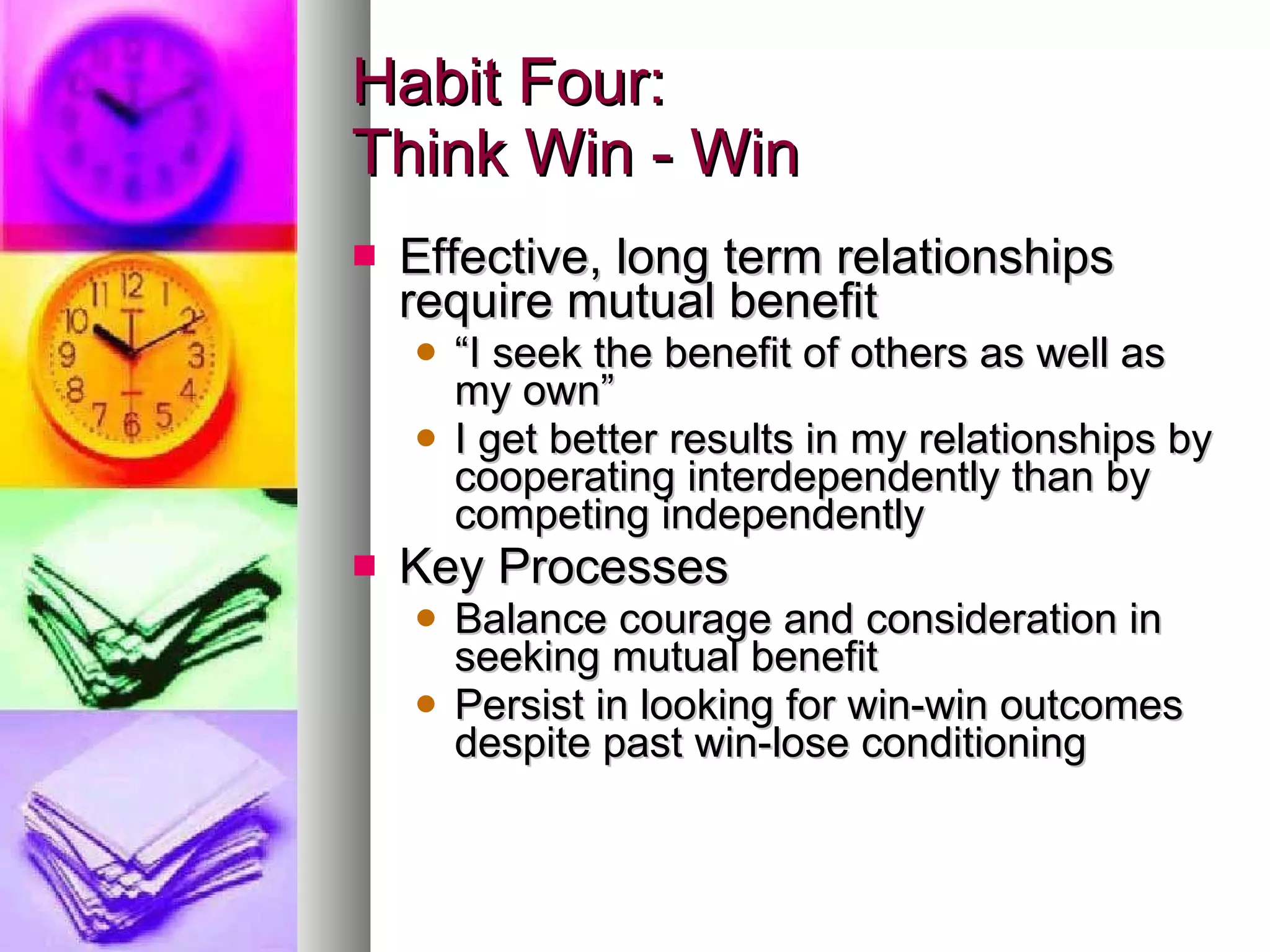
Habit Four: Think Win - Win Effective, long term relationships require mutual benefit “ I seek the benefit of others as well as my own” I get better results in my relationships by cooperating interdependently than by competing independently Key Processes Balance courage and consideration in seeking mutual benefit Persist in looking for win-win outcomes despite past win-lose conditioning
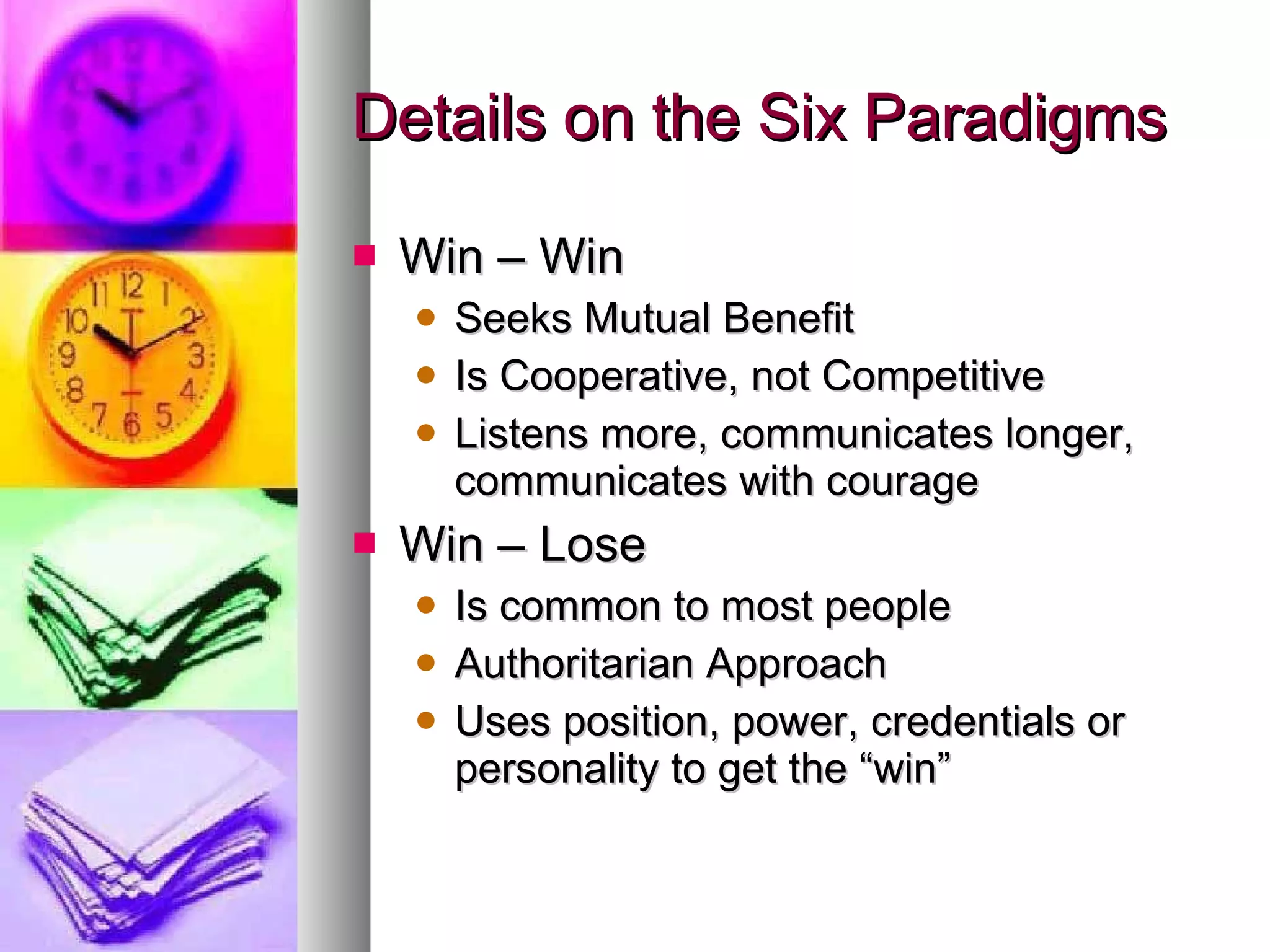
Six Paradigms of Human Interaction Win – Win Win – Lose Lose – Win Lose – Lose Win Win – Win or “No Deal”
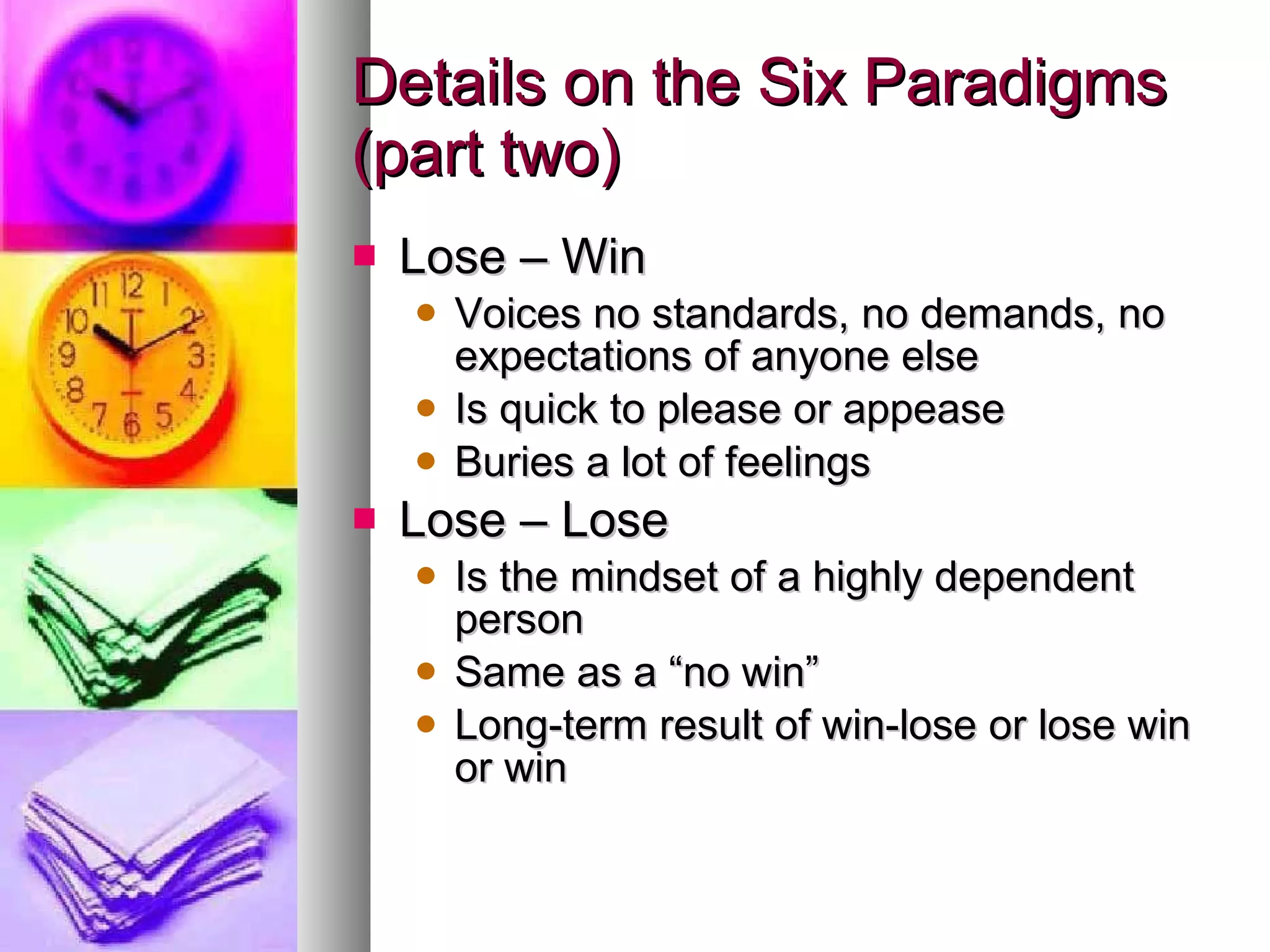
Details on the Six Paradigms Win – Win Seeks Mutual Benefit Is Cooperative, not Competitive Listens more, communicates longer, communicates with courage Win – Lose Is common to most people Authoritarian Approach Uses position, power, credentials or personality to get the “win”
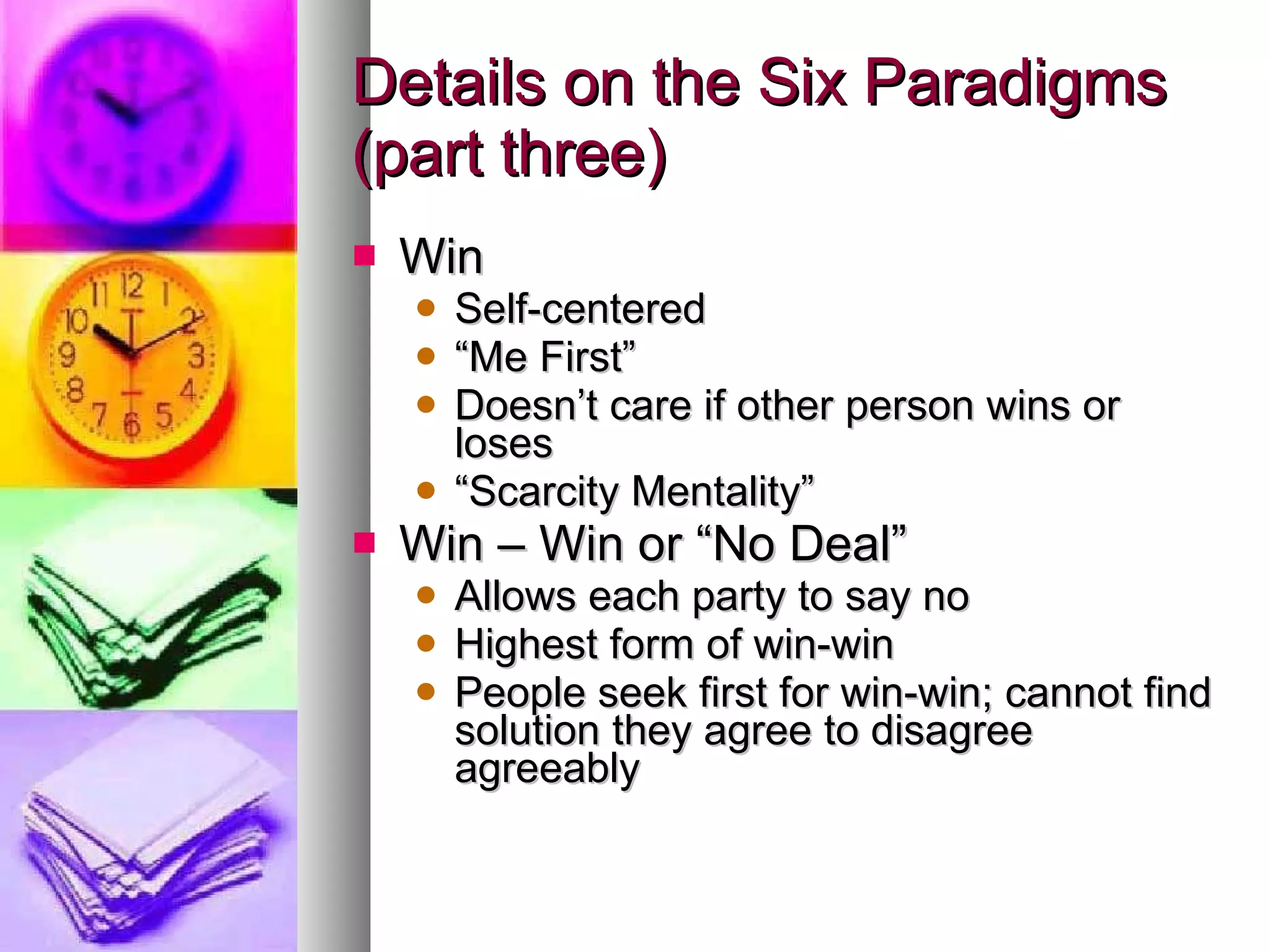
Details on the Six Paradigms (part two) Lose – Win Voices no standards, no demands, no expectations of anyone else Is quick to please or appease Buries a lot of feelings Lose – Lose Is the mindset of a highly dependent person Same as a “no win” Long-term result of win-lose or lose win or win
Details on the Six Paradigms (part three) Win Self-centered “ Me First” Doesn’t care if other person wins or loses “ Scarcity Mentality” Win – Win or “No Deal” Allows each party to say no Highest form of win-win People seek first for win-win; cannot find solution they agree to disagree agreeably
Win – Win Character Integrity – true to their feelings, values and commitments Maturity – Express their ideas and feelings with courage and consideration for ideas and feelings of others Abundance Mentality – There is plenty for everyone
Habit Five: Seek First To Understand, Then to Be Understood Diagnosis must precede prescription Understanding comes through listening “ I assume that I don’t fully understand and I need to listen” “ If I listen first to understand, then I will be better understood” Key Processes Empathetic Listening Skills Empathy is deep understanding of another person
Diagnose before you prescribe Have you ever experienced someone listening with the intent to respond rather than understand? Think of a time when someone didn’t listen to you prior to prescribing an answer How did that make you feel? Have you ever done that to another person? Would you like to go to a doctor who gives you a prescription without ever asking you what is wrong?
Levels of Listening Ignoring  – making no effort to listen Pretend Listening  – Making believe or giving the appearance that you are listening Selective Listening  – Hearing only the parts of the conversation which interest you Attentive Listening  – Paying attention and focusing on what the speaker says and comparing that to your own experiences Empathetic Listening  – Listening and responding both with the heart and mind to understand the speaker’s words, intent and feelings
Barriers to Empathetic Listening Responding with autobiographical references Probe Advise Interpreting Evaluating We give our responses based on the way  we  see things, based on our own experiences and motives
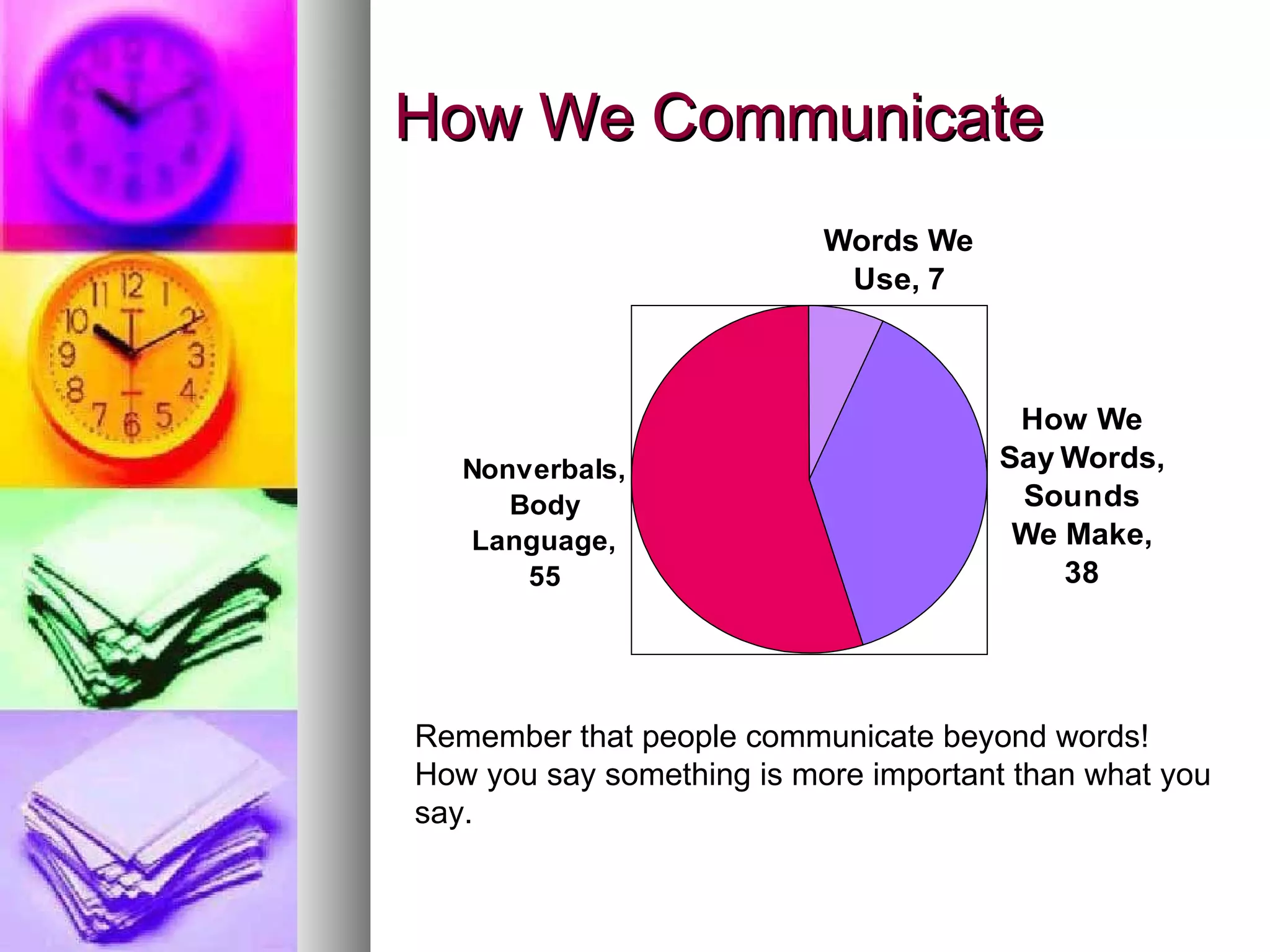
How We Communicate Remember that people communicate beyond words!  How you say something is more important than what you say.
Understanding and Perception As you learn to listen deeply to other people, you will discover tremendous differences in perception.  Habit 5 is the first step in the process of Win/Win.
Then Seek to Be Understood Knowing how to be understood is the other half of Habit 5 and is crucial in reaching Win/Win solutions.  The essence of making effective presentations:  Ethos -- your personal credibility.  Pathos -- the empathic side.  Logos -- the logic.
Habit Six: Synergize The whole is greater than the sum of its parts I value the differences in others and seek the “Third Alternative” Working together cooperatively takes time but produces better long-term results Key Processes Apply win-win thinking and empathic communication to seek “synergistic” outcomes
The Process of Synergizing Synergy – Takes place when two or more people produce more together than the sum of what they could have produced separately “ Shared Pool” of knowledge
What synergizing is (and is not) To Synergize is: Results-oriented positive synergy Challenging your paradigm Cooperating Having a mutually-agreed upon end in mind Worth the effort and highly effective A Process Synergize is not: Brainstorming free for all Accepting others’ ideas as full truth Win-Lose “ Group Think” (Giving into peer pressure) Always Easy Only a negotiation technique
Ground Rules for Synergizing Develop win-win mentality. Keep minds, heart and expressions open to new possibilities Recognize others’ differing viewpoints as helpful when seeking solutions.  Finding value in these differences will help you discover things together that you could not discover alone. You cannot make your point until you restate the other person’ point to his/her satisfaction
Compromise “ The enemy of the best is the good” When two or more people settle for less than they want so each of their wants can be satisfied
The Third Alternative A cooperative solution reached in the “win-win” spirit that all involved parties feel good about Communicate until you both have a solution you feel good about Listen with the intent to understand, not reply Express how you feel about and see the situation
Habit Seven: Sharpen the Saw Production (results) requires development of Production Capacity (resources) I will continuously improve Key Processes Constantly develop and renew personal resources to create better results/resources balance Set and achieve goals in physical, mental, spiritual and social/emotional dimensions
Four Dimensions of Renewal Physical – proper nutrition, exercise, rest and stress management Mental – reading, writing and thinking Spiritual – Reading inspiring literature, meditating and praying, spend time in nature Social / Emotional – Make consistent daily deposits into our emotional bank account of any of our key relationships
Upward Spiral The law of harvest:  As you sow, so shall you reap Time spent in renewing and revisiting your skills will only strengthen you to accept new skills and challenges
That is it! Thanks for listening! If you are truly interested I recommend the 7 Habits of Highly Effective People by Stephen Covey

Introduction to the 7 habits of highly effective

  • 1.
    Introduction to the7 Habits of Highly Effective People Sanjeev Sahgal
  • 2.
    Overview Stephen Covey’sbrainchild Seven Habits compose his “system” Think of the most influential person in your life (past or present). Why does this person stand out in your mind?
  • 3.
    Developing Habits DevelopingHabits Habit = intersection of desire, skill and knowledge Habits Live Here Knowledge (what to, why to) Desire (want to) Skill (how to)
  • 4.
    Character and PersonalityPersonality is what people see, formed by your character. Your personality reflects only a small part of your character
  • 5.
    How do yousee things? How do you see the world? How do you want to see the world?
  • 6.
  • 7.
    Four Levels ofLeadership To lead other effectively, individuals must be able to lead themselves effectively Organizational Alignment Managerial Empowerment Interpersonal Trust Personal Trustworthiness
  • 8.
    Character and CompetenceCharacter – A person with high character exhibits integrity, maturity and an Abundance Mentality Competence – A person with high competence has a knowledge and ability in a given area To be truly effective, a person must have a balance of these 2 items.
  • 9.
  • 10.
    Emotional Bank AccountMetaphor for amount of trust in a relationship. A Deposit is something that builds and repairs trust in your relationships A Withdrawal is something which lessens trust in relationships “ You cannot talk your way out of problems you behaved into”
  • 11.
    Emotional Bank AccountExercise Rate the following as Withdrawal, Deposit or Neutral You receive verbal thanks for working 3 weekends in a row You are asked to cover shift for an engineer who is taking the afternoon off You give a late birthday card You get a dinner for two and tickets to the movies for the extra hours you have been putting in You respond sarcastically to a co-workers genuine question
  • 12.
    Emotional Bank Account Rate Chart Deposits Kindness and courtesy Keeping promises Honoring expectations Loyalty to the absent Making apologies Withdrawals Unkindness and discourtesy Breaking promises Violating expectations Disloyalty, Duplicity Pride, Conceit, Arrogance
  • 13.
    Habit One: Be Proactive Individuals are responsible for their own choices and have the freedom to choose. “ I am responsible for my behavior and the choices I make” “ I can expand my personal freedom and influence through being proactive” Key Processes Recognize reactive tendencies & develop proactive responses Increase Circle of Influence
  • 14.
    Reactive vs. ProactiveBehavior Reactive: Allow outside influences control responses Proactive: Use space between stimulus and response to make choices which best apply values Stimulus Response Response Stimulus Space for freedom to choose according to values
  • 15.
    Circle of Influence/ Circle of Concern Circle of Influence: things you can affect directly Circle of Concern: Things which you care about Circle of Concern Circle of Influence
  • 16.
    Reactive Focus Circleof Influences Decreases Circle of Concern Circle of Influence
  • 17.
    Proactive Focus Circleof Influence increases Circle of Concern Circle of Influence
  • 18.
    Proactive and ReactiveLanguage Proactive I choose to go I control my own feelings Let’s explore alternatives I can… Reactive I have to go He makes me so mad There’s nothing I can do If only….
  • 19.
    Habit Two: BeginWith The End In Mind Mental creation precedes physical creation “ I can choose my own future and create a vision of it” “ I will create my results mentally before beginning any activity” Key Processes Create and apply personal and organizational mission statements in daily life Envision desired results to guide activities
  • 20.
    Personal Mission StatementPowerful document that expresses your personal sense of purpose and meaning in life; it acts as a governing constitution by which you evaluate decisions and choose behaviors
  • 21.
    Benefits of MissionStatement Encourages you to think deeply about life Helps you examine your innermost thoughts and feelings Clarifies what is really important to you Expands your perspective Imprints self-determined values and purposes firmly in your mind Provides direction and commitment to values Enables you to make daily progress toward your goals Provides the first or mental creation of your desired results in your life
  • 22.
    Intro to MissionStatement Creation Answer the following questions honestly What things do I want to have that I feel are important? What am I about? What are the qualities of character I would like to emulate? What legacy do I want to leave?
  • 23.
    Principle-Centered Living Missionstatement is the gateway to Principle-Centered living What am I about? What principles do I operate in my life?
  • 24.
    Habit Three: PutFirst things First Effectiveness requires balancing important relationships, roles and activities “ Things which matter most should never be at the mercy of things which matter least” “ I will focus on importance rather than urgency” Key Processes Focus on the truly important and say no to the unimportant.
  • 25.
    The 4 QuadrantsImportant Not Important Urgent Not Urgent I Crises Pressing Problems Deadline-driven projects, meetings, preparations II Preparation Prevention Values Clarification Planning Relationship Building Empowerment III Interruptions, some telephone calls Some mail, some reports Some meetings Many proximate, pressing matters Many popular activities IV Trivia, Busywork Some telephone calls Time wasters “ Escape” activities Irrelevant Mail Excessive TV
  • 26.
  • 27.
  • 28.
    Habit Four: ThinkWin - Win Effective, long term relationships require mutual benefit “ I seek the benefit of others as well as my own” I get better results in my relationships by cooperating interdependently than by competing independently Key Processes Balance courage and consideration in seeking mutual benefit Persist in looking for win-win outcomes despite past win-lose conditioning
  • 29.
    Six Paradigms ofHuman Interaction Win – Win Win – Lose Lose – Win Lose – Lose Win Win – Win or “No Deal”
  • 30.
    Details on theSix Paradigms Win – Win Seeks Mutual Benefit Is Cooperative, not Competitive Listens more, communicates longer, communicates with courage Win – Lose Is common to most people Authoritarian Approach Uses position, power, credentials or personality to get the “win”
  • 31.
    Details on theSix Paradigms (part two) Lose – Win Voices no standards, no demands, no expectations of anyone else Is quick to please or appease Buries a lot of feelings Lose – Lose Is the mindset of a highly dependent person Same as a “no win” Long-term result of win-lose or lose win or win
  • 32.
    Details on theSix Paradigms (part three) Win Self-centered “ Me First” Doesn’t care if other person wins or loses “ Scarcity Mentality” Win – Win or “No Deal” Allows each party to say no Highest form of win-win People seek first for win-win; cannot find solution they agree to disagree agreeably
  • 33.
    Win – WinCharacter Integrity – true to their feelings, values and commitments Maturity – Express their ideas and feelings with courage and consideration for ideas and feelings of others Abundance Mentality – There is plenty for everyone
  • 34.
    Habit Five: SeekFirst To Understand, Then to Be Understood Diagnosis must precede prescription Understanding comes through listening “ I assume that I don’t fully understand and I need to listen” “ If I listen first to understand, then I will be better understood” Key Processes Empathetic Listening Skills Empathy is deep understanding of another person
  • 35.
    Diagnose before youprescribe Have you ever experienced someone listening with the intent to respond rather than understand? Think of a time when someone didn’t listen to you prior to prescribing an answer How did that make you feel? Have you ever done that to another person? Would you like to go to a doctor who gives you a prescription without ever asking you what is wrong?
  • 36.
    Levels of ListeningIgnoring – making no effort to listen Pretend Listening – Making believe or giving the appearance that you are listening Selective Listening – Hearing only the parts of the conversation which interest you Attentive Listening – Paying attention and focusing on what the speaker says and comparing that to your own experiences Empathetic Listening – Listening and responding both with the heart and mind to understand the speaker’s words, intent and feelings
  • 37.
    Barriers to EmpatheticListening Responding with autobiographical references Probe Advise Interpreting Evaluating We give our responses based on the way we see things, based on our own experiences and motives
  • 38.
    How We CommunicateRemember that people communicate beyond words! How you say something is more important than what you say.
  • 39.
    Understanding and PerceptionAs you learn to listen deeply to other people, you will discover tremendous differences in perception. Habit 5 is the first step in the process of Win/Win.
  • 40.
    Then Seek toBe Understood Knowing how to be understood is the other half of Habit 5 and is crucial in reaching Win/Win solutions. The essence of making effective presentations: Ethos -- your personal credibility. Pathos -- the empathic side. Logos -- the logic.
  • 41.
    Habit Six: SynergizeThe whole is greater than the sum of its parts I value the differences in others and seek the “Third Alternative” Working together cooperatively takes time but produces better long-term results Key Processes Apply win-win thinking and empathic communication to seek “synergistic” outcomes
  • 42.
    The Process ofSynergizing Synergy – Takes place when two or more people produce more together than the sum of what they could have produced separately “ Shared Pool” of knowledge
  • 43.
    What synergizing is(and is not) To Synergize is: Results-oriented positive synergy Challenging your paradigm Cooperating Having a mutually-agreed upon end in mind Worth the effort and highly effective A Process Synergize is not: Brainstorming free for all Accepting others’ ideas as full truth Win-Lose “ Group Think” (Giving into peer pressure) Always Easy Only a negotiation technique
  • 44.
    Ground Rules forSynergizing Develop win-win mentality. Keep minds, heart and expressions open to new possibilities Recognize others’ differing viewpoints as helpful when seeking solutions. Finding value in these differences will help you discover things together that you could not discover alone. You cannot make your point until you restate the other person’ point to his/her satisfaction
  • 45.
    Compromise “ Theenemy of the best is the good” When two or more people settle for less than they want so each of their wants can be satisfied
  • 46.
    The Third AlternativeA cooperative solution reached in the “win-win” spirit that all involved parties feel good about Communicate until you both have a solution you feel good about Listen with the intent to understand, not reply Express how you feel about and see the situation
  • 47.
    Habit Seven: Sharpenthe Saw Production (results) requires development of Production Capacity (resources) I will continuously improve Key Processes Constantly develop and renew personal resources to create better results/resources balance Set and achieve goals in physical, mental, spiritual and social/emotional dimensions
  • 48.
    Four Dimensions ofRenewal Physical – proper nutrition, exercise, rest and stress management Mental – reading, writing and thinking Spiritual – Reading inspiring literature, meditating and praying, spend time in nature Social / Emotional – Make consistent daily deposits into our emotional bank account of any of our key relationships
  • 49.
    Upward Spiral Thelaw of harvest: As you sow, so shall you reap Time spent in renewing and revisiting your skills will only strengthen you to accept new skills and challenges
  • 50.
    That is it!Thanks for listening! If you are truly interested I recommend the 7 Habits of Highly Effective People by Stephen Covey