FLUID MECHANICS – 1
     First Semester 2011 - 2012


           Week – 3
           Class – 1


  Buoyancy and Flotation


   Compiled and modified
               by
  Sharma, Adam and Idriss
OBJECTIVES
• Concept of buoyancy
     Buoyancy force
     Archimedes’ principle

• Stability of floating bodies
BUOYANCY AND STABILITY
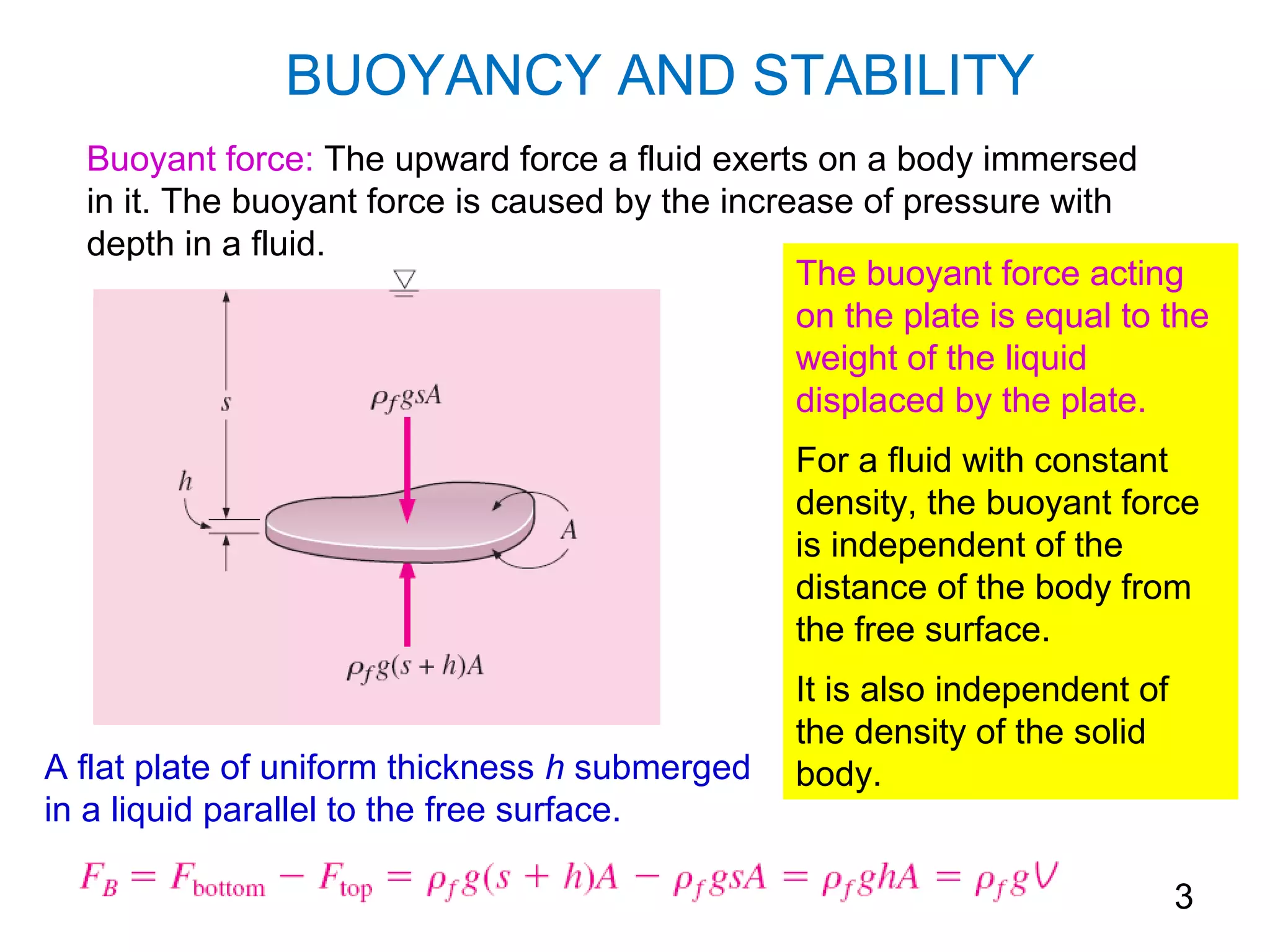
  Buoyant force: The upward force a fluid exerts on a body immersed
  in it. The buoyant force is caused by the increase of pressure with
  depth in a fluid.
                                                 The buoyant force acting
                                                 on the plate is equal to the
                                                 weight of the liquid
                                                 displaced by the plate.
                                                 For a fluid with constant
                                                 density, the buoyant force
                                                 is independent of the
                                                 distance of the body from
                                                 the free surface.
                                                 It is also independent of
                                                 the density of the solid
A flat plate of uniform thickness h submerged    body.
in a liquid parallel to the free surface.

                                                                             3
ARCHIMEDES’ PRINCIPLE

The buoyant force acting on a body immersed in a
fluid is equal to the weight of the fluid displaced by
the body, and it acts upward through the centroid
of the displaced volume.
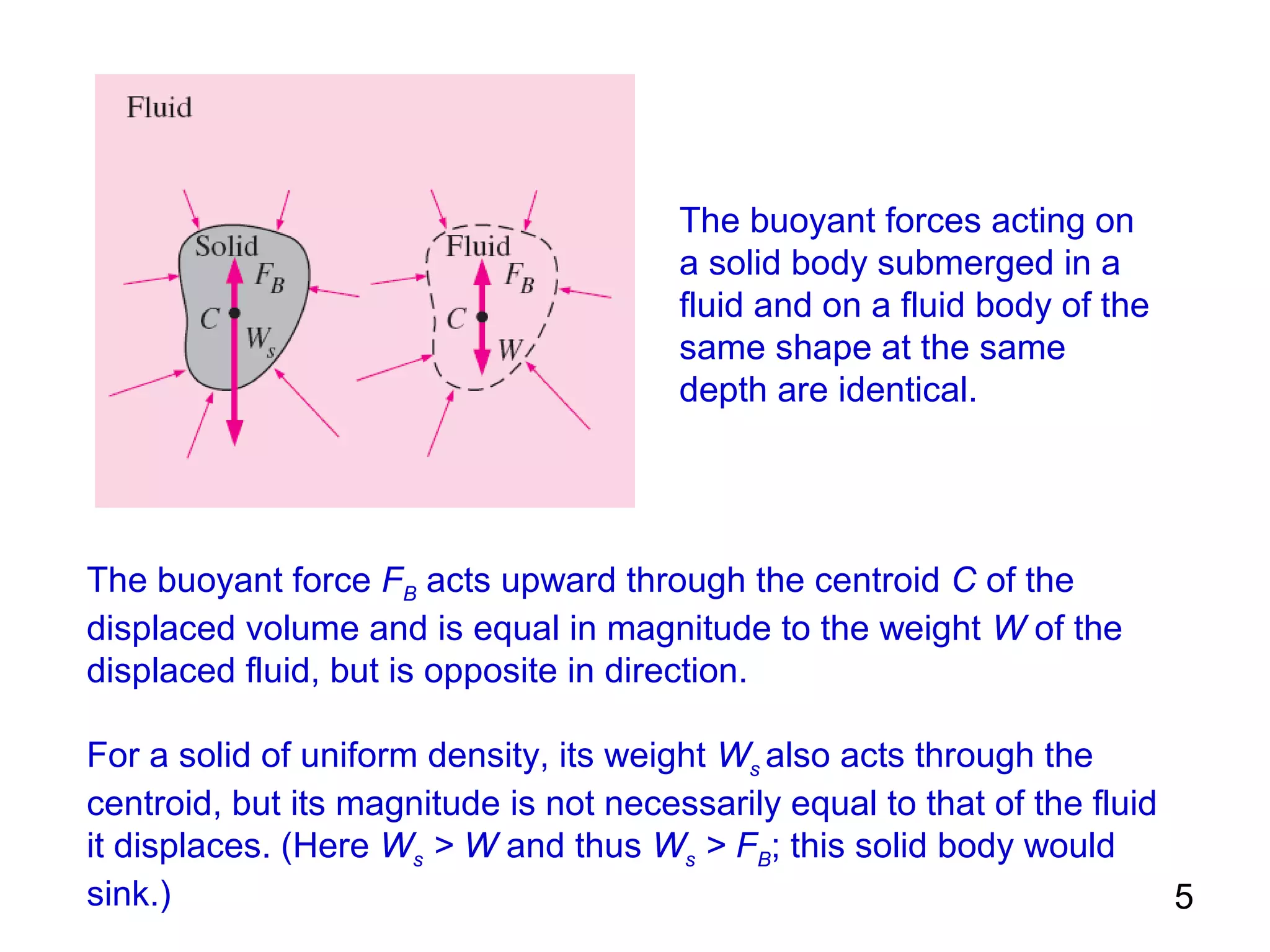
The buoyant forces acting on
                                        a solid body submerged in a
                                        fluid and on a fluid body of the
                                        same shape at the same
                                        depth are identical.


The buoyant force FB acts upward through the centroid C of the
displaced volume and is equal in magnitude to the weight W of the
displaced fluid, but is opposite in direction.

For a solid of uniform density, its weight Ws also acts through the
centroid, but its magnitude is not necessarily equal to that of the fluid
it displaces. (Here Ws > W and thus Ws > FB; this solid body would
sink.)                                                                    5
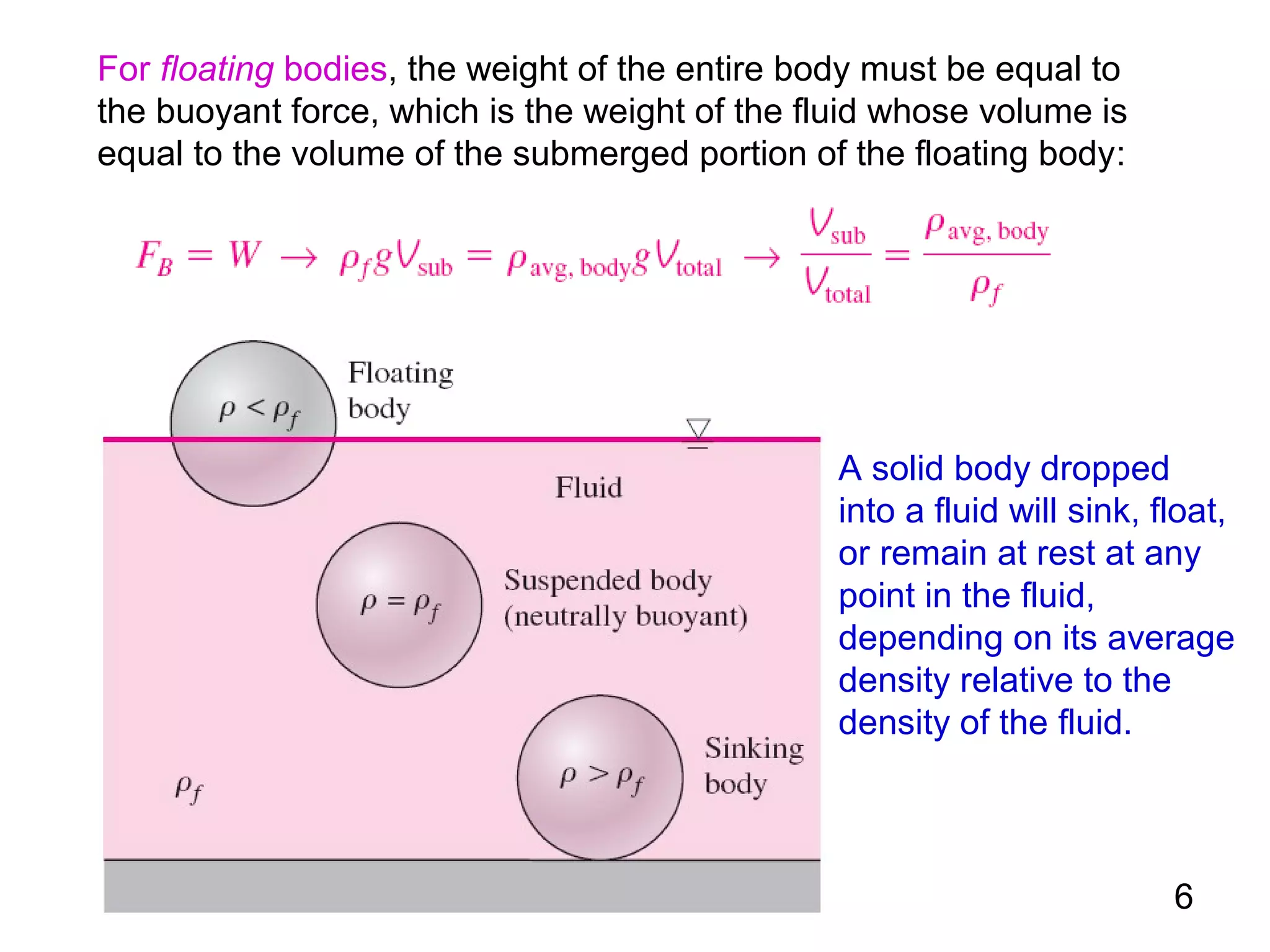
For floating bodies, the weight of the entire body must be equal to
the buoyant force, which is the weight of the fluid whose volume is
equal to the volume of the submerged portion of the floating body:


                                                A solid body dropped
                                                into a fluid will sink, float,
                                                or remain at rest at any
                                                point in the fluid,
                                                depending on its average
                                                density relative to the
                                                density of the fluid.


                                                                         6
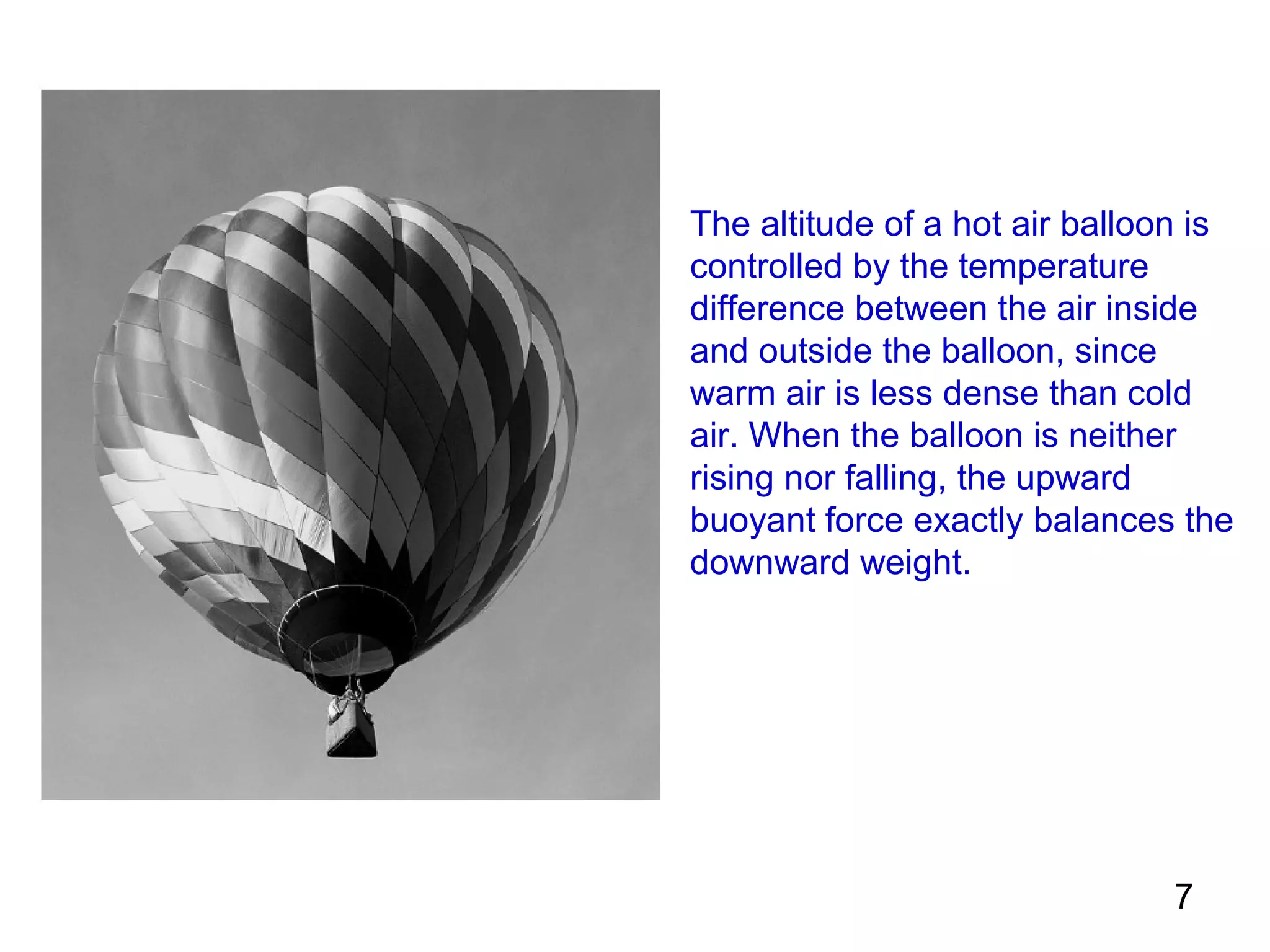
The altitude of a hot air balloon is
controlled by the temperature
difference between the air inside
and outside the balloon, since
warm air is less dense than cold
air. When the balloon is neither
rising nor falling, the upward
buoyant force exactly balances the
downward weight.


                                7
8
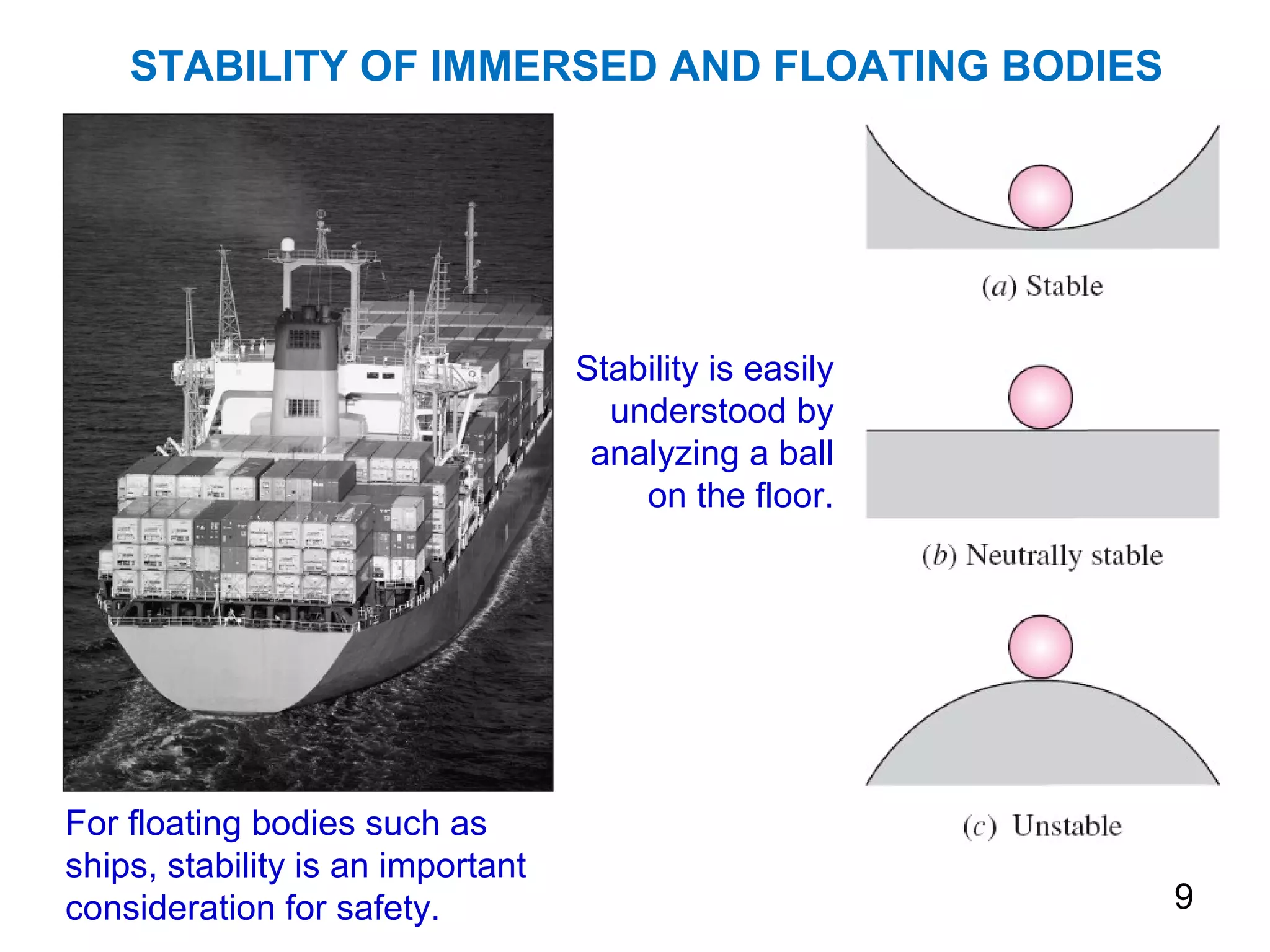
STABILITY OF IMMERSED AND FLOATING BODIES


                                   Stability is easily
                                     understood by
                                    analyzing a ball
                                       on the floor.


For floating bodies such as
ships, stability is an important
consideration for safety.                                9
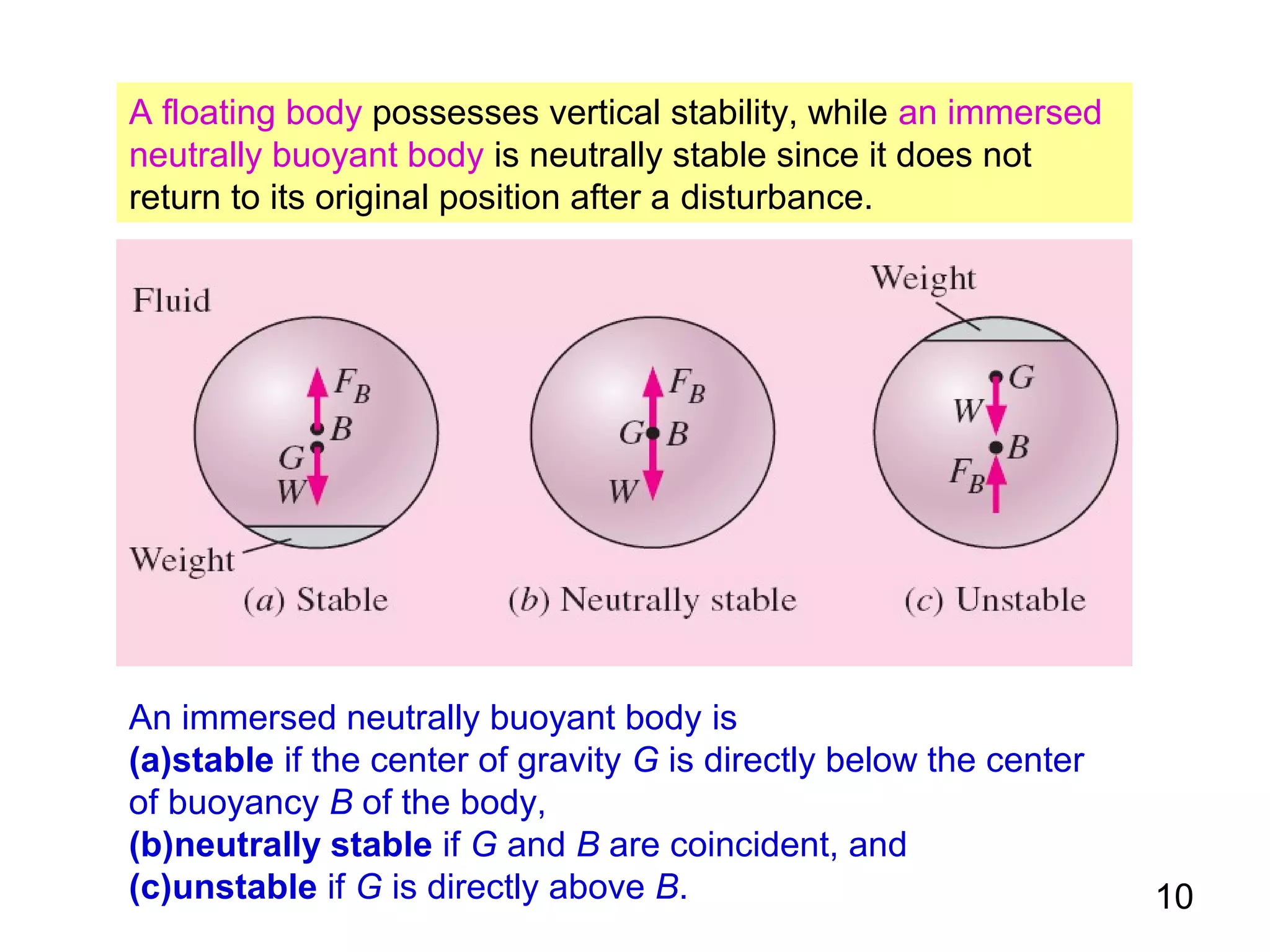
A floating body possesses vertical stability, while an immersed
neutrally buoyant body is neutrally stable since it does not
return to its original position after a disturbance.


An immersed neutrally buoyant body is
(a)stable if the center of gravity G is directly below the center
of buoyancy B of the body,
(b)neutrally stable if G and B are coincident, and
(c)unstable if G is directly above B.                               10
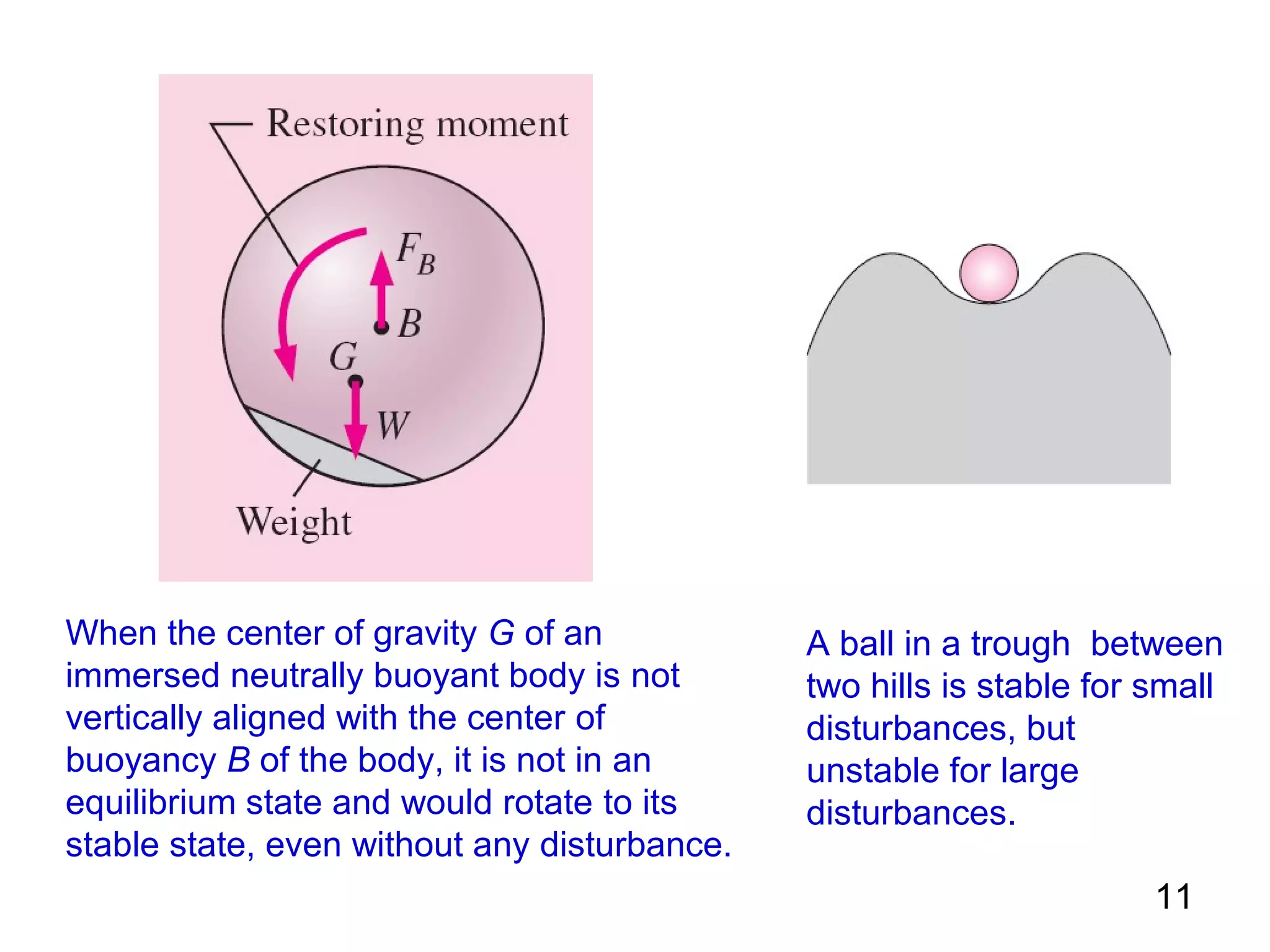
When the center of gravity G of an            A ball in a trough between
immersed neutrally buoyant body is not        two hills is stable for small
vertically aligned with the center of         disturbances, but
buoyancy B of the body, it is not in an       unstable for large
equilibrium state and would rotate to its     disturbances.
stable state, even without any disturbance.
                                                                      11
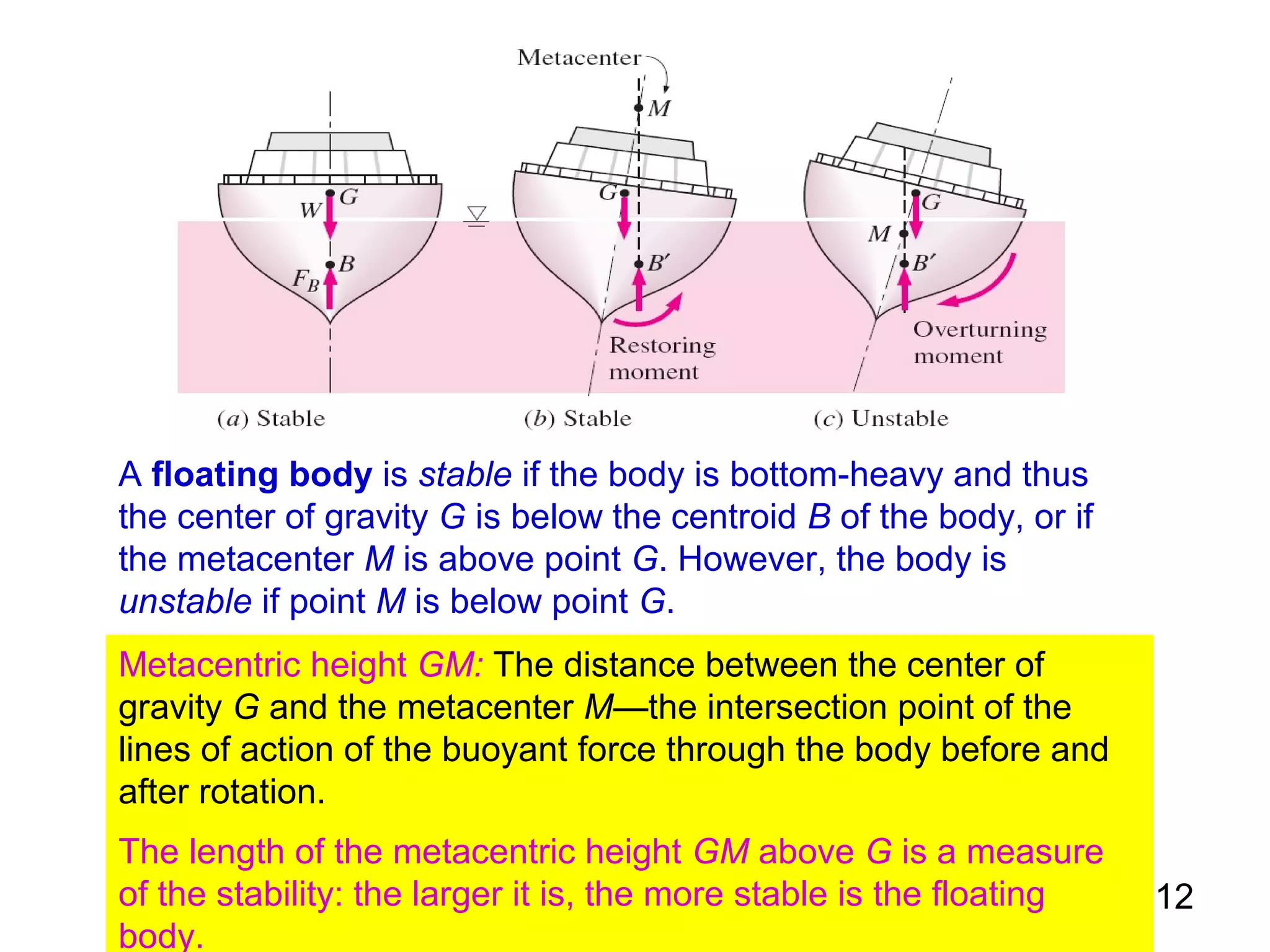
A floating body is stable if the body is bottom-heavy and thus
the center of gravity G is below the centroid B of the body, or if
the metacenter M is above point G. However, the body is
unstable if point M is below point G.
Metacentric height GM: The distance between the center of
gravity G and the metacenter M—the intersection point of the
lines of action of the buoyant force through the body before and
after rotation.
The length of the metacentric height GM above G is a measure
of the stability: the larger it is, the more stable is the floating   12
body.
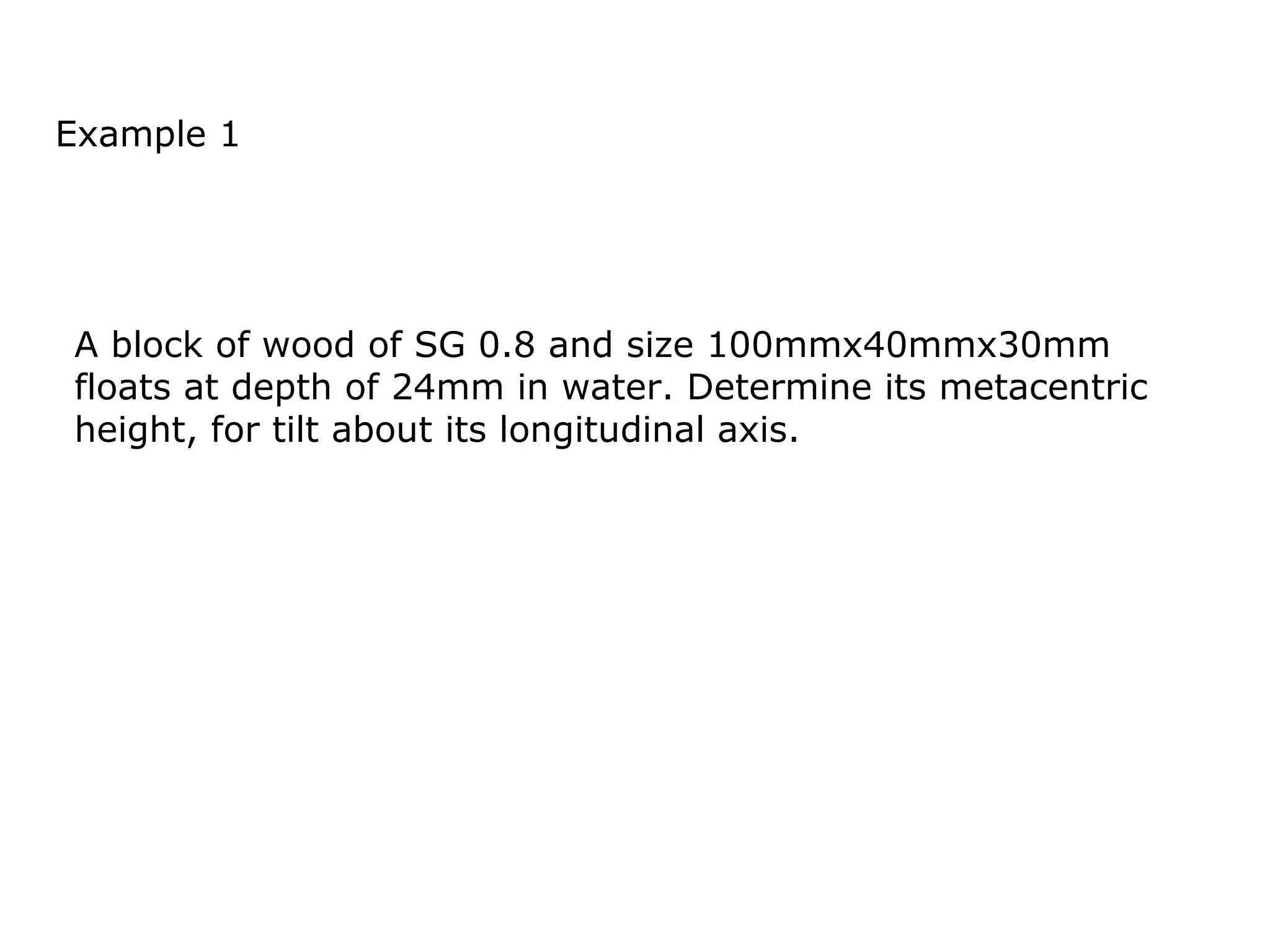
Example 1


A block of wood of SG 0.8 and size 100mmx40mmx30mm
floats at depth of 24mm in water. Determine its metacentric
height, for tilt about its longitudinal axis.
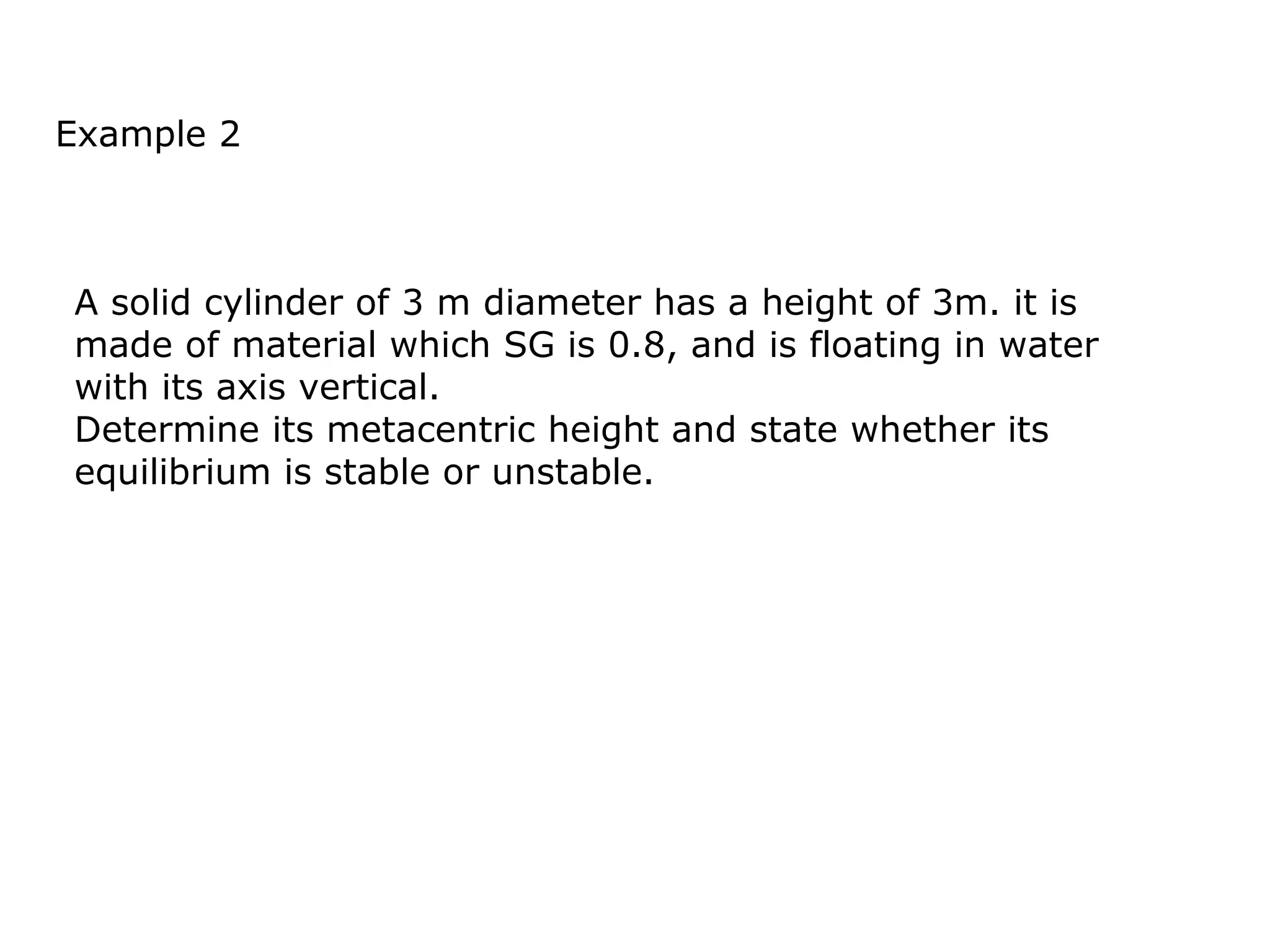
Example 2


A solid cylinder of 3 m diameter has a height of 3m. it is
made of material which SG is 0.8, and is floating in water
with its axis vertical.
Determine its metacentric height and state whether its
equilibrium is stable or unstable.
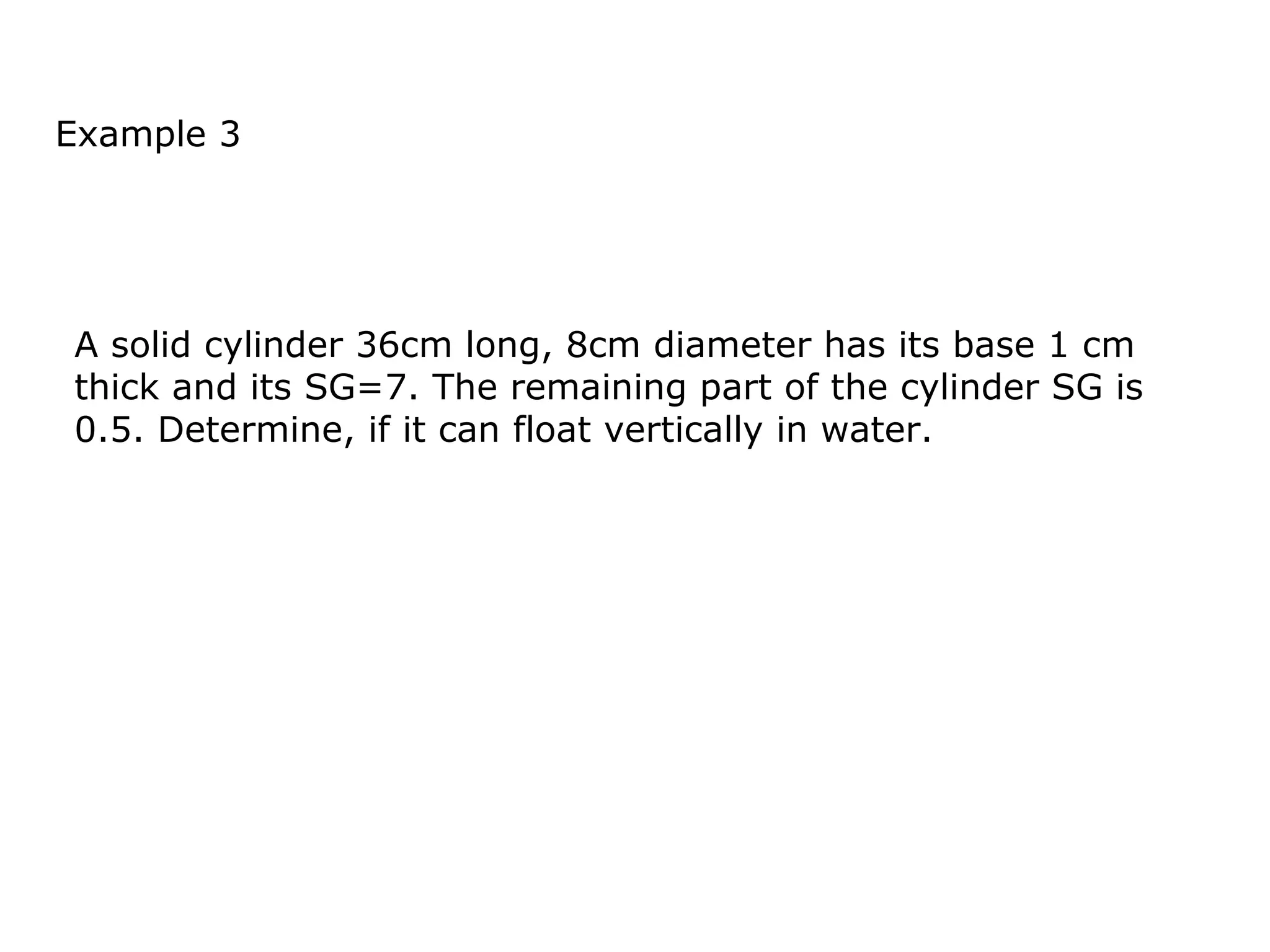
Example 3


A solid cylinder 36cm long, 8cm diameter has its base 1 cm
thick and its SG=7. The remaining part of the cylinder SG is
0.5. Determine, if it can float vertically in water.
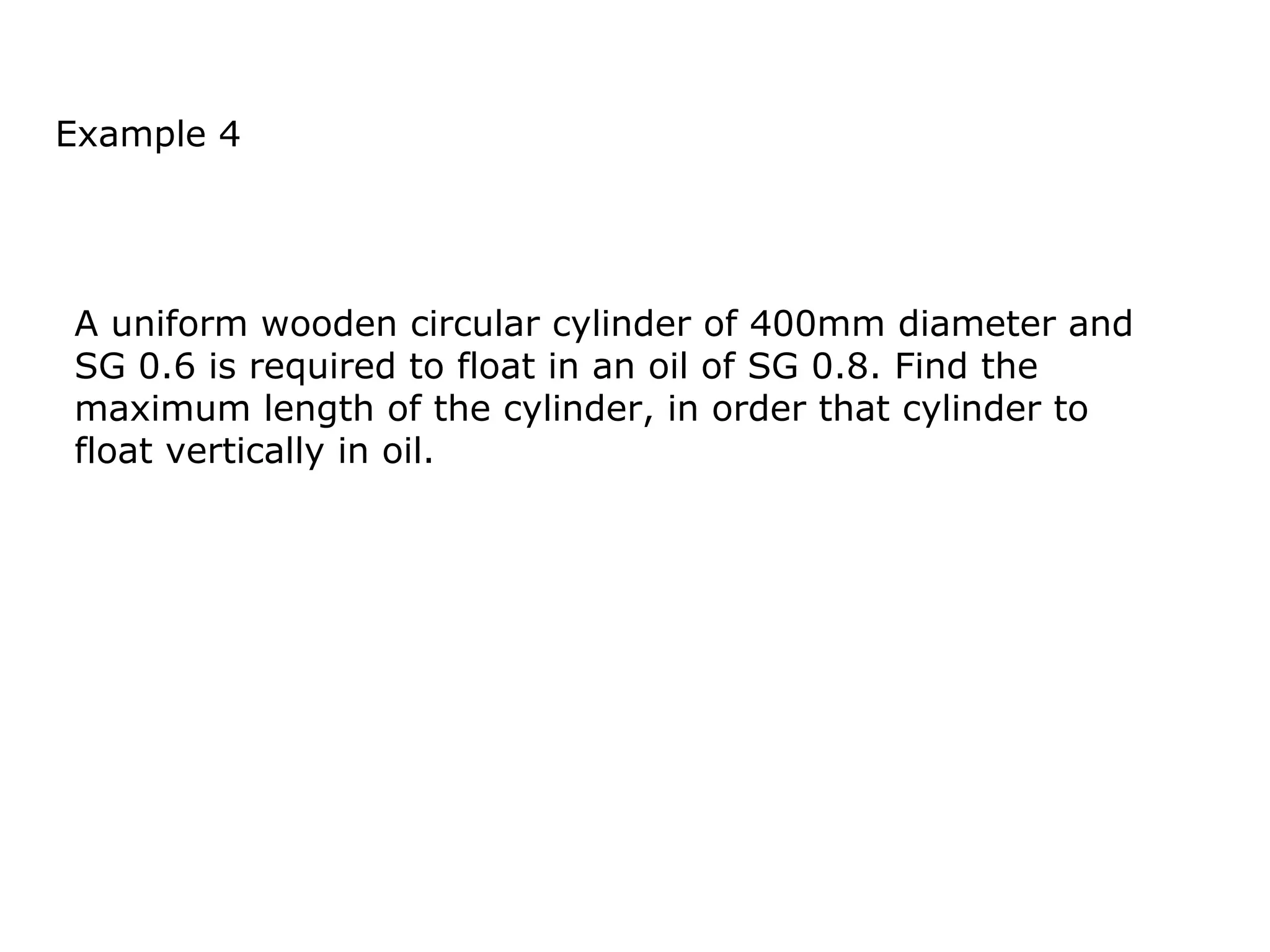
Example 4


A uniform wooden circular cylinder of 400mm diameter and
SG 0.6 is required to float in an oil of SG 0.8. Find the
maximum length of the cylinder, in order that cylinder to
float vertically in oil.
End of Fluid Statics

4. fs buoyancy class 4

  • 1.
    FLUID MECHANICS –1 First Semester 2011 - 2012 Week – 3 Class – 1 Buoyancy and Flotation Compiled and modified by Sharma, Adam and Idriss
  • 2.
    OBJECTIVES • Concept ofbuoyancy Buoyancy force Archimedes’ principle • Stability of floating bodies
  • 3.
    BUOYANCY AND STABILITY Buoyant force: The upward force a fluid exerts on a body immersed in it. The buoyant force is caused by the increase of pressure with depth in a fluid. The buoyant force acting on the plate is equal to the weight of the liquid displaced by the plate. For a fluid with constant density, the buoyant force is independent of the distance of the body from the free surface. It is also independent of the density of the solid A flat plate of uniform thickness h submerged body. in a liquid parallel to the free surface. 3
  • 4.
    ARCHIMEDES’ PRINCIPLE The buoyantforce acting on a body immersed in a fluid is equal to the weight of the fluid displaced by the body, and it acts upward through the centroid of the displaced volume.
  • 5.
    The buoyant forcesacting on a solid body submerged in a fluid and on a fluid body of the same shape at the same depth are identical. The buoyant force FB acts upward through the centroid C of the displaced volume and is equal in magnitude to the weight W of the displaced fluid, but is opposite in direction. For a solid of uniform density, its weight Ws also acts through the centroid, but its magnitude is not necessarily equal to that of the fluid it displaces. (Here Ws > W and thus Ws > FB; this solid body would sink.) 5
  • 6.
    For floating bodies,the weight of the entire body must be equal to the buoyant force, which is the weight of the fluid whose volume is equal to the volume of the submerged portion of the floating body: A solid body dropped into a fluid will sink, float, or remain at rest at any point in the fluid, depending on its average density relative to the density of the fluid. 6
  • 7.
    The altitude ofa hot air balloon is controlled by the temperature difference between the air inside and outside the balloon, since warm air is less dense than cold air. When the balloon is neither rising nor falling, the upward buoyant force exactly balances the downward weight. 7
  • 8.
  • 9.
    STABILITY OF IMMERSEDAND FLOATING BODIES Stability is easily understood by analyzing a ball on the floor. For floating bodies such as ships, stability is an important consideration for safety. 9
  • 10.
    A floating bodypossesses vertical stability, while an immersed neutrally buoyant body is neutrally stable since it does not return to its original position after a disturbance. An immersed neutrally buoyant body is (a)stable if the center of gravity G is directly below the center of buoyancy B of the body, (b)neutrally stable if G and B are coincident, and (c)unstable if G is directly above B. 10
  • 11.
    When the centerof gravity G of an A ball in a trough between immersed neutrally buoyant body is not two hills is stable for small vertically aligned with the center of disturbances, but buoyancy B of the body, it is not in an unstable for large equilibrium state and would rotate to its disturbances. stable state, even without any disturbance. 11
  • 12.
    A floating bodyis stable if the body is bottom-heavy and thus the center of gravity G is below the centroid B of the body, or if the metacenter M is above point G. However, the body is unstable if point M is below point G. Metacentric height GM: The distance between the center of gravity G and the metacenter M—the intersection point of the lines of action of the buoyant force through the body before and after rotation. The length of the metacentric height GM above G is a measure of the stability: the larger it is, the more stable is the floating 12 body.
  • 13.
    Example 1 A blockof wood of SG 0.8 and size 100mmx40mmx30mm floats at depth of 24mm in water. Determine its metacentric height, for tilt about its longitudinal axis.
  • 14.
    Example 2 A solidcylinder of 3 m diameter has a height of 3m. it is made of material which SG is 0.8, and is floating in water with its axis vertical. Determine its metacentric height and state whether its equilibrium is stable or unstable.
  • 15.
    Example 3 A solidcylinder 36cm long, 8cm diameter has its base 1 cm thick and its SG=7. The remaining part of the cylinder SG is 0.5. Determine, if it can float vertically in water.
  • 16.
    Example 4 A uniformwooden circular cylinder of 400mm diameter and SG 0.6 is required to float in an oil of SG 0.8. Find the maximum length of the cylinder, in order that cylinder to float vertically in oil.
  • 18.
    End of FluidStatics