FLUID MECHANICS – 1
      Semester 1 2011 - 2012


            Week – 1
            Class – 1


         Properties of Fluid


  Compiled and modified
           by
     Sharma, Adam
OBJECTIVES
• Introduction to fluid mechanics

• Applications of fluid mechanics

• Dimensions and Units {CGS, FPS, MKS and SI
  system}

• Fluid properties – Density and Viscosity
INTRODUCTION - CONCEPTS
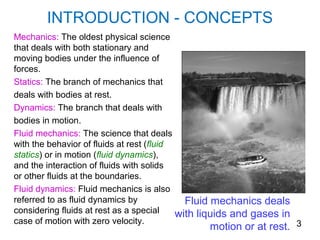
Mechanics: The oldest physical science
that deals with both stationary and
moving bodies under the influence of
forces.
Statics: The branch of mechanics that
deals with bodies at rest.
Dynamics: The branch that deals with
bodies in motion.
Fluid mechanics: The science that deals
with the behavior of fluids at rest (fluid
statics) or in motion (fluid dynamics),
and the interaction of fluids with solids
or other fluids at the boundaries.
Fluid dynamics: Fluid mechanics is also
referred to as fluid dynamics by             Fluid mechanics deals
considering fluids at rest as a special    with liquids and gases in
case of motion with zero velocity.
                                                   motion or at rest. 3
INTRODUCTION – SOLIDS AND FLUIDS
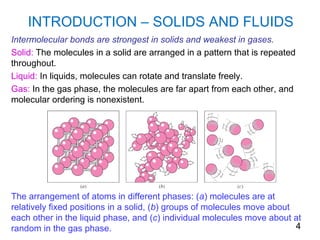
Intermolecular bonds are strongest in solids and weakest in gases.
Solid: The molecules in a solid are arranged in a pattern that is repeated
throughout.
Liquid: In liquids, molecules can rotate and translate freely.
Gas: In the gas phase, the molecules are far apart from each other, and
molecular ordering is nonexistent.


The arrangement of atoms in different phases: (a) molecules are at
relatively fixed positions in a solid, (b) groups of molecules move about
each other in the liquid phase, and (c) individual molecules move about at
random in the gas phase.                                                  4
INTRODUCTION – LIQUID AND GAS
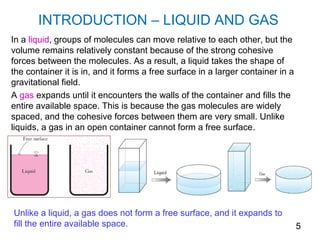
In a liquid, groups of molecules can move relative to each other, but the
volume remains relatively constant because of the strong cohesive
forces between the molecules. As a result, a liquid takes the shape of
the container it is in, and it forms a free surface in a larger container in a
gravitational field.
A gas expands until it encounters the walls of the container and fills the
entire available space. This is because the gas molecules are widely
spaced, and the cohesive forces between them are very small. Unlike
liquids, a gas in an open container cannot form a free surface.


Unlike a liquid, a gas does not form a free surface, and it expands to
fill the entire available space.                                                 5
INTRODUCTION – GAS AND VAPOR
Gas and vapor are often used as synonymous words.
Gas: The vapor phase of a substance is customarily called a gas when
it is above the critical temperature.
Vapor: Usually implies that the current phase is not far from a state of
condensation.


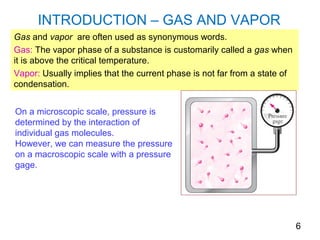
On a microscopic scale, pressure is
determined by the interaction of
individual gas molecules.
However, we can measure the pressure
on a macroscopic scale with a pressure
gage.


                                                                           6
INTRODUCTION - STRESS
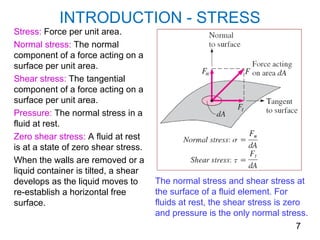
Stress: Force per unit area.
Normal stress: The normal
component of a force acting on a
surface per unit area.
Shear stress: The tangential
component of a force acting on a
surface per unit area.
Pressure: The normal stress in a
fluid at rest.
Zero shear stress: A fluid at rest
is at a state of zero shear stress.
When the walls are removed or a
liquid container is tilted, a shear
develops as the liquid moves to       The normal stress and shear stress at
re-establish a horizontal free        the surface of a fluid element. For
surface.                              fluids at rest, the shear stress is zero
                                      and pressure is the only normal stress.
                                                                             7
DIFFERENCE BETWEEN SOLID & FLUID
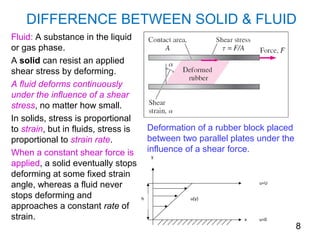
Fluid: A substance in the liquid
or gas phase.
A solid can resist an applied
shear stress by deforming.
A fluid deforms continuously
under the influence of a shear
stress, no matter how small.
In solids, stress is proportional
to strain, but in fluids, stress is       Deformation of a rubber block placed
proportional to strain rate.              between two parallel plates under the
When a constant shear force is            influence of a shear force.
                                           y
applied, a solid eventually stops
deforming at some fixed strain
angle, whereas a fluid never                                          u=U

stops deforming and                   h             u(y)
approaches a constant rate of
strain.                                                           x   u=0
                                                                                  8
AREAS OF APPLICATIONS


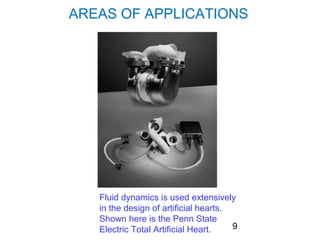
   Fluid dynamics is used extensively
   in the design of artificial hearts.
   Shown here is the Penn State
   Electric Total Artificial Heart.    9
10
11
DIMENSIONS AND UNITS


                       12
DIMENSIONS AND UNITS
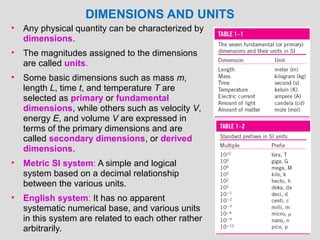
•   Any physical quantity can be characterized by
    dimensions.
•   The magnitudes assigned to the dimensions
    are called units.
•   Some basic dimensions such as mass m,
    length L, time t, and temperature T are
    selected as primary or fundamental
    dimensions, while others such as velocity V,
    energy E, and volume V are expressed in
    terms of the primary dimensions and are
    called secondary dimensions, or derived
    dimensions.
•   Metric SI system: A simple and logical
    system based on a decimal relationship
    between the various units.
•   English system: It has no apparent
    systematic numerical base, and various units
    in this system are related to each other rather
                                                      13
    arbitrarily.
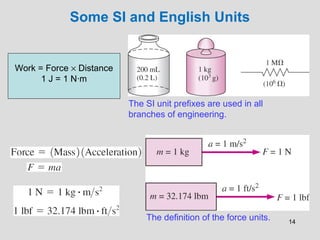
Some SI and English Units


Work = Force × Distance
      1 J = 1 N∙m

                          The SI unit prefixes are used in all
                          branches of engineering.


                              The definition of the force units.   14
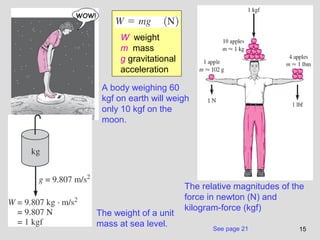
W weight
      m mass
      g gravitational
      acceleration

 A body weighing 60
 kgf on earth will weigh
 only 10 kgf on the
 moon.


                        The relative magnitudes of the
                        force in newton (N) and
                        kilogram-force (kgf)
The weight of a unit
mass at sea level.             See page 21          15
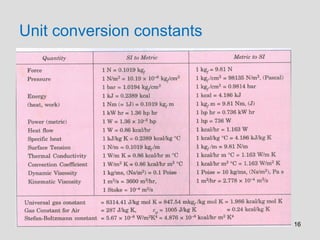
Unit conversion constants


                            16
DENSITY


          17
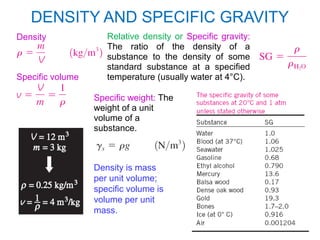
DENSITY AND SPECIFIC GRAVITY
Density              Relative density or Specific gravity:
                     The ratio of the density of a
                     substance to the density of some
                     standard substance at a specified
Specific volume      temperature (usually water at 4°C).

                  Specific weight: The
                  weight of a unit
                  volume of a
                  substance.


                  Density is mass
                  per unit volume;
                  specific volume is
                  volume per unit
                  mass.
                                                     18
VISCOSITY


            19
VISCOSITY
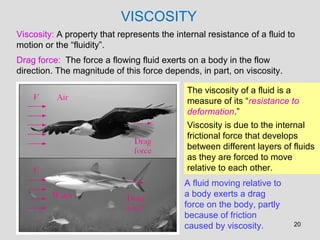
Viscosity: A property that represents the internal resistance of a fluid to
motion or the “fluidity”.
Drag force: The force a flowing fluid exerts on a body in the flow
direction. The magnitude of this force depends, in part, on viscosity.

                                             The viscosity of a fluid is a
                                             measure of its “resistance to
                                             deformation.”
                                             Viscosity is due to the internal
                                             frictional force that develops
                                             between different layers of fluids
                                             as they are forced to move
                                             relative to each other.
                                             A fluid moving relative to
                                             a body exerts a drag
                                             force on the body, partly
                                             because of friction
                                             caused by viscosity.         20
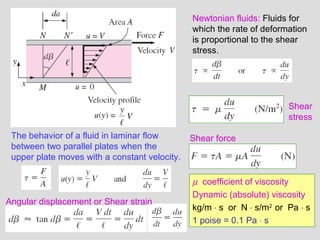
Newtonian fluids: Fluids for
                                               which the rate of deformation
                                               is proportional to the shear
                                               stress.


                                                                       Shear
                                                                       stress

 The behavior of a fluid in laminar flow       Shear force
 between two parallel plates when the
 upper plate moves with a constant velocity.

                                               µ coefficient of viscosity
                                               Dynamic (absolute) viscosity
Angular displacement or Shear strain
                                               kg/m ⋅ s or N ⋅ s/m2 or Pa ⋅ s
                                               1 poise = 0.1 Pa ⋅ s       21
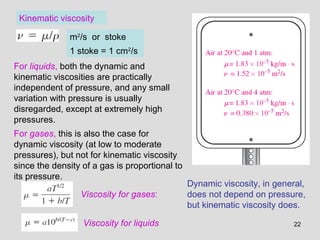
Kinematic viscosity

              m2/s or stoke
              1 stoke = 1 cm2/s
For liquids, both the dynamic and
kinematic viscosities are practically
independent of pressure, and any small
variation with pressure is usually
disregarded, except at extremely high
pressures.
For gases, this is also the case for
dynamic viscosity (at low to moderate
pressures), but not for kinematic viscosity
since the density of a gas is proportional to
its pressure.
                                                Dynamic viscosity, in general,
                 Viscosity for gases:           does not depend on pressure,
                                                but kinematic viscosity does.

                  Viscosity for liquids                                    22
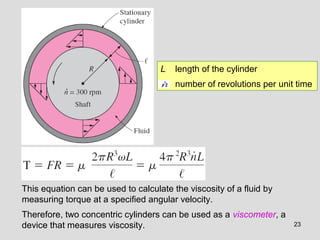
L   length of the cylinder
                                        number of revolutions per unit time


This equation can be used to calculate the viscosity of a fluid by
measuring torque at a specified angular velocity.
Therefore, two concentric cylinders can be used as a viscometer, a
device that measures viscosity.                                       23
Summary

    Introduction to Fluid mechanics
          Concepts and definitions

    Applications of fluid mechanics

    Dimensions and Units
        Basic dimensions in FM
        Different units of measurement

    Properties of fluids
         Density and Relative density
         Absolute and kinematic viscosity


                                            24

1. fs rho & mu class 1

  • 1.
    FLUID MECHANICS –1 Semester 1 2011 - 2012 Week – 1 Class – 1 Properties of Fluid Compiled and modified by Sharma, Adam
  • 2.
    OBJECTIVES • Introduction tofluid mechanics • Applications of fluid mechanics • Dimensions and Units {CGS, FPS, MKS and SI system} • Fluid properties – Density and Viscosity
  • 3.
    INTRODUCTION - CONCEPTS Mechanics:The oldest physical science that deals with both stationary and moving bodies under the influence of forces. Statics: The branch of mechanics that deals with bodies at rest. Dynamics: The branch that deals with bodies in motion. Fluid mechanics: The science that deals with the behavior of fluids at rest (fluid statics) or in motion (fluid dynamics), and the interaction of fluids with solids or other fluids at the boundaries. Fluid dynamics: Fluid mechanics is also referred to as fluid dynamics by Fluid mechanics deals considering fluids at rest as a special with liquids and gases in case of motion with zero velocity. motion or at rest. 3
  • 4.
    INTRODUCTION – SOLIDSAND FLUIDS Intermolecular bonds are strongest in solids and weakest in gases. Solid: The molecules in a solid are arranged in a pattern that is repeated throughout. Liquid: In liquids, molecules can rotate and translate freely. Gas: In the gas phase, the molecules are far apart from each other, and molecular ordering is nonexistent. The arrangement of atoms in different phases: (a) molecules are at relatively fixed positions in a solid, (b) groups of molecules move about each other in the liquid phase, and (c) individual molecules move about at random in the gas phase. 4
  • 5.
    INTRODUCTION – LIQUIDAND GAS In a liquid, groups of molecules can move relative to each other, but the volume remains relatively constant because of the strong cohesive forces between the molecules. As a result, a liquid takes the shape of the container it is in, and it forms a free surface in a larger container in a gravitational field. A gas expands until it encounters the walls of the container and fills the entire available space. This is because the gas molecules are widely spaced, and the cohesive forces between them are very small. Unlike liquids, a gas in an open container cannot form a free surface. Unlike a liquid, a gas does not form a free surface, and it expands to fill the entire available space. 5
  • 6.
    INTRODUCTION – GASAND VAPOR Gas and vapor are often used as synonymous words. Gas: The vapor phase of a substance is customarily called a gas when it is above the critical temperature. Vapor: Usually implies that the current phase is not far from a state of condensation. On a microscopic scale, pressure is determined by the interaction of individual gas molecules. However, we can measure the pressure on a macroscopic scale with a pressure gage. 6
  • 7.
    INTRODUCTION - STRESS Stress:Force per unit area. Normal stress: The normal component of a force acting on a surface per unit area. Shear stress: The tangential component of a force acting on a surface per unit area. Pressure: The normal stress in a fluid at rest. Zero shear stress: A fluid at rest is at a state of zero shear stress. When the walls are removed or a liquid container is tilted, a shear develops as the liquid moves to The normal stress and shear stress at re-establish a horizontal free the surface of a fluid element. For surface. fluids at rest, the shear stress is zero and pressure is the only normal stress. 7
  • 8.
    DIFFERENCE BETWEEN SOLID& FLUID Fluid: A substance in the liquid or gas phase. A solid can resist an applied shear stress by deforming. A fluid deforms continuously under the influence of a shear stress, no matter how small. In solids, stress is proportional to strain, but in fluids, stress is Deformation of a rubber block placed proportional to strain rate. between two parallel plates under the When a constant shear force is influence of a shear force. y applied, a solid eventually stops deforming at some fixed strain angle, whereas a fluid never u=U stops deforming and h u(y) approaches a constant rate of strain. x u=0 8
  • 9.
    AREAS OF APPLICATIONS Fluid dynamics is used extensively in the design of artificial hearts. Shown here is the Penn State Electric Total Artificial Heart. 9
  • 10.
  • 11.
  • 12.
  • 13.
    DIMENSIONS AND UNITS • Any physical quantity can be characterized by dimensions. • The magnitudes assigned to the dimensions are called units. • Some basic dimensions such as mass m, length L, time t, and temperature T are selected as primary or fundamental dimensions, while others such as velocity V, energy E, and volume V are expressed in terms of the primary dimensions and are called secondary dimensions, or derived dimensions. • Metric SI system: A simple and logical system based on a decimal relationship between the various units. • English system: It has no apparent systematic numerical base, and various units in this system are related to each other rather 13 arbitrarily.
  • 14.
    Some SI andEnglish Units Work = Force × Distance 1 J = 1 N∙m The SI unit prefixes are used in all branches of engineering. The definition of the force units. 14
  • 15.
    W weight m mass g gravitational acceleration A body weighing 60 kgf on earth will weigh only 10 kgf on the moon. The relative magnitudes of the force in newton (N) and kilogram-force (kgf) The weight of a unit mass at sea level. See page 21 15
  • 16.
  • 17.
  • 18.
    DENSITY AND SPECIFICGRAVITY Density Relative density or Specific gravity: The ratio of the density of a substance to the density of some standard substance at a specified Specific volume temperature (usually water at 4°C). Specific weight: The weight of a unit volume of a substance. Density is mass per unit volume; specific volume is volume per unit mass. 18
  • 19.
  • 20.
    VISCOSITY Viscosity: A propertythat represents the internal resistance of a fluid to motion or the “fluidity”. Drag force: The force a flowing fluid exerts on a body in the flow direction. The magnitude of this force depends, in part, on viscosity. The viscosity of a fluid is a measure of its “resistance to deformation.” Viscosity is due to the internal frictional force that develops between different layers of fluids as they are forced to move relative to each other. A fluid moving relative to a body exerts a drag force on the body, partly because of friction caused by viscosity. 20
  • 21.
    Newtonian fluids: Fluidsfor which the rate of deformation is proportional to the shear stress. Shear stress The behavior of a fluid in laminar flow Shear force between two parallel plates when the upper plate moves with a constant velocity. µ coefficient of viscosity Dynamic (absolute) viscosity Angular displacement or Shear strain kg/m ⋅ s or N ⋅ s/m2 or Pa ⋅ s 1 poise = 0.1 Pa ⋅ s 21
  • 22.
    Kinematic viscosity m2/s or stoke 1 stoke = 1 cm2/s For liquids, both the dynamic and kinematic viscosities are practically independent of pressure, and any small variation with pressure is usually disregarded, except at extremely high pressures. For gases, this is also the case for dynamic viscosity (at low to moderate pressures), but not for kinematic viscosity since the density of a gas is proportional to its pressure. Dynamic viscosity, in general, Viscosity for gases: does not depend on pressure, but kinematic viscosity does. Viscosity for liquids 22
  • 23.
    L length of the cylinder number of revolutions per unit time This equation can be used to calculate the viscosity of a fluid by measuring torque at a specified angular velocity. Therefore, two concentric cylinders can be used as a viscometer, a device that measures viscosity. 23
  • 24.
    Summary Introduction to Fluid mechanics Concepts and definitions Applications of fluid mechanics Dimensions and Units Basic dimensions in FM Different units of measurement Properties of fluids Density and Relative density Absolute and kinematic viscosity 24

Editor's Notes

  • #9 Definition: Strain is the definition of how much a material has been stretched (or compressed) when compared to its original length. The most common measure of strain in metals is called engineering strain, calculated as the change in length divided by the original length. For example, a 2.0" titanium bar that has been stretched to 2.2" is said to have experienced a tensile strain of 0.1, or 10%.