FLUID MECHANICS – 1
     First Semester 2011 - 2012


            Week – 1
            Class – 2


      Pressure and Manometers


  Compiled and modified
           by
     Sharma, Adam
Review

  Introduction to Fluid mechanics
       Concepts and definitions

  Applications of fluid mechanics

  Dimensions and Units
       Basic dimensions in FM
       Different units of measurement

  Properties of fluids
       Density and Relative density
       Absolute and kinematic viscosity


                                          2
OBJECTIVES

• Concept of pressure
• Pressure variation in a fluid at rest
• Pressure measuring devices
• Measurement of pressure using various kinds
  of manometers


                                                3
PRESSURE
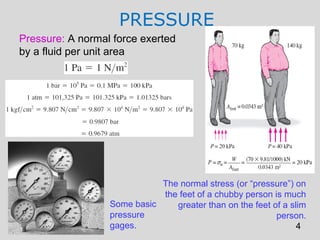
Pressure: A normal force exerted
by a fluid per unit area


                             The normal stress (or “pressure”) on
                             the feet of a chubby person is much
                  Some basic    greater than on the feet of a slim
                  pressure                                person.
                  gages.                                        4
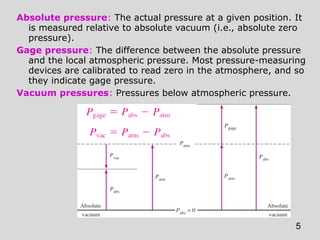
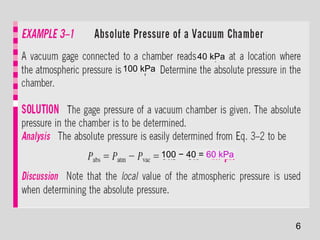
Absolute pressure: The actual pressure at a given position. It
  is measured relative to absolute vacuum (i.e., absolute zero
  pressure).
Gage pressure: The difference between the absolute pressure
  and the local atmospheric pressure. Most pressure-measuring
  devices are calibrated to read zero in the atmosphere, and so
  they indicate gage pressure.
Vacuum pressures: Pressures below atmospheric pressure.


                                                            5
40 kPa
100 kPa


          100 − 40 = 60 kPa


                              6
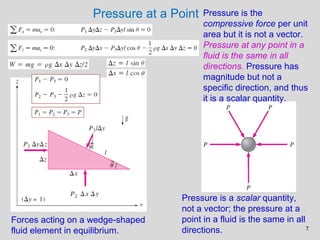
Pressure at a Point   Pressure is the
                                        compressive force per unit
                                        area but it is not a vector.
                                        Pressure at any point in a
                                        fluid is the same in all
                                        directions. Pressure has
                                        magnitude but not a
                                        specific direction, and thus
                                        it is a scalar quantity.


                                  Pressure is a scalar quantity,
                                  not a vector; the pressure at a
Forces acting on a wedge-shaped   point in a fluid is the same in all
fluid element in equilibrium.     directions.                         7
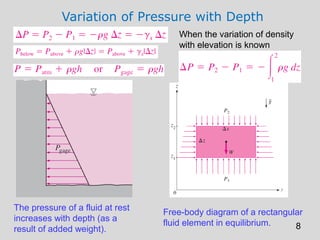
Variation of Pressure with Depth
                                     When the variation of density
                                     with elevation is known


The pressure of a fluid at rest
                                  Free-body diagram of a rectangular
increases with depth (as a
                                  fluid element in equilibrium.   8
result of added weight).
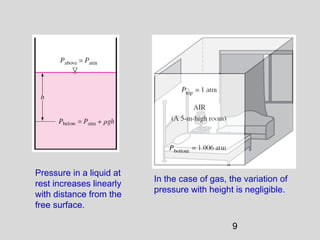
Pressure in a liquid at
                          In the case of gas, the variation of
rest increases linearly
                          pressure with height is negligible.
with distance from the
free surface.

                                               9
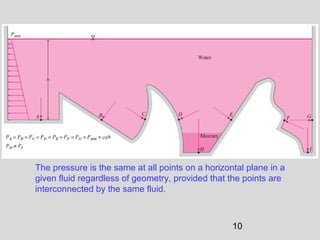
The pressure is the same at all points on a horizontal plane in a
given fluid regardless of geometry, provided that the points are
interconnected by the same fluid.


                                                   10
PRESSURE MEASURING
     DEVICES
PRESSURE MEASUREMENT DEVICES
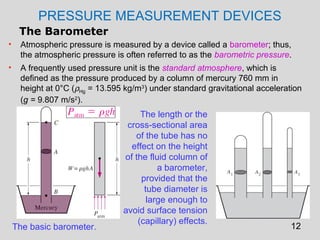
     The Barometer
•    Atmospheric pressure is measured by a device called a barometer; thus,
     the atmospheric pressure is often referred to as the barometric pressure.
•    A frequently used pressure unit is the standard atmosphere, which is
     defined as the pressure produced by a column of mercury 760 mm in
     height at 0°C (ρHg = 13.595 kg/m3) under standard gravitational acceleration
     (g = 9.807 m/s2).
                                     The length or the
                                 cross-sectional area
                                   of the tube has no
                                  effect on the height
                                of the fluid column of
                                          a barometer,
                                     provided that the
                                      tube diameter is
                                       large enough to
                                avoid surface tension
                                    (capillary) effects.
    The basic barometer.                                                      12
13
14
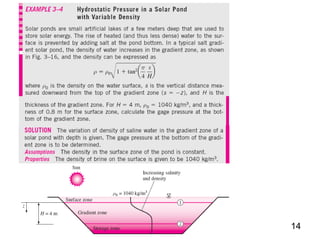
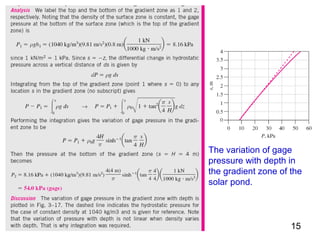
The variation of gage
pressure with depth in
the gradient zone of the
solar pond.


                     15
MEASUREMENT OF PRESSURE
 USING VARIOUS KINDS OF
      MANOMETERS
PASCAL’S LAW
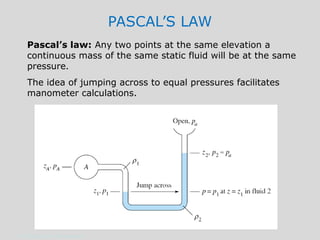
     Pascal’s law: Any two points at the same elevation a
     continuous mass of the same static fluid will be at the same
     pressure.
     The idea of jumping across to equal pressures facilitates
     manometer calculations.


11-15 January 2010 M Subramanian
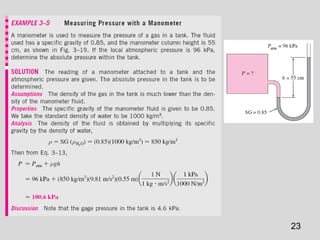
MANOMETER
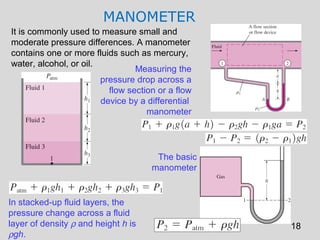
It is commonly used to measure small and
moderate pressure differences. A manometer
contains one or more fluids such as mercury,
water, alcohol, or oil.
                                 Measuring the
                        pressure drop across a
                          flow section or a flow
                        device by a differential
                                    manometer


                                      The basic
                                     manometer


In stacked-up fluid layers, the
pressure change across a fluid
layer of density ρ and height h is                 18
ρgh.
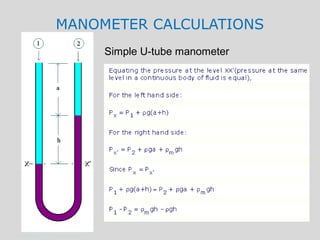
MANOMETER CALCULATIONS
                                   Simple U-tube manometer


11-15 January 2010 M Subramanian
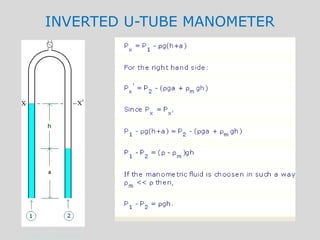
INVERTED U-TUBE MANOMETER


11-15 January 2010 M Subramanian
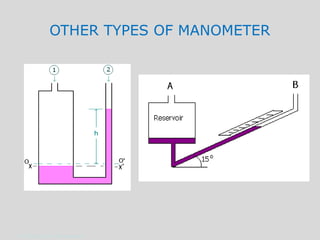
OTHER TYPES OF MANOMETER


11-15 January 2010 M Subramanian
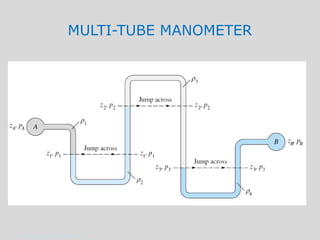
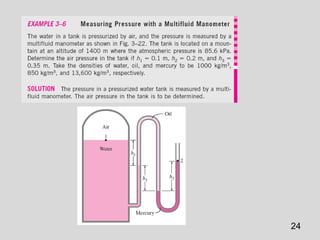
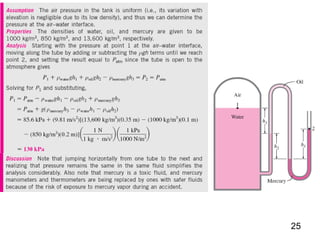
MULTI-TUBE MANOMETER


11-15 January 2010 M Subramanian
23
24
25
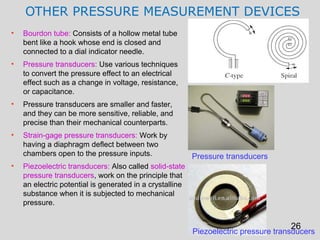
OTHER PRESSURE MEASUREMENT DEVICES
•   Bourdon tube: Consists of a hollow metal tube
    bent like a hook whose end is closed and
    connected to a dial indicator needle.
•   Pressure transducers: Use various techniques
    to convert the pressure effect to an electrical
    effect such as a change in voltage, resistance,
    or capacitance.
•   Pressure transducers are smaller and faster,
    and they can be more sensitive, reliable, and
    precise than their mechanical counterparts.
•   Strain-gage pressure transducers: Work by
    having a diaphragm deflect between two
    chambers open to the pressure inputs.                 Pressure transducers
•   Piezoelectric transducers: Also called solid-state
    pressure transducers, work on the principle that
    an electric potential is generated in a crystalline
    substance when it is subjected to mechanical
    pressure.


                                                                                     26
                                                          Piezoelectric pressure transducers
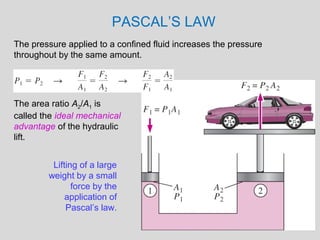
PASCAL’S LAW
The pressure applied to a confined fluid increases the pressure
throughout by the same amount.


The area ratio A2/A1 is
called the ideal mechanical
advantage of the hydraulic
lift.


         Lifting of a large
        weight by a small
               force by the
             application of
             Pascal’s law.

                                                       27
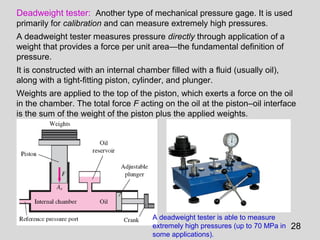
Deadweight tester: Another type of mechanical pressure gage. It is used
primarily for calibration and can measure extremely high pressures.
A deadweight tester measures pressure directly through application of a
weight that provides a force per unit area—the fundamental definition of
pressure.
It is constructed with an internal chamber filled with a fluid (usually oil),
along with a tight-fitting piston, cylinder, and plunger.
Weights are applied to the top of the piston, which exerts a force on the oil
in the chamber. The total force F acting on the oil at the piston–oil interface
is the sum of the weight of the piston plus the applied weights.


                                      A deadweight tester is able to measure
                                      extremely high pressures (up to 70 MPa in   28
                                      some applications).
Any Questions?


11-15 January 2010 M Subramanian

2. fs pr class 2

  • 1.
    FLUID MECHANICS –1 First Semester 2011 - 2012 Week – 1 Class – 2 Pressure and Manometers Compiled and modified by Sharma, Adam
  • 2.
    Review Introductionto Fluid mechanics Concepts and definitions Applications of fluid mechanics Dimensions and Units Basic dimensions in FM Different units of measurement Properties of fluids Density and Relative density Absolute and kinematic viscosity 2
  • 3.
    OBJECTIVES • Concept ofpressure • Pressure variation in a fluid at rest • Pressure measuring devices • Measurement of pressure using various kinds of manometers 3
  • 4.
    PRESSURE Pressure: A normalforce exerted by a fluid per unit area The normal stress (or “pressure”) on the feet of a chubby person is much Some basic greater than on the feet of a slim pressure person. gages. 4
  • 5.
    Absolute pressure: Theactual pressure at a given position. It is measured relative to absolute vacuum (i.e., absolute zero pressure). Gage pressure: The difference between the absolute pressure and the local atmospheric pressure. Most pressure-measuring devices are calibrated to read zero in the atmosphere, and so they indicate gage pressure. Vacuum pressures: Pressures below atmospheric pressure. 5
  • 6.
    40 kPa 100 kPa 100 − 40 = 60 kPa 6
  • 7.
    Pressure at aPoint Pressure is the compressive force per unit area but it is not a vector. Pressure at any point in a fluid is the same in all directions. Pressure has magnitude but not a specific direction, and thus it is a scalar quantity. Pressure is a scalar quantity, not a vector; the pressure at a Forces acting on a wedge-shaped point in a fluid is the same in all fluid element in equilibrium. directions. 7
  • 8.
    Variation of Pressurewith Depth When the variation of density with elevation is known The pressure of a fluid at rest Free-body diagram of a rectangular increases with depth (as a fluid element in equilibrium. 8 result of added weight).
  • 9.
    Pressure in aliquid at In the case of gas, the variation of rest increases linearly pressure with height is negligible. with distance from the free surface. 9
  • 10.
    The pressure isthe same at all points on a horizontal plane in a given fluid regardless of geometry, provided that the points are interconnected by the same fluid. 10
  • 11.
  • 12.
    PRESSURE MEASUREMENT DEVICES The Barometer • Atmospheric pressure is measured by a device called a barometer; thus, the atmospheric pressure is often referred to as the barometric pressure. • A frequently used pressure unit is the standard atmosphere, which is defined as the pressure produced by a column of mercury 760 mm in height at 0°C (ρHg = 13.595 kg/m3) under standard gravitational acceleration (g = 9.807 m/s2). The length or the cross-sectional area of the tube has no effect on the height of the fluid column of a barometer, provided that the tube diameter is large enough to avoid surface tension (capillary) effects. The basic barometer. 12
  • 13.
  • 14.
  • 15.
    The variation ofgage pressure with depth in the gradient zone of the solar pond. 15
  • 16.
    MEASUREMENT OF PRESSURE USING VARIOUS KINDS OF MANOMETERS
  • 17.
    PASCAL’S LAW Pascal’s law: Any two points at the same elevation a continuous mass of the same static fluid will be at the same pressure. The idea of jumping across to equal pressures facilitates manometer calculations. 11-15 January 2010 M Subramanian
  • 18.
    MANOMETER It is commonlyused to measure small and moderate pressure differences. A manometer contains one or more fluids such as mercury, water, alcohol, or oil. Measuring the pressure drop across a flow section or a flow device by a differential manometer The basic manometer In stacked-up fluid layers, the pressure change across a fluid layer of density ρ and height h is 18 ρgh.
  • 19.
    MANOMETER CALCULATIONS Simple U-tube manometer 11-15 January 2010 M Subramanian
  • 20.
    INVERTED U-TUBE MANOMETER 11-15January 2010 M Subramanian
  • 21.
    OTHER TYPES OFMANOMETER 11-15 January 2010 M Subramanian
  • 22.
  • 23.
  • 24.
  • 25.
  • 26.
    OTHER PRESSURE MEASUREMENTDEVICES • Bourdon tube: Consists of a hollow metal tube bent like a hook whose end is closed and connected to a dial indicator needle. • Pressure transducers: Use various techniques to convert the pressure effect to an electrical effect such as a change in voltage, resistance, or capacitance. • Pressure transducers are smaller and faster, and they can be more sensitive, reliable, and precise than their mechanical counterparts. • Strain-gage pressure transducers: Work by having a diaphragm deflect between two chambers open to the pressure inputs. Pressure transducers • Piezoelectric transducers: Also called solid-state pressure transducers, work on the principle that an electric potential is generated in a crystalline substance when it is subjected to mechanical pressure. 26 Piezoelectric pressure transducers
  • 27.
    PASCAL’S LAW The pressureapplied to a confined fluid increases the pressure throughout by the same amount. The area ratio A2/A1 is called the ideal mechanical advantage of the hydraulic lift. Lifting of a large weight by a small force by the application of Pascal’s law. 27
  • 28.
    Deadweight tester: Anothertype of mechanical pressure gage. It is used primarily for calibration and can measure extremely high pressures. A deadweight tester measures pressure directly through application of a weight that provides a force per unit area—the fundamental definition of pressure. It is constructed with an internal chamber filled with a fluid (usually oil), along with a tight-fitting piston, cylinder, and plunger. Weights are applied to the top of the piston, which exerts a force on the oil in the chamber. The total force F acting on the oil at the piston–oil interface is the sum of the weight of the piston plus the applied weights. A deadweight tester is able to measure extremely high pressures (up to 70 MPa in 28 some applications).
  • 29.
    Any Questions? 11-15 January2010 M Subramanian