Chapter Presentation Transparencies Sample Problems Visual Concepts Standardized Test Prep Chapter 8 – Fluid Dynamics
Table of Contents Section 1  Fluids and Buoyant Force Section 2  Fluid Pressure Section 3  Fluids in Motion Fluid Mechanics Chapter  8
Objectives Define   a fluid. Distinguish   a gas from a liquid. Determine   the magnitude of the buoyant force exerted on a floating object or a submerged object. Explain   why some objects float and some objects sink. Section 1  Fluids and Buoyant Force Chapter  8
Defining a Fluid A  fluid   is a nonsolid state of matter in which the atoms or molecules are free to move past each other Both  liquids and gases are considered fluids Section 1  Fluids and Buoyant Force Chapter  8
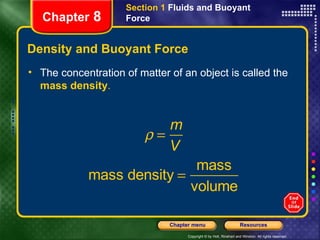
Density and Buoyant Force The concentration of matter of an object is called the   mass density . Section 1  Fluids and Buoyant Force Chapter  8
Mass Density Chapter  8 Section 1  Fluids and Buoyant Force
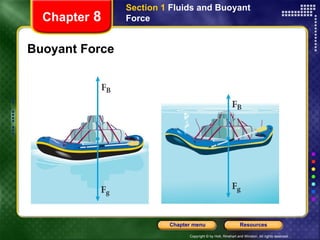
Density and Buoyant Force,  continued The  buoyant force   is the upward force exerted by a liquid on an object immersed in or floating on the liquid. Buoyant forces  can keep objects afloat. Section 1  Fluids and Buoyant Force Chapter  8
Buoyant Force and Archimedes’ Principle Chapter  8 Section 1  Fluids and Buoyant Force
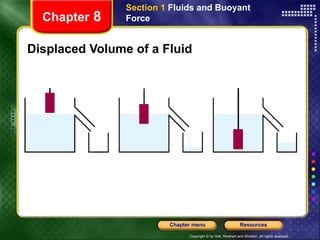
Displaced Volume of a Fluid Chapter  8 Section 1  Fluids and Buoyant Force
Density and Buoyant Force,  continued Archimedes’ principle:  Any object completely or partially submerged in a fluid experiences an upward buoyant force equal in magnitude to the weight of the fluid displaced by the object. F B  =  F g  (displaced fluid)  =  m f g magnitude of buoyant force = weight of fluid displaced Section 1  Fluids and Buoyant Force Chapter  8
Buoyant Force on Floating Objects Chapter  8 Section 1  Fluids and Buoyant Force
Buoyant Force Chapter  8 Section 1  Fluids and Buoyant Force
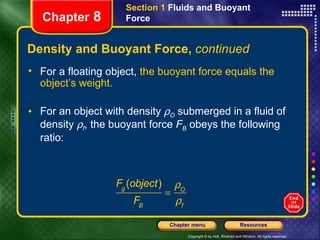
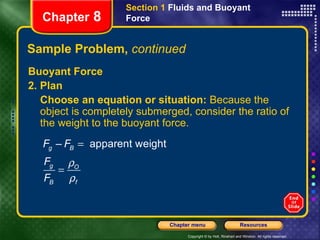
Density and Buoyant Force,  continued For a floating object,  the buoyant force equals the object’s weight. For an object with density   O  submerged in a fluid of density   f , the buoyant force  F B  obeys the following ratio:   Section 1  Fluids and Buoyant Force Chapter  8
Sample Problem Buoyant Force A bargain hunter purchases a “gold” crown at a flea market. After she gets home, she hangs the crown from a scale and finds its weight to be 7.84 N. She then weighs the crown while it is immersed in water, and the scale reads 6.86 N. Is the crown made of pure gold? Explain. Section 1  Fluids and Buoyant Force Chapter  8
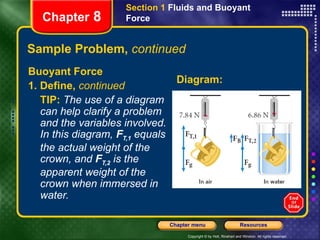
Sample Problem,  continued Buoyant Force 1. Define Given: F g  = 7.84 N apparent weight = 6.86 N  f  =  p water  = 1.00    10 3  kg/m 3 Unknown:  O  = ? Section 1  Fluids and Buoyant Force Chapter  8
Sample Problem,  continued Buoyant Force 1. Define,  continued TIP:   The use of a diagram can help clarify a problem and the variables involved. In this diagram,  F T,1  equals the actual weight of the crown, and  F T,2  is the apparent weight of the crown when immersed in water. Section 1  Fluids and Buoyant Force Chapter  8 Diagram:
Sample Problem,  continued Buoyant Force 2. Plan Choose an equation or situation:  Because the object is completely submerged, consider the ratio of the weight to the buoyant force. Section 1  Fluids and Buoyant Force Chapter  8
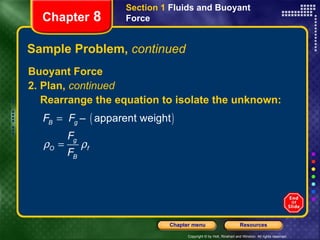
Sample Problem,  continued Buoyant Force 2. Plan,  continued Rearrange the equation to isolate the unknown: Section 1  Fluids and Buoyant Force Chapter  8
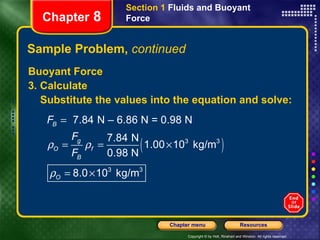
Sample Problem,  continued Buoyant Force 3. Calculate Substitute the values into the equation and solve: Section 1  Fluids and Buoyant Force Chapter  8
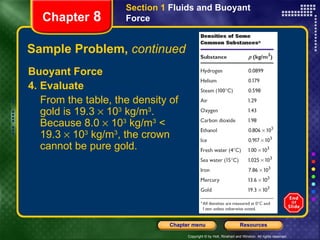
Sample Problem,  continued Buoyant Force 4. Evaluate From the table, the density of gold is 19.3    10 3  kg/m 3 . Because 8.0    10 3  kg/m 3  < 19.3    10 3  kg/m 3 , the crown cannot be pure gold. Section 1  Fluids and Buoyant Force Chapter  8
Objectives Calculate   the pressure exerted by a fluid. Calculate   how pressure varies with depth in a fluid. Section 2  Fluid Pressure Chapter  8
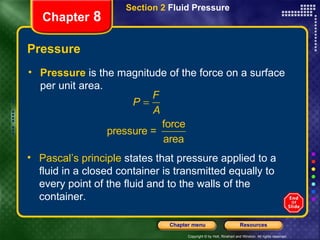
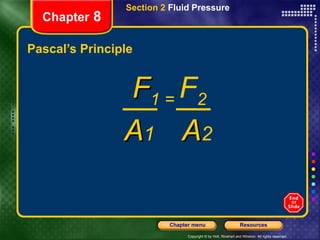
Pressure Pressure  is the magnitude of the force on a surface per unit area. Section 2  Fluid Pressure Chapter  8 Pascal’s principle  states that pressure applied to a fluid in a closed container is transmitted equally to every point of the fluid and to the walls of the container.
Pascal’s Principle Chapter  8 Section 2  Fluid Pressure
Pascal’s Principle Chapter  8 Section 2  Fluid Pressure F 1 =  F 2   A 1  A 2
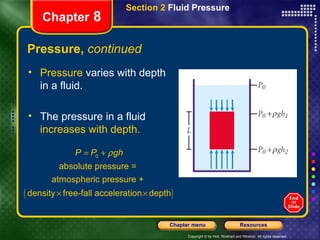
Pressure,  continued Pressure  varies with depth in a fluid. The pressure in a fluid  increases with depth. Section 2  Fluid Pressure Chapter  8
Fluid Pressure as a Function of Depth Chapter  8 Section 2  Fluid Pressure
Objectives Examine  the motion of a fluid using the continuity equation. Recognize   the effects of Bernoulli’s principle on fluid motion. Section 3  Fluids in Motion Chapter  8
Fluid Flow Moving fluids can exhibit   laminar   (smooth) flow or   turbulent   (irregular) flow. An   ideal fluid   is a fluid that has no internal friction or viscosity and is incompressible. The ideal fluid model simplifies  fluid-flow analysis. Section 3  Fluids in Motion Chapter  8
Characteristics of an Ideal Fluid Chapter  8 Section 3  Fluids in Motion
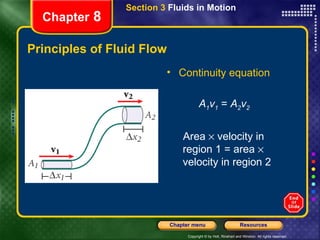
Principles of Fluid Flow Continuity equation A 1 v 1  =  A 2 v 2 Area    velocity in region 1 = area    velocity in region 2 Section 3  Fluids in Motion Chapter  8
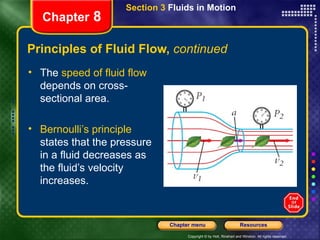
Principles of Fluid Flow,  continued The  speed of fluid flow  depends on cross-sectional area. Bernoulli’s principle  states that the pressure in a fluid decreases as the fluid’s velocity increases. Section 3  Fluids in Motion Chapter  8
Bernoulli’s Principle Chapter  8 Section 3  Fluids in Motion
Multiple Choice 1.  Which of the following is the correct equation for the net force acting on a submerged object? A.   F net  = 0 B.   F net  = (  object  –   fluid ) gV object C.   F net  = (  fluid  –   object ) gV object D.   F net  = (  fluid  +   object ) gV object Standardized Test Prep Chapter  8
Multiple Choice,  continued 2.  How many times greater than the lifting force must the force applied to a hydraulic lift be if the ratio of the area where pressure is applied to the lifted area is 1/7 ? F.  1/49 G.  1/7 H.  7 J.  49 Standardized Test Prep Chapter  8
Multiple Choice,  continued 3.  A typical silo on a farm has many bands wrapped around its perimeter, as shown in the figure below. Why is the spacing between successive bands smaller toward the bottom? A.  to provide support for the silo’s sides above them B.  to resist the increasing pressure that the grains exert with increasing depth C.  to resist the increasing pressure that the atmosphere exerts with increasing depth D.  to make access to smaller quantities of grain near the ground possible Standardized Test Prep Chapter  8
Multiple Choice,  continued 4.  A fish rests on the bottom of a bucket of water while the bucket is being weighed. When the fish begins to swim around in the bucket, how does the reading on the scale change? F.  The motion of the fish causes the scale reading to increase. G.  The motion of the fish causes the scale reading to decrease. H.  The buoyant force on the fish is exerted downward on the bucket, causing the scale reading to increase. J.  The mass of the system, and so the scale  reading, will remain unchanged. Standardized Test Prep Chapter  8
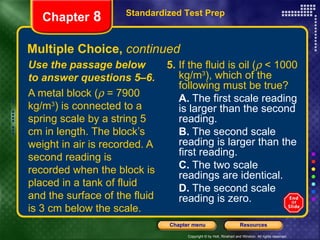
Multiple Choice,  continued Use the passage below to answer questions 5–6. A metal block (   = 7900 kg/m 3 ) is connected to a spring scale by a string 5 cm in length. The block’s weight in air is recorded. A second reading is recorded when the block is placed in a tank of fluid and the surface of the fluid is 3 cm below the scale. 5.  If the fluid is oil (   < 1000 kg/m 3 ), which of the following must be true? A.  The first scale reading is larger than the second reading. B.  The second scale reading is larger than the first reading. C.  The two scale readings are identical. D.  The second scale reading is zero. Standardized Test Prep Chapter  8
Multiple Choice,  continued 5.  If the fluid is oil (   < 1000 kg/m 3 ), which of the following must be true? A.  The first scale reading is larger than the second reading. B.  The second scale reading is larger than the first reading. C.  The two scale readings are identical. D.  The second scale reading is zero. Use the passage below to answer questions 5–6. A metal block (   = 7900 kg/m 3 ) is connected to a spring scale by a string 5 cm in length. The block’s weight in air is recorded. A second reading is recorded when the block is placed in a tank of fluid and the surface of the fluid is 3 cm below the scale. Standardized Test Prep Chapter  8
Multiple Choice,  continued 6.  If the fluid is mercury (   = 13 600 kg/m 3 ), which of the following must be true? F.  The first scale reading is larger than the second reading. G.  The second scale reading is larger than the first reading. H.  The two scale readings are identical. J.  The second scale reading is zero. Use the passage below to answer questions 5–6. A metal block (   = 7900 kg/m 3 ) is connected to a spring scale by a string 5 cm in length. The block’s weight in air is recorded. A second reading is recorded when the block is placed in a tank of fluid and the surface of the fluid is 3 cm below the scale. Standardized Test Prep Chapter  8
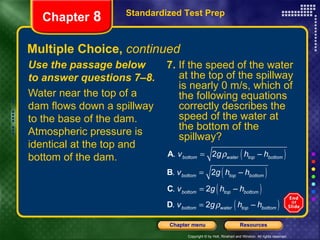
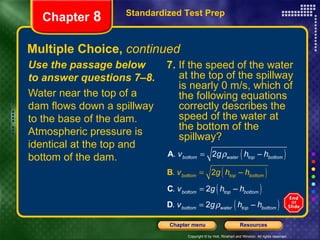
Multiple Choice,  continued Use the passage below to answer questions 7–8. Water near the top of a dam flows down a spillway to the base of the dam. Atmospheric pressure is identical at the top and bottom of the dam. 7.  If the speed of the water at the top of the spillway is nearly 0 m/s, which of the following equations correctly describes the speed of the water at the bottom of the spillway? Standardized Test Prep Chapter  8
Multiple Choice,  continued Use the passage below to answer questions 7–8. Water near the top of a dam flows down a spillway to the base of the dam. Atmospheric pressure is identical at the top and bottom of the dam. 8.  If the cross-sectional area of the spillway were half as large, how many times faster would the water flow out of the spillway? F.  1/4 G.  1/2 H.  2 J.  4 Standardized Test Prep Chapter  8
Short Response 9.  Will an ice cube float higher in water or in mercury? Explain your answer. Standardized Test Prep Chapter  8
Short Response,  continued 9.  Will an ice cube float higher in water or in mercury? Explain your answer. Answer:  mercury; because the density of mercury is greater than that of water Standardized Test Prep Chapter  8
Short Response,  continued 10.  The approximate inside diameter of the aorta is 1.6 cm, and that of a capillary is 1.0    10 –6  m. The average flow speed is about 1.0 m/s in the aorta and 1.0 cm/s in the capillaries. If all the blood in the aorta eventually flows through the capillaries, estimate the number of capillaries. Standardized Test Prep Chapter  8
Short Response,  continued 10.  The approximate inside diameter of the aorta is 1.6 cm, and that of a capillary is 1.0    10 –6  m. The average flow speed is about 1.0 m/s in the aorta and 1.0 cm/s in the capillaries. If all the blood in the aorta eventually flows through the capillaries, estimate the number of capillaries. Answer:   2.5    10 10  capillaries Standardized Test Prep Chapter  8
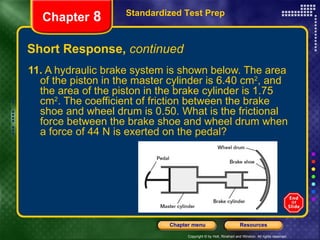
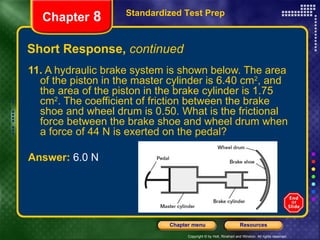
Short Response,  continued 11.  A hydraulic brake system is shown below. The area of the piston in the master cylinder is 6.40 cm 2 , and the area of the piston in the brake cylinder is 1.75 cm 2 . The coefficient of friction between the brake shoe and wheel drum is 0.50. What is the frictional force between the brake shoe and wheel drum when a force of 44 N is exerted on the pedal? Standardized Test Prep Chapter  8
Short Response,  continued 11.  A hydraulic brake system is shown below. The area of the piston in the master cylinder is 6.40 cm 2 , and the area of the piston in the brake cylinder is 1.75 cm 2 . The coefficient of friction between the brake shoe and wheel drum is 0.50. What is the frictional force between the brake shoe and wheel drum when a force of 44 N is exerted on the pedal? Answer:  6.0 N Standardized Test Prep Chapter  8
Extended Response Standardized Test Prep Chapter  8 Base your answers to questions 12–14 on the information below. Oil, which has a density of 930.0 kg/m 3 , floats on water. A rectangular block of wood with a height,  h , of 4.00 cm and a density of 960.0 kg/m 3  floats partly in the water, and the rest floats under the oil layer. 12.  What is the balanced force equation for this  situation?
Extended Response Standardized Test Prep Chapter  8 Base your answers to questions 12–14 on the information below. Oil, which has a density of 930.0 kg/m 3 , floats on water. A rectangular block of wood with a height,  h , of 4.00 cm and a density of 960.0 kg/m 3  floats partly in the water, and the rest floats under the oil layer. 12.  What is the balanced force equation for this  situation? Answer:   F B,oil  +  F B,water  =  F g,block
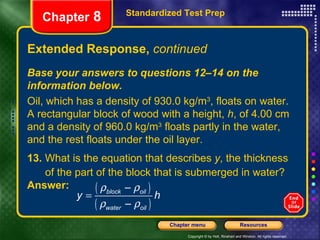
Extended Response,  continued 13.  What is the equation that describes  y , the thickness  of the part of the block that is submerged in water? Standardized Test Prep Chapter  8 Base your answers to questions 12–14 on the information below. Oil, which has a density of 930.0 kg/m 3 , floats on water. A rectangular block of wood with a height,  h , of 4.00 cm and a density of 960.0 kg/m 3  floats partly in the water, and the rest floats under the oil layer.
Extended Response,  continued 13.  What is the equation that describes  y , the thickness  of the part of the block that is submerged in water? Answer:  Standardized Test Prep Chapter  8 Base your answers to questions 12–14 on the information below. Oil, which has a density of 930.0 kg/m 3 , floats on water. A rectangular block of wood with a height,  h , of 4.00 cm and a density of 960.0 kg/m 3  floats partly in the water, and the rest floats under the oil layer.
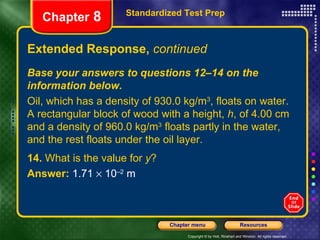
Extended Response,  continued 14.  What is the value for  y ? Standardized Test Prep Chapter  8 Base your answers to questions 12–14 on the information below. Oil, which has a density of 930.0 kg/m 3 , floats on water. A rectangular block of wood with a height,  h , of 4.00 cm and a density of 960.0 kg/m 3  floats partly in the water, and the rest floats under the oil layer.
Extended Response,  continued 14.  What is the value for  y ? Answer:   1.71    10 –2  m Standardized Test Prep Chapter  8 Base your answers to questions 12–14 on the information below. Oil, which has a density of 930.0 kg/m 3 , floats on water. A rectangular block of wood with a height,  h , of 4.00 cm and a density of 960.0 kg/m 3  floats partly in the water, and the rest floats under the oil layer.

Chapter 8 Powerpoint

  • 1.
    Chapter Presentation TransparenciesSample Problems Visual Concepts Standardized Test Prep Chapter 8 – Fluid Dynamics
  • 2.
    Table of ContentsSection 1 Fluids and Buoyant Force Section 2 Fluid Pressure Section 3 Fluids in Motion Fluid Mechanics Chapter 8
  • 3.
    Objectives Define a fluid. Distinguish a gas from a liquid. Determine the magnitude of the buoyant force exerted on a floating object or a submerged object. Explain why some objects float and some objects sink. Section 1 Fluids and Buoyant Force Chapter 8
  • 4.
    Defining a FluidA fluid is a nonsolid state of matter in which the atoms or molecules are free to move past each other Both liquids and gases are considered fluids Section 1 Fluids and Buoyant Force Chapter 8
  • 5.
    Density and BuoyantForce The concentration of matter of an object is called the mass density . Section 1 Fluids and Buoyant Force Chapter 8
  • 6.
    Mass Density Chapter 8 Section 1 Fluids and Buoyant Force
  • 7.
    Density and BuoyantForce, continued The buoyant force is the upward force exerted by a liquid on an object immersed in or floating on the liquid. Buoyant forces can keep objects afloat. Section 1 Fluids and Buoyant Force Chapter 8
  • 8.
    Buoyant Force andArchimedes’ Principle Chapter 8 Section 1 Fluids and Buoyant Force
  • 9.
    Displaced Volume ofa Fluid Chapter 8 Section 1 Fluids and Buoyant Force
  • 10.
    Density and BuoyantForce, continued Archimedes’ principle: Any object completely or partially submerged in a fluid experiences an upward buoyant force equal in magnitude to the weight of the fluid displaced by the object. F B = F g (displaced fluid) = m f g magnitude of buoyant force = weight of fluid displaced Section 1 Fluids and Buoyant Force Chapter 8
  • 11.
    Buoyant Force onFloating Objects Chapter 8 Section 1 Fluids and Buoyant Force
  • 12.
    Buoyant Force Chapter 8 Section 1 Fluids and Buoyant Force
  • 13.
    Density and BuoyantForce, continued For a floating object, the buoyant force equals the object’s weight. For an object with density  O submerged in a fluid of density  f , the buoyant force F B obeys the following ratio: Section 1 Fluids and Buoyant Force Chapter 8
  • 14.
    Sample Problem BuoyantForce A bargain hunter purchases a “gold” crown at a flea market. After she gets home, she hangs the crown from a scale and finds its weight to be 7.84 N. She then weighs the crown while it is immersed in water, and the scale reads 6.86 N. Is the crown made of pure gold? Explain. Section 1 Fluids and Buoyant Force Chapter 8
  • 15.
    Sample Problem, continued Buoyant Force 1. Define Given: F g = 7.84 N apparent weight = 6.86 N  f = p water = 1.00  10 3 kg/m 3 Unknown:  O = ? Section 1 Fluids and Buoyant Force Chapter 8
  • 16.
    Sample Problem, continued Buoyant Force 1. Define, continued TIP: The use of a diagram can help clarify a problem and the variables involved. In this diagram, F T,1 equals the actual weight of the crown, and F T,2 is the apparent weight of the crown when immersed in water. Section 1 Fluids and Buoyant Force Chapter 8 Diagram:
  • 17.
    Sample Problem, continued Buoyant Force 2. Plan Choose an equation or situation: Because the object is completely submerged, consider the ratio of the weight to the buoyant force. Section 1 Fluids and Buoyant Force Chapter 8
  • 18.
    Sample Problem, continued Buoyant Force 2. Plan, continued Rearrange the equation to isolate the unknown: Section 1 Fluids and Buoyant Force Chapter 8
  • 19.
    Sample Problem, continued Buoyant Force 3. Calculate Substitute the values into the equation and solve: Section 1 Fluids and Buoyant Force Chapter 8
  • 20.
    Sample Problem, continued Buoyant Force 4. Evaluate From the table, the density of gold is 19.3  10 3 kg/m 3 . Because 8.0  10 3 kg/m 3 < 19.3  10 3 kg/m 3 , the crown cannot be pure gold. Section 1 Fluids and Buoyant Force Chapter 8
  • 21.
    Objectives Calculate the pressure exerted by a fluid. Calculate how pressure varies with depth in a fluid. Section 2 Fluid Pressure Chapter 8
  • 22.
    Pressure Pressure is the magnitude of the force on a surface per unit area. Section 2 Fluid Pressure Chapter 8 Pascal’s principle states that pressure applied to a fluid in a closed container is transmitted equally to every point of the fluid and to the walls of the container.
  • 23.
    Pascal’s Principle Chapter 8 Section 2 Fluid Pressure
  • 24.
    Pascal’s Principle Chapter 8 Section 2 Fluid Pressure F 1 = F 2 A 1 A 2
  • 25.
    Pressure, continuedPressure varies with depth in a fluid. The pressure in a fluid increases with depth. Section 2 Fluid Pressure Chapter 8
  • 26.
    Fluid Pressure asa Function of Depth Chapter 8 Section 2 Fluid Pressure
  • 27.
    Objectives Examine the motion of a fluid using the continuity equation. Recognize the effects of Bernoulli’s principle on fluid motion. Section 3 Fluids in Motion Chapter 8
  • 28.
    Fluid Flow Movingfluids can exhibit laminar (smooth) flow or turbulent (irregular) flow. An ideal fluid is a fluid that has no internal friction or viscosity and is incompressible. The ideal fluid model simplifies fluid-flow analysis. Section 3 Fluids in Motion Chapter 8
  • 29.
    Characteristics of anIdeal Fluid Chapter 8 Section 3 Fluids in Motion
  • 30.
    Principles of FluidFlow Continuity equation A 1 v 1 = A 2 v 2 Area  velocity in region 1 = area  velocity in region 2 Section 3 Fluids in Motion Chapter 8
  • 31.
    Principles of FluidFlow, continued The speed of fluid flow depends on cross-sectional area. Bernoulli’s principle states that the pressure in a fluid decreases as the fluid’s velocity increases. Section 3 Fluids in Motion Chapter 8
  • 32.
    Bernoulli’s Principle Chapter 8 Section 3 Fluids in Motion
  • 33.
    Multiple Choice 1. Which of the following is the correct equation for the net force acting on a submerged object? A. F net = 0 B. F net = (  object –  fluid ) gV object C. F net = (  fluid –  object ) gV object D. F net = (  fluid +  object ) gV object Standardized Test Prep Chapter 8
  • 34.
    Multiple Choice 1. Which of the following is the correct equation for the net force acting on a submerged object? A. F net = 0 B. F net = (  object –  fluid ) gV object C. F net = (  fluid –  object ) gV object D. F net = (  fluid +  object ) gV object Standardized Test Prep Chapter 8
  • 35.
    Multiple Choice, continued 2. How many times greater than the lifting force must the force applied to a hydraulic lift be if the ratio of the area where pressure is applied to the lifted area is 1/7 ? F. 1/49 G. 1/7 H. 7 J. 49 Standardized Test Prep Chapter 8
  • 36.
    Multiple Choice, continued 2. How many times greater than the lifting force must the force applied to a hydraulic lift be if the ratio of the area where pressure is applied to the lifted area is 1/7 ? F. 1/49 G. 1/7 H. 7 J. 49 Standardized Test Prep Chapter 8
  • 37.
    Multiple Choice, continued 3. A typical silo on a farm has many bands wrapped around its perimeter, as shown in the figure below. Why is the spacing between successive bands smaller toward the bottom? A. to provide support for the silo’s sides above them B. to resist the increasing pressure that the grains exert with increasing depth C. to resist the increasing pressure that the atmosphere exerts with increasing depth D. to make access to smaller quantities of grain near the ground possible Standardized Test Prep Chapter 8
  • 38.
    Multiple Choice, continued 3. A typical silo on a farm has many bands wrapped around its perimeter, as shown in the figure below. Why is the spacing between successive bands smaller toward the bottom? A. to provide support for the silo’s sides above them B. to resist the increasing pressure that the grains exert with increasing depth C. to resist the increasing pressure that the atmosphere exerts with increasing depth D. to make access to smaller quantities of grain near the ground possible Standardized Test Prep Chapter 8
  • 39.
    Multiple Choice, continued 4. A fish rests on the bottom of a bucket of water while the bucket is being weighed. When the fish begins to swim around in the bucket, how does the reading on the scale change? F. The motion of the fish causes the scale reading to increase. G. The motion of the fish causes the scale reading to decrease. H. The buoyant force on the fish is exerted downward on the bucket, causing the scale reading to increase. J. The mass of the system, and so the scale reading, will remain unchanged. Standardized Test Prep Chapter 8
  • 40.
    Multiple Choice, continued 4. A fish rests on the bottom of a bucket of water while the bucket is being weighed. When the fish begins to swim around in the bucket, how does the reading on the scale change? F. The motion of the fish causes the scale reading to increase. G. The motion of the fish causes the scale reading to decrease. H. The buoyant force on the fish is exerted downward on the bucket, causing the scale reading to increase. J. The mass of the system, and so the scale reading, will remain unchanged. Standardized Test Prep Chapter 8
  • 41.
    Multiple Choice, continued Use the passage below to answer questions 5–6. A metal block (  = 7900 kg/m 3 ) is connected to a spring scale by a string 5 cm in length. The block’s weight in air is recorded. A second reading is recorded when the block is placed in a tank of fluid and the surface of the fluid is 3 cm below the scale. 5. If the fluid is oil (  < 1000 kg/m 3 ), which of the following must be true? A. The first scale reading is larger than the second reading. B. The second scale reading is larger than the first reading. C. The two scale readings are identical. D. The second scale reading is zero. Standardized Test Prep Chapter 8
  • 42.
    Multiple Choice, continued 5. If the fluid is oil (  < 1000 kg/m 3 ), which of the following must be true? A. The first scale reading is larger than the second reading. B. The second scale reading is larger than the first reading. C. The two scale readings are identical. D. The second scale reading is zero. Use the passage below to answer questions 5–6. A metal block (  = 7900 kg/m 3 ) is connected to a spring scale by a string 5 cm in length. The block’s weight in air is recorded. A second reading is recorded when the block is placed in a tank of fluid and the surface of the fluid is 3 cm below the scale. Standardized Test Prep Chapter 8
  • 43.
    Multiple Choice, continued 6. If the fluid is mercury (  = 13 600 kg/m 3 ), which of the following must be true? F. The first scale reading is larger than the second reading. G. The second scale reading is larger than the first reading. H. The two scale readings are identical. J. The second scale reading is zero. Use the passage below to answer questions 5–6. A metal block (  = 7900 kg/m 3 ) is connected to a spring scale by a string 5 cm in length. The block’s weight in air is recorded. A second reading is recorded when the block is placed in a tank of fluid and the surface of the fluid is 3 cm below the scale. Standardized Test Prep Chapter 8
  • 44.
    Multiple Choice, continued 6. If the fluid is mercury (  = 13 600 kg/m 3 ), which of the following must be true? F. The first scale reading is larger than the second reading. G. The second scale reading is larger than the first reading. H. The two scale readings are identical. J. The second scale reading is zero. Use the passage below to answer questions 5–6. A metal block (  = 7900 kg/m 3 ) is connected to a spring scale by a string 5 cm in length. The block’s weight in air is recorded. A second reading is recorded when the block is placed in a tank of fluid and the surface of the fluid is 3 cm below the scale. Standardized Test Prep Chapter 8
  • 45.
    Multiple Choice, continued Use the passage below to answer questions 7–8. Water near the top of a dam flows down a spillway to the base of the dam. Atmospheric pressure is identical at the top and bottom of the dam. 7. If the speed of the water at the top of the spillway is nearly 0 m/s, which of the following equations correctly describes the speed of the water at the bottom of the spillway? Standardized Test Prep Chapter 8
  • 46.
    Multiple Choice, continued Use the passage below to answer questions 7–8. Water near the top of a dam flows down a spillway to the base of the dam. Atmospheric pressure is identical at the top and bottom of the dam. 7. If the speed of the water at the top of the spillway is nearly 0 m/s, which of the following equations correctly describes the speed of the water at the bottom of the spillway? Standardized Test Prep Chapter 8
  • 47.
    Multiple Choice, continued Use the passage below to answer questions 7–8. Water near the top of a dam flows down a spillway to the base of the dam. Atmospheric pressure is identical at the top and bottom of the dam. 8. If the cross-sectional area of the spillway were half as large, how many times faster would the water flow out of the spillway? F. 1/4 G. 1/2 H. 2 J. 4 Standardized Test Prep Chapter 8
  • 48.
    Multiple Choice, continued Use the passage below to answer questions 7–8. Water near the top of a dam flows down a spillway to the base of the dam. Atmospheric pressure is identical at the top and bottom of the dam. 8. If the cross-sectional area of the spillway were half as large, how many times faster would the water flow out of the spillway? F. 1/4 G. 1/2 H. 2 J. 4 Standardized Test Prep Chapter 8
  • 49.
    Short Response 9. Will an ice cube float higher in water or in mercury? Explain your answer. Standardized Test Prep Chapter 8
  • 50.
    Short Response, continued 9. Will an ice cube float higher in water or in mercury? Explain your answer. Answer: mercury; because the density of mercury is greater than that of water Standardized Test Prep Chapter 8
  • 51.
    Short Response, continued 10. The approximate inside diameter of the aorta is 1.6 cm, and that of a capillary is 1.0  10 –6 m. The average flow speed is about 1.0 m/s in the aorta and 1.0 cm/s in the capillaries. If all the blood in the aorta eventually flows through the capillaries, estimate the number of capillaries. Standardized Test Prep Chapter 8
  • 52.
    Short Response, continued 10. The approximate inside diameter of the aorta is 1.6 cm, and that of a capillary is 1.0  10 –6 m. The average flow speed is about 1.0 m/s in the aorta and 1.0 cm/s in the capillaries. If all the blood in the aorta eventually flows through the capillaries, estimate the number of capillaries. Answer: 2.5  10 10 capillaries Standardized Test Prep Chapter 8
  • 53.
    Short Response, continued 11. A hydraulic brake system is shown below. The area of the piston in the master cylinder is 6.40 cm 2 , and the area of the piston in the brake cylinder is 1.75 cm 2 . The coefficient of friction between the brake shoe and wheel drum is 0.50. What is the frictional force between the brake shoe and wheel drum when a force of 44 N is exerted on the pedal? Standardized Test Prep Chapter 8
  • 54.
    Short Response, continued 11. A hydraulic brake system is shown below. The area of the piston in the master cylinder is 6.40 cm 2 , and the area of the piston in the brake cylinder is 1.75 cm 2 . The coefficient of friction between the brake shoe and wheel drum is 0.50. What is the frictional force between the brake shoe and wheel drum when a force of 44 N is exerted on the pedal? Answer: 6.0 N Standardized Test Prep Chapter 8
  • 55.
    Extended Response StandardizedTest Prep Chapter 8 Base your answers to questions 12–14 on the information below. Oil, which has a density of 930.0 kg/m 3 , floats on water. A rectangular block of wood with a height, h , of 4.00 cm and a density of 960.0 kg/m 3 floats partly in the water, and the rest floats under the oil layer. 12. What is the balanced force equation for this situation?
  • 56.
    Extended Response StandardizedTest Prep Chapter 8 Base your answers to questions 12–14 on the information below. Oil, which has a density of 930.0 kg/m 3 , floats on water. A rectangular block of wood with a height, h , of 4.00 cm and a density of 960.0 kg/m 3 floats partly in the water, and the rest floats under the oil layer. 12. What is the balanced force equation for this situation? Answer: F B,oil + F B,water = F g,block
  • 57.
    Extended Response, continued 13. What is the equation that describes y , the thickness of the part of the block that is submerged in water? Standardized Test Prep Chapter 8 Base your answers to questions 12–14 on the information below. Oil, which has a density of 930.0 kg/m 3 , floats on water. A rectangular block of wood with a height, h , of 4.00 cm and a density of 960.0 kg/m 3 floats partly in the water, and the rest floats under the oil layer.
  • 58.
    Extended Response, continued 13. What is the equation that describes y , the thickness of the part of the block that is submerged in water? Answer: Standardized Test Prep Chapter 8 Base your answers to questions 12–14 on the information below. Oil, which has a density of 930.0 kg/m 3 , floats on water. A rectangular block of wood with a height, h , of 4.00 cm and a density of 960.0 kg/m 3 floats partly in the water, and the rest floats under the oil layer.
  • 59.
    Extended Response, continued 14. What is the value for y ? Standardized Test Prep Chapter 8 Base your answers to questions 12–14 on the information below. Oil, which has a density of 930.0 kg/m 3 , floats on water. A rectangular block of wood with a height, h , of 4.00 cm and a density of 960.0 kg/m 3 floats partly in the water, and the rest floats under the oil layer.
  • 60.
    Extended Response, continued 14. What is the value for y ? Answer: 1.71  10 –2 m Standardized Test Prep Chapter 8 Base your answers to questions 12–14 on the information below. Oil, which has a density of 930.0 kg/m 3 , floats on water. A rectangular block of wood with a height, h , of 4.00 cm and a density of 960.0 kg/m 3 floats partly in the water, and the rest floats under the oil layer.