About Archimedes
• Archimedes was a Greek
scientist. He discovered the
principle, subsequently named
after him, after noticing that the
water in a bath tub overflowed
when he stepped into it. He ran
through the streets shouting “
EUREKA!!” which means “I got
it”. This knowledge helped him to
About Archimedes
• His work in the field of geometry and
mechanics made him famous. His
understanding of levers, pulleys, wheels-
and – axle helped the Greek army in its
war with roman army. Archimedes’
principle has many applications. It is used
in designing ships and submarines.
Lactometers, which are used to determine
the purity of a sample of milk and
hydrometers used for determin9ing
density of liquids, are based in this
principle.
Archimedes principle
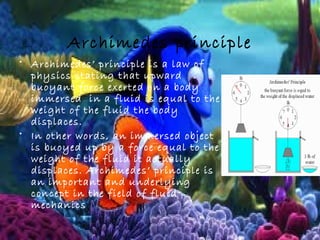
• Archimedes’ principle is a law of
physics stating that upward
buoyant force exerted on a body
immersed in a fluid is equal to the
weight of the fluid the body
displaces.
• In other words, an immersed object
is buoyed up by a force equal to the
weight of the fluid it actually
displaces. Archimedes’ principle is
an important and underlying
concept in the field of fluid
mechanics
Formula
• Formula
• Consider a cube immersed in a fluid, with its sides parallel to the direction
of gravity. The fluid will exert a normal force on each face, and therefore
only the forces on the top and bottom faces will contribute to buoyancy.
The pressure difference between the bottom and the top face is directly
proportional to the height (difference in depth). Multiplying the pressure
difference by the area of a face gives the net force on the cube – the
buoyancy, or the weight of the fluid displaced. By extending this reasoning
to irregular shapes, we can see that, whatever the shape of the submerged
body, the buoyant force is equal to the weight of the fluid displaced. aparent
loss in wt of water= wt of object in air-wt of object in water
• The weight of the displaced fluid is directly proportional to the volume of the
displaced fluid (if the surrounding fluid is of uniform density). The
weight of the object in the fluid is reduced, because of the force acting on it,
which is called upthrust. In simple terms, the principle states that the
buoyant force on an object is equal to the weight of the fluid displaced by
the object, or the density of the fluid multiplied by the submerged volume
times the gravitational constant, g. Thus, among completely submerged
objects with equal masses, objects with greater volume have greater
buoyancy.
Formula
• Suppose a rock's weight is measured as
10 newtons when suspended by a string in
a vacuum with gravity acting on it. Suppose that
when the rock is lowered into water, it displaces
water of weight 3 newtons. The force it then exerts
on the string from which it hangs would be 10
newtons minus the 3 newtons of buoyant force:
10 − 3 = 7 newtons. Buoyancy reduces the
apparent weight of objects that have sunk
completely to the sea floor. It is generally easier to
lift an object up through the water than it is to
pull it out of the water.
• For a fully submerged object, Archimedes'
principle can be reformulated as follows:
–
Formula
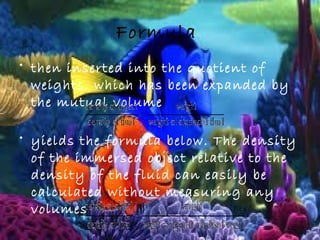
• then inserted into the quotient of
weights, which has been expanded by
the mutual volume
• yields the formula below. The density
of the immersed object relative to the
density of the fluid can easily be
calculated without measuring any
volumes:
Formula
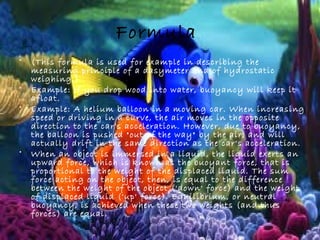
• (This formula is used for example in describing the
measuring principle of a dasymeter and of hydrostatic
weighing.)
• Example: If you drop wood into water, buoyancy will keep it
afloat.
• Example: A helium balloon in a moving car. When increasing
speed or driving in a curve, the air moves in the opposite
direction to the car's acceleration. However, due to buoyancy,
the balloon is pushed "out of the way" by the air, and will
actually drift in the same direction as the car's acceleration.
• When an object is immersed in a liquid, the liquid exerts an
upward force, which is known as the buoyant force, that is
proportional to the weight of the displaced liquid. The sum
force acting on the object, then, is equal to the difference
between the weight of the object ('down' force) and the weight
of displaced liquid ('up' force). Equilibrium, or neutral
buoyancy, is achieved when these two weights (and thus
forces) are equal.
ARCHIMEDES' PRINCIPLE

ARCHIMEDES' PRINCIPLE

  • 2.
    About Archimedes • Archimedeswas a Greek scientist. He discovered the principle, subsequently named after him, after noticing that the water in a bath tub overflowed when he stepped into it. He ran through the streets shouting “ EUREKA!!” which means “I got it”. This knowledge helped him to
  • 3.
    About Archimedes • Hiswork in the field of geometry and mechanics made him famous. His understanding of levers, pulleys, wheels- and – axle helped the Greek army in its war with roman army. Archimedes’ principle has many applications. It is used in designing ships and submarines. Lactometers, which are used to determine the purity of a sample of milk and hydrometers used for determin9ing density of liquids, are based in this principle.
  • 4.
    Archimedes principle • Archimedes’principle is a law of physics stating that upward buoyant force exerted on a body immersed in a fluid is equal to the weight of the fluid the body displaces. • In other words, an immersed object is buoyed up by a force equal to the weight of the fluid it actually displaces. Archimedes’ principle is an important and underlying concept in the field of fluid mechanics
  • 5.
    Formula • Formula • Considera cube immersed in a fluid, with its sides parallel to the direction of gravity. The fluid will exert a normal force on each face, and therefore only the forces on the top and bottom faces will contribute to buoyancy. The pressure difference between the bottom and the top face is directly proportional to the height (difference in depth). Multiplying the pressure difference by the area of a face gives the net force on the cube – the buoyancy, or the weight of the fluid displaced. By extending this reasoning to irregular shapes, we can see that, whatever the shape of the submerged body, the buoyant force is equal to the weight of the fluid displaced. aparent loss in wt of water= wt of object in air-wt of object in water • The weight of the displaced fluid is directly proportional to the volume of the displaced fluid (if the surrounding fluid is of uniform density). The weight of the object in the fluid is reduced, because of the force acting on it, which is called upthrust. In simple terms, the principle states that the buoyant force on an object is equal to the weight of the fluid displaced by the object, or the density of the fluid multiplied by the submerged volume times the gravitational constant, g. Thus, among completely submerged objects with equal masses, objects with greater volume have greater buoyancy.
  • 6.
    Formula • Suppose arock's weight is measured as 10 newtons when suspended by a string in a vacuum with gravity acting on it. Suppose that when the rock is lowered into water, it displaces water of weight 3 newtons. The force it then exerts on the string from which it hangs would be 10 newtons minus the 3 newtons of buoyant force: 10 − 3 = 7 newtons. Buoyancy reduces the apparent weight of objects that have sunk completely to the sea floor. It is generally easier to lift an object up through the water than it is to pull it out of the water. • For a fully submerged object, Archimedes' principle can be reformulated as follows: –
  • 7.
    Formula • then insertedinto the quotient of weights, which has been expanded by the mutual volume • yields the formula below. The density of the immersed object relative to the density of the fluid can easily be calculated without measuring any volumes:
  • 8.
    Formula • (This formulais used for example in describing the measuring principle of a dasymeter and of hydrostatic weighing.) • Example: If you drop wood into water, buoyancy will keep it afloat. • Example: A helium balloon in a moving car. When increasing speed or driving in a curve, the air moves in the opposite direction to the car's acceleration. However, due to buoyancy, the balloon is pushed "out of the way" by the air, and will actually drift in the same direction as the car's acceleration. • When an object is immersed in a liquid, the liquid exerts an upward force, which is known as the buoyant force, that is proportional to the weight of the displaced liquid. The sum force acting on the object, then, is equal to the difference between the weight of the object ('down' force) and the weight of displaced liquid ('up' force). Equilibrium, or neutral buoyancy, is achieved when these two weights (and thus forces) are equal.