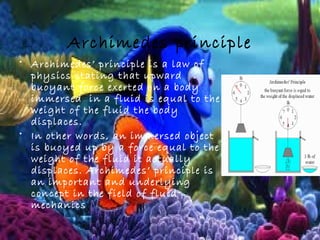
Archimedes was a Greek scientist who discovered the principle of buoyancy, now known as Archimedes' Principle, after noticing that he displaced water in a bath tub when he stepped inside. His work in geometry, mechanics, and understanding of levers helped the Greek army defeat the Romans. Archimedes' Principle states that the buoyant force on an object in a fluid is equal to the weight of the fluid displaced by the object. This principle is used in ship and submarine design and in instruments like lactometers and hydrometers that measure density. The formula for Archimedes' Principle relates the density of an object to the density of the fluid, allowing calculation of buoyant force without measuring volumes.