By: Zhian F Asaad
Brainstorming: is an informal way of generating
, focusing, and organizing ideas for an essay , a
report, or topics to write about.
Good writers think of & write down ideas that can
use.
Why do we need it?
We need it because:
It’s the best way to collect your thoughts.
It’s helpful for organization.
It can help you choose a topic, and develop it.
Free writing
 Think about the topic.
 Choose a title ,
 Write your title at the top ,
 Write Whatever comes into your mind– even if it
doesn’t have to do with the topic.
Editing
 After you brainstorm, you need to go back and see
which ideas you can use by :
 Underlining or highlighting the good idea.
 Crossing out ideas that are not related to your
topic or that you don’t want to use.
Capitalization Rules for Titles:
 Always capitalize the first letter of the first word .
 Do not capitalize articles (a, an, the)
 Do not capitalize coordinating conjunctions (and, but,
or, etc.)
 Do not capitalize prepositions (on, at, in, off, etc.)
Descriptive writing
 Gives the reader or the listener some idea of how
some thing looks, sounds, smells, or feels.
 it is used when you are going :
 To write a narrative essay.
 To write a descriptive essay.
When you write a formal essay, you should not start a sentence
with “And”, “But”, or “So”.
 When you write, you need to avoid sentence
fragments.
 A “fragment” is a “piece” of something, so a
sentence fragment is just a piece of a sentence –
not a complete sentence.
 A complete sentence should have a subject (what is
the sentence about?) and a predicate (what does
the subject do?).
 Because I was tired. (sentence fragment)
 I went to sleep because I was tired. (complete
sentence)
 A run‐on sentence: is when two complete sentences
are put together without correct punctuation (a comma or
period, for example). You should avoid run‐on sentences
when you write!
Example:
 We went to the beach it was a lot of fun. (run‐on
sentence)
 We went to the beach. ,and It was a lot of fun.
To correct this, youcan add a period Or you can add a
conjunction (and / but / so / because) between the
sentences.
Note: With “and/but/so” you need to use a comma (,), but
with “because” you usually don’t need a comma.
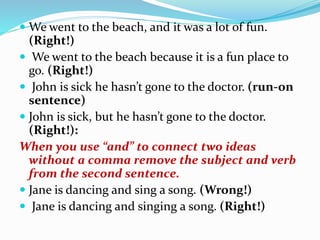
 We went to the beach, and it was a lot of fun.
(Right!)
 We went to the beach because it is a fun place to
go. (Right!)
 John is sick he hasn’t gone to the doctor. (run‐on
sentence)
 John is sick, but he hasn’t gone to the doctor.
(Right!):
When you use “and” to connect two ideas
without a comma remove the subject and verb
from the second sentence.
 Jane is dancing and sing a song. (Wrong!)
 Jane is dancing and singing a song. (Right!)
3rd l

3rd l

  • 1.
  • 2.
    Brainstorming: is aninformal way of generating , focusing, and organizing ideas for an essay , a report, or topics to write about. Good writers think of & write down ideas that can use. Why do we need it? We need it because: It’s the best way to collect your thoughts. It’s helpful for organization. It can help you choose a topic, and develop it.
  • 3.
    Free writing  Thinkabout the topic.  Choose a title ,  Write your title at the top ,  Write Whatever comes into your mind– even if it doesn’t have to do with the topic.
  • 4.
    Editing  After youbrainstorm, you need to go back and see which ideas you can use by :  Underlining or highlighting the good idea.  Crossing out ideas that are not related to your topic or that you don’t want to use.
  • 5.
    Capitalization Rules forTitles: Capitalization Rules for Titles:  Always capitalize the first letter of the first word .  Do not capitalize articles (a, an, the)  Do not capitalize coordinating conjunctions (and, but, or, etc.)  Do not capitalize prepositions (on, at, in, off, etc.)
  • 6.
    Descriptive writing  Givesthe reader or the listener some idea of how some thing looks, sounds, smells, or feels.  it is used when you are going :  To write a narrative essay.  To write a descriptive essay.
  • 7.
    When you writea formal essay, you should not start a sentence with “And”, “But”, or “So”.  When you write, you need to avoid sentence fragments.  A “fragment” is a “piece” of something, so a sentence fragment is just a piece of a sentence – not a complete sentence.  A complete sentence should have a subject (what is the sentence about?) and a predicate (what does the subject do?).  Because I was tired. (sentence fragment)  I went to sleep because I was tired. (complete sentence)
  • 8.
     A run‐onsentence: is when two complete sentences are put together without correct punctuation (a comma or period, for example). You should avoid run‐on sentences when you write! Example:  We went to the beach it was a lot of fun. (run‐on sentence)  We went to the beach. ,and It was a lot of fun. To correct this, youcan add a period Or you can add a conjunction (and / but / so / because) between the sentences. Note: With “and/but/so” you need to use a comma (,), but with “because” you usually don’t need a comma.
  • 9.
     We wentto the beach, and it was a lot of fun. (Right!)  We went to the beach because it is a fun place to go. (Right!)  John is sick he hasn’t gone to the doctor. (run‐on sentence)  John is sick, but he hasn’t gone to the doctor. (Right!): When you use “and” to connect two ideas without a comma remove the subject and verb from the second sentence.  Jane is dancing and sing a song. (Wrong!)  Jane is dancing and singing a song. (Right!)