Advanced Sentence
      Structures-II

• Parallelism
• Sentence Fragments
• Run-on Sentences
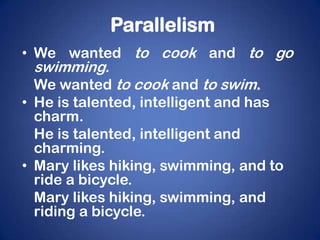
Parallelism
• We wanted to cook and to go
 swimming.
  We wanted to cook and to swim.
• He is talented, intelligent and has
  charm.
  He is talented, intelligent and
  charming.
• Mary likes hiking, swimming, and to
  ride a bicycle.
  Mary likes hiking, swimming, and
  riding a bicycle.
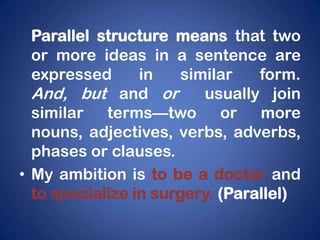
Parallel structure means that two
  or more ideas in a sentence are
  expressed      in    similar   form.
  And, but and or         usually join
  similar terms—two or more
  nouns, adjectives, verbs, adverbs,
  phases or clauses.
• My ambition is to be a doctor and
  to specialize in surgery. (Parallel)
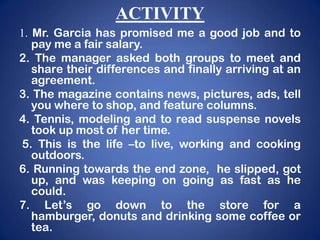
ACTIVITY
1. Mr. Garcia has promised me a good job and to
   pay me a fair salary.
2. The manager asked both groups to meet and
   share their differences and finally arriving at an
   agreement.
3. The magazine contains news, pictures, ads, tell
   you where to shop, and feature columns.
4. Tennis, modeling and to read suspense novels
   took up most of her time.
5. This is the life –to live, working and cooking
   outdoors.
6. Running towards the end zone, he slipped, got
   up, and was keeping on going as fast as he
   could.
7. Let’s go down to the store for a
   hamburger, donuts and drinking some coffee or
   tea.
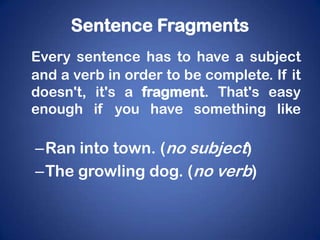
Sentence Fragments
Every sentence has to have a subject
and a verb in order to be complete. If it
doesn't, it's a fragment. That's easy
enough if you have something like

–Ran into town. (no subject)
–The growling dog. (no verb)
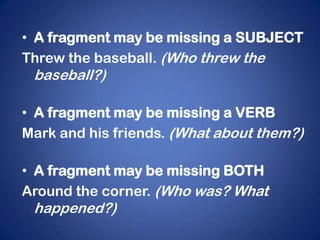
• A fragment may be missing a SUBJECT
Threw the baseball. (Who threw the
 baseball?)

• A fragment may be missing a VERB
Mark and his friends. (What about them?)

• A fragment may be missing BOTH
Around the corner. (Who was? What
 happened?)
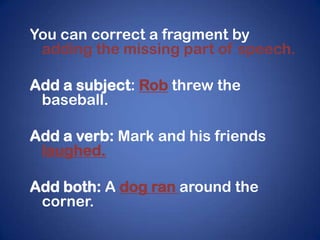
You can correct a fragment by
 adding the missing part of speech.

Add a subject: Rob threw the
 baseball.

Add a verb: Mark and his friends
 laughed.

Add both: A dog ran around the
 corner.
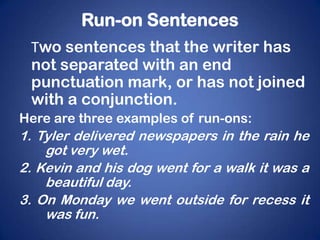
Run-on Sentences
 Two sentences that the writer has
 not separated with an end
 punctuation mark, or has not joined
 with a conjunction.
Here are three examples of run-ons:
1. Tyler delivered newspapers in the rain he
    got very wet.
2. Kevin and his dog went for a walk it was a
    beautiful day.
3. On Monday we went outside for recess it
    was fun.
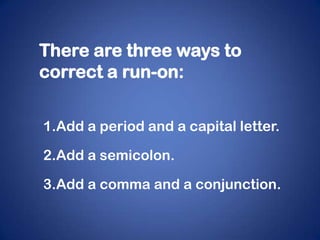
There are three ways to
correct a run-on:


1.Add a period and a capital letter.

2.Add a semicolon.

3.Add a comma and a conjunction.
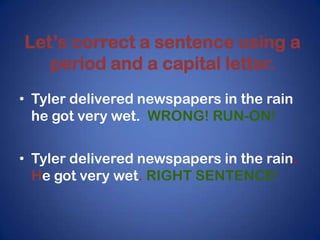
Let’s correct a sentence using a
   period and a capital letter.
• Tyler delivered newspapers in the rain
  he got very wet. WRONG! RUN-ON!

• Tyler delivered newspapers in the rain.
  He got very wet. RIGHT SENTENCE!
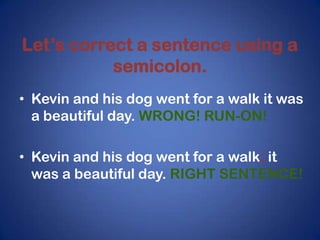
Let’s correct a sentence using a
           semicolon.
• Kevin and his dog went for a walk it was
  a beautiful day. WRONG! RUN-ON!

• Kevin and his dog went for a walk; it
  was a beautiful day. RIGHT SENTENCE!
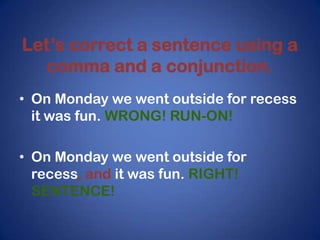
Let’s correct a sentence using a
  comma and a conjunction.
• On Monday we went outside for recess
  it was fun. WRONG! RUN-ON!

• On Monday we went outside for
  recess, and it was fun. RIGHT!
  SENTENCE!

Advanced Sentence Structures

  • 1.
    Advanced Sentence Structures-II • Parallelism • Sentence Fragments • Run-on Sentences
  • 2.
    Parallelism • We wantedto cook and to go swimming. We wanted to cook and to swim. • He is talented, intelligent and has charm. He is talented, intelligent and charming. • Mary likes hiking, swimming, and to ride a bicycle. Mary likes hiking, swimming, and riding a bicycle.
  • 3.
    Parallel structure meansthat two or more ideas in a sentence are expressed in similar form. And, but and or usually join similar terms—two or more nouns, adjectives, verbs, adverbs, phases or clauses. • My ambition is to be a doctor and to specialize in surgery. (Parallel)
  • 4.
    ACTIVITY 1. Mr. Garciahas promised me a good job and to pay me a fair salary. 2. The manager asked both groups to meet and share their differences and finally arriving at an agreement. 3. The magazine contains news, pictures, ads, tell you where to shop, and feature columns. 4. Tennis, modeling and to read suspense novels took up most of her time. 5. This is the life –to live, working and cooking outdoors. 6. Running towards the end zone, he slipped, got up, and was keeping on going as fast as he could. 7. Let’s go down to the store for a hamburger, donuts and drinking some coffee or tea.
  • 5.
    Sentence Fragments Every sentencehas to have a subject and a verb in order to be complete. If it doesn't, it's a fragment. That's easy enough if you have something like –Ran into town. (no subject) –The growling dog. (no verb)
  • 6.
    • A fragmentmay be missing a SUBJECT Threw the baseball. (Who threw the baseball?) • A fragment may be missing a VERB Mark and his friends. (What about them?) • A fragment may be missing BOTH Around the corner. (Who was? What happened?)
  • 7.
    You can correcta fragment by adding the missing part of speech. Add a subject: Rob threw the baseball. Add a verb: Mark and his friends laughed. Add both: A dog ran around the corner.
  • 8.
    Run-on Sentences Twosentences that the writer has not separated with an end punctuation mark, or has not joined with a conjunction. Here are three examples of run-ons: 1. Tyler delivered newspapers in the rain he got very wet. 2. Kevin and his dog went for a walk it was a beautiful day. 3. On Monday we went outside for recess it was fun.
  • 9.
    There are threeways to correct a run-on: 1.Add a period and a capital letter. 2.Add a semicolon. 3.Add a comma and a conjunction.
  • 10.
    Let’s correct asentence using a period and a capital letter. • Tyler delivered newspapers in the rain he got very wet. WRONG! RUN-ON! • Tyler delivered newspapers in the rain. He got very wet. RIGHT SENTENCE!
  • 11.
    Let’s correct asentence using a semicolon. • Kevin and his dog went for a walk it was a beautiful day. WRONG! RUN-ON! • Kevin and his dog went for a walk; it was a beautiful day. RIGHT SENTENCE!
  • 12.
    Let’s correct asentence using a comma and a conjunction. • On Monday we went outside for recess it was fun. WRONG! RUN-ON! • On Monday we went outside for recess, and it was fun. RIGHT! SENTENCE!