The 5 fatal mistakesThe 5 fatal mistakes
in English usagein English usage
Papers (or journal or blog entriesPapers (or journal or blog entries
with these errors will not receive awith these errors will not receive a
grade)grade)
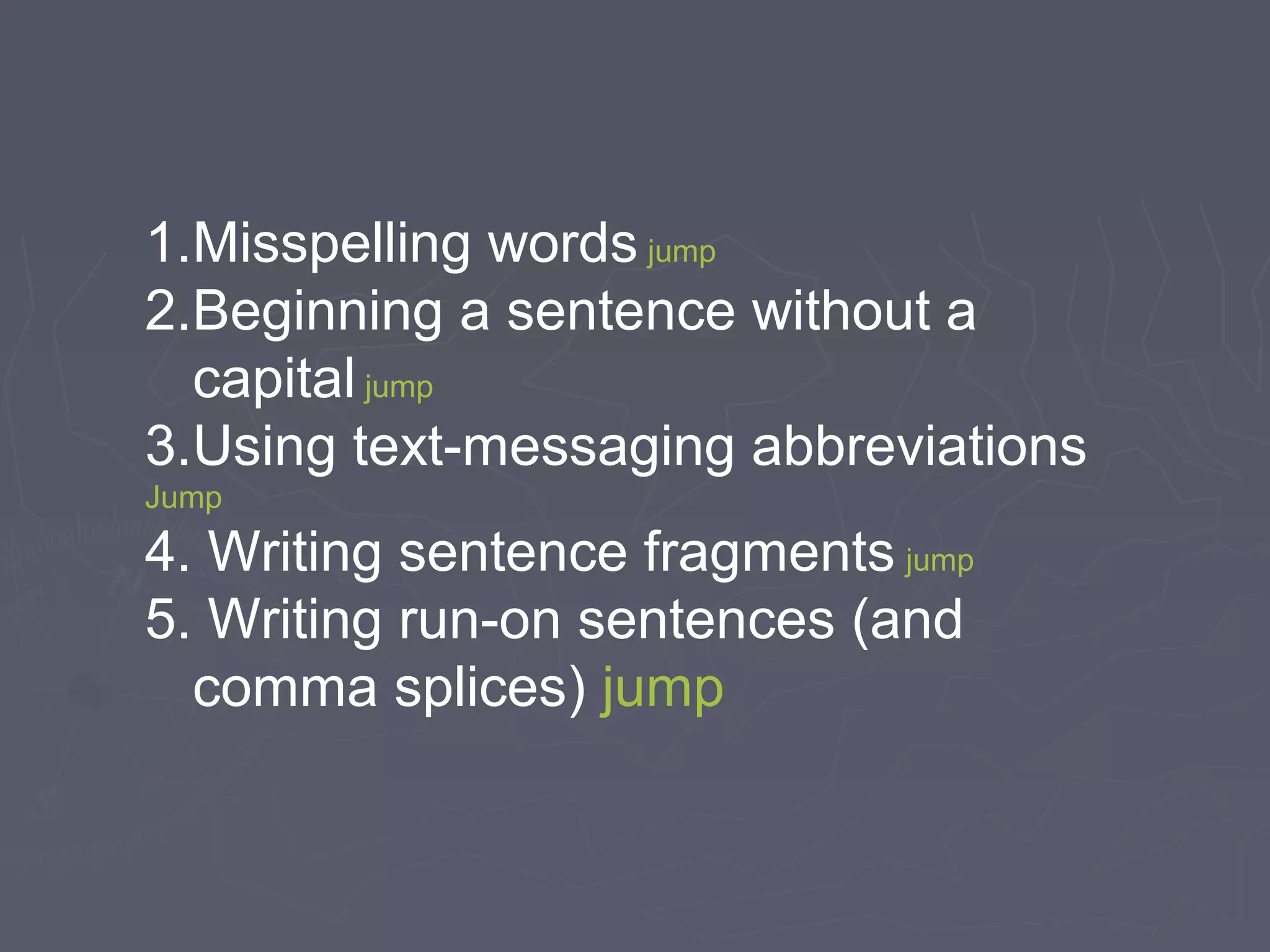
1.Misspelling words jump
2.Beginning a sentence without a
capital jump
3.Using text-messaging abbreviations
Jump
4. Writing sentence fragments jump
5. Writing run-on sentences (and
comma splices) jump
Misspelled WordsMisspelled Words
We live in the spell check era.
Use it.
To a large extent, the worlds of
education, business, and government
are closed to you if you cannot turn in
text without misspellings.
The habit of checking, and re-
checking, the spelling of documents
you create is vital.
No school assignment should be
handed in with words misspelled.
Beginning a sentence
without a capital
(or failing to capitalize “I”)
Not capitalizing the first word of each
sentence is the quickest and easiest
way to:
1. Not get that job you want. Few
employers will bother with someone
who can’t or doesn’t write standard
English.
2. Not be taken seriously by other
people. People will assume you’re
dumb if your writing is sloppy. In fact,
not taking the time to fix simple
problems is dumb.
3. Not to pass this class.
It’s true that some online communities
Have relaxed rules about
capitalization. Sometimes, no
capitalization is used.
This is okay, in those places, just as
it’s okay to lounge around the house in
slippers and a ragged t-shirt.
But it’s not okay at school or at work.
Using text-messagingUsing text-messaging
abbreviationsabbreviations
If u wan2tlk to tptb u need 2tlk in
English 
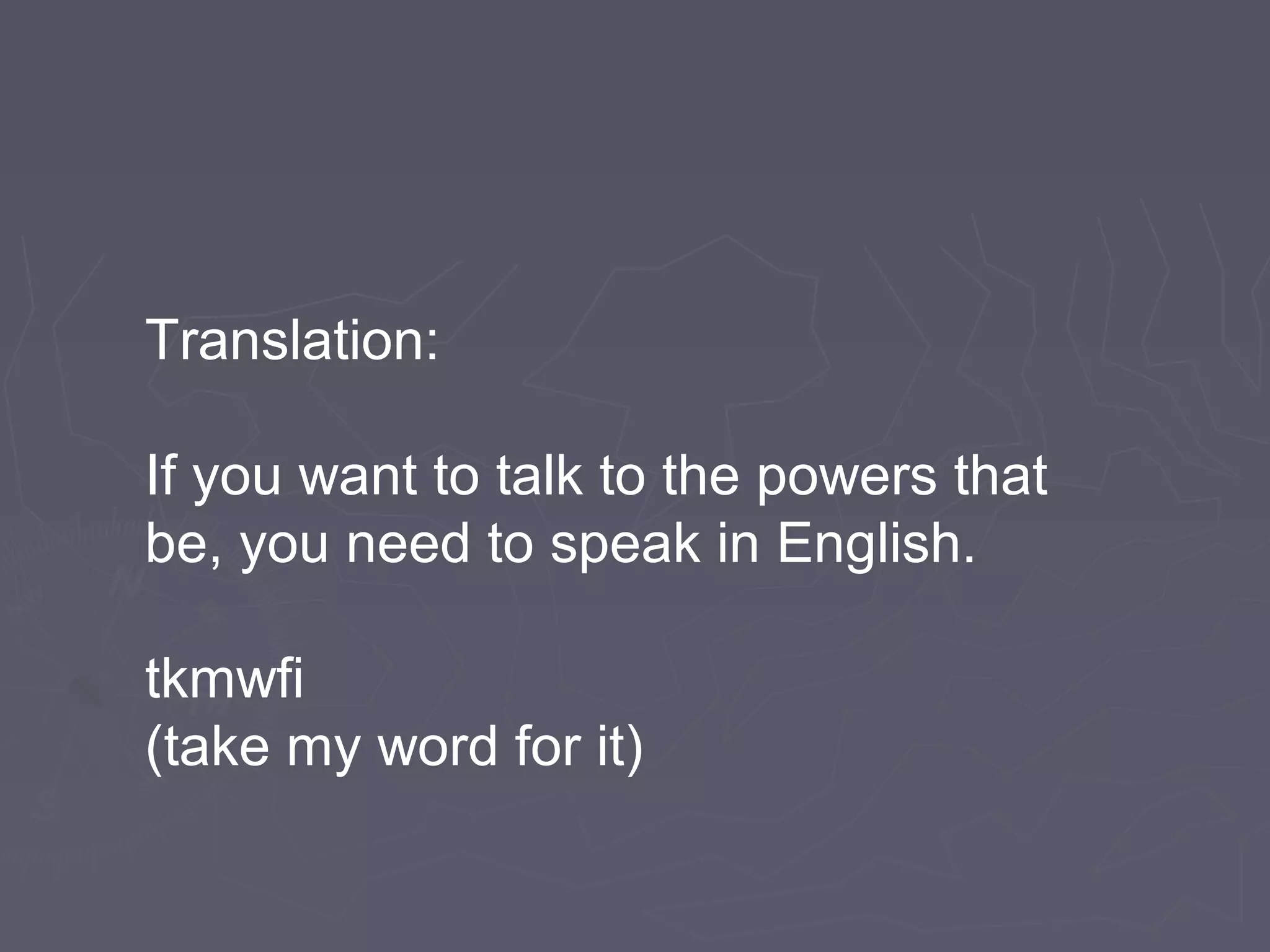
Translation:
If you want to talk to the powers that
be, you need to speak in English.
tkmwfi
(take my word for it)
Sentence fragmentsSentence fragments
A complete sentence expressesA complete sentence expresses
a complete thoughta complete thought
Are these groups of wordsAre these groups of words
sentences?sentences?
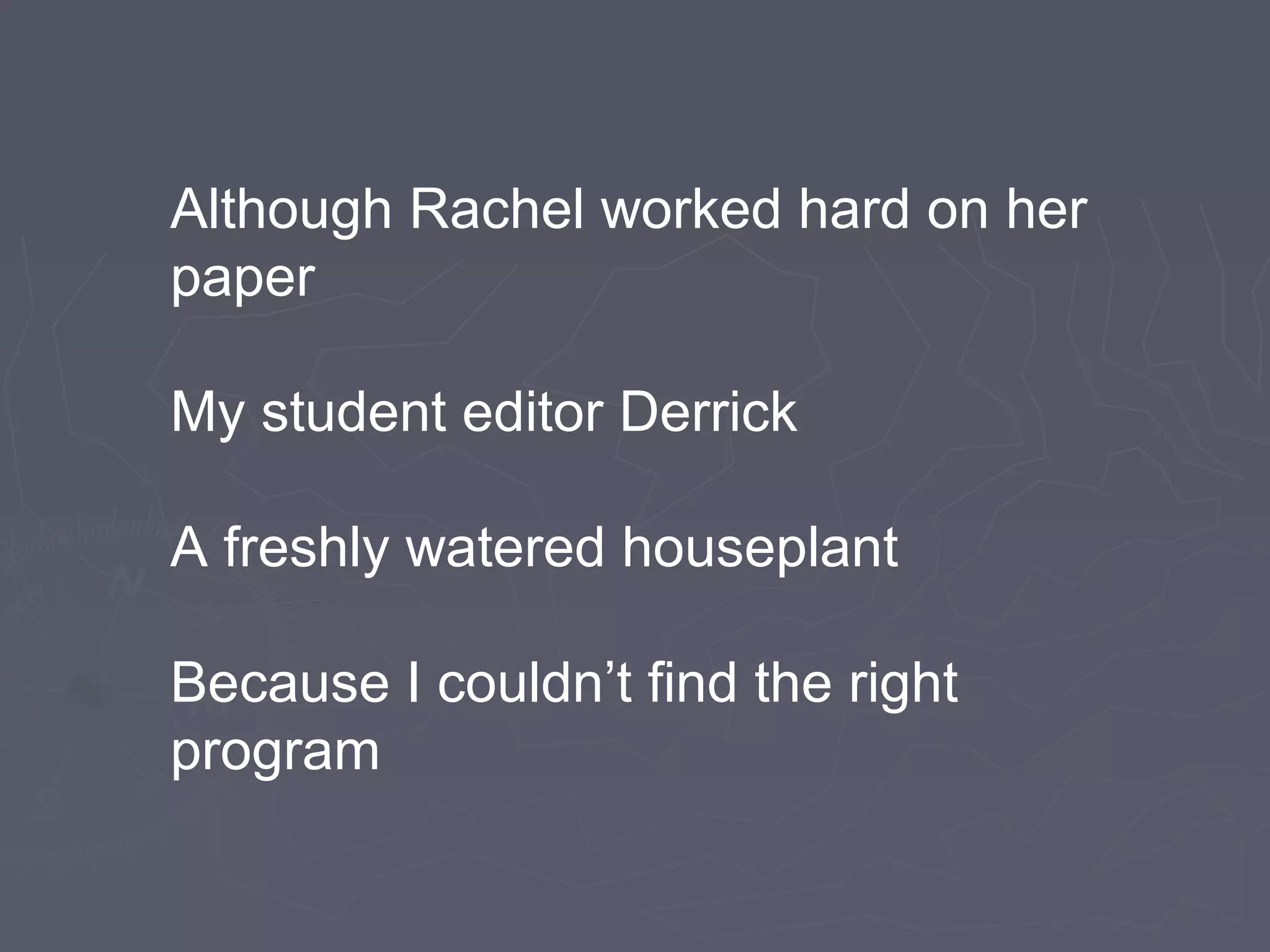
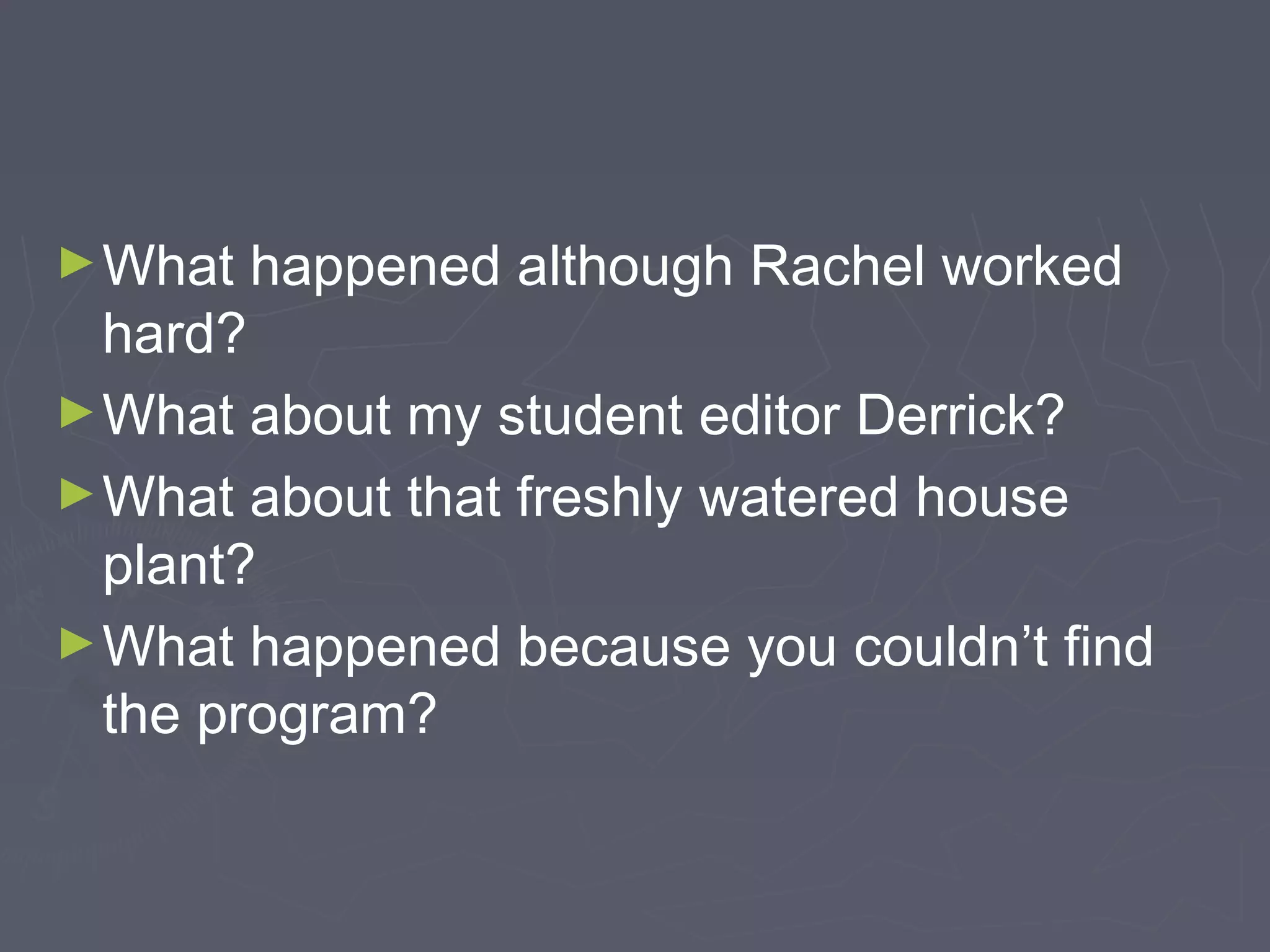
Although Rachel worked hard on her
paper
My student editor Derrick
A freshly watered houseplant
Because I couldn’t find the right
program
They aren’t sentences becauseThey aren’t sentences because
they aren’t complete thoughts.they aren’t complete thoughts.
►What happened although Rachel worked
hard?
►What about my student editor Derrick?
►What about that freshly watered house
plant?
►What happened because you couldn’t find
the program?
What’s wrong with the followingWhat’s wrong with the following
“sentence”?“sentence”?
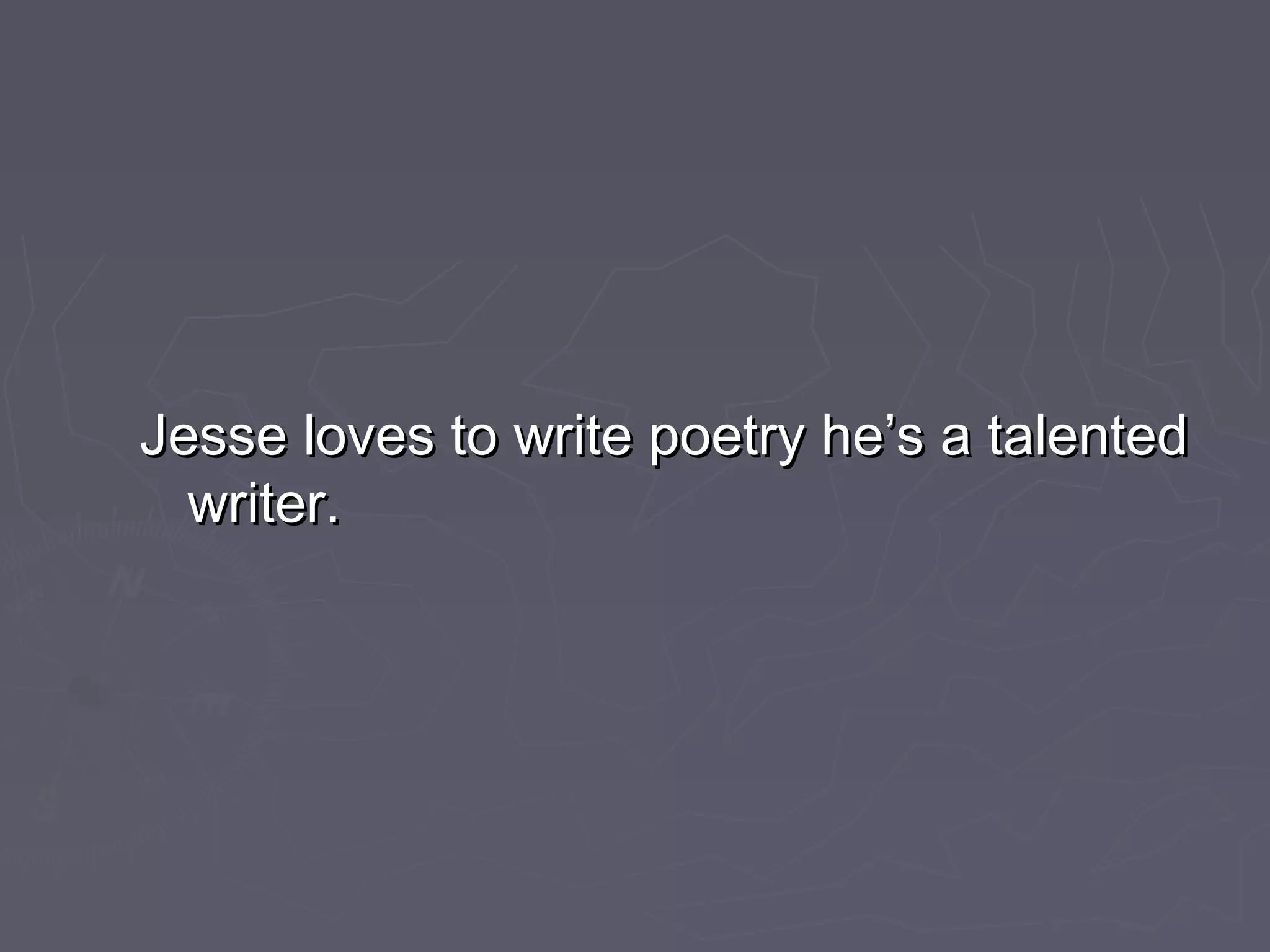
Jesse loves to write poetry he’s a talentedJesse loves to write poetry he’s a talented
writer.writer.
The sentence is wrong because “Jesse likesThe sentence is wrong because “Jesse likes
to write poetry” and “He’s a talented writer”to write poetry” and “He’s a talented writer”
can both stand as complete sentences.can both stand as complete sentences.
Therefore, we can’t merge them into aTherefore, we can’t merge them into a
single sentence without separating them insingle sentence without separating them in
some way.some way.
It’s a “run-on sentence.” It’s not goodIt’s a “run-on sentence.” It’s not good
enough to join the two thoughts withenough to join the two thoughts with
a comma. That’s called a “commaa comma. That’s called a “comma
splice”:splice”:
Jesse stopped at the grocery store, heJesse stopped at the grocery store, he
needed a lunch for the field tripneeded a lunch for the field trip
tomorrow.tomorrow.
If you have two independent clauses,
they need to be separated by
something more powerful than a
comma.
A clause is a group of words that containsA clause is a group of words that contains
both a subject and a predicate.both a subject and a predicate.
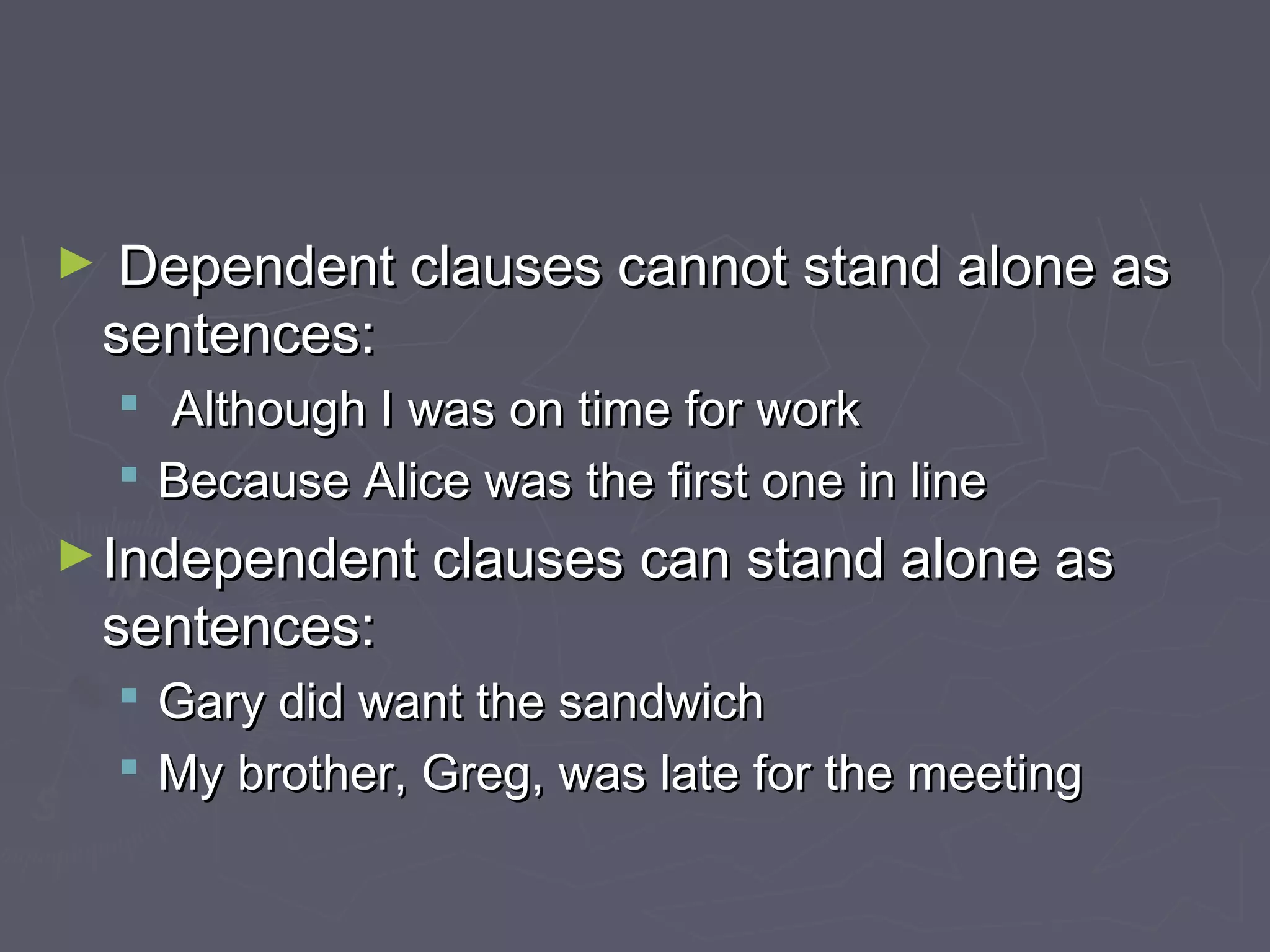
► Dependent clauses cannot stand alone asDependent clauses cannot stand alone as
sentences:sentences:
 Although I was on time for workAlthough I was on time for work
 Because Alice was the first one in lineBecause Alice was the first one in line
►Independent clauses can stand alone asIndependent clauses can stand alone as
sentences:sentences:
 Gary did want the sandwichGary did want the sandwich
 My brother, Greg, was late for the meetingMy brother, Greg, was late for the meeting
There are 5 ways to fix run-onThere are 5 ways to fix run-on
sentencessentences
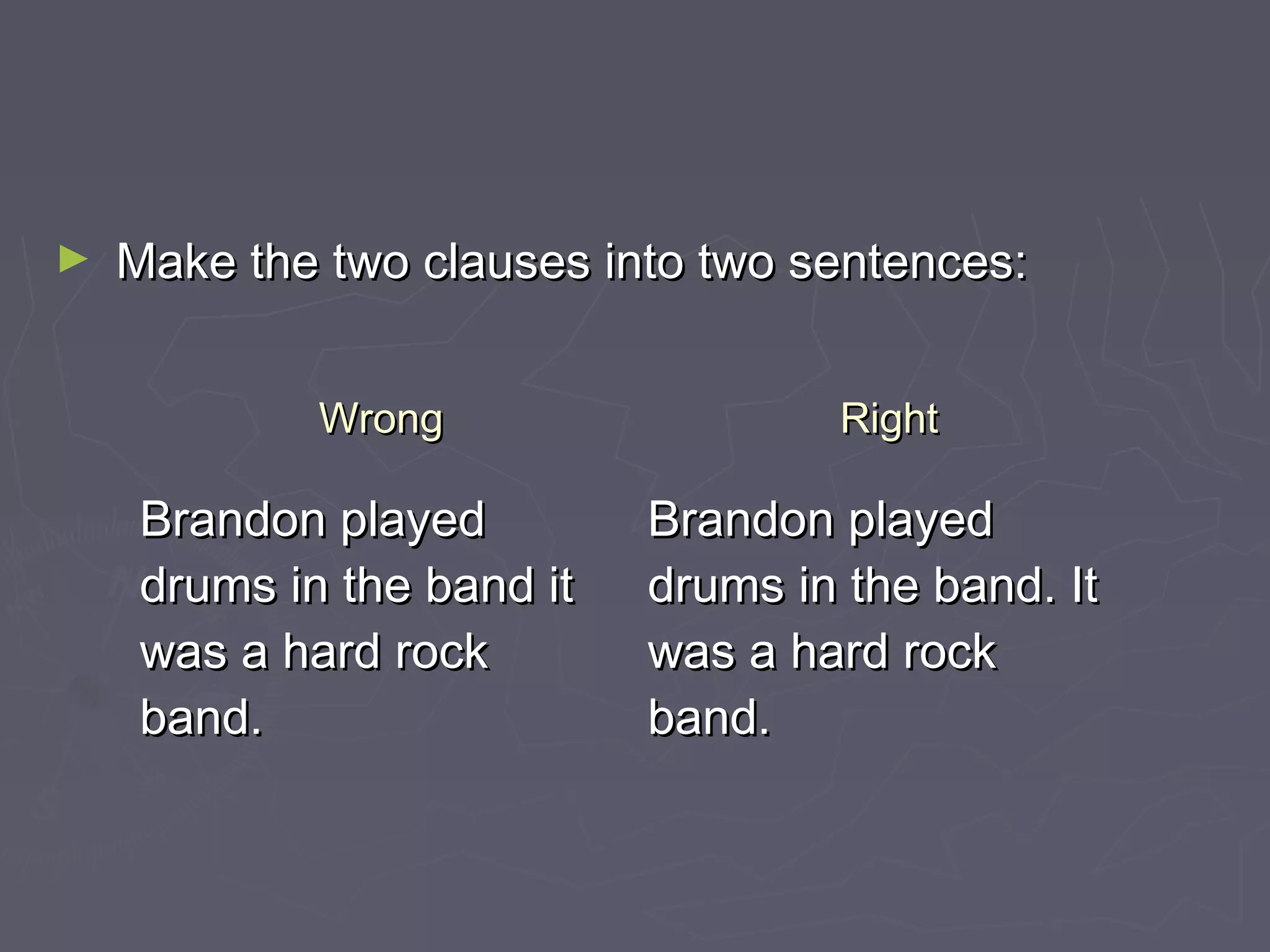
► Make the two clauses into two sentences:Make the two clauses into two sentences:
WrongWrong RightRight
Brandon playedBrandon played
drums in the band itdrums in the band it
was a hard rockwas a hard rock
band.band.
Brandon playedBrandon played
drums in the band. Itdrums in the band. It
was a hard rockwas a hard rock
band.band.
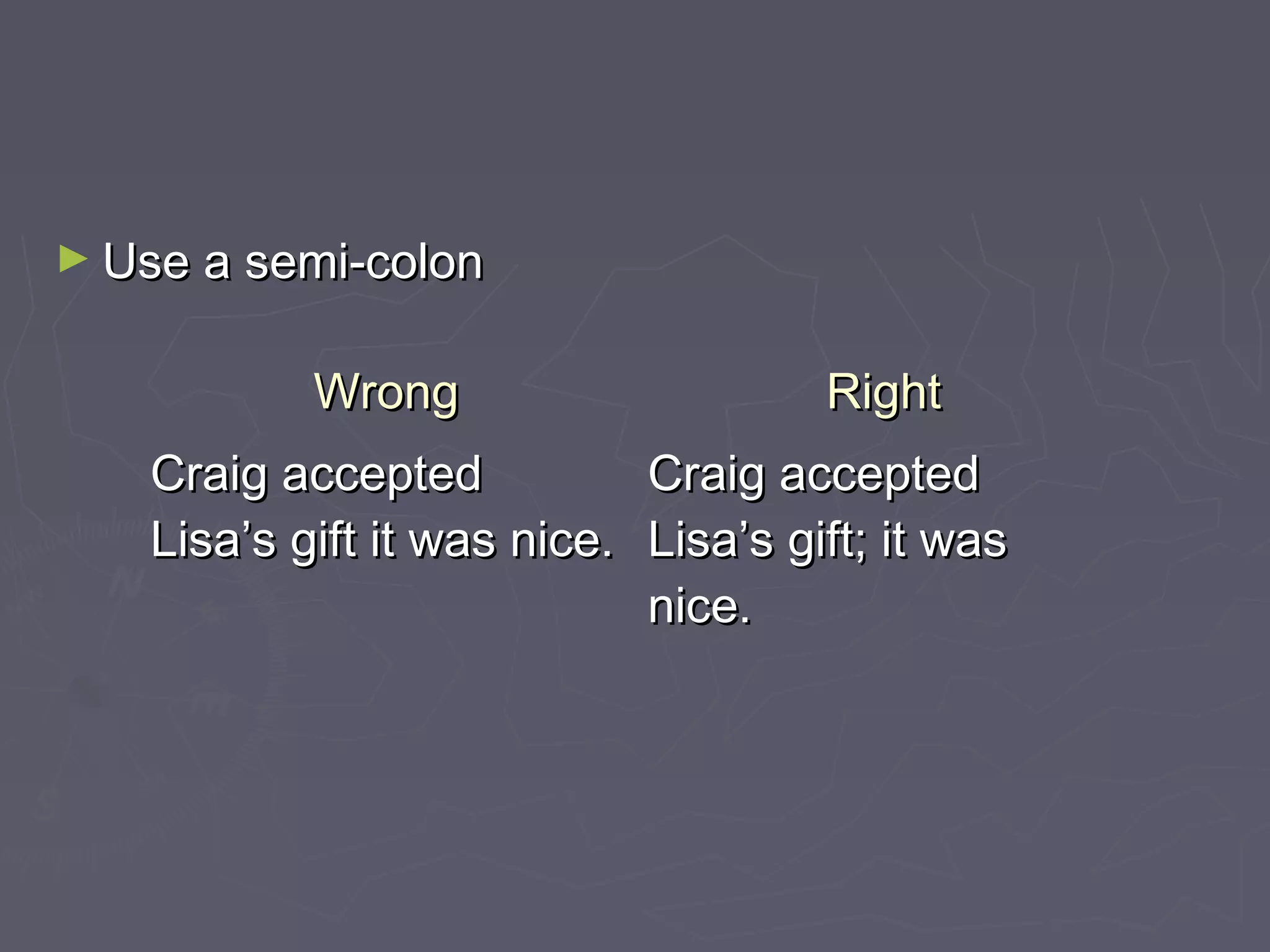
► Use a semi-colonUse a semi-colon
WrongWrong RightRight
Craig acceptedCraig accepted
Lisa’s gift it was nice.Lisa’s gift it was nice.
Craig acceptedCraig accepted
Lisa’s gift; it wasLisa’s gift; it was
nice.nice.
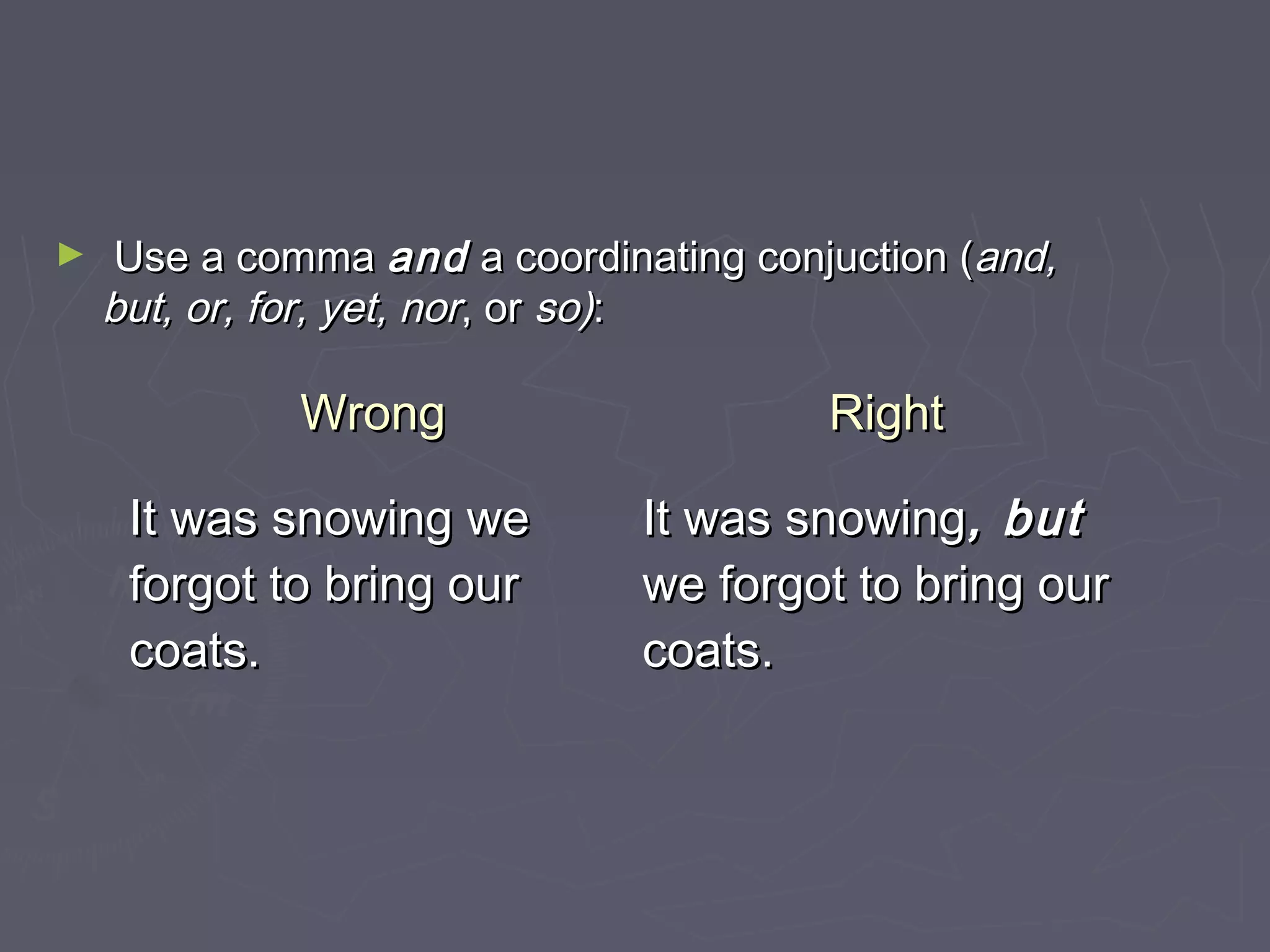
► Use a commaUse a comma andand a coordinating conjuction (a coordinating conjuction (and,and,
but, or, for, yet, norbut, or, for, yet, nor, or, or so)so)::
WrongWrong RightRight
It was snowing weIt was snowing we
forgot to bring ourforgot to bring our
coats.coats.
It was snowingIt was snowing, but, but
we forgot to bring ourwe forgot to bring our
coats.coats.
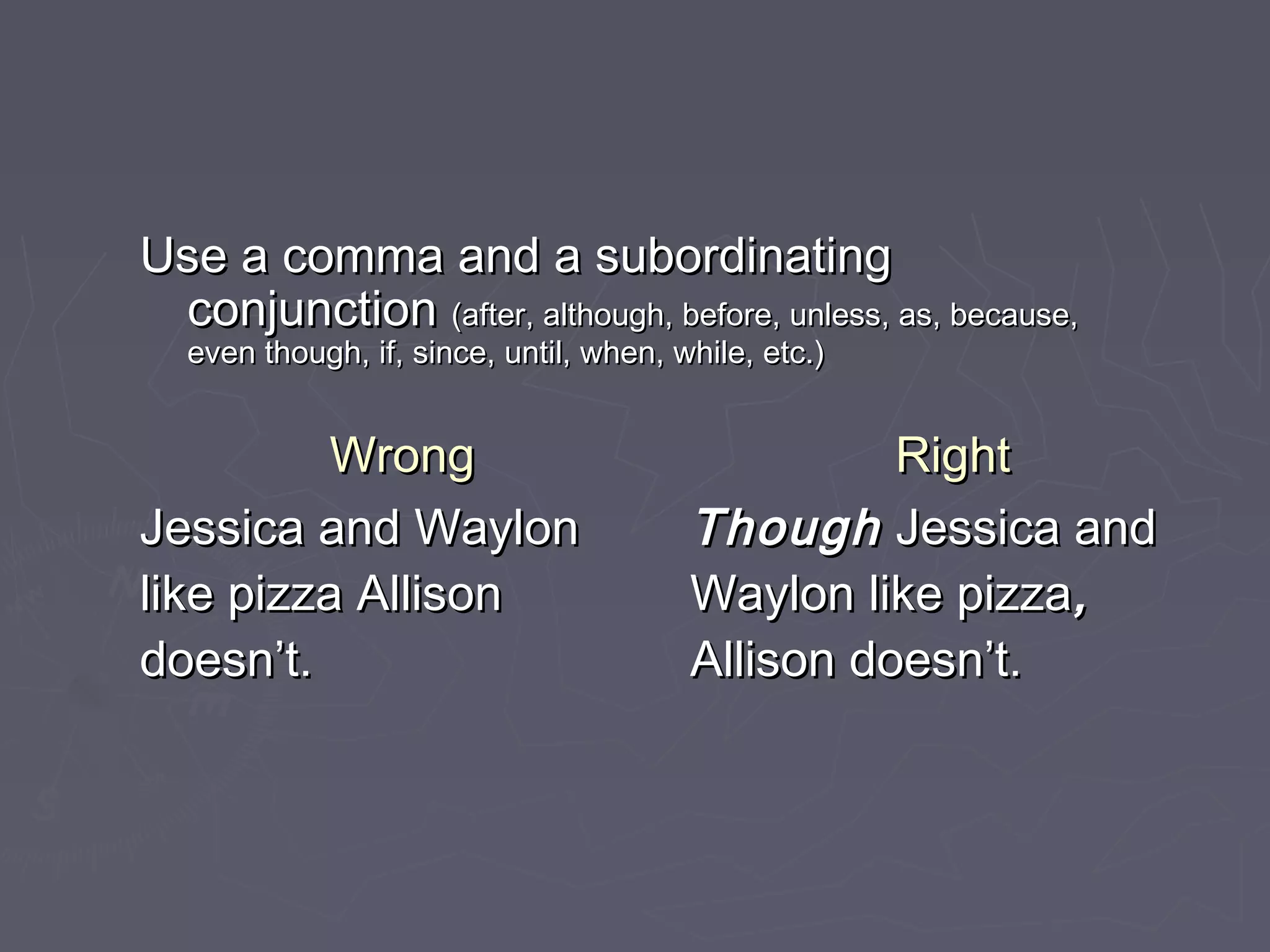
Use a comma and a subordinatingUse a comma and a subordinating
conjunctionconjunction (after, although, before, unless, as, because,(after, although, before, unless, as, because,
even though, if, since, until, when, while, etc.)even though, if, since, until, when, while, etc.)
WrongWrong RightRight
Jessica and WaylonJessica and Waylon
like pizza Allisonlike pizza Allison
doesn’t.doesn’t.
ThoughThough Jessica andJessica and
Waylon like pizzaWaylon like pizza,,
Allison doesn’t.Allison doesn’t.
► Use a semi-colon and a transitionUse a semi-colon and a transition (however,(however,
moreover, on the other hand, nevertheless, instead, also,moreover, on the other hand, nevertheless, instead, also,
consquently, otherwise, as a result, etc.)consquently, otherwise, as a result, etc.)
WrongWrong RightRight
I thought the colorsI thought the colors
would go togetherwould go together
well I was mistaken.well I was mistaken.
I thought the colorsI thought the colors
would go togetherwould go together
wellwell; however,; however, II
was mistaken.was mistaken.
Getting these things right isn’t hard.
They have more to do with habits of
carefulness than with any great
knowledge of writing.
Habit, if not resisted, soon becomes
necessity.
St . Augustine
We first make our habits, and then our
habits make us.
John Dryden
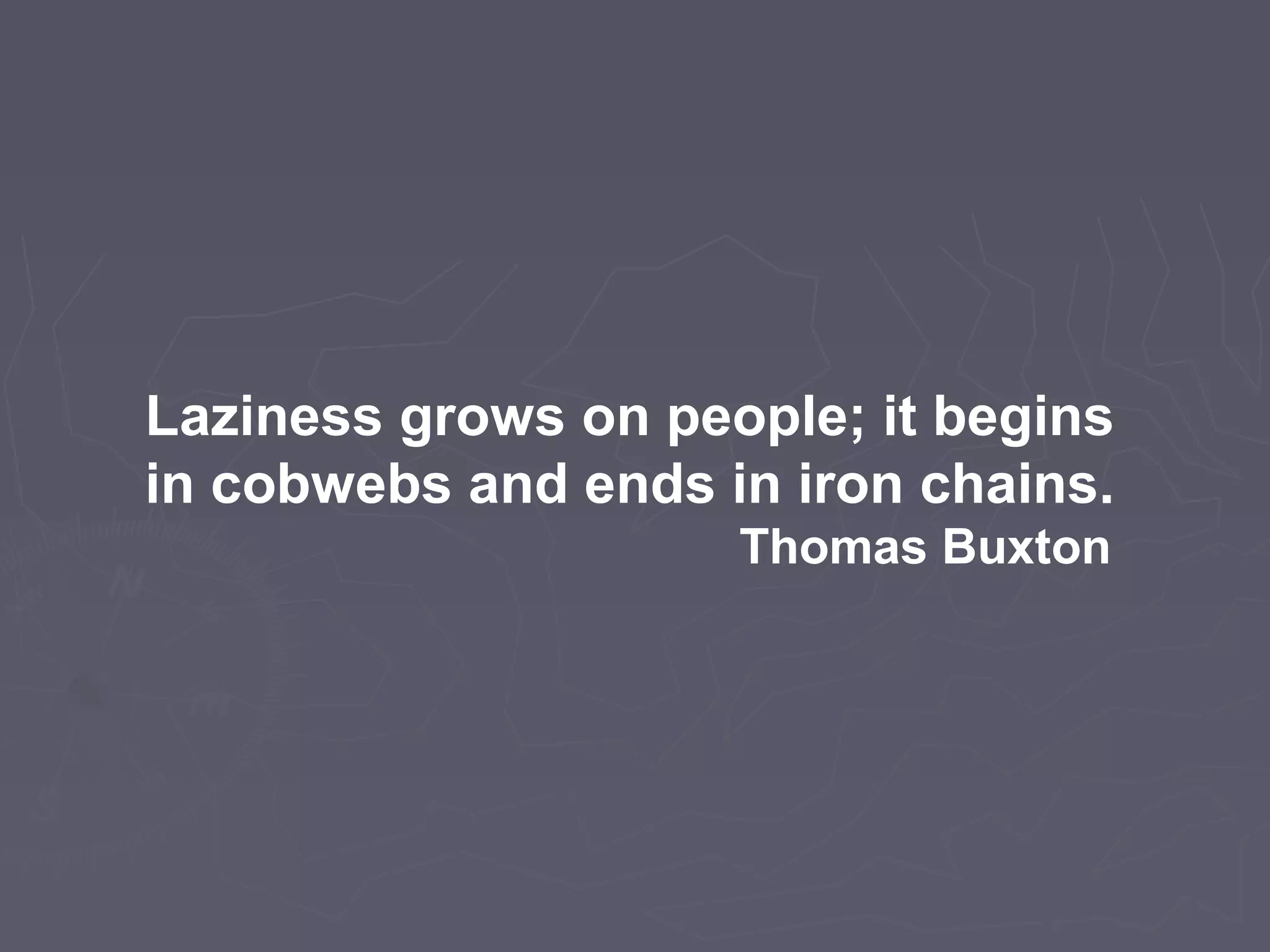
Laziness grows on people; it begins
in cobwebs and ends in iron chains.
Thomas Buxton
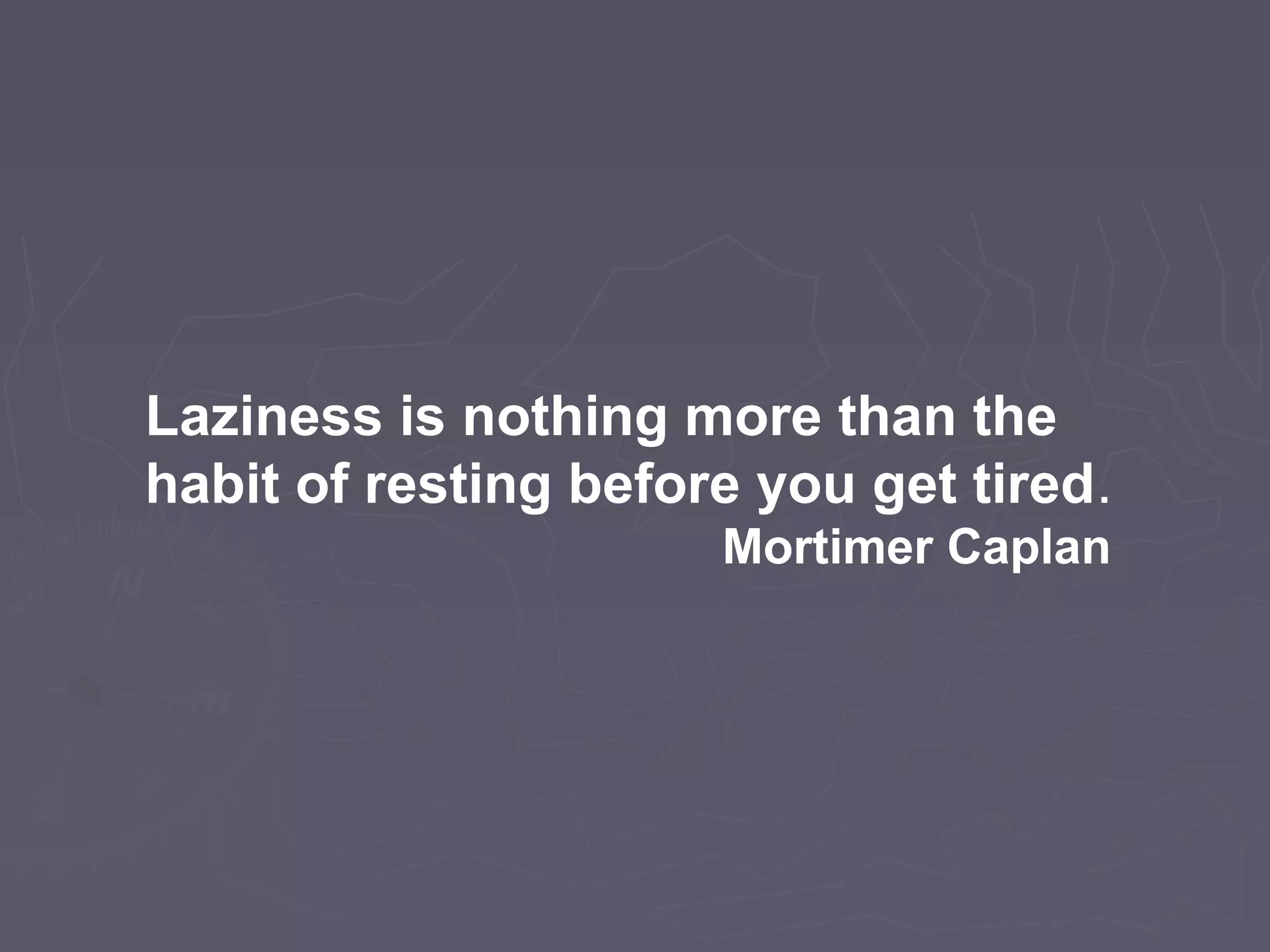
Laziness is nothing more than the
habit of resting before you get tired.
Mortimer Caplan

Fatal mistakes in the english language

  • 1.
    The 5 fatalmistakesThe 5 fatal mistakes in English usagein English usage Papers (or journal or blog entriesPapers (or journal or blog entries with these errors will not receive awith these errors will not receive a grade)grade)
  • 2.
    1.Misspelling words jump 2.Beginninga sentence without a capital jump 3.Using text-messaging abbreviations Jump 4. Writing sentence fragments jump 5. Writing run-on sentences (and comma splices) jump
  • 3.
  • 4.
    We live inthe spell check era. Use it.
  • 5.
    To a largeextent, the worlds of education, business, and government are closed to you if you cannot turn in text without misspellings.
  • 6.
    The habit ofchecking, and re- checking, the spelling of documents you create is vital.
  • 7.
    No school assignmentshould be handed in with words misspelled.
  • 8.
    Beginning a sentence withouta capital (or failing to capitalize “I”)
  • 9.
    Not capitalizing thefirst word of each sentence is the quickest and easiest way to:
  • 10.
    1. Not getthat job you want. Few employers will bother with someone who can’t or doesn’t write standard English.
  • 11.
    2. Not betaken seriously by other people. People will assume you’re dumb if your writing is sloppy. In fact, not taking the time to fix simple problems is dumb.
  • 12.
    3. Not topass this class.
  • 13.
    It’s true thatsome online communities Have relaxed rules about capitalization. Sometimes, no capitalization is used.
  • 14.
    This is okay,in those places, just as it’s okay to lounge around the house in slippers and a ragged t-shirt.
  • 15.
    But it’s notokay at school or at work.
  • 16.
  • 17.
    If u wan2tlkto tptb u need 2tlk in English 
  • 18.
    Translation: If you wantto talk to the powers that be, you need to speak in English. tkmwfi (take my word for it)
  • 19.
    Sentence fragmentsSentence fragments Acomplete sentence expressesA complete sentence expresses a complete thoughta complete thought
  • 20.
    Are these groupsof wordsAre these groups of words sentences?sentences?
  • 21.
    Although Rachel workedhard on her paper My student editor Derrick A freshly watered houseplant Because I couldn’t find the right program
  • 22.
    They aren’t sentencesbecauseThey aren’t sentences because they aren’t complete thoughts.they aren’t complete thoughts.
  • 23.
    ►What happened althoughRachel worked hard? ►What about my student editor Derrick? ►What about that freshly watered house plant? ►What happened because you couldn’t find the program?
  • 24.
    What’s wrong withthe followingWhat’s wrong with the following “sentence”?“sentence”?
  • 25.
    Jesse loves towrite poetry he’s a talentedJesse loves to write poetry he’s a talented writer.writer.
  • 26.
    The sentence iswrong because “Jesse likesThe sentence is wrong because “Jesse likes to write poetry” and “He’s a talented writer”to write poetry” and “He’s a talented writer” can both stand as complete sentences.can both stand as complete sentences. Therefore, we can’t merge them into aTherefore, we can’t merge them into a single sentence without separating them insingle sentence without separating them in some way.some way.
  • 27.
    It’s a “run-onsentence.” It’s not goodIt’s a “run-on sentence.” It’s not good enough to join the two thoughts withenough to join the two thoughts with a comma. That’s called a “commaa comma. That’s called a “comma splice”:splice”: Jesse stopped at the grocery store, heJesse stopped at the grocery store, he needed a lunch for the field tripneeded a lunch for the field trip tomorrow.tomorrow.
  • 28.
    If you havetwo independent clauses, they need to be separated by something more powerful than a comma.
  • 29.
    A clause isa group of words that containsA clause is a group of words that contains both a subject and a predicate.both a subject and a predicate.
  • 30.
    ► Dependent clausescannot stand alone asDependent clauses cannot stand alone as sentences:sentences:  Although I was on time for workAlthough I was on time for work  Because Alice was the first one in lineBecause Alice was the first one in line ►Independent clauses can stand alone asIndependent clauses can stand alone as sentences:sentences:  Gary did want the sandwichGary did want the sandwich  My brother, Greg, was late for the meetingMy brother, Greg, was late for the meeting
  • 31.
    There are 5ways to fix run-onThere are 5 ways to fix run-on sentencessentences
  • 32.
    ► Make thetwo clauses into two sentences:Make the two clauses into two sentences: WrongWrong RightRight Brandon playedBrandon played drums in the band itdrums in the band it was a hard rockwas a hard rock band.band. Brandon playedBrandon played drums in the band. Itdrums in the band. It was a hard rockwas a hard rock band.band.
  • 33.
    ► Use asemi-colonUse a semi-colon WrongWrong RightRight Craig acceptedCraig accepted Lisa’s gift it was nice.Lisa’s gift it was nice. Craig acceptedCraig accepted Lisa’s gift; it wasLisa’s gift; it was nice.nice.
  • 34.
    ► Use acommaUse a comma andand a coordinating conjuction (a coordinating conjuction (and,and, but, or, for, yet, norbut, or, for, yet, nor, or, or so)so):: WrongWrong RightRight It was snowing weIt was snowing we forgot to bring ourforgot to bring our coats.coats. It was snowingIt was snowing, but, but we forgot to bring ourwe forgot to bring our coats.coats.
  • 35.
    Use a commaand a subordinatingUse a comma and a subordinating conjunctionconjunction (after, although, before, unless, as, because,(after, although, before, unless, as, because, even though, if, since, until, when, while, etc.)even though, if, since, until, when, while, etc.) WrongWrong RightRight Jessica and WaylonJessica and Waylon like pizza Allisonlike pizza Allison doesn’t.doesn’t. ThoughThough Jessica andJessica and Waylon like pizzaWaylon like pizza,, Allison doesn’t.Allison doesn’t.
  • 36.
    ► Use asemi-colon and a transitionUse a semi-colon and a transition (however,(however, moreover, on the other hand, nevertheless, instead, also,moreover, on the other hand, nevertheless, instead, also, consquently, otherwise, as a result, etc.)consquently, otherwise, as a result, etc.) WrongWrong RightRight I thought the colorsI thought the colors would go togetherwould go together well I was mistaken.well I was mistaken. I thought the colorsI thought the colors would go togetherwould go together wellwell; however,; however, II was mistaken.was mistaken.
  • 37.
    Getting these thingsright isn’t hard. They have more to do with habits of carefulness than with any great knowledge of writing.
  • 38.
    Habit, if notresisted, soon becomes necessity. St . Augustine
  • 39.
    We first makeour habits, and then our habits make us. John Dryden
  • 40.
    Laziness grows onpeople; it begins in cobwebs and ends in iron chains. Thomas Buxton
  • 41.
    Laziness is nothingmore than the habit of resting before you get tired. Mortimer Caplan