   Comma splices entail the incorrect use
    of a comma to join two (or more)
    independent clauses together in a single
    sentence.
 Replace the comma with a semicolon;
Incorrect: We have hundreds of pages of
  reading to do, it will be impossible to
  finish it all before the exam.
Correct: We have hundreds of pages of
  reading to do; it will be impossible to
  finish it all before the exam
 Divide the comma-spliced sentence into
  smaller sentences, replacing the erroneous
  comma with appropriate ending
  punctuation;
Incorrect: She wished she had some ice
  cream and because it was raining, she
  asked her roommate to drive her to the
  store, but she refused.
Correct: She wished she had some ice cream.
  Because it was raining, she asked her
  roommate to drive her to the store, but she
  refused.
  Insert a coordinating conjunction after the comma. In
   case you don't know what a coordinating conjunction
   is, here's a list: and, but, so, or, nor, for, yet.
Incorrect: I tried to clean the house, I gave up and watched
   soap operas instead.
Correct: I tried to clean the house, but I gave up and
   watched soap operas instead.
Incorrect: I repaired all the structural errors in my paper, then I
   turned it in.
Correct: I repaired all the structural errors in my paper, and
   then I turned it in.
Correct: I repaired all the structural errors in my paper. Then I
   turned it in.

  Instead of a using a comma alone to separate the
   independent clauses, rearrange the sentence into
   the following format: INDEPENDENT CLAUSE;
   CONJUNCTIVE ADVERB, INDEPENDENT CLAUSE.
Incorrect: They wanted to start a band, none of them
   knew how to sing.
Correct: They wanted to start a band; however, none of
   them knew how to sing.
Incorrect: Semicolons are my favorite kind of
   punctuation, they work especially well with
   conjunctive adverbs.
Correct: Semicolons are my favorite kind of
   punctuation; moreover, they work especially well
   with conjunctive adverbs.
   A sentence fragment is a group of words
    looking like a complete sentence.
    Sentence fragments, as incomplete
    sentences, can confuse your reader or
    make your meaning unclear. There is an
    easy way to test for sentence
    completeness. Ask the following
    sentences as you are writing:
 Is there a verb (action word)?
 Is there a subject?
 If the phrase starts with a subordinating
  word (like "because" or "since"), does it
  also include an independent clause to
  complete the thought?
 If you answered "no" to any of these
  questions, you've got yourself a sentence
  fragment.
 Expand the fragments into sentences,
  supplying the missing elements like subjects,
  verbs, and clauses.
Incorrect: Confusing and distracting to
  readers.
Correct: Sentence fragments are confusing
  and distracting to readers.
Incorrect: Because they are confusing and
  distracting to readers.
Correct: Because they are confusing and
  distracting to readers, writers should
  generally avoid sentence fragments.
 Incorporate the fragment into a nearby
  sentence.
Incorrect: The dog was waiting in the
  window when his owner got home.
  Then, excited, wagging his tail. He went
  to greet her at the door.
Correct: The dog was waiting in the
  window when his owner got home.
  Excited, he wagged his tail and went to
  greet her at the door.
 Add more information to fix the
  fragment.
Incorrect: Because I care.
Correct: Because I care, I decided to
  donate money.
 Add a subject to the fragment.
Incorrect: Wanted to get to work on time.
Correct: Frank wanted to get to work on
  time.
   Parallel sentence structure is about
    balancing your sentences. The words "and,"
    "but" and "or" are conjunctions, used to join
    ideas and comparisons in sentences. The
    ideas and comparisons on each side of
    these words should be balanced out in
    order to be considered parallel. If they are
    not balanced out then they are nonparallel
    sentences.
 Use the same form of comparison words
  within a sentence.
Incorrect: He likes playing and to run at
  recess.
Correct: He likes playing and running at
  recess.
Incorrect: Her details of the events were
  recounted correct and clearly.
Correct: Her details of the events were
  recounted correctly and clearly
 Keep nouns, adjectives and verbs
  constant in a descriptive list; don't mix
  them.
Incorrect: He was full of greed and
  ignorant.
Correct: He was full of greed and
  ignorance
Correct: He was greedy and ignorant.
 Make sure the verb usage is balanced out.
  If you use a verb with one word, use a verb
  with all of the words on each side of your
  "and," "but" and "or.“
Incorrect: Newborns frequently cry and are
  restless at night.
Correct: Newborns frequently cry and restless
  at night.
 Place your connecting words so that
  they come before both of the ideas that
  you are connecting.
Incorrect: She was not only the best person
  on our team, but a good friend too.
Correct: She not only was the best person
  on our team, but a good friend too.
   A run-on sentence is a sentence in which
    several main clauses are strung together
    without proper punctuation and so run
    together as if they were one sentence.
    Run-on sentences make your reader's
    job difficult; they interrupt the rhythm of
    your writing and condense too much
    information into a small space.
 Separate the independent clauses into two
  sentences.
Incorrect: They gossiped about many things
  at lunch they always have the most to say
  about their coworkers.
Correct: They gossiped about many things at
  lunch. They always have the most to say
  about their coworkers.
 If the ideas expressed in the clauses are
  connected, they can be joined with a semi-
  colon.
Incorrect: They gossiped about many things
  at lunch they always have the most to say
  about their coworkers.
Correct: They gossiped about many things at
  lunch; they always have the most to say
  about their coworkers.
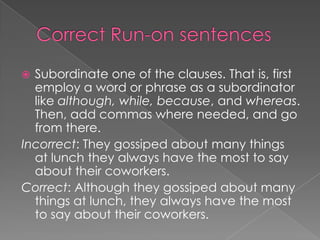
 Subordinate one of the clauses. That is, first
  employ a word or phrase as a subordinator
  like although, while, because, and whereas.
  Then, add commas where needed, and go
  from there.
Incorrect: They gossiped about many things
  at lunch they always have the most to say
  about their coworkers.
Correct: Although they gossiped about many
  things at lunch, they always have the most
  to say about their coworkers.

Leyla döner

  • 2.
    Comma splices entail the incorrect use of a comma to join two (or more) independent clauses together in a single sentence.
  • 3.
     Replace thecomma with a semicolon; Incorrect: We have hundreds of pages of reading to do, it will be impossible to finish it all before the exam. Correct: We have hundreds of pages of reading to do; it will be impossible to finish it all before the exam
  • 4.
     Divide thecomma-spliced sentence into smaller sentences, replacing the erroneous comma with appropriate ending punctuation; Incorrect: She wished she had some ice cream and because it was raining, she asked her roommate to drive her to the store, but she refused. Correct: She wished she had some ice cream. Because it was raining, she asked her roommate to drive her to the store, but she refused.
  • 5.
     Inserta coordinating conjunction after the comma. In case you don't know what a coordinating conjunction is, here's a list: and, but, so, or, nor, for, yet. Incorrect: I tried to clean the house, I gave up and watched soap operas instead. Correct: I tried to clean the house, but I gave up and watched soap operas instead. Incorrect: I repaired all the structural errors in my paper, then I turned it in. Correct: I repaired all the structural errors in my paper, and then I turned it in. Correct: I repaired all the structural errors in my paper. Then I turned it in. 
  • 6.
     Insteadof a using a comma alone to separate the independent clauses, rearrange the sentence into the following format: INDEPENDENT CLAUSE; CONJUNCTIVE ADVERB, INDEPENDENT CLAUSE. Incorrect: They wanted to start a band, none of them knew how to sing. Correct: They wanted to start a band; however, none of them knew how to sing. Incorrect: Semicolons are my favorite kind of punctuation, they work especially well with conjunctive adverbs. Correct: Semicolons are my favorite kind of punctuation; moreover, they work especially well with conjunctive adverbs.
  • 7.
    A sentence fragment is a group of words looking like a complete sentence. Sentence fragments, as incomplete sentences, can confuse your reader or make your meaning unclear. There is an easy way to test for sentence completeness. Ask the following sentences as you are writing:
  • 8.
     Is therea verb (action word)?  Is there a subject?  If the phrase starts with a subordinating word (like "because" or "since"), does it also include an independent clause to complete the thought?  If you answered "no" to any of these questions, you've got yourself a sentence fragment.
  • 9.
     Expand thefragments into sentences, supplying the missing elements like subjects, verbs, and clauses. Incorrect: Confusing and distracting to readers. Correct: Sentence fragments are confusing and distracting to readers. Incorrect: Because they are confusing and distracting to readers. Correct: Because they are confusing and distracting to readers, writers should generally avoid sentence fragments.
  • 10.
     Incorporate thefragment into a nearby sentence. Incorrect: The dog was waiting in the window when his owner got home. Then, excited, wagging his tail. He went to greet her at the door. Correct: The dog was waiting in the window when his owner got home. Excited, he wagged his tail and went to greet her at the door.
  • 11.
     Add moreinformation to fix the fragment. Incorrect: Because I care. Correct: Because I care, I decided to donate money.
  • 12.
     Add asubject to the fragment. Incorrect: Wanted to get to work on time. Correct: Frank wanted to get to work on time.
  • 13.
    Parallel sentence structure is about balancing your sentences. The words "and," "but" and "or" are conjunctions, used to join ideas and comparisons in sentences. The ideas and comparisons on each side of these words should be balanced out in order to be considered parallel. If they are not balanced out then they are nonparallel sentences.
  • 14.
     Use thesame form of comparison words within a sentence. Incorrect: He likes playing and to run at recess. Correct: He likes playing and running at recess. Incorrect: Her details of the events were recounted correct and clearly. Correct: Her details of the events were recounted correctly and clearly
  • 15.
     Keep nouns,adjectives and verbs constant in a descriptive list; don't mix them. Incorrect: He was full of greed and ignorant. Correct: He was full of greed and ignorance Correct: He was greedy and ignorant.
  • 16.
     Make surethe verb usage is balanced out. If you use a verb with one word, use a verb with all of the words on each side of your "and," "but" and "or.“ Incorrect: Newborns frequently cry and are restless at night. Correct: Newborns frequently cry and restless at night.
  • 17.
     Place yourconnecting words so that they come before both of the ideas that you are connecting. Incorrect: She was not only the best person on our team, but a good friend too. Correct: She not only was the best person on our team, but a good friend too.
  • 18.
    A run-on sentence is a sentence in which several main clauses are strung together without proper punctuation and so run together as if they were one sentence. Run-on sentences make your reader's job difficult; they interrupt the rhythm of your writing and condense too much information into a small space.
  • 19.
     Separate theindependent clauses into two sentences. Incorrect: They gossiped about many things at lunch they always have the most to say about their coworkers. Correct: They gossiped about many things at lunch. They always have the most to say about their coworkers.
  • 20.
     If theideas expressed in the clauses are connected, they can be joined with a semi- colon. Incorrect: They gossiped about many things at lunch they always have the most to say about their coworkers. Correct: They gossiped about many things at lunch; they always have the most to say about their coworkers.
  • 21.
     Subordinate oneof the clauses. That is, first employ a word or phrase as a subordinator like although, while, because, and whereas. Then, add commas where needed, and go from there. Incorrect: They gossiped about many things at lunch they always have the most to say about their coworkers. Correct: Although they gossiped about many things at lunch, they always have the most to say about their coworkers.