Capital letters, full stops
and other basics.
Ok, you are already experts at using these parts of grammar!
Just some gentle reminders…
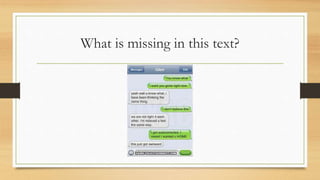
What is missing in this text?
Some of the capital letters and full stops!
When we communicate via technology, we often take short cuts by ignoring
important aspects of grammar. This is fine and saves time; however, you need
to ensure that this does not occur in your formal writing.
Capital letters must be used:
For the first word in every sentence and the first word in direct speech
For proper nouns
For the pronoun ‘I’
For abbreviations.
1.
• Capital letters are used at the beginning of sentences and
the beginning of direct speech.
Examples:
• Dogs make wonderful pets. (Dog is a common noun and as such, would not
normally need a capital letter).
• Sarah yelled, ‘Remember to text me when you arrive.’
2.
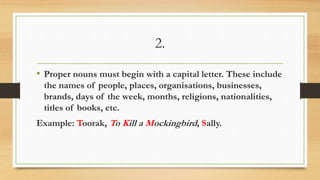
• Proper nouns must begin with a capital letter. These include
the names of people, places, organisations, businesses,
brands, days of the week, months, religions, nationalities,
titles of books, etc.
Example: Toorak, To Kill a Mockingbird, Sally.
3.
• The pronoun ‘I’ must always be capitalised.
4.
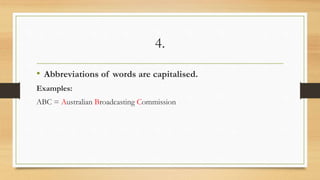
• Abbreviations of words are capitalised.
Examples:
ABC = Australian Broadcasting Commission
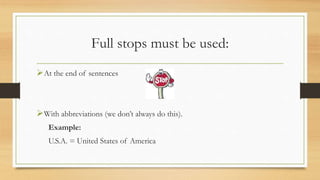
Full stops must be used:
At the end of sentences
With abbreviations (we don’t always do this).
Example:
U.S.A. = United States of America
Question marks
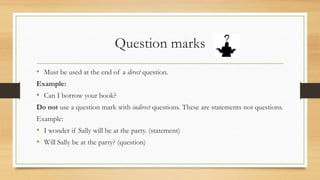
• Must be used at the end of a direct question.
Example:
• Can I borrow your book?
Do not use a question mark with indirect questions. These are statements not questions.
Example:
• I wonder if Sally will be at the party. (statement)
• Will Sally be at the party? (question)
Exclamation marks
Exclamation marks are used:
To show strong feeling or surprise
Example:
Your new hairstyle is amazing! Warning: use sparingly!
After a brief, forceful command.
Come here now!

Capital letters full stops etc

  • 1.
    Capital letters, fullstops and other basics. Ok, you are already experts at using these parts of grammar! Just some gentle reminders…
  • 2.
    What is missingin this text?
  • 3.
    Some of thecapital letters and full stops! When we communicate via technology, we often take short cuts by ignoring important aspects of grammar. This is fine and saves time; however, you need to ensure that this does not occur in your formal writing.
  • 4.
    Capital letters mustbe used: For the first word in every sentence and the first word in direct speech For proper nouns For the pronoun ‘I’ For abbreviations.
  • 5.
    1. • Capital lettersare used at the beginning of sentences and the beginning of direct speech. Examples: • Dogs make wonderful pets. (Dog is a common noun and as such, would not normally need a capital letter). • Sarah yelled, ‘Remember to text me when you arrive.’
  • 6.
    2. • Proper nounsmust begin with a capital letter. These include the names of people, places, organisations, businesses, brands, days of the week, months, religions, nationalities, titles of books, etc. Example: Toorak, To Kill a Mockingbird, Sally.
  • 7.
    3. • The pronoun‘I’ must always be capitalised.
  • 8.
    4. • Abbreviations ofwords are capitalised. Examples: ABC = Australian Broadcasting Commission
  • 9.
    Full stops mustbe used: At the end of sentences With abbreviations (we don’t always do this). Example: U.S.A. = United States of America
  • 10.
    Question marks • Mustbe used at the end of a direct question. Example: • Can I borrow your book? Do not use a question mark with indirect questions. These are statements not questions. Example: • I wonder if Sally will be at the party. (statement) • Will Sally be at the party? (question)
  • 11.
    Exclamation marks Exclamation marksare used: To show strong feeling or surprise Example: Your new hairstyle is amazing! Warning: use sparingly! After a brief, forceful command. Come here now!