Avoiding FragmentsBy VeenaGadepalli
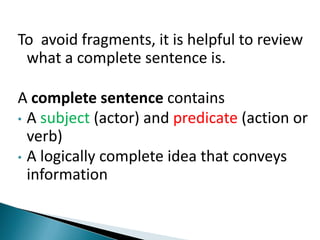
To  avoid fragments, it is helpful to review what a complete sentence is. A complete sentence containsA subject (actor) and predicate (action or verb)
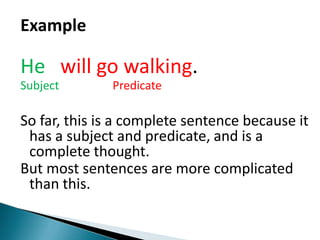
A logically complete idea that conveys informationExampleHewill go walking. SubjectPredicateSo far, this is a complete sentence because it has a subject and predicate, and is a complete thought. But most sentences are more complicated than this.
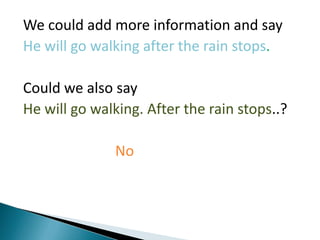
We could add more information and say He will go walking after the rain stops. Could we also sayHe will go walking. After the rain stops..? No
To further understand how to avoid fragments, it’s necessary to look at the difference between independent and dependent clauses.
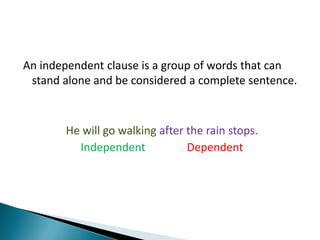
An independent clause is a group of words that can stand alone and be considered a complete sentence. He will go walking after the rain stops. IndependentDependent
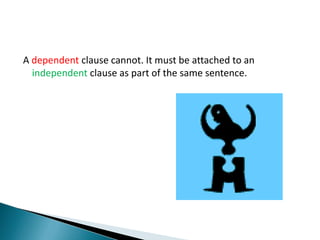
A dependent clause cannot. It must be attached to an independent clause as part of the same sentence.
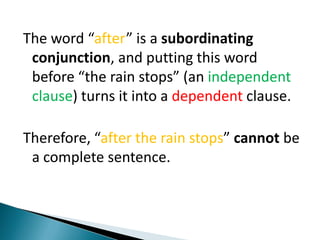
The word “after” is a subordinating conjunction, and putting this word before “the rain stops” (an independent clause) turns it into a dependent clause. Therefore, “after the rain stops” cannot be a complete sentence.
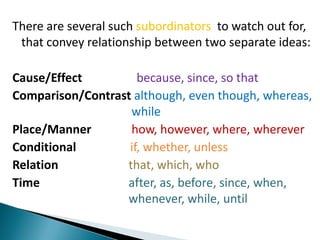
There are several such subordinators  to watch out for, that convey relationship between two separate ideas:Cause/Effectbecause, since, so thatComparison/Contrastalthough, even though, whereas, 			         whilePlace/Manner         how, however, where, whereverConditionalif, whether, unlessRelation        that, which, whoTime	after, as, before, since, when, 				        whenever, while, until
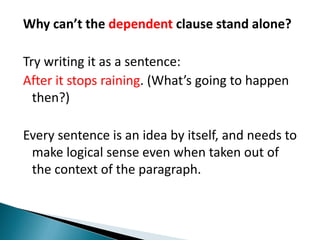
Why can’t the dependent clause stand alone? Try writing it as a sentence: After it stops raining. (What’s going to happen  then?)Every sentence is an idea by itself, and needs to make logical sense even when taken out of the context of the paragraph.
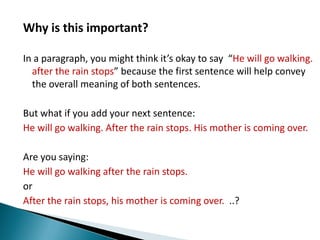
Why is this important?In a paragraph, you might think it’s okay to say  “He will go walking. after the rain stops” because the first sentence will help convey the overall meaning of both sentences. But what if you add your next sentence:He will go walking. After the rain stops. His mother is coming over. Are you saying:He will go walking after the rain stops.orAfter the rain stops, his mother is coming over.  ..?
The purpose of writing is to communicate, and in order for  information to be shared efficiently and clearly, it is very important to maintain proper sentence structure. Fragments can disrupt the flow of ideas in a paper and even cause misinterpretation on the reader’s part.
Avoiding Sentence FragmentsAlways check if every sentence you write provides complete information and makes logical sense.

Avoiding sentence fragments

  • 1.
  • 2.
    To avoidfragments, it is helpful to review what a complete sentence is. A complete sentence containsA subject (actor) and predicate (action or verb)
  • 3.
    A logically completeidea that conveys informationExampleHewill go walking. SubjectPredicateSo far, this is a complete sentence because it has a subject and predicate, and is a complete thought. But most sentences are more complicated than this.
  • 4.
    We could addmore information and say He will go walking after the rain stops. Could we also sayHe will go walking. After the rain stops..? No
  • 5.
    To further understandhow to avoid fragments, it’s necessary to look at the difference between independent and dependent clauses.
  • 6.
    An independent clauseis a group of words that can stand alone and be considered a complete sentence. He will go walking after the rain stops. IndependentDependent
  • 7.
    A dependent clausecannot. It must be attached to an independent clause as part of the same sentence.
  • 8.
    The word “after”is a subordinating conjunction, and putting this word before “the rain stops” (an independent clause) turns it into a dependent clause. Therefore, “after the rain stops” cannot be a complete sentence.
  • 9.
    There are severalsuch subordinators to watch out for, that convey relationship between two separate ideas:Cause/Effectbecause, since, so thatComparison/Contrastalthough, even though, whereas, whilePlace/Manner how, however, where, whereverConditionalif, whether, unlessRelation that, which, whoTime after, as, before, since, when, whenever, while, until
  • 10.
    Why can’t thedependent clause stand alone? Try writing it as a sentence: After it stops raining. (What’s going to happen then?)Every sentence is an idea by itself, and needs to make logical sense even when taken out of the context of the paragraph.
  • 11.
    Why is thisimportant?In a paragraph, you might think it’s okay to say “He will go walking. after the rain stops” because the first sentence will help convey the overall meaning of both sentences. But what if you add your next sentence:He will go walking. After the rain stops. His mother is coming over. Are you saying:He will go walking after the rain stops.orAfter the rain stops, his mother is coming over. ..?
  • 12.
    The purpose ofwriting is to communicate, and in order for information to be shared efficiently and clearly, it is very important to maintain proper sentence structure. Fragments can disrupt the flow of ideas in a paper and even cause misinterpretation on the reader’s part.
  • 13.
    Avoiding Sentence FragmentsAlwayscheck if every sentence you write provides complete information and makes logical sense.