Adjectival Clause
Ms. Irene V. Delarmino
REVIEW
• An adjectival clause is a dependent
clause used as an adjective within a
sentence. It is also known as relative
clause.
• In a written work, you may use
adjective clauses effectively in order to
make your sentences more varied.
• Like a single-word adjective, an
adjectival clause describes a noun (in
the sentence’s main clause) and answers
one of these questions:
• Which one?
• What kind?
• Clause - - A group of words
made up of a subject and a
predicate.
Kinds:
1. Dependent /subordinate
clause – It has no complete
thought
- Adjectival clause
- Adverbial clause
- Nominal clause
2. Independent/main clause -
It can stand alone as a
sentence. It has a complete
thought.
An adjectival clause usually
begins with a relative pronoun,
which makes the clause
subordinate (dependent).
Relative pronouns:
1. who, whom, and whose -
used to describe people.
2. that and which - used to
describe things.
Adjectival clauses always
follow the person, place, or
thing they describe.
The woman who lives next door is a
registered nurse.
The vegetables that people leave
uneaten are often the most nutritious.
Math, which is Dave's favorite subject,
has always been easy for him.
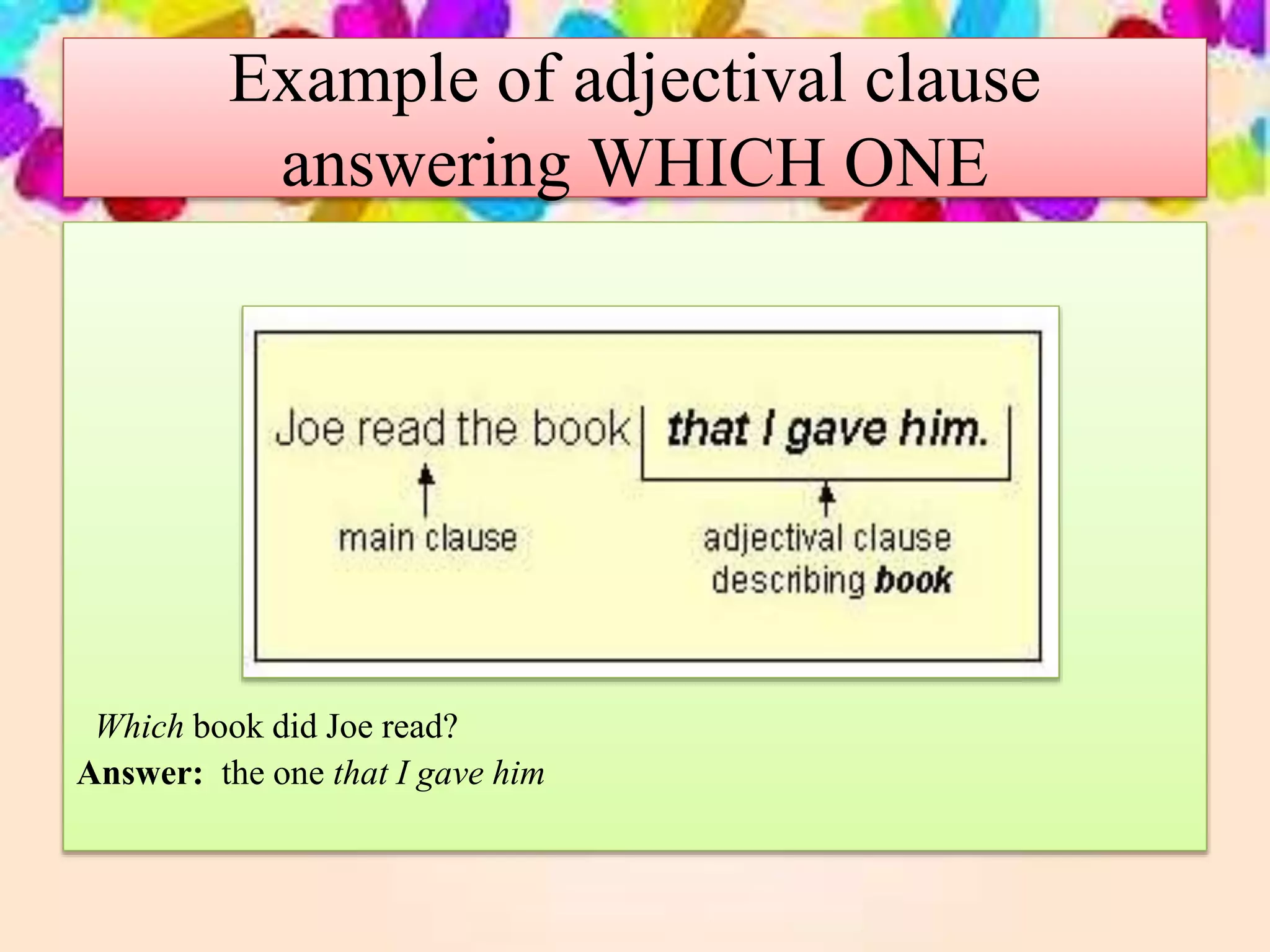
Example of adjectival clause
answering WHICH ONE
Which book did Joe read?
Answer: the one that I gave him
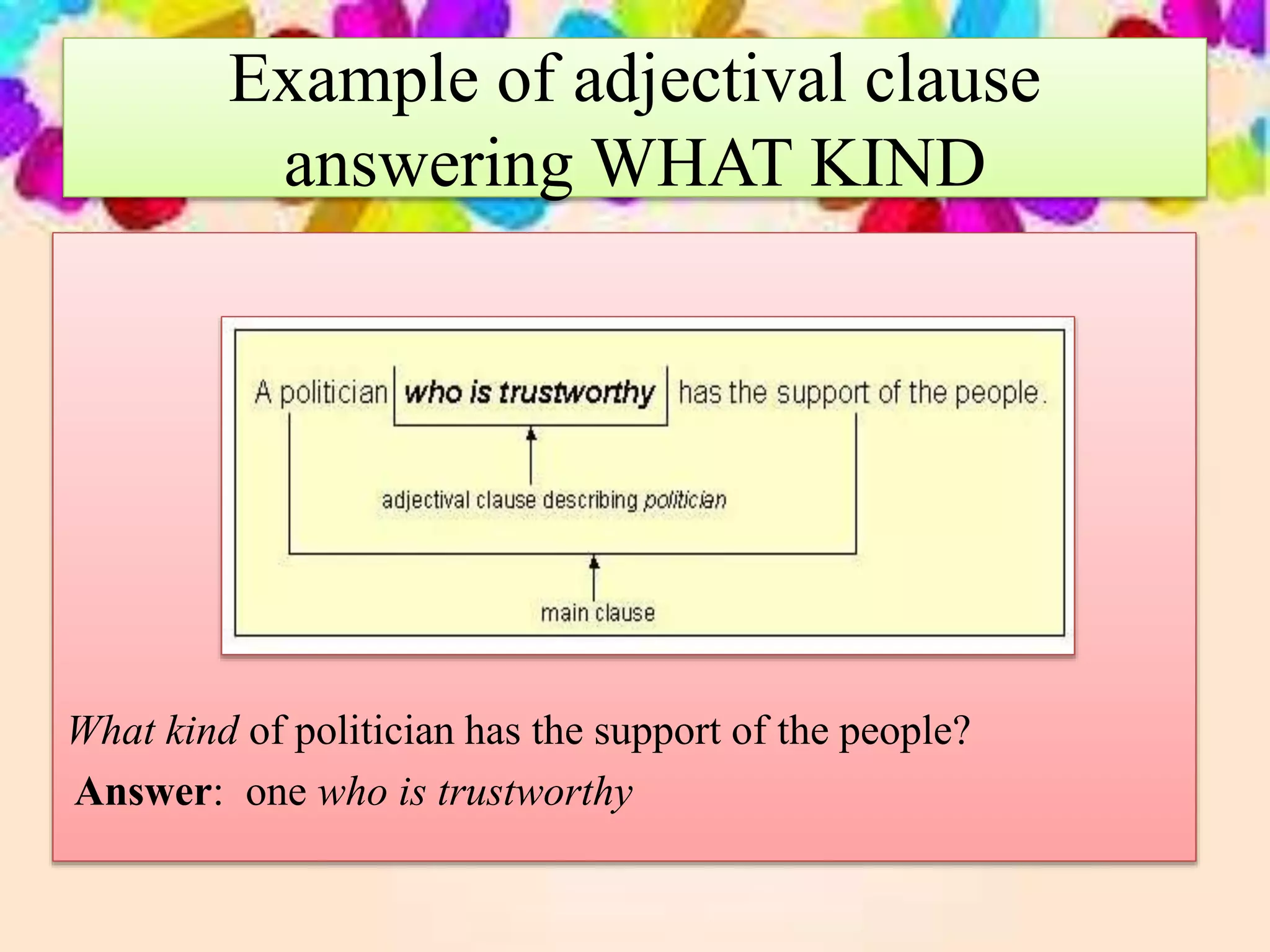
Example of adjectival clause
answering WHAT KIND
What kind of politician has the support of the people?
Answer: one who is trustworthy
Adjectival clauses may also begin with selected
subordinating conjunctions:
when - to describe a time
Adjectival clauses may also begin with selected
subordinating conjunctions:
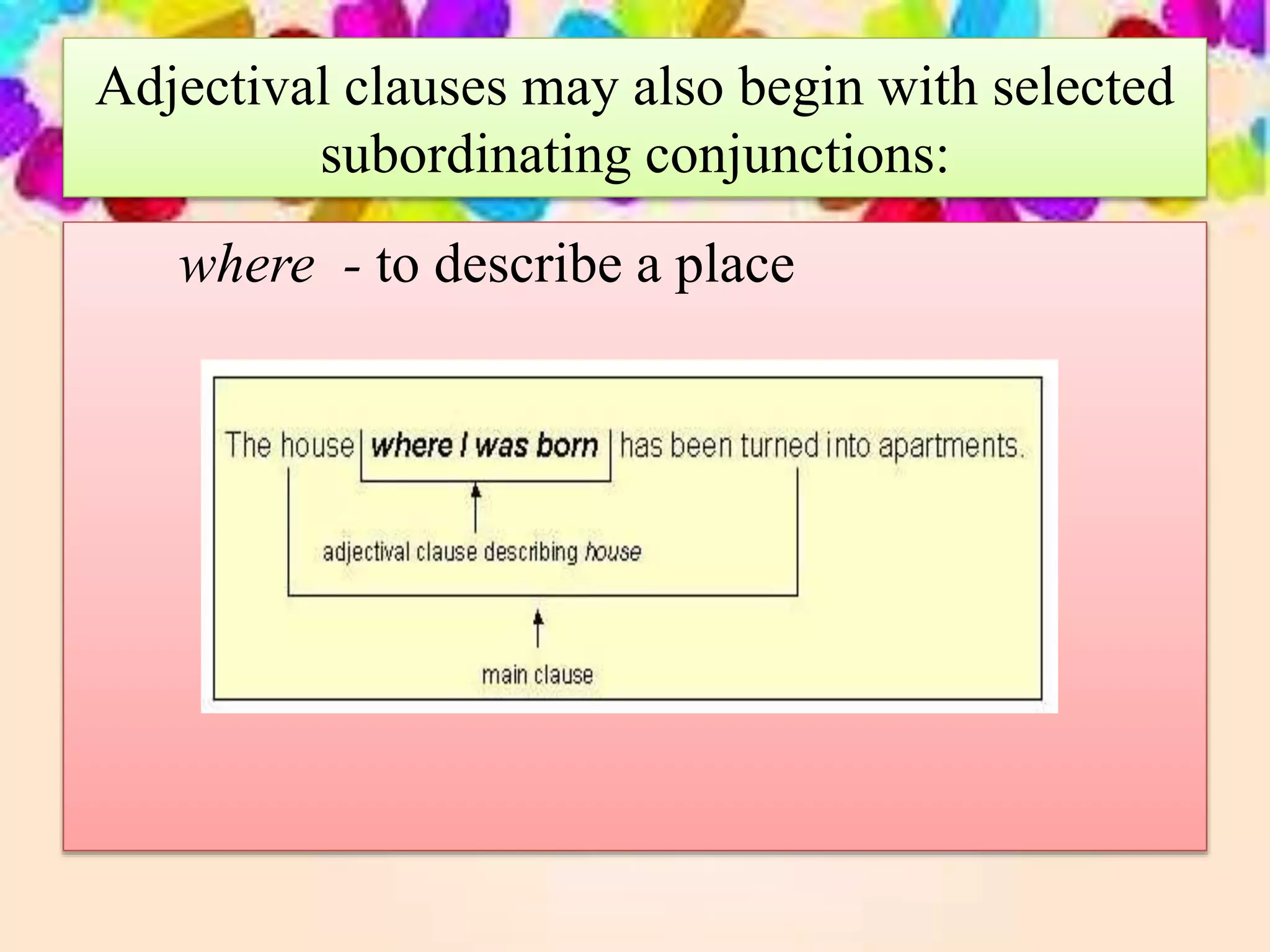
where - to describe a place
Adjectival clauses may also begin with selected
subordinating conjunctions:
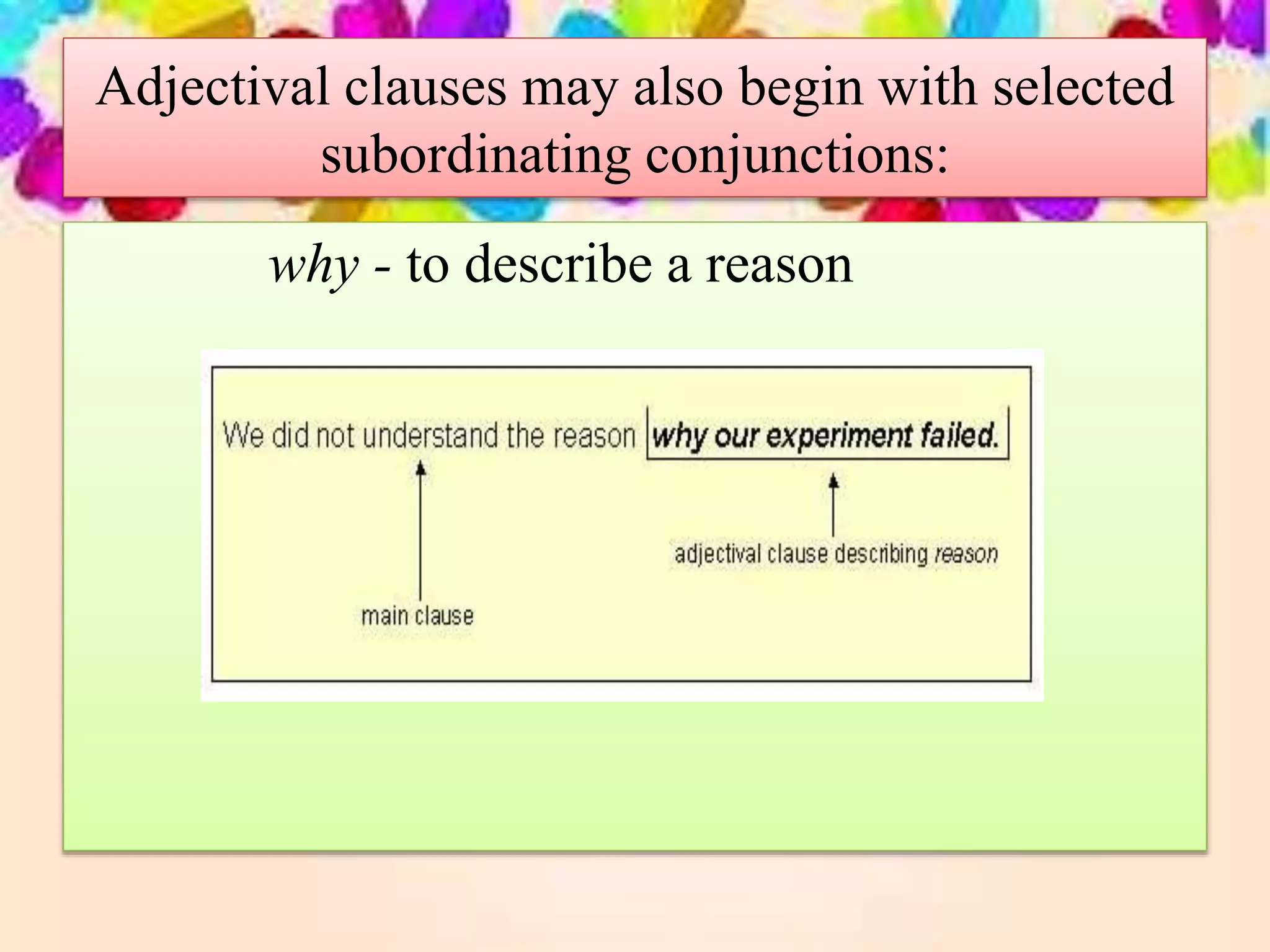
why - to describe a reason
Two basic types of adjective clauses:
1 . Restrictive or Essential Adjective Clause
 It offers essential [information] and is needed to complete the sentence's
thought.
2. Nonrestrictive or Nonessential Adjective Clause
 This clause simply gives extra information about the noun.
Restrictive or Essential Adjective
Clause
• If the adjectival clause is essential (or
"needed"), no commas should be used to
separate it from the main clause.
• Generally, essential adjectival clauses should
not begin with which.
Restrictive or Essential Adjective Clause
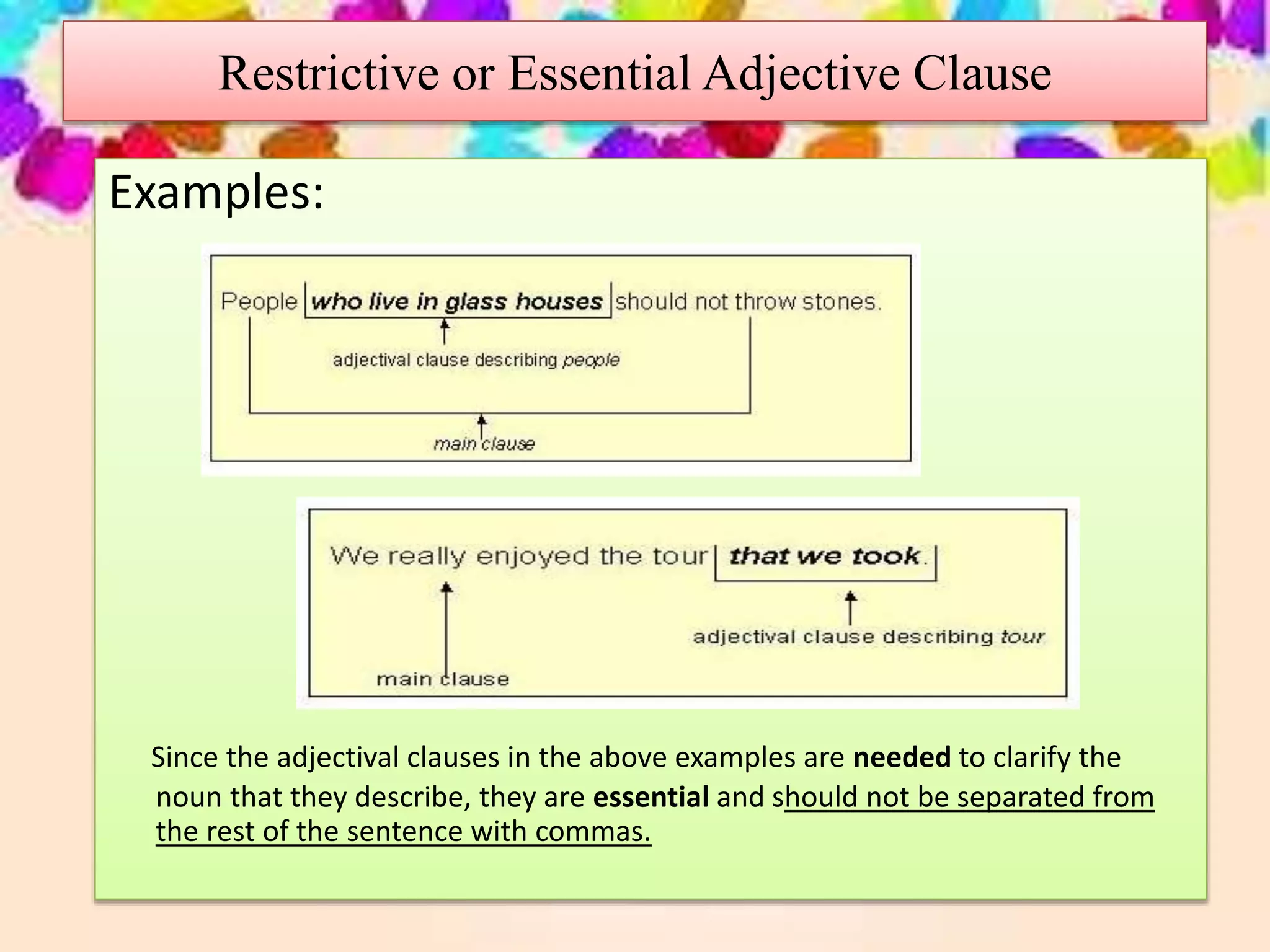
Examples:
Since the adjectival clauses in the above examples are needed to clarify the
noun that they describe, they are essential and should not be separated from
the rest of the sentence with commas.
Nonrestrictive or Nonessential Adjective Clause
• If the adjectival clause is nonessential (or "not
needed"), commas should separate it from the
main clause.
• Nonessential adjectival clauses should not
begin with that.
Nonrestrictive or Nonessential Adjective Clause
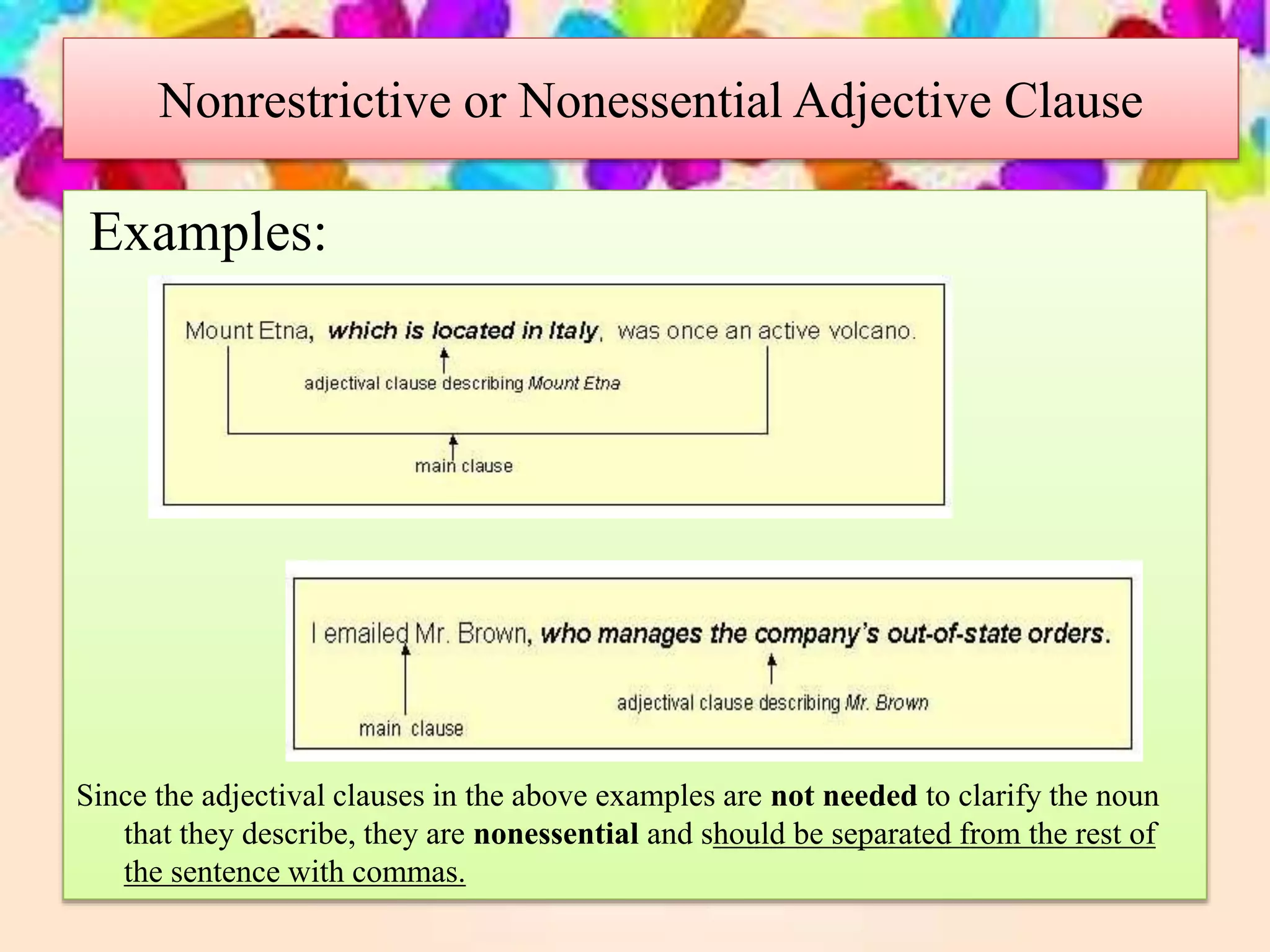
Examples:
Since the adjectival clauses in the above examples are not needed to clarify the noun
that they describe, they are nonessential and should be separated from the rest of
the sentence with commas.
Note the difference between the sentences in
each pair:
Note the difference between the sentences in
each pair:
Exercises:
A. Directions: Pick out the adjective clause in each sentence. Circle the
noun or the pronoun that the adjective clause describes.
1. Everyone who attended the party liked the cake.
2. They will call someone who can help them.
3. That's something that I find hard to believe.
4. It's hard to believe anything that she says.
5. You should ask someone who knows how to do it.
B. Directions: Complete the following sentences by adding appropriate
adjective clauses.
1. The target of development is the populace that __________________.
2. Slum dwellers are those that ___________________.
3. He doesn't like anything ___________________.
4. There are some combinations of traits and values __________________.
5. She is someone ___________________.
Thank you!
Adjectival clause

Adjectival clause

  • 1.
  • 2.
    REVIEW • An adjectivalclause is a dependent clause used as an adjective within a sentence. It is also known as relative clause. • In a written work, you may use adjective clauses effectively in order to make your sentences more varied. • Like a single-word adjective, an adjectival clause describes a noun (in the sentence’s main clause) and answers one of these questions: • Which one? • What kind? • Clause - - A group of words made up of a subject and a predicate. Kinds: 1. Dependent /subordinate clause – It has no complete thought - Adjectival clause - Adverbial clause - Nominal clause 2. Independent/main clause - It can stand alone as a sentence. It has a complete thought.
  • 3.
    An adjectival clauseusually begins with a relative pronoun, which makes the clause subordinate (dependent). Relative pronouns: 1. who, whom, and whose - used to describe people. 2. that and which - used to describe things. Adjectival clauses always follow the person, place, or thing they describe. The woman who lives next door is a registered nurse. The vegetables that people leave uneaten are often the most nutritious. Math, which is Dave's favorite subject, has always been easy for him.
  • 4.
    Example of adjectivalclause answering WHICH ONE Which book did Joe read? Answer: the one that I gave him
  • 5.
    Example of adjectivalclause answering WHAT KIND What kind of politician has the support of the people? Answer: one who is trustworthy
  • 6.
    Adjectival clauses mayalso begin with selected subordinating conjunctions: when - to describe a time
  • 7.
    Adjectival clauses mayalso begin with selected subordinating conjunctions: where - to describe a place
  • 8.
    Adjectival clauses mayalso begin with selected subordinating conjunctions: why - to describe a reason
  • 9.
    Two basic typesof adjective clauses: 1 . Restrictive or Essential Adjective Clause  It offers essential [information] and is needed to complete the sentence's thought. 2. Nonrestrictive or Nonessential Adjective Clause  This clause simply gives extra information about the noun.
  • 10.
    Restrictive or EssentialAdjective Clause • If the adjectival clause is essential (or "needed"), no commas should be used to separate it from the main clause. • Generally, essential adjectival clauses should not begin with which.
  • 11.
    Restrictive or EssentialAdjective Clause Examples: Since the adjectival clauses in the above examples are needed to clarify the noun that they describe, they are essential and should not be separated from the rest of the sentence with commas.
  • 12.
    Nonrestrictive or NonessentialAdjective Clause • If the adjectival clause is nonessential (or "not needed"), commas should separate it from the main clause. • Nonessential adjectival clauses should not begin with that.
  • 13.
    Nonrestrictive or NonessentialAdjective Clause Examples: Since the adjectival clauses in the above examples are not needed to clarify the noun that they describe, they are nonessential and should be separated from the rest of the sentence with commas.
  • 14.
    Note the differencebetween the sentences in each pair:
  • 15.
    Note the differencebetween the sentences in each pair:
  • 16.
    Exercises: A. Directions: Pickout the adjective clause in each sentence. Circle the noun or the pronoun that the adjective clause describes. 1. Everyone who attended the party liked the cake. 2. They will call someone who can help them. 3. That's something that I find hard to believe. 4. It's hard to believe anything that she says. 5. You should ask someone who knows how to do it. B. Directions: Complete the following sentences by adding appropriate adjective clauses. 1. The target of development is the populace that __________________. 2. Slum dwellers are those that ___________________. 3. He doesn't like anything ___________________. 4. There are some combinations of traits and values __________________. 5. She is someone ___________________.
  • 17.