Writing Business Letters:Style
 Style is how you write the letter.
 Business letters are written in formal
language.
 C’s of business letters:
 Clear
 Concise
 Complete
 Constructive
 Correct
Formal and Informal Writing
 Which style should you use?
 Formal or
 Informal ?
 It depends on _
 the purpose; and
 to whom you are writing
 Formal English is used mainly in
academic writing and business
communications,
 Informal English is casual and is
appropriate when communicating with
friends and other close ones.
 Choose the style of writing keeping in
mind what you are writing and to whom.
 But whichever style you write in – formal
or informal – be sure to keep it
consistent, do not mix the two.
Informal Writing Style
 Colloquial –
 Informal writing is similar to a spoken conversation.
 Informal writing may include slang, figures of
speech, broken syntax, asides and so on.
 Informal writing takes a personal tone as if you
were speaking directly to your audience (the
reader).
 You can use the first or third person point of view (I
and we), and you are likely to address the reader
using second person (you and your).
 Simple –
 Short sentences are acceptable and sometimes
essential to making a point in informal writing.
 There may be incomplete sentences or
ellipsis(…) to make points.
 Contractions and Abbreviations
 Words are likely to be simplified using
contractions (for example, I’m, doesn’t, couldn’t,
it’s)
 and abbreviations (e.g. TV, photos) whenever
possible.
Formal Writing Style
 Complex –
 Longer sentences are likely to be more prevalent
in formal writing.
 Each main point needs to be introduced,
elaborated and concluded.
 Objective –
 A formal writing style shows a limited range of
emotions and avoids emotive punctuation such
as exclamation points, ellipsis, etc., unless they
are being cited from another source.
 Full Words –
 No contractions should be used to simplify words
(in other words use "It is" rather than "It's").
 Abbreviations must be spelt out in full when first
used, the only exceptions being when the
acronym is better known than the full name (BBC,
NATO for example).
 Third Person –
 Formal writing is not a personal writing style.
 The formal writer is disconnected from the topic
and does not use the first person point of view (I
or we) or second person (you).
 Example 1: This is to inform you that your book has
been rejected by our publishing company as it was
not up to the required standard. In case you would
like us to reconsider it, we would suggest that you
go over it and make some necessary changes.
Example 2: You know that book I wrote? Well, the
publishing company rejected it. They thought it was
awful. But hey, I did the best I could, and I think it
was great. I’m not gonna redo it the way they said I
should.
Structure
Fragments, Comma Splices, and
Run-On Sentences
 In everyday conversations we often use fragment
sentences to convey our thoughts.
 If someone in our office asks, "Where are you
going?" we might answer, "To get coffee" or
"Downstairs"
 Writing, unfortunately, does not welcome any of
these manners of communication.
 Writing, or rather your reader, insists upon
complete thoughts.
Fragment Sentence
 Fragment sentences lack a subject, verb, or
phrase to complete a thought.
 Example:
A fine idea. (no subject or verb)
 Correction:
Your suggestion is a fine idea.
 Example:
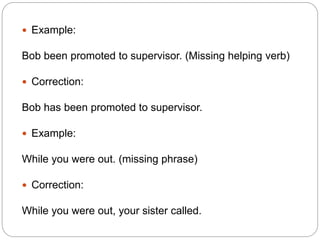
Bob been promoted to supervisor. (Missing helping verb)
 Correction:
Bob has been promoted to supervisor.
 Example:
While you were out. (missing phrase)
 Correction:
While you were out, your sister called.
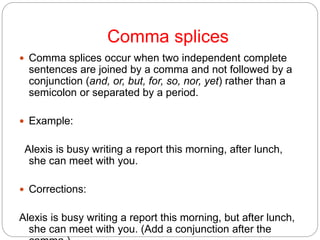
Comma splices
 Comma splices occur when two independent complete
sentences are joined by a comma and not followed by a
conjunction (and, or, but, for, so, nor, yet) rather than a
semicolon or separated by a period.
 Example:
Alexis is busy writing a report this morning, after lunch,
she can meet with you.
 Corrections:
Alexis is busy writing a report this morning, but after lunch,
she can meet with you. (Add a conjunction after the
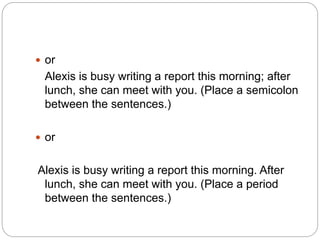
 or
Alexis is busy writing a report this morning; after
lunch, she can meet with you. (Place a semicolon
between the sentences.)
 or
Alexis is busy writing a report this morning. After
lunch, she can meet with you. (Place a period
between the sentences.)
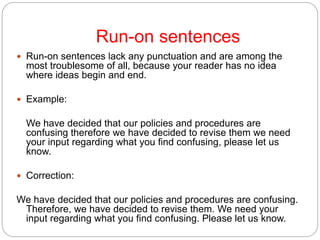
Run-on sentences
 Run-on sentences lack any punctuation and are among the
most troublesome of all, because your reader has no idea
where ideas begin and end.
 Example:
We have decided that our policies and procedures are
confusing therefore we have decided to revise them we need
your input regarding what you find confusing, please let us
know.
 Correction:
We have decided that our policies and procedures are confusing.
Therefore, we have decided to revise them. We need your
input regarding what you find confusing. Please let us know.
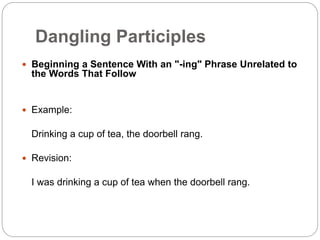
Dangling Participles
 Beginning a Sentence With an "-ing" Phrase Unrelated to
the Words That Follow
 Example:
Drinking a cup of tea, the doorbell rang.
 Revision:
I was drinking a cup of tea when the doorbell rang.
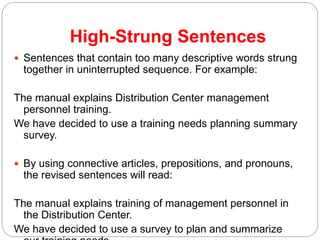
High-Strung Sentences
 Sentences that contain too many descriptive words strung
together in uninterrupted sequence. For example:
The manual explains Distribution Center management
personnel training.
We have decided to use a training needs planning summary
survey.
 By using connective articles, prepositions, and pronouns,
the revised sentences will read:
The manual explains training of management personnel in
the Distribution Center.
We have decided to use a survey to plan and summarize

Writing business-letters-style

  • 1.
  • 2.
     Style ishow you write the letter.  Business letters are written in formal language.  C’s of business letters:  Clear  Concise  Complete  Constructive  Correct
  • 3.
    Formal and InformalWriting  Which style should you use?  Formal or  Informal ?  It depends on _  the purpose; and  to whom you are writing
  • 4.
     Formal Englishis used mainly in academic writing and business communications,  Informal English is casual and is appropriate when communicating with friends and other close ones.
  • 5.
     Choose thestyle of writing keeping in mind what you are writing and to whom.  But whichever style you write in – formal or informal – be sure to keep it consistent, do not mix the two.
  • 6.
    Informal Writing Style Colloquial –  Informal writing is similar to a spoken conversation.  Informal writing may include slang, figures of speech, broken syntax, asides and so on.  Informal writing takes a personal tone as if you were speaking directly to your audience (the reader).  You can use the first or third person point of view (I and we), and you are likely to address the reader using second person (you and your).
  • 7.
     Simple – Short sentences are acceptable and sometimes essential to making a point in informal writing.  There may be incomplete sentences or ellipsis(…) to make points.
  • 8.
     Contractions andAbbreviations  Words are likely to be simplified using contractions (for example, I’m, doesn’t, couldn’t, it’s)  and abbreviations (e.g. TV, photos) whenever possible.
  • 9.
    Formal Writing Style Complex –  Longer sentences are likely to be more prevalent in formal writing.  Each main point needs to be introduced, elaborated and concluded.
  • 10.
     Objective – A formal writing style shows a limited range of emotions and avoids emotive punctuation such as exclamation points, ellipsis, etc., unless they are being cited from another source.
  • 11.
     Full Words–  No contractions should be used to simplify words (in other words use "It is" rather than "It's").  Abbreviations must be spelt out in full when first used, the only exceptions being when the acronym is better known than the full name (BBC, NATO for example).
  • 12.
     Third Person–  Formal writing is not a personal writing style.  The formal writer is disconnected from the topic and does not use the first person point of view (I or we) or second person (you).
  • 13.
     Example 1:This is to inform you that your book has been rejected by our publishing company as it was not up to the required standard. In case you would like us to reconsider it, we would suggest that you go over it and make some necessary changes. Example 2: You know that book I wrote? Well, the publishing company rejected it. They thought it was awful. But hey, I did the best I could, and I think it was great. I’m not gonna redo it the way they said I should.
  • 14.
  • 15.
    Fragments, Comma Splices,and Run-On Sentences  In everyday conversations we often use fragment sentences to convey our thoughts.  If someone in our office asks, "Where are you going?" we might answer, "To get coffee" or "Downstairs"  Writing, unfortunately, does not welcome any of these manners of communication.  Writing, or rather your reader, insists upon complete thoughts.
  • 16.
    Fragment Sentence  Fragmentsentences lack a subject, verb, or phrase to complete a thought.  Example: A fine idea. (no subject or verb)  Correction: Your suggestion is a fine idea.
  • 17.
     Example: Bob beenpromoted to supervisor. (Missing helping verb)  Correction: Bob has been promoted to supervisor.  Example: While you were out. (missing phrase)  Correction: While you were out, your sister called.
  • 18.
    Comma splices  Commasplices occur when two independent complete sentences are joined by a comma and not followed by a conjunction (and, or, but, for, so, nor, yet) rather than a semicolon or separated by a period.  Example: Alexis is busy writing a report this morning, after lunch, she can meet with you.  Corrections: Alexis is busy writing a report this morning, but after lunch, she can meet with you. (Add a conjunction after the
  • 19.
     or Alexis isbusy writing a report this morning; after lunch, she can meet with you. (Place a semicolon between the sentences.)  or Alexis is busy writing a report this morning. After lunch, she can meet with you. (Place a period between the sentences.)
  • 20.
    Run-on sentences  Run-onsentences lack any punctuation and are among the most troublesome of all, because your reader has no idea where ideas begin and end.  Example: We have decided that our policies and procedures are confusing therefore we have decided to revise them we need your input regarding what you find confusing, please let us know.  Correction: We have decided that our policies and procedures are confusing. Therefore, we have decided to revise them. We need your input regarding what you find confusing. Please let us know.
  • 21.
    Dangling Participles  Beginninga Sentence With an "-ing" Phrase Unrelated to the Words That Follow  Example: Drinking a cup of tea, the doorbell rang.  Revision: I was drinking a cup of tea when the doorbell rang.
  • 22.
    High-Strung Sentences  Sentencesthat contain too many descriptive words strung together in uninterrupted sequence. For example: The manual explains Distribution Center management personnel training. We have decided to use a training needs planning summary survey.  By using connective articles, prepositions, and pronouns, the revised sentences will read: The manual explains training of management personnel in the Distribution Center. We have decided to use a survey to plan and summarize