
SRI VENKATESHWARA POLYTECHNIC COLLEGE
ADUKAMPARAI, VELLORE-11.
3RD GENERATION TECHNOLOGY
BY,
M.ASHVITHA
A.ARTHI
 3G Overview
 Advantage, Capabilities, Organizations, IMT-2000
radio interface, Technologies, Evolution paths
 UMTS-FDD / WCDMA
 Physical layer, Mac layer, RLC layer, RRC layer
 Hand Over
 Power Control
 QoS Support
 What’s next after 3G?
 Summary
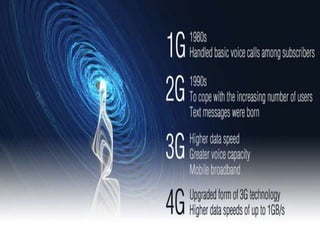
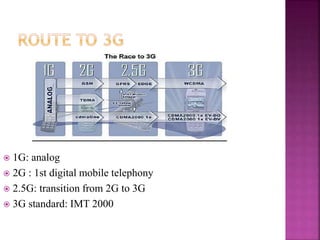
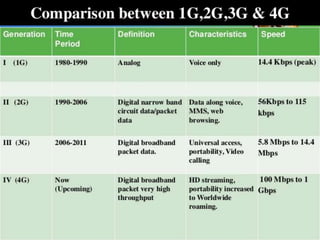
 1G: analog
 2G : 1st digital mobile telephony
 2.5G: transition from 2G to 3G
 3G standard: IMT 2000
First Generation:-
 Its using a analog signal.
 Listen to handset.
 Frequency is typically 150 MHZ and above.
Second Generation:-
 Using GSM.(Global System for Mobile
communications).
 GSM provides voice and limited data services and
uses digital modulation for improved audio
quality.
 Digital AMPS,CDMA were some of 2G systems.
 AMPS acronym is Advanced Mobile Phone
System.
 CDMA acronym is Code Division Multiple
Access.
2.5 Generation:-
 CDMA 2000 1x and GPRS are used.
 GPRS acronym is General Packet Radio
Service.
 GPRS data transfer through cellular network.
 It’s is widely used in America and Asia.
 The network’s operate in 800 and 1900 MHZ.
 It’s used in mobile internet, MMS and other
communications.
 It’s theory speed limit is 115 kbps.
 Most network around 35 kbps.
 It’s implemented by using WCDMA,CDMA 2000
1x EV-DO,CDMA 2000 1x EV-DV.
CDMA 2000 1x EV-DO:-
 It supports data rates up to 2.4 Mbps.
 But needs to be deployed in a separate
spectrum.
CDMA 2000 1x EV-DV:-
 It supports data rates of around 3-5 Mbps.
 And also it supports voice capabilities.
WCDMA:-
 Wideband Code Division Multiple Access.
 Wireless standard which allows use of both
voice and data.
 Data speeds of up to 384 kbps.
 Europe and Asia frequency band is 2100MHZ.
 North America frequency band is 1900 MHZ
and 850 MHZ.
 It’s also called as UMTS(Universal Mobile
Telecommunication System).
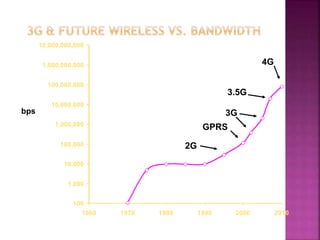
100
1,000
10,000
100,000
1,000,000
10,000,000
100,000,000
1,000,000,000
10,000,000,000
1960 1970 1980 1990 2000 2010
bps
GPRS
3G
4G
2G
3.5G
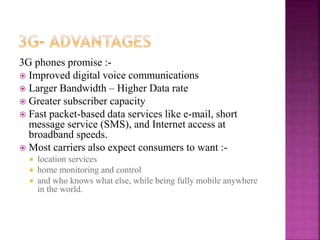
3G phones promise :-
 Improved digital voice communications
 Larger Bandwidth – Higher Data rate
 Greater subscriber capacity
 Fast packet-based data services like e-mail, short
message service (SMS), and Internet access at
broadband speeds.
 Most carriers also expect consumers to want :-
 location services
 home monitoring and control
 and who knows what else, while being fully mobile anywhere
in the world.
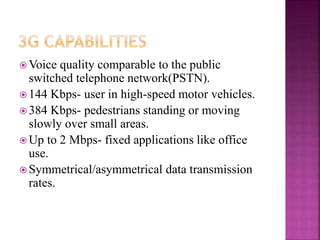
 Voice quality comparable to the public
switched telephone network(PSTN).
 144 Kbps- user in high-speed motor vehicles.
 384 Kbps- pedestrians standing or moving
slowly over small areas.
 Up to 2 Mbps- fixed applications like office
use.
 Symmetrical/asymmetrical data transmission
rates.
 3G is also known as UMTS (Universal Mobile
Telecommunication System)
 3GPP 3rd Generation Partnership Project.
 3GPP2 3rd Generation Partnership Project 2
 Internet Engineering Taskforce (IETF)
 ITU-IMT-2000 Standard (International
Telecommunication Union- International Mobile
Telecommunication)
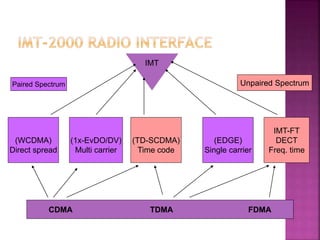
(WCDMA)
Direct spread
(1x-EvDO/DV)
Multi carrier
(TD-SCDMA)
Time code
(EDGE)
Single carrier
IMT-FT
DECT
Freq. time
CDMA TDMA FDMA
IMT
Paired Spectrum Unpaired Spectrum
 3G is superior to the other digital standards like:-
 GSM (Global System for Mobile) communications standard used worldwide
 And IS-136 TDMA standard used primarily in North America.
 3G Technologies:-
 WCDMA or UMTS-FDD (Universal Mobile Telecommunications System -
Frequency Division Duplex)---Direct Spread
 CDMA2000 - 1x-EvDO/EvDV---Multi carrier
 UMTS – TDD (Time Division Duplex) or TD-SCDMA (Time Division -
Synchronous Code Division Multiple Access) ---Time Code
 4G Technologies:-
 Digital Audio Broadcast (DAB) and Digital Video Broadcast (DVB) for wide area
broadcasting
 Local Multipoint Distribution System (LMDS)
 Microwave Multipoint Distribution System (MMDS)
 Universal Mobile Telecommunications System-
Frequency Division Duplex.
 Wideband Direct Sequence Code Division
Multiple Access.
 Does not assign a specific frequency to each user.
 Instead every channel uses the full available
spectrum.
 Narrowband option for TDD(Time Division
Duplex).
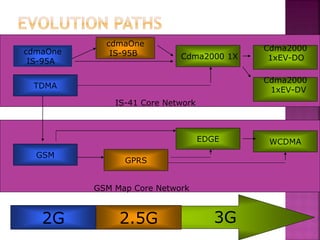
2.5G
2G 3G
cdmaOne
IS-95A
TDMA
cdmaOne
IS-95B Cdma2000 1X
Cdma2000
1xEV-DV
Cdma2000
1xEV-DO
GSM
GPRS
EDGE WCDMA
GSM Map Core Network
IS-41 Core Network
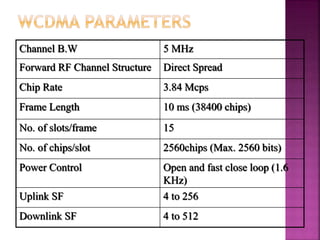
Channel B.W 5 MHz
Forward RF Channel Structure Direct Spread
Chip Rate 3.84 Mcps
Frame Length 10 ms (38400 chips)
No. of slots/frame 15
No. of chips/slot 2560chips (Max. 2560 bits)
Power Control Open and fast close loop (1.6
KHz)
Uplink SF 4 to 256
Downlink SF 4 to 512
 The physical layer offers information transfer services to the
MAC layer. These services are denoted as Transport channels
(TrCh’s). There are also Physical channels.
 Physical layer comprises following functions:
 􀂉 Various handover functions
 􀂉 Error detection and report to higher layers
 􀂉 Multiplexing of transport channels
 􀂉 Mapping of transport channels to physical channels
 􀂉 Fast Close loop Power control
 􀂉 Frequency and Time Synchronization
 􀂉 Other responsibilities associated with transmitting
and receiving signals over the wireless media.
 The MAC layer offers Data transfer to RLC and higher layers.
 The MAC layer comprises the following functions:
 Selection of appropriate TF (basically bit rate), within a predefined set,
per information unit delivered to the physical layer
 Service multiplexing on RACH, FACH, and dedicated channels
 Priority handling between ‘data flows’ of one user as well as between
data flows from several users—the latter being achieved by means of
dynamic scheduling
 Access control on RACH
 Address control on RACH and FACH
 Contention resolution on RACH
 The RLC layer offers the following services to the higher
layers:
 Layer 2 connection establishment/release
 Transparent data transfer.
 Assured and un assured data transfer
 The RLC layer comprises the following functions:
 Segmentation and assembly
 Transfer of user data
 Error correction by means of retransmission optimized for the WCDMA
physical layer
 Sequence integrity (used by at least the control plane)
 Duplicate detection
 Flow control
 Ciphering
 The RRC layer comprises the following functions:
 Broadcasting information from network
 Radio resource handling (e.g., code allocation, handover, admission
control, and measurement reporting/control)
 QoS Control
 UE measurement reporting and control of the reporting
 Power Control, Encryption and Integrity protection
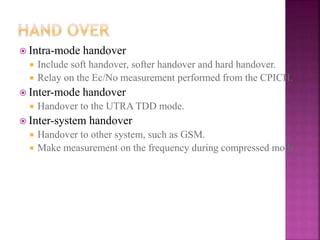
 Intra-mode handover
 Include soft handover, softer handover and hard handover.
 Relay on the Ec/No measurement performed from the CPICH.
 Inter-mode handover
 Handover to the UTRA TDD mode.
 Inter-system handover
 Handover to other system, such as GSM.
 Make measurement on the frequency during compressed mode.
 Fast Closed Loop PC – Inner Loop PC
 Feedback information.
 Two special cases for fast closed loop PC:
 Soft handover.
 Compressed mode.
 Open loop PC
 No feedback information.
 Make a rough estimate of the path loss by means of a downlink
beacon signal.
 Provide a coarse initial power setting of the mobile at the
beginning of a connection.
 Apply only prior to initiating the transmission on
RACH(Random Access Channel) or CPCH(Common Packet
Channel).
 The standard provides an overview of the functionality
needed to establish, modify and maintain a UMTS link
with a specific QoS.
 Divided into:
 Control plane
 Managing, translating, admitting and controlling users requests and
network resources.
 User plane
 QoS signaling and monitoring of user data traffic
 Conversational (real time):-
 VoIP
 Telephony
 Video conferencing
 􀂉 Streaming (real time):-
 Video and audio streams
 􀂉 Interactive:-
 Web browsing
 Data retrieval
 Server access
 􀂉 Background:-
 Download of emails and files
 Higher bit rates than 3G (20 Mbps < peak < 200 Mbps)
 Higher spectral efficiency and Lower Cost per bit than 3G
 Air interface and MAC optimized for IP traffic
 Adaptive modulation/coding with power control, hybrid ARQ
 Smaller cells, on average, than 3G
 However, cell size will be made as large as possible via:
 High power base station to boost downlink range
 Asymmetry - used to boost uplink range when necessary
 Adaptive antennas option
 Higher frequency band than 3G (below 5 GHz preferred)
 RF channel bandwidths of 20 MHz and higher
 Frequency Domain methods:
 OFDM is promising for downlink
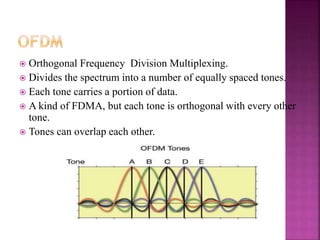
 Orthogonal Frequency Division Multiplexing.
 Divides the spectrum into a number of equally spaced tones.
 Each tone carries a portion of data.
 A kind of FDMA, but each tone is orthogonal with every other
tone.
 Tones can overlap each other.
 3G wireless services are rapidly spreading the global market place with CDMA as the
preferred technology solution
 The following are the key 3G Technologies that have emerged to be the key commercial
players:
 CDMA2000 1X
 CDMA2000 1xEV-DO
 UMTS/WCDMA
 WCDMA is one of them, which provides:-
 Larger Bandwidth – Higher Data rate – Lower cost
 Greater subscriber capacity
 IMT-2000 Radio interface standard offers 3G standard
 Hand Over, Power Control problems are addressed
 4G Frequency bands less than 5 GHz preferred for wide-area, mobile services
 4G system bandwidth between 20 and 100 MHz
 Lower cost per bit than 3G
Aa

Aa

  • 1.
    SRI VENKATESHWARA POLYTECHNICCOLLEGE ADUKAMPARAI, VELLORE-11. 3RD GENERATION TECHNOLOGY BY, M.ASHVITHA A.ARTHI
  • 3.
     3G Overview Advantage, Capabilities, Organizations, IMT-2000 radio interface, Technologies, Evolution paths  UMTS-FDD / WCDMA  Physical layer, Mac layer, RLC layer, RRC layer  Hand Over  Power Control  QoS Support  What’s next after 3G?  Summary
  • 6.
     1G: analog 2G : 1st digital mobile telephony  2.5G: transition from 2G to 3G  3G standard: IMT 2000
  • 7.
    First Generation:-  Itsusing a analog signal.  Listen to handset.  Frequency is typically 150 MHZ and above. Second Generation:-  Using GSM.(Global System for Mobile communications).  GSM provides voice and limited data services and uses digital modulation for improved audio quality.
  • 8.
     Digital AMPS,CDMAwere some of 2G systems.  AMPS acronym is Advanced Mobile Phone System.  CDMA acronym is Code Division Multiple Access. 2.5 Generation:-  CDMA 2000 1x and GPRS are used.  GPRS acronym is General Packet Radio Service.  GPRS data transfer through cellular network.
  • 9.
     It’s iswidely used in America and Asia.  The network’s operate in 800 and 1900 MHZ.  It’s used in mobile internet, MMS and other communications.  It’s theory speed limit is 115 kbps.  Most network around 35 kbps.
  • 10.
     It’s implementedby using WCDMA,CDMA 2000 1x EV-DO,CDMA 2000 1x EV-DV. CDMA 2000 1x EV-DO:-  It supports data rates up to 2.4 Mbps.  But needs to be deployed in a separate spectrum. CDMA 2000 1x EV-DV:-  It supports data rates of around 3-5 Mbps.  And also it supports voice capabilities.
  • 11.
    WCDMA:-  Wideband CodeDivision Multiple Access.  Wireless standard which allows use of both voice and data.  Data speeds of up to 384 kbps.  Europe and Asia frequency band is 2100MHZ.  North America frequency band is 1900 MHZ and 850 MHZ.  It’s also called as UMTS(Universal Mobile Telecommunication System).
  • 12.
  • 14.
    3G phones promise:-  Improved digital voice communications  Larger Bandwidth – Higher Data rate  Greater subscriber capacity  Fast packet-based data services like e-mail, short message service (SMS), and Internet access at broadband speeds.  Most carriers also expect consumers to want :-  location services  home monitoring and control  and who knows what else, while being fully mobile anywhere in the world.
  • 15.
     Voice qualitycomparable to the public switched telephone network(PSTN).  144 Kbps- user in high-speed motor vehicles.  384 Kbps- pedestrians standing or moving slowly over small areas.  Up to 2 Mbps- fixed applications like office use.  Symmetrical/asymmetrical data transmission rates.
  • 16.
     3G isalso known as UMTS (Universal Mobile Telecommunication System)  3GPP 3rd Generation Partnership Project.  3GPP2 3rd Generation Partnership Project 2  Internet Engineering Taskforce (IETF)  ITU-IMT-2000 Standard (International Telecommunication Union- International Mobile Telecommunication)
  • 17.
    (WCDMA) Direct spread (1x-EvDO/DV) Multi carrier (TD-SCDMA) Timecode (EDGE) Single carrier IMT-FT DECT Freq. time CDMA TDMA FDMA IMT Paired Spectrum Unpaired Spectrum
  • 18.
     3G issuperior to the other digital standards like:-  GSM (Global System for Mobile) communications standard used worldwide  And IS-136 TDMA standard used primarily in North America.  3G Technologies:-  WCDMA or UMTS-FDD (Universal Mobile Telecommunications System - Frequency Division Duplex)---Direct Spread  CDMA2000 - 1x-EvDO/EvDV---Multi carrier  UMTS – TDD (Time Division Duplex) or TD-SCDMA (Time Division - Synchronous Code Division Multiple Access) ---Time Code  4G Technologies:-  Digital Audio Broadcast (DAB) and Digital Video Broadcast (DVB) for wide area broadcasting  Local Multipoint Distribution System (LMDS)  Microwave Multipoint Distribution System (MMDS)
  • 19.
     Universal MobileTelecommunications System- Frequency Division Duplex.  Wideband Direct Sequence Code Division Multiple Access.  Does not assign a specific frequency to each user.  Instead every channel uses the full available spectrum.  Narrowband option for TDD(Time Division Duplex).
  • 20.
    2.5G 2G 3G cdmaOne IS-95A TDMA cdmaOne IS-95B Cdma20001X Cdma2000 1xEV-DV Cdma2000 1xEV-DO GSM GPRS EDGE WCDMA GSM Map Core Network IS-41 Core Network
  • 21.
    Channel B.W 5MHz Forward RF Channel Structure Direct Spread Chip Rate 3.84 Mcps Frame Length 10 ms (38400 chips) No. of slots/frame 15 No. of chips/slot 2560chips (Max. 2560 bits) Power Control Open and fast close loop (1.6 KHz) Uplink SF 4 to 256 Downlink SF 4 to 512
  • 23.
     The physicallayer offers information transfer services to the MAC layer. These services are denoted as Transport channels (TrCh’s). There are also Physical channels.  Physical layer comprises following functions:  􀂉 Various handover functions  􀂉 Error detection and report to higher layers  􀂉 Multiplexing of transport channels  􀂉 Mapping of transport channels to physical channels  􀂉 Fast Close loop Power control  􀂉 Frequency and Time Synchronization  􀂉 Other responsibilities associated with transmitting and receiving signals over the wireless media.
  • 25.
     The MAClayer offers Data transfer to RLC and higher layers.  The MAC layer comprises the following functions:  Selection of appropriate TF (basically bit rate), within a predefined set, per information unit delivered to the physical layer  Service multiplexing on RACH, FACH, and dedicated channels  Priority handling between ‘data flows’ of one user as well as between data flows from several users—the latter being achieved by means of dynamic scheduling  Access control on RACH  Address control on RACH and FACH  Contention resolution on RACH
  • 27.
     The RLClayer offers the following services to the higher layers:  Layer 2 connection establishment/release  Transparent data transfer.  Assured and un assured data transfer  The RLC layer comprises the following functions:  Segmentation and assembly  Transfer of user data  Error correction by means of retransmission optimized for the WCDMA physical layer  Sequence integrity (used by at least the control plane)  Duplicate detection  Flow control  Ciphering
  • 29.
     The RRClayer comprises the following functions:  Broadcasting information from network  Radio resource handling (e.g., code allocation, handover, admission control, and measurement reporting/control)  QoS Control  UE measurement reporting and control of the reporting  Power Control, Encryption and Integrity protection
  • 31.
     Intra-mode handover Include soft handover, softer handover and hard handover.  Relay on the Ec/No measurement performed from the CPICH.  Inter-mode handover  Handover to the UTRA TDD mode.  Inter-system handover  Handover to other system, such as GSM.  Make measurement on the frequency during compressed mode.
  • 33.
     Fast ClosedLoop PC – Inner Loop PC  Feedback information.  Two special cases for fast closed loop PC:  Soft handover.  Compressed mode.
  • 34.
     Open loopPC  No feedback information.  Make a rough estimate of the path loss by means of a downlink beacon signal.  Provide a coarse initial power setting of the mobile at the beginning of a connection.  Apply only prior to initiating the transmission on RACH(Random Access Channel) or CPCH(Common Packet Channel).
  • 35.
     The standardprovides an overview of the functionality needed to establish, modify and maintain a UMTS link with a specific QoS.  Divided into:  Control plane  Managing, translating, admitting and controlling users requests and network resources.  User plane  QoS signaling and monitoring of user data traffic
  • 36.
     Conversational (realtime):-  VoIP  Telephony  Video conferencing  􀂉 Streaming (real time):-  Video and audio streams  􀂉 Interactive:-  Web browsing  Data retrieval  Server access  􀂉 Background:-  Download of emails and files
  • 37.
     Higher bitrates than 3G (20 Mbps < peak < 200 Mbps)  Higher spectral efficiency and Lower Cost per bit than 3G  Air interface and MAC optimized for IP traffic  Adaptive modulation/coding with power control, hybrid ARQ  Smaller cells, on average, than 3G  However, cell size will be made as large as possible via:  High power base station to boost downlink range  Asymmetry - used to boost uplink range when necessary  Adaptive antennas option  Higher frequency band than 3G (below 5 GHz preferred)  RF channel bandwidths of 20 MHz and higher  Frequency Domain methods:  OFDM is promising for downlink
  • 38.
     Orthogonal FrequencyDivision Multiplexing.  Divides the spectrum into a number of equally spaced tones.  Each tone carries a portion of data.  A kind of FDMA, but each tone is orthogonal with every other tone.  Tones can overlap each other.
  • 39.
     3G wirelessservices are rapidly spreading the global market place with CDMA as the preferred technology solution  The following are the key 3G Technologies that have emerged to be the key commercial players:  CDMA2000 1X  CDMA2000 1xEV-DO  UMTS/WCDMA  WCDMA is one of them, which provides:-  Larger Bandwidth – Higher Data rate – Lower cost  Greater subscriber capacity  IMT-2000 Radio interface standard offers 3G standard  Hand Over, Power Control problems are addressed  4G Frequency bands less than 5 GHz preferred for wide-area, mobile services  4G system bandwidth between 20 and 100 MHz  Lower cost per bit than 3G

Editor's Notes

  • #39 Do not need frequency guard