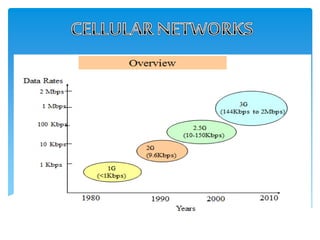
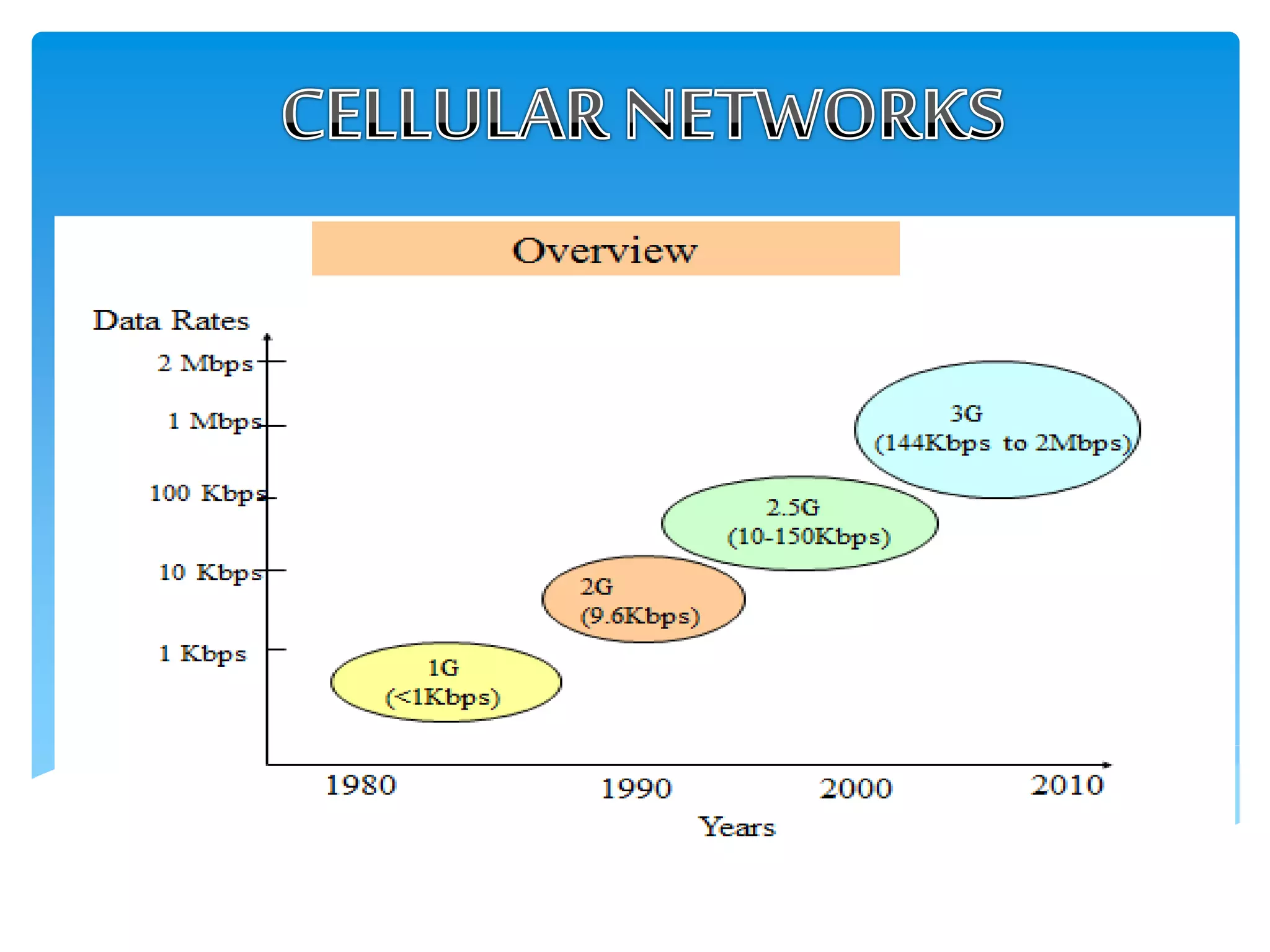
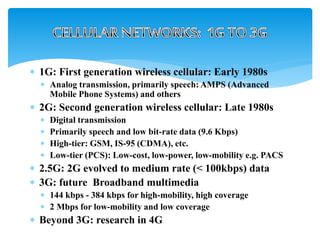
 1G: First generation wireless cellular: Early 1980s
 Analog transmission, primarily speech: AMPS (Advanced
Mobile Phone Systems) and others
 2G: Second generation wireless cellular: Late 1980s
 Digital transmission
 Primarily speech and low bit-rate data (9.6 Kbps)
 High-tier: GSM, IS-95 (CDMA), etc.
 Low-tier (PCS): Low-cost, low-power, low-mobility e.g. PACS
 2.5G: 2G evolved to medium rate (< 100kbps) data
 3G: future Broadband multimedia
 144 kbps - 384 kbps for high-mobility, high coverage
 2 Mbps for low-mobility and low coverage
 Beyond 3G: research in 4G
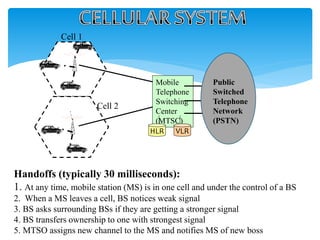
Handoffs (typically 30 milliseconds):
1. At any time, mobile station (MS) is in one cell and under the control of a BS
2. When a MS leaves a cell, BS notices weak signal
3. BS asks surrounding BSs if they are getting a stronger signal
4. BS transfers ownership to one with strongest signal
5. MTSO assigns new channel to the MS and notifies MS of new boss
Mobile
Telephone
Switching
Center
(MTSC)
Cell 1
Cell 2
HLR VLR
Public
Switched
Telephone
Network
(PSTN)
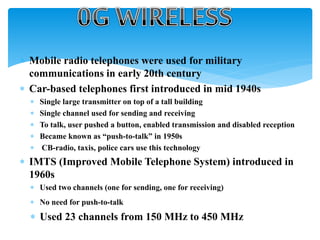
 Mobile radio telephones were used for military
communications in early 20th century
 Car-based telephones first introduced in mid 1940s
 Single large transmitter on top of a tall building
 Single channel used for sending and receiving
 To talk, user pushed a button, enabled transmission and disabled reception
 Became known as “push-to-talk” in 1950s
 CB-radio, taxis, police cars use this technology
 IMTS (Improved Mobile Telephone System) introduced in
1960s
 Used two channels (one for sending, one for receiving)
 No need for push-to-talk
 Used 23 channels from 150 MHz to 450 MHz
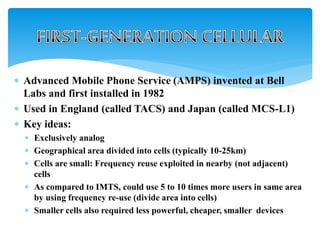
 Advanced Mobile Phone Service (AMPS) invented at Bell
Labs and first installed in 1982
 Used in England (called TACS) and Japan (called MCS-L1)
 Key ideas:
 Exclusively analog
 Geographical area divided into cells (typically 10-25km)
 Cells are small: Frequency reuse exploited in nearby (not adjacent)
cells
 As compared to IMTS, could use 5 to 10 times more users in same area
by using frequency re-use (divide area into cells)
 Smaller cells also required less powerful, cheaper, smaller devices
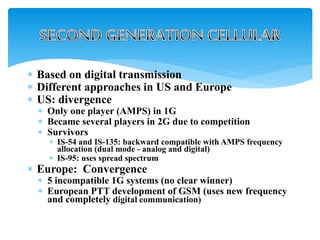
 Based on digital transmission
 Different approaches in US and Europe
 US: divergence
 Only one player (AMPS) in 1G
 Became several players in 2G due to competition
 Survivors
 IS-54 and IS-135: backward compatible with AMPS frequency
allocation (dual mode - analog and digital)
 IS-95: uses spread spectrum
 Europe: Convergence
 5 incompatible 1G systems (no clear winner)
 European PTT development of GSM (uses new frequency
and completely digital communication)
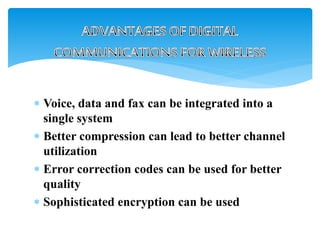
 Voice, data and fax can be integrated into a
single system
 Better compression can lead to better channel
utilization
 Error correction codes can be used for better
quality
 Sophisticated encryption can be used
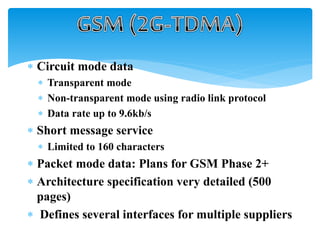
 Circuit mode data
 Transparent mode
 Non-transparent mode using radio link protocol
 Data rate up to 9.6kb/s
 Short message service
 Limited to 160 characters
 Packet mode data: Plans for GSM Phase 2+
 Architecture specification very detailed (500
pages)
 Defines several interfaces for multiple suppliers
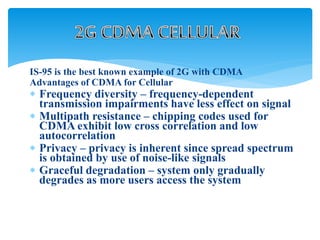
IS-95 is the best known example of 2G with CDMA
Advantages of CDMA for Cellular
 Frequency diversity – frequency-dependent
transmission impairments have less effect on signal
 Multipath resistance – chipping codes used for
CDMA exhibit low cross correlation and low
autocorrelation
 Privacy – privacy is inherent since spread spectrum
is obtained by use of noise-like signals
 Graceful degradation – system only gradually
degrades as more users access the system
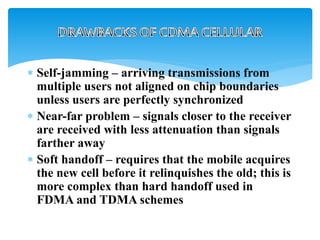
 Self-jamming – arriving transmissions from
multiple users not aligned on chip boundaries
unless users are perfectly synchronized
 Near-far problem – signals closer to the receiver
are received with less attenuation than signals
farther away
 Soft handoff – requires that the mobile acquires
the new cell before it relinquishes the old; this is
more complex than hard handoff used in
FDMA and TDMA schemes
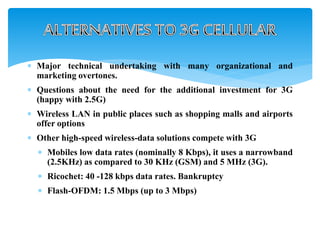
 Major technical undertaking with many organizational and
marketing overtones.
 Questions about the need for the additional investment for 3G
(happy with 2.5G)
 Wireless LAN in public places such as shopping malls and airports
offer options
 Other high-speed wireless-data solutions compete with 3G
 Mobiles low data rates (nominally 8 Kbps), it uses a narrowband
(2.5KHz) as compared to 30 KHz (GSM) and 5 MHz (3G).
 Ricochet: 40 -128 kbps data rates. Bankruptcy
 Flash-OFDM: 1.5 Mbps (up to 3 Mbps)
 Wireless networks with cellular data rates of 20 Mbits/second
and beyond.
 AT&T has began a two-phase upgrade of its wireless
network on the way to 4G Access.
 Nortel developing features for Internet protocol-based 4G
networks
 Alcatel, Ericsson, Nokia and Siemens found a new Wireless
World Research Forum (WWRF) for research on wireless
communications beyond 3G.
 Many new technologies and techniques (multiplexing,
intelligent antennas, digital signal processing)
 Industry response is mixed (some very critical)

Cellular system

  • 2.
     1G: Firstgeneration wireless cellular: Early 1980s  Analog transmission, primarily speech: AMPS (Advanced Mobile Phone Systems) and others  2G: Second generation wireless cellular: Late 1980s  Digital transmission  Primarily speech and low bit-rate data (9.6 Kbps)  High-tier: GSM, IS-95 (CDMA), etc.  Low-tier (PCS): Low-cost, low-power, low-mobility e.g. PACS  2.5G: 2G evolved to medium rate (< 100kbps) data  3G: future Broadband multimedia  144 kbps - 384 kbps for high-mobility, high coverage  2 Mbps for low-mobility and low coverage  Beyond 3G: research in 4G
  • 3.
    Handoffs (typically 30milliseconds): 1. At any time, mobile station (MS) is in one cell and under the control of a BS 2. When a MS leaves a cell, BS notices weak signal 3. BS asks surrounding BSs if they are getting a stronger signal 4. BS transfers ownership to one with strongest signal 5. MTSO assigns new channel to the MS and notifies MS of new boss Mobile Telephone Switching Center (MTSC) Cell 1 Cell 2 HLR VLR Public Switched Telephone Network (PSTN)
  • 4.
     Mobile radiotelephones were used for military communications in early 20th century  Car-based telephones first introduced in mid 1940s  Single large transmitter on top of a tall building  Single channel used for sending and receiving  To talk, user pushed a button, enabled transmission and disabled reception  Became known as “push-to-talk” in 1950s  CB-radio, taxis, police cars use this technology  IMTS (Improved Mobile Telephone System) introduced in 1960s  Used two channels (one for sending, one for receiving)  No need for push-to-talk  Used 23 channels from 150 MHz to 450 MHz
  • 5.
     Advanced MobilePhone Service (AMPS) invented at Bell Labs and first installed in 1982  Used in England (called TACS) and Japan (called MCS-L1)  Key ideas:  Exclusively analog  Geographical area divided into cells (typically 10-25km)  Cells are small: Frequency reuse exploited in nearby (not adjacent) cells  As compared to IMTS, could use 5 to 10 times more users in same area by using frequency re-use (divide area into cells)  Smaller cells also required less powerful, cheaper, smaller devices
  • 6.
     Based ondigital transmission  Different approaches in US and Europe  US: divergence  Only one player (AMPS) in 1G  Became several players in 2G due to competition  Survivors  IS-54 and IS-135: backward compatible with AMPS frequency allocation (dual mode - analog and digital)  IS-95: uses spread spectrum  Europe: Convergence  5 incompatible 1G systems (no clear winner)  European PTT development of GSM (uses new frequency and completely digital communication)
  • 7.
     Voice, dataand fax can be integrated into a single system  Better compression can lead to better channel utilization  Error correction codes can be used for better quality  Sophisticated encryption can be used
  • 8.
     Circuit modedata  Transparent mode  Non-transparent mode using radio link protocol  Data rate up to 9.6kb/s  Short message service  Limited to 160 characters  Packet mode data: Plans for GSM Phase 2+  Architecture specification very detailed (500 pages)  Defines several interfaces for multiple suppliers
  • 9.
    IS-95 is thebest known example of 2G with CDMA Advantages of CDMA for Cellular  Frequency diversity – frequency-dependent transmission impairments have less effect on signal  Multipath resistance – chipping codes used for CDMA exhibit low cross correlation and low autocorrelation  Privacy – privacy is inherent since spread spectrum is obtained by use of noise-like signals  Graceful degradation – system only gradually degrades as more users access the system
  • 10.
     Self-jamming –arriving transmissions from multiple users not aligned on chip boundaries unless users are perfectly synchronized  Near-far problem – signals closer to the receiver are received with less attenuation than signals farther away  Soft handoff – requires that the mobile acquires the new cell before it relinquishes the old; this is more complex than hard handoff used in FDMA and TDMA schemes
  • 11.
     Major technicalundertaking with many organizational and marketing overtones.  Questions about the need for the additional investment for 3G (happy with 2.5G)  Wireless LAN in public places such as shopping malls and airports offer options  Other high-speed wireless-data solutions compete with 3G  Mobiles low data rates (nominally 8 Kbps), it uses a narrowband (2.5KHz) as compared to 30 KHz (GSM) and 5 MHz (3G).  Ricochet: 40 -128 kbps data rates. Bankruptcy  Flash-OFDM: 1.5 Mbps (up to 3 Mbps)
  • 12.
     Wireless networkswith cellular data rates of 20 Mbits/second and beyond.  AT&T has began a two-phase upgrade of its wireless network on the way to 4G Access.  Nortel developing features for Internet protocol-based 4G networks  Alcatel, Ericsson, Nokia and Siemens found a new Wireless World Research Forum (WWRF) for research on wireless communications beyond 3G.  Many new technologies and techniques (multiplexing, intelligent antennas, digital signal processing)  Industry response is mixed (some very critical)