1www.TempusTelcosys.com
Telecom Tutorials
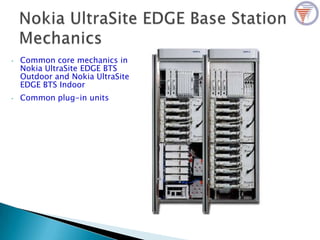
• Common core mechanics in
Nokia UltraSite EDGE BTS
Outdoor and Nokia UltraSite
EDGE BTS Indoor
• Common plug-in units
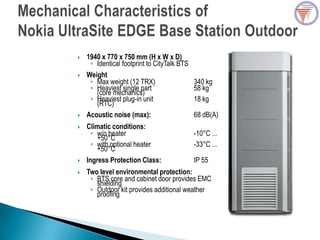
 1940 x 770 x 750 mm (H x W x D)
◦ Identical footprint to CityTalk BTS
 Weight
◦ Max weight (12 TRX) 340 kg
◦ Heaviest single part 58 kg
(core mechanics)
◦ Heaviest plug-in unit 18 kg
(RTC)
 Acoustic noise (max): 68 dB(A)
 Climatic conditions:
◦ w/o heater -10°C ...
+50°C
◦ with optional heater -33°C ...
+50°C
 Ingress Protection Class: IP 55
 Two level environmental protection:
◦ BTS core and cabinet door provides EMC
shielding
◦ Outdoor kit provides additional weather
proofing
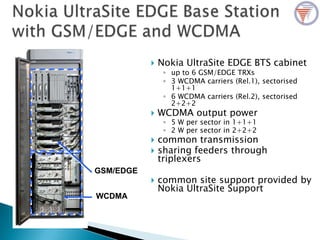
 Nokia UltraSite EDGE BTS cabinet
◦ up to 6 GSM/EDGE TRXs
◦ 3 WCDMA carriers (Rel.1), sectorised
1+1+1
◦ 6 WCDMA carriers (Rel.2), sectorised
2+2+2
 WCDMA output power
◦ 5 W per sector in 1+1+1
◦ 2 W per sector in 2+2+2
 common transmission
 sharing feeders through
triplexers
 common site support provided by
Nokia UltraSite Support
GSM/EDGE
WCDMA
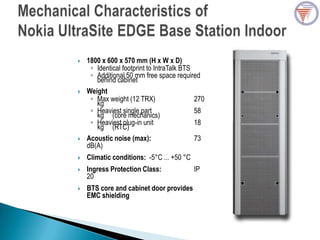
 1800 x 600 x 570 mm (H x W x D)
◦ Identical footprint to IntraTalk BTS
◦ Additional 50 mm free space required
behind cabinet
 Weight
◦ Max weight (12 TRX) 270
kg
◦ Heaviest single part 58
kg (core mechanics)
◦ Heaviest plug-in unit 18
kg (RTC)
 Acoustic noise (max): 73
dB(A)
 Climatic conditions: -5°C ... +50 °C
 Ingress Protection Class: IP
20
 BTS core and cabinet door provides
EMC shielding
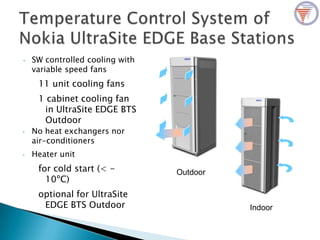
• SW controlled cooling with
variable speed fans
11 unit cooling fans
1 cabinet cooling fan
in UltraSite EDGE BTS
Outdoor
• No heat exchangers nor
air-conditioners
• Heater unit
for cold start (< -
10ºC)
optional for UltraSite
EDGE BTS Outdoor Indoor
Outdoor
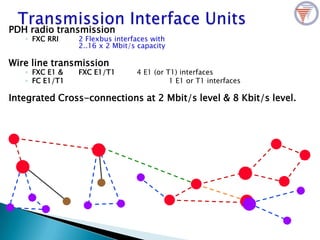
PDH radio transmission
◦ FXC RRI 2 Flexbus interfaces with
2..16 x 2 Mbit/s capacity
Wire line transmission
◦ FXC E1 & FXC E1/T1 4 E1 (or T1) interfaces
◦ FC E1/T1 1 E1 or T1 interfaces
Integrated Cross-connections at 2 Mbit/s level & 8 Kbit/s level.
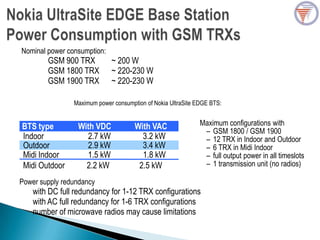
Maximum power consumption of Nokia UltraSite EDGE BTS:
BTS type With VACWith VDC
Indoor 3.2 kW2.7 kW
3.4 kW2.9 kWOutdoor
1.8 kW1.5 kWMidi Indoor
Midi Outdoor 2.2 kW 2.5 kW
Maximum configurations with
– GSM 1800 / GSM 1900
– 12 TRX in Indoor and Outdoor
– 6 TRX in Midi Indoor
– full output power in all timeslots
– 1 transmission unit (no radios)
Power supply redundancy
with DC full redundancy for 1-12 TRX configurations
with AC full redundancy for 1-6 TRX configurations
number of microwave radios may cause limitations
Nominal power consumption:
GSM 900 TRX ~ 200 W
GSM 1800 TRX ~ 220-230 W
GSM 1900 TRX ~ 220-230 W
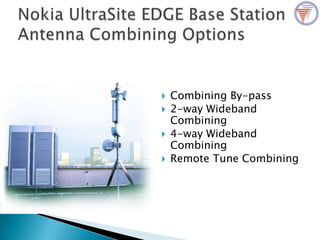
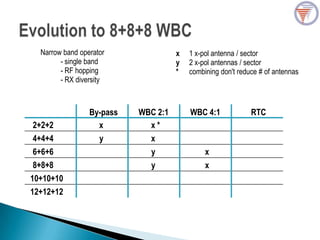
 Combining By-pass
 2-way Wideband
Combining
 4-way Wideband
Combining
 Remote Tune Combining
1
2
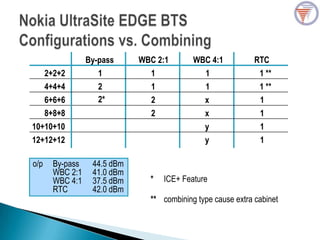
6+6+6
2+2+2
4+4+4
10+10+10
12+12+12
8+8+8
2
1
1
2
1
1
x
y
y
x
By-pass WBC 2:1 WBC 4:1 RTC
1
1 **
1 **
1
1
1
o/p By-pass 44.5 dBm
WBC 2:1 41.0 dBm
WBC 4:1 37.5 dBm
RTC 42.0 dBm
* ICE+ Feature
** combining type cause extra cabinet
2*
2+2+2
4+4+4
6+6+6
8+8+8
10+10+10
12+12+12
By-pass WBC 2:1 WBC 4:1 RTC
x
x
x x *
y
y x
Narrow band operator
- single band
- RF hopping
- RX diversity
x 1 x-pol antenna / sector
y 2 x-pol antennas / sector
* combining don't reduce # of antennas
y
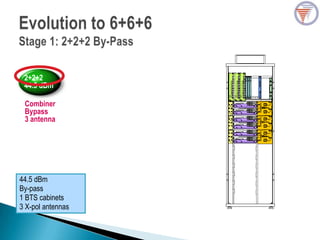
44.5 dBm
By-pass
1 BTS cabinets
3 X-pol antennas
2+2+2
44.5 dBm
Combiner
Bypass
3 antenna
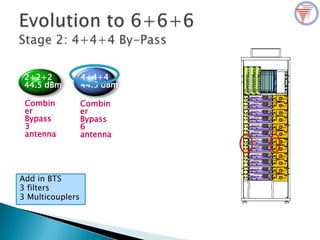
Add in BTS
3 filters
3 Multicouplers
2+2+2
44.5 dBm
4+4+4
44.5 dBm
Combin
er
Bypass
3
antenna
Combin
er
Bypass
6
antenna
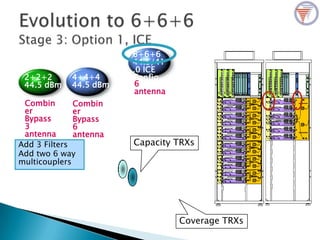
Add 3 Filters
Add two 6 way
multicouplers
2+2+2
44.5 dBm
4+4+4
44.5 dBm
6+6+6
44.5/41
.0 ICE
Config
+6+6
42 dBm
Combin
er
Bypass
3
antenna
Combin
er
Bypass
6
antenna
6
antenna
Capacity TRXs
Coverage TRXs
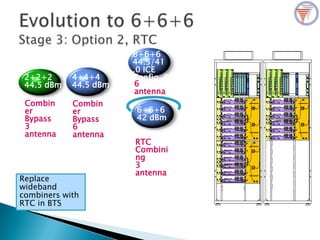
Replace
wideband
combiners with
RTC in BTS
2+2+2
44.5 dBm
4+4+4
44.5 dBm
6+6+6
44.5/41
.0 ICE
Config 8+8+8
37.5
dBm
6+6+6
42 dBm
Combin
er
Bypass
3
antenna
Combin
er
Bypass
6
antenna
6
antenna
RTC
Combini
ng
3
antenna
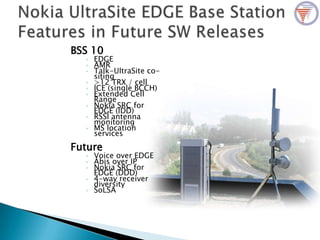
BSS 10
◦ EDGE
◦ AMR
◦ Talk-UltraSite co-
siting
◦ >12 TRX / cell
◦ ICE (single BCCH)
◦ Extended Cell
Range
◦ Nokia SRC for
EDGE (IDD)
◦ RSSI antenna
monitoring
◦ MS location
services
Future
◦ Voice over EDGE
◦ Abis over IP
◦ Nokia SRC for
EDGE (DDD)
◦ 4-way receiver
diversity
◦ SoLSA

Ultrasite technical for 4op

  • 1.
  • 3.
    • Common coremechanics in Nokia UltraSite EDGE BTS Outdoor and Nokia UltraSite EDGE BTS Indoor • Common plug-in units
  • 4.
     1940 x770 x 750 mm (H x W x D) ◦ Identical footprint to CityTalk BTS  Weight ◦ Max weight (12 TRX) 340 kg ◦ Heaviest single part 58 kg (core mechanics) ◦ Heaviest plug-in unit 18 kg (RTC)  Acoustic noise (max): 68 dB(A)  Climatic conditions: ◦ w/o heater -10°C ... +50°C ◦ with optional heater -33°C ... +50°C  Ingress Protection Class: IP 55  Two level environmental protection: ◦ BTS core and cabinet door provides EMC shielding ◦ Outdoor kit provides additional weather proofing
  • 5.
     Nokia UltraSiteEDGE BTS cabinet ◦ up to 6 GSM/EDGE TRXs ◦ 3 WCDMA carriers (Rel.1), sectorised 1+1+1 ◦ 6 WCDMA carriers (Rel.2), sectorised 2+2+2  WCDMA output power ◦ 5 W per sector in 1+1+1 ◦ 2 W per sector in 2+2+2  common transmission  sharing feeders through triplexers  common site support provided by Nokia UltraSite Support GSM/EDGE WCDMA
  • 6.
     1800 x600 x 570 mm (H x W x D) ◦ Identical footprint to IntraTalk BTS ◦ Additional 50 mm free space required behind cabinet  Weight ◦ Max weight (12 TRX) 270 kg ◦ Heaviest single part 58 kg (core mechanics) ◦ Heaviest plug-in unit 18 kg (RTC)  Acoustic noise (max): 73 dB(A)  Climatic conditions: -5°C ... +50 °C  Ingress Protection Class: IP 20  BTS core and cabinet door provides EMC shielding
  • 7.
    • SW controlledcooling with variable speed fans 11 unit cooling fans 1 cabinet cooling fan in UltraSite EDGE BTS Outdoor • No heat exchangers nor air-conditioners • Heater unit for cold start (< - 10ºC) optional for UltraSite EDGE BTS Outdoor Indoor Outdoor
  • 8.
    PDH radio transmission ◦FXC RRI 2 Flexbus interfaces with 2..16 x 2 Mbit/s capacity Wire line transmission ◦ FXC E1 & FXC E1/T1 4 E1 (or T1) interfaces ◦ FC E1/T1 1 E1 or T1 interfaces Integrated Cross-connections at 2 Mbit/s level & 8 Kbit/s level.
  • 9.
    Maximum power consumptionof Nokia UltraSite EDGE BTS: BTS type With VACWith VDC Indoor 3.2 kW2.7 kW 3.4 kW2.9 kWOutdoor 1.8 kW1.5 kWMidi Indoor Midi Outdoor 2.2 kW 2.5 kW Maximum configurations with – GSM 1800 / GSM 1900 – 12 TRX in Indoor and Outdoor – 6 TRX in Midi Indoor – full output power in all timeslots – 1 transmission unit (no radios) Power supply redundancy with DC full redundancy for 1-12 TRX configurations with AC full redundancy for 1-6 TRX configurations number of microwave radios may cause limitations Nominal power consumption: GSM 900 TRX ~ 200 W GSM 1800 TRX ~ 220-230 W GSM 1900 TRX ~ 220-230 W
  • 10.
     Combining By-pass 2-way Wideband Combining  4-way Wideband Combining  Remote Tune Combining
  • 11.
    1 2 6+6+6 2+2+2 4+4+4 10+10+10 12+12+12 8+8+8 2 1 1 2 1 1 x y y x By-pass WBC 2:1WBC 4:1 RTC 1 1 ** 1 ** 1 1 1 o/p By-pass 44.5 dBm WBC 2:1 41.0 dBm WBC 4:1 37.5 dBm RTC 42.0 dBm * ICE+ Feature ** combining type cause extra cabinet 2*
  • 12.
    2+2+2 4+4+4 6+6+6 8+8+8 10+10+10 12+12+12 By-pass WBC 2:1WBC 4:1 RTC x x x x * y y x Narrow band operator - single band - RF hopping - RX diversity x 1 x-pol antenna / sector y 2 x-pol antennas / sector * combining don't reduce # of antennas y
  • 13.
    44.5 dBm By-pass 1 BTScabinets 3 X-pol antennas 2+2+2 44.5 dBm Combiner Bypass 3 antenna
  • 14.
    Add in BTS 3filters 3 Multicouplers 2+2+2 44.5 dBm 4+4+4 44.5 dBm Combin er Bypass 3 antenna Combin er Bypass 6 antenna
  • 15.
    Add 3 Filters Addtwo 6 way multicouplers 2+2+2 44.5 dBm 4+4+4 44.5 dBm 6+6+6 44.5/41 .0 ICE Config +6+6 42 dBm Combin er Bypass 3 antenna Combin er Bypass 6 antenna 6 antenna Capacity TRXs Coverage TRXs
  • 16.
    Replace wideband combiners with RTC inBTS 2+2+2 44.5 dBm 4+4+4 44.5 dBm 6+6+6 44.5/41 .0 ICE Config 8+8+8 37.5 dBm 6+6+6 42 dBm Combin er Bypass 3 antenna Combin er Bypass 6 antenna 6 antenna RTC Combini ng 3 antenna
  • 17.
    BSS 10 ◦ EDGE ◦AMR ◦ Talk-UltraSite co- siting ◦ >12 TRX / cell ◦ ICE (single BCCH) ◦ Extended Cell Range ◦ Nokia SRC for EDGE (IDD) ◦ RSSI antenna monitoring ◦ MS location services Future ◦ Voice over EDGE ◦ Abis over IP ◦ Nokia SRC for EDGE (DDD) ◦ 4-way receiver diversity ◦ SoLSA