Applications of conic sections
•Parabola
•Ellipse
•Circle
•Hyperbola
Submitted To: Ma’m Sapna Makhdoom
Submitted By:
•Irum GulBahar 02
•Hajrah Majeed 14
•Humera Yousaf 19
•Amna Ayub 21
Topic: Applications of Conic Sections in Real/Daily Life
Session: 2013-17
Department: Mathematics
Mirpur University Of Science & Technology
(MUST)
• Dedication:
We dedicate this project name “ Applications of
Conic sections in real Life” to our parents
and Family members.
• Abstract
In this project we discuss “Applications of Conic
Sections in Real Life”. There are a lot of uses
of conic sections in real life. we have
discussed only some.
• Acknowledgement
First of all we would like to thank Allah almighty
for making this project possible for us. Then
special thanks to Ma’m Sapna Makhdoom for
helping us in completing this project
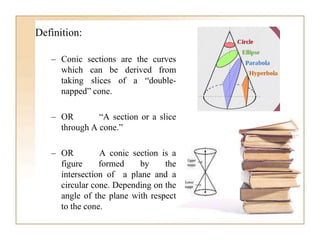
Definition:
– Conic sections are the curves
which can be derived from
taking slices of a “double-
napped” cone.
– OR “A section or a slice
through A cone.”
– OR A conic section is a
figure formed by the
intersection of a plane and a
circular cone. Depending on the
angle of the plane with respect
to the cone.
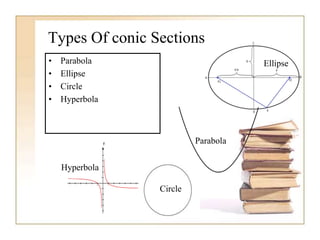
Types Of conic Sections
• Parabola
• Ellipse
• Circle
• Hyperbola
Hyperbola
Parabola
Ellipse
Circle
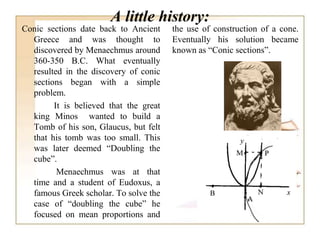
A little history:
Conic sections date back to Ancient
Greece and was thought to
discovered by Menaechmus around
360-350 B.C. What eventually
resulted in the discovery of conic
sections began with a simple
problem.
It is believed that the great
king Minos wanted to build a
Tomb of his son, Glaucus, but felt
that his tomb was too small. This
was later deemed “Doubling the
cube”.
Menaechmus was at that
time and a student of Eudoxus, a
famous Greek scholar. To solve the
case of “doubling the cube” he
focused on mean proportions and
the use of construction of a cone.
Eventually his solution became
known as “Conic sections”.
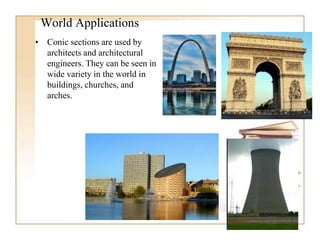
World Applications
• Conic sections are used by
architects and architectural
engineers. They can be seen in
wide variety in the world in
buildings, churches, and
arches.
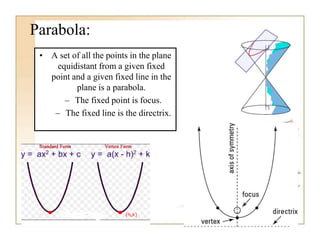
Parabola:
• A set of all the points in the plane
equidistant from a given fixed
point and a given fixed line in the
plane is a parabola.
– The fixed point is focus.
– The fixed line is the directrix.
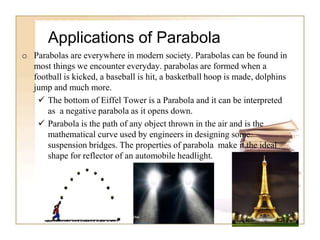
Applications of Parabola
o Parabolas are everywhere in modern society. Parabolas can be found in
most things we encounter everyday. parabolas are formed when a
football is kicked, a baseball is hit, a basketball hoop is made, dolphins
jump and much more.
 The bottom of Eiffel Tower is a Parabola and it can be interpreted
as a negative parabola as it opens down.
 Parabola is the path of any object thrown in the air and is the
mathematical curve used by engineers in designing some
suspension bridges. The properties of parabola make it the ideal
shape for reflector of an automobile headlight.
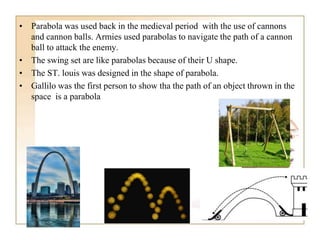
• Parabola was used back in the medieval period with the use of cannons
and cannon balls. Armies used parabolas to navigate the path of a cannon
ball to attack the enemy.
• The swing set are like parabolas because of their U shape.
• The ST. louis was designed in the shape of parabola.
• Gallilo was the first person to show tha the path of an object thrown in the
space is a parabola
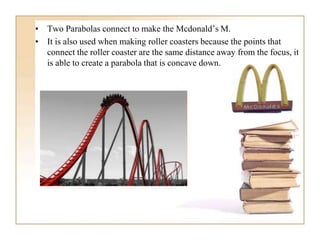
• Two Parabolas connect to make the Mcdonald’s M.
• It is also used when making roller coasters because the points that
connect the roller coaster are the same distance away from the focus, it
is able to create a parabola that is concave down.
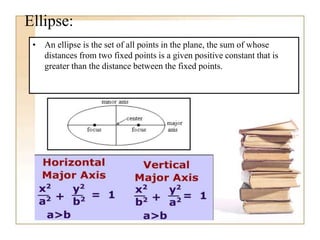
Ellipse:
• An ellipse is the set of all points in the plane, the sum of whose
distances from two fixed points is a given positive constant that is
greater than the distance between the fixed points.
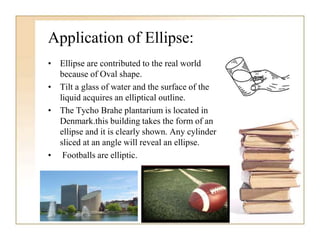
Application of Ellipse:
• Ellipse are contributed to the real world
because of Oval shape.
• Tilt a glass of water and the surface of the
liquid acquires an elliptical outline.
• The Tycho Brahe plantarium is located in
Denmark.this building takes the form of an
ellipse and it is clearly shown. Any cylinder
sliced at an angle will reveal an ellipse.
• Footballs are elliptic.
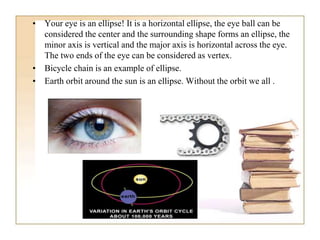
• Your eye is an ellipse! It is a horizontal ellipse, the eye ball can be
considered the center and the surrounding shape forms an ellipse, the
minor axis is vertical and the major axis is horizontal across the eye.
The two ends of the eye can be considered as vertex.
• Bicycle chain is an example of ellipse.
• Earth orbit around the sun is an ellipse. Without the orbit we all .
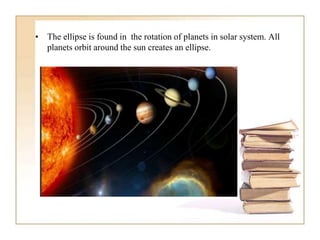
• The ellipse is found in the rotation of planets in solar system. All
planets orbit around the sun creates an ellipse.
Circle:
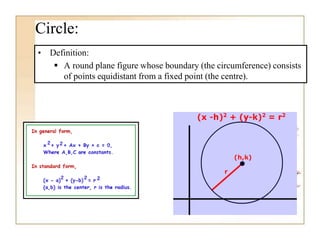
• Definition:
 A round plane figure whose boundary (the circumference) consists
of points equidistant from a fixed point (the centre).
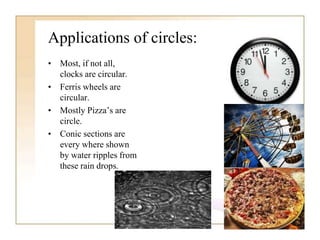
Applications of circles:
• Most, if not all,
clocks are circular.
• Ferris wheels are
circular.
• Mostly Pizza’s are
circle.
• Conic sections are
every where shown
by water ripples from
these rain drops.
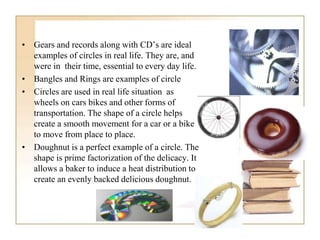
• Gears and records along with CD’s are ideal
examples of circles in real life. They are, and
were in their time, essential to every day life.
• Bangles and Rings are examples of circle
• Circles are used in real life situation as
wheels on cars bikes and other forms of
transportation. The shape of a circle helps
create a smooth movement for a car or a bike
to move from place to place.
• Doughnut is a perfect example of a circle. The
shape is prime factorization of the delicacy. It
allows a baker to induce a heat distribution to
create an evenly backed delicious doughnut.
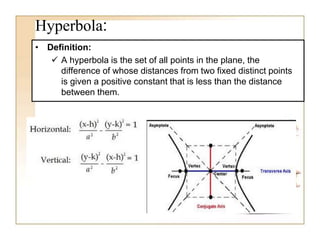
Hyperbola:
• Definition:
 A hyperbola is the set of all points in the plane, the
difference of whose distances from two fixed distinct points
is given a positive constant that is less than the distance
between them.
Applications of Hyperbola
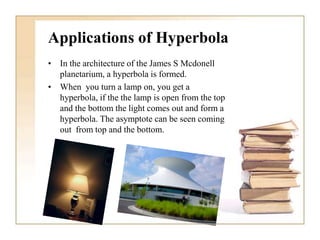
• In the architecture of the James S Mcdonell
planetarium, a hyperbola is formed.
• When you turn a lamp on, you get a
hyperbola, if the the lamp is open from the top
and the bottom the light comes out and form a
hyperbola. The asymptote can be seen coming
out from top and the bottom.
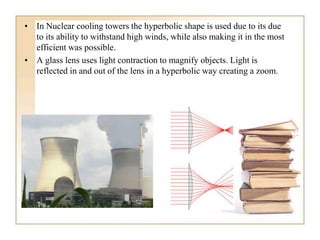
• In Nuclear cooling towers the hyperbolic shape is used due to its due
to its ability to withstand high winds, while also making it in the most
efficient was possible.
• A glass lens uses light contraction to magnify objects. Light is
reflected in and out of the lens in a hyperbolic way creating a zoom.
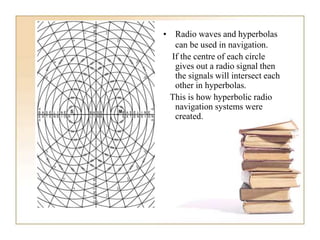
• Radio waves and hyperbolas
can be used in navigation.
If the centre of each circle
gives out a radio signal then
the signals will intersect each
other in hyperbolas.
This is how hyperbolic radio
navigation systems were
created.
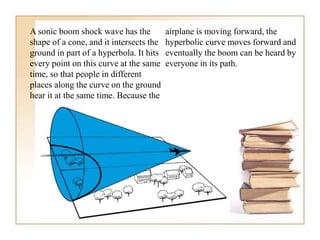
A sonic boom shock wave has the
shape of a cone, and it intersects the
ground in part of a hyperbola. It hits
every point on this curve at the same
time, so that people in different
places along the curve on the ground
hear it at the same time. Because the
airplane is moving forward, the
hyperbolic curve moves forward and
eventually the boom can be heard by
everyone in its path.
Applications of conic sections3

Applications of conic sections3

  • 1.
    Applications of conicsections •Parabola •Ellipse •Circle •Hyperbola
  • 3.
    Submitted To: Ma’mSapna Makhdoom Submitted By: •Irum GulBahar 02 •Hajrah Majeed 14 •Humera Yousaf 19 •Amna Ayub 21 Topic: Applications of Conic Sections in Real/Daily Life Session: 2013-17 Department: Mathematics Mirpur University Of Science & Technology (MUST)
  • 4.
    • Dedication: We dedicatethis project name “ Applications of Conic sections in real Life” to our parents and Family members.
  • 5.
    • Abstract In thisproject we discuss “Applications of Conic Sections in Real Life”. There are a lot of uses of conic sections in real life. we have discussed only some.
  • 6.
    • Acknowledgement First ofall we would like to thank Allah almighty for making this project possible for us. Then special thanks to Ma’m Sapna Makhdoom for helping us in completing this project
  • 7.
    Definition: – Conic sectionsare the curves which can be derived from taking slices of a “double- napped” cone. – OR “A section or a slice through A cone.” – OR A conic section is a figure formed by the intersection of a plane and a circular cone. Depending on the angle of the plane with respect to the cone.
  • 8.
    Types Of conicSections • Parabola • Ellipse • Circle • Hyperbola Hyperbola Parabola Ellipse Circle
  • 9.
    A little history: Conicsections date back to Ancient Greece and was thought to discovered by Menaechmus around 360-350 B.C. What eventually resulted in the discovery of conic sections began with a simple problem. It is believed that the great king Minos wanted to build a Tomb of his son, Glaucus, but felt that his tomb was too small. This was later deemed “Doubling the cube”. Menaechmus was at that time and a student of Eudoxus, a famous Greek scholar. To solve the case of “doubling the cube” he focused on mean proportions and the use of construction of a cone. Eventually his solution became known as “Conic sections”.
  • 10.
    World Applications • Conicsections are used by architects and architectural engineers. They can be seen in wide variety in the world in buildings, churches, and arches.
  • 11.
    Parabola: • A setof all the points in the plane equidistant from a given fixed point and a given fixed line in the plane is a parabola. – The fixed point is focus. – The fixed line is the directrix.
  • 12.
    Applications of Parabola oParabolas are everywhere in modern society. Parabolas can be found in most things we encounter everyday. parabolas are formed when a football is kicked, a baseball is hit, a basketball hoop is made, dolphins jump and much more.  The bottom of Eiffel Tower is a Parabola and it can be interpreted as a negative parabola as it opens down.  Parabola is the path of any object thrown in the air and is the mathematical curve used by engineers in designing some suspension bridges. The properties of parabola make it the ideal shape for reflector of an automobile headlight.
  • 13.
    • Parabola wasused back in the medieval period with the use of cannons and cannon balls. Armies used parabolas to navigate the path of a cannon ball to attack the enemy. • The swing set are like parabolas because of their U shape. • The ST. louis was designed in the shape of parabola. • Gallilo was the first person to show tha the path of an object thrown in the space is a parabola
  • 14.
    • Two Parabolasconnect to make the Mcdonald’s M. • It is also used when making roller coasters because the points that connect the roller coaster are the same distance away from the focus, it is able to create a parabola that is concave down.
  • 15.
    Ellipse: • An ellipseis the set of all points in the plane, the sum of whose distances from two fixed points is a given positive constant that is greater than the distance between the fixed points.
  • 16.
    Application of Ellipse: •Ellipse are contributed to the real world because of Oval shape. • Tilt a glass of water and the surface of the liquid acquires an elliptical outline. • The Tycho Brahe plantarium is located in Denmark.this building takes the form of an ellipse and it is clearly shown. Any cylinder sliced at an angle will reveal an ellipse. • Footballs are elliptic.
  • 17.
    • Your eyeis an ellipse! It is a horizontal ellipse, the eye ball can be considered the center and the surrounding shape forms an ellipse, the minor axis is vertical and the major axis is horizontal across the eye. The two ends of the eye can be considered as vertex. • Bicycle chain is an example of ellipse. • Earth orbit around the sun is an ellipse. Without the orbit we all .
  • 18.
    • The ellipseis found in the rotation of planets in solar system. All planets orbit around the sun creates an ellipse.
  • 19.
    Circle: • Definition:  Around plane figure whose boundary (the circumference) consists of points equidistant from a fixed point (the centre).
  • 20.
    Applications of circles: •Most, if not all, clocks are circular. • Ferris wheels are circular. • Mostly Pizza’s are circle. • Conic sections are every where shown by water ripples from these rain drops.
  • 21.
    • Gears andrecords along with CD’s are ideal examples of circles in real life. They are, and were in their time, essential to every day life. • Bangles and Rings are examples of circle • Circles are used in real life situation as wheels on cars bikes and other forms of transportation. The shape of a circle helps create a smooth movement for a car or a bike to move from place to place. • Doughnut is a perfect example of a circle. The shape is prime factorization of the delicacy. It allows a baker to induce a heat distribution to create an evenly backed delicious doughnut.
  • 22.
    Hyperbola: • Definition:  Ahyperbola is the set of all points in the plane, the difference of whose distances from two fixed distinct points is given a positive constant that is less than the distance between them.
  • 23.
    Applications of Hyperbola •In the architecture of the James S Mcdonell planetarium, a hyperbola is formed. • When you turn a lamp on, you get a hyperbola, if the the lamp is open from the top and the bottom the light comes out and form a hyperbola. The asymptote can be seen coming out from top and the bottom.
  • 24.
    • In Nuclearcooling towers the hyperbolic shape is used due to its due to its ability to withstand high winds, while also making it in the most efficient was possible. • A glass lens uses light contraction to magnify objects. Light is reflected in and out of the lens in a hyperbolic way creating a zoom.
  • 25.
    • Radio wavesand hyperbolas can be used in navigation. If the centre of each circle gives out a radio signal then the signals will intersect each other in hyperbolas. This is how hyperbolic radio navigation systems were created.
  • 26.
    A sonic boomshock wave has the shape of a cone, and it intersects the ground in part of a hyperbola. It hits every point on this curve at the same time, so that people in different places along the curve on the ground hear it at the same time. Because the airplane is moving forward, the hyperbolic curve moves forward and eventually the boom can be heard by everyone in its path.