Vectors and 3D
Vector
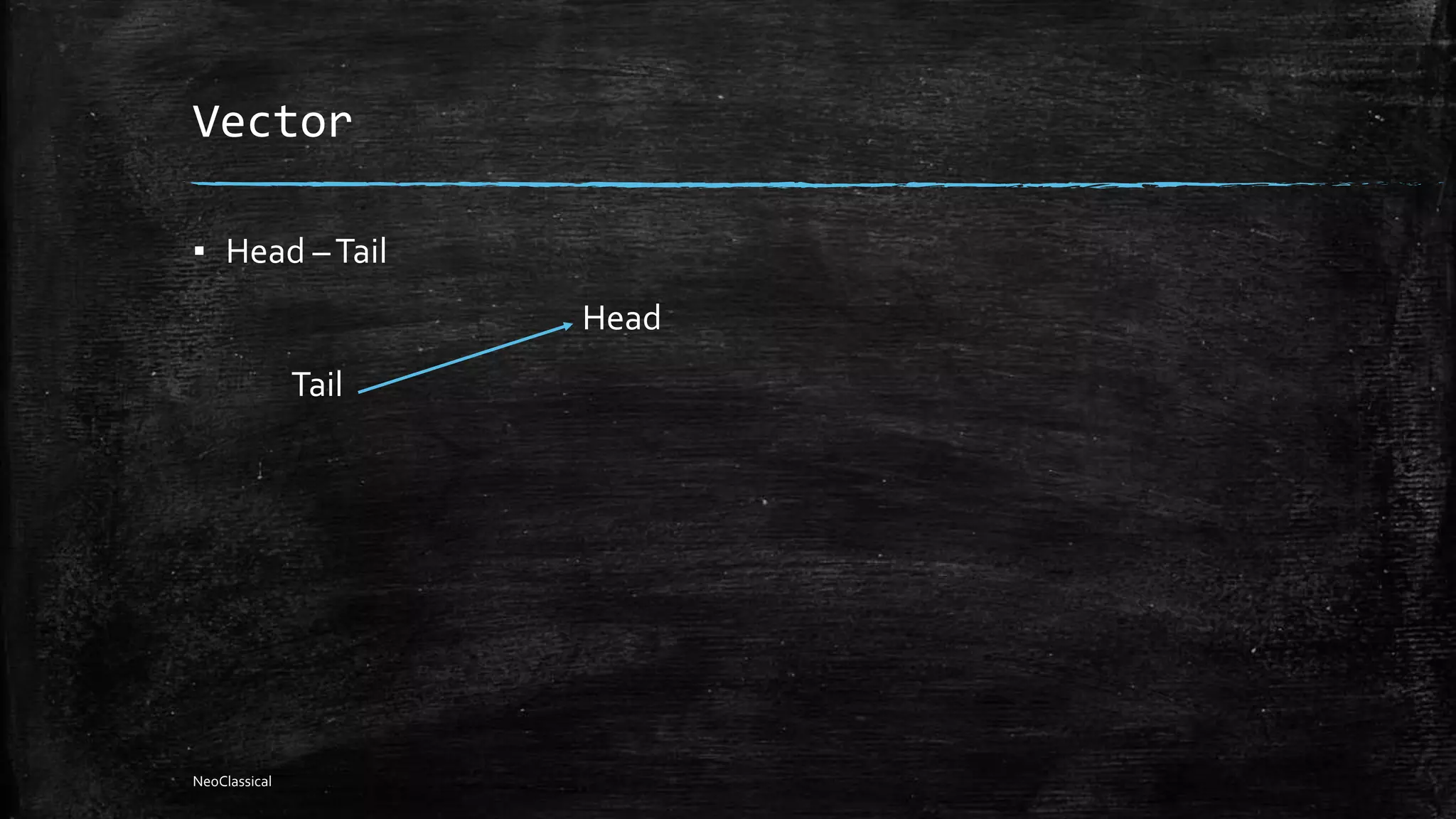
▪ Head –Tail
Head
Tail
NeoClassical
Dot Product
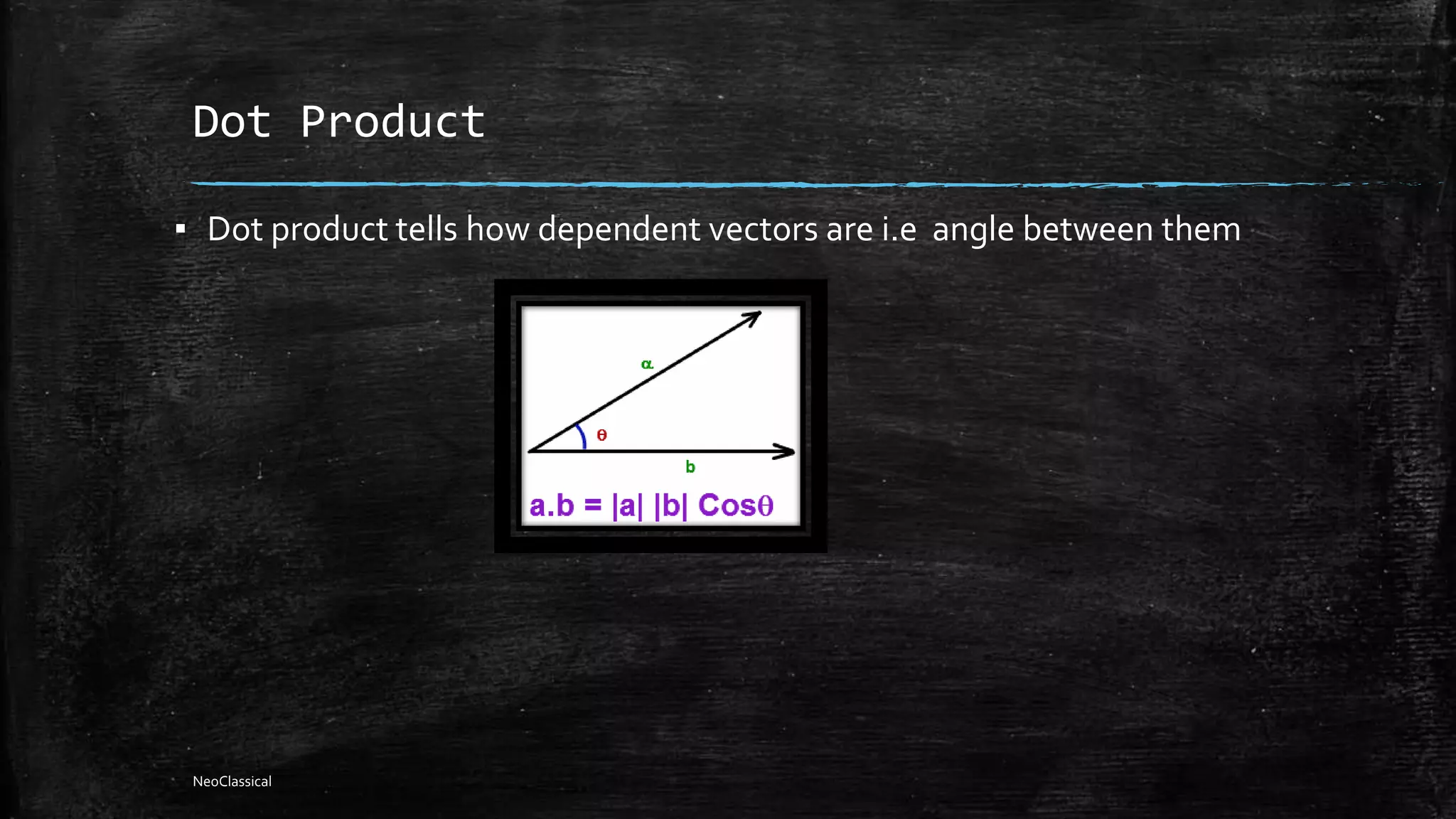
▪ Dot product tells how dependent vectors are i.e angle between them
NeoClassical
Uses of Dot Product
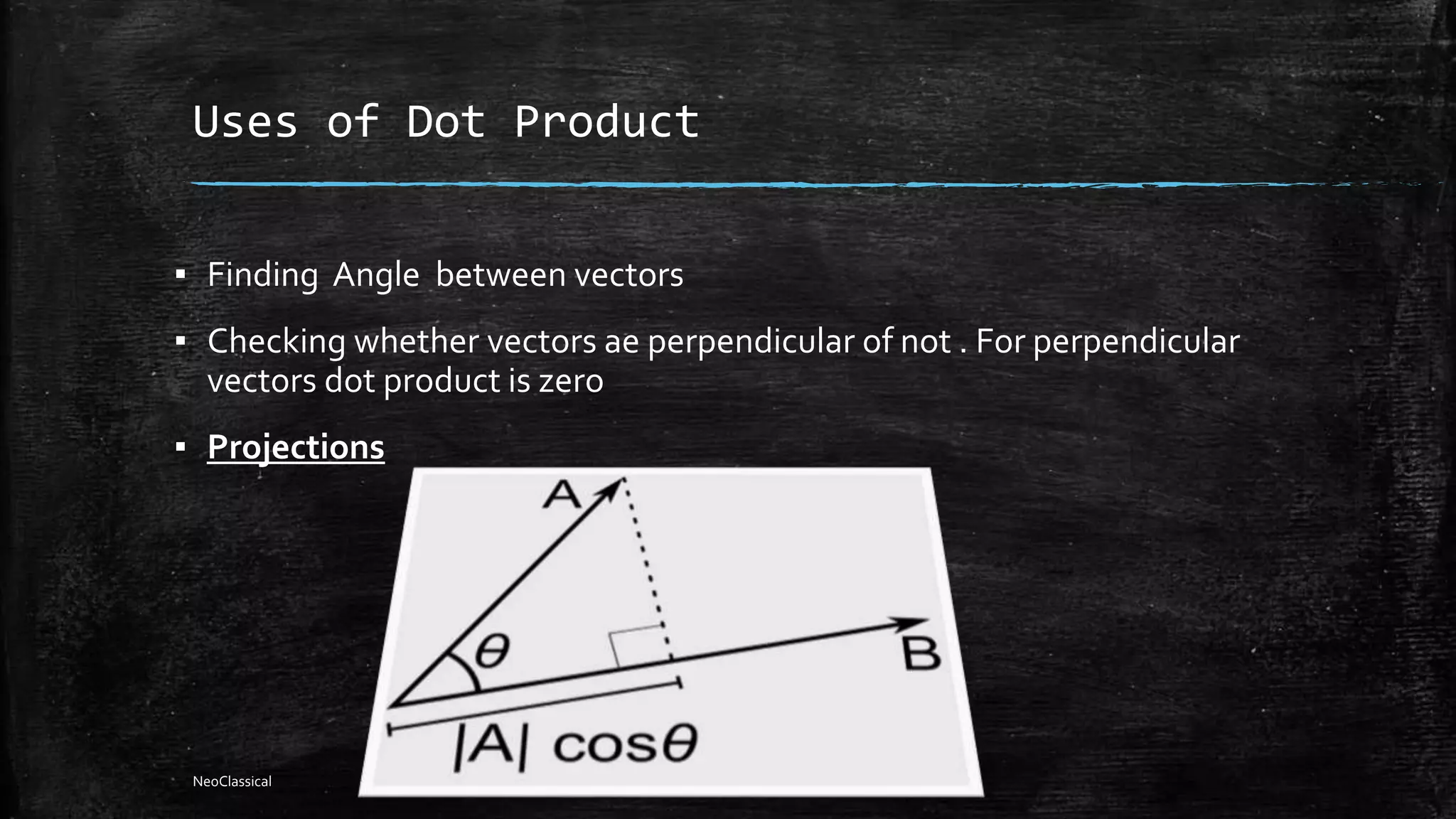
▪ Finding Angle between vectors
▪ Checking whether vectors ae perpendicular of not . For perpendicular
vectors dot product is zero
▪ Projections
NeoClassical
▪ Dot product can be used to find magnitude of a vector due to the following
property
a . a = |a|2
Example to find |A+B| we calculate
|A+B|2 = (A+B) .(A+B) = |A|2 + |B|2 + 2 A .B
Similarly for |A+B+C| we have to its dot product with itself
|A+B+C|2 = (A+B+C) .(A+B+C)
NeoClassical
CROSS PRODUCT
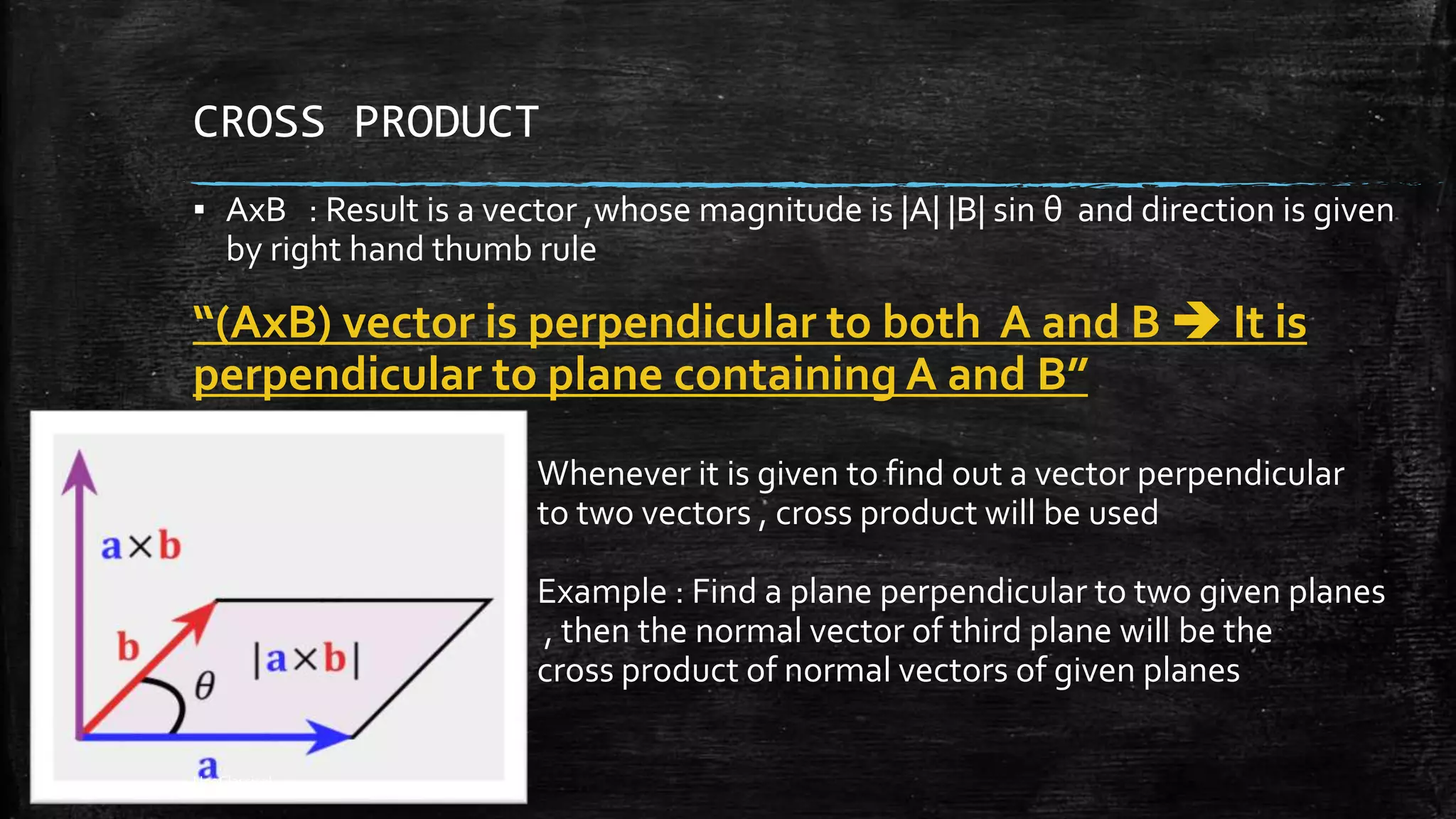
▪ AxB : Result is a vector ,whose magnitude is |A| |B| sin θ and direction is given
by right hand thumb rule
“(AxB) vector is perpendicular to both A and B  It is
perpendicular to plane containing A and B”
Whenever it is given to find out a vector perpendicular
to two vectors , cross product will be used
Example : Find a plane perpendicular to two given planes
, then the normal vector of third plane will be the
cross product of normal vectors of given planes
NeoClassical
▪ Order is Important (AXB) ≠ (BXA)
▪ (AXB) = -(BXA)
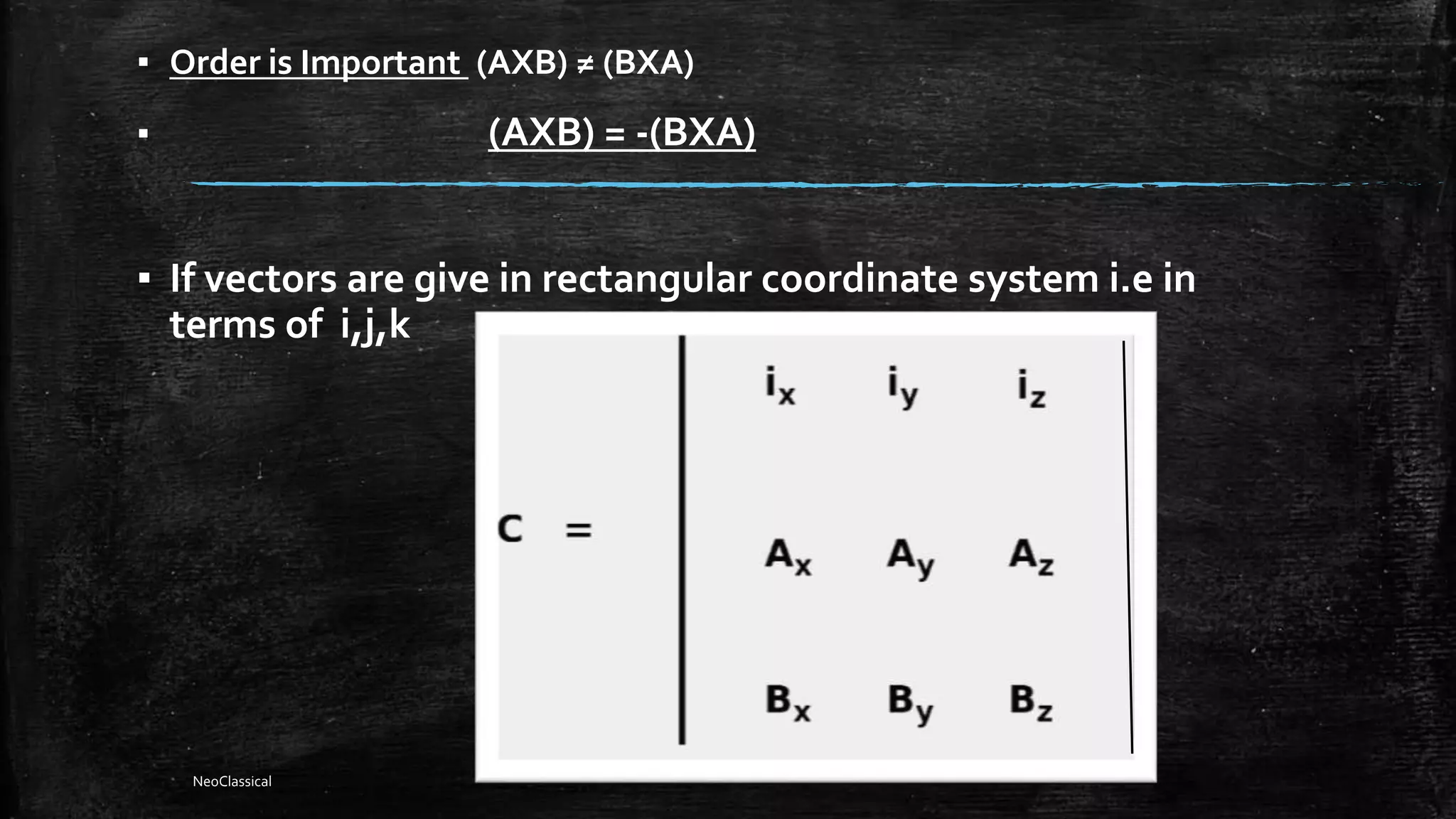
▪ If vectors are give in rectangular coordinate system i.e in
terms of i,j,k
NeoClassical
Cross Product for calculating area
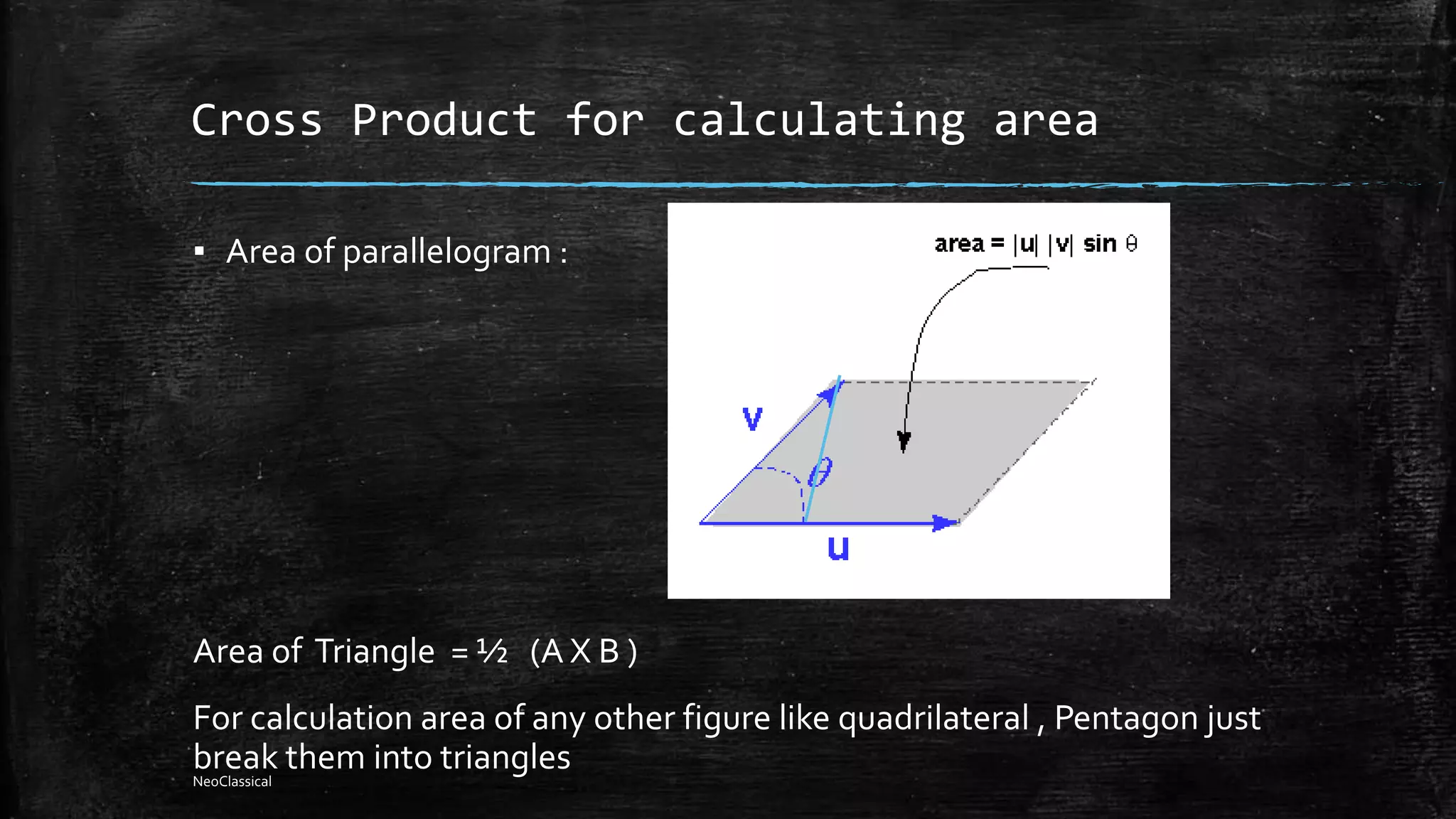
▪ Area of parallelogram :
Area of Triangle = ½ (A X B )
For calculation area of any other figure like quadrilateral , Pentagon just
break them into trianglesNeoClassical
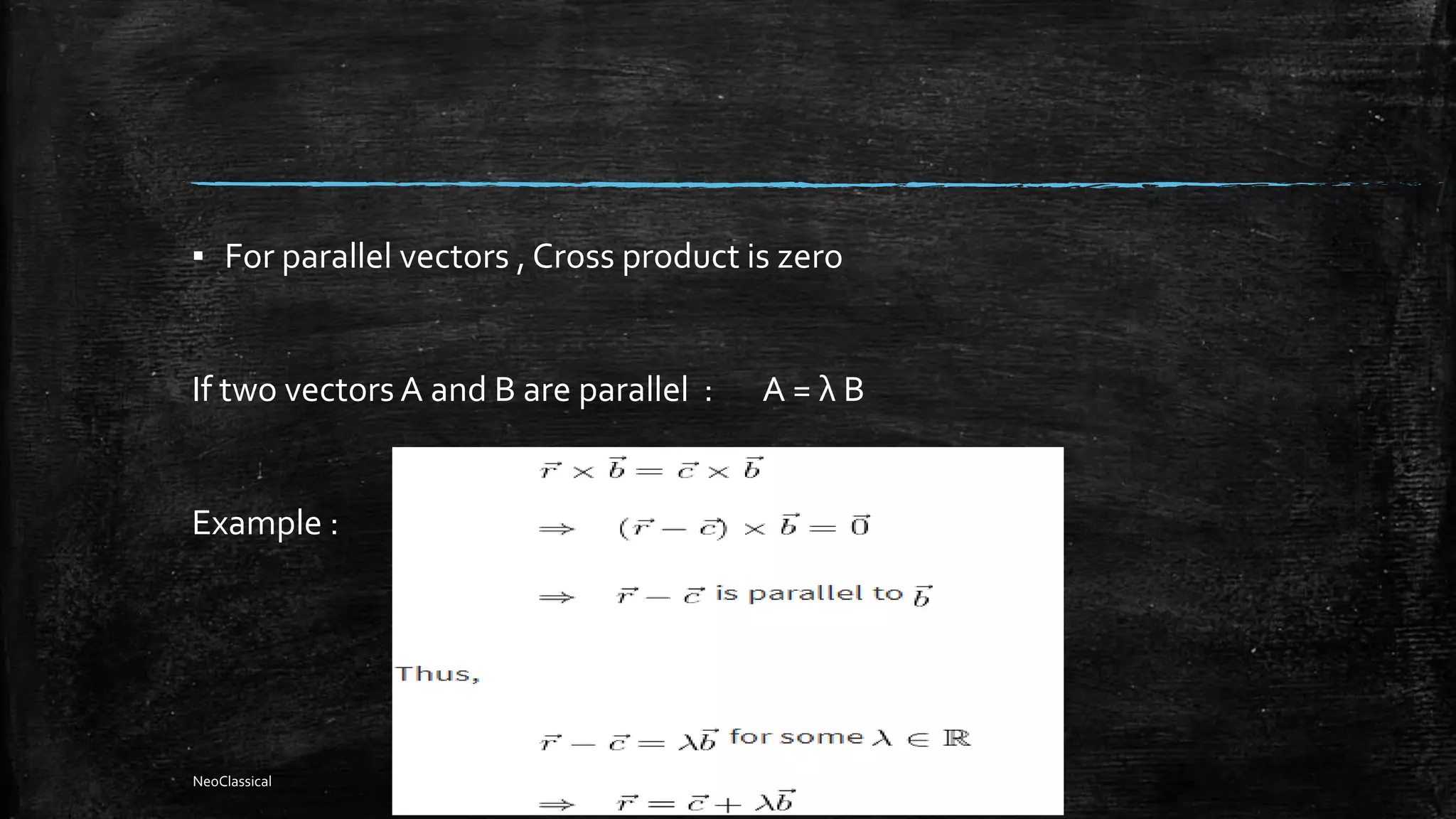
▪ For parallel vectors , Cross product is zero
If two vectors A and B are parallel : A = λ B
Example :
NeoClassical
Scalar Triple Product
▪ STP or box product = A.(BXC) denoted as [ A B C ]
▪ First cross product then dot product
▪ Geometric interpretation :Volume of Parallelepiped = [A B C ]
▪ Tetrahedron = (1/6) [A B C]
▪ A ,B ,C are adjacent sides
NeoClassical
Properties :
▪ Position of Dot and cross can be interchanged
A.(BXC) = (AXB).C
Can be cyclically permuted  [a b c] =[b c a] = [c a b]
If order is not maintained it becomes negative [ a b c] = - [ a c b]
Important : If Box product of three vectors A,B,C is zero ,
then they are coplanar . Reverse is also true
Coplanartiy :::Think of Box product
NeoClassical
Example
▪ Prove [ (a+b) (b+c) (c+a) ] = 2 [a b c ]
NeoClassical
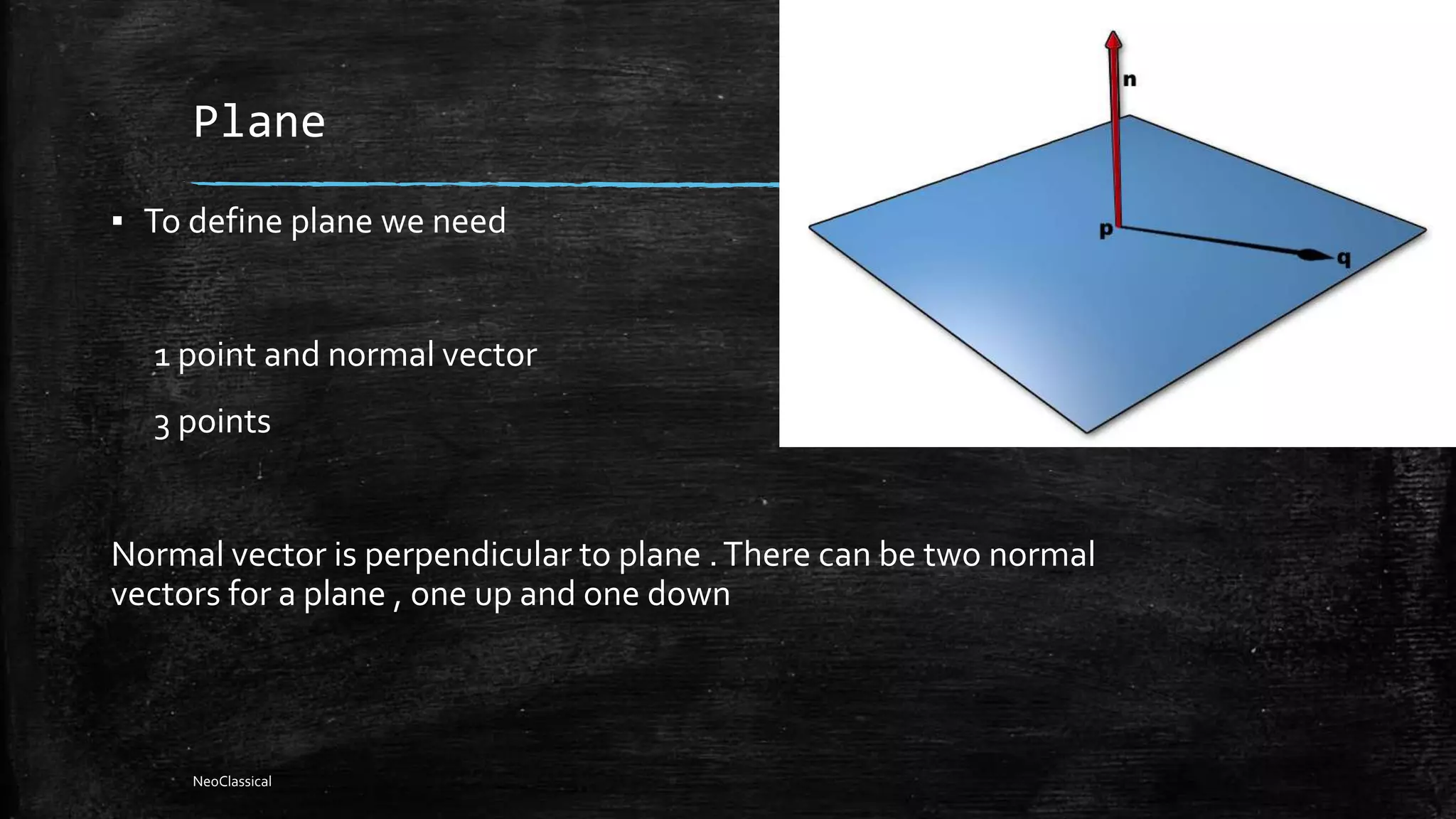
Plane
▪ To define plane we need
1 point and normal vector
3 points
Normal vector is perpendicular to plane .There can be two normal
vectors for a plane , one up and one down
NeoClassical
Equation of plane
▪ Point on plane and normal vector is known
( r – a) . n = 0 r.n = a.n
In rectangular coordinate system Given point (x1,y1,z1)
a(x-x1) + b(y-y1) + c(z-z1) = 0
Coefficient of x , y and z give normal vector
Example : Plane = 3x+ 4y + 7z = 8
Normal vector  3 i + 4 j + 7 kNeoClassical
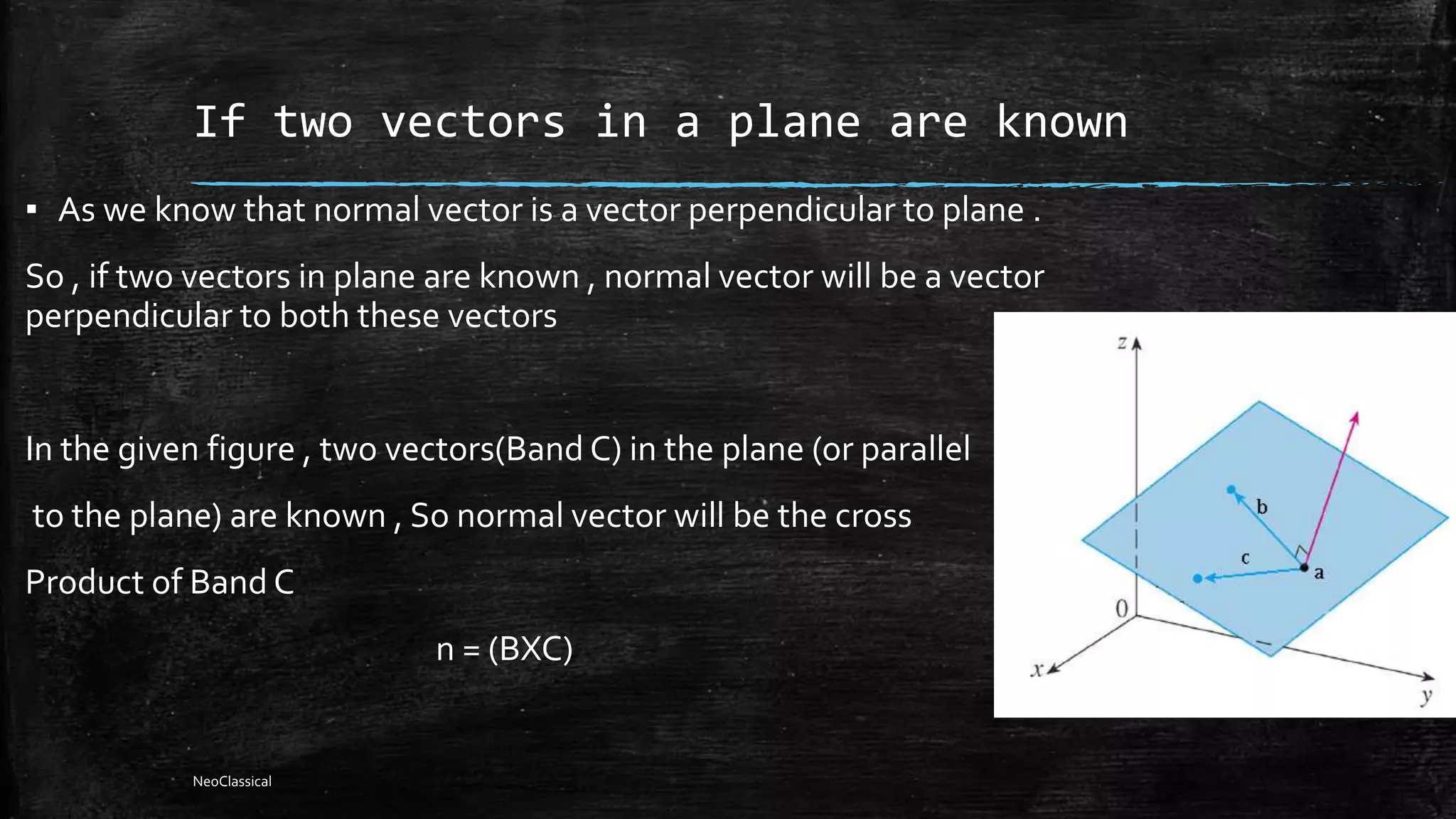
If two vectors in a plane are known
▪ As we know that normal vector is a vector perpendicular to plane .
So , if two vectors in plane are known , normal vector will be a vector
perpendicular to both these vectors
In the given figure , two vectors(Band C) in the plane (or parallel
to the plane) are known , So normal vector will be the cross
Product of Band C
n = (BXC)
NeoClassical
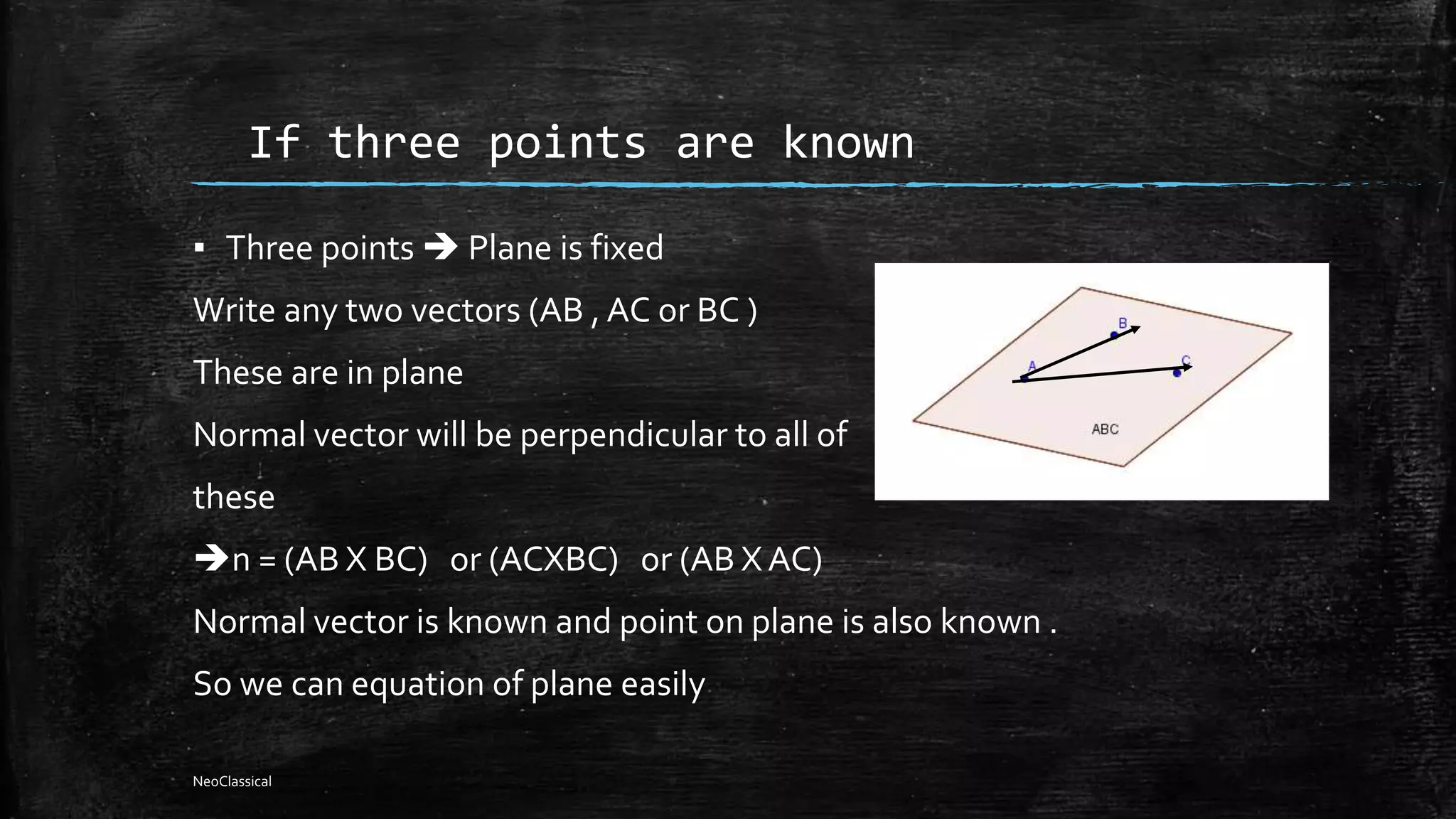
If three points are known
▪ Three points  Plane is fixed
Write any two vectors (AB , AC or BC )
These are in plane
Normal vector will be perpendicular to all of
these
n = (AB X BC) or (ACXBC) or (AB XAC)
Normal vector is known and point on plane is also known .
So we can equation of plane easily
NeoClassical
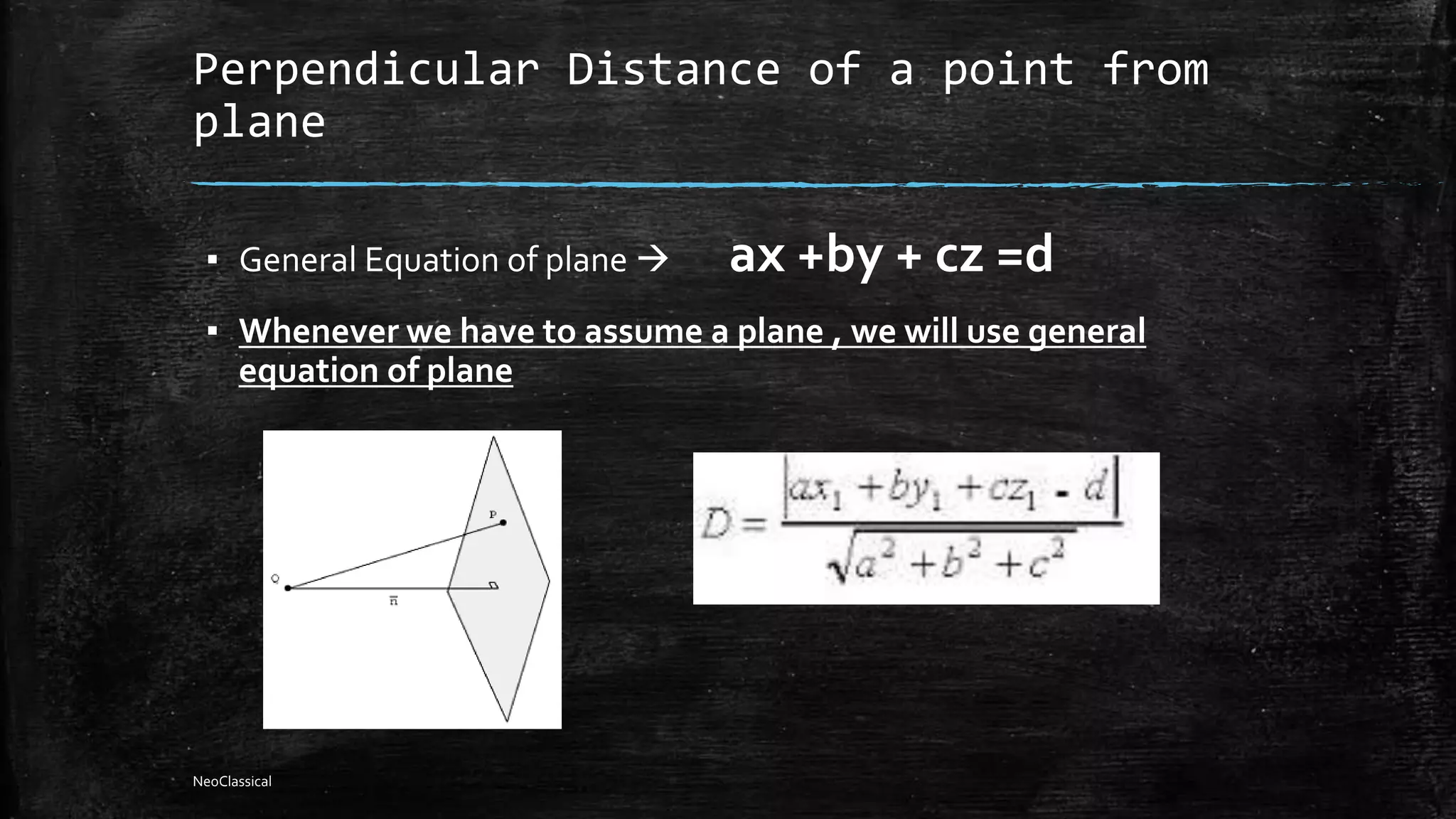
Perpendicular Distance of a point from
plane
▪ General Equation of plane  ax +by + cz =d
▪ Whenever we have to assume a plane , we will use general
equation of plane
NeoClassical
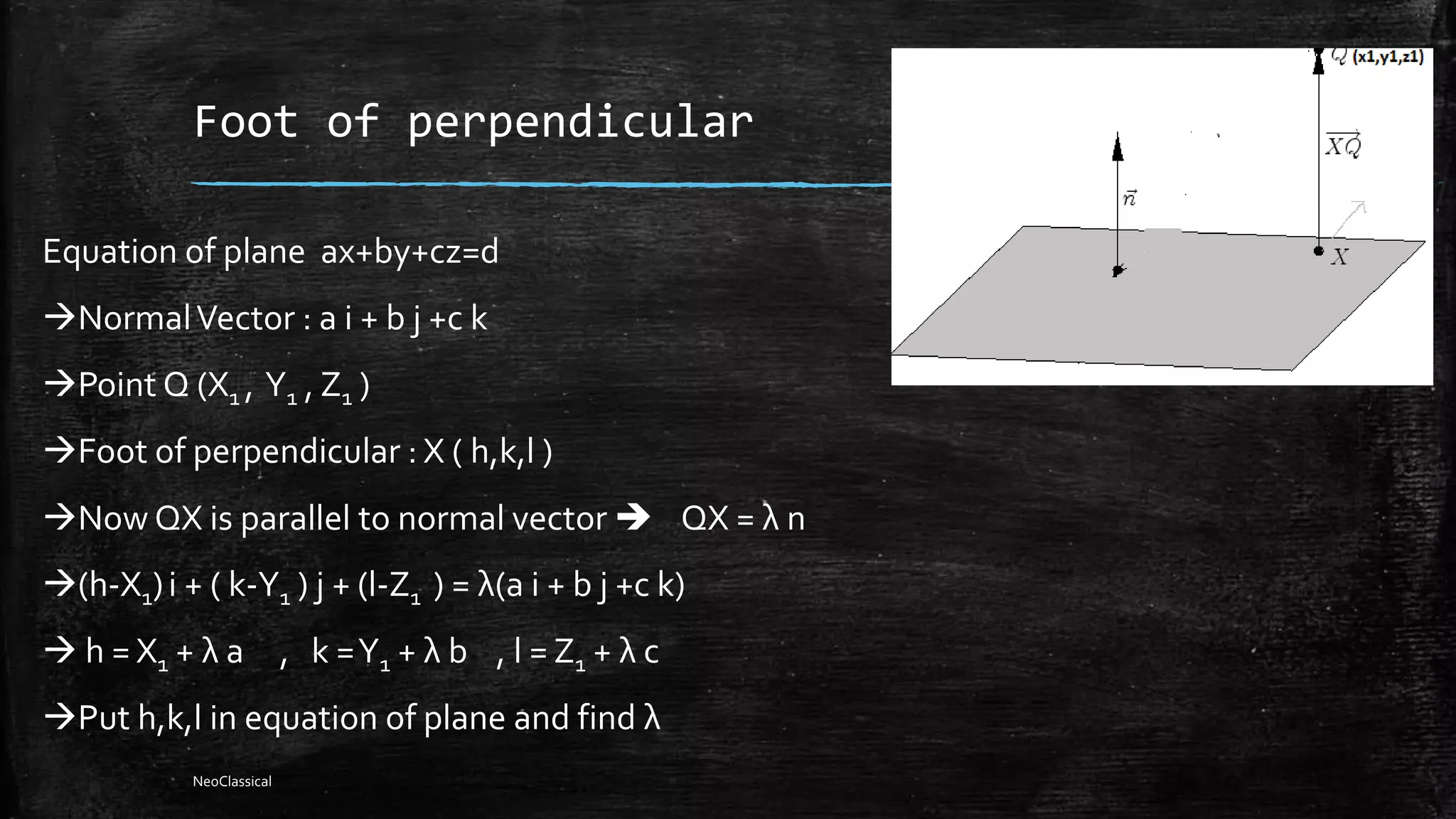
Foot of perpendicular
Equation of plane ax+by+cz=d
NormalVector : a i + b j +c k
Point Q (X1 , Y1 , Z1 )
Foot of perpendicular : X ( h,k,l )
Now QX is parallel to normal vector  QX = λ n
(h-X1)i + ( k-Y1 ) j + (l-Z1 ) = λ(a i + b j +c k)
 h = X1 + λ a , k =Y1 + λ b , l = Z1 + λ c
Put h,k,l in equation of plane and find λ
NeoClassical
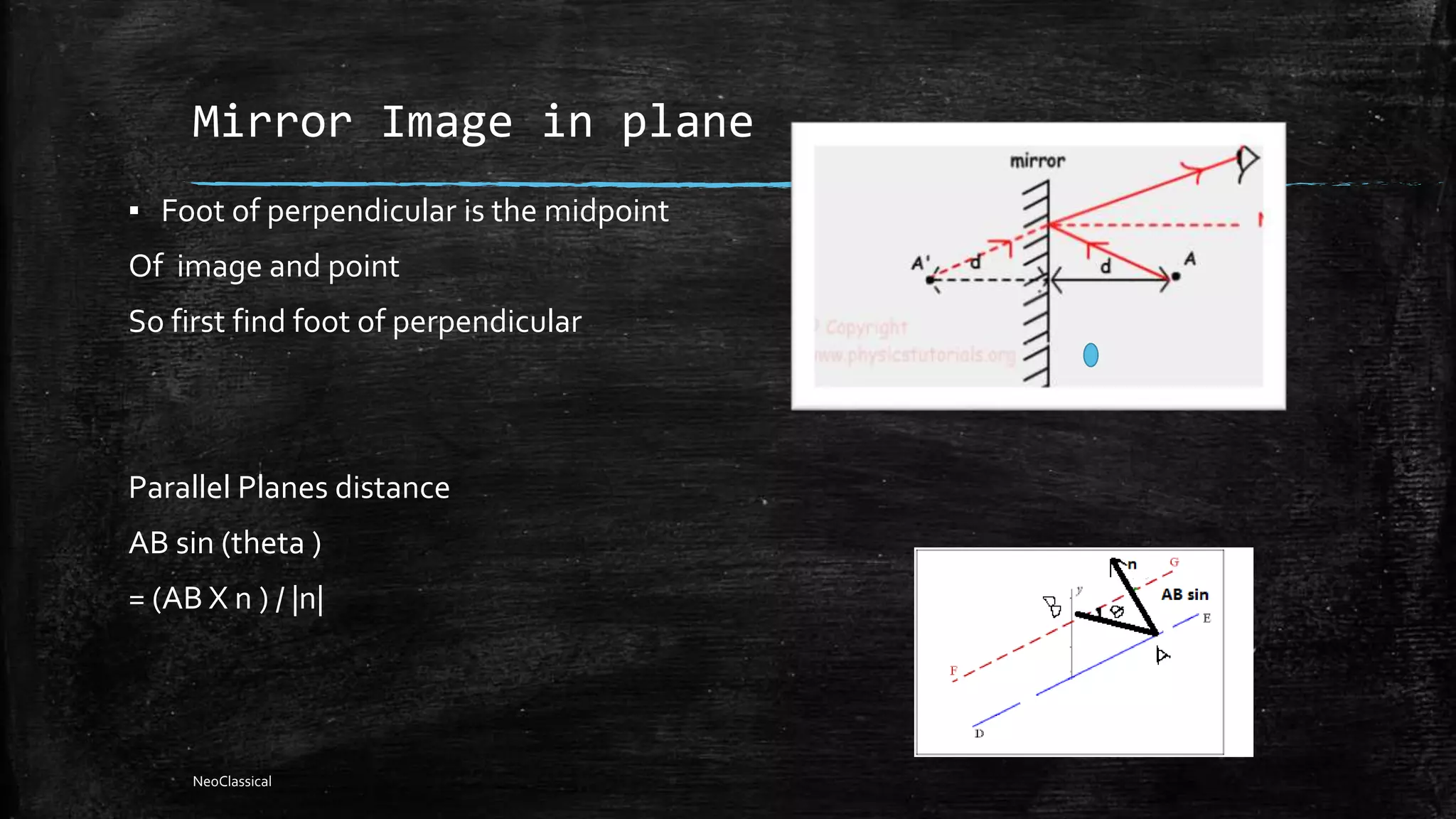
Mirror Image in plane
▪ Foot of perpendicular is the midpoint
Of image and point
So first find foot of perpendicular
Parallel Planes distance
AB sin (theta )
= (AB X n ) / |n|
NeoClassical
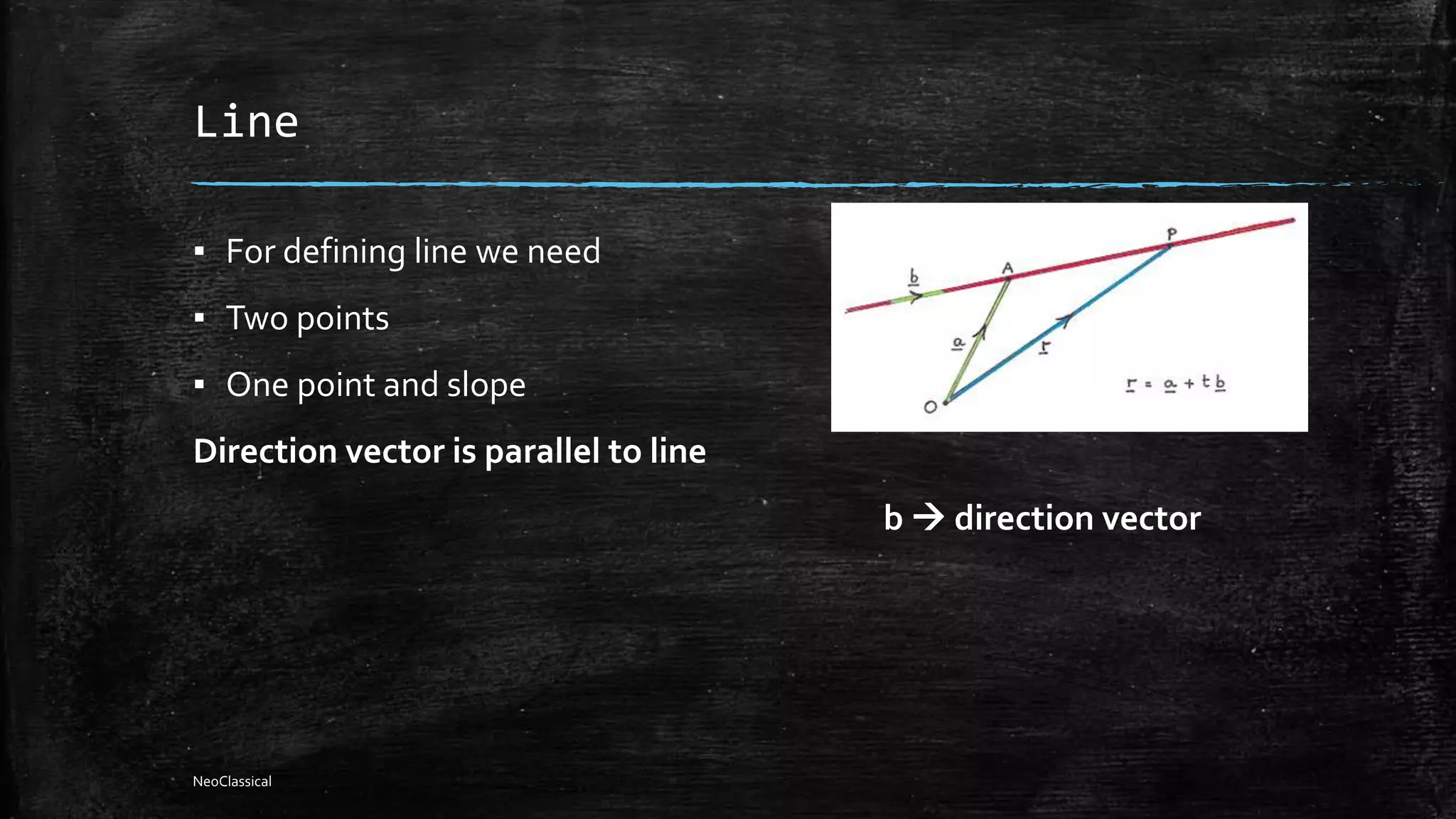
Line
▪ For defining line we need
▪ Two points
▪ One point and slope
Direction vector is parallel to line
b  direction vector
NeoClassical
Equation of line
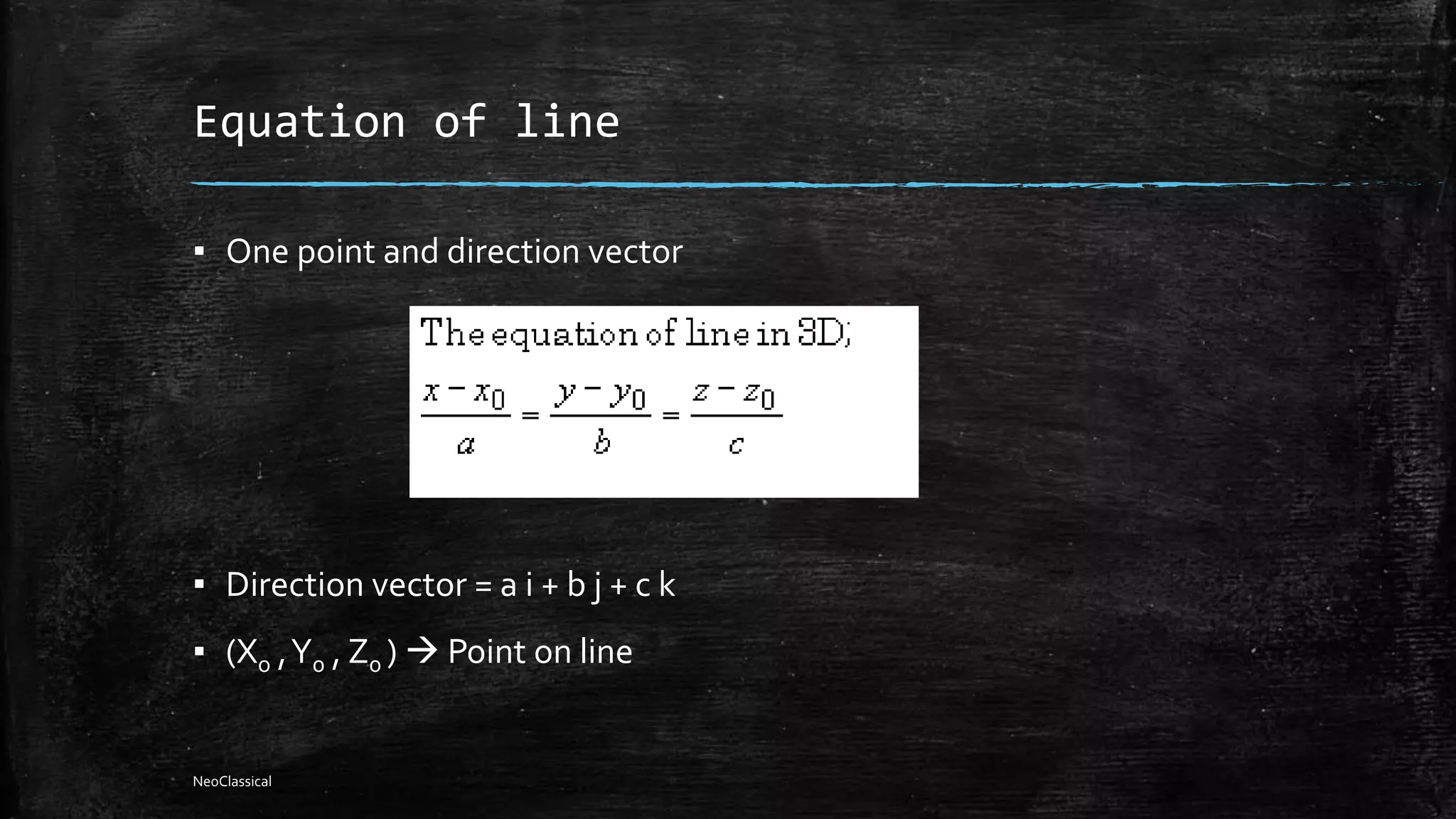
▪ One point and direction vector
▪ Direction vector = a i + b j + c k
▪ (Xo ,Y0 , Z0 )  Point on line
NeoClassical
If two points are given
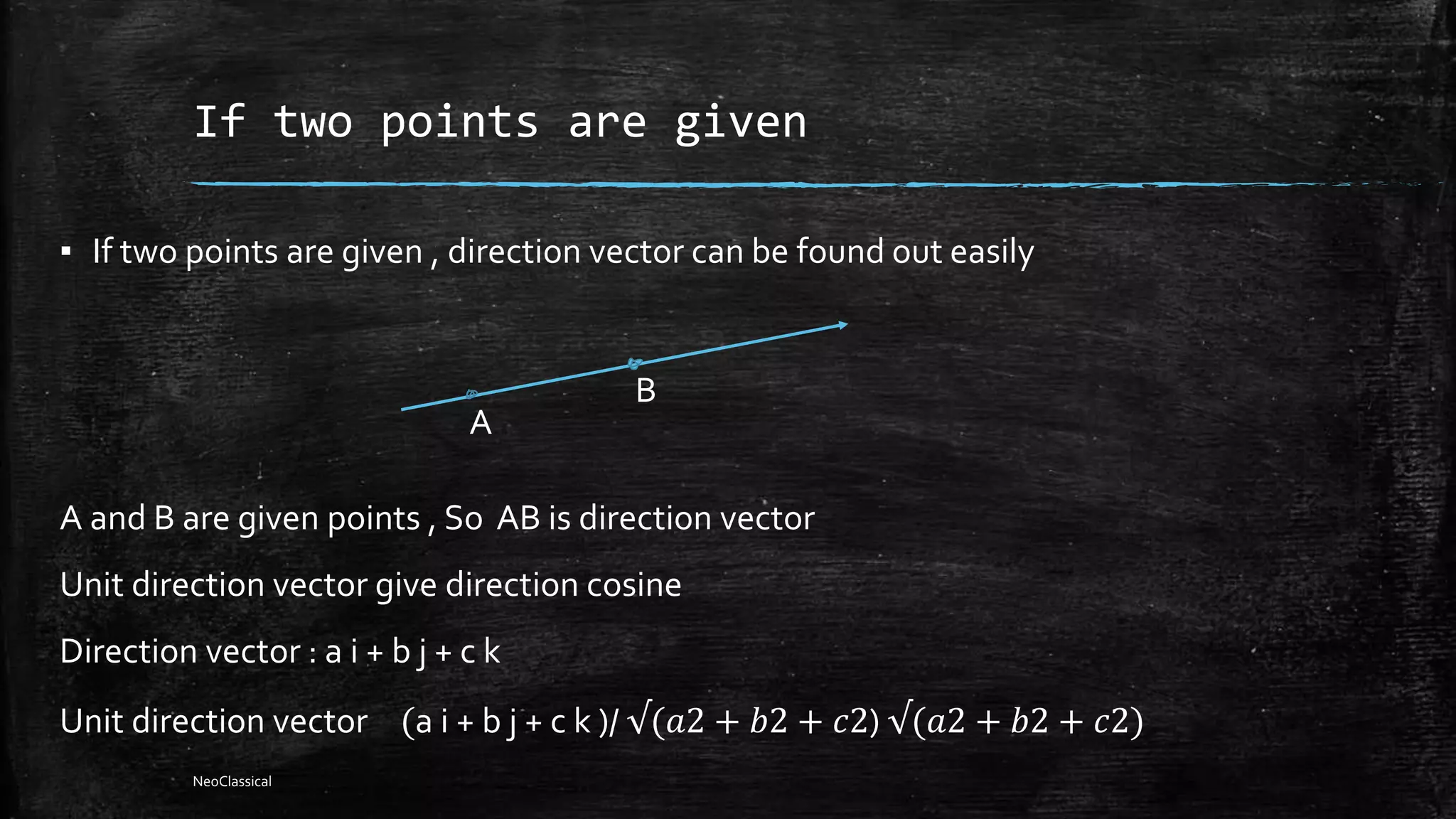
▪ If two points are given , direction vector can be found out easily
A and B are given points , So AB is direction vector
Unit direction vector give direction cosine
Direction vector : a i + b j + c k
Unit direction vector (a i + b j + c k )/ √(𝑎2 + 𝑏2 + 𝑐2) √(𝑎2 + 𝑏2 + 𝑐2)
A
B
NeoClassical
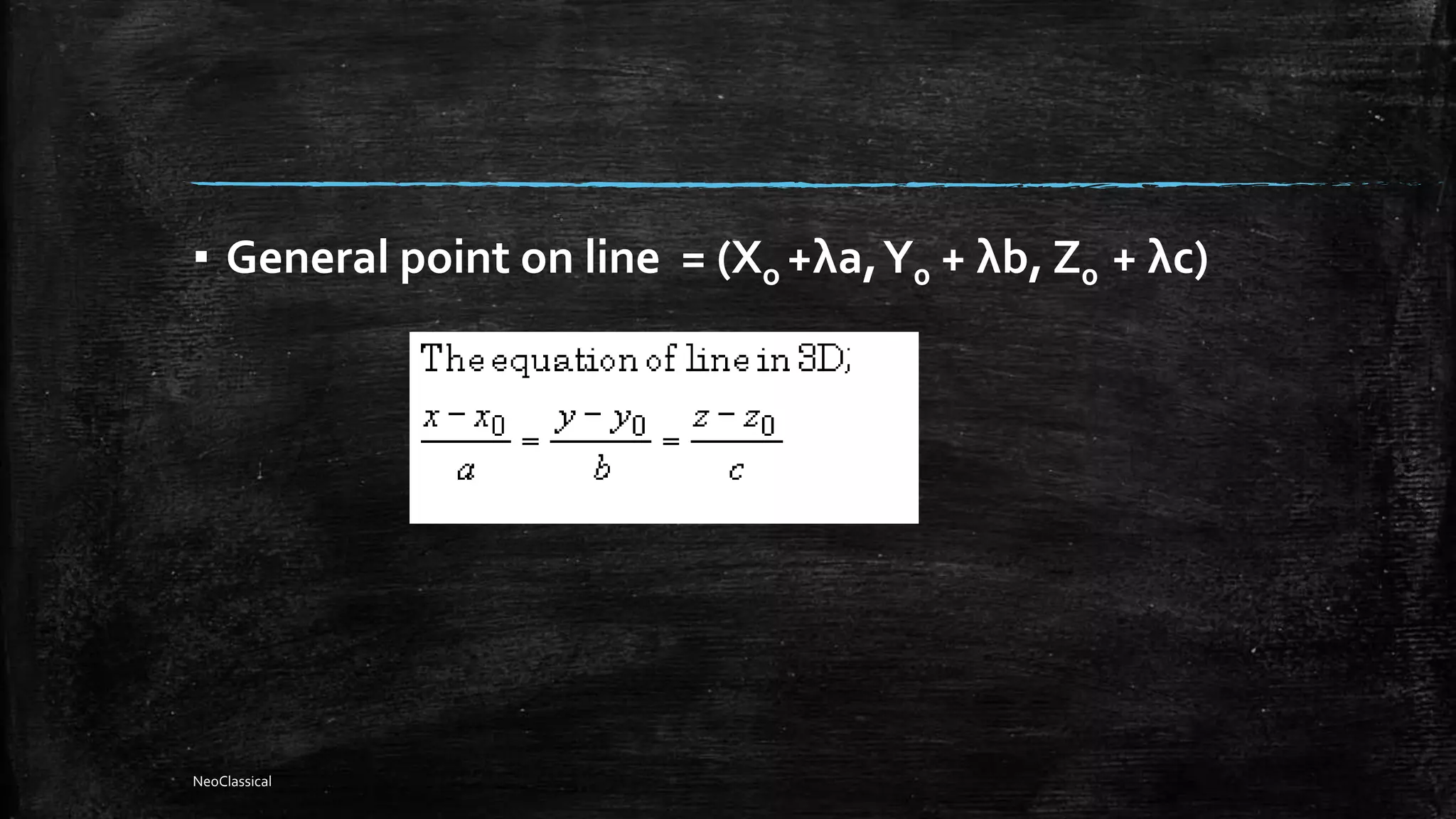
▪ General point on line = (Xo +λa,Y0 + λb, Z0 + λc)
NeoClassical
Line and Line
NeoClassical
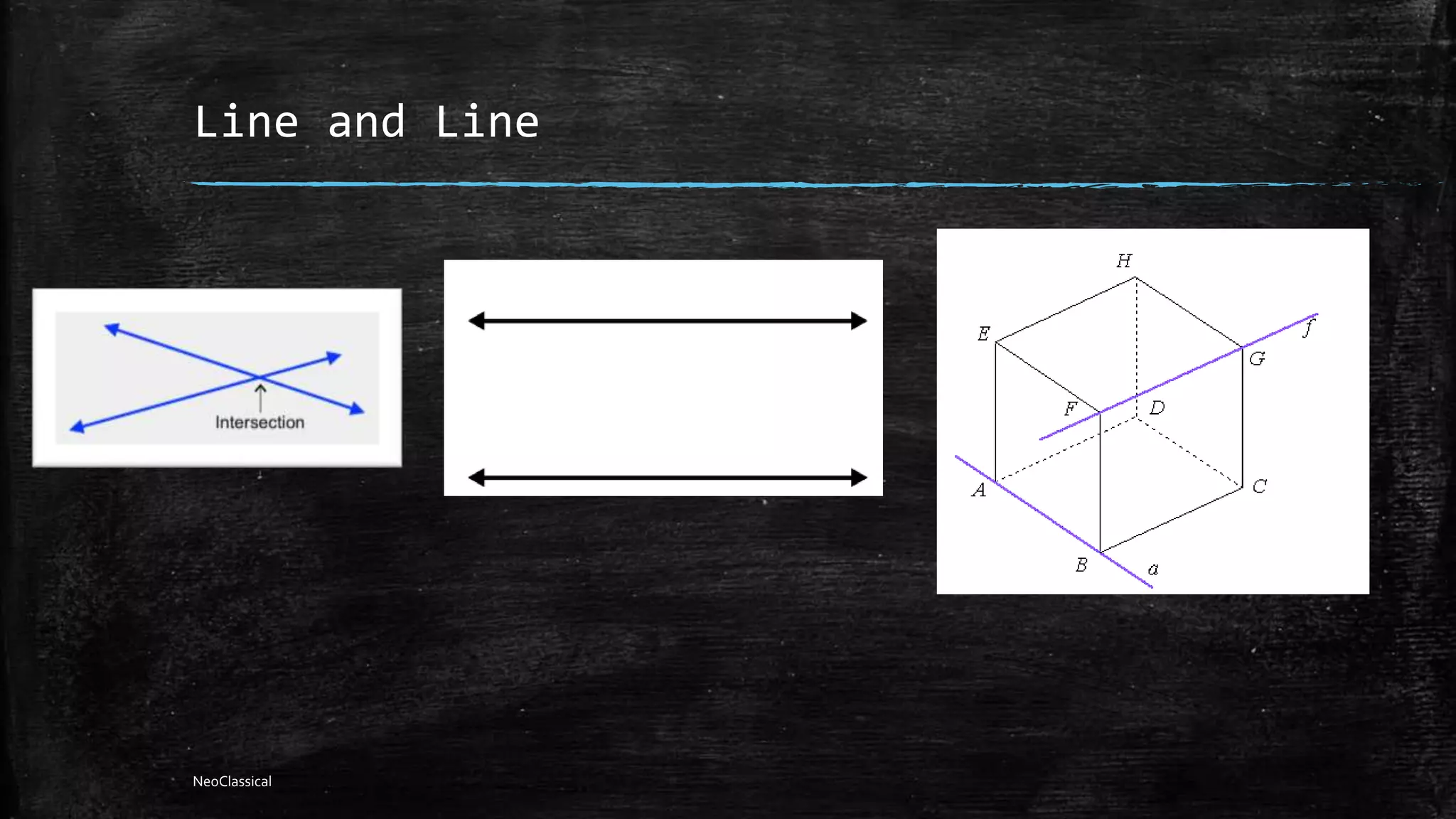
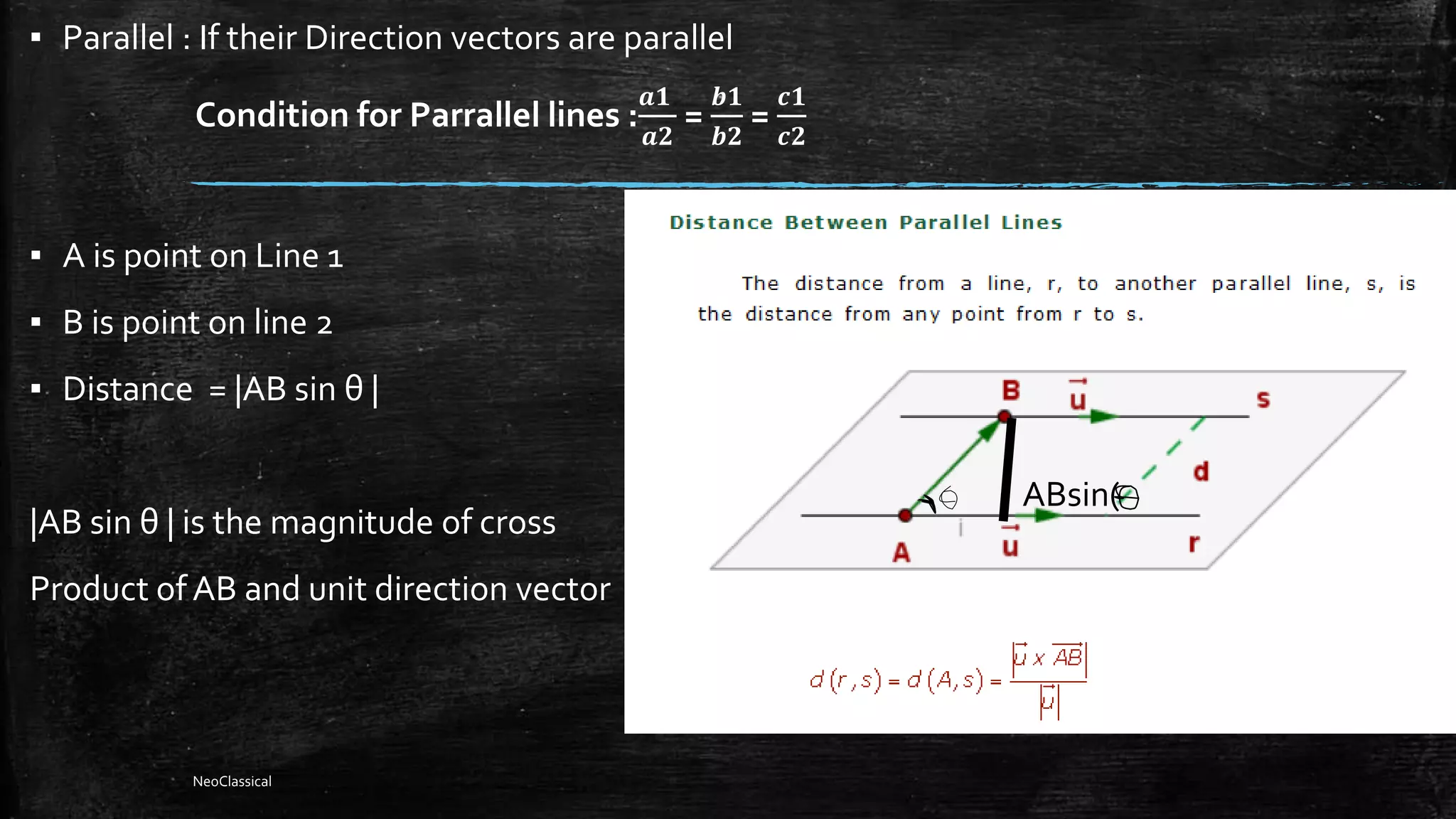
▪ Parallel : If their Direction vectors are parallel
Condition for Parrallel lines :
𝒂𝟏
𝒂𝟐
=
𝒃𝟏
𝒃𝟐
=
𝒄𝟏
𝒄𝟐
▪ A is point on Line 1
▪ B is point on line 2
▪ Distance = |AB sin θ |
|AB sin θ | is the magnitude of cross
Product ofAB and unit direction vector
ABsin(
NeoClassical
Distance between skew lines
▪ Skew lines are neither parallel nor intersecting
▪ Skew Lines have perpendicular direction vectors
▪ They form parallelepiped
▪ A is point on first line , B point on 2nd line
▪ Volume of parallelepiped = | [ u AB v ] |
▪ Volume = area X distance
▪ Area = |u X v|
NeoClassical
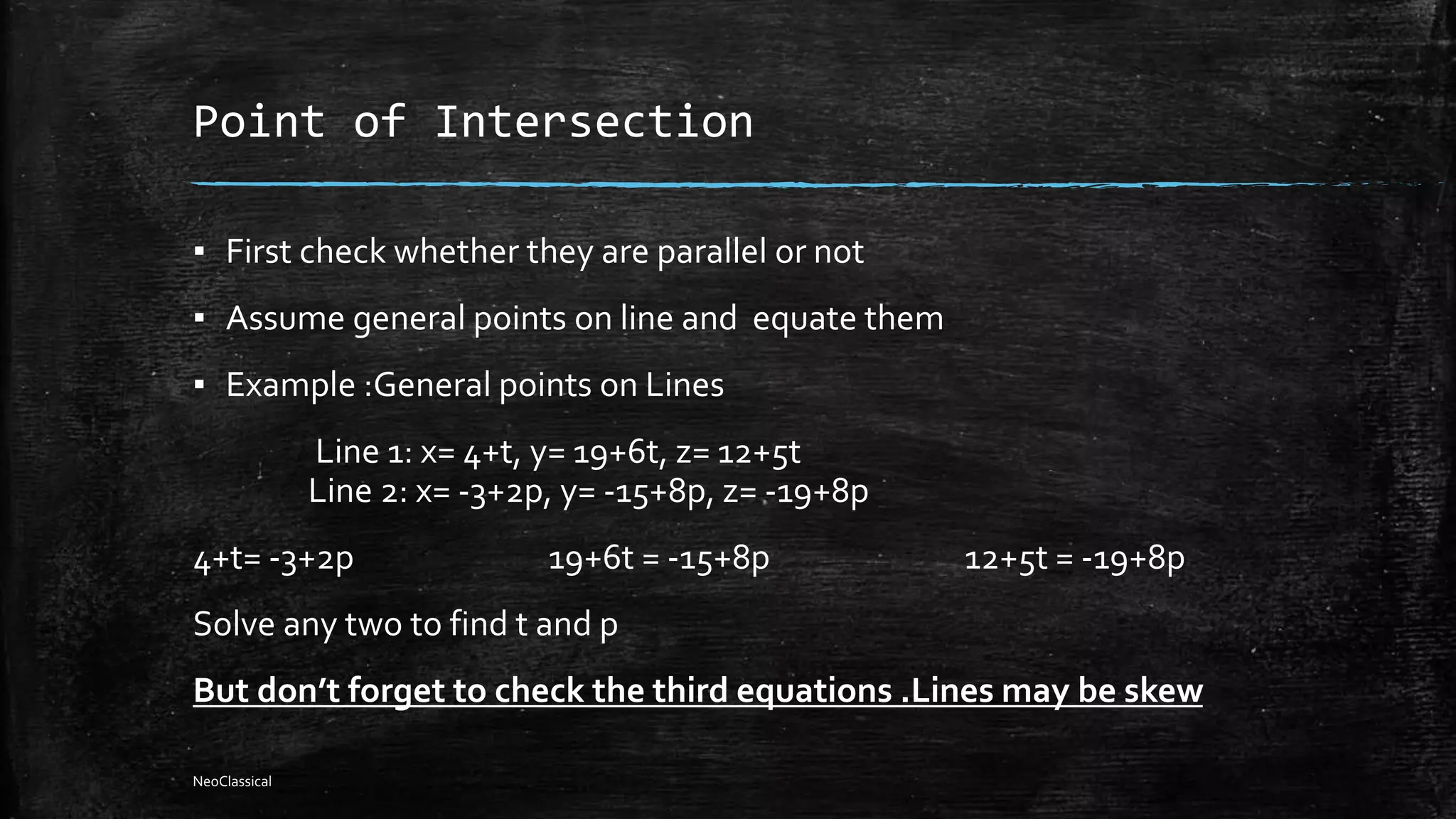
Point of Intersection
▪ First check whether they are parallel or not
▪ Assume general points on line and equate them
▪ Example :General points on Lines
Line 1: x= 4+t, y= 19+6t, z= 12+5t
Line 2: x= -3+2p, y= -15+8p, z= -19+8p
4+t= -3+2p 19+6t = -15+8p 12+5t = -19+8p
Solve any two to find t and p
But don’t forget to check the third equations .Lines may be skew
NeoClassical
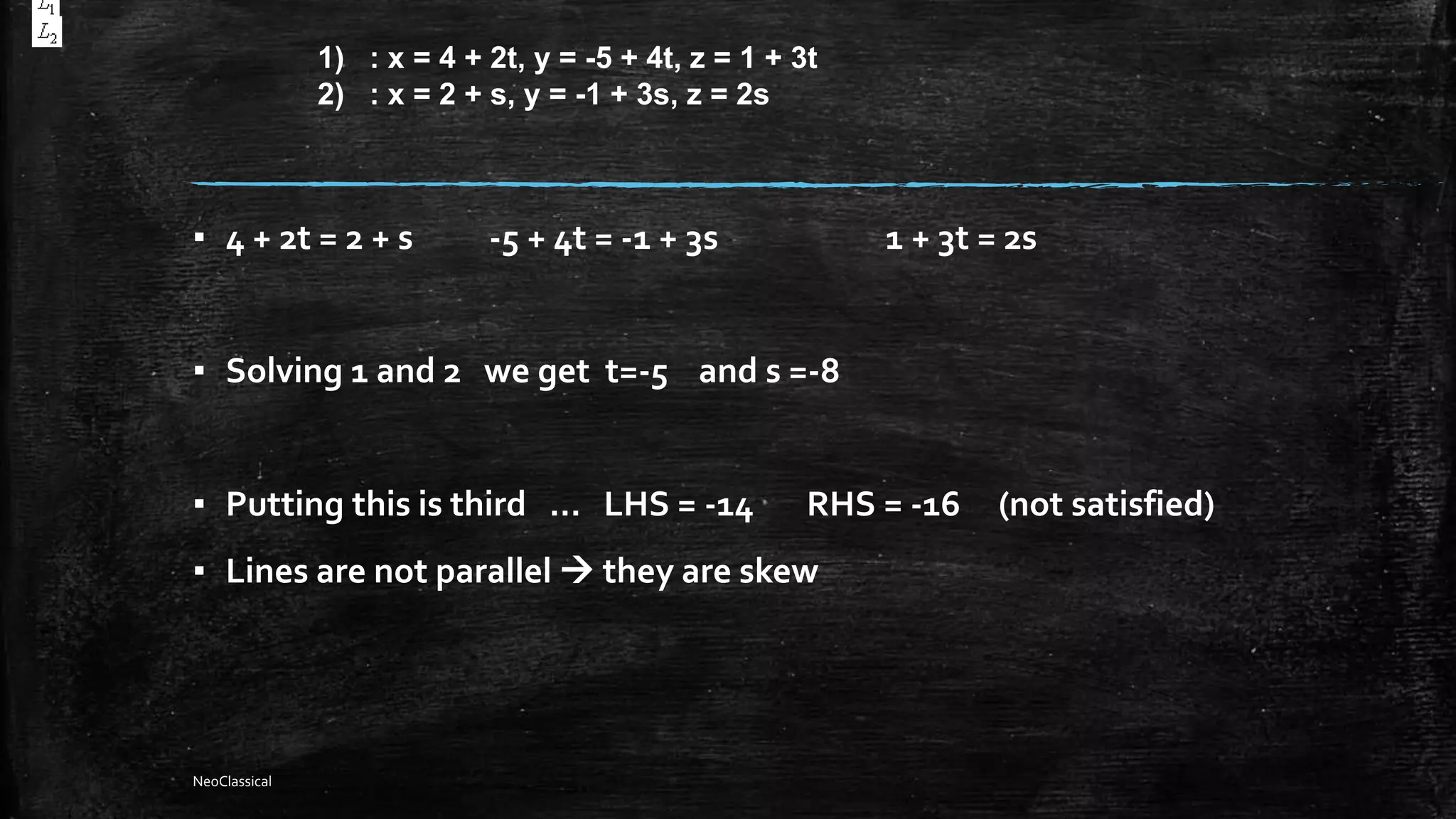
▪ 4 + 2t = 2 + s -5 + 4t = -1 + 3s 1 + 3t = 2s
▪ Solving 1 and 2 we get t=-5 and s =-8
▪ Putting this is third … LHS = -14 RHS = -16 (not satisfied)
▪ Lines are not parallel  they are skew
1) : x = 4 + 2t, y = -5 + 4t, z = 1 + 3t
2) : x = 2 + s, y = -1 + 3s, z = 2s
NeoClassical
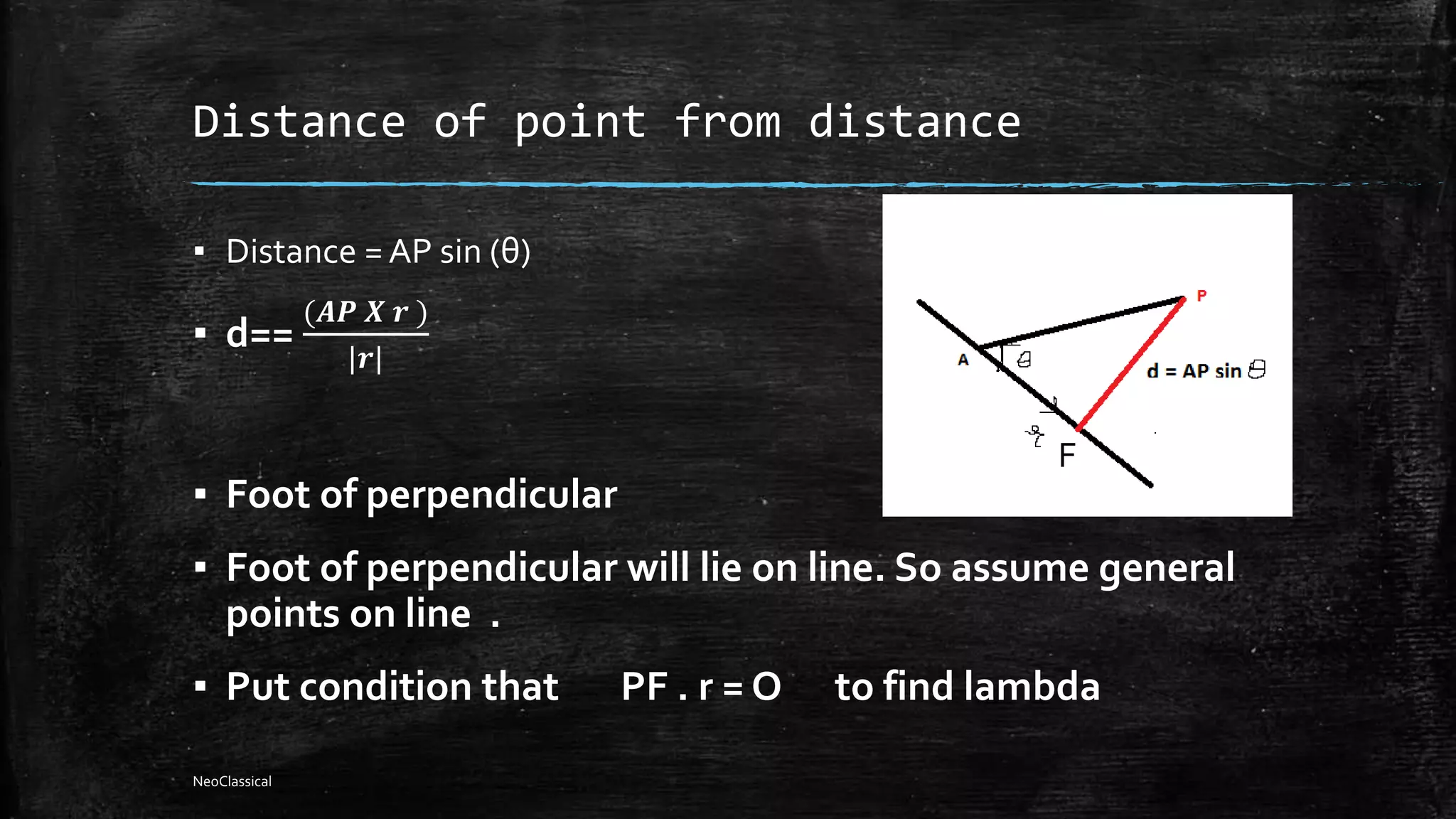
Distance of point from distance
▪ Distance = AP sin (θ)
▪ d==
(𝑨𝑷 𝑿 𝒓 )
|𝒓|
▪ Foot of perpendicular
▪ Foot of perpendicular will lie on line. So assume general
points on line .
▪ Put condition that PF . r = O to find lambda
F
NeoClassical
Plane and Line
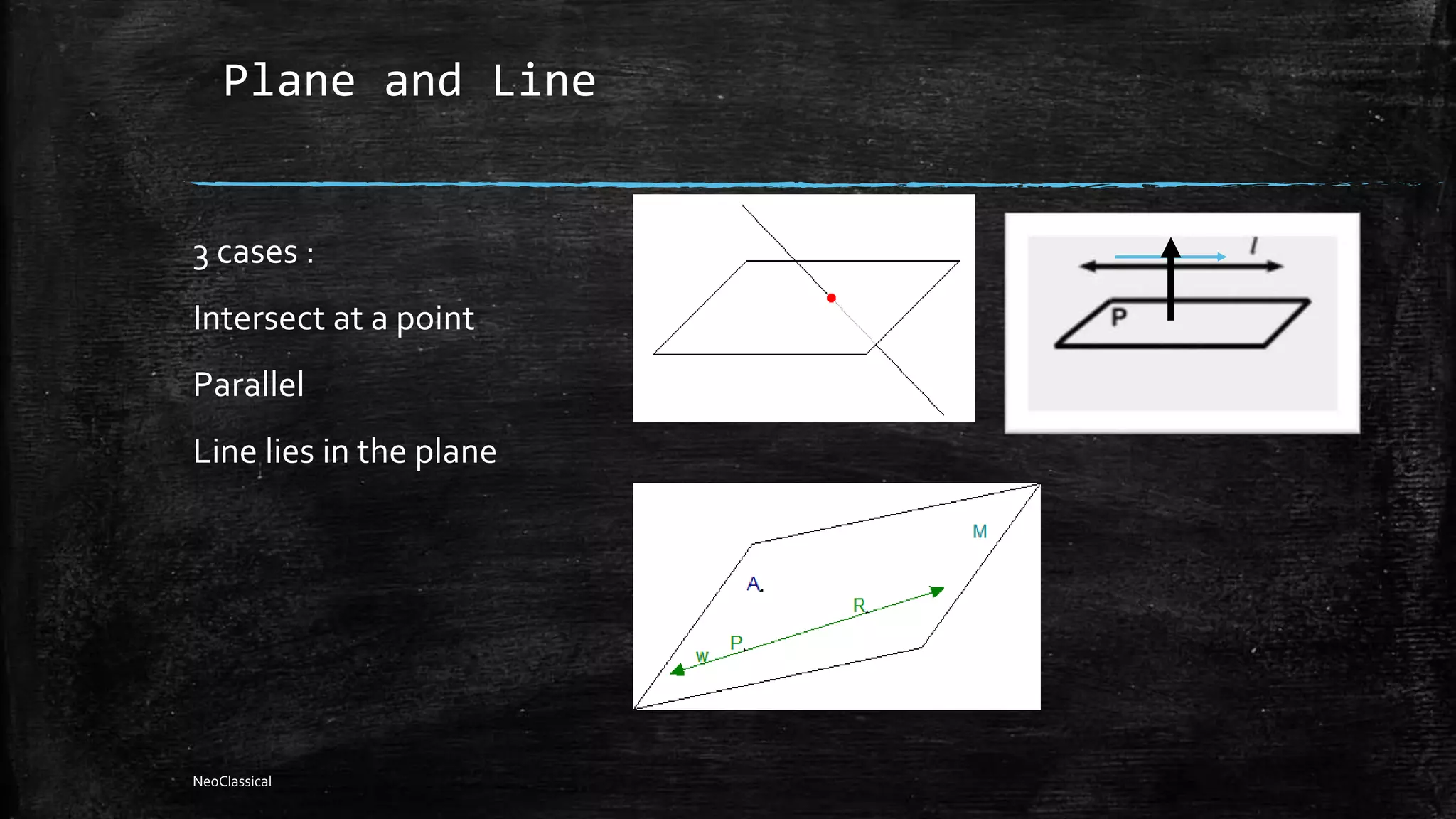
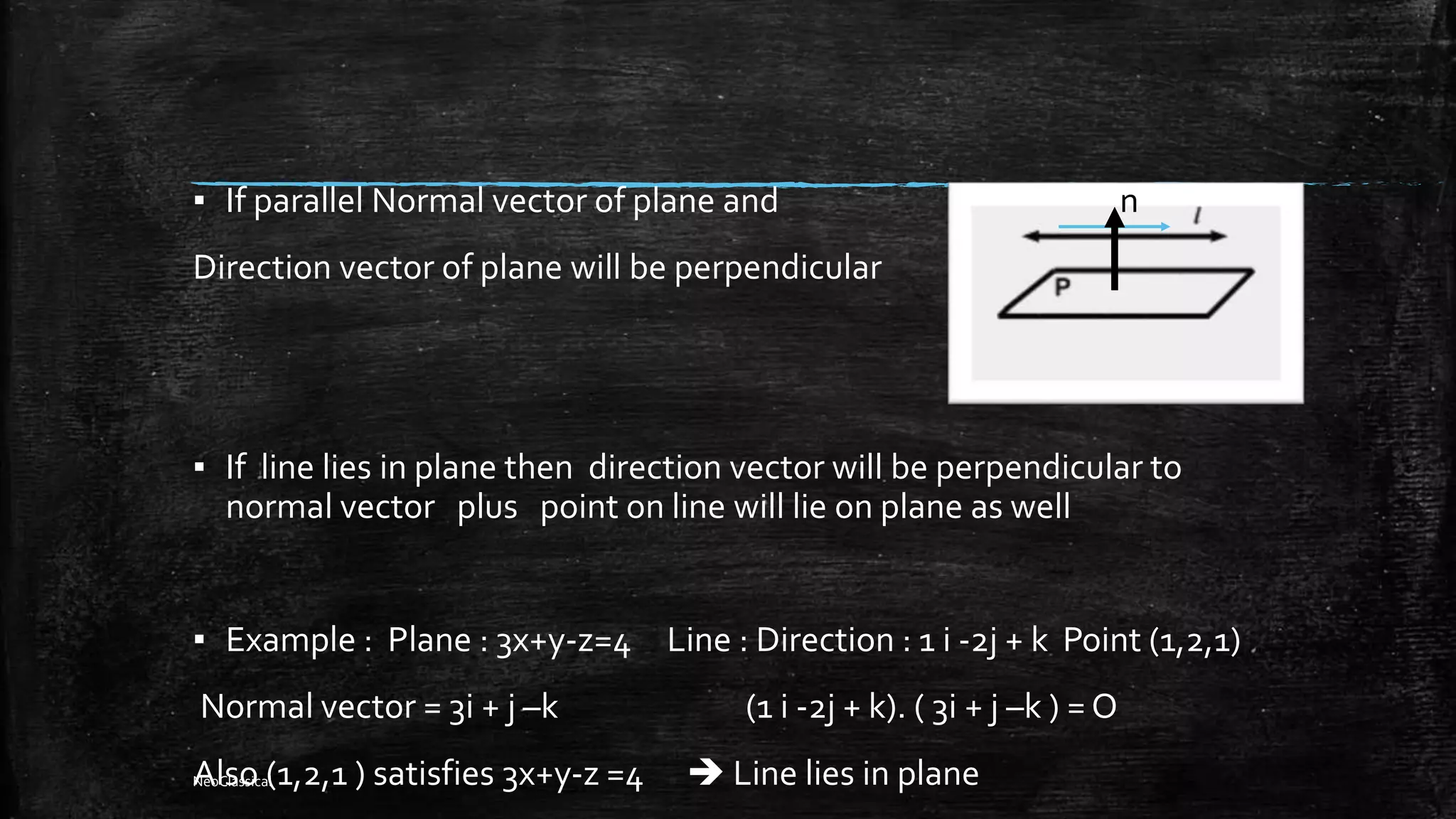
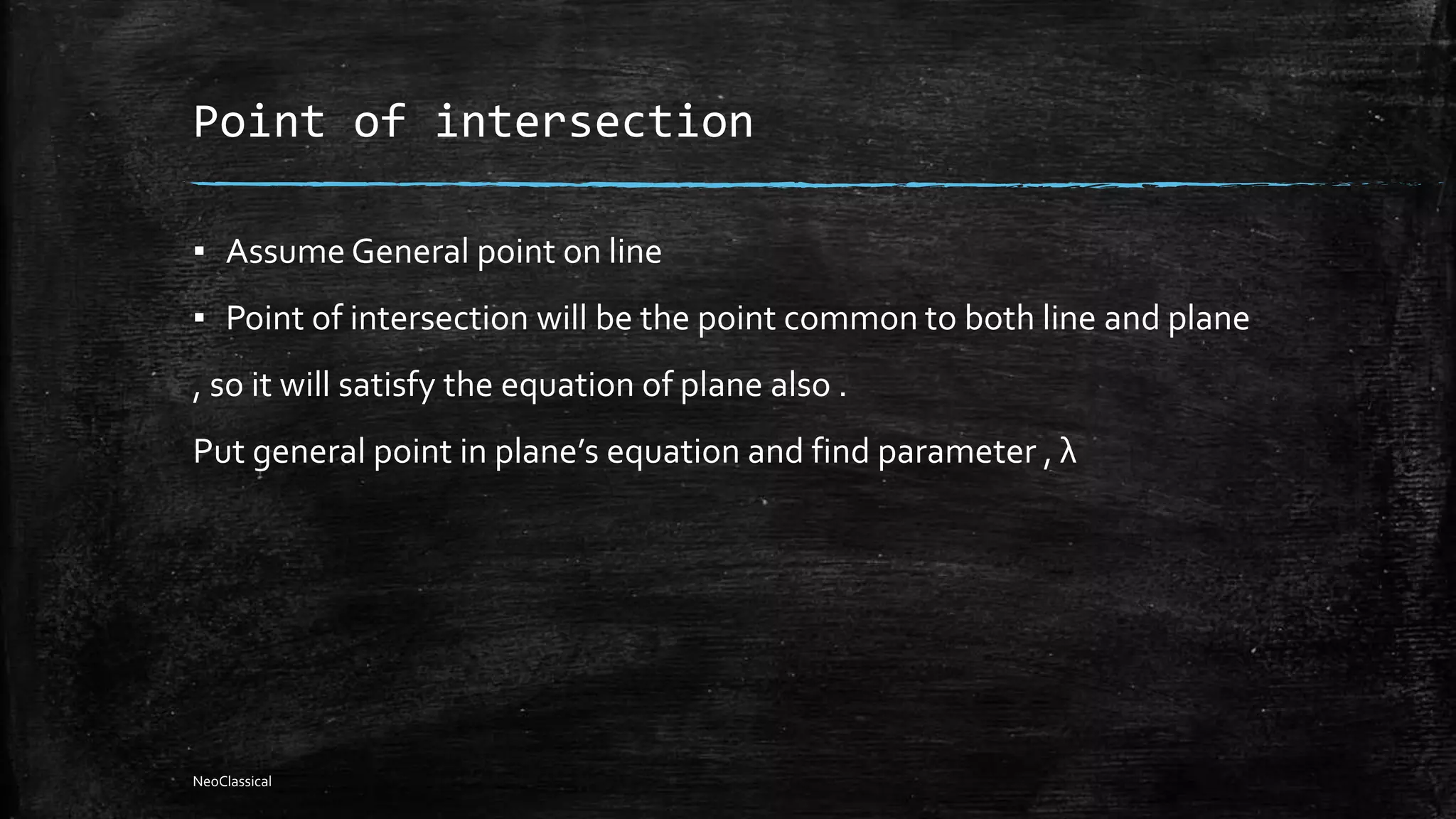
3 cases :
Intersect at a point
Parallel
Line lies in the plane
NeoClassical
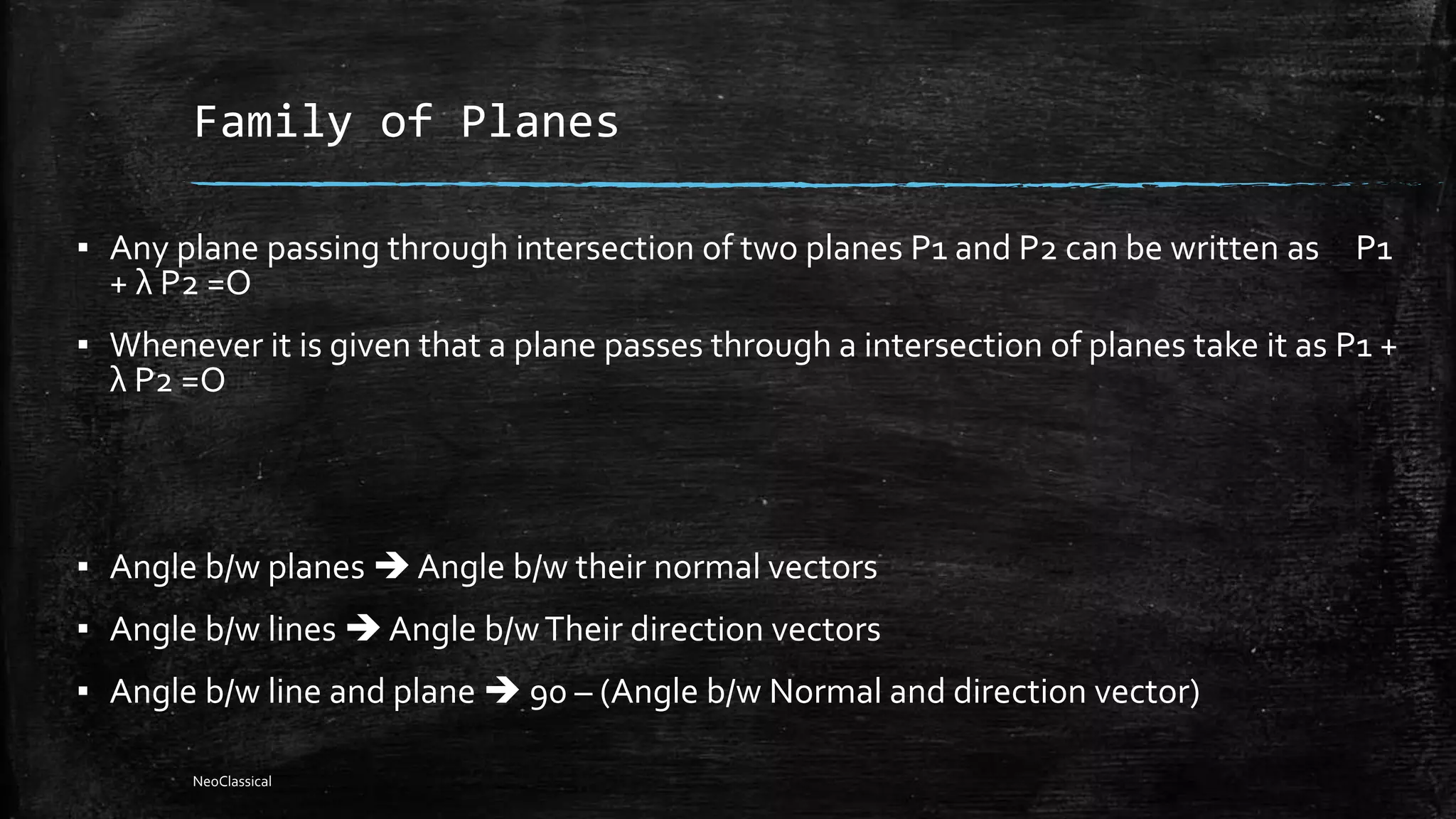
▪ If parallel Normal vector of plane and
Direction vector of plane will be perpendicular
▪ If line lies in plane then direction vector will be perpendicular to
normal vector plus point on line will lie on plane as well
▪ Example : Plane : 3x+y-z=4 Line : Direction : 1 i -2j + k Point (1,2,1)
Normal vector = 3i + j –k (1 i -2j + k). ( 3i + j –k ) = O
Also (1,2,1 ) satisfies 3x+y-z =4  Line lies in plane
n
NeoClassical
Point of intersection
▪ Assume General point on line
▪ Point of intersection will be the point common to both line and plane
, so it will satisfy the equation of plane also .
Put general point in plane’s equation and find parameter , λ
NeoClassical
Family of Planes
▪ Any plane passing through intersection of two planes P1 and P2 can be written as P1
+ λ P2 =O
▪ Whenever it is given that a plane passes through a intersection of planes take it as P1 +
λ P2 =O
▪ Angle b/w planes  Angle b/w their normal vectors
▪ Angle b/w lines  Angle b/wTheir direction vectors
▪ Angle b/w line and plane  90 – (Angle b/w Normal and direction vector)
NeoClassical
Distance of a point from plane measured
along line
Check this :
http://www.meritnation.com/ask-answer/question/find-the-distance-
of-the-point-1-2-3-from-the-plane-x-y-z/three-dimensional-
geometry/1811158
NeoClassical

Vectors and 3 d

  • 1.
  • 2.
  • 3.
    Dot Product ▪ Dotproduct tells how dependent vectors are i.e angle between them NeoClassical
  • 4.
    Uses of DotProduct ▪ Finding Angle between vectors ▪ Checking whether vectors ae perpendicular of not . For perpendicular vectors dot product is zero ▪ Projections NeoClassical
  • 5.
    ▪ Dot productcan be used to find magnitude of a vector due to the following property a . a = |a|2 Example to find |A+B| we calculate |A+B|2 = (A+B) .(A+B) = |A|2 + |B|2 + 2 A .B Similarly for |A+B+C| we have to its dot product with itself |A+B+C|2 = (A+B+C) .(A+B+C) NeoClassical
  • 6.
    CROSS PRODUCT ▪ AxB: Result is a vector ,whose magnitude is |A| |B| sin θ and direction is given by right hand thumb rule “(AxB) vector is perpendicular to both A and B  It is perpendicular to plane containing A and B” Whenever it is given to find out a vector perpendicular to two vectors , cross product will be used Example : Find a plane perpendicular to two given planes , then the normal vector of third plane will be the cross product of normal vectors of given planes NeoClassical
  • 7.
    ▪ Order isImportant (AXB) ≠ (BXA) ▪ (AXB) = -(BXA) ▪ If vectors are give in rectangular coordinate system i.e in terms of i,j,k NeoClassical
  • 8.
    Cross Product forcalculating area ▪ Area of parallelogram : Area of Triangle = ½ (A X B ) For calculation area of any other figure like quadrilateral , Pentagon just break them into trianglesNeoClassical
  • 9.
    ▪ For parallelvectors , Cross product is zero If two vectors A and B are parallel : A = λ B Example : NeoClassical
  • 10.
    Scalar Triple Product ▪STP or box product = A.(BXC) denoted as [ A B C ] ▪ First cross product then dot product ▪ Geometric interpretation :Volume of Parallelepiped = [A B C ] ▪ Tetrahedron = (1/6) [A B C] ▪ A ,B ,C are adjacent sides NeoClassical
  • 11.
    Properties : ▪ Positionof Dot and cross can be interchanged A.(BXC) = (AXB).C Can be cyclically permuted  [a b c] =[b c a] = [c a b] If order is not maintained it becomes negative [ a b c] = - [ a c b] Important : If Box product of three vectors A,B,C is zero , then they are coplanar . Reverse is also true Coplanartiy :::Think of Box product NeoClassical
  • 12.
    Example ▪ Prove [(a+b) (b+c) (c+a) ] = 2 [a b c ] NeoClassical
  • 13.
    Plane ▪ To defineplane we need 1 point and normal vector 3 points Normal vector is perpendicular to plane .There can be two normal vectors for a plane , one up and one down NeoClassical
  • 14.
    Equation of plane ▪Point on plane and normal vector is known ( r – a) . n = 0 r.n = a.n In rectangular coordinate system Given point (x1,y1,z1) a(x-x1) + b(y-y1) + c(z-z1) = 0 Coefficient of x , y and z give normal vector Example : Plane = 3x+ 4y + 7z = 8 Normal vector  3 i + 4 j + 7 kNeoClassical
  • 15.
    If two vectorsin a plane are known ▪ As we know that normal vector is a vector perpendicular to plane . So , if two vectors in plane are known , normal vector will be a vector perpendicular to both these vectors In the given figure , two vectors(Band C) in the plane (or parallel to the plane) are known , So normal vector will be the cross Product of Band C n = (BXC) NeoClassical
  • 16.
    If three pointsare known ▪ Three points  Plane is fixed Write any two vectors (AB , AC or BC ) These are in plane Normal vector will be perpendicular to all of these n = (AB X BC) or (ACXBC) or (AB XAC) Normal vector is known and point on plane is also known . So we can equation of plane easily NeoClassical
  • 17.
    Perpendicular Distance ofa point from plane ▪ General Equation of plane  ax +by + cz =d ▪ Whenever we have to assume a plane , we will use general equation of plane NeoClassical
  • 18.
    Foot of perpendicular Equationof plane ax+by+cz=d NormalVector : a i + b j +c k Point Q (X1 , Y1 , Z1 ) Foot of perpendicular : X ( h,k,l ) Now QX is parallel to normal vector  QX = λ n (h-X1)i + ( k-Y1 ) j + (l-Z1 ) = λ(a i + b j +c k)  h = X1 + λ a , k =Y1 + λ b , l = Z1 + λ c Put h,k,l in equation of plane and find λ NeoClassical
  • 19.
    Mirror Image inplane ▪ Foot of perpendicular is the midpoint Of image and point So first find foot of perpendicular Parallel Planes distance AB sin (theta ) = (AB X n ) / |n| NeoClassical
  • 20.
    Line ▪ For definingline we need ▪ Two points ▪ One point and slope Direction vector is parallel to line b  direction vector NeoClassical
  • 21.
    Equation of line ▪One point and direction vector ▪ Direction vector = a i + b j + c k ▪ (Xo ,Y0 , Z0 )  Point on line NeoClassical
  • 22.
    If two pointsare given ▪ If two points are given , direction vector can be found out easily A and B are given points , So AB is direction vector Unit direction vector give direction cosine Direction vector : a i + b j + c k Unit direction vector (a i + b j + c k )/ √(𝑎2 + 𝑏2 + 𝑐2) √(𝑎2 + 𝑏2 + 𝑐2) A B NeoClassical
  • 23.
    ▪ General pointon line = (Xo +λa,Y0 + λb, Z0 + λc) NeoClassical
  • 24.
  • 25.
    ▪ Parallel :If their Direction vectors are parallel Condition for Parrallel lines : 𝒂𝟏 𝒂𝟐 = 𝒃𝟏 𝒃𝟐 = 𝒄𝟏 𝒄𝟐 ▪ A is point on Line 1 ▪ B is point on line 2 ▪ Distance = |AB sin θ | |AB sin θ | is the magnitude of cross Product ofAB and unit direction vector ABsin( NeoClassical
  • 26.
    Distance between skewlines ▪ Skew lines are neither parallel nor intersecting ▪ Skew Lines have perpendicular direction vectors ▪ They form parallelepiped ▪ A is point on first line , B point on 2nd line ▪ Volume of parallelepiped = | [ u AB v ] | ▪ Volume = area X distance ▪ Area = |u X v| NeoClassical
  • 27.
    Point of Intersection ▪First check whether they are parallel or not ▪ Assume general points on line and equate them ▪ Example :General points on Lines Line 1: x= 4+t, y= 19+6t, z= 12+5t Line 2: x= -3+2p, y= -15+8p, z= -19+8p 4+t= -3+2p 19+6t = -15+8p 12+5t = -19+8p Solve any two to find t and p But don’t forget to check the third equations .Lines may be skew NeoClassical
  • 28.
    ▪ 4 +2t = 2 + s -5 + 4t = -1 + 3s 1 + 3t = 2s ▪ Solving 1 and 2 we get t=-5 and s =-8 ▪ Putting this is third … LHS = -14 RHS = -16 (not satisfied) ▪ Lines are not parallel  they are skew 1) : x = 4 + 2t, y = -5 + 4t, z = 1 + 3t 2) : x = 2 + s, y = -1 + 3s, z = 2s NeoClassical
  • 29.
    Distance of pointfrom distance ▪ Distance = AP sin (θ) ▪ d== (𝑨𝑷 𝑿 𝒓 ) |𝒓| ▪ Foot of perpendicular ▪ Foot of perpendicular will lie on line. So assume general points on line . ▪ Put condition that PF . r = O to find lambda F NeoClassical
  • 30.
    Plane and Line 3cases : Intersect at a point Parallel Line lies in the plane NeoClassical
  • 31.
    ▪ If parallelNormal vector of plane and Direction vector of plane will be perpendicular ▪ If line lies in plane then direction vector will be perpendicular to normal vector plus point on line will lie on plane as well ▪ Example : Plane : 3x+y-z=4 Line : Direction : 1 i -2j + k Point (1,2,1) Normal vector = 3i + j –k (1 i -2j + k). ( 3i + j –k ) = O Also (1,2,1 ) satisfies 3x+y-z =4  Line lies in plane n NeoClassical
  • 32.
    Point of intersection ▪Assume General point on line ▪ Point of intersection will be the point common to both line and plane , so it will satisfy the equation of plane also . Put general point in plane’s equation and find parameter , λ NeoClassical
  • 33.
    Family of Planes ▪Any plane passing through intersection of two planes P1 and P2 can be written as P1 + λ P2 =O ▪ Whenever it is given that a plane passes through a intersection of planes take it as P1 + λ P2 =O ▪ Angle b/w planes  Angle b/w their normal vectors ▪ Angle b/w lines  Angle b/wTheir direction vectors ▪ Angle b/w line and plane  90 – (Angle b/w Normal and direction vector) NeoClassical
  • 34.
    Distance of apoint from plane measured along line Check this : http://www.meritnation.com/ask-answer/question/find-the-distance- of-the-point-1-2-3-from-the-plane-x-y-z/three-dimensional- geometry/1811158 NeoClassical