ANALYTHIC GEOMETRYANALYTHIC GEOMETRY
OFOF
THREE DIMENSIONSTHREE DIMENSIONS
Corradi Davide, Codibue Martina 5^D liceo scientifico a.s. 2015/2016
Carthesian coordinate systemCarthesian coordinate system
● In a plane the point is originated by
two coordinates: “x” which is
associated with the x-axis, an
horizontal line with the positive
direction to the right, and “y”, which
is associated with the y-axis, i.e. a
vertical line with the positive
direction upward.
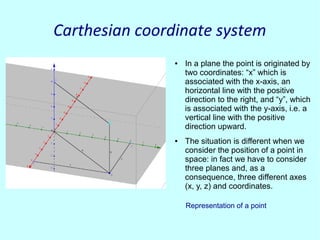
● The situation is different when we
consider the position of a point in
space: in fact we have to consider
three planes and, as a
consequence, three different axes
(x, y, z) and coordinates.
Representation of a point
The distance between two pointsThe distance between two points
and the segmentand the segment
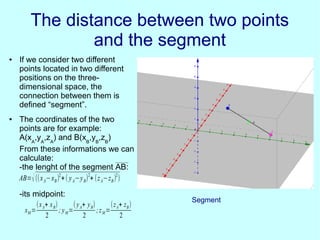
● If we consider two different
points located in two different
positions on the three-
dimensional space, the
connection between them is
defined “segment”.
● The coordinates of the two
points are for example:
A(xA
,yA
,zA
) and B(xB
,yB
,zB
)
From these informations we can
calculate:
-the lenght of the segment AB:
-its midpoint:
AB=√((xA−xB)2
+( yA−yB)2
+ (zA−zB)2
)
xM=
(xA+ xB)
2
; yM=
(yA+ yB)
2
;zM=
(zA+ zB)
2
Segment
The planeThe plane
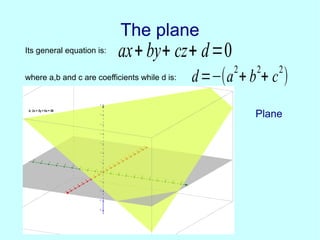
ax+ by+ cz+ d=0Its general equation is:
where a,b and c are coefficients while d is: d=−(a
2
+ b
2
+ c
2
)
Plane
Particular planesParticular planes
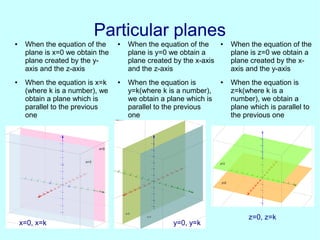
● When the equation of the
plane is x=0 we obtain the
plane created by the y-
axis and the z-axis
● When the equation is x=k
(where k is a number), we
obtain a plane which is
parallel to the previous
one
● When the equation of the
plane is y=0 we obtain a
plane created by the x-axis
and the z-axis
● When the equation is
y=k(where k is a number),
we obtain a plane which is
parallel to the previous
one
● When the equation of the
plane is z=0 we obtain a
plane created by the x-
axis and the y-axis
● When the equation is
z=k(where k is a
number), we obtain a
plane which is parallel to
the previous one
x=0, x=k y=0, y=k
z=0, z=k
Other informations about planesOther informations about planes
● The explicit equation of a plane
where:
m= -a/c
n= -b/c
q= (a
2
+ b
2
+ c
2
)
c
● Condition of parallelism between
planes:
plane one: ax+by+cz+d=0
plane two: a'x+b'y+c'z+d'=0
(
a
a
' )=(
b
b
')=(
c
c
')
z=mx+ ny+ q
● Condition of perpendicularity
between planes:
plane one: ax+by+cz+d=0
plane two: a'x+b'y+c'z+d'=0
● Distance between a point and a
plane:
(aa')+ (bb')+(cc')=0 h=
∣axA+ byA+ czA+ d∣
√a
2
+ b
2
+ c
2
The straight lineThe straight line
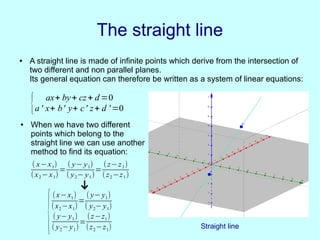
● A straight line is made of infinite points which derive from the intersection of
two different and non parallel planes.
Its general equation can therefore be written as a system of linear equations:
{ ax+ by+ cz+ d =0
a ' x+ b' y+ c' z+ d '=0
● When we have two different
points which belong to the
straight line we can use another
method to find its equation:
( x−x1)
(x2−x1)
=
( y− y1)
( y2− y1)
=
(z−z1)
(z2−z1)
↓
{
(x−x1)
(x2−x1)
=
( y− y1)
( y2− y1)
( y− y1)
( y2−y1)
=
(z−z1)
(z2−z1) Straight line
Definition of surfaces andDefinition of surfaces and
the spheric surfacethe spheric surface
● In the three-dimensional space a surface is defined as a set of points called
locus whose location satisfies or is determined by one or more particular
conditions.
For example these conditions can be an algebric equation.
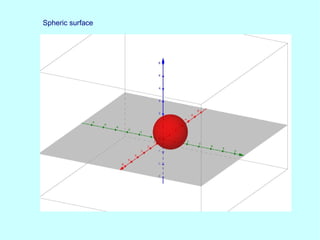
● The spheric surface is defined as a locus whose property is that all its
points have the same distance called radius(r) from its center.
Coordinates of the center: C(x0
;y0
;z0
)
Ipothetical point of the sphere: P(x;y;z)
calculating their distance we obtain the equation of the sphere:
↓
(x−x0)
2
+(y−y0)
2
+ (z−z0)
2
=r
2
→ x
2
+ y
2
+ z
2
+ ax+ by+ cz+ d=0
Spheric surface
Composition of figuresComposition of figures
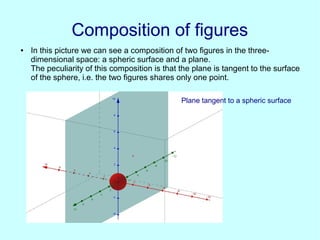
● In this picture we can see a composition of two figures in the three-
dimensional space: a spheric surface and a plane.
The peculiarity of this composition is that the plane is tangent to the surface
of the sphere, i.e. the two figures shares only one point.
Plane tangent to a spheric surface
Applications of the three-Applications of the three-
dimensional geometrydimensional geometry
When do we use the three-
dimensional geometry in real life?
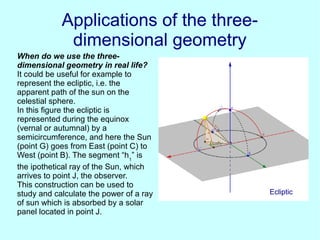
It could be useful for example to
represent the ecliptic, i.e. the
apparent path of the sun on the
celestial sphere.
In this figure the ecliptic is
represented during the equinox
(vernal or autumnal) by a
semicircumference, and here the Sun
(point G) goes from East (point C) to
West (point B). The segment “h1
” is
the ipothetical ray of the Sun, which
arrives to point J, the observer.
This construction can be used to
study and calculate the power of a ray
of sun which is absorbed by a solar
panel located in point J.
Ecliptic

Three dimensional space complete

  • 1.
    ANALYTHIC GEOMETRYANALYTHIC GEOMETRY OFOF THREEDIMENSIONSTHREE DIMENSIONS Corradi Davide, Codibue Martina 5^D liceo scientifico a.s. 2015/2016
  • 2.
    Carthesian coordinate systemCarthesiancoordinate system ● In a plane the point is originated by two coordinates: “x” which is associated with the x-axis, an horizontal line with the positive direction to the right, and “y”, which is associated with the y-axis, i.e. a vertical line with the positive direction upward. ● The situation is different when we consider the position of a point in space: in fact we have to consider three planes and, as a consequence, three different axes (x, y, z) and coordinates. Representation of a point
  • 3.
    The distance betweentwo pointsThe distance between two points and the segmentand the segment ● If we consider two different points located in two different positions on the three- dimensional space, the connection between them is defined “segment”. ● The coordinates of the two points are for example: A(xA ,yA ,zA ) and B(xB ,yB ,zB ) From these informations we can calculate: -the lenght of the segment AB: -its midpoint: AB=√((xA−xB)2 +( yA−yB)2 + (zA−zB)2 ) xM= (xA+ xB) 2 ; yM= (yA+ yB) 2 ;zM= (zA+ zB) 2 Segment
  • 4.
    The planeThe plane ax+by+ cz+ d=0Its general equation is: where a,b and c are coefficients while d is: d=−(a 2 + b 2 + c 2 ) Plane
  • 5.
    Particular planesParticular planes ●When the equation of the plane is x=0 we obtain the plane created by the y- axis and the z-axis ● When the equation is x=k (where k is a number), we obtain a plane which is parallel to the previous one ● When the equation of the plane is y=0 we obtain a plane created by the x-axis and the z-axis ● When the equation is y=k(where k is a number), we obtain a plane which is parallel to the previous one ● When the equation of the plane is z=0 we obtain a plane created by the x- axis and the y-axis ● When the equation is z=k(where k is a number), we obtain a plane which is parallel to the previous one x=0, x=k y=0, y=k z=0, z=k
  • 6.
    Other informations aboutplanesOther informations about planes ● The explicit equation of a plane where: m= -a/c n= -b/c q= (a 2 + b 2 + c 2 ) c ● Condition of parallelism between planes: plane one: ax+by+cz+d=0 plane two: a'x+b'y+c'z+d'=0 ( a a ' )=( b b ')=( c c ') z=mx+ ny+ q ● Condition of perpendicularity between planes: plane one: ax+by+cz+d=0 plane two: a'x+b'y+c'z+d'=0 ● Distance between a point and a plane: (aa')+ (bb')+(cc')=0 h= ∣axA+ byA+ czA+ d∣ √a 2 + b 2 + c 2
  • 7.
    The straight lineThestraight line ● A straight line is made of infinite points which derive from the intersection of two different and non parallel planes. Its general equation can therefore be written as a system of linear equations: { ax+ by+ cz+ d =0 a ' x+ b' y+ c' z+ d '=0 ● When we have two different points which belong to the straight line we can use another method to find its equation: ( x−x1) (x2−x1) = ( y− y1) ( y2− y1) = (z−z1) (z2−z1) ↓ { (x−x1) (x2−x1) = ( y− y1) ( y2− y1) ( y− y1) ( y2−y1) = (z−z1) (z2−z1) Straight line
  • 8.
    Definition of surfacesandDefinition of surfaces and the spheric surfacethe spheric surface ● In the three-dimensional space a surface is defined as a set of points called locus whose location satisfies or is determined by one or more particular conditions. For example these conditions can be an algebric equation. ● The spheric surface is defined as a locus whose property is that all its points have the same distance called radius(r) from its center. Coordinates of the center: C(x0 ;y0 ;z0 ) Ipothetical point of the sphere: P(x;y;z) calculating their distance we obtain the equation of the sphere: ↓ (x−x0) 2 +(y−y0) 2 + (z−z0) 2 =r 2 → x 2 + y 2 + z 2 + ax+ by+ cz+ d=0
  • 9.
  • 10.
    Composition of figuresCompositionof figures ● In this picture we can see a composition of two figures in the three- dimensional space: a spheric surface and a plane. The peculiarity of this composition is that the plane is tangent to the surface of the sphere, i.e. the two figures shares only one point. Plane tangent to a spheric surface
  • 11.
    Applications of thethree-Applications of the three- dimensional geometrydimensional geometry When do we use the three- dimensional geometry in real life? It could be useful for example to represent the ecliptic, i.e. the apparent path of the sun on the celestial sphere. In this figure the ecliptic is represented during the equinox (vernal or autumnal) by a semicircumference, and here the Sun (point G) goes from East (point C) to West (point B). The segment “h1 ” is the ipothetical ray of the Sun, which arrives to point J, the observer. This construction can be used to study and calculate the power of a ray of sun which is absorbed by a solar panel located in point J. Ecliptic