Chapter 3
Section 1


            
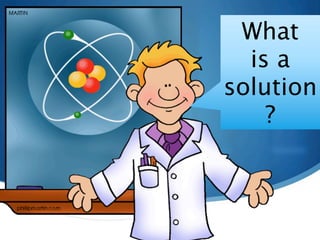
What
  is a
solution
    ?
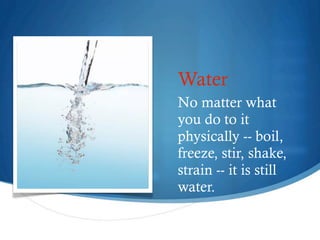
Water
    No matter what
    you do to it
    physically -- boil,
    freeze, stir, shake,
    strain -- it is still
    water.

3
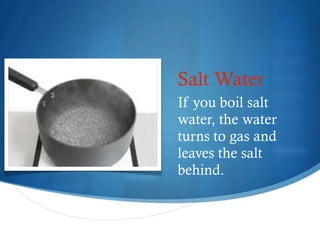
Salt Water
    If you boil salt
    water, the water
    turns to gas and
    leaves the salt
    behind.


4
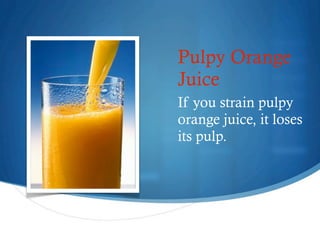
Pulpy Orange
    Juice
    If you strain pulpy
    orange juice, it loses
    its pulp.


5
Substances
Water, salt water and pulpy
 orange juice are different. These
 differences can be explained using
 CHEMISTRY!


                 6
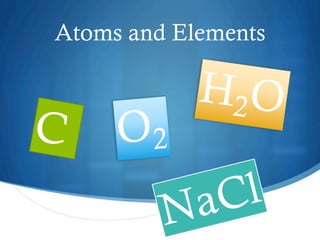
Atoms and Elements
Atoms and Elements

            H2O
C    O2
         N aC l
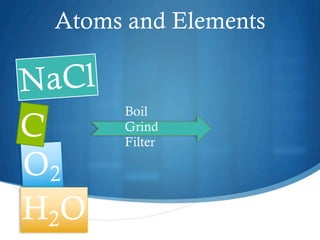
Atoms and Elements

N aCl
        Boil
C       Grind
        Filter

O2
H2O
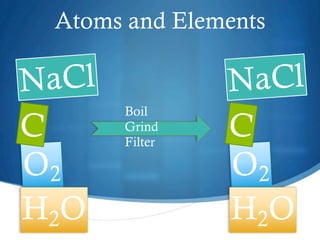
Atoms and Elements

N aCl            N aCl
        Boil
C       Grind
        Filter
                 C
O2               O2
H2O              H2O
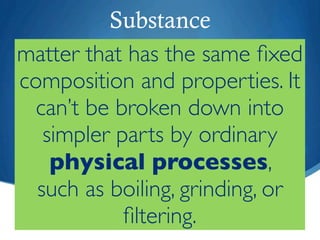
Substance
matter that has the same fixed
composition and properties. It
  can’t be broken down into
   simpler parts by ordinary
    physical processes,
  such as boiling, grinding, or
            filtering.
Compounds
Compounds
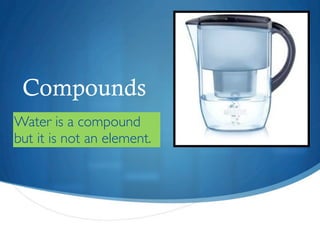
Water is a compound
but it is not an element.
Compounds
Water is a compound
but it is not an element.
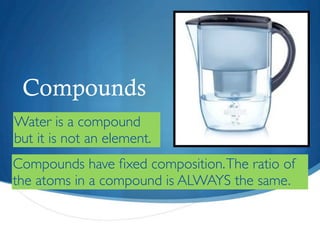
Compounds have fixed composition. The ratio of
the atoms in a compound is ALWAYS the same.
Compounds
Water is a compound
but it is not an element.
Compounds have fixed composition. The ratio of
the atoms in a compound is ALWAYS the same.
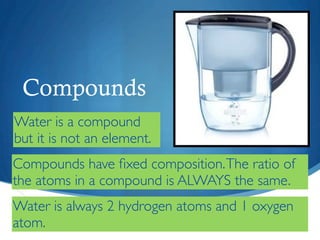
Water is always 2 hydrogen atoms and 1 oxygen
atom.
Mixtures
Mixtures
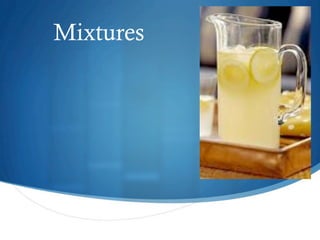
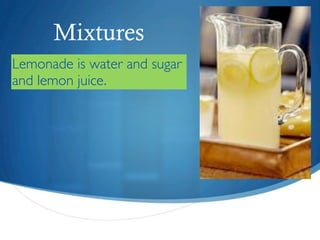
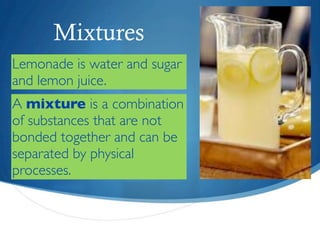
Lemonade is water and sugar
and lemon juice.
Mixtures
Lemonade is water and sugar
and lemon juice.
A mixture is a combination
of substances that are not
bonded together and can be
separated by physical
processes.
Mixtures
Lemonade is water and sugar
and lemon juice.
A mixture is a combination
of substances that are not
bonded together and can be
separated by physical
processes.
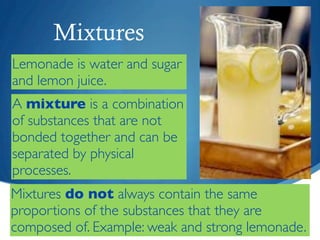
Mixtures do not always contain the same
proportions of the substances that they are
composed of. Example: weak and strong lemonade.
Heterogeneous
Heterogeneous


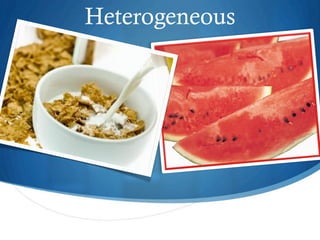
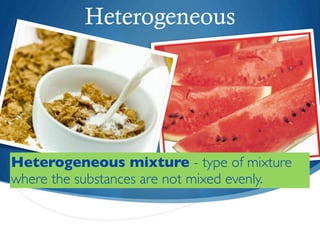
Heterogeneous mixture - type of mixture
where the substances are not mixed evenly.
Heterogeneous


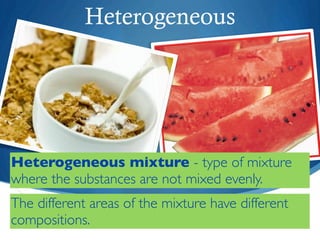
Heterogeneous mixture - type of mixture
where the substances are not mixed evenly.
The different areas of the mixture have different
compositions.
Homogeneous (Solution)


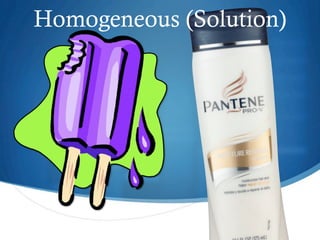
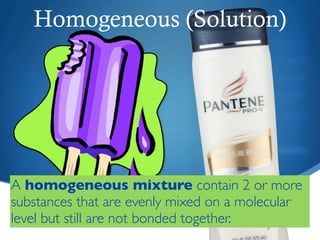
A homogeneous mixture contain 2 or more
substances that are evenly mixed on a molecular
level but still are not bonded together.
Homogeneous (Solution)
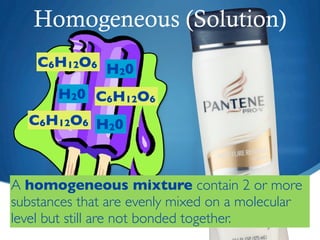
    C6H12O6 H 0
             2

       H20 C6H12O6
  C6H12O6 H20


A homogeneous mixture contain 2 or more
substances that are evenly mixed on a molecular
level but still are not bonded together.
How
Solutions
 Form
How
   Solutions
    Form
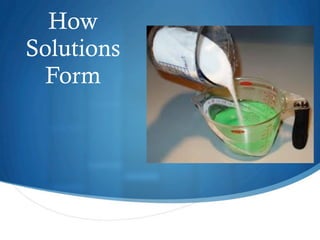
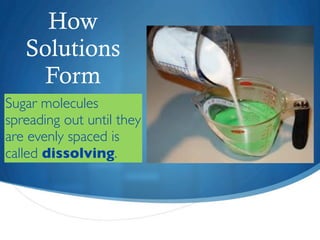
Sugar molecules
spreading out until they
are evenly spaced is
called dissolving.
How
   Solutions
    Form
Sugar molecules
spreading out until they
are evenly spaced is
called dissolving.
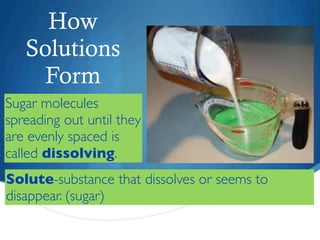
Solute-substance that dissolves or seems to
disappear. (sugar)
How
   Solutions
    Form
Sugar molecules
spreading out until they
are evenly spaced is
called dissolving.
Solute-substance that dissolves or seems to
disappear. (sugar)
Solvent-substance that dissolves the solute.(water)
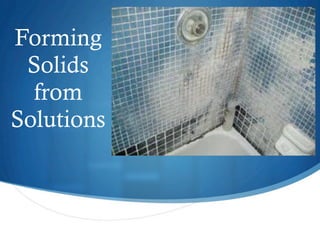
Forming
Solids from
 Solutions
Forming
Solids from
 Solutions

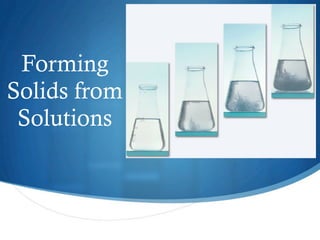
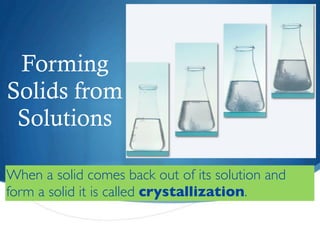
When a solid comes back out of its solution and
form a solid it is called crystallization.
Forming
Solids from
 Solutions

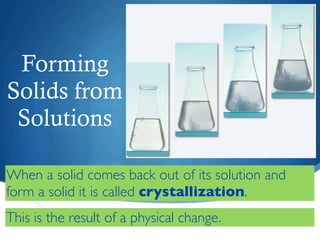
When a solid comes back out of its solution and
form a solid it is called crystallization.
This is the result of a physical change.
Forming Solids
from Solutions
Forming Solids
 from Solutions
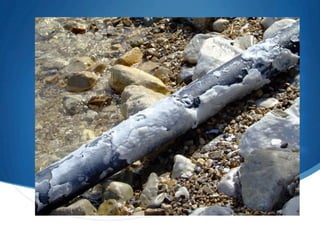
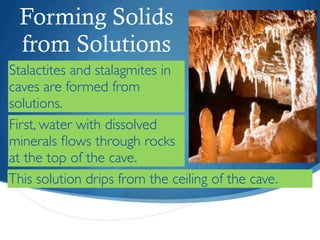
Stalactites and stalagmites in
caves are formed from
solutions.
Forming Solids
 from Solutions
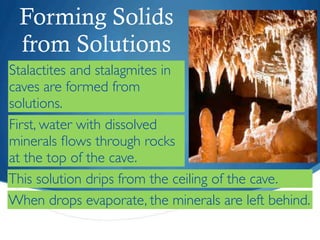
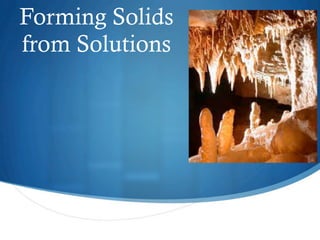
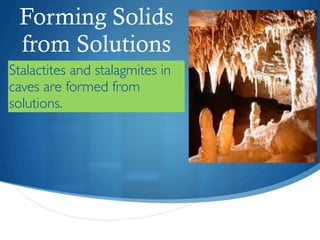
Stalactites and stalagmites in
caves are formed from
solutions.
First, water with dissolved
minerals flows through rocks
at the top of the cave.
Forming Solids
 from Solutions
Stalactites and stalagmites in
caves are formed from
solutions.
First, water with dissolved
minerals flows through rocks
at the top of the cave.
This solution drips from the ceiling of the cave.
Forming Solids
 from Solutions
Stalactites and stalagmites in
caves are formed from
solutions.
First, water with dissolved
minerals flows through rocks
at the top of the cave.
This solution drips from the ceiling of the cave.
When drops evaporate, the minerals are left behind.
Forming Solids
 from Solutions
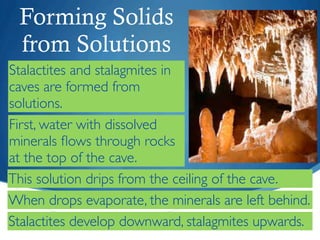
Stalactites and stalagmites in
caves are formed from
solutions.
First, water with dissolved
minerals flows through rocks
at the top of the cave.
This solution drips from the ceiling of the cave.
When drops evaporate, the minerals are left behind.
Stalactites develop downward, stalagmites upwards.
Forming
 Solids
  from
Solutions
Forming
 Solids
  from
Solutions
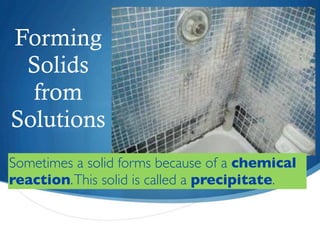
Sometimes a solid forms because of a chemical
reaction. This solid is called a precipitate.
Forming
 Solids
  from
Solutions
Sometimes a solid forms because of a chemical
reaction. This solid is called a precipitate.
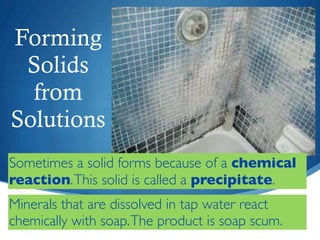
Minerals that are dissolved in tap water react
chemically with soap. The product is soap scum.
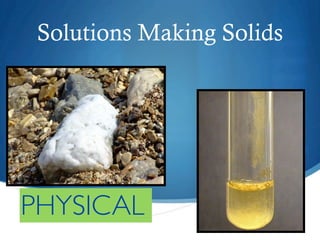
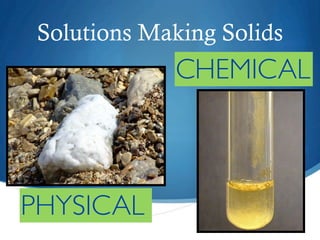
Solutions Making Solids


PHYSICAL
Solutions Making Solids
             CHEMICAL


PHYSICAL
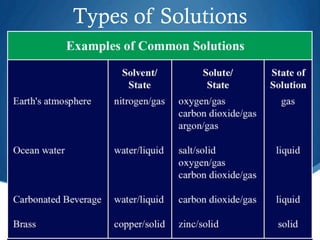
Types of Solutions
Types of Solutions
Liquid Solutions
Liquid Solutions
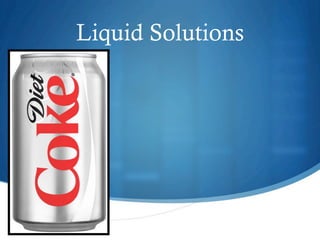
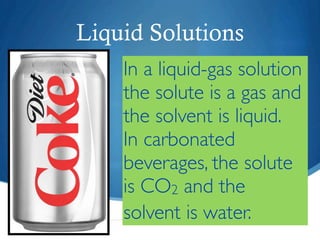
    In a liquid-gas solution
    the solute is a gas and
    the solvent is liquid.
    In carbonated
    beverages, the solute
    is CO2 and the
    solvent is water.
Liquid Solutions
Liquid Solutions
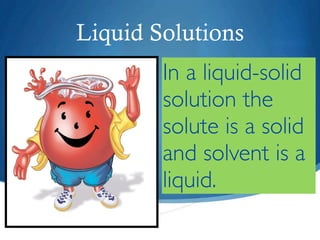
        In a liquid-solid
        solution the
        solute is a solid
        and solvent is a
        liquid.
Liquid Solutions
Liquid Solutions
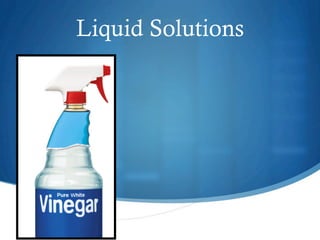
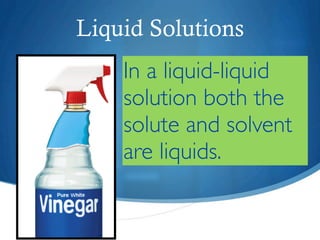
    In a liquid-liquid
    solution both the
    solute and solvent
    are liquids.
Gaseous
Solution
Gaseous
 Solution
A smaller amount
of one gas is
dissolved in a
larger amount of
another gas.
Gaseous
                             Solution
                           A smaller amount
                           of one gas is
                           dissolved in a
                           larger amount of
                           another gas.
Nitrogen makes up 78% of dry air and is the
solvent.
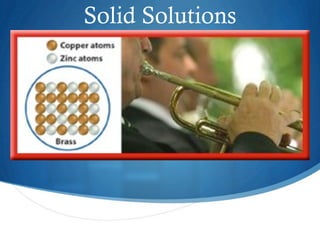
Solid Solutions
Solid Solutions


The solvent is a solid, the solute is a solid, liquid or
gas. The most common is solid-solid solutions.
Solid Solutions


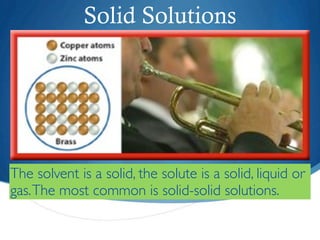
The solvent is a solid, the solute is a solid, liquid or
gas. The most common is solid-solid solutions.
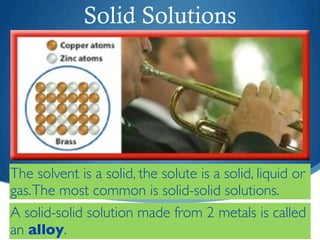
A solid-solid solution made from 2 metals is called
an alloy.
Finished
    !

3.1 What is a solution?

  • 1.
  • 2.
    What isa solution ?
  • 3.
    Water No matter what you do to it physically -- boil, freeze, stir, shake, strain -- it is still water. 3
  • 4.
    Salt Water If you boil salt water, the water turns to gas and leaves the salt behind. 4
  • 5.
    Pulpy Orange Juice If you strain pulpy orange juice, it loses its pulp. 5
  • 6.
    Substances Water, salt waterand pulpy orange juice are different. These differences can be explained using CHEMISTRY! 6
  • 7.
  • 8.
    Atoms and Elements H2O C O2 N aC l
  • 9.
    Atoms and Elements NaCl Boil C Grind Filter O2 H2O
  • 10.
    Atoms and Elements NaCl N aCl Boil C Grind Filter C O2 O2 H2O H2O
  • 11.
    Substance matter that hasthe same fixed composition and properties. It can’t be broken down into simpler parts by ordinary physical processes, such as boiling, grinding, or filtering.
  • 14.
  • 15.
    Compounds Water is acompound but it is not an element.
  • 16.
    Compounds Water is acompound but it is not an element. Compounds have fixed composition. The ratio of the atoms in a compound is ALWAYS the same.
  • 17.
    Compounds Water is acompound but it is not an element. Compounds have fixed composition. The ratio of the atoms in a compound is ALWAYS the same. Water is always 2 hydrogen atoms and 1 oxygen atom.
  • 18.
  • 19.
    Mixtures Lemonade is waterand sugar and lemon juice.
  • 20.
    Mixtures Lemonade is waterand sugar and lemon juice. A mixture is a combination of substances that are not bonded together and can be separated by physical processes.
  • 21.
    Mixtures Lemonade is waterand sugar and lemon juice. A mixture is a combination of substances that are not bonded together and can be separated by physical processes. Mixtures do not always contain the same proportions of the substances that they are composed of. Example: weak and strong lemonade.
  • 22.
  • 23.
    Heterogeneous Heterogeneous mixture -type of mixture where the substances are not mixed evenly.
  • 24.
    Heterogeneous Heterogeneous mixture -type of mixture where the substances are not mixed evenly. The different areas of the mixture have different compositions.
  • 25.
  • 26.
    Homogeneous (Solution) A homogeneousmixture contain 2 or more substances that are evenly mixed on a molecular level but still are not bonded together.
  • 27.
    Homogeneous (Solution) C6H12O6 H 0 2 H20 C6H12O6 C6H12O6 H20 A homogeneous mixture contain 2 or more substances that are evenly mixed on a molecular level but still are not bonded together.
  • 28.
  • 29.
    How Solutions Form Sugar molecules spreading out until they are evenly spaced is called dissolving.
  • 30.
    How Solutions Form Sugar molecules spreading out until they are evenly spaced is called dissolving. Solute-substance that dissolves or seems to disappear. (sugar)
  • 31.
    How Solutions Form Sugar molecules spreading out until they are evenly spaced is called dissolving. Solute-substance that dissolves or seems to disappear. (sugar) Solvent-substance that dissolves the solute.(water)
  • 32.
  • 33.
    Forming Solids from Solutions Whena solid comes back out of its solution and form a solid it is called crystallization.
  • 34.
    Forming Solids from Solutions Whena solid comes back out of its solution and form a solid it is called crystallization. This is the result of a physical change.
  • 35.
  • 36.
    Forming Solids fromSolutions Stalactites and stalagmites in caves are formed from solutions.
  • 37.
    Forming Solids fromSolutions Stalactites and stalagmites in caves are formed from solutions. First, water with dissolved minerals flows through rocks at the top of the cave.
  • 38.
    Forming Solids fromSolutions Stalactites and stalagmites in caves are formed from solutions. First, water with dissolved minerals flows through rocks at the top of the cave. This solution drips from the ceiling of the cave.
  • 39.
    Forming Solids fromSolutions Stalactites and stalagmites in caves are formed from solutions. First, water with dissolved minerals flows through rocks at the top of the cave. This solution drips from the ceiling of the cave. When drops evaporate, the minerals are left behind.
  • 40.
    Forming Solids fromSolutions Stalactites and stalagmites in caves are formed from solutions. First, water with dissolved minerals flows through rocks at the top of the cave. This solution drips from the ceiling of the cave. When drops evaporate, the minerals are left behind. Stalactites develop downward, stalagmites upwards.
  • 41.
    Forming Solids from Solutions
  • 42.
    Forming Solids from Solutions Sometimes a solid forms because of a chemical reaction. This solid is called a precipitate.
  • 43.
    Forming Solids from Solutions Sometimes a solid forms because of a chemical reaction. This solid is called a precipitate. Minerals that are dissolved in tap water react chemically with soap. The product is soap scum.
  • 44.
  • 45.
    Solutions Making Solids CHEMICAL PHYSICAL
  • 47.
  • 48.
  • 49.
  • 50.
    Liquid Solutions In a liquid-gas solution the solute is a gas and the solvent is liquid. In carbonated beverages, the solute is CO2 and the solvent is water.
  • 51.
  • 52.
    Liquid Solutions In a liquid-solid solution the solute is a solid and solvent is a liquid.
  • 53.
  • 54.
    Liquid Solutions In a liquid-liquid solution both the solute and solvent are liquids.
  • 55.
  • 56.
    Gaseous Solution A smalleramount of one gas is dissolved in a larger amount of another gas.
  • 57.
    Gaseous Solution A smaller amount of one gas is dissolved in a larger amount of another gas. Nitrogen makes up 78% of dry air and is the solvent.
  • 58.
  • 59.
    Solid Solutions The solventis a solid, the solute is a solid, liquid or gas. The most common is solid-solid solutions.
  • 60.
    Solid Solutions The solventis a solid, the solute is a solid, liquid or gas. The most common is solid-solid solutions. A solid-solid solution made from 2 metals is called an alloy.
  • 61.