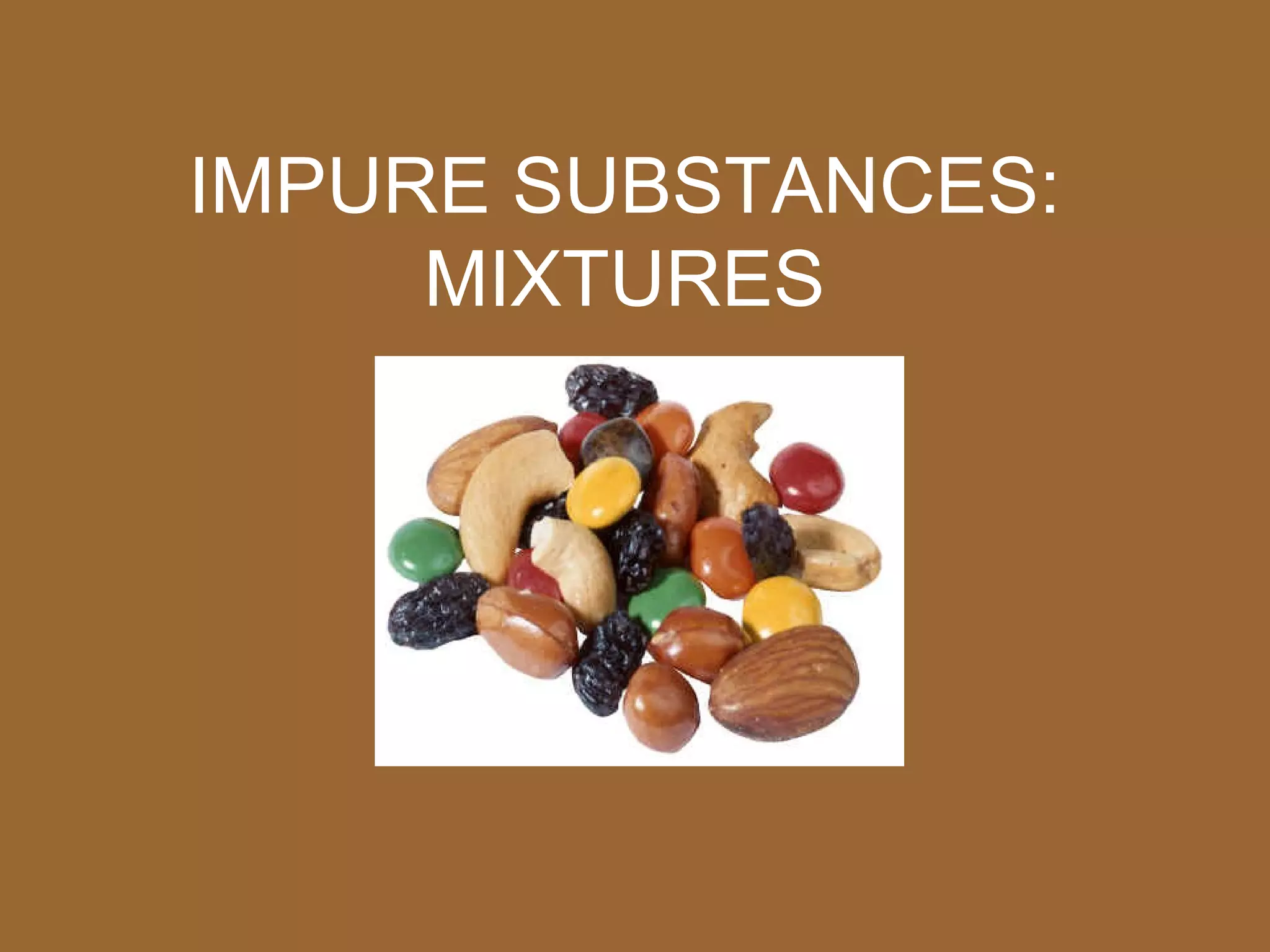
IMPURE SUBSTANCES:
     MIXTURES
PROPERTIES OF MIXTURES
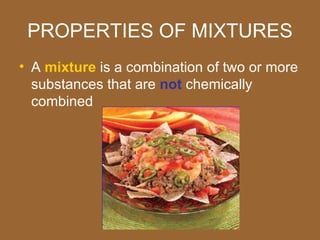
• A mixture is a combination of two or more
  substances that are not chemically
  combined
PROPERTIES OF MIXTURES
• No Chemical Changes in a Mixture No
  chemical changes happen when a mixture
  is made. So, each substance has the
  same chemical makeup it had before the
  mixture was formed.
• Making a mixture is a
  physical change.
PROPERTIES OF MIXTURES
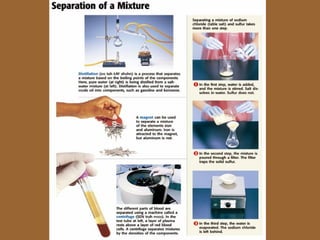
• Separating Mixtures Through Physical
  Methods Mixtures can be separated by
  using physical changes. Physical changes
  do not change the identities of the
  substances.
• Some methods could be distillation,
  evaporation, filtration, dissolve, use of
  magnets, centrifugation,and
  chromatography.
PROPERTIES OF MIXTURES
• The Ratio of Components
  in a Mixture The
  components of a mixture
  do not need to be mixed in
  a definite ratio.
• For example, granite is a
  mixture of different
  minerals. Different ratios of
  the minerals give granite
  different colors, but the
  mixture is always called
  granite.
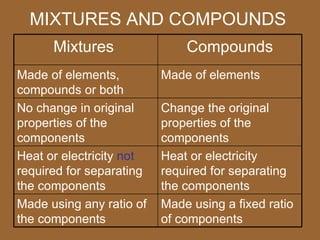
MIXTURES AND COMPOUNDS
      Mixtures                Compounds
Made of elements,         Made of elements
compounds or both
No change in original     Change the original
properties of the         properties of the
components                components
Heat or electricity not   Heat or electricity
required for separating   required for separating
the components            the components
Made using any ratio of   Made using a fixed ratio
the components            of components
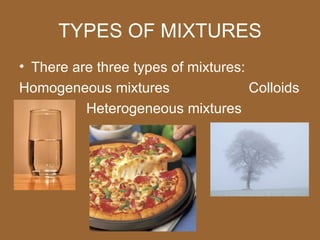
TYPES OF MIXTURES
• There are three types of mixtures:
Homogeneous mixtures                 Colloids
          Heterogeneous mixtures
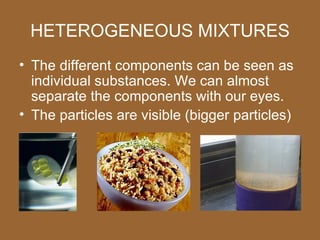
HETEROGENEOUS MIXTURES
• The different components can be seen as
  individual substances. We can almost
  separate the components with our eyes.
• The particles are visible (bigger particles)
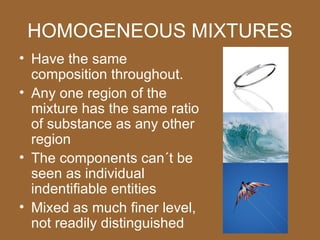
HOMOGENEOUS MIXTURES
• Have the same
  composition throughout.
• Any one region of the
  mixture has the same ratio
  of substance as any other
  region
• The components can´t be
  seen as individual
  indentifiable entities
• Mixed as much finer level,
  not readily distinguished
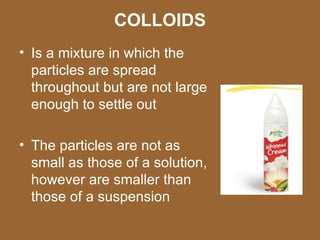
COLLOIDS
• Is a mixture in which the
  particles are spread
  throughout but are not large
  enough to settle out

• The particles are not as
  small as those of a solution,
  however are smaller than
  those of a suspension
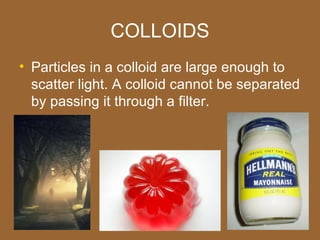
COLLOIDS
• Particles in a colloid are large enough to
  scatter light. A colloid cannot be separated
  by passing it through a filter.
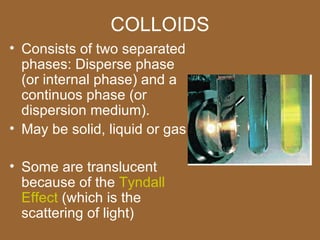
COLLOIDS
• Consists of two separated
  phases: Disperse phase
  (or internal phase) and a
  continuos phase (or
  dispersion medium).
• May be solid, liquid or gas

• Some are translucent
  because of the Tyndall
  Effect (which is the
  scattering of light)
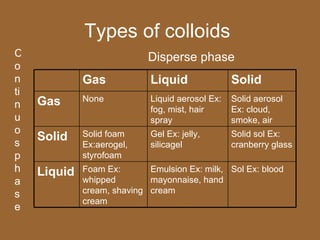
Types of colloids
C                            Disperse phase
o
n             Gas            Liquid               Solid
ti
     Gas      None           Liquid aerosol Ex:   Solid aerosol
n                            fog, mist, hair      Ex: cloud,
u                            spray                smoke, air
o             Solid foam     Gel Ex: jelly,       Solid sol Ex:
s
     Solid
              Ex:aerogel,    silicagel            cranberry glass
p             styrofoam
h    Liquid   Foam Ex:       Emulsion Ex: milk, Sol Ex: blood
a             whipped        mayonnaise, hand
s             cream, shaving cream
              cream
e
TYPES OF HOMOGENEOUS
       MIXTURES
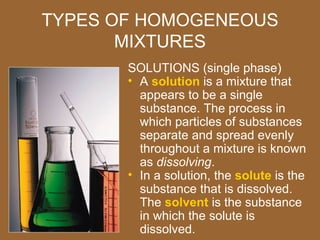
       SOLUTIONS (single phase)
       • A solution is a mixture that
         appears to be a single
         substance. The process in
         which particles of substances
         separate and spread evenly
         throughout a mixture is known
         as dissolving.
       • In a solution, the solute is the
         substance that is dissolved.
         The solvent is the substance
         in which the solute is
         dissolved.
TYPES OF HOMOGENEOUS
           MIXTURES
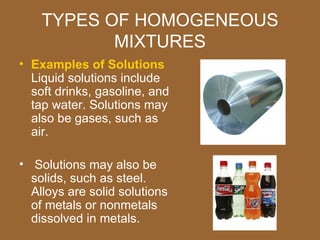
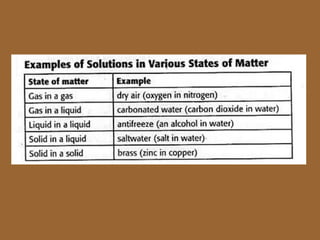
• Examples of Solutions
  Liquid solutions include
  soft drinks, gasoline, and
  tap water. Solutions may
  also be gases, such as
  air.

• Solutions may also be
  solids, such as steel.
  Alloys are solid solutions
  of metals or nonmetals
  dissolved in metals.
SOLUTIONS
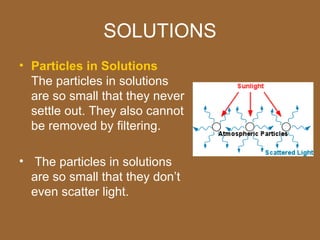
• Particles in Solutions
  The particles in solutions
  are so small that they never
  settle out. They also cannot
  be removed by filtering.

• The particles in solutions
  are so small that they don’t
  even scatter light.
SOLUTIONS
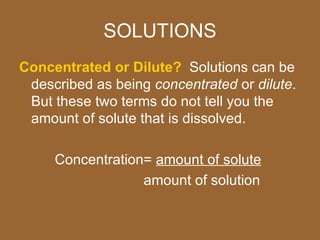
Concentrated or Dilute? Solutions can be
 described as being concentrated or dilute.
 But these two terms do not tell you the
 amount of solute that is dissolved.

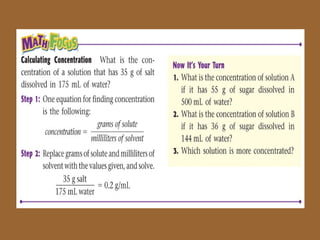
     Concentration= amount of solute
                  amount of solution
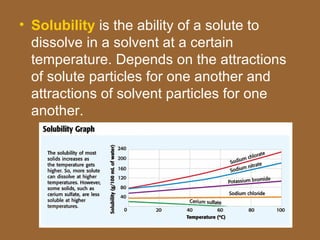
• Solubility is the ability of a solute to
  dissolve in a solvent at a certain
  temperature. Depends on the attractions
  of solute particles for one another and
  attractions of solvent particles for one
  another.
• Dissolving Gases in Liquids Gases
  become less soluble in liquids as the
  temperature is raised.
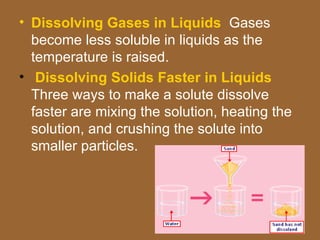
• Dissolving Solids Faster in Liquids
  Three ways to make a solute dissolve
  faster are mixing the solution, heating the
  solution, and crushing the solute into
  smaller particles.
SOLUTIONS
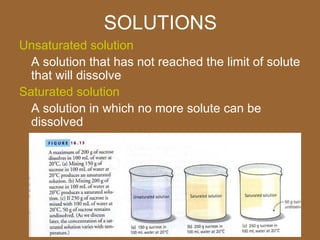
Unsaturated solution
  A solution that has not reached the limit of solute
  that will dissolve
Saturated solution
  A solution in which no more solute can be
  dissolved
TYPES OF HETEROGENEOUS
         MIXTURES
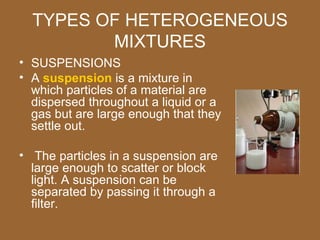
• SUSPENSIONS
• A suspension is a mixture in
  which particles of a material are
  dispersed throughout a liquid or a
  gas but are large enough that they
  settle out.

• The particles in a suspension are
  large enough to scatter or block
  light. A suspension can be
  separated by passing it through a
  filter.
SUSPENSIONS
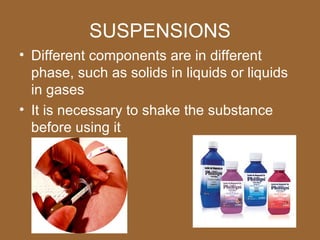
• Different components are in different
  phase, such as solids in liquids or liquids
  in gases
• It is necessary to shake the substance
  before using it
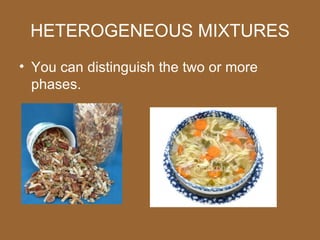
HETEROGENEOUS MIXTURES
• You can distinguish the two or more
  phases.
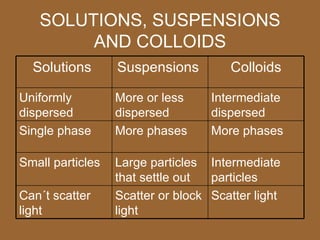
SOLUTIONS, SUSPENSIONS
        AND COLLOIDS
  Solutions       Suspensions         Colloids

Uniformly         More or less     Intermediate
dispersed         dispersed        dispersed
Single phase      More phases      More phases

Small particles   Large particles Intermediate
                  that settle out  particles
Can´t scatter     Scatter or block Scatter light
light             light

Mixtures (2)

  • 1.
  • 2.
    PROPERTIES OF MIXTURES •A mixture is a combination of two or more substances that are not chemically combined
  • 3.
    PROPERTIES OF MIXTURES •No Chemical Changes in a Mixture No chemical changes happen when a mixture is made. So, each substance has the same chemical makeup it had before the mixture was formed. • Making a mixture is a physical change.
  • 4.
    PROPERTIES OF MIXTURES •Separating Mixtures Through Physical Methods Mixtures can be separated by using physical changes. Physical changes do not change the identities of the substances. • Some methods could be distillation, evaporation, filtration, dissolve, use of magnets, centrifugation,and chromatography.
  • 6.
    PROPERTIES OF MIXTURES •The Ratio of Components in a Mixture The components of a mixture do not need to be mixed in a definite ratio. • For example, granite is a mixture of different minerals. Different ratios of the minerals give granite different colors, but the mixture is always called granite.
  • 7.
    MIXTURES AND COMPOUNDS Mixtures Compounds Made of elements, Made of elements compounds or both No change in original Change the original properties of the properties of the components components Heat or electricity not Heat or electricity required for separating required for separating the components the components Made using any ratio of Made using a fixed ratio the components of components
  • 8.
    TYPES OF MIXTURES •There are three types of mixtures: Homogeneous mixtures Colloids Heterogeneous mixtures
  • 9.
    HETEROGENEOUS MIXTURES • Thedifferent components can be seen as individual substances. We can almost separate the components with our eyes. • The particles are visible (bigger particles)
  • 10.
    HOMOGENEOUS MIXTURES • Havethe same composition throughout. • Any one region of the mixture has the same ratio of substance as any other region • The components can´t be seen as individual indentifiable entities • Mixed as much finer level, not readily distinguished
  • 11.
    COLLOIDS • Is amixture in which the particles are spread throughout but are not large enough to settle out • The particles are not as small as those of a solution, however are smaller than those of a suspension
  • 12.
    COLLOIDS • Particles ina colloid are large enough to scatter light. A colloid cannot be separated by passing it through a filter.
  • 13.
    COLLOIDS • Consists oftwo separated phases: Disperse phase (or internal phase) and a continuos phase (or dispersion medium). • May be solid, liquid or gas • Some are translucent because of the Tyndall Effect (which is the scattering of light)
  • 14.
    Types of colloids C Disperse phase o n Gas Liquid Solid ti Gas None Liquid aerosol Ex: Solid aerosol n fog, mist, hair Ex: cloud, u spray smoke, air o Solid foam Gel Ex: jelly, Solid sol Ex: s Solid Ex:aerogel, silicagel cranberry glass p styrofoam h Liquid Foam Ex: Emulsion Ex: milk, Sol Ex: blood a whipped mayonnaise, hand s cream, shaving cream cream e
  • 15.
    TYPES OF HOMOGENEOUS MIXTURES SOLUTIONS (single phase) • A solution is a mixture that appears to be a single substance. The process in which particles of substances separate and spread evenly throughout a mixture is known as dissolving. • In a solution, the solute is the substance that is dissolved. The solvent is the substance in which the solute is dissolved.
  • 16.
    TYPES OF HOMOGENEOUS MIXTURES • Examples of Solutions Liquid solutions include soft drinks, gasoline, and tap water. Solutions may also be gases, such as air. • Solutions may also be solids, such as steel. Alloys are solid solutions of metals or nonmetals dissolved in metals.
  • 17.
    SOLUTIONS • Particles inSolutions The particles in solutions are so small that they never settle out. They also cannot be removed by filtering. • The particles in solutions are so small that they don’t even scatter light.
  • 18.
    SOLUTIONS Concentrated or Dilute?Solutions can be described as being concentrated or dilute. But these two terms do not tell you the amount of solute that is dissolved. Concentration= amount of solute amount of solution
  • 20.
    • Solubility isthe ability of a solute to dissolve in a solvent at a certain temperature. Depends on the attractions of solute particles for one another and attractions of solvent particles for one another.
  • 21.
    • Dissolving Gasesin Liquids Gases become less soluble in liquids as the temperature is raised. • Dissolving Solids Faster in Liquids Three ways to make a solute dissolve faster are mixing the solution, heating the solution, and crushing the solute into smaller particles.
  • 23.
    SOLUTIONS Unsaturated solution A solution that has not reached the limit of solute that will dissolve Saturated solution A solution in which no more solute can be dissolved
  • 24.
    TYPES OF HETEROGENEOUS MIXTURES • SUSPENSIONS • A suspension is a mixture in which particles of a material are dispersed throughout a liquid or a gas but are large enough that they settle out. • The particles in a suspension are large enough to scatter or block light. A suspension can be separated by passing it through a filter.
  • 25.
    SUSPENSIONS • Different componentsare in different phase, such as solids in liquids or liquids in gases • It is necessary to shake the substance before using it
  • 26.
    HETEROGENEOUS MIXTURES • Youcan distinguish the two or more phases.
  • 27.
    SOLUTIONS, SUSPENSIONS AND COLLOIDS Solutions Suspensions Colloids Uniformly More or less Intermediate dispersed dispersed dispersed Single phase More phases More phases Small particles Large particles Intermediate that settle out particles Can´t scatter Scatter or block Scatter light light light