Name
                                                                    Date
                                                                    Period

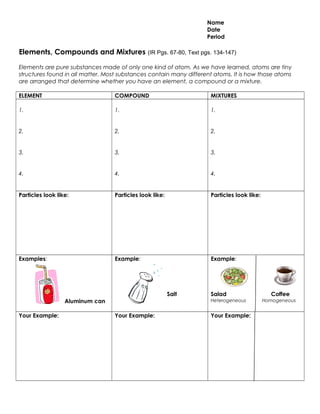
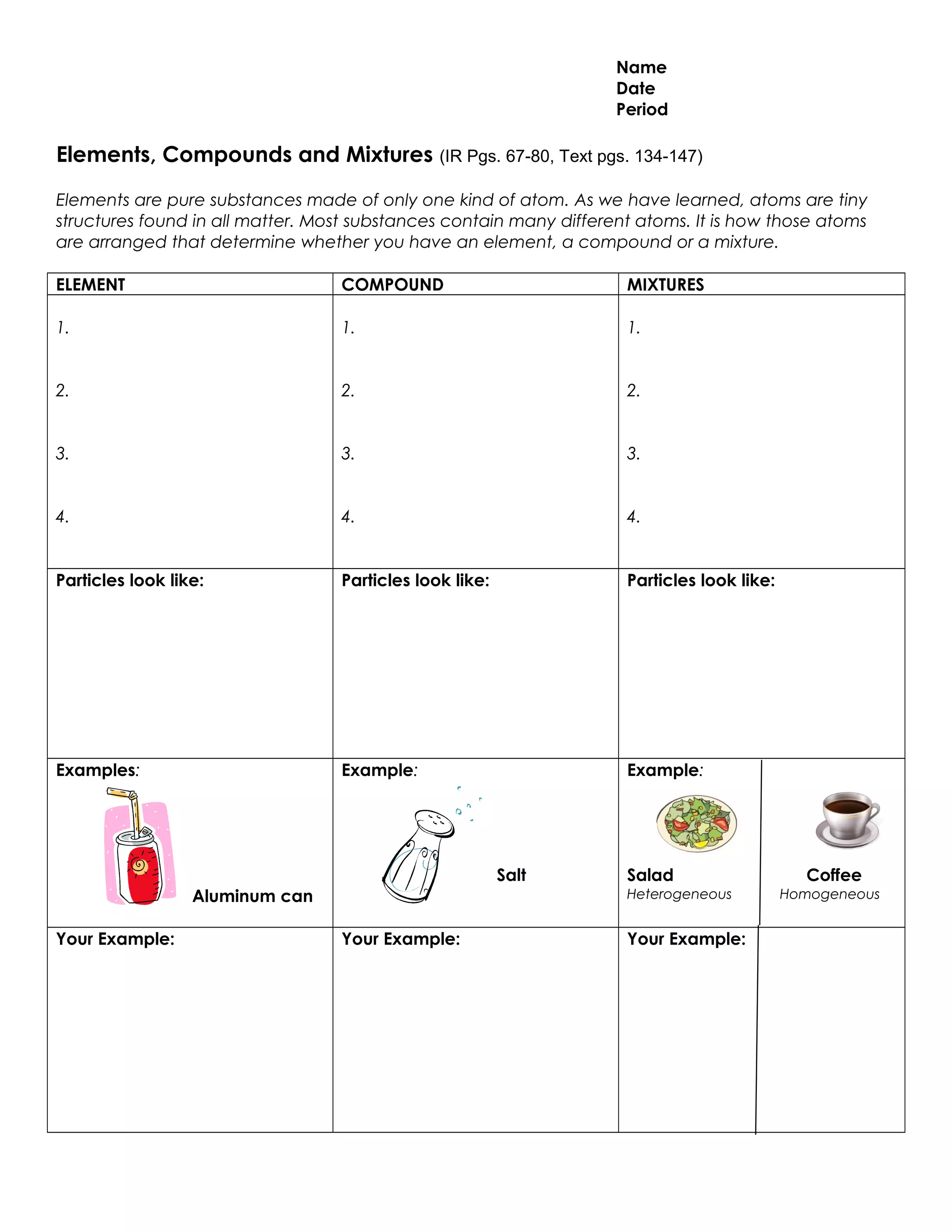
Elements, Compounds and Mixtures (IR Pgs. 67-80, Text pgs. 134-147)

Elements are pure substances made of only one kind of atom. As we have learned, atoms are tiny
structures found in all matter. Most substances contain many different atoms. It is how those atoms
are arranged that determine whether you have an element, a compound or a mixture.

ELEMENT                           COMPOUND                           MIXTURES

1.                                1.                                 1.


2.                                2.                                 2.


3.                                3.                                 3.


4.                                4.                                 4.


Particles look like:              Particles look like:               Particles look like:


Examples:                         Example:                           Example:


                                                         Salt        Salad                    Coffee
                  Aluminum can                                       Heterogeneous          Homogeneous


Your Example:                     Your Example:                      Your Example:
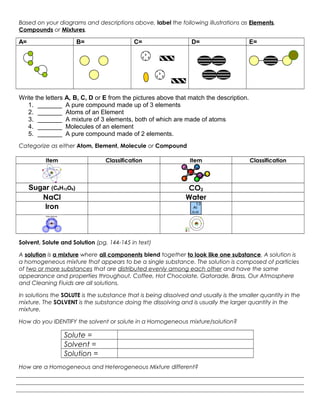
Based on your diagrams and descriptions above, label the following illustrations as Elements,
Compounds or Mixtures.

A=                     B=                  C=                    D=                     E=


Write the letters A, B, C, D or E from the pictures above that match the description.
   1. _______ A pure compound made up of 3 elements
   2. _______ Atoms of an Element
   3. _______ A mixture of 3 elements, both of which are made of atoms
   4. _______ Molecules of an element
   5. _______ A pure compound made of 2 elements.
Categorize as either Atom, Element, Molecule or Compound

          Item                  Classification                   Item                   Classification


     Sugar (C6H12O6)                                           CO2
        NaCl                                                   Water
         Iron


Solvent, Solute and Solution (pg. 144-145 in text)

A solution is a mixture where all components blend together to look like one substance. A solution is
a homogeneous mixture that appears to be a single substance. The solution is composed of particles
of two or more substances that are distributed evenly among each other and have the same
appearance and properties throughout. Coffee, Hot Chocolate, Gatorade, Brass, Our Atmosphere
and Cleaning Fluids are all solutions.

In solutions the SOLUTE is the substance that is being dissolved and usually is the smaller quantity in the
mixture. The SOLVENT is the substance doing the dissolving and is usually the larger quantity in the
mixture.

How do you IDENTIFY the solvent or solute in a Homogeneous mixture/solution?

                 Solute =
                 Solvent =
                 Solution =
How are a Homogeneous and Heterogeneous Mixture different?
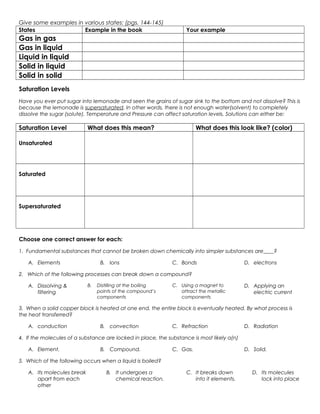
Give some examples in various states: (pgs. 144-145)
States                Example in the book                           Your example
Gas in gas
Gas in liquid
Liquid in liquid
Solid in liquid
Solid in solid
Saturation Levels
Have you ever put sugar into lemonade and seen the grains of sugar sink to the bottom and not dissolve? This is
because the lemonade is supersaturated. In other words, there is not enough water(solvent) to completely
dissolve the sugar (solute). Temperature and Pressure can affect saturation levels. Solutions can either be:

Saturation Level            What does this mean?                        What does this look like? (color)

Unsaturated


Saturated


Supersaturated


Choose one correct answer for each:

1. Fundamental substances that cannot be broken down chemically into simpler substances are____?

   A. Elements                    B. Ions                     C. Bonds                      D. electrons

2. Which of the following processes can break down a compound?

   A. Dissolving &          B.   Distilling at the boiling    C. Using a magnet to          D. Applying an
      filtering                  points of the compound’s        attract the metallic          electric current
                                 components                      components

3. When a solid copper block is heated at one end, the entire block is eventually heated. By what process is
the heat transferred?

   A. conduction                  B. convection               C. Refraction                 D. Radiation

4. If the molecules of a substance are locked in place, the substance is most likely a(n)

   A. Element.                    B. Compound.                C. Gas.                       D. Solid.

5. Which of the following occurs when a liquid is boiled?

   A. Its molecules break            B. It undergoes a              C. It breaks down          D. Its molecules
      apart from each                   chemical reaction.             into it elements.          lock into place
      other
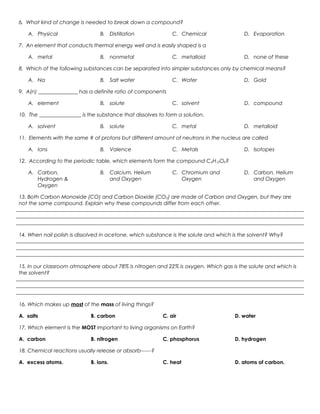
6. What kind of change is needed to break down a compound?

   A. Physical                   B. Distillation               C. Chemical                D. Evaporation

7. An element that conducts thermal energy well and is easily shaped is a

   A. metal                      B. nonmetal                   C. metalloid               D. none of these

8. Which of the following substances can be separated into simpler substances only by chemical means?

   A. Na                         B. Salt water                 C. Water                   D. Gold

9. A(n) _______________ has a definite ratio of components

   A. element                    B. solute                     C. solvent                 D. compound

10. The ________________ is the substance that dissolves to form a solution.

   A. solvent                    B. solute                     C. metal                   D. metalloid

11. Elements with the same # of protons but different amount of neutrons in the nucleus are called

   A. Ions                       B. Valence                    C. Metals                  D. Isotopes

12. According to the periodic table, which elements form the compound C 6H12O6?

   A. Carbon,                    B. Calcium, Helium            C. Chromium and            D. Carbon, Helium
      Hydrogen &                    and Oxygen                    Oxygen                     and Oxygen
      Oxygen

13. Both Carbon Monoxide (CO) and Carbon Dioxide (CO 2) are made of Carbon and Oxygen, but they are
not the same compound. Explain why these compounds differ from each other.


14. When nail polish is dissolved in acetone, which substance is the solute and which is the solvent? Why?


15. In our classroom atmosphere about 78% is nitrogen and 22% is oxygen. Which gas is the solute and which is
the solvent?


16. Which makes up most of the mass of living things?

A. salts                     B. carbon                     C. air                     D. water

17. Which element is the MOST important to living organisms on Earth?

A. carbon                    B. nitrogen                   C. phosphorus              D. hydrogen

18. Chemical reactions usually release or absorb------?

A. excess atoms.             B. ions.                      C. heat                    D. atoms of carbon.
Create 2 examples of each using the bolts, screws and washers in your lab kit.
              Element                       Compound                                   Mixture
   •      Pure Substance              •   Pure Substance                 •   Not a pure substance
   •      One type of Atom or         •   Two or more Substances         •   Two or more substances blended
          Molecule                        bonded                             together
                                      •   Same kind of Molecule          •   Can blend atoms or molecules….but not
                                                                             attached

       Element Illustration #1       Compound Illustration #1                  Mixture Illustration #1


       Element Illustration #2       Compound Illustration #2                  Mixture Illustration #2


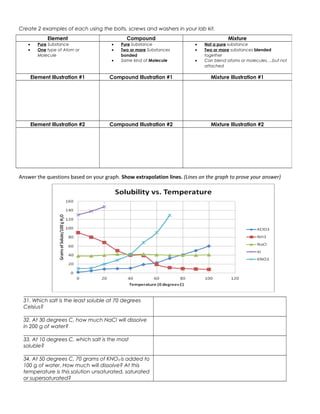
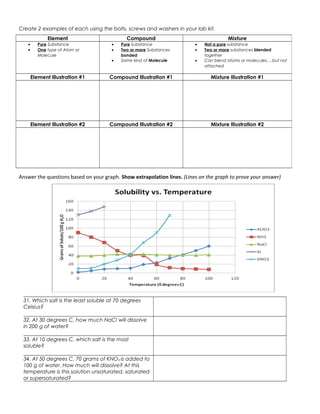
Answer the questions based on your graph. Show extrapolation lines. (Lines on the graph to prove your answer)


 31. Which salt is the least soluble at 70 degrees
 Celsius?

 32. At 30 degrees C, how much NaCl will dissolve
 in 200 g of water?

 33. At 10 degrees C, which salt is the most
 soluble?

 34. At 50 degrees C, 70 grams of KNO3 is added to
 100 g of water. How much will dissolve? At this
 temperature is this solution unsaturated, saturated
 or supersaturated?
Create 2 examples of each using the bolts, screws and washers in your lab kit.
              Element                       Compound                                   Mixture
   •      Pure Substance              •   Pure Substance                 •   Not a pure substance
   •      One type of Atom or         •   Two or more Substances         •   Two or more substances blended
          Molecule                        bonded                             together
                                      •   Same kind of Molecule          •   Can blend atoms or molecules….but not
                                                                             attached

       Element Illustration #1       Compound Illustration #1                  Mixture Illustration #1


       Element Illustration #2       Compound Illustration #2                  Mixture Illustration #2


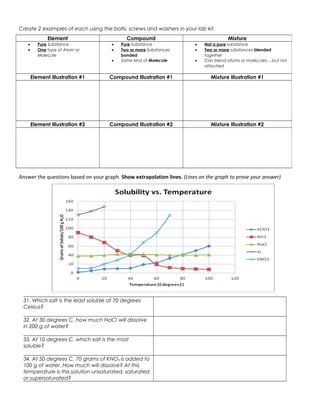
Answer the questions based on your graph. Show extrapolation lines. (Lines on the graph to prove your answer)


 31. Which salt is the least soluble at 70 degrees
 Celsius?

 32. At 30 degrees C, how much NaCl will dissolve
 in 200 g of water?

 33. At 10 degrees C, which salt is the most
 soluble?

 34. At 50 degrees C, 70 grams of KNO3 is added to
 100 g of water. How much will dissolve? At this
 temperature is this solution unsaturated, saturated
 or supersaturated?
Create 2 examples of each using the bolts, screws and washers in your lab kit.
              Element                       Compound                                   Mixture
   •      Pure Substance              •   Pure Substance                 •   Not a pure substance
   •      One type of Atom or         •   Two or more Substances         •   Two or more substances blended
          Molecule                        bonded                             together
                                      •   Same kind of Molecule          •   Can blend atoms or molecules….but not
                                                                             attached

       Element Illustration #1       Compound Illustration #1                  Mixture Illustration #1


       Element Illustration #2       Compound Illustration #2                  Mixture Illustration #2


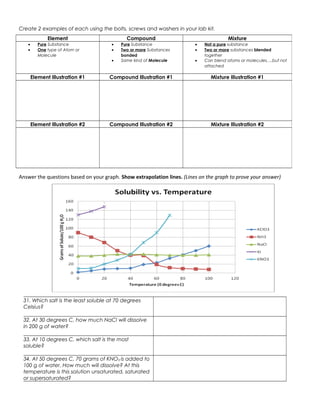
Answer the questions based on your graph. Show extrapolation lines. (Lines on the graph to prove your answer)


 31. Which salt is the least soluble at 70 degrees
 Celsius?

 32. At 30 degrees C, how much NaCl will dissolve
 in 200 g of water?

 33. At 10 degrees C, which salt is the most
 soluble?

 34. At 50 degrees C, 70 grams of KNO3 is added to
 100 g of water. How much will dissolve? At this
 temperature is this solution unsaturated, saturated
 or supersaturated?
Create 2 examples of each using the bolts, screws and washers in your lab kit.
              Element                       Compound                                   Mixture
   •      Pure Substance              •   Pure Substance                 •   Not a pure substance
   •      One type of Atom or         •   Two or more Substances         •   Two or more substances blended
          Molecule                        bonded                             together
                                      •   Same kind of Molecule          •   Can blend atoms or molecules….but not
                                                                             attached

       Element Illustration #1       Compound Illustration #1                  Mixture Illustration #1


       Element Illustration #2       Compound Illustration #2                  Mixture Illustration #2


Answer the questions based on your graph. Show extrapolation lines. (Lines on the graph to prove your answer)


 31. Which salt is the least soluble at 70 degrees
 Celsius?

 32. At 30 degrees C, how much NaCl will dissolve
 in 200 g of water?

 33. At 10 degrees C, which salt is the most
 soluble?

 34. At 50 degrees C, 70 grams of KNO3 is added to
 100 g of water. How much will dissolve? At this
 temperature is this solution unsaturated, saturated
 or supersaturated?

Elements, Compounds & Mixtures- Day 1 2013

  • 1.
    Name Date Period Elements, Compounds and Mixtures (IR Pgs. 67-80, Text pgs. 134-147) Elements are pure substances made of only one kind of atom. As we have learned, atoms are tiny structures found in all matter. Most substances contain many different atoms. It is how those atoms are arranged that determine whether you have an element, a compound or a mixture. ELEMENT COMPOUND MIXTURES 1. 1. 1. 2. 2. 2. 3. 3. 3. 4. 4. 4. Particles look like: Particles look like: Particles look like: Examples: Example: Example: Salt Salad Coffee Aluminum can Heterogeneous Homogeneous Your Example: Your Example: Your Example:
  • 2.
    Based on yourdiagrams and descriptions above, label the following illustrations as Elements, Compounds or Mixtures. A= B= C= D= E= Write the letters A, B, C, D or E from the pictures above that match the description. 1. _______ A pure compound made up of 3 elements 2. _______ Atoms of an Element 3. _______ A mixture of 3 elements, both of which are made of atoms 4. _______ Molecules of an element 5. _______ A pure compound made of 2 elements. Categorize as either Atom, Element, Molecule or Compound Item Classification Item Classification Sugar (C6H12O6) CO2 NaCl Water Iron Solvent, Solute and Solution (pg. 144-145 in text) A solution is a mixture where all components blend together to look like one substance. A solution is a homogeneous mixture that appears to be a single substance. The solution is composed of particles of two or more substances that are distributed evenly among each other and have the same appearance and properties throughout. Coffee, Hot Chocolate, Gatorade, Brass, Our Atmosphere and Cleaning Fluids are all solutions. In solutions the SOLUTE is the substance that is being dissolved and usually is the smaller quantity in the mixture. The SOLVENT is the substance doing the dissolving and is usually the larger quantity in the mixture. How do you IDENTIFY the solvent or solute in a Homogeneous mixture/solution? Solute = Solvent = Solution = How are a Homogeneous and Heterogeneous Mixture different?
  • 3.
    Give some examplesin various states: (pgs. 144-145) States Example in the book Your example Gas in gas Gas in liquid Liquid in liquid Solid in liquid Solid in solid Saturation Levels Have you ever put sugar into lemonade and seen the grains of sugar sink to the bottom and not dissolve? This is because the lemonade is supersaturated. In other words, there is not enough water(solvent) to completely dissolve the sugar (solute). Temperature and Pressure can affect saturation levels. Solutions can either be: Saturation Level What does this mean? What does this look like? (color) Unsaturated Saturated Supersaturated Choose one correct answer for each: 1. Fundamental substances that cannot be broken down chemically into simpler substances are____? A. Elements B. Ions C. Bonds D. electrons 2. Which of the following processes can break down a compound? A. Dissolving & B. Distilling at the boiling C. Using a magnet to D. Applying an filtering points of the compound’s attract the metallic electric current components components 3. When a solid copper block is heated at one end, the entire block is eventually heated. By what process is the heat transferred? A. conduction B. convection C. Refraction D. Radiation 4. If the molecules of a substance are locked in place, the substance is most likely a(n) A. Element. B. Compound. C. Gas. D. Solid. 5. Which of the following occurs when a liquid is boiled? A. Its molecules break B. It undergoes a C. It breaks down D. Its molecules apart from each chemical reaction. into it elements. lock into place other
  • 4.
    6. What kindof change is needed to break down a compound? A. Physical B. Distillation C. Chemical D. Evaporation 7. An element that conducts thermal energy well and is easily shaped is a A. metal B. nonmetal C. metalloid D. none of these 8. Which of the following substances can be separated into simpler substances only by chemical means? A. Na B. Salt water C. Water D. Gold 9. A(n) _______________ has a definite ratio of components A. element B. solute C. solvent D. compound 10. The ________________ is the substance that dissolves to form a solution. A. solvent B. solute C. metal D. metalloid 11. Elements with the same # of protons but different amount of neutrons in the nucleus are called A. Ions B. Valence C. Metals D. Isotopes 12. According to the periodic table, which elements form the compound C 6H12O6? A. Carbon, B. Calcium, Helium C. Chromium and D. Carbon, Helium Hydrogen & and Oxygen Oxygen and Oxygen Oxygen 13. Both Carbon Monoxide (CO) and Carbon Dioxide (CO 2) are made of Carbon and Oxygen, but they are not the same compound. Explain why these compounds differ from each other. 14. When nail polish is dissolved in acetone, which substance is the solute and which is the solvent? Why? 15. In our classroom atmosphere about 78% is nitrogen and 22% is oxygen. Which gas is the solute and which is the solvent? 16. Which makes up most of the mass of living things? A. salts B. carbon C. air D. water 17. Which element is the MOST important to living organisms on Earth? A. carbon B. nitrogen C. phosphorus D. hydrogen 18. Chemical reactions usually release or absorb------? A. excess atoms. B. ions. C. heat D. atoms of carbon.
  • 5.
    Create 2 examplesof each using the bolts, screws and washers in your lab kit. Element Compound Mixture • Pure Substance • Pure Substance • Not a pure substance • One type of Atom or • Two or more Substances • Two or more substances blended Molecule bonded together • Same kind of Molecule • Can blend atoms or molecules….but not attached Element Illustration #1 Compound Illustration #1 Mixture Illustration #1 Element Illustration #2 Compound Illustration #2 Mixture Illustration #2 Answer the questions based on your graph. Show extrapolation lines. (Lines on the graph to prove your answer) 31. Which salt is the least soluble at 70 degrees Celsius? 32. At 30 degrees C, how much NaCl will dissolve in 200 g of water? 33. At 10 degrees C, which salt is the most soluble? 34. At 50 degrees C, 70 grams of KNO3 is added to 100 g of water. How much will dissolve? At this temperature is this solution unsaturated, saturated or supersaturated?
  • 6.
    Create 2 examplesof each using the bolts, screws and washers in your lab kit. Element Compound Mixture • Pure Substance • Pure Substance • Not a pure substance • One type of Atom or • Two or more Substances • Two or more substances blended Molecule bonded together • Same kind of Molecule • Can blend atoms or molecules….but not attached Element Illustration #1 Compound Illustration #1 Mixture Illustration #1 Element Illustration #2 Compound Illustration #2 Mixture Illustration #2 Answer the questions based on your graph. Show extrapolation lines. (Lines on the graph to prove your answer) 31. Which salt is the least soluble at 70 degrees Celsius? 32. At 30 degrees C, how much NaCl will dissolve in 200 g of water? 33. At 10 degrees C, which salt is the most soluble? 34. At 50 degrees C, 70 grams of KNO3 is added to 100 g of water. How much will dissolve? At this temperature is this solution unsaturated, saturated or supersaturated?
  • 7.
    Create 2 examplesof each using the bolts, screws and washers in your lab kit. Element Compound Mixture • Pure Substance • Pure Substance • Not a pure substance • One type of Atom or • Two or more Substances • Two or more substances blended Molecule bonded together • Same kind of Molecule • Can blend atoms or molecules….but not attached Element Illustration #1 Compound Illustration #1 Mixture Illustration #1 Element Illustration #2 Compound Illustration #2 Mixture Illustration #2 Answer the questions based on your graph. Show extrapolation lines. (Lines on the graph to prove your answer) 31. Which salt is the least soluble at 70 degrees Celsius? 32. At 30 degrees C, how much NaCl will dissolve in 200 g of water? 33. At 10 degrees C, which salt is the most soluble? 34. At 50 degrees C, 70 grams of KNO3 is added to 100 g of water. How much will dissolve? At this temperature is this solution unsaturated, saturated or supersaturated?
  • 8.
    Create 2 examplesof each using the bolts, screws and washers in your lab kit. Element Compound Mixture • Pure Substance • Pure Substance • Not a pure substance • One type of Atom or • Two or more Substances • Two or more substances blended Molecule bonded together • Same kind of Molecule • Can blend atoms or molecules….but not attached Element Illustration #1 Compound Illustration #1 Mixture Illustration #1 Element Illustration #2 Compound Illustration #2 Mixture Illustration #2 Answer the questions based on your graph. Show extrapolation lines. (Lines on the graph to prove your answer) 31. Which salt is the least soluble at 70 degrees Celsius? 32. At 30 degrees C, how much NaCl will dissolve in 200 g of water? 33. At 10 degrees C, which salt is the most soluble? 34. At 50 degrees C, 70 grams of KNO3 is added to 100 g of water. How much will dissolve? At this temperature is this solution unsaturated, saturated or supersaturated?