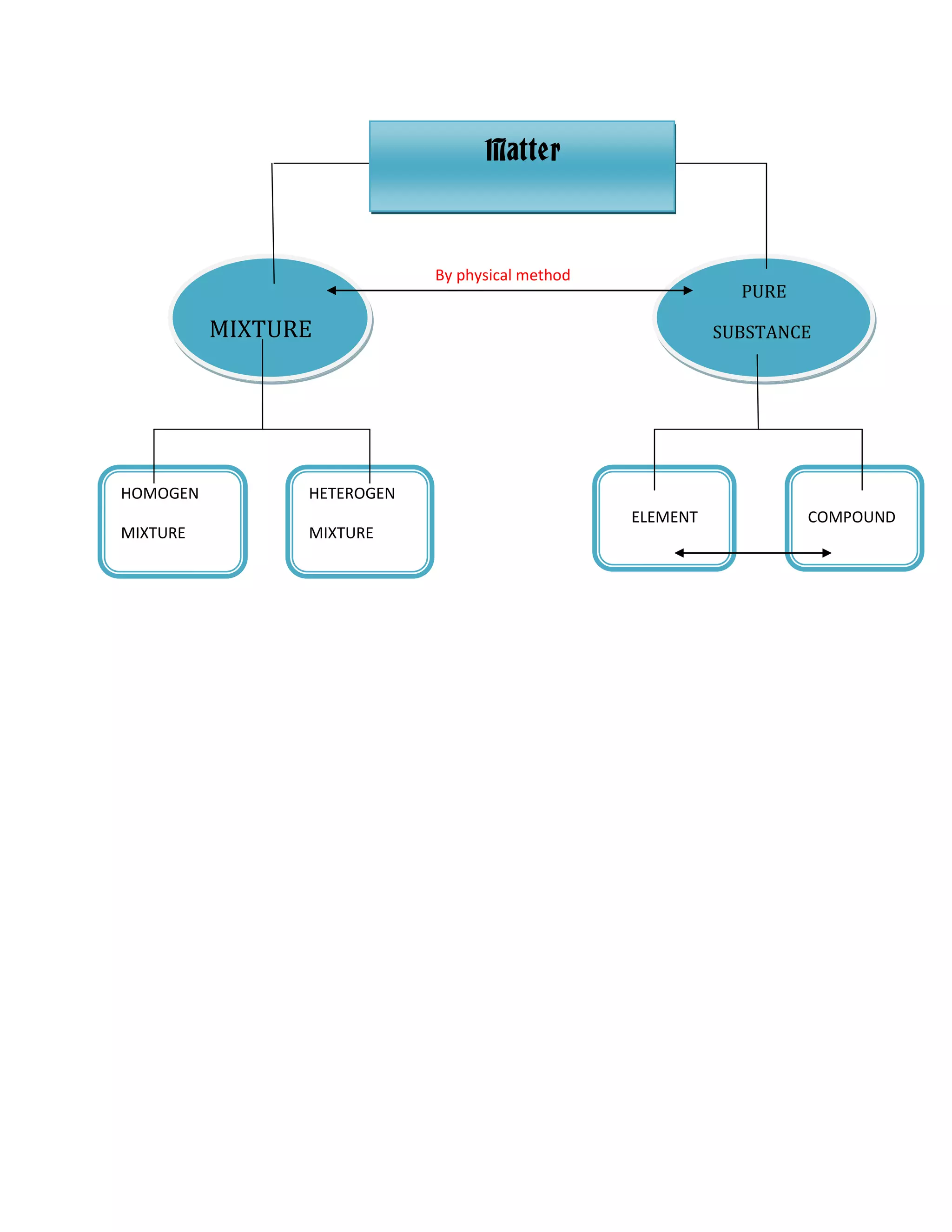
Matter


                            By physical method
                                                             PURE

          MIXTURE                                          SUBSTANCE


HOMOGEN         HETEROGEN
                                                 ELEMENT            COMPOUND
MIXTURE         MIXTURE
A MIXTURE is a combination of two or more substances that are not chemically united and do
not exist in fixed proportions to each other. Most natural substances are mixtures.


A homogeneous mixture has the same uniform appearance and composition throughout.
Many homogeneous mixtures are commonly referred to as solutions.

 Particle size distinguishes homogeneous solutions from other heterogeneous mixtures. Solutions
have particles which are the size of atoms or molecules - too small to be seen.

A colloid is a homogeneous solution with intermediate particle size between a solution and a
suspension. Colloid particles may be seen in a beam of light such as dust in air in a "shaft" of
sunlight. Milk, fog, and jello are examples of colloids.

Corn oil is homogeneous, White vinegar is homogeneous. A sugar solution is homogeneous
since only a colorless liquid is observed. Air with no clouds is homogeneous


A heterogeneous mixture consists of visibly different substances or phases. The three phases or
states of matter are gas, liquid, and solid.

Graphic on the left of "Dancing Raisins" shows liquid, solid, and gas substances in a
heterogeneous mixture

In contrast a suspension is a heterogeneous mixture of larger particles. These particles are
visible and will settle out on standing. Examples of suspensions are: fine sand or silt in water or
tomato juice. For example beach sand is heterogeneous since you can see different colored
particles. Vinegar and oil salad dressing is heterogeneous since two liquid layers are present, as
well as solids. Air with clouds is heterogeneous, as the clouds contain tiny droplets of liquid
water.
Different of solid, liquid, and gas


           Forms of matter
           Matter exists in several different forms:

                   solid
                         o   Solids keep their shape.
                         o   Solid surfaces do not move a lot when pushed.
                         o   Rocks, wood and ice are solids.
                   liquid
                         o   Liquids take the shape of their containers.
                         o   Liquids move easily when pushed.
                         o   Water, lava, and things to drink are liquids.
                   gas
                         o   Gases also take the shape of their containers.
                         o   Gases move very easily when pushed.
                         o   The air close to the earth is made of gases.
                         o   Steam is a gas.

Elements             Chemical Properties                                      Virtual ChemBook
What are Mixtures and Solutions?
 A MIXTURE is a combination of two or more substances
that are not chemically united and do not exist in fixed
proportions to each other. Most natural substances are
mixtures.

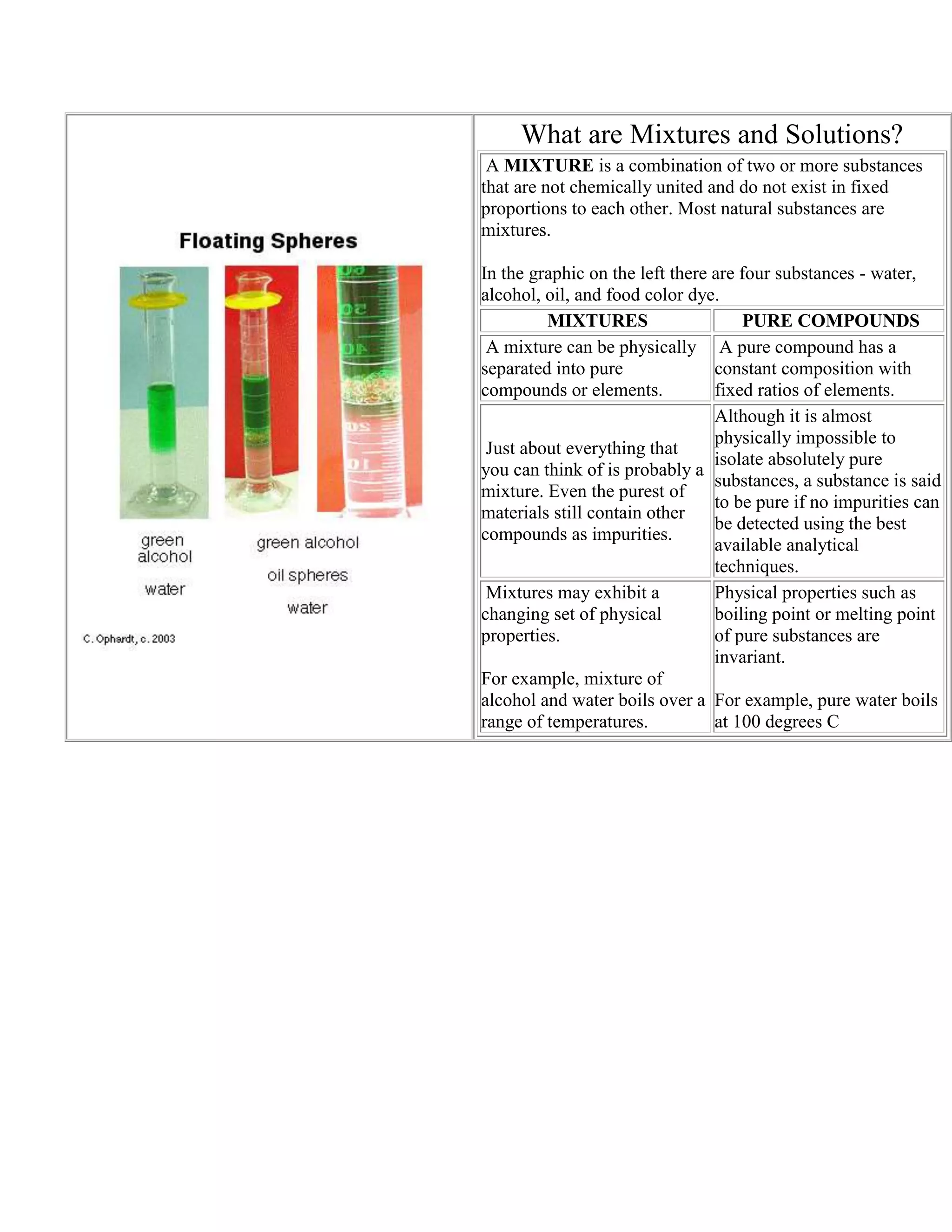
In the graphic on the left there are four substances - water,
alcohol, oil, and food color dye.
         MIXTURES                     PURE COMPOUNDS
 A mixture can be physically A pure compound has a
separated into pure              constant composition with
compounds or elements.           fixed ratios of elements.
                                 Although it is almost
                                 physically impossible to
 Just about everything that
                                 isolate absolutely pure
you can think of is probably a
                                 substances, a substance is said
mixture. Even the purest of
                                 to be pure if no impurities can
materials still contain other
                                 be detected using the best
compounds as impurities.
                                 available analytical
                                 techniques.
 Mixtures may exhibit a          Physical properties such as
changing set of physical         boiling point or melting point
properties.                      of pure substances are
                                 invariant.
For example, mixture of
alcohol and water boils over a For example, pure water boils
range of temperatures.           at 100 degrees C
HOMOGENEOUS                   HETEROGENEOUS
       MIXTURES                       MIXTURES
 The prefixes "homo"-           The prefixes: "hetero"-
indicate sameness               indicate difference.
                            A heterogeneous mixture
                            consists of visibly different
                            substances or phases. The
A homogeneous mixture has three phases or states of
the same uniform appearance matter are gas, liquid, and
and composition throughout. solid.
Many homogeneous mixtures
are commonly referred to as Graphic on the left of
solutions.                  "Dancing Raisins" shows
                            liquid, solid, and gas
                            substances in a
                            heterogeneous mixture.
Particle size distinguishes
homogeneous solutions from
other heterogeneous
mixtures. Solutions have
particles which are the size of
atoms or molecules - too        In contrast a suspension is a
small to be seen.               heterogeneous mixture of
                                larger particles. These
 A colloid is a homogeneous particles are visible and will
 solution with intermediate     settle out on standing.
 particle size between a        Examples of suspensions are:
 solution and a suspension.     fine sand or silt in water or
 Colloid particles may be       tomato juice.
 seen in a beam of light such
 as dust in air in a "shaft" of
 sunlight. Milk, fog, and
 jello are examples of
 colloids.

                                For example beach sand is
Corn oil is homogeneous,        heterogeneous since you can
White vinegar is                see different colored
homogeneous. A sugar            particles. Vinegar and oil
solution is homogeneous         salad dressing is
since only a colorless liquid   heterogeneous since two
is observed. Air with no        liquid layers are present, as
clouds is homogeneous.          well as solids. Air with
                                clouds is heterogeneous, as
the clouds contain tiny
droplets of liquid water.
SOLUTIONS are homogeneous mixtures.
A solution is a mixture of two or more substances in a single
phase. At least two substances must be mixed in order to
have a solution. The substance in the smallest amount and
the one that dissolves or disperses is called the SOLUTE.
The substance in the larger amount is called the SOLVENT.
In most common instances water is the solvent. The gases,
liquids, or solids dissolved in water are the solutes.

In the graphic, the blue bottle is a homogeneous solution
mixture of water, KOH, glucose, oxygen gas dissolved, and
methylene blue - an indicator.
 Since solutions are mixtures, their compositions may vary
over a very wide range. The concentrations may be
expressed using a variety of measures. The non-specific
terms concentrated and dilute are sometimes used. A
concentrated solution has a relatively large (but non-
specific) amount of solute dissolved in a solvent. A dilute
solution has a smaller quantity of solute dissolved.

                  TYPES OF SOLUTIONS
   Concentrations
 Solute    Solvent
Less than More than                    Examples
  50%       50%
                                          wine beer, vodka
   liquid       liquid    alcohol - water acetic acid /
                                          water - vinegar
                                           saline (NaCl)
                                           solution
   solid        liquid      salt - water   sugar solution
                                           CaCO3 - hard
                                           water
                                          CO2 - carbonated
                                         water
    gas         liquid    oxygen - water
                                         NH3 - ammonia
                                         solution
                              air =
    gas          gas        oxygen -
                            nitrogen
hydrogen -
                                                         gas         solid
                                                                             platinum
                                                        liquid       gas        water in air
                                                        solid        gas          smog
                                                                                mercury -
                                                       liquid        solid
                                                                              another metal
                                                        solid        solid         alloy


Homogeneous Mixtures: it is the same throughout and can be evenly mixed
Salt water.
brewed tea or coffee
soapy water
a dilute solution of hydrochloric acid
hard alcohol
wine

Heterogeneous Mixtures: can be easily seperated
sandy water
carbonated beverage or beer (the CO2 gas is mixed with the liquid)
orange juice with pulp in it
water with ice cubes in it
chicken noodle soup
A pure substance is a kind of matter that cannot be separated into other kinds of matter by any physical
or chemical process. It has the same color, taste, texture and composition. Also it is made out of a same
particle. Examples are, water, juice and coffee.
A pure substance are substance that cannot be broken down into simpler piece. Element is an example
of a pure substance because it cannot be broken down into simpler substance.

*As a note: Coffee is not a pure substance, the coffee can be seperated through boiling the water. The
black sludge left at the bottom of the pot if the seperated mass from the water which evaporated. Also,
juice is considered a mixture as well, given it is made up of multiple ingredients that can be seperated
out through various means, i.e.-distilling, boiling, freeze-drying.

True examples of pure substances would be: H20(just regular water can have a multitude of other things
in it making it not pure, so must be H2O only to be pure), Neon(an element), and Table Salt


Read more: http://wiki.answers.com/Q/What_is_a_pure_substance#ixzz1W96pgDdA

Kimia kul

  • 1.
    Matter By physical method PURE MIXTURE SUBSTANCE HOMOGEN HETEROGEN ELEMENT COMPOUND MIXTURE MIXTURE
  • 2.
    A MIXTURE isa combination of two or more substances that are not chemically united and do not exist in fixed proportions to each other. Most natural substances are mixtures. A homogeneous mixture has the same uniform appearance and composition throughout. Many homogeneous mixtures are commonly referred to as solutions. Particle size distinguishes homogeneous solutions from other heterogeneous mixtures. Solutions have particles which are the size of atoms or molecules - too small to be seen. A colloid is a homogeneous solution with intermediate particle size between a solution and a suspension. Colloid particles may be seen in a beam of light such as dust in air in a "shaft" of sunlight. Milk, fog, and jello are examples of colloids. Corn oil is homogeneous, White vinegar is homogeneous. A sugar solution is homogeneous since only a colorless liquid is observed. Air with no clouds is homogeneous A heterogeneous mixture consists of visibly different substances or phases. The three phases or states of matter are gas, liquid, and solid. Graphic on the left of "Dancing Raisins" shows liquid, solid, and gas substances in a heterogeneous mixture In contrast a suspension is a heterogeneous mixture of larger particles. These particles are visible and will settle out on standing. Examples of suspensions are: fine sand or silt in water or tomato juice. For example beach sand is heterogeneous since you can see different colored particles. Vinegar and oil salad dressing is heterogeneous since two liquid layers are present, as well as solids. Air with clouds is heterogeneous, as the clouds contain tiny droplets of liquid water.
  • 4.
    Different of solid,liquid, and gas Forms of matter Matter exists in several different forms: solid o Solids keep their shape. o Solid surfaces do not move a lot when pushed. o Rocks, wood and ice are solids. liquid o Liquids take the shape of their containers. o Liquids move easily when pushed. o Water, lava, and things to drink are liquids. gas o Gases also take the shape of their containers. o Gases move very easily when pushed. o The air close to the earth is made of gases. o Steam is a gas. Elements Chemical Properties Virtual ChemBook
  • 5.
    What are Mixturesand Solutions? A MIXTURE is a combination of two or more substances that are not chemically united and do not exist in fixed proportions to each other. Most natural substances are mixtures. In the graphic on the left there are four substances - water, alcohol, oil, and food color dye. MIXTURES PURE COMPOUNDS A mixture can be physically A pure compound has a separated into pure constant composition with compounds or elements. fixed ratios of elements. Although it is almost physically impossible to Just about everything that isolate absolutely pure you can think of is probably a substances, a substance is said mixture. Even the purest of to be pure if no impurities can materials still contain other be detected using the best compounds as impurities. available analytical techniques. Mixtures may exhibit a Physical properties such as changing set of physical boiling point or melting point properties. of pure substances are invariant. For example, mixture of alcohol and water boils over a For example, pure water boils range of temperatures. at 100 degrees C
  • 6.
    HOMOGENEOUS HETEROGENEOUS MIXTURES MIXTURES The prefixes "homo"- The prefixes: "hetero"- indicate sameness indicate difference. A heterogeneous mixture consists of visibly different substances or phases. The A homogeneous mixture has three phases or states of the same uniform appearance matter are gas, liquid, and and composition throughout. solid. Many homogeneous mixtures are commonly referred to as Graphic on the left of solutions. "Dancing Raisins" shows liquid, solid, and gas substances in a heterogeneous mixture. Particle size distinguishes homogeneous solutions from other heterogeneous mixtures. Solutions have particles which are the size of atoms or molecules - too In contrast a suspension is a small to be seen. heterogeneous mixture of larger particles. These A colloid is a homogeneous particles are visible and will solution with intermediate settle out on standing. particle size between a Examples of suspensions are: solution and a suspension. fine sand or silt in water or Colloid particles may be tomato juice. seen in a beam of light such as dust in air in a "shaft" of sunlight. Milk, fog, and jello are examples of colloids. For example beach sand is Corn oil is homogeneous, heterogeneous since you can White vinegar is see different colored homogeneous. A sugar particles. Vinegar and oil solution is homogeneous salad dressing is since only a colorless liquid heterogeneous since two is observed. Air with no liquid layers are present, as clouds is homogeneous. well as solids. Air with clouds is heterogeneous, as
  • 7.
    the clouds containtiny droplets of liquid water.
  • 8.
    SOLUTIONS are homogeneousmixtures. A solution is a mixture of two or more substances in a single phase. At least two substances must be mixed in order to have a solution. The substance in the smallest amount and the one that dissolves or disperses is called the SOLUTE. The substance in the larger amount is called the SOLVENT. In most common instances water is the solvent. The gases, liquids, or solids dissolved in water are the solutes. In the graphic, the blue bottle is a homogeneous solution mixture of water, KOH, glucose, oxygen gas dissolved, and methylene blue - an indicator. Since solutions are mixtures, their compositions may vary over a very wide range. The concentrations may be expressed using a variety of measures. The non-specific terms concentrated and dilute are sometimes used. A concentrated solution has a relatively large (but non- specific) amount of solute dissolved in a solvent. A dilute solution has a smaller quantity of solute dissolved. TYPES OF SOLUTIONS Concentrations Solute Solvent Less than More than Examples 50% 50% wine beer, vodka liquid liquid alcohol - water acetic acid / water - vinegar saline (NaCl) solution solid liquid salt - water sugar solution CaCO3 - hard water CO2 - carbonated water gas liquid oxygen - water NH3 - ammonia solution air = gas gas oxygen - nitrogen
  • 9.
    hydrogen - gas solid platinum liquid gas water in air solid gas smog mercury - liquid solid another metal solid solid alloy Homogeneous Mixtures: it is the same throughout and can be evenly mixed Salt water. brewed tea or coffee soapy water a dilute solution of hydrochloric acid hard alcohol wine Heterogeneous Mixtures: can be easily seperated sandy water carbonated beverage or beer (the CO2 gas is mixed with the liquid) orange juice with pulp in it water with ice cubes in it chicken noodle soup
  • 10.
    A pure substanceis a kind of matter that cannot be separated into other kinds of matter by any physical or chemical process. It has the same color, taste, texture and composition. Also it is made out of a same particle. Examples are, water, juice and coffee. A pure substance are substance that cannot be broken down into simpler piece. Element is an example of a pure substance because it cannot be broken down into simpler substance. *As a note: Coffee is not a pure substance, the coffee can be seperated through boiling the water. The black sludge left at the bottom of the pot if the seperated mass from the water which evaporated. Also, juice is considered a mixture as well, given it is made up of multiple ingredients that can be seperated out through various means, i.e.-distilling, boiling, freeze-drying. True examples of pure substances would be: H20(just regular water can have a multitude of other things in it making it not pure, so must be H2O only to be pure), Neon(an element), and Table Salt Read more: http://wiki.answers.com/Q/What_is_a_pure_substance#ixzz1W96pgDdA