Main Parts of a Solution: Solute – The substance that gets dissolved 👉 Example: Salt in saltwater Solvent – The substance that does the dissolving 👉 Example: Water in saltwater Tip: Usually, the solvent is the component present in greater amount.
Main Parts of a Solution:
Solute – The substance that gets dissolved
👉 Example: Salt in saltwater
Solvent – The substance that does the dissolving
👉 Example: Water in saltwater
Tip: Usually, the solvent is the component present in greater amount.
Similar to Main Parts of a Solution: Solute – The substance that gets dissolved 👉 Example: Salt in saltwater Solvent – The substance that does the dissolving 👉 Example: Water in saltwater Tip: Usually, the solvent is the component present in greater amount.
Main Parts of a Solution: Solute – The substance that gets dissolved 👉 Example: Salt in saltwater Solvent – The substance that does the dissolving 👉 Example: Water in saltwater Tip: Usually, the solvent is the component present in greater amount.
2.
Define these terms:Solution, Solute, and Solvent.
Distinguish Solutions, Mixtures, and Colloids.
Describe Various Types of Solutions.
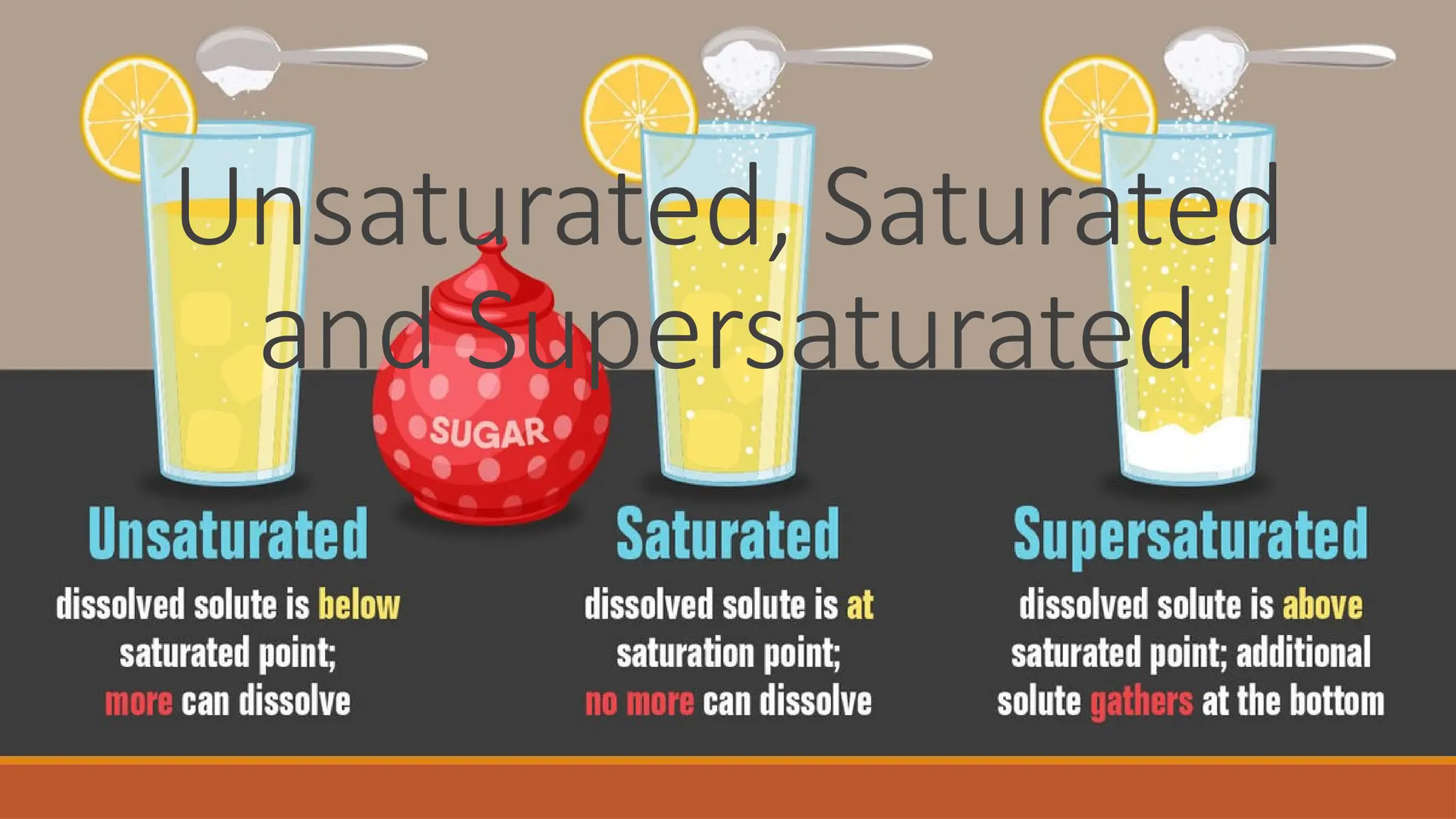
Distinguish Unsaturated, Saturated, and Supersaturated
Solutions.
Skills to Develop
3.
Solutions are definedas homogeneous mixtures that are mixed
so thoroughly that neither component can be observed
independently of the other.
Solutions are all around us.
Air, for example, is a solution.
If you live near a lake, a river, or an ocean, that body of water is
not pure H2O but most probably a SOLUTION.
Much of what we drink—for example, soda, coffee, tea, and
milk are solutions.
Solutions are a large part of everyday life.
4.
Characteristics of aSolution
A chemical solution exhibits several properties:
A solution consists of a homogeneous mixture.
A solution is composed of one phase (e.g., solid, liquid,
gas).
Particles in a solution are not visible to the naked eye.
A solution does not scatter a light beam.
Components of a solution cannot be separated using
simple mechanical filtration.
5.
Examples of Solution
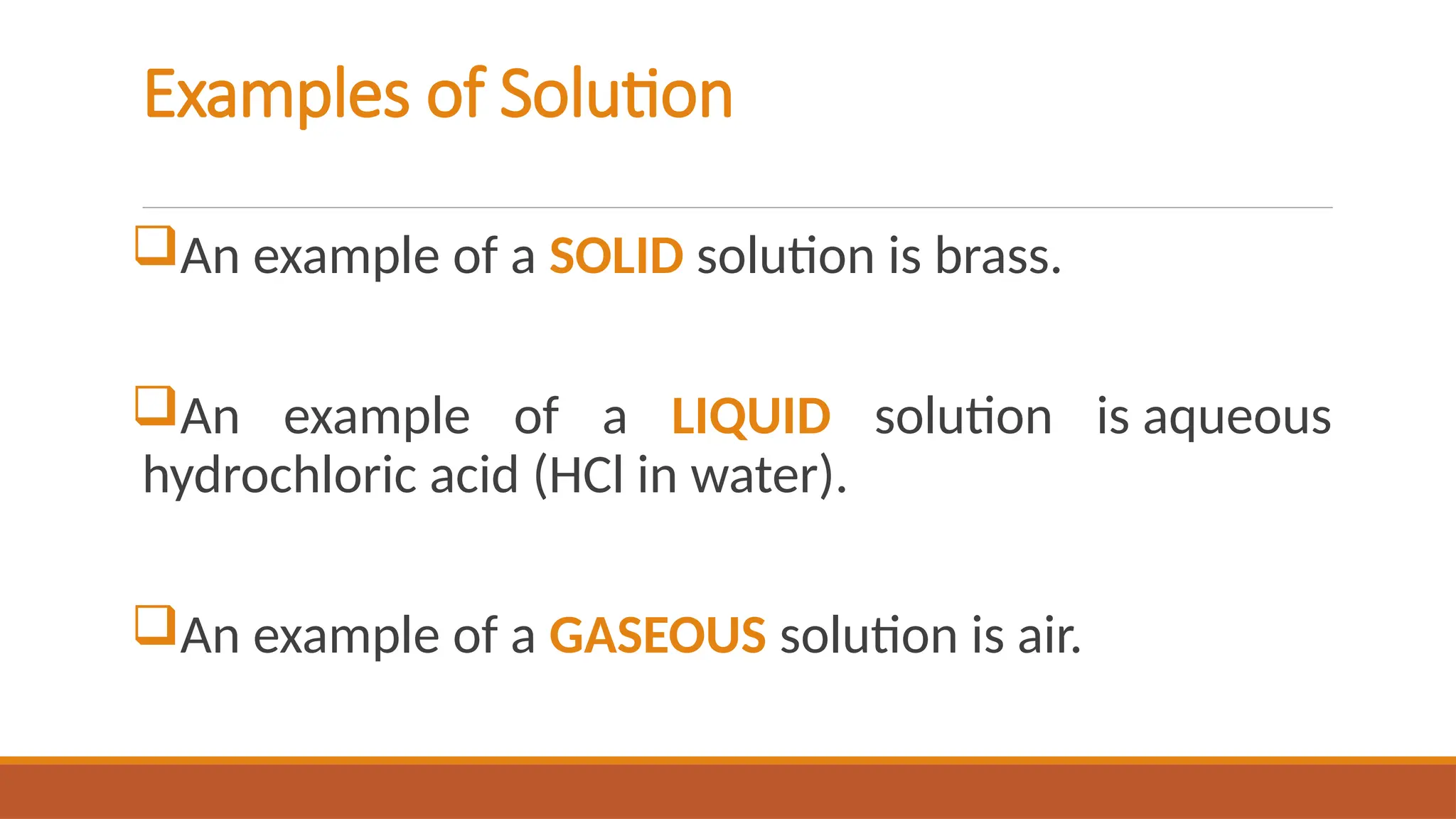
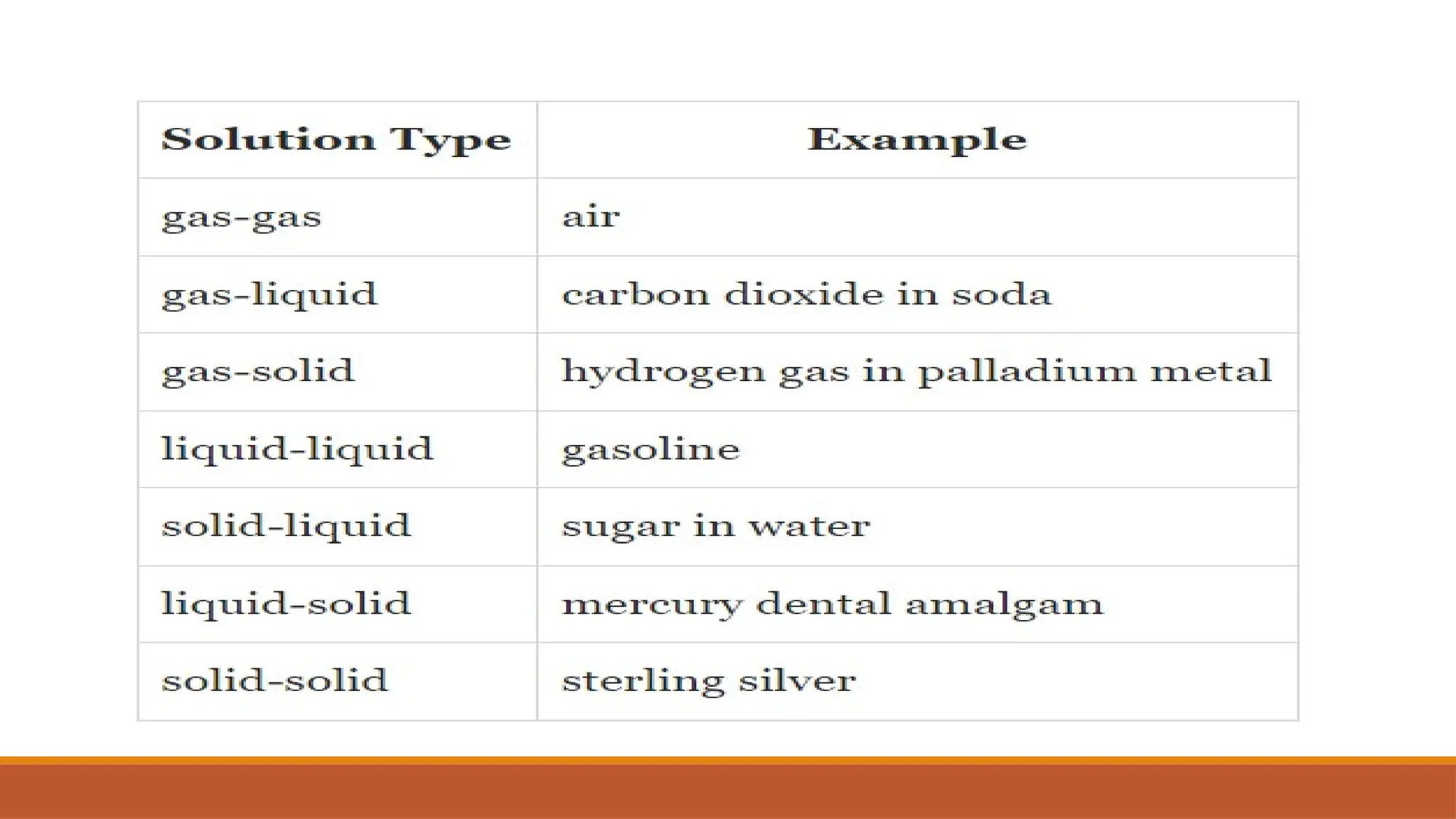
Anexample of a SOLID solution is brass.
An example of a LIQUID solution is aqueous
hydrochloric acid (HCl in water).
An example of a GASEOUS solution is air.
7.
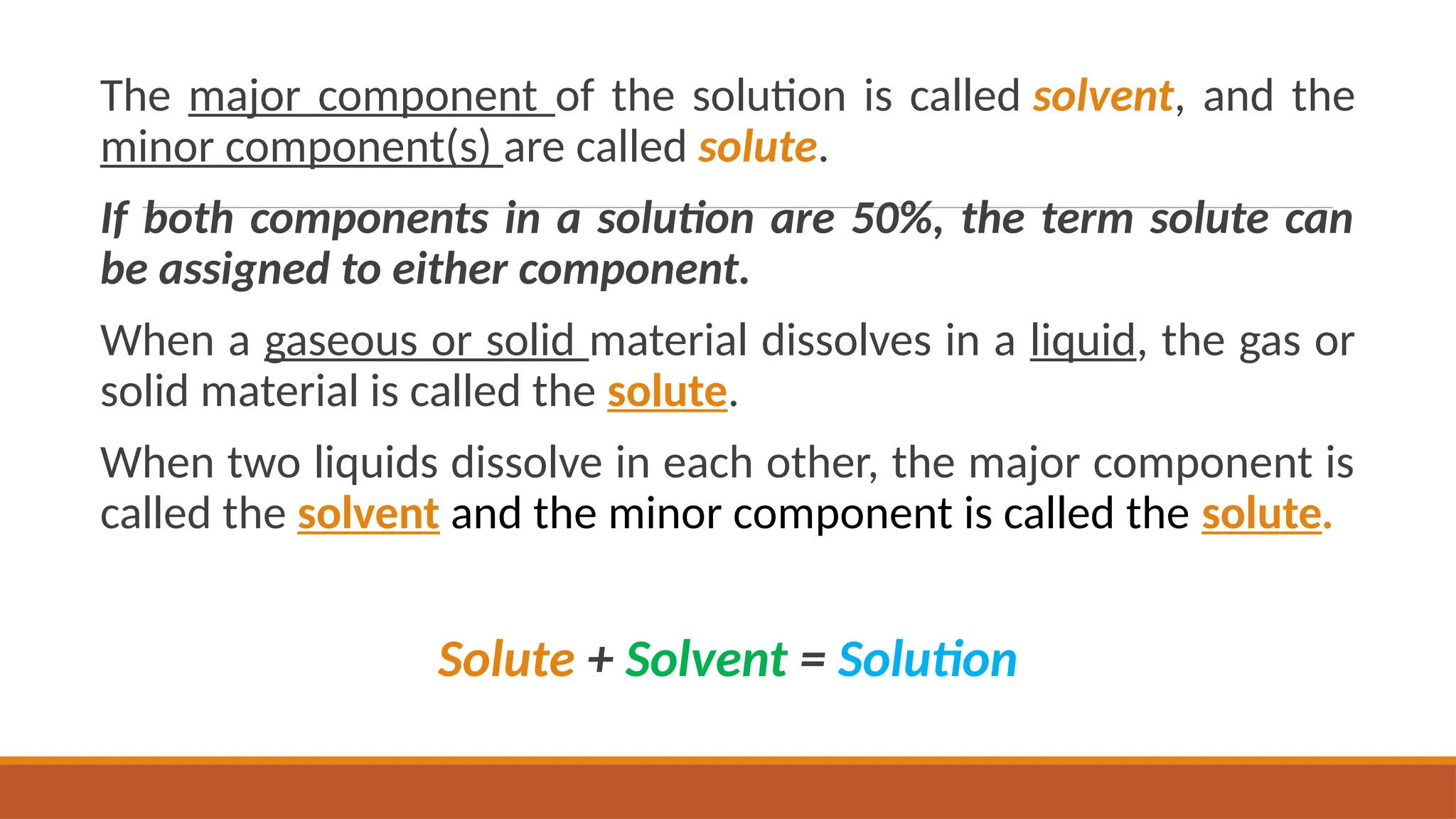
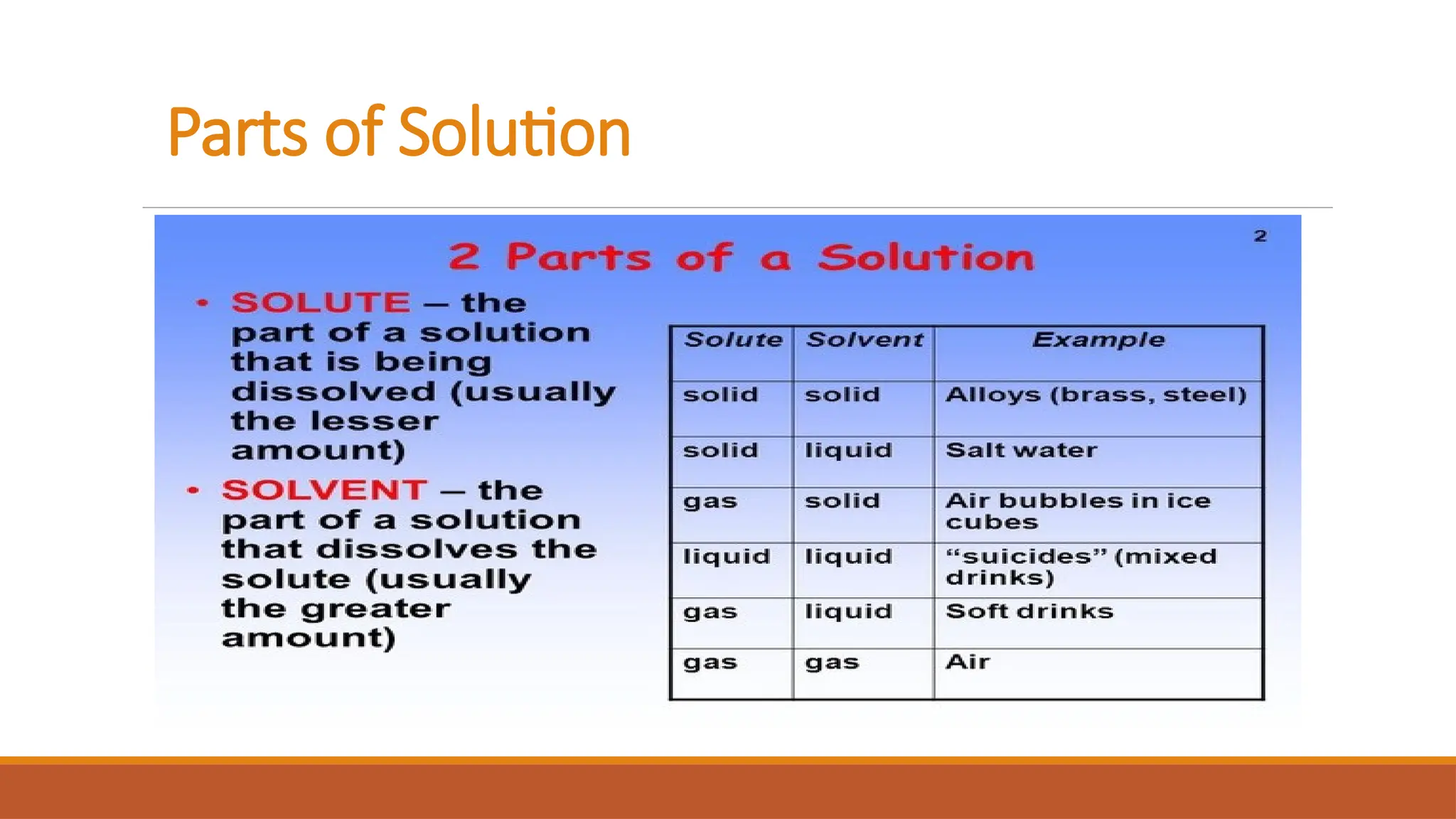
The major componentof the solution is called solvent, and the
minor component(s) are called solute.
If both components in a solution are 50%, the term solute can
be assigned to either component.
When a gaseous or solid material dissolves in a liquid, the gas or
solid material is called the solute.
When two liquids dissolve in each other, the major component is
called the solvent and the minor component is called the solute.
Solute + Solvent = Solution
Mixture
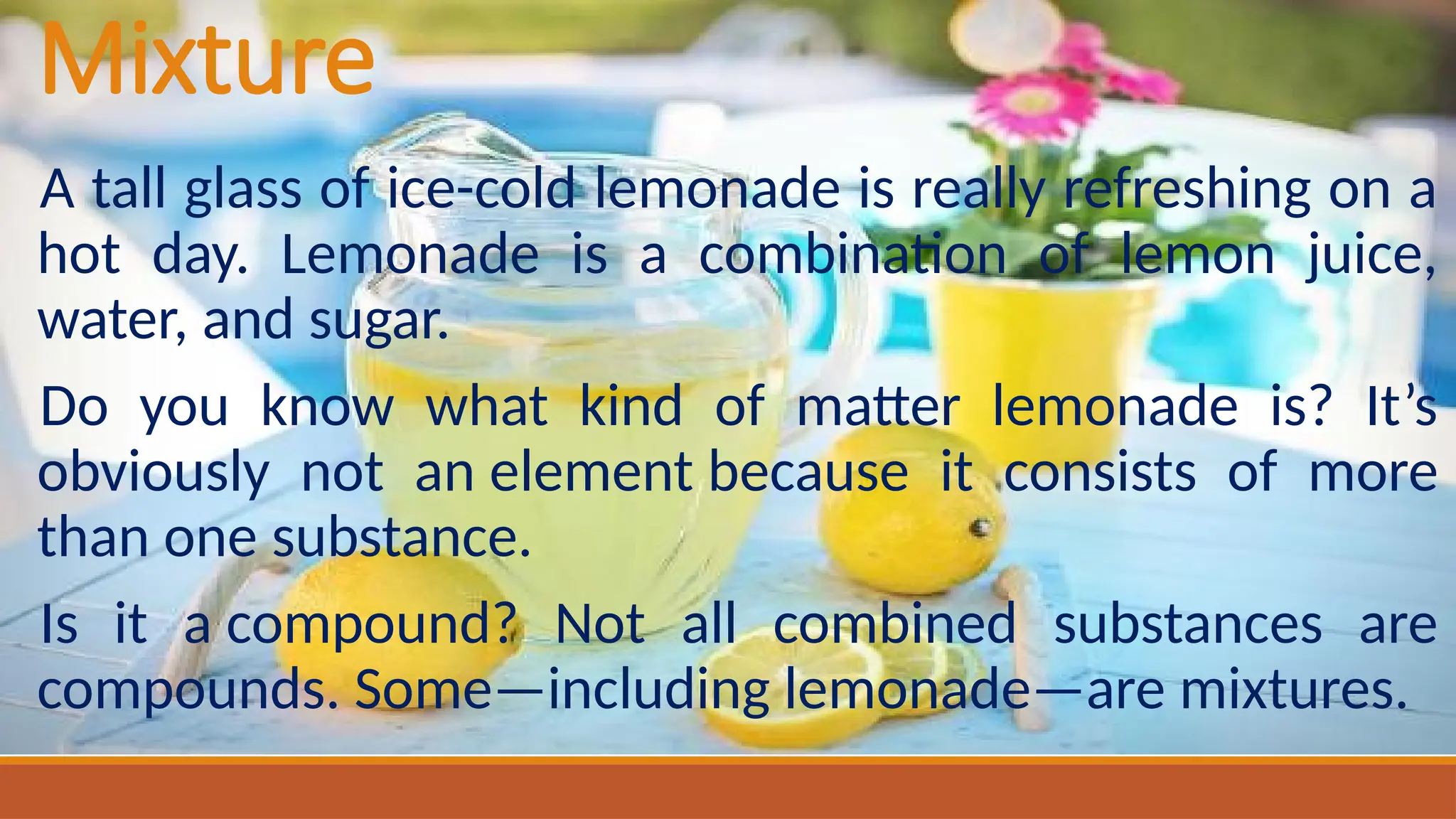
A tall glassof ice-cold lemonade is really refreshing on a
hot day. Lemonade is a combination of lemon juice,
water, and sugar.
Do you know what kind of matter lemonade is? It’s
obviously not an element because it consists of more
than one substance.
Is it a compound? Not all combined substances are
compounds. Some—including lemonade—are mixtures.
10.
A mixture ismade when two or more substances are
combined, but they are not combined chemically.
The lemonade pictured above is a mixture because it
doesn’t have fixed proportions of ingredients. It could
have more or less lemon juice, for example, or more or
less sugar, and it would still be lemonade.
What is a Mixture?
Homogeneous
A homogeneous mixtureis a mixture in which the
components that make up the mixture are uniformly
distributed throughout the mixture.
13.
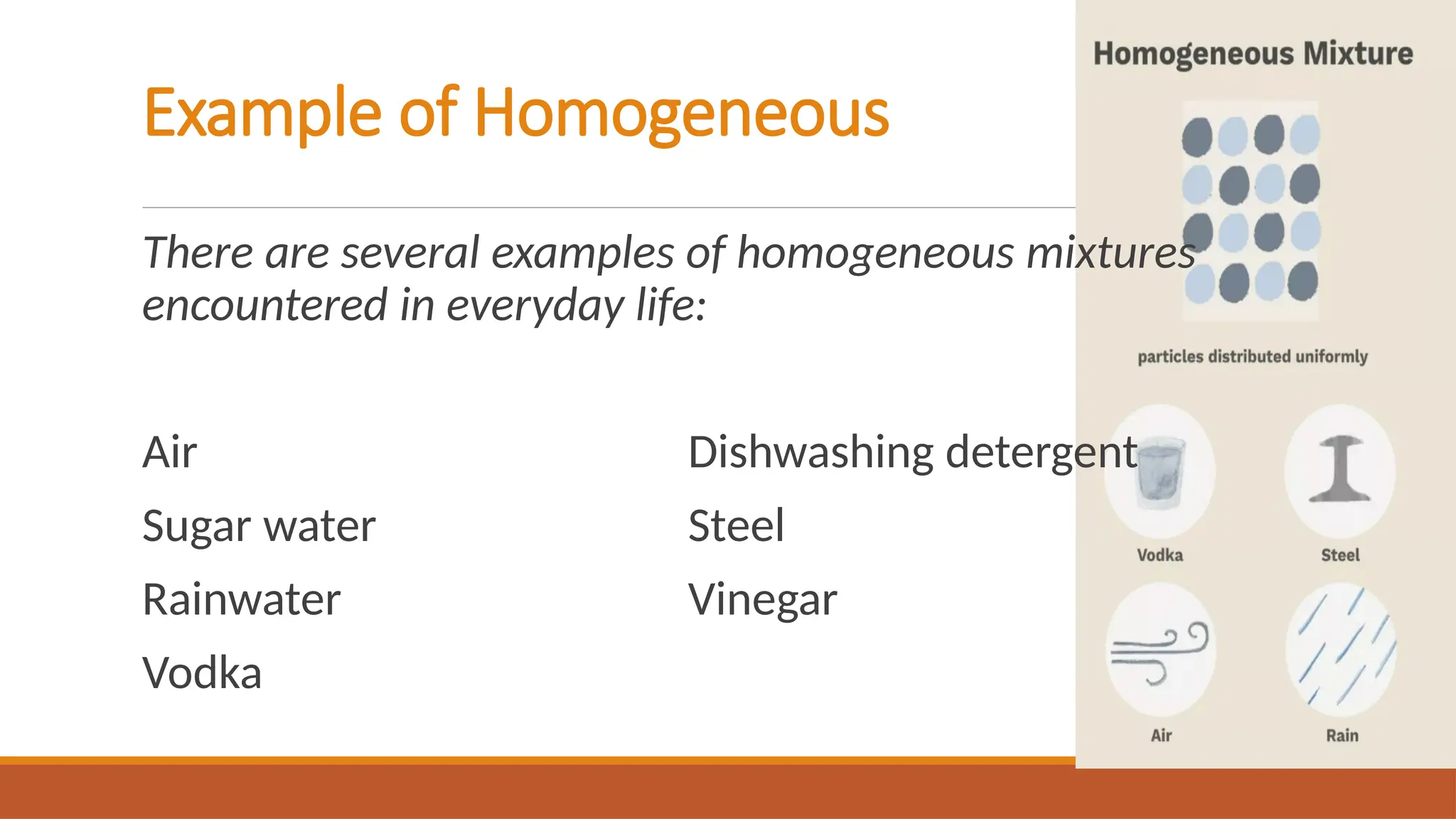
Example of Homogeneous
Thereare several examples of homogeneous mixtures
encountered in everyday life:
Air Dishwashing detergent
Sugar water Steel
Rainwater Vinegar
Vodka
14.
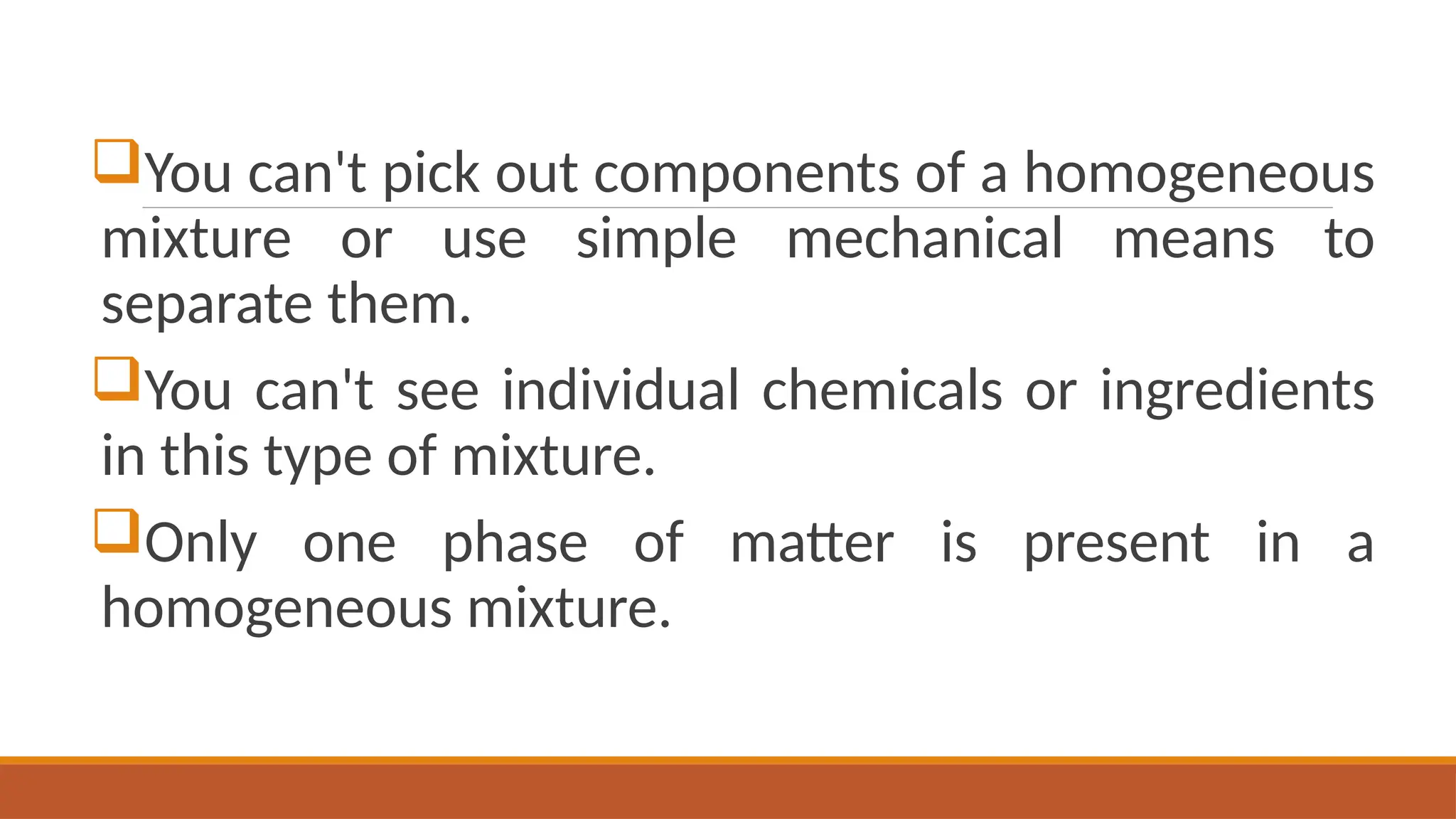
You can't pickout components of a homogeneous
mixture or use simple mechanical means to
separate them.
You can't see individual chemicals or ingredients
in this type of mixture.
Only one phase of matter is present in a
homogeneous mixture.
15.
Heterogeneous
A heterogeneous mixtureis a mixture in which the
components of the mixture are not uniform or have
localized regions with different properties.
Different samples from the mixture are not identical to each
other.
There are always two or more phases in a heterogeneous
mixture, where you can identify a region with properties
that are distinct from those of another region, even if they
are the same state of matter (e.g., liquid, solid).
16.
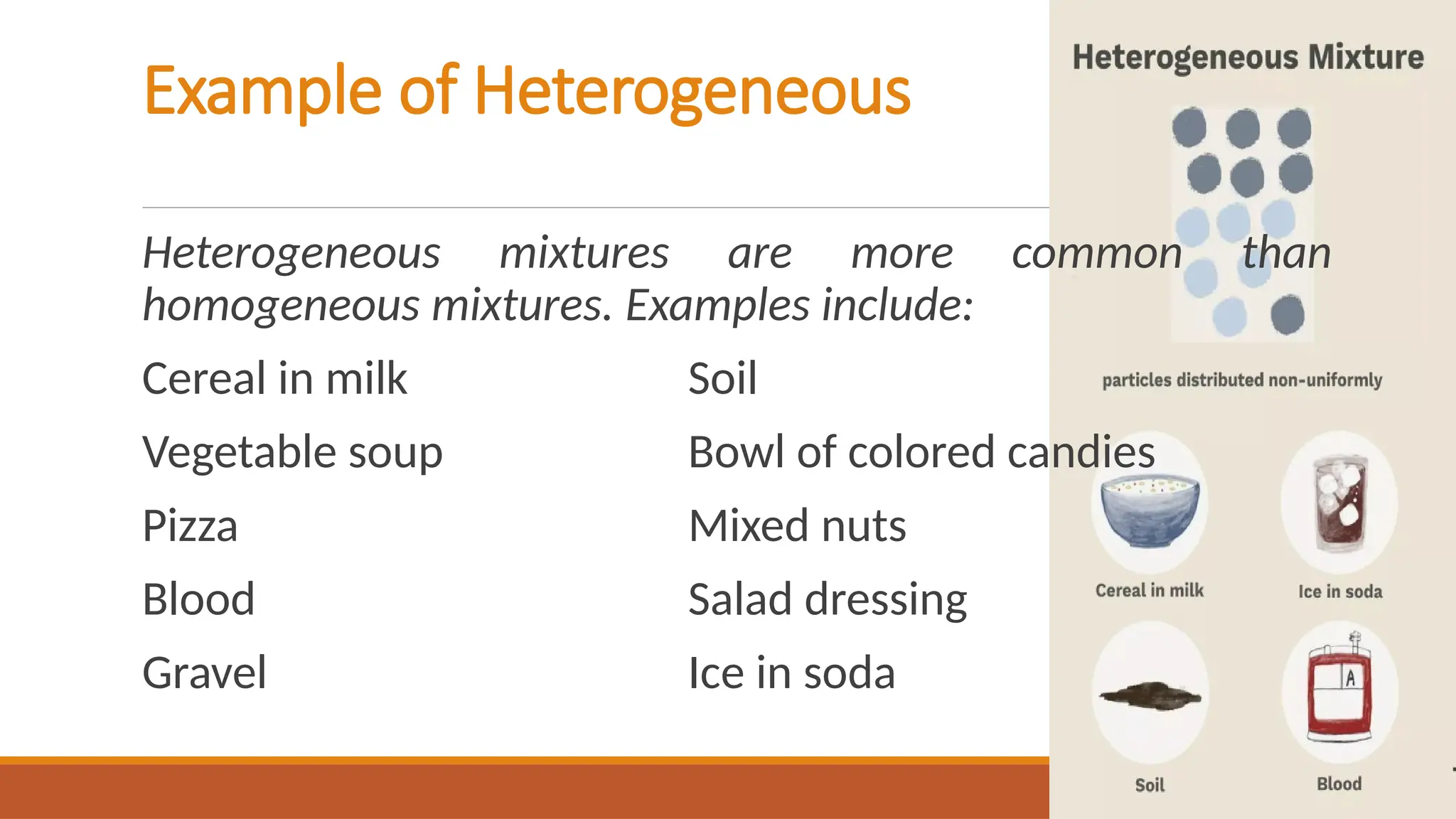
Example of Heterogeneous
Heterogeneousmixtures are more common than
homogeneous mixtures. Examples include:
Cereal in milk Soil
Vegetable soup Bowl of colored candies
Pizza Mixed nuts
Blood Salad dressing
Gravel Ice in soda
17.
Usually, it's possibleto physically separate
components of a heterogeneous mixture.
For example:
You can centrifuge (spin out) solid blood
cells to separate them from the plasma of
blood.
You can remove ice cubes from soda.
You can separate candies according to color.
18.
Types of Mixtures
Mixtureshave different properties depending
on the size of their particles.
Three types of mixtures based on particle size
are Solutions, Suspensions, and Colloids, all of
which are described in the table below.
19.
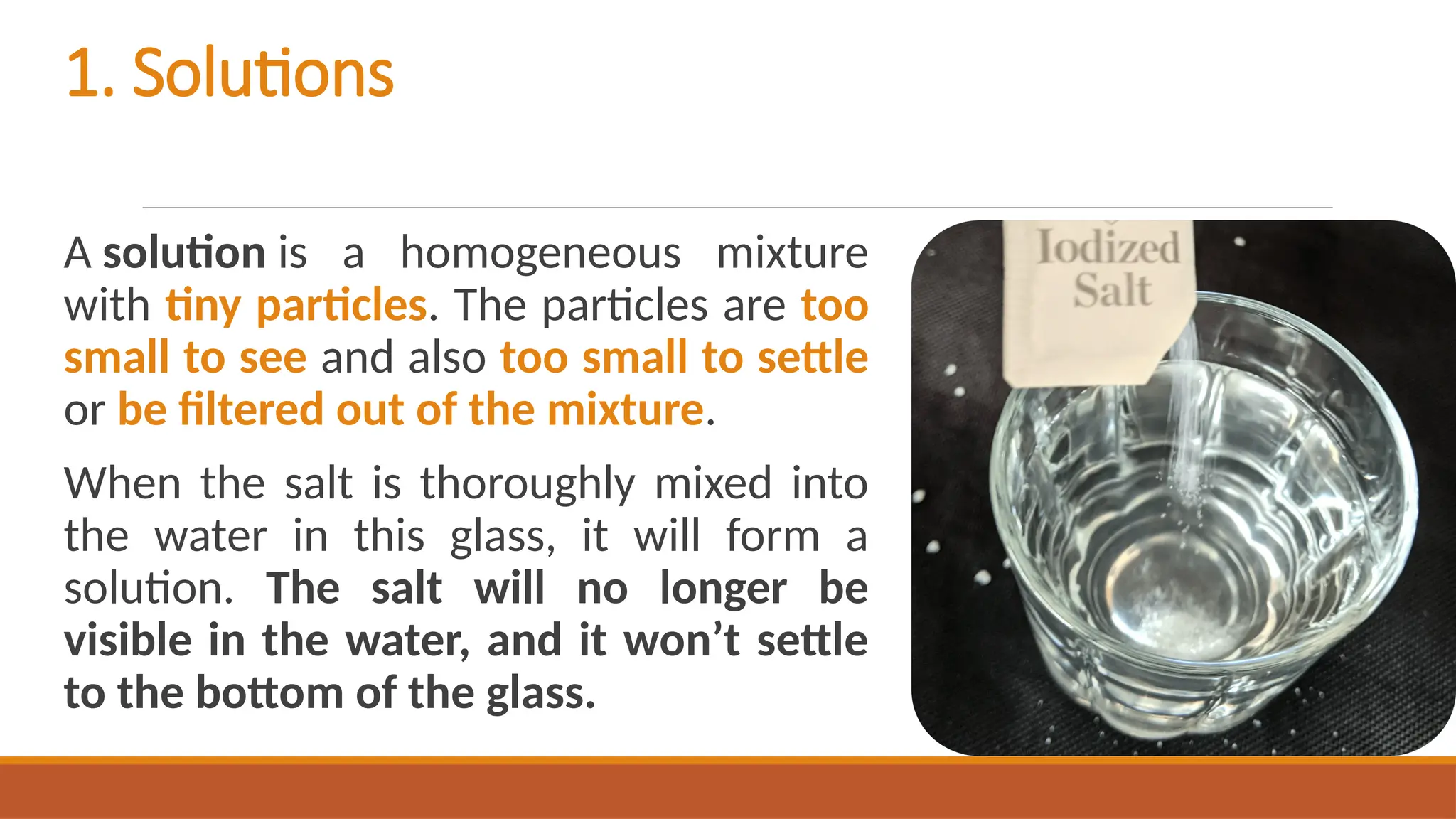
1. Solutions
A solutionis a homogeneous mixture
with tiny particles. The particles are too
small to see and also too small to settle
or be filtered out of the mixture.
When the salt is thoroughly mixed into
the water in this glass, it will form a
solution. The salt will no longer be
visible in the water, and it won’t settle
to the bottom of the glass.
20.
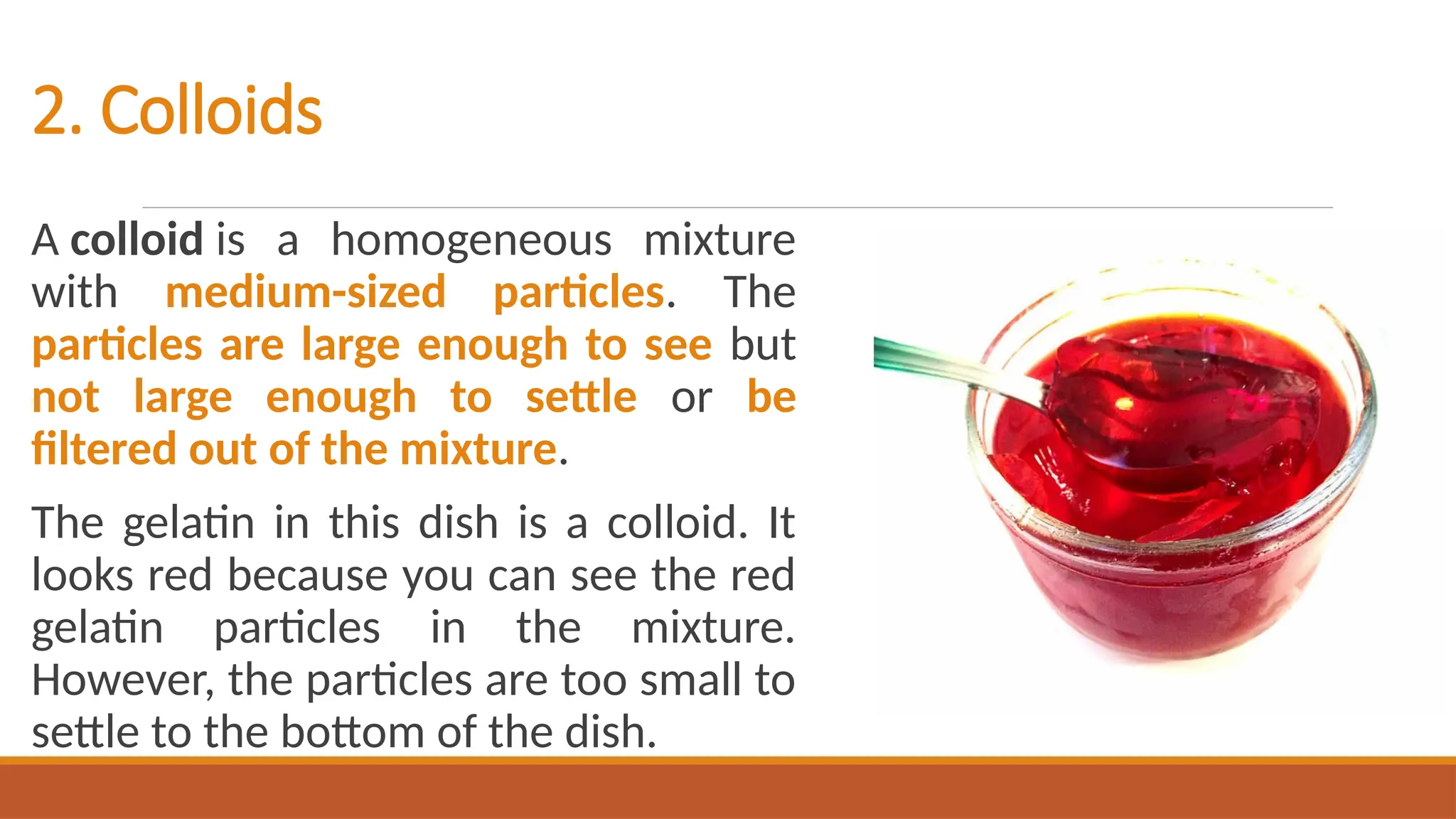
2. Colloids
A colloidis a homogeneous mixture
with medium-sized particles. The
particles are large enough to see but
not large enough to settle or be
filtered out of the mixture.
The gelatin in this dish is a colloid. It
looks red because you can see the red
gelatin particles in the mixture.
However, the particles are too small to
settle to the bottom of the dish.
21.
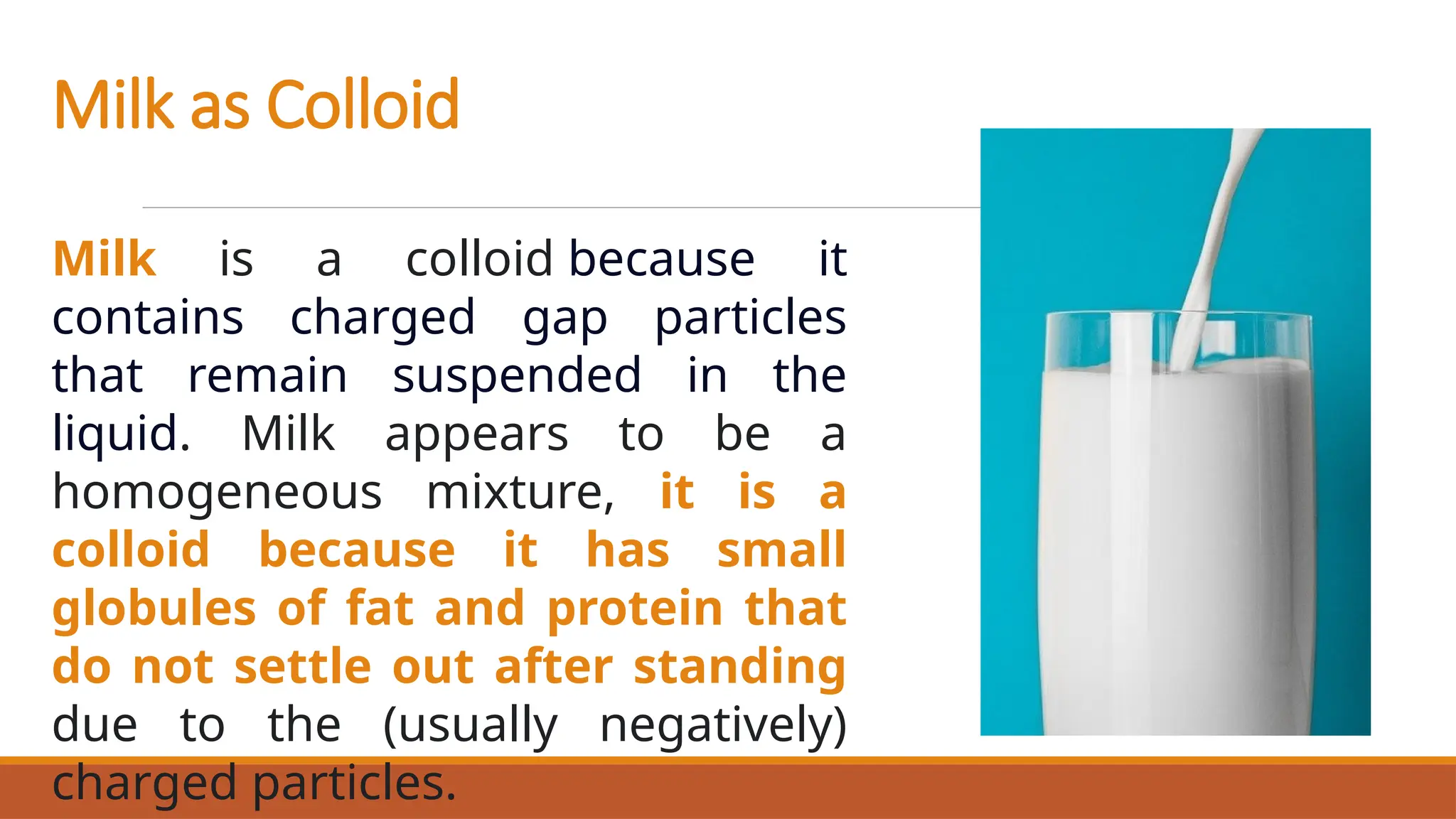
Milk as Colloid
Milkis a colloid because it
contains charged gap particles
that remain suspended in the
liquid. Milk appears to be a
homogeneous mixture, it is a
colloid because it has small
globules of fat and protein that
do not settle out after standing
due to the (usually negatively)
charged particles.
22.
Colloids
Colloids are commonin everyday life.
Some examples include whipped cream,
mayonnaise, milk, butter, gelatin, jelly,
muddy water, colored glass, and paper.
23.
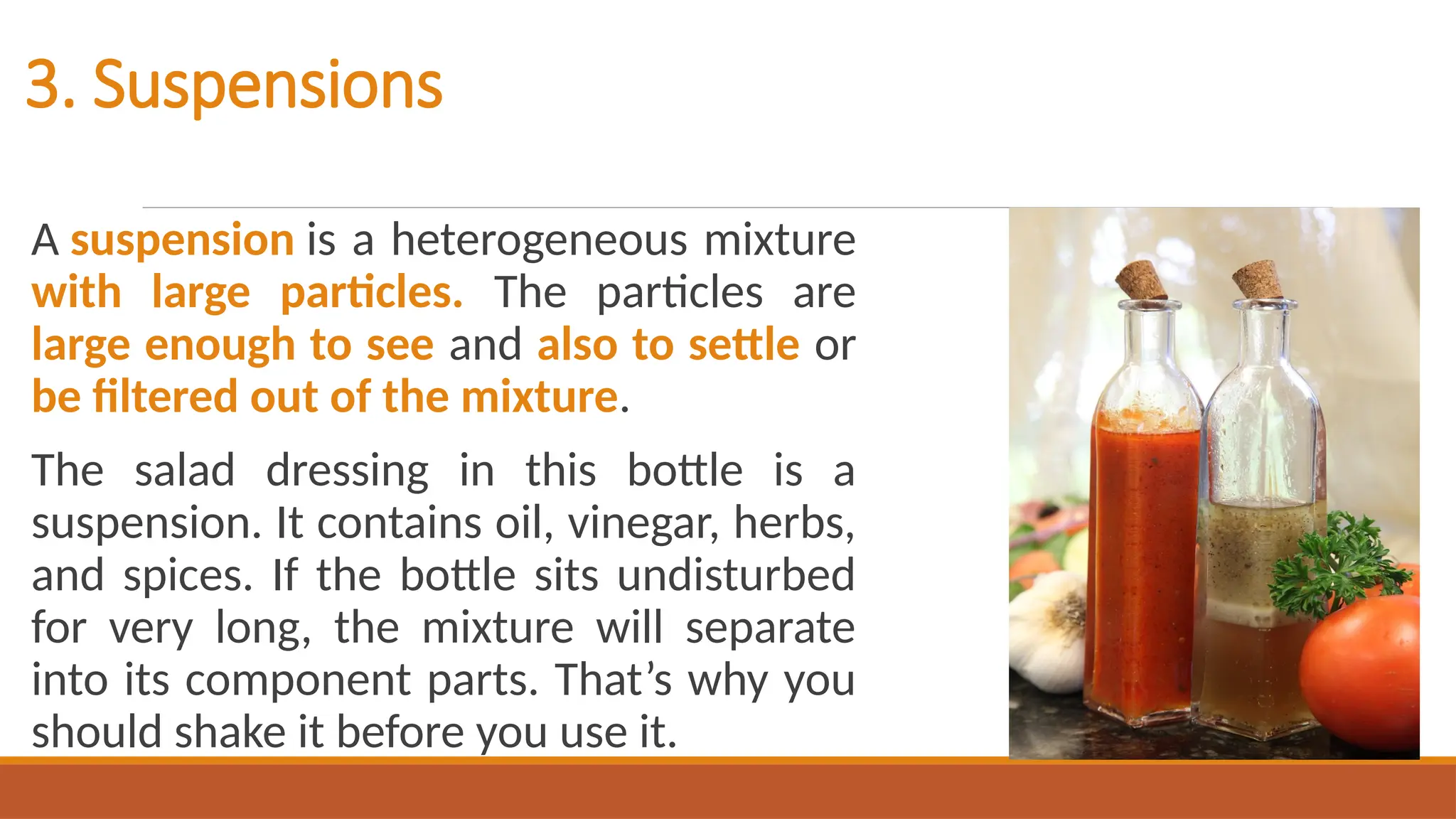
3. Suspensions
A suspensionis a heterogeneous mixture
with large particles. The particles are
large enough to see and also to settle or
be filtered out of the mixture.
The salad dressing in this bottle is a
suspension. It contains oil, vinegar, herbs,
and spices. If the bottle sits undisturbed
for very long, the mixture will separate
into its component parts. That’s why you
should shake it before you use it.
24.
Separating Mixtures
The componentsof a mixture keep their own identity when
they combine, so they retain their physical properties.
Examples of physical properties include boiling point, ability
to dissolve, and particle size. When components of mixtures
vary in physical properties such as these, processes such as
boiling, dissolving, or filtering can be used to separate
them.
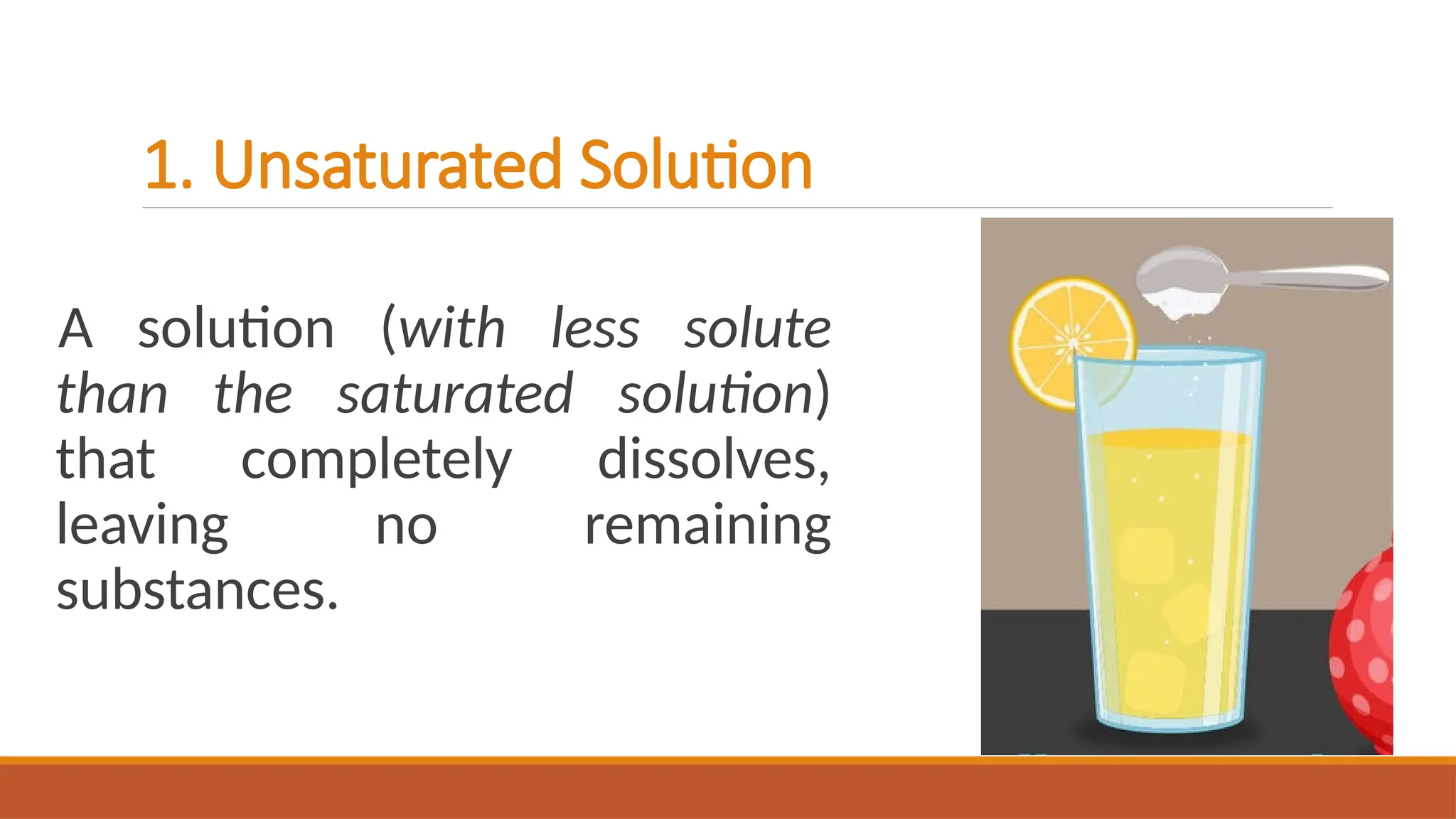
1. Unsaturated Solution
Asolution (with less solute
than the saturated solution)
that completely dissolves,
leaving no remaining
substances.
27.
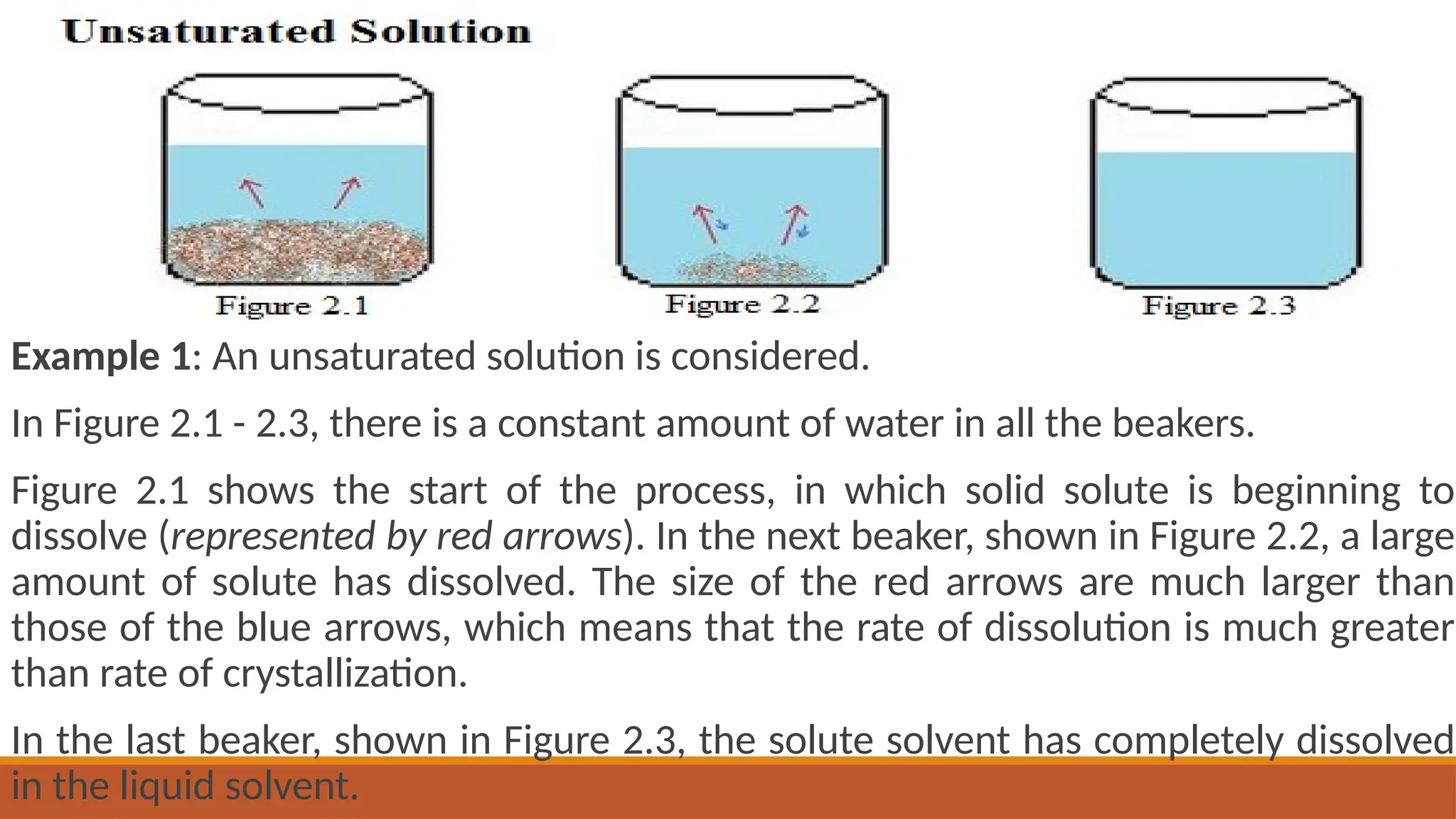
Example 1: Anunsaturated solution is considered.
In Figure 2.1 - 2.3, there is a constant amount of water in all the beakers.
Figure 2.1 shows the start of the process, in which solid solute is beginning to
dissolve (represented by red arrows). In the next beaker, shown in Figure 2.2, a large
amount of solute has dissolved. The size of the red arrows are much larger than
those of the blue arrows, which means that the rate of dissolution is much greater
than rate of crystallization.
In the last beaker, shown in Figure 2.3, the solute solvent has completely dissolved
in the liquid solvent.
28.
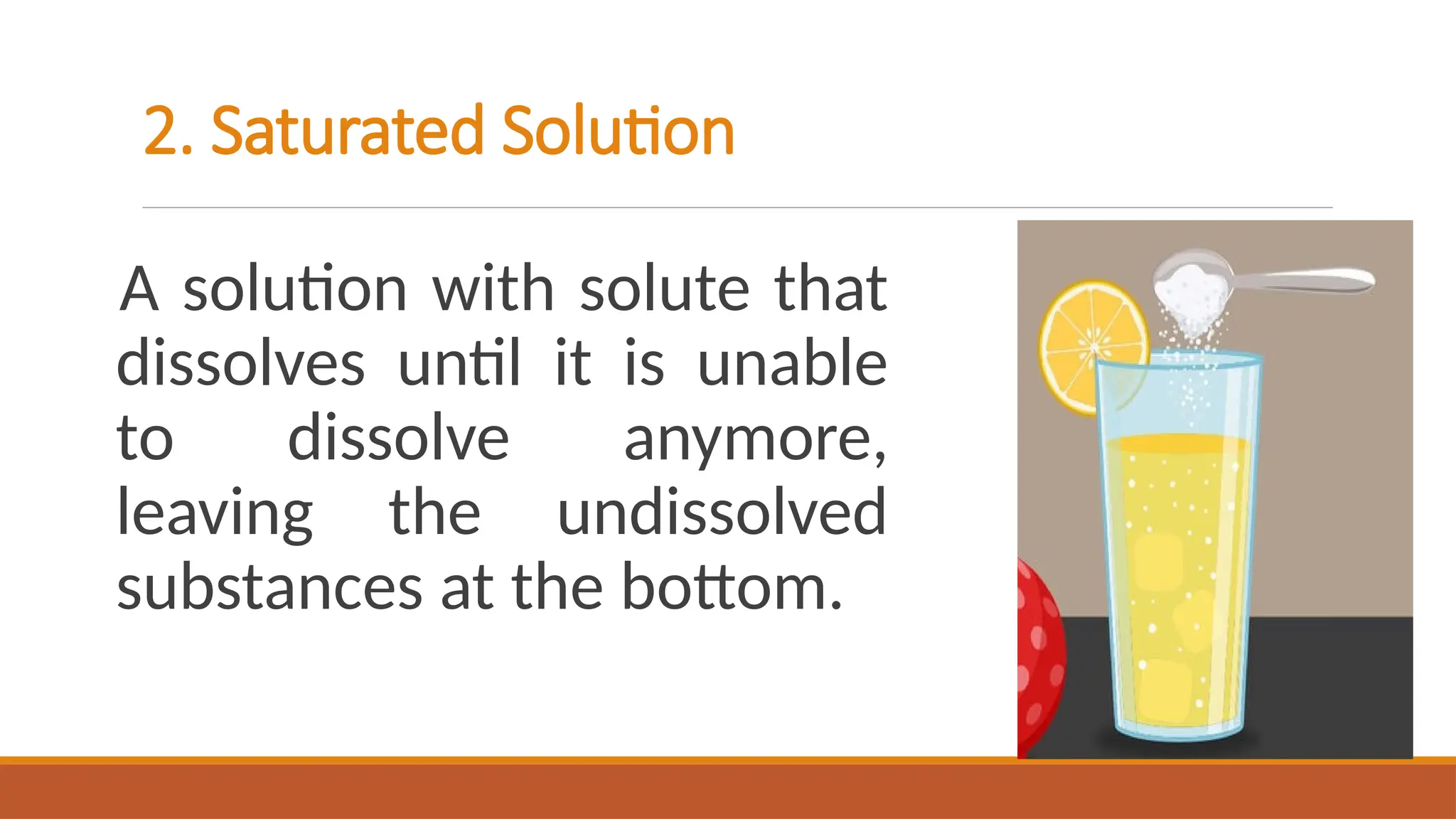
2. Saturated Solution
Asolution with solute that
dissolves until it is unable
to dissolve anymore,
leaving the undissolved
substances at the bottom.
29.
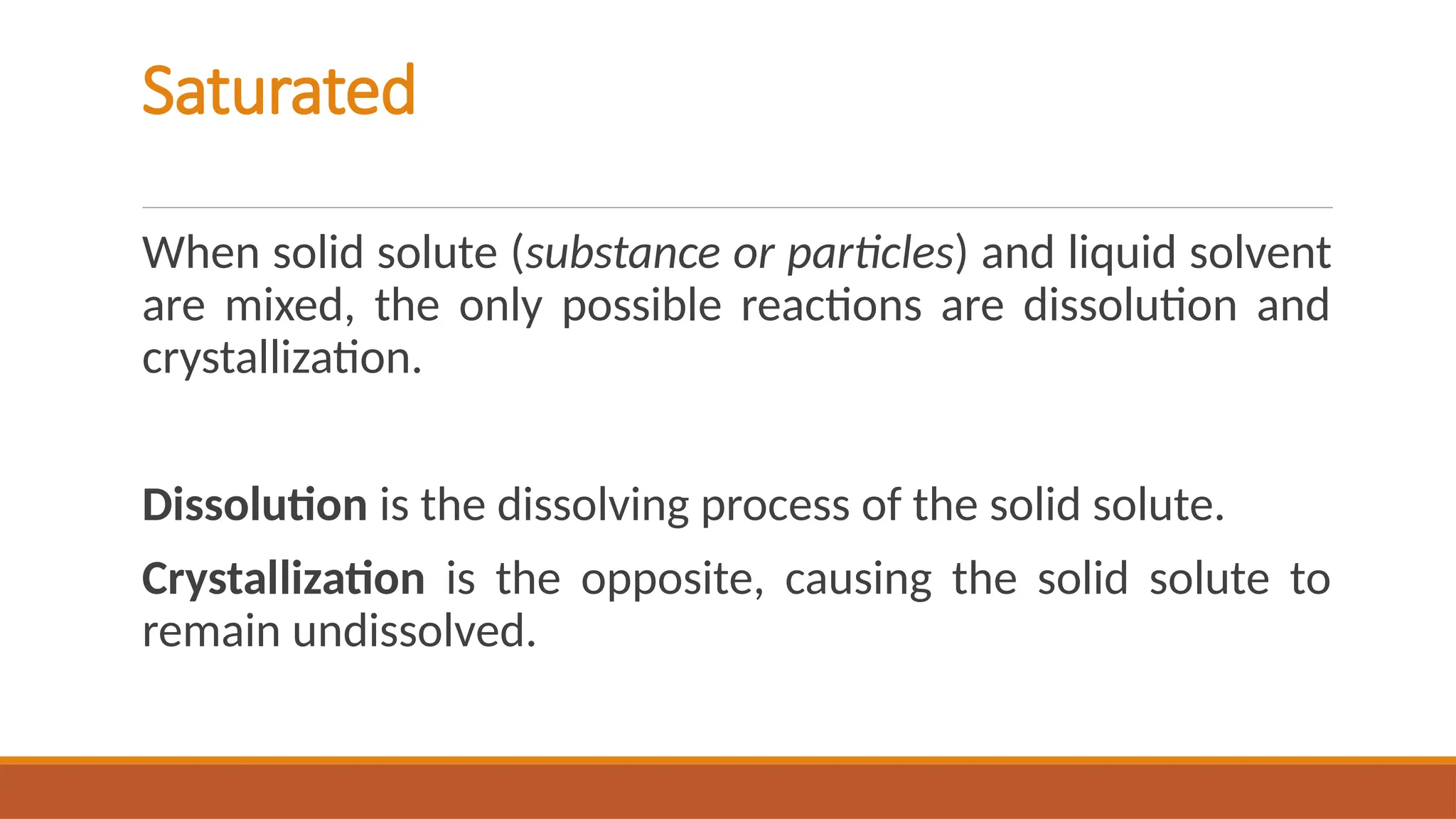
Saturated
When solid solute(substance or particles) and liquid solvent
are mixed, the only possible reactions are dissolution and
crystallization.
Dissolution is the dissolving process of the solid solute.
Crystallization is the opposite, causing the solid solute to
remain undissolved.
30.
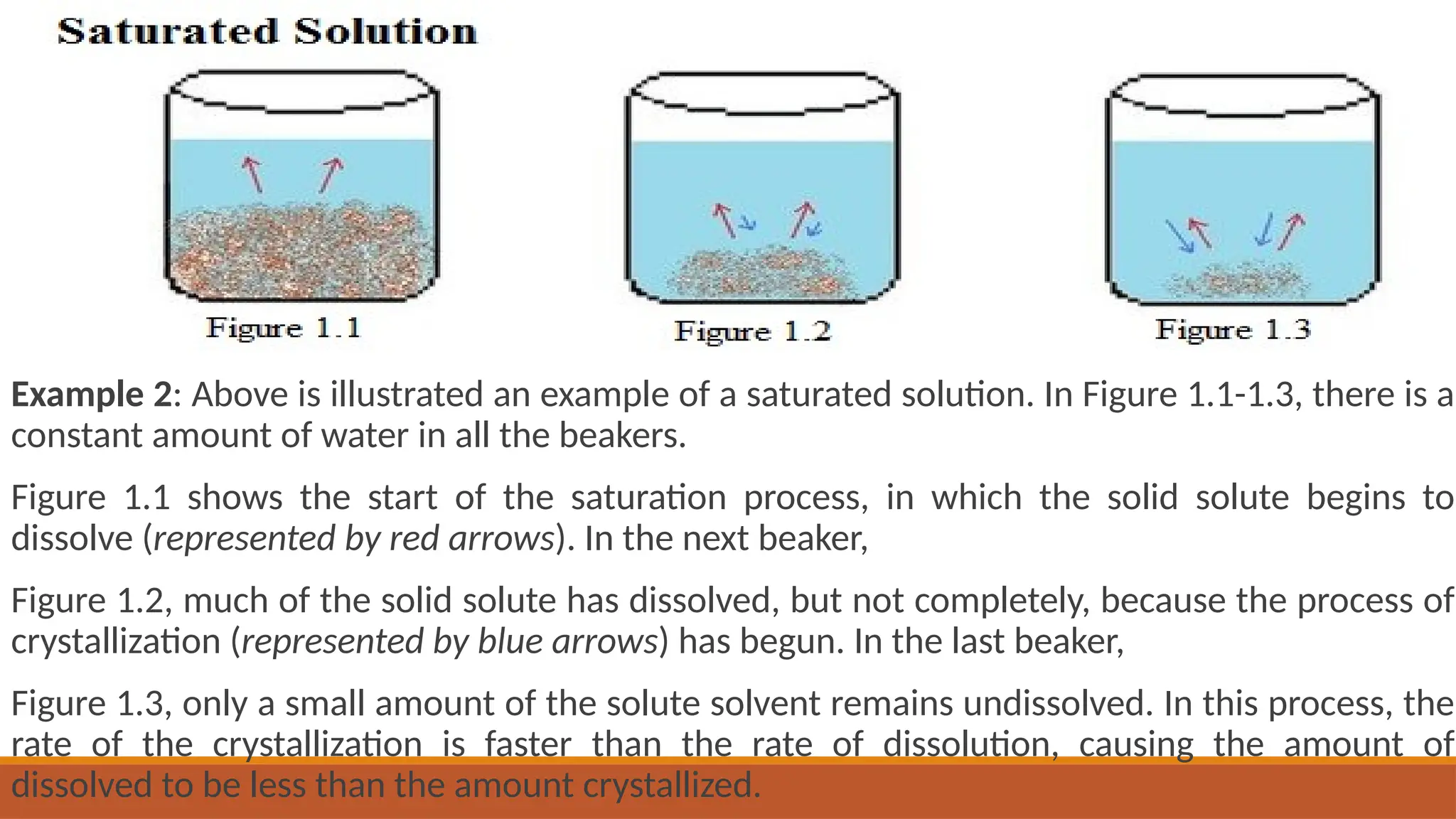
Example 2: Aboveis illustrated an example of a saturated solution. In Figure 1.1-1.3, there is a
constant amount of water in all the beakers.
Figure 1.1 shows the start of the saturation process, in which the solid solute begins to
dissolve (represented by red arrows). In the next beaker,
Figure 1.2, much of the solid solute has dissolved, but not completely, because the process of
crystallization (represented by blue arrows) has begun. In the last beaker,
Figure 1.3, only a small amount of the solute solvent remains undissolved. In this process, the
rate of the crystallization is faster than the rate of dissolution, causing the amount of
dissolved to be less than the amount crystallized.
31.
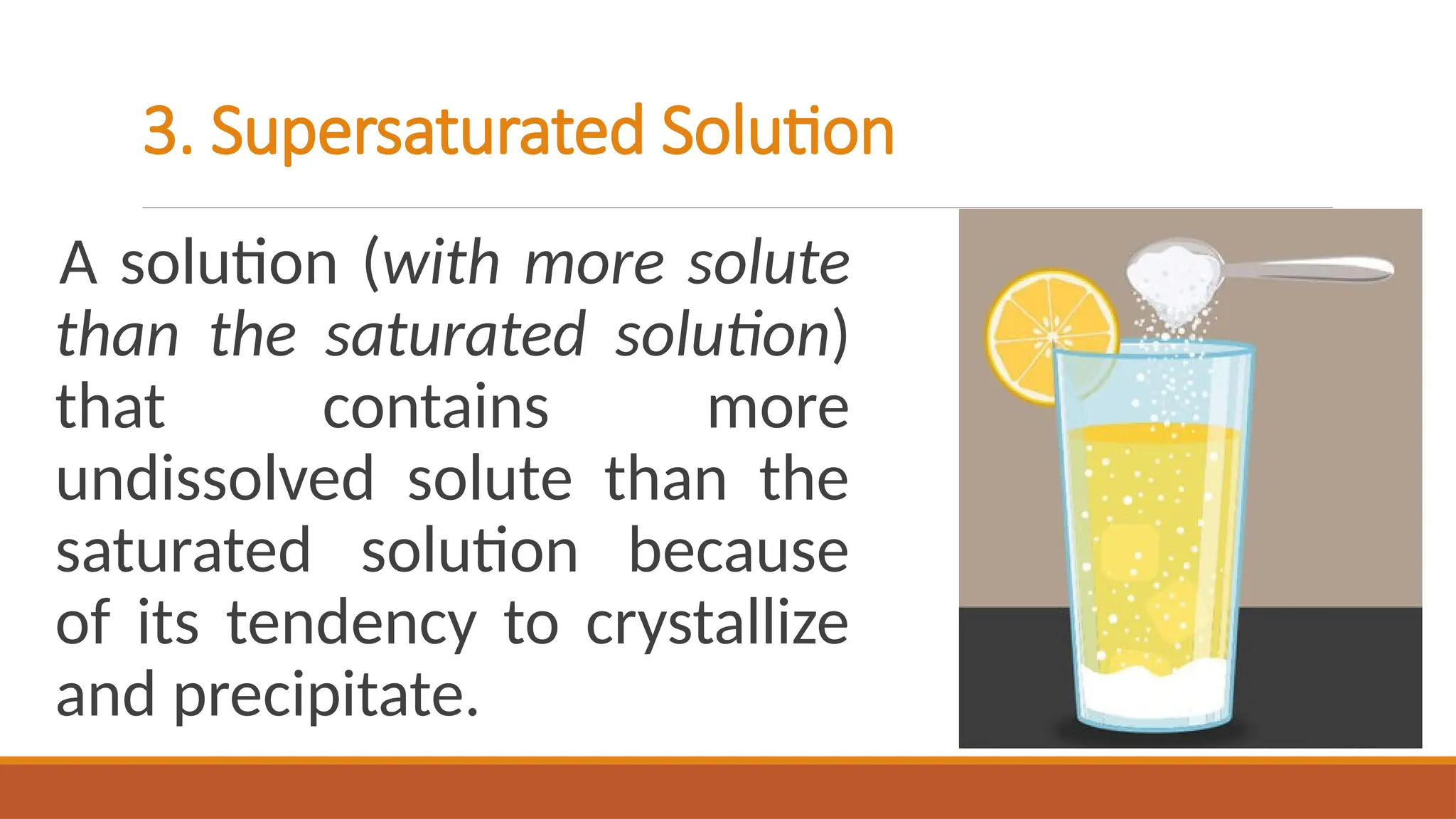
3. Supersaturated Solution
Asolution (with more solute
than the saturated solution)
that contains more
undissolved solute than the
saturated solution because
of its tendency to crystallize
and precipitate.
32.
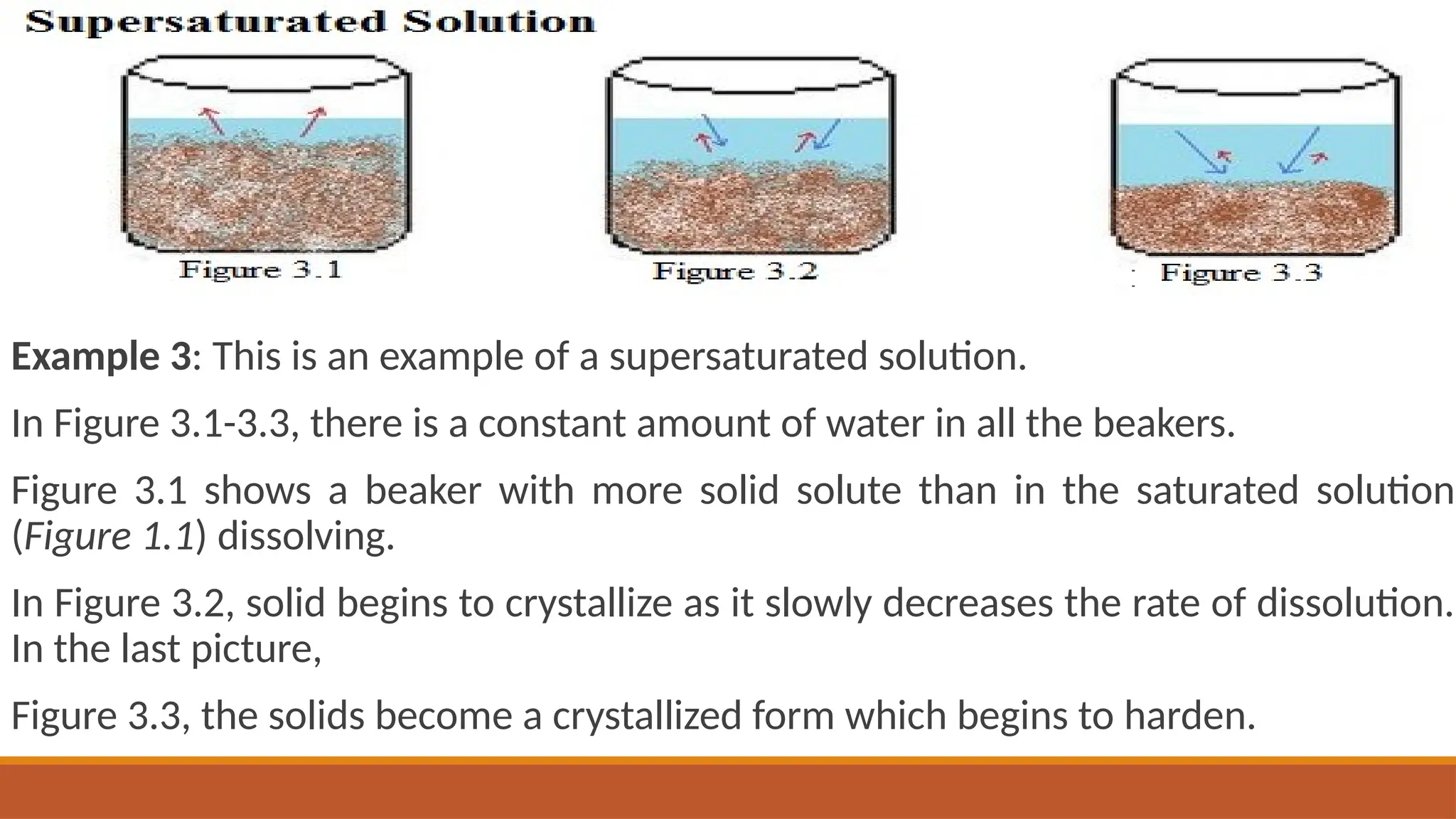
Example 3: Thisis an example of a supersaturated solution.
In Figure 3.1-3.3, there is a constant amount of water in all the beakers.
Figure 3.1 shows a beaker with more solid solute than in the saturated solution
(Figure 1.1) dissolving.
In Figure 3.2, solid begins to crystallize as it slowly decreases the rate of dissolution.
In the last picture,
Figure 3.3, the solids become a crystallized form which begins to harden.
#12 Wala kang makikitang nagseseparate ang mga sangkap
#26 Konti pa lang ang solute na nilagay sa isang solvent.
For example. 1 cup of water then add 1 tablespoon of salt
Malulusaw parin ang salt kase kakaunti palang ang solute
#28 Natunaw ng totally ang solute na nilagay sa solvent, walang maiiwang residue sa ilalaim ng baso