DR. ANJALI WAGH
PROFESSOR & HOD
DEPT. OF COMMUNITY MEDICINE
D.Y.PATIL MEDICAL COLLEGE, KOLHAPUR
Descriptive
Epidemiology
Epidemiological studies
Observational
studies
a) Descriptive
studies
b) Analytical
Studies
i) Case
control study
ii) Cohort
study
Experimental
studies /
Intervention
studies
a) Randomized
Control Studies
b) Field trials
c) Community
trials
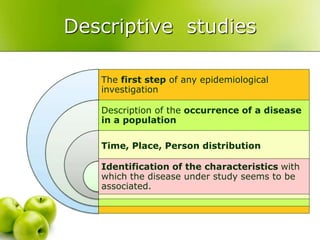
Descriptive studies
The first step of any epidemiological
investigation
Description of the occurrence of a disease
in a population
Time, Place, Person distribution
Identification of the characteristics with
which the disease under study seems to be
associated.
Descriptive studies
Studies of changing pattern of health &
disease over a period of time & space.
Community diagnosis of health problem or
assessment of needs.
Studies of existing data( case series ,
surveillance report, disease registries )
Studies of the natural history of disease
Descriptive studies
• Time distribution
When is the
disease occurring?
• Place distribution
Where is it
occurring?
• Person distribution
Who is getting
the disease?
Descriptive studies
Purpose - Use information to formulate
Hypothesis ultimately for taking health
action
Unit of the study - populations or its sub
groups, not on individuals
Study Instruments
a) Questionnaire & interview schedules
• 1. preparation , pre-coding , pretesting of the
questionnaire
• 2. plan for interviews
• 3. training of interviewers
• 4. Preparation of instructional manual
b) other methods of observation
• Medical examination
• Laboratory tests
• Screening procedures.
Tools with which data is collected
Steps in descriptive studies
1. Defining the population to be
studied
2. Defining the disease under the
study
3. Describing the disease by
a) Time b) Place c) Person
4. Measurement of disease
5. Comparing with known indices.
6. Formulation of aetiological hypothesis
1. Defining the population
“Defined population” can be
•whole population, or
•representative sample
•specifically selected group such as age, sex,
occupational groups, school children ,
pregnant mothers etc.
The concept of defined population
is critical because it provides the
denominator for calculating rates.
Describing the study
population
• Total Number
• Age composition,
• Sex composition,
• Occupations,
• Socioeconomic
status,
• Literacy profile
• Social customs,
habits
• Specific lifestyles
• knowledge of health
facilities available
and their utilization
Vital requirements of study
population
Then only the results of
hypothesis tested on any study
population can be generalized
to the reference population.
1. Its representativeness to the
parent reference population
2. Its optimum size
2. Defining the disease
under study
• The disease or condition can
be identified and measured in
the defined population with a
degree of accuracy.
‘Operational
definition’
This is required so as to enable
observer to identify those who have
the disease from those who do not
have.
• ’Tonsillitis’ is defined as an
inflammation of the tonsils, caused by
infection, usually with streptococcus
pyogenes.
Clinical
definition
• Tonsillitis would include the presence of
enlarged, red tonsils with white
exudates which on throat swab culture
grow predominantly s.pyogenes
Operational
definition
Disease definition
3. Describing the disease
Describes the occurrence and distribution of
the disease by
The time
• year, season, month, week, day.
The place
• country,cities,towns,urban/rural.
The persons who are affected with the disease.
• age, sex, occupation, education, S.E.status personal habits,
Ht.,wt., B.P. etc.
The Basic Triad of Descriptive
Epidemiology
The three essential characteristics of disease
we look for in descriptive epidemiology:
TIME
PERSONPLACE
Time distribution
1. Short term fluctuations(hours, days,
week ) = Epidemics
2. Periodic fluctuation ( months) =
Cyclic trends /seasonal variation
3. Long term or
secular trends
Short term fluctuations
Epidemic
 Def.- “ The occurrence of cases of an illness
or other health related events in a region or a
community clearly in excess of the normal
expectancy.
 Epidemic curve – A graph of the time
distribution of epidemic cases.
 It shows time relationship with exposure to a
suspected source.
Epidemic curve (Point source)Numberofcases
Times ( Hours / days)
Exposure
Types of epidemics
A) Common
source
epidemics
•a) Single exposure
or ‘point source’
epidemics
•b) Continuous or
multiple exposure
epidemics
B)Propagated
epidemics
• person to person
• arthropod vector
• animal reservoir
C) Slow
(modern)
epidemics
Point source epidemic
There is sudden rise and sudden fall
There are no secondary curves.
Large number of cases occur with a
narrow interval of time
All cases have the same incubation period.
Exposure is almost simultaneous and brief.
All cases develop almost simultaneously following single
exposure. e.g. food poisoning, Bhopal gas tragedy.
Characteristics -
1. Point Epidemic
Short-term changes
occur over limited
time frames
• Hours
• Days
• Weeks
• Months
Used for short-term exposures or diseases with short
incubation and/or illness durations
Common-Source Outbreak
Cholera!The Broad
Street
Pump.
Common-Source Outbreak
Sewage
contamination of
drinking water.
Continuous exposure epidemic
• Epidemic occurs from common source.
• Epidemic is not explosive.
• Exposure occurs continuously or repeatedly not
necessarily simultaneously.
• Sudden rise & gradual fall of the curve.
• e.g. CSW as a source of gonorrhea, infecting all her clients
over period of time.
• Well with contaminated water in outbreak of cholera.
Common source , repeated exposure
Times
Numberofcases
Propagated epidemics
A gradual rise & tails off over a
long period of time.
Transmission continues till
susceptible individuals are
exposed to infected persons.
speed of spread depends
upon Herd immunity
The propagated epidemics are most often of infectious
origin usually results from person to person transmission
of infectious agent.
e.g. Hepatitis A , poliomyelitis, Measles
Characteristics :
Propagated Epidemic
Initial Period of
Epidemic
Height of
Epidemic
Termination of
Epidemic
O O O O O
O O O O O
O O O O O O O O
O O O O O
O O O O O O O O O
O O O O O O O O
O O O O O O O O
O O O O O O
O O O O O O
O O O O O O O
O O O O
O O
Susceptible Immune
O Fail to infect othersO Infects others
Propagating Epidemic
Epidemic
spreads via
multiple
sources.
2.Periodic fluctuations
Periodic fluctuations
Seasonal variations Cyclic trends
Seasonal trends:
It is a prominent feature of infections.
for e.g.-
Measles and chickenpox
in the early spring seasons.
URTI
in winter season ,
Diarrheal diseases
during summer months.
Cyclic trends :
certain diseases appear in cycles
which may be spread over short
periods of time like
days, weeks, months or years.
e.g.- epidemic of
Measles in every 2-3 yrs,
Influenza once in 7 to 10 yrs.
Accidents more on week ends.
Seasonal Variation
• Seasonal variation can be used to suggest
possible etiology.
Migratory Birds?
Cyclic Trends
3.Long term fluctuations
Changes occur over long period of time.
(usually > 10yrs).
It could be increasing or decreasing, real or apparent,
communicable diseases or non-communicable disease.
• e.g.. 1) downward trend : Plague & cholera.
2) upward trend : DM, CHD, lung cancer
Secular trends
Why we should know
time trends?
• To know diseases which are increasing or
decreasing & emerging health problems.
• Can frame effective measures to control the
diseases.
• Formulate etiological hypothesis.
• Provide guidelines to health administrator in
matters of prevention or control of disease.
Place Distribution
knowledge of geographic pattern of
diseases are major important sources of
clues about the etiology of disease.
International
variations
National
variations
Rural–urban
variations
Local
distributions
1)
International
• a) Malaria,
Leprosy in hot
and humid
climate. e.g..
Africa and
South America.
• b) Ca stomach
– Japan, Ca
oral cavity, Ca
cervix – India.
2)
National
• Endemic
goitre,
lathyrism,
malaria ,filaria
leprosy etc.
3)
Local
• Studied with
the help of
spot map in a
given area.
• E.g.. a) John
Snow study on
cholera in
London.
• b) Endemic
flurosis in
Nalgonda,
Kolar
4)
Urban - Rural
• Tetanus, OP
poisoning,
zoonotic
diseases
common in
rural.
• RTA, drug
abuse, DM
cancer,
mental stress
more
common in
urban .
Place distribution
Geographic spot map
Common-Source Outbreak
The Broad
Street
Pump.
Individual
cases of
(deaths from)
cholera.
Spot map
 It is a graphical presentation of the place
distribution of the disease of occurrence.
 “ clustering “ of cases suggest common source of
infection & mode of spread.
e.g. Investigation of cholera epidemic by John
Snow of England with help of spot map
 Factors influencing geographical variations are
culture, standards of living, external environment
and genetic factors.
1) Age
2) Race, religion &
ethnicity
3) Gender : Male,
Female.
4) Occupation :
agricultural /
Industry.
5) Marriage : Single,
married, divorce,
separated.
6) Residence.
7) Socio-Cultural
environment.
8) Socio-Economic
background.
9) Behavior ( lifestyle)
10) Stress
11) Migration
Person Distribution
Age
Person distribution
 Age – Bimodality
Rateperlakhpopulation
0 8070605040302010
7
6
5
4
3
2
0
1
90
Bimodality of Hodgkin’s disease distribution
4. Measurement of disease
measurement of mortality
measurement of morbidity
• Incidence ( longitudinal study) &
• Prevalence ( cross-sectional study)
‘Disease load’ in population
5. Comparing with known
indices
By making comparison between
• Different populations or
• Subgroups of the same population
1.It is possible to arrive at clues to disease
aetiology.
2. Identify groups which are at ‘high risk’ for the
disease.
6. Formulation of hypothesis
 e.g. The smoking of 30-40 cigarettes per
day causes lung cancer in 10% of smokers
after 20 years of exposures.
• Population ( characteristics of persons )
• The specific cause
• The expected outcome – disease
• The dose- response relationship
• Time- response relationship
An epidemiological hypothesis should specify
Descriptive studies
Case report Case series
KAPB /
opinion
study
Ecological /
co-relation
study
Cross
sectional
study
Longitudinal
study
Cross sectional study
 Disease frequency survey or
‘ Prevalence study’
• Simple descriptive epidemiological study.
• Single examination of all subjects in population or
re-presentative sample for presence or absence of
disease or risk factors at one point of time.
• Field based , suited for chronic diseases
• Useful for screening of population for undiagnosed
disease.
Cross sectional study
Data collected – age, sex, family history, physical
exercise, body weight, salt intake, lifestyle etc.
Study tells aetiology & distribution of disease in
population
Multi-factorial causation
Help in prevention of disease by possible interventions.
Example : Study the prevalence of hypertension
Cross sectional study
 Uses
• 1. Determine the prevalence of disease.
• 2. Identify possible causative factors in disease.
• 3. Study shows association between variables
but they do not establish causality.
• 4. Use to formulate hypothesis
Longitudinal study
 Incidence study
 Observations are repeated in the same population over
a prolonged period of time by follow up examination.
Useful to study natural history of disease.
Helps to find out incidence rate.
Helps to identify risk factors of disease.
study is time consuming & costly.
Dropouts during study period ( Attrition)
Differences between longitudinal & cross
sectional study
LONGITUDINAL STUDY CROSS SECTIONAL STUDY
Observations are repeated by means
of follow-up exam. in population
Observations are done only once in
the population
Carried over a long period of time
( minimum one year)
Carried over a given point of time
This help to find out the occurrence
of new cases (incidence)
This help to find out the existence
of both old & new cases
(prevalence)
Helps to study the natural history of
the disease & the risk factors
Does not helps to study the natural
history of the disease & the risk
factors
Study is time consuming , difficult &
costly
Not time consuming , easy & cheap
Uses of
Descriptive epidemiology
Helps to know magnitude of disease in community.
• morbidity & mortality rates
Helps to know the distribution of the disease.
• time, place, person
Helps to formulate an etiological hypothesis.
Helps to plan, organize & implement curative and preventive services.
Helps in doing research.
Descriptive epidemiology

Descriptive epidemiology

  • 1.
    DR. ANJALI WAGH PROFESSOR& HOD DEPT. OF COMMUNITY MEDICINE D.Y.PATIL MEDICAL COLLEGE, KOLHAPUR Descriptive Epidemiology
  • 2.
    Epidemiological studies Observational studies a) Descriptive studies b)Analytical Studies i) Case control study ii) Cohort study Experimental studies / Intervention studies a) Randomized Control Studies b) Field trials c) Community trials
  • 3.
    Descriptive studies The firststep of any epidemiological investigation Description of the occurrence of a disease in a population Time, Place, Person distribution Identification of the characteristics with which the disease under study seems to be associated.
  • 4.
    Descriptive studies Studies ofchanging pattern of health & disease over a period of time & space. Community diagnosis of health problem or assessment of needs. Studies of existing data( case series , surveillance report, disease registries ) Studies of the natural history of disease
  • 5.
    Descriptive studies • Timedistribution When is the disease occurring? • Place distribution Where is it occurring? • Person distribution Who is getting the disease?
  • 6.
    Descriptive studies Purpose -Use information to formulate Hypothesis ultimately for taking health action Unit of the study - populations or its sub groups, not on individuals
  • 7.
    Study Instruments a) Questionnaire& interview schedules • 1. preparation , pre-coding , pretesting of the questionnaire • 2. plan for interviews • 3. training of interviewers • 4. Preparation of instructional manual b) other methods of observation • Medical examination • Laboratory tests • Screening procedures. Tools with which data is collected
  • 8.
    Steps in descriptivestudies 1. Defining the population to be studied 2. Defining the disease under the study 3. Describing the disease by a) Time b) Place c) Person 4. Measurement of disease 5. Comparing with known indices. 6. Formulation of aetiological hypothesis
  • 9.
    1. Defining thepopulation “Defined population” can be •whole population, or •representative sample •specifically selected group such as age, sex, occupational groups, school children , pregnant mothers etc. The concept of defined population is critical because it provides the denominator for calculating rates.
  • 10.
    Describing the study population •Total Number • Age composition, • Sex composition, • Occupations, • Socioeconomic status, • Literacy profile • Social customs, habits • Specific lifestyles • knowledge of health facilities available and their utilization
  • 11.
    Vital requirements ofstudy population Then only the results of hypothesis tested on any study population can be generalized to the reference population. 1. Its representativeness to the parent reference population 2. Its optimum size
  • 12.
    2. Defining thedisease under study • The disease or condition can be identified and measured in the defined population with a degree of accuracy. ‘Operational definition’ This is required so as to enable observer to identify those who have the disease from those who do not have.
  • 13.
    • ’Tonsillitis’ isdefined as an inflammation of the tonsils, caused by infection, usually with streptococcus pyogenes. Clinical definition • Tonsillitis would include the presence of enlarged, red tonsils with white exudates which on throat swab culture grow predominantly s.pyogenes Operational definition Disease definition
  • 14.
    3. Describing thedisease Describes the occurrence and distribution of the disease by The time • year, season, month, week, day. The place • country,cities,towns,urban/rural. The persons who are affected with the disease. • age, sex, occupation, education, S.E.status personal habits, Ht.,wt., B.P. etc.
  • 15.
    The Basic Triadof Descriptive Epidemiology The three essential characteristics of disease we look for in descriptive epidemiology: TIME PERSONPLACE
  • 16.
    Time distribution 1. Shortterm fluctuations(hours, days, week ) = Epidemics 2. Periodic fluctuation ( months) = Cyclic trends /seasonal variation 3. Long term or secular trends
  • 17.
    Short term fluctuations Epidemic Def.- “ The occurrence of cases of an illness or other health related events in a region or a community clearly in excess of the normal expectancy.  Epidemic curve – A graph of the time distribution of epidemic cases.  It shows time relationship with exposure to a suspected source.
  • 18.
    Epidemic curve (Pointsource)Numberofcases Times ( Hours / days) Exposure
  • 19.
    Types of epidemics A)Common source epidemics •a) Single exposure or ‘point source’ epidemics •b) Continuous or multiple exposure epidemics B)Propagated epidemics • person to person • arthropod vector • animal reservoir C) Slow (modern) epidemics
  • 20.
    Point source epidemic Thereis sudden rise and sudden fall There are no secondary curves. Large number of cases occur with a narrow interval of time All cases have the same incubation period. Exposure is almost simultaneous and brief. All cases develop almost simultaneously following single exposure. e.g. food poisoning, Bhopal gas tragedy. Characteristics -
  • 21.
    1. Point Epidemic Short-termchanges occur over limited time frames • Hours • Days • Weeks • Months Used for short-term exposures or diseases with short incubation and/or illness durations
  • 22.
  • 23.
  • 24.
    Continuous exposure epidemic •Epidemic occurs from common source. • Epidemic is not explosive. • Exposure occurs continuously or repeatedly not necessarily simultaneously. • Sudden rise & gradual fall of the curve. • e.g. CSW as a source of gonorrhea, infecting all her clients over period of time. • Well with contaminated water in outbreak of cholera.
  • 25.
    Common source ,repeated exposure Times Numberofcases
  • 26.
    Propagated epidemics A gradualrise & tails off over a long period of time. Transmission continues till susceptible individuals are exposed to infected persons. speed of spread depends upon Herd immunity The propagated epidemics are most often of infectious origin usually results from person to person transmission of infectious agent. e.g. Hepatitis A , poliomyelitis, Measles Characteristics :
  • 27.
    Propagated Epidemic Initial Periodof Epidemic Height of Epidemic Termination of Epidemic O O O O O O O O O O O O O O O O O O O O O O O O O O O O O O O O O O O O O O O O O O O O O O O O O O O O O O O O O O O O O O O O O O O O O O O O O Susceptible Immune O Fail to infect othersO Infects others
  • 28.
  • 29.
    2.Periodic fluctuations Periodic fluctuations Seasonalvariations Cyclic trends Seasonal trends: It is a prominent feature of infections. for e.g.- Measles and chickenpox in the early spring seasons. URTI in winter season , Diarrheal diseases during summer months. Cyclic trends : certain diseases appear in cycles which may be spread over short periods of time like days, weeks, months or years. e.g.- epidemic of Measles in every 2-3 yrs, Influenza once in 7 to 10 yrs. Accidents more on week ends.
  • 30.
    Seasonal Variation • Seasonalvariation can be used to suggest possible etiology. Migratory Birds?
  • 31.
  • 32.
    3.Long term fluctuations Changesoccur over long period of time. (usually > 10yrs). It could be increasing or decreasing, real or apparent, communicable diseases or non-communicable disease. • e.g.. 1) downward trend : Plague & cholera. 2) upward trend : DM, CHD, lung cancer Secular trends
  • 33.
    Why we shouldknow time trends? • To know diseases which are increasing or decreasing & emerging health problems. • Can frame effective measures to control the diseases. • Formulate etiological hypothesis. • Provide guidelines to health administrator in matters of prevention or control of disease.
  • 34.
    Place Distribution knowledge ofgeographic pattern of diseases are major important sources of clues about the etiology of disease. International variations National variations Rural–urban variations Local distributions
  • 35.
    1) International • a) Malaria, Leprosyin hot and humid climate. e.g.. Africa and South America. • b) Ca stomach – Japan, Ca oral cavity, Ca cervix – India. 2) National • Endemic goitre, lathyrism, malaria ,filaria leprosy etc. 3) Local • Studied with the help of spot map in a given area. • E.g.. a) John Snow study on cholera in London. • b) Endemic flurosis in Nalgonda, Kolar 4) Urban - Rural • Tetanus, OP poisoning, zoonotic diseases common in rural. • RTA, drug abuse, DM cancer, mental stress more common in urban . Place distribution
  • 36.
  • 37.
  • 38.
    Spot map  Itis a graphical presentation of the place distribution of the disease of occurrence.  “ clustering “ of cases suggest common source of infection & mode of spread. e.g. Investigation of cholera epidemic by John Snow of England with help of spot map  Factors influencing geographical variations are culture, standards of living, external environment and genetic factors.
  • 39.
    1) Age 2) Race,religion & ethnicity 3) Gender : Male, Female. 4) Occupation : agricultural / Industry. 5) Marriage : Single, married, divorce, separated. 6) Residence. 7) Socio-Cultural environment. 8) Socio-Economic background. 9) Behavior ( lifestyle) 10) Stress 11) Migration Person Distribution
  • 40.
  • 41.
    Person distribution  Age– Bimodality Rateperlakhpopulation 0 8070605040302010 7 6 5 4 3 2 0 1 90 Bimodality of Hodgkin’s disease distribution
  • 42.
    4. Measurement ofdisease measurement of mortality measurement of morbidity • Incidence ( longitudinal study) & • Prevalence ( cross-sectional study) ‘Disease load’ in population
  • 43.
    5. Comparing withknown indices By making comparison between • Different populations or • Subgroups of the same population 1.It is possible to arrive at clues to disease aetiology. 2. Identify groups which are at ‘high risk’ for the disease.
  • 44.
    6. Formulation ofhypothesis  e.g. The smoking of 30-40 cigarettes per day causes lung cancer in 10% of smokers after 20 years of exposures. • Population ( characteristics of persons ) • The specific cause • The expected outcome – disease • The dose- response relationship • Time- response relationship An epidemiological hypothesis should specify
  • 45.
    Descriptive studies Case reportCase series KAPB / opinion study Ecological / co-relation study Cross sectional study Longitudinal study
  • 46.
    Cross sectional study Disease frequency survey or ‘ Prevalence study’ • Simple descriptive epidemiological study. • Single examination of all subjects in population or re-presentative sample for presence or absence of disease or risk factors at one point of time. • Field based , suited for chronic diseases • Useful for screening of population for undiagnosed disease.
  • 47.
    Cross sectional study Datacollected – age, sex, family history, physical exercise, body weight, salt intake, lifestyle etc. Study tells aetiology & distribution of disease in population Multi-factorial causation Help in prevention of disease by possible interventions. Example : Study the prevalence of hypertension
  • 48.
    Cross sectional study Uses • 1. Determine the prevalence of disease. • 2. Identify possible causative factors in disease. • 3. Study shows association between variables but they do not establish causality. • 4. Use to formulate hypothesis
  • 49.
    Longitudinal study  Incidencestudy  Observations are repeated in the same population over a prolonged period of time by follow up examination. Useful to study natural history of disease. Helps to find out incidence rate. Helps to identify risk factors of disease. study is time consuming & costly. Dropouts during study period ( Attrition)
  • 50.
    Differences between longitudinal& cross sectional study LONGITUDINAL STUDY CROSS SECTIONAL STUDY Observations are repeated by means of follow-up exam. in population Observations are done only once in the population Carried over a long period of time ( minimum one year) Carried over a given point of time This help to find out the occurrence of new cases (incidence) This help to find out the existence of both old & new cases (prevalence) Helps to study the natural history of the disease & the risk factors Does not helps to study the natural history of the disease & the risk factors Study is time consuming , difficult & costly Not time consuming , easy & cheap
  • 51.
    Uses of Descriptive epidemiology Helpsto know magnitude of disease in community. • morbidity & mortality rates Helps to know the distribution of the disease. • time, place, person Helps to formulate an etiological hypothesis. Helps to plan, organize & implement curative and preventive services. Helps in doing research.