DESCRIPTIVE
EPIDEMIOLOGY
Presenter: Dr. Shamin Eabenson
CONTENTS
• Introduction
• Epidemiology definition
• Classification of study design
• Descriptive epidemiology
• Types of Descriptive epidemiology
• Procedures of Descriptive studies
• Uses of Descriptive epidemiology
• Limitations of Descriptive epidemiology
• References 2
INTRODUCTION
• Epidemiology is the foundation of public health.
• It was first expressed by Hippocrates and others, that environment causes and influences
the existences of disease.
• Epidemiology started as “ a branch of medical science that treats epidemics.”
• Concept of epidemiology is currently used to examine the role of biomarkers at molecular
level and genetic variation as determinants of health and diseases i.e., now epidemiology is
not concerned about disease only, but any health related states and events like risk-factors,
risk-behaviours etc.
3
EPIDEMIOLOGY
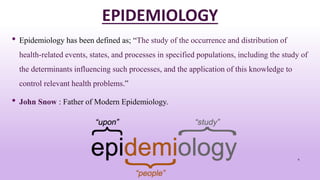
• Epidemiology has been defined as; “The study of the occurrence and distribution of
health-related events, states, and processes in specified populations, including the study of
the determinants influencing such processes, and the application of this knowledge to
control relevant health problems.”
• John Snow : Father of Modern Epidemiology.
4
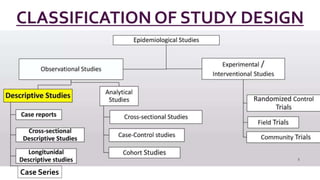
CLASSIFICATION OF STUDY DESIGN
5
Case Series
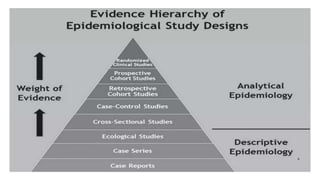
6
DESCRIPTIVE EPIDEMIOLOGY
• Descriptive studies describes the patterns of disease occurrence and distribution of
disease in relation to variables such as place, person, and time.
• First phase of epidemiological investigation.
• Concerned with observing the distribution of disease or health related characteristics
in human populations and identifying the characteristics with which the disease in
question seems to be associated.
7
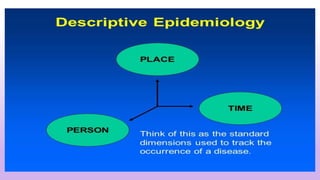
Descriptive Epidemiology
• When is the disease occurring? – Time distribution
• Where is it occurring? - Place distribution
• Who is getting the disease? – Person distribution
8
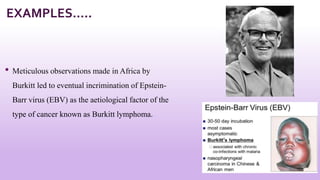
• Meticulous observations made in Africa by
Burkitt led to eventual incrimination of Epstein-
Barr virus (EBV) as the aetiological factor of the
type of cancer known as Burkitt lymphoma.
9
EXAMPLES…..
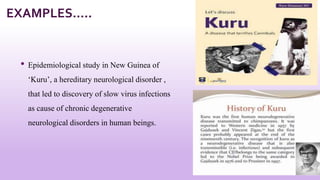
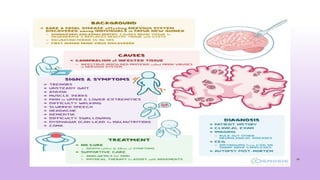
• Epidemiological study in New Guinea of
‘Kuru’, a hereditary neurological disorder ,
that led to discovery of slow virus infections
as cause of chronic degenerative
neurological disorders in human beings.
10
EXAMPLES…..
11
In Descriptive Epidemiology: Hypothesis are generated and basic control measures
are initiated.
In Analytical Epidemiology: The hypothesis that were generated are tested,
underlying causes are established and scientifically sound health programs and
intervention measures are suggested.
12
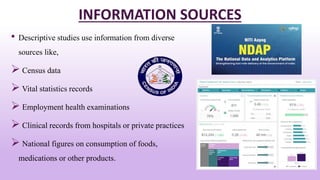
INFORMATION SOURCES
• Descriptive studies use information from diverse
sources like,
 Census data
 Vital statistics records
 Employment health examinations
 Clinical records from hospitals or private practices
 National figures on consumption of foods,
medications or other products. 13
TYPES OF DESCRIPTIVE STUDIES
I) CASE REPORTS AND CASE SERIES
• This type of study is based on reports of a single, or else a
series of cases of specific treated or untreated condition
without any specific comparison (control) group.
• Apart from describing symptoms in series of patients, we
may also work out “proportions”
14
EXAMPLE….
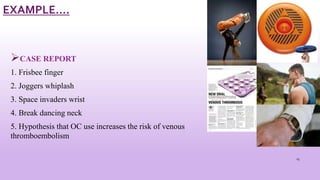
CASE REPORT
1. Frisbee finger
2. Joggers whiplash
3. Space invaders wrist
4. Break dancing neck
5. Hypothesis that OC use increases the risk of venous
thromboembolism
15
CASE SERIES
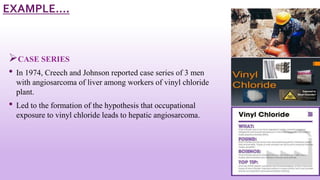
• In 1974, Creech and Johnson reported case series of 3 men
with angiosarcoma of liver among workers of vinyl chloride
plant.
• Led to the formation of the hypothesis that occupational
exposure to vinyl chloride leads to hepatic angiosarcoma.
16
EXAMPLE….
LIMITATIONS OF CASE REPORT & CASE SERIES
• They cannot be used to test for a valid statistical association.
• Case report is based on the experience of only one person.
• The interpretability of information is severely limited due to lack of appropriate
comparison group.
17
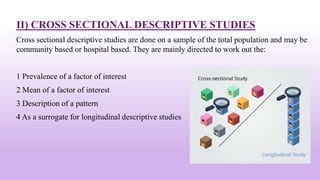
II) CROSS SECTIONAL DESCRIPTIVE STUDIES
Cross sectional descriptive studies are done on a sample of the total population and may be
community based or hospital based. They are mainly directed to work out the:
1 Prevalence of a factor of interest
2 Mean of a factor of interest
3 Description of a pattern
4 As a surrogate for longitudinal descriptive studies
18
III) LONGITUDINAL DESCRIPTIVE STUDIES
• More scientific than cross sectional ones but at the same time more costly and time consuming.
• In contrast to a cross sectional descriptive study, a longitudinal descriptive study follows up a
single group of subjects over a defined period of time.
• A Cross sectional study gives us the prevalence while a longitudinal study gives us the incidence
• General objectives of longitudinal descriptive study
To see the incidence of a disease
To describe the natural history of a disease
19
To describe a health related natural phenomena
To study the trend of a disease
To study the trend of a health- related phenomena.
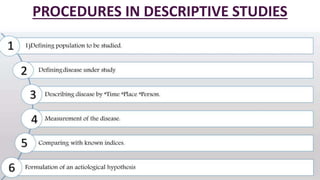
PROCEDURES IN DESCRIPTIVE STUDIES
20
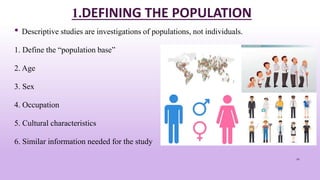
1.DEFINING THE POPULATION
• Descriptive studies are investigations of populations, not individuals.
1. Define the “population base”
2. Age
3. Sex
4. Occupation
5. Cultural characteristics
6. Similar information needed for the study
21
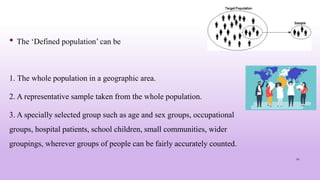
• The ‘Defined population’ can be
1. The whole population in a geographic area.
2. A representative sample taken from the whole population.
3. A specially selected group such as age and sex groups, occupational
groups, hospital patients, school children, small communities, wider
groupings, wherever groups of people can be fairly accurately counted.
22
2. DEFINING THE DISEASE UNDER STUDY
• The epidemiologist needs an “operational definition”, by which the condition can be
identified and measured in the defined population with good degree of accuracy.
• Example: Tonsillitis - defined clinically as an inflammation of the tonsils caused by
infection, usually with streptococcus pyogenes.
• Whereas an "operational definition" would include the presence of enlarged, red tonsils
with white exudate, which on throat swab culture grow predominantly S. pyogenes.
23
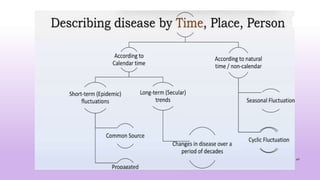
3. DESCRIBING DISEASE BY TIME, PLACE, PERSON
• Many diseases have typical spatial relationships. Geographic pathology is an important
dimension of descriptive epidemiology.
• Differences in the distribution of disease according to place may be made according to
political boundaries or according to natural boundaries.
oInternational – National variations.
oRural – Urban variations.
oLocal distributions.
24
 Describing disease by place:
oMigration studies.
These can be carried out in two ways,
a) Comparison of disease and death rates for migrants with those of their kin who have stayed at
home.
b) Comparison of migrants with local population of the host country.
25
 Defining the disease by person
Person related variables:
• Age
• Sex
• Ethnicity
• Social class
26
• Behaviour
• Occupation
• Marital status
• Stress
• Migration
 Defining the disease by time
• The pattern of disease may be described by the time of its occurrence i.e., by week,
month, year, day, hour etc.
• Epidemiologists have identified three kinds of time trends or fluctuations in disease
occurrence:
A) Short-term fluctuation
B) Periodic fluctuation
C) Long-term or secular trends
27
A) SHORTTERM FLUCTUATION
An epidemic is the best example of short term fluctuation.
An epidemic : “Unusual increase in the number of cases of an illness or other health
related events in a defined geographic area and defined time period.”
The type of curve can give an idea about the type of epidemic.
28
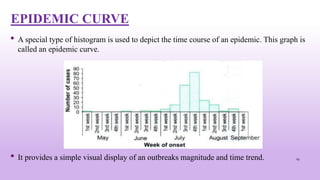
EPIDEMIC CURVE
• A special type of histogram is used to depict the time course of an epidemic. This graph is
called an epidemic curve.
• It provides a simple visual display of an outbreaks magnitude and time trend. 29
Epidemic curve provides idea about :
1. The magnitude of epidemic over time as a simple, easily understood visual.
2. The pattern of spread in the population (through the shape of the curve).
3. The course of epidemic (still on rise, on the down slope, or after the epidemic has ended)
4. Are the intervention measures working?
5. If the disease and its incubation period are known, the epidemic curve can be used to
derive a probable time of exposure and that can be used to develop a questionnaire focused
on that time period.
30
Three major types of epidemics may be distinguished
 Common source epidemics
a) Single exposure or
“point source” epidemics
b) Continuous or multiple
exposure epidemics
31
 Propagated epidemics
a) Person to person
b) Arthropod vector
c) Animal reservoir
 Slow (modern) epidemics
1. COMMON SOURCE (VEHICLE) EPIDEMICS
32
SINGLE/POINT EXPOSURE:
• Infectious agent present for short period of time, during this period all those who come
in contact are exposed to infection.
• Example:
o Leukemia; Hiroshima, following atomic bomb blast
o Food poisoning : In people who ate at a common point.
33
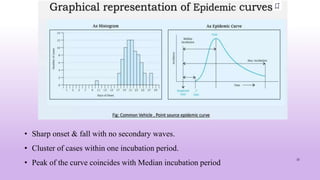
• Sharp onset & fall with no secondary waves.
• Cluster of cases within one incubation period.
• Peak of the curve coincides with Median incubation period
34
CONTINOUS/MULTIPLE EXPOSURE:
• Infectious agent remains in common vehicle for some time.
• Decline of the epidemic occurs either because the cause of contamination is removed
or because of the reason that all “susceptibles” are infected.
• Example:
o Infectious hepatitis/Cholera – due to contaminated water.
oTyphoid fever
35
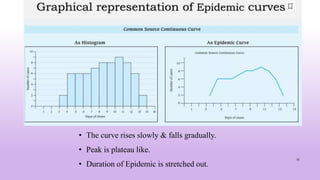
• The curve rises slowly & falls gradually.
• Peak is plateau like.
• Duration of Epidemic is stretched out.
36
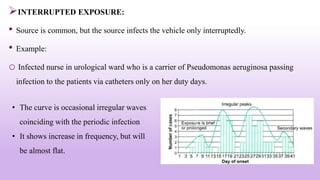
INTERRUPTED EXPOSURE:
• Source is common, but the source infects the vehicle only interruptedly.
• Example:
o Infected nurse in urological ward who is a carrier of Pseudomonas aeruginosa passing
infection to the patients via catheters only on her duty days.
• The curve is occasional irregular waves
coinciding with the periodic infection
• It shows increase in frequency, but will
be almost flat.
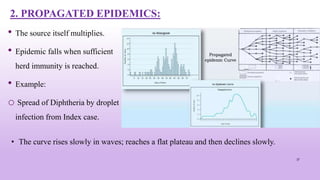
2. PROPAGATED EPIDEMICS:
37
• The source itself multiplies.
• Epidemic falls when sufficient
herd immunity is reached.
• Example:
o Spread of Diphtheria by droplet
infection from Index case.
• The curve rises slowly in waves; reaches a flat plateau and then declines slowly.
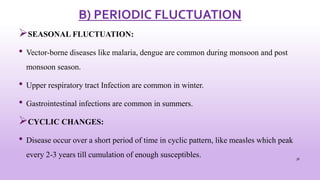
B) PERIODIC FLUCTUATION
SEASONAL FLUCTUATION:
• Vector-borne diseases like malaria, dengue are common during monsoon and post
monsoon season.
• Upper respiratory tract Infection are common in winter.
• Gastrointestinal infections are common in summers.
CYCLIC CHANGES:
• Disease occur over a short period of time in cyclic pattern, like measles which peak
every 2-3 years till cumulation of enough susceptibles. 38
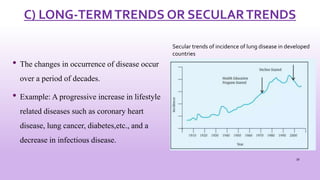
C) LONG-TERMTRENDS OR SECULARTRENDS
• The changes in occurrence of disease occur
over a period of decades.
• Example: A progressive increase in lifestyle
related diseases such as coronary heart
disease, lung cancer, diabetes,etc., and a
decrease in infectious disease.
39
Secular trends of incidence of lung disease in developed
countries
40
4. MEASUREMENT OF DISEASE
• Mandatory to have a clear picture of the amount of disease in the population(Disease load)
• Information should be available in terms of mortality, morbidity, disability.
• Morbidity has two aspects – Incidence and Prevalence.
• Incidence can be obtained from longitudinal studies.
• Prevalence can be obtained from cross sectional studies
41
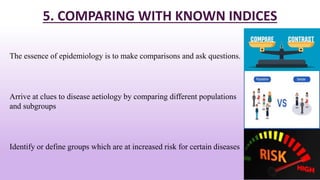
5. COMPARING WITH KNOWN INDICES
The essence of epidemiology is to make comparisons and ask questions.
Arrive at clues to disease aetiology by comparing different populations
and subgroups
Identify or define groups which are at increased risk for certain diseases
42
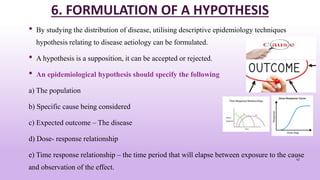
6. FORMULATION OF A HYPOTHESIS
• By studying the distribution of disease, utilising descriptive epidemiology techniques
hypothesis relating to disease aetiology can be formulated.
• A hypothesis is a supposition, it can be accepted or rejected.
• An epidemiological hypothesis should specify the following
a) The population
b) Specific cause being considered
c) Expected outcome – The disease
d) Dose- response relationship
e) Time response relationship – the time period that will elapse between exposure to the cause
and observation of the effect.
43
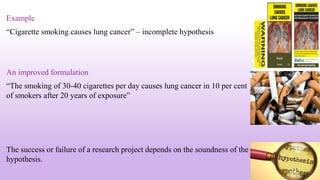
Example
“Cigarette smoking causes lung cancer” – incomplete hypothesis
An improved formulation
“The smoking of 30-40 cigarettes per day causes lung cancer in 10 per cent
of smokers after 20 years of exposure”
The success or failure of a research project depends on the soundness of the
hypothesis. 44
USES OF DESCRIPTIVE EPIDEMIOLOGY
• Provide data regarding the magnitude of the disease load and types of disease problems in
the community in terms of morbidity and mortality rates and ratios.
• Provide clues to disease aetiology, and help in the formulation of an aetiological hypothesis.
• Provide background data for planning, organising and evaluating preventive and curative
services.
• They contribute to research by describing variations in disease occurrence by time, place,
person. 45
LIMITATIONS OF DESCRIPTIVE EPIDEMIOLOGY
• Since there is no information of the population at risk, nor a comparison group, neither
can risk be calculated nor can a hypothesis be tested.
• Ecological fallacy.
46
REFERENCES
• 1. Park K. Park’s textbook of Preventive and Social Medicine. 27th ed.
Jabalpur: M/S Banarsidas Bhanot; 2023.
• 2. KADRI A. IAPSMS Textbook of Community Medicine. 2nd ed. S.l.:
JAYPEE BROTHERS MEDICAL P; 2024.
• 3. Balwar R. Textbook of Community Medicine. 5th ed. Wolters Kluwer;
2023.
• 4. Suryakantha A. Textbook of Community Medicine. 7th ed. New Delhi:
Jaypee Brothers; 2023.
47
THANK YOU!
48

DESCRIPTIVE EPIDEMIOLOGY - Dr SHAMIN EABENSON

  • 1.
  • 2.
    CONTENTS • Introduction • Epidemiologydefinition • Classification of study design • Descriptive epidemiology • Types of Descriptive epidemiology • Procedures of Descriptive studies • Uses of Descriptive epidemiology • Limitations of Descriptive epidemiology • References 2
  • 3.
    INTRODUCTION • Epidemiology isthe foundation of public health. • It was first expressed by Hippocrates and others, that environment causes and influences the existences of disease. • Epidemiology started as “ a branch of medical science that treats epidemics.” • Concept of epidemiology is currently used to examine the role of biomarkers at molecular level and genetic variation as determinants of health and diseases i.e., now epidemiology is not concerned about disease only, but any health related states and events like risk-factors, risk-behaviours etc. 3
  • 4.
    EPIDEMIOLOGY • Epidemiology hasbeen defined as; “The study of the occurrence and distribution of health-related events, states, and processes in specified populations, including the study of the determinants influencing such processes, and the application of this knowledge to control relevant health problems.” • John Snow : Father of Modern Epidemiology. 4
  • 5.
    CLASSIFICATION OF STUDYDESIGN 5 Case Series
  • 6.
  • 7.
    DESCRIPTIVE EPIDEMIOLOGY • Descriptivestudies describes the patterns of disease occurrence and distribution of disease in relation to variables such as place, person, and time. • First phase of epidemiological investigation. • Concerned with observing the distribution of disease or health related characteristics in human populations and identifying the characteristics with which the disease in question seems to be associated. 7
  • 8.
    Descriptive Epidemiology • Whenis the disease occurring? – Time distribution • Where is it occurring? - Place distribution • Who is getting the disease? – Person distribution 8
  • 9.
    • Meticulous observationsmade in Africa by Burkitt led to eventual incrimination of Epstein- Barr virus (EBV) as the aetiological factor of the type of cancer known as Burkitt lymphoma. 9 EXAMPLES…..
  • 10.
    • Epidemiological studyin New Guinea of ‘Kuru’, a hereditary neurological disorder , that led to discovery of slow virus infections as cause of chronic degenerative neurological disorders in human beings. 10 EXAMPLES…..
  • 11.
  • 12.
    In Descriptive Epidemiology:Hypothesis are generated and basic control measures are initiated. In Analytical Epidemiology: The hypothesis that were generated are tested, underlying causes are established and scientifically sound health programs and intervention measures are suggested. 12
  • 13.
    INFORMATION SOURCES • Descriptivestudies use information from diverse sources like,  Census data  Vital statistics records  Employment health examinations  Clinical records from hospitals or private practices  National figures on consumption of foods, medications or other products. 13
  • 14.
    TYPES OF DESCRIPTIVESTUDIES I) CASE REPORTS AND CASE SERIES • This type of study is based on reports of a single, or else a series of cases of specific treated or untreated condition without any specific comparison (control) group. • Apart from describing symptoms in series of patients, we may also work out “proportions” 14
  • 15.
    EXAMPLE…. CASE REPORT 1. Frisbeefinger 2. Joggers whiplash 3. Space invaders wrist 4. Break dancing neck 5. Hypothesis that OC use increases the risk of venous thromboembolism 15
  • 16.
    CASE SERIES • In1974, Creech and Johnson reported case series of 3 men with angiosarcoma of liver among workers of vinyl chloride plant. • Led to the formation of the hypothesis that occupational exposure to vinyl chloride leads to hepatic angiosarcoma. 16 EXAMPLE….
  • 17.
    LIMITATIONS OF CASEREPORT & CASE SERIES • They cannot be used to test for a valid statistical association. • Case report is based on the experience of only one person. • The interpretability of information is severely limited due to lack of appropriate comparison group. 17
  • 18.
    II) CROSS SECTIONALDESCRIPTIVE STUDIES Cross sectional descriptive studies are done on a sample of the total population and may be community based or hospital based. They are mainly directed to work out the: 1 Prevalence of a factor of interest 2 Mean of a factor of interest 3 Description of a pattern 4 As a surrogate for longitudinal descriptive studies 18
  • 19.
    III) LONGITUDINAL DESCRIPTIVESTUDIES • More scientific than cross sectional ones but at the same time more costly and time consuming. • In contrast to a cross sectional descriptive study, a longitudinal descriptive study follows up a single group of subjects over a defined period of time. • A Cross sectional study gives us the prevalence while a longitudinal study gives us the incidence • General objectives of longitudinal descriptive study To see the incidence of a disease To describe the natural history of a disease 19 To describe a health related natural phenomena To study the trend of a disease To study the trend of a health- related phenomena.
  • 20.
  • 21.
    1.DEFINING THE POPULATION •Descriptive studies are investigations of populations, not individuals. 1. Define the “population base” 2. Age 3. Sex 4. Occupation 5. Cultural characteristics 6. Similar information needed for the study 21
  • 22.
    • The ‘Definedpopulation’ can be 1. The whole population in a geographic area. 2. A representative sample taken from the whole population. 3. A specially selected group such as age and sex groups, occupational groups, hospital patients, school children, small communities, wider groupings, wherever groups of people can be fairly accurately counted. 22
  • 23.
    2. DEFINING THEDISEASE UNDER STUDY • The epidemiologist needs an “operational definition”, by which the condition can be identified and measured in the defined population with good degree of accuracy. • Example: Tonsillitis - defined clinically as an inflammation of the tonsils caused by infection, usually with streptococcus pyogenes. • Whereas an "operational definition" would include the presence of enlarged, red tonsils with white exudate, which on throat swab culture grow predominantly S. pyogenes. 23
  • 24.
    3. DESCRIBING DISEASEBY TIME, PLACE, PERSON • Many diseases have typical spatial relationships. Geographic pathology is an important dimension of descriptive epidemiology. • Differences in the distribution of disease according to place may be made according to political boundaries or according to natural boundaries. oInternational – National variations. oRural – Urban variations. oLocal distributions. 24  Describing disease by place:
  • 25.
    oMigration studies. These canbe carried out in two ways, a) Comparison of disease and death rates for migrants with those of their kin who have stayed at home. b) Comparison of migrants with local population of the host country. 25
  • 26.
     Defining thedisease by person Person related variables: • Age • Sex • Ethnicity • Social class 26 • Behaviour • Occupation • Marital status • Stress • Migration
  • 27.
     Defining thedisease by time • The pattern of disease may be described by the time of its occurrence i.e., by week, month, year, day, hour etc. • Epidemiologists have identified three kinds of time trends or fluctuations in disease occurrence: A) Short-term fluctuation B) Periodic fluctuation C) Long-term or secular trends 27
  • 28.
    A) SHORTTERM FLUCTUATION Anepidemic is the best example of short term fluctuation. An epidemic : “Unusual increase in the number of cases of an illness or other health related events in a defined geographic area and defined time period.” The type of curve can give an idea about the type of epidemic. 28
  • 29.
    EPIDEMIC CURVE • Aspecial type of histogram is used to depict the time course of an epidemic. This graph is called an epidemic curve. • It provides a simple visual display of an outbreaks magnitude and time trend. 29
  • 30.
    Epidemic curve providesidea about : 1. The magnitude of epidemic over time as a simple, easily understood visual. 2. The pattern of spread in the population (through the shape of the curve). 3. The course of epidemic (still on rise, on the down slope, or after the epidemic has ended) 4. Are the intervention measures working? 5. If the disease and its incubation period are known, the epidemic curve can be used to derive a probable time of exposure and that can be used to develop a questionnaire focused on that time period. 30
  • 31.
    Three major typesof epidemics may be distinguished  Common source epidemics a) Single exposure or “point source” epidemics b) Continuous or multiple exposure epidemics 31  Propagated epidemics a) Person to person b) Arthropod vector c) Animal reservoir  Slow (modern) epidemics
  • 32.
    1. COMMON SOURCE(VEHICLE) EPIDEMICS 32 SINGLE/POINT EXPOSURE: • Infectious agent present for short period of time, during this period all those who come in contact are exposed to infection. • Example: o Leukemia; Hiroshima, following atomic bomb blast o Food poisoning : In people who ate at a common point.
  • 33.
    33 • Sharp onset& fall with no secondary waves. • Cluster of cases within one incubation period. • Peak of the curve coincides with Median incubation period
  • 34.
    34 CONTINOUS/MULTIPLE EXPOSURE: • Infectiousagent remains in common vehicle for some time. • Decline of the epidemic occurs either because the cause of contamination is removed or because of the reason that all “susceptibles” are infected. • Example: o Infectious hepatitis/Cholera – due to contaminated water. oTyphoid fever
  • 35.
    35 • The curverises slowly & falls gradually. • Peak is plateau like. • Duration of Epidemic is stretched out.
  • 36.
    36 INTERRUPTED EXPOSURE: • Sourceis common, but the source infects the vehicle only interruptedly. • Example: o Infected nurse in urological ward who is a carrier of Pseudomonas aeruginosa passing infection to the patients via catheters only on her duty days. • The curve is occasional irregular waves coinciding with the periodic infection • It shows increase in frequency, but will be almost flat.
  • 37.
    2. PROPAGATED EPIDEMICS: 37 •The source itself multiplies. • Epidemic falls when sufficient herd immunity is reached. • Example: o Spread of Diphtheria by droplet infection from Index case. • The curve rises slowly in waves; reaches a flat plateau and then declines slowly.
  • 38.
    B) PERIODIC FLUCTUATION SEASONALFLUCTUATION: • Vector-borne diseases like malaria, dengue are common during monsoon and post monsoon season. • Upper respiratory tract Infection are common in winter. • Gastrointestinal infections are common in summers. CYCLIC CHANGES: • Disease occur over a short period of time in cyclic pattern, like measles which peak every 2-3 years till cumulation of enough susceptibles. 38
  • 39.
    C) LONG-TERMTRENDS ORSECULARTRENDS • The changes in occurrence of disease occur over a period of decades. • Example: A progressive increase in lifestyle related diseases such as coronary heart disease, lung cancer, diabetes,etc., and a decrease in infectious disease. 39 Secular trends of incidence of lung disease in developed countries
  • 40.
  • 41.
    4. MEASUREMENT OFDISEASE • Mandatory to have a clear picture of the amount of disease in the population(Disease load) • Information should be available in terms of mortality, morbidity, disability. • Morbidity has two aspects – Incidence and Prevalence. • Incidence can be obtained from longitudinal studies. • Prevalence can be obtained from cross sectional studies 41
  • 42.
    5. COMPARING WITHKNOWN INDICES The essence of epidemiology is to make comparisons and ask questions. Arrive at clues to disease aetiology by comparing different populations and subgroups Identify or define groups which are at increased risk for certain diseases 42
  • 43.
    6. FORMULATION OFA HYPOTHESIS • By studying the distribution of disease, utilising descriptive epidemiology techniques hypothesis relating to disease aetiology can be formulated. • A hypothesis is a supposition, it can be accepted or rejected. • An epidemiological hypothesis should specify the following a) The population b) Specific cause being considered c) Expected outcome – The disease d) Dose- response relationship e) Time response relationship – the time period that will elapse between exposure to the cause and observation of the effect. 43
  • 44.
    Example “Cigarette smoking causeslung cancer” – incomplete hypothesis An improved formulation “The smoking of 30-40 cigarettes per day causes lung cancer in 10 per cent of smokers after 20 years of exposure” The success or failure of a research project depends on the soundness of the hypothesis. 44
  • 45.
    USES OF DESCRIPTIVEEPIDEMIOLOGY • Provide data regarding the magnitude of the disease load and types of disease problems in the community in terms of morbidity and mortality rates and ratios. • Provide clues to disease aetiology, and help in the formulation of an aetiological hypothesis. • Provide background data for planning, organising and evaluating preventive and curative services. • They contribute to research by describing variations in disease occurrence by time, place, person. 45
  • 46.
    LIMITATIONS OF DESCRIPTIVEEPIDEMIOLOGY • Since there is no information of the population at risk, nor a comparison group, neither can risk be calculated nor can a hypothesis be tested. • Ecological fallacy. 46
  • 47.
    REFERENCES • 1. ParkK. Park’s textbook of Preventive and Social Medicine. 27th ed. Jabalpur: M/S Banarsidas Bhanot; 2023. • 2. KADRI A. IAPSMS Textbook of Community Medicine. 2nd ed. S.l.: JAYPEE BROTHERS MEDICAL P; 2024. • 3. Balwar R. Textbook of Community Medicine. 5th ed. Wolters Kluwer; 2023. • 4. Suryakantha A. Textbook of Community Medicine. 7th ed. New Delhi: Jaypee Brothers; 2023. 47
  • 48.