17/10/2024 1
DESCRIPTIVE METHODS
IN EPIDEMIOLOGY
PRESENTER :DR.AKILA.G.V
GUIDE :DR.SUMAN.G
17/10/2024 2
CONTENTS
 Introduction
 History of epidemiology
 Definition of epidemiology
 Study designs in epidemiology
 Characteristics of descriptive study
 Descriptive triad pentad
17/10/2024 3
 Types of descriptive study
 Merits and demerits
 Uses
 Conclusion
 References
17/10/2024 4
INTRODUCTION
 A descriptive study is the simple description of the
health status of a community and is often the first step
in an epidemiological investigation.
 The first foray into a new disease or area of inquiry—
the first scientific “toe in the water”
 “Concerned with and designed only to describe the
existing distribution of variables, without regard to
causal or other hypotheses.”
17/10/2024 5
HISTORY OF EPIDEMIOLOLGY
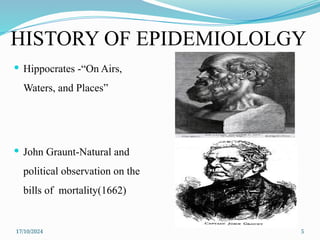
 Hippocrates -“On Airs,
Waters, and Places”
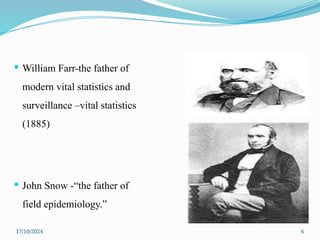
 John Graunt-Natural and
political observation on the
bills of mortality(1662)
17/10/2024 6
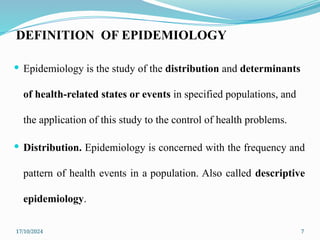
 William Farr-the father of
modern vital statistics and
surveillance –vital statistics
(1885)
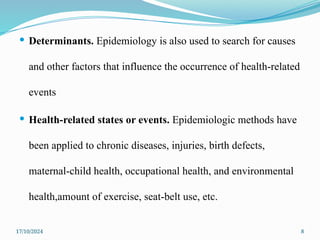
 John Snow -“the father of
field epidemiology.”
17/10/2024 7
DEFINITION OF EPIDEMIOLOGY
 Epidemiology is the study of the distribution and determinants
of health-related states or events in specified populations, and
the application of this study to the control of health problems.
 Distribution. Epidemiology is concerned with the frequency and
pattern of health events in a population. Also called descriptive
epidemiology.
17/10/2024 8
 Determinants. Epidemiology is also used to search for causes
and other factors that influence the occurrence of health-related
events
 Health-related states or events. Epidemiologic methods have
been applied to chronic diseases, injuries, birth defects,
maternal-child health, occupational health, and environmental
health,amount of exercise, seat-belt use, etc.
17/10/2024 9
STUDY DESIGNS IN EPIDEMIOLOGY
 Descriptive studies
Populations(correlation studies)
Individuals
Case reports
Case series
Cross sectional studies
 Analytical studies
Case contol studies
Cohort studies
 Interventional studies
17/10/2024 10
CHARACTERISTIC OF DESCRIPTIVE STUDY
A descriptive study can be defined as one in which only one
group, i.e. subjects having the outcome (disease or any other
health related phenomena of interest) are studied, without
any comparison group, for describing the outcome or health-
related phenomena according to its frequency or such other
summary figures (as mean), and its distribution according to
selected variables related to person, place and time.
17/10/2024 11
 They do not proceed to test a “pre - formed hypothesis”
 The study is done only on one group of subjects; there is
no comparison group.
 The main objective of a descriptive study is to “describe
”the “mean value” of a health related condition, or a
“proportion” or the natural history of disease or a health -
related phenomena
17/10/2024 12
 The study also intends to describe the “distribution”
according to variables related to “person” “Place” and
“time” .
 A descriptive study culminates by making suggestions /
hypotheses about certain “cause and effect” relationships
which can be further tested by analytical studies.
17/10/2024 13
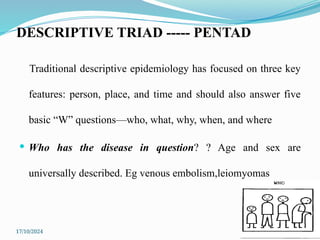
DESCRIPTIVE TRIAD ----- PENTAD
Traditional descriptive epidemiology has focused on three key
features: person, place, and time and should also answer five
basic “W” questions—who, what, why, when, and where
 Who has the disease in question? ? Age and sex are
universally described. Eg venous embolism,leiomyomas
17/10/2024 14
 What is the condition or disease being studied? Development of
a clear, specific, and measurable case definition is an essential
step in descriptive epidemiology. Generally, stringent criteria for
case definitions are desirable.
 Why did the condition or disease arise? Descriptive studies often
provide clues about cause that can be pursued with more
sophisticated research designs
17/10/2024 15
 When is the condition common or rare? Time provides
important clues about health events. E.g the outbreak of
gastroenteritis soon after ingestion of staphylococcal toxin
 Where does or does not the disease or condition arise?
Geography has had a huge effect on health. Living close to
rodents and insects (and thus their parasites.Latitude plays a
part in both multiple sclerosis and vitamin D deficiency.
17/10/2024 16
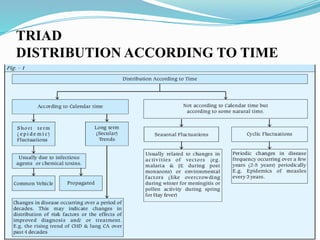
TRIAD
DISTRIBUTION ACCORDING TO TIME
17/10/2024 17
SHORT-TERM FLUCTUATIONS
 The best known short-term fluctuation in the occurrence of a
disease is an epidemic. According to modern
concepts ,epidemic is defined as "the occurrence in a
community or region of cases of an illness or other health-
related events clearly in excess of normal expectancy
 Common Vehicle Epidemics : A common vehicle epidemic
occurs due to presence of infectious or a chemical noxious
agent in a common vehicle which serves as the channel of
transmission,
17/10/2024 18
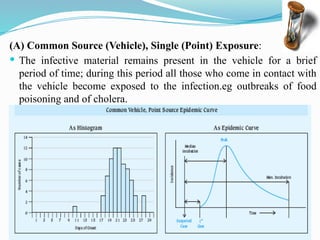
(A) Common Source (Vehicle), Single (Point) Exposure:
 The infective material remains present in the vehicle for a brief
period of time; during this period all those who come in contact with
the vehicle become exposed to the infection.eg outbreaks of food
poisoning and of cholera.
17/10/2024 19
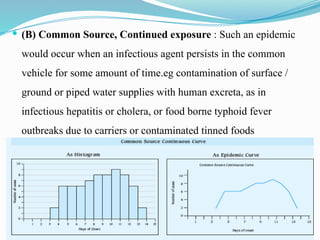
 (B) Common Source, Continued exposure : Such an epidemic
would occur when an infectious agent persists in the common
vehicle for some amount of time.eg contamination of surface /
ground or piped water supplies with human excreta, as in
infectious hepatitis or cholera, or food borne typhoid fever
outbreaks due to carriers or contaminated tinned foods
17/10/2024 20
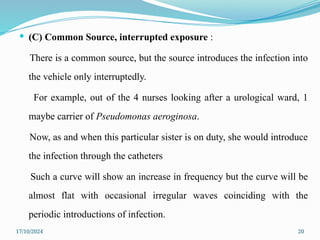
 (C) Common Source, interrupted exposure :
There is a common source, but the source introduces the infection into
the vehicle only interruptedly.
For example, out of the 4 nurses looking after a urological ward, 1
maybe carrier of Pseudomonas aeroginosa.
Now, as and when this particular sister is on duty, she would introduce
the infection through the catheters
Such a curve will show an increase in frequency but the curve will be
almost flat with occasional irregular waves coinciding with the
periodic introductions of infection.
17/10/2024 21
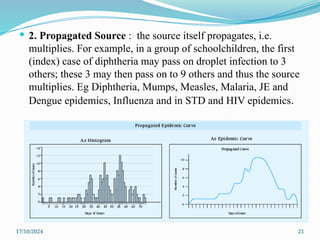
 2. Propagated Source : the source itself propagates, i.e.
multiplies. For example, in a group of schoolchildren, the first
(index) case of diphtheria may pass on droplet infection to 3
others; these 3 may then pass on to 9 others and thus the source
multiplies. Eg Diphtheria, Mumps, Measles, Malaria, JE and
Dengue epidemics, Influenza and in STD and HIV epidemics.
17/10/2024 22
 Seasonal fluctuations : Malaria and JE are commoner during
immediate post monsoon season due to increased breeding of vectors.
Similarly, asthma shows highest incidence during spring and autumn
suggesting specific environmental factors in its causation,eg Maxcy s
findings
 Cyclical Changes : These are periodic peaks in disease frequencies
occurring every 3 - 5 years. The common example is of measles in
which epidemics tend to occur in cycles of 2 – 3 years, possibly due to
accumulation of enough susceptibles.
17/10/2024 23
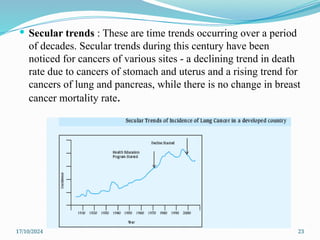
 Secular trends : These are time trends occurring over a period
of decades. Secular trends during this century have been
noticed for cancers of various sites - a declining trend in death
rate due to cancers of stomach and uterus and a rising trend for
cancers of lung and pancreas, while there is no change in breast
cancer mortality rate.
17/10/2024 24
DISTRIBUTION ACCORDING TO PLACE
 Studies of the geography of disease (or geographical
pathology) is one of the important dimensions of descriptive
epidemiology.
These variations may be classified as :
 a. International variations
 b. National variations
 c. Rural - urban differences
 d. Local distributions
17/10/2024 25
INTERNATIONAL VARIATIONS
Japan has very low CHD mortality rates but high rates for
cerebro - vascular accidents, Hypertension and gastric CA; UK
has high lung CA rates while USA has high CHD rates.
17/10/2024 26
National, Regional or International differences in the
availability of medical services, diagnostic practices
of physicians, quality of available diagnostics,
differences in disease classification procedures,
completeness of reporting of death & disease and
completeness of census may all introduce artifactual
differences,can be assessed by migrant studies
17/10/2024 27
 NATIONAL VARIATIONS
Variations in the disease occurs within countries or national
boundaries.
Death statistics and notification of infectious disease are
major sources of data for comparison within countries.
17/10/2024 28
 RURAL – URBAN VARIATION
These variations may be due to differences in population
density, social class,deficiences in medical care,levels of
sanitation,education, environmental factors.
Chronic bronchitis, accidents, lung cancer, cardio-vascular
diseases, mental illness and drug dependence are more frequent
in urban than in rural areas.
On the hand, skin and zoonotic diseases and soil-transmitted
helminths may be more frequent in rural areas than in urban.
17/10/2024 29
LOCAL VARIATION
 This is the differences in disease occurrence according to
place within small, defined localities.
 For examining such differences, the epidemiologist makes a
“spot map” which is a detailed layout map of that area or
locality
 1. The inhabitants of that place, by virtue of their
genetic factors or socio economic factors, are different
from those at other places.
17/10/2024 30
 2. Some etiologic factors, characteristic in the place are present. If this
is the reason, then :
(i) High rates of disease will be observed in all ethnic groups in that
area.
(ii) High rates are not observed in persons of similar ethnic groups
living in other areas.
(iii) Healthy persons entering that area become ill with a frequency
similar to the indigenous inhabitants.
(iv) Inhabitants who have left that area do not show high rates.
(v) Some evidence of the disease may also be found in animals in the
same area.
17/10/2024 31
MIGRANT STUDIES
 Let us say a group of people ‘M’, have immigrated from the original
country ‘X’ to a new country ‘Y’.
 Let us say, the mortality (or morbidity) rates due to a given disease of
interest ‘A’ are as follows :Rates in original country = ‘X’; Rates in new
country = ‘Y’;Rates among the migrants = ‘M’.
 Now, if the differences in a disease are due to environmental factors, then
‘M’ would approximate ‘Y’ but ‘M’ would tend to be different than ‘X’.
 On the other hand, if the disease is determined by genetic factors, ‘X’ and
‘M’ will be equal, and ‘X’ and ‘M’ will be different from ‘Y’.
17/10/2024 32
DISTRIBUTION ACCORDING TO PERSON
AGE
 Age is a person related variable that is almost universally
studied.
 “Bimodality”,i.e. two peaks in the age distribution of
morbidity or death due to a particular disease
 Certain diseases are more frequent in certain age groups
than in others, e.g., measles in childhood, cancer in middle
age and atherosclerosis in old age.
17/10/2024 33
Sex
 The sex related differences may be due to hormonal or other
biological differences or due to differences in attitude towards
life.
 Sex linked genetic inheritance, and (b) cultural and behavioural
ETHNIC GROUP
 Ethnic group is defined as a group of persons who have a
greater degree of homogeneity than the population at large in
respect of biologic inheritance and present day customs.
 ● Race.
 ● Nativity
 ● Religion
 ● Local reproductive and social units
17/10/2024 34
SOCIAL STATUS
 Social status may be an independent risk factor for the disease
or it may be indirectly associated with the disease in question
OCCUPATION
 The stress of occupation and exposure to various physical,
chemical and biological disease agents therein, may be
associated with high occurrence of such diseases.. In case of
studies on children occupation, education and income of the
father and mother .
17/10/2024 35
EDUCATION
 Education leads to an improved level of knowledge and hence
is likely to be associated with reduced risk of disease.
MARITAL STATUS
 In general, mortality rates are lowest among married, followed
by single, widowed, and divorced, in that order, irrespective of
sex.
 Marital status is also a risk factor for some disease and
condition.eg cancer cervix is rare in nuns.
17/10/2024 36
TWIN STUDIES
 Concordance of a disease in monozygotic twins as compared to
dizygotic is a strong indication of genetic background and
discordance point towards environmental factors
BEHAVIOUR
 The behaviourial factors which have attracted the greatest
attention smoking. sedentary life, over-eating and drug
STRESS
 Stress has been shown to affect a variety of variables related to
patients response,
17/10/2024 37
TYPES OF DESCRIPTIVE STUDY
CASE REPORT
 The case report is the least publishable unit in the medical
literature.
 Observant clinician reports an unusual disease or association,
which prompts further investigations with more rigorous study
designs .
 For example, a clinician reported benign hepatocellular
adenomas, a rare tumour, in women who had taken oral
contraceptives.
17/10/2024 38
Case-series report
 A case-series aggregates individual cases in one report.
 For example, a cluster of homosexual men in Los Angeles
with a similar clinical syndrome alerted the medical
community to the AIDS epidemic in North America.
 A convenient feature of case-series reports is that they can
constitute the case group for a case-control study, which can
then explore hunches about causes of disease.
17/10/2024 39
CROSS SECTIONAL STUDIES
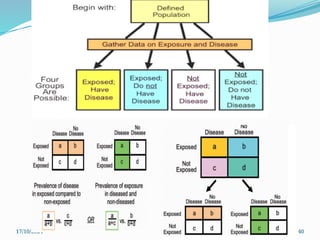
 Snapshot of the population at a certain point in time.
 The design is also called a prevalence study.
 We define a population and determine the presence or
absence of exposure and the presence or absence of
disease for each individual. Each subject then can be
categorized into one of four possible subgroups.
17/10/2024 40
17/10/2024 41
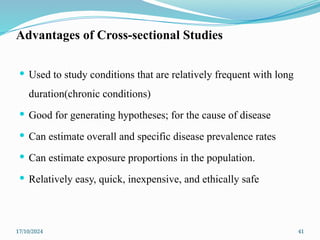
Advantages of Cross-sectional Studies
 Used to study conditions that are relatively frequent with long
duration(chronic conditions)
 Good for generating hypotheses; for the cause of disease
 Can estimate overall and specific disease prevalence rates
 Can estimate exposure proportions in the population.
 Relatively easy, quick, inexpensive, and ethically safe
17/10/2024 42
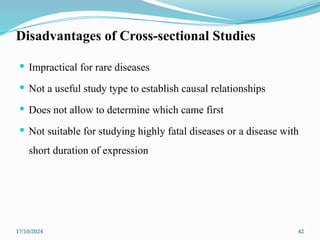
Disadvantages of Cross-sectional Studies
 Impractical for rare diseases
 Not a useful study type to establish causal relationships
 Does not allow to determine which came first
 Not suitable for studying highly fatal diseases or a disease with
short duration of expression
17/10/2024 43
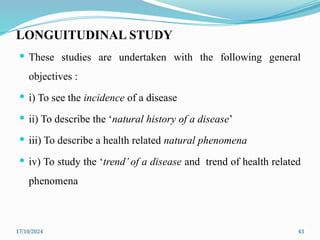
LONGUITUDINAL STUDY
 These studies are undertaken with the following general
objectives :
 i) To see the incidence of a disease
 ii) To describe the ‘natural history of a disease’
 iii) To describe a health related natural phenomena
 iv) To study the ‘trend’ of a disease and trend of health related
phenomena
17/10/2024 44
ECOLOGICAL STUDIES
Correlational studies look for associations between
exposures and outcomes in populations rather than in
individuals.
Limitations—ie, the inability to link exposure to outcome
in individuals and to control for confounding (a mixing or
blurring of effects).
17/10/2024 45
 Ecological fallacy can be defined as the state when an
association which has been seen among variables, on an
aggregate level may not necessarily represent an association at
the individual.
 Ecological studies can be of two types, viz., cross – sectional
and longitudinal
17/10/2024 46
MERITS AND DEMERITS
 The data are already available and thus inexpensive and
efficient to use
 Only few ethical difficulties exist.
 Forwards tentative guesses (hypothesis) about the possible
causal role of certain factors in the outcome of the interest,
 Study also intends to describe the “distribution” of such
means, proportions or natural progress of health – related
phenomena
17/10/2024 47
 Descriptive studies have important limitations.
 Temporal associations between putative causes and effects
might be unclear.
 A dangerous pitfall is that the investigators might draw causal
inferences when none is possible
 The study is done only on one group of subjects; there is no
comparison group
 Incidence and risk cannot be calculated
17/10/2024 48
USES
 Trend analysis
 Provides background data for planning ,organizing and evaluating
preventive and curative services
 Provide data regarding magnitude of the disease load and types of disease
problems in the community in terms of morbidity and mortality ,rates ratios
 Provide clues to disease aetiology, and help in formulation of an
aetiological hypothesis
 They contribute to research by describing variation in disease occurrence by
time, place and person
17/10/2024 49
CONCLUSION
 Descriptive studies are often the first, tentative approach to a new
event or condition.
 These studies generally emphasise features of a new disease or
assess the health status of communities.
 Health administrators use descriptive studies to monitor trends
and plan for resources.
 By contrast, epidemiologists and clinicians generally use
descriptive reports to search for clues of cause of disease—i.e.,
generation of hypotheses.
17/10/2024 50
REFERENCES AND BIBLIOGRAPHY
1. Bhalwar R.Textbook of Public Health and Community Medicine.1st
ed. Depatment of communitymedicine:Pune;2009.
2. Leavell H R,Clark E G.Preventive medicine for the doctor in his
community.2nd ed.McGraw – hill book company inc: New
York;1958.
3. Self study course 3030-G.Principles of Epidemiology.2nd
ed.US
department of health and human services:Atlanta,Georgia;1982.
4. Vaughan JP,Morrow RH.Manual of Epidemiology for district
health management.WHO:Geneva:1989.
17/10/2024 51
5. Maxcy,Rosenau,Last.Public Health and Preventive
Medicine.15th
ed. Mc-Graw-Hill companies:New Delhi;2007.
6. Park K.Textbook of Preventive and Social Medicine. 21th
ed.
Bhanarasidas Bhanot : Jabalpur (India); 2011.
7. Bomita R,Beaglehole R,Kjellstrom T.Basic epidemiology.2nd
ed.WHO:Geneva;2006.
8. Grimes DA,Schutz KF.Descriptive studies:what they can do
and cannot do.THE LANCET 2002 jan 12;359:145-49.
17/10/2024 52
9. Silman AJ,Macfarlane GJ.Epidemiology studies-a
practical guide.2nd
ed.Cambridge university
press:Cambridge;2002.
10. MacMohan B,Pugh TF.Epidemiology-principles and
methods.Little brown and company:Borton USA;1970
17/10/2024 53
THANK YOU

Descriptive Methods in Epidemiology.pptx

  • 1.
    17/10/2024 1 DESCRIPTIVE METHODS INEPIDEMIOLOGY PRESENTER :DR.AKILA.G.V GUIDE :DR.SUMAN.G
  • 2.
    17/10/2024 2 CONTENTS  Introduction History of epidemiology  Definition of epidemiology  Study designs in epidemiology  Characteristics of descriptive study  Descriptive triad pentad
  • 3.
    17/10/2024 3  Typesof descriptive study  Merits and demerits  Uses  Conclusion  References
  • 4.
    17/10/2024 4 INTRODUCTION  Adescriptive study is the simple description of the health status of a community and is often the first step in an epidemiological investigation.  The first foray into a new disease or area of inquiry— the first scientific “toe in the water”  “Concerned with and designed only to describe the existing distribution of variables, without regard to causal or other hypotheses.”
  • 5.
    17/10/2024 5 HISTORY OFEPIDEMIOLOLGY  Hippocrates -“On Airs, Waters, and Places”  John Graunt-Natural and political observation on the bills of mortality(1662)
  • 6.
    17/10/2024 6  WilliamFarr-the father of modern vital statistics and surveillance –vital statistics (1885)  John Snow -“the father of field epidemiology.”
  • 7.
    17/10/2024 7 DEFINITION OFEPIDEMIOLOGY  Epidemiology is the study of the distribution and determinants of health-related states or events in specified populations, and the application of this study to the control of health problems.  Distribution. Epidemiology is concerned with the frequency and pattern of health events in a population. Also called descriptive epidemiology.
  • 8.
    17/10/2024 8  Determinants.Epidemiology is also used to search for causes and other factors that influence the occurrence of health-related events  Health-related states or events. Epidemiologic methods have been applied to chronic diseases, injuries, birth defects, maternal-child health, occupational health, and environmental health,amount of exercise, seat-belt use, etc.
  • 9.
    17/10/2024 9 STUDY DESIGNSIN EPIDEMIOLOGY  Descriptive studies Populations(correlation studies) Individuals Case reports Case series Cross sectional studies  Analytical studies Case contol studies Cohort studies  Interventional studies
  • 10.
    17/10/2024 10 CHARACTERISTIC OFDESCRIPTIVE STUDY A descriptive study can be defined as one in which only one group, i.e. subjects having the outcome (disease or any other health related phenomena of interest) are studied, without any comparison group, for describing the outcome or health- related phenomena according to its frequency or such other summary figures (as mean), and its distribution according to selected variables related to person, place and time.
  • 11.
    17/10/2024 11  Theydo not proceed to test a “pre - formed hypothesis”  The study is done only on one group of subjects; there is no comparison group.  The main objective of a descriptive study is to “describe ”the “mean value” of a health related condition, or a “proportion” or the natural history of disease or a health - related phenomena
  • 12.
    17/10/2024 12  Thestudy also intends to describe the “distribution” according to variables related to “person” “Place” and “time” .  A descriptive study culminates by making suggestions / hypotheses about certain “cause and effect” relationships which can be further tested by analytical studies.
  • 13.
    17/10/2024 13 DESCRIPTIVE TRIAD----- PENTAD Traditional descriptive epidemiology has focused on three key features: person, place, and time and should also answer five basic “W” questions—who, what, why, when, and where  Who has the disease in question? ? Age and sex are universally described. Eg venous embolism,leiomyomas
  • 14.
    17/10/2024 14  Whatis the condition or disease being studied? Development of a clear, specific, and measurable case definition is an essential step in descriptive epidemiology. Generally, stringent criteria for case definitions are desirable.  Why did the condition or disease arise? Descriptive studies often provide clues about cause that can be pursued with more sophisticated research designs
  • 15.
    17/10/2024 15  Whenis the condition common or rare? Time provides important clues about health events. E.g the outbreak of gastroenteritis soon after ingestion of staphylococcal toxin  Where does or does not the disease or condition arise? Geography has had a huge effect on health. Living close to rodents and insects (and thus their parasites.Latitude plays a part in both multiple sclerosis and vitamin D deficiency.
  • 16.
  • 17.
    17/10/2024 17 SHORT-TERM FLUCTUATIONS The best known short-term fluctuation in the occurrence of a disease is an epidemic. According to modern concepts ,epidemic is defined as "the occurrence in a community or region of cases of an illness or other health- related events clearly in excess of normal expectancy  Common Vehicle Epidemics : A common vehicle epidemic occurs due to presence of infectious or a chemical noxious agent in a common vehicle which serves as the channel of transmission,
  • 18.
    17/10/2024 18 (A) CommonSource (Vehicle), Single (Point) Exposure:  The infective material remains present in the vehicle for a brief period of time; during this period all those who come in contact with the vehicle become exposed to the infection.eg outbreaks of food poisoning and of cholera.
  • 19.
    17/10/2024 19  (B)Common Source, Continued exposure : Such an epidemic would occur when an infectious agent persists in the common vehicle for some amount of time.eg contamination of surface / ground or piped water supplies with human excreta, as in infectious hepatitis or cholera, or food borne typhoid fever outbreaks due to carriers or contaminated tinned foods
  • 20.
    17/10/2024 20  (C)Common Source, interrupted exposure : There is a common source, but the source introduces the infection into the vehicle only interruptedly. For example, out of the 4 nurses looking after a urological ward, 1 maybe carrier of Pseudomonas aeroginosa. Now, as and when this particular sister is on duty, she would introduce the infection through the catheters Such a curve will show an increase in frequency but the curve will be almost flat with occasional irregular waves coinciding with the periodic introductions of infection.
  • 21.
    17/10/2024 21  2.Propagated Source : the source itself propagates, i.e. multiplies. For example, in a group of schoolchildren, the first (index) case of diphtheria may pass on droplet infection to 3 others; these 3 may then pass on to 9 others and thus the source multiplies. Eg Diphtheria, Mumps, Measles, Malaria, JE and Dengue epidemics, Influenza and in STD and HIV epidemics.
  • 22.
    17/10/2024 22  Seasonalfluctuations : Malaria and JE are commoner during immediate post monsoon season due to increased breeding of vectors. Similarly, asthma shows highest incidence during spring and autumn suggesting specific environmental factors in its causation,eg Maxcy s findings  Cyclical Changes : These are periodic peaks in disease frequencies occurring every 3 - 5 years. The common example is of measles in which epidemics tend to occur in cycles of 2 – 3 years, possibly due to accumulation of enough susceptibles.
  • 23.
    17/10/2024 23  Seculartrends : These are time trends occurring over a period of decades. Secular trends during this century have been noticed for cancers of various sites - a declining trend in death rate due to cancers of stomach and uterus and a rising trend for cancers of lung and pancreas, while there is no change in breast cancer mortality rate.
  • 24.
    17/10/2024 24 DISTRIBUTION ACCORDINGTO PLACE  Studies of the geography of disease (or geographical pathology) is one of the important dimensions of descriptive epidemiology. These variations may be classified as :  a. International variations  b. National variations  c. Rural - urban differences  d. Local distributions
  • 25.
    17/10/2024 25 INTERNATIONAL VARIATIONS Japanhas very low CHD mortality rates but high rates for cerebro - vascular accidents, Hypertension and gastric CA; UK has high lung CA rates while USA has high CHD rates.
  • 26.
    17/10/2024 26 National, Regionalor International differences in the availability of medical services, diagnostic practices of physicians, quality of available diagnostics, differences in disease classification procedures, completeness of reporting of death & disease and completeness of census may all introduce artifactual differences,can be assessed by migrant studies
  • 27.
    17/10/2024 27  NATIONALVARIATIONS Variations in the disease occurs within countries or national boundaries. Death statistics and notification of infectious disease are major sources of data for comparison within countries.
  • 28.
    17/10/2024 28  RURAL– URBAN VARIATION These variations may be due to differences in population density, social class,deficiences in medical care,levels of sanitation,education, environmental factors. Chronic bronchitis, accidents, lung cancer, cardio-vascular diseases, mental illness and drug dependence are more frequent in urban than in rural areas. On the hand, skin and zoonotic diseases and soil-transmitted helminths may be more frequent in rural areas than in urban.
  • 29.
    17/10/2024 29 LOCAL VARIATION This is the differences in disease occurrence according to place within small, defined localities.  For examining such differences, the epidemiologist makes a “spot map” which is a detailed layout map of that area or locality  1. The inhabitants of that place, by virtue of their genetic factors or socio economic factors, are different from those at other places.
  • 30.
    17/10/2024 30  2.Some etiologic factors, characteristic in the place are present. If this is the reason, then : (i) High rates of disease will be observed in all ethnic groups in that area. (ii) High rates are not observed in persons of similar ethnic groups living in other areas. (iii) Healthy persons entering that area become ill with a frequency similar to the indigenous inhabitants. (iv) Inhabitants who have left that area do not show high rates. (v) Some evidence of the disease may also be found in animals in the same area.
  • 31.
    17/10/2024 31 MIGRANT STUDIES Let us say a group of people ‘M’, have immigrated from the original country ‘X’ to a new country ‘Y’.  Let us say, the mortality (or morbidity) rates due to a given disease of interest ‘A’ are as follows :Rates in original country = ‘X’; Rates in new country = ‘Y’;Rates among the migrants = ‘M’.  Now, if the differences in a disease are due to environmental factors, then ‘M’ would approximate ‘Y’ but ‘M’ would tend to be different than ‘X’.  On the other hand, if the disease is determined by genetic factors, ‘X’ and ‘M’ will be equal, and ‘X’ and ‘M’ will be different from ‘Y’.
  • 32.
    17/10/2024 32 DISTRIBUTION ACCORDINGTO PERSON AGE  Age is a person related variable that is almost universally studied.  “Bimodality”,i.e. two peaks in the age distribution of morbidity or death due to a particular disease  Certain diseases are more frequent in certain age groups than in others, e.g., measles in childhood, cancer in middle age and atherosclerosis in old age.
  • 33.
    17/10/2024 33 Sex  Thesex related differences may be due to hormonal or other biological differences or due to differences in attitude towards life.  Sex linked genetic inheritance, and (b) cultural and behavioural ETHNIC GROUP  Ethnic group is defined as a group of persons who have a greater degree of homogeneity than the population at large in respect of biologic inheritance and present day customs.  ● Race.  ● Nativity  ● Religion  ● Local reproductive and social units
  • 34.
    17/10/2024 34 SOCIAL STATUS Social status may be an independent risk factor for the disease or it may be indirectly associated with the disease in question OCCUPATION  The stress of occupation and exposure to various physical, chemical and biological disease agents therein, may be associated with high occurrence of such diseases.. In case of studies on children occupation, education and income of the father and mother .
  • 35.
    17/10/2024 35 EDUCATION  Educationleads to an improved level of knowledge and hence is likely to be associated with reduced risk of disease. MARITAL STATUS  In general, mortality rates are lowest among married, followed by single, widowed, and divorced, in that order, irrespective of sex.  Marital status is also a risk factor for some disease and condition.eg cancer cervix is rare in nuns.
  • 36.
    17/10/2024 36 TWIN STUDIES Concordance of a disease in monozygotic twins as compared to dizygotic is a strong indication of genetic background and discordance point towards environmental factors BEHAVIOUR  The behaviourial factors which have attracted the greatest attention smoking. sedentary life, over-eating and drug STRESS  Stress has been shown to affect a variety of variables related to patients response,
  • 37.
    17/10/2024 37 TYPES OFDESCRIPTIVE STUDY CASE REPORT  The case report is the least publishable unit in the medical literature.  Observant clinician reports an unusual disease or association, which prompts further investigations with more rigorous study designs .  For example, a clinician reported benign hepatocellular adenomas, a rare tumour, in women who had taken oral contraceptives.
  • 38.
    17/10/2024 38 Case-series report A case-series aggregates individual cases in one report.  For example, a cluster of homosexual men in Los Angeles with a similar clinical syndrome alerted the medical community to the AIDS epidemic in North America.  A convenient feature of case-series reports is that they can constitute the case group for a case-control study, which can then explore hunches about causes of disease.
  • 39.
    17/10/2024 39 CROSS SECTIONALSTUDIES  Snapshot of the population at a certain point in time.  The design is also called a prevalence study.  We define a population and determine the presence or absence of exposure and the presence or absence of disease for each individual. Each subject then can be categorized into one of four possible subgroups.
  • 40.
  • 41.
    17/10/2024 41 Advantages ofCross-sectional Studies  Used to study conditions that are relatively frequent with long duration(chronic conditions)  Good for generating hypotheses; for the cause of disease  Can estimate overall and specific disease prevalence rates  Can estimate exposure proportions in the population.  Relatively easy, quick, inexpensive, and ethically safe
  • 42.
    17/10/2024 42 Disadvantages ofCross-sectional Studies  Impractical for rare diseases  Not a useful study type to establish causal relationships  Does not allow to determine which came first  Not suitable for studying highly fatal diseases or a disease with short duration of expression
  • 43.
    17/10/2024 43 LONGUITUDINAL STUDY These studies are undertaken with the following general objectives :  i) To see the incidence of a disease  ii) To describe the ‘natural history of a disease’  iii) To describe a health related natural phenomena  iv) To study the ‘trend’ of a disease and trend of health related phenomena
  • 44.
    17/10/2024 44 ECOLOGICAL STUDIES Correlationalstudies look for associations between exposures and outcomes in populations rather than in individuals. Limitations—ie, the inability to link exposure to outcome in individuals and to control for confounding (a mixing or blurring of effects).
  • 45.
    17/10/2024 45  Ecologicalfallacy can be defined as the state when an association which has been seen among variables, on an aggregate level may not necessarily represent an association at the individual.  Ecological studies can be of two types, viz., cross – sectional and longitudinal
  • 46.
    17/10/2024 46 MERITS ANDDEMERITS  The data are already available and thus inexpensive and efficient to use  Only few ethical difficulties exist.  Forwards tentative guesses (hypothesis) about the possible causal role of certain factors in the outcome of the interest,  Study also intends to describe the “distribution” of such means, proportions or natural progress of health – related phenomena
  • 47.
    17/10/2024 47  Descriptivestudies have important limitations.  Temporal associations between putative causes and effects might be unclear.  A dangerous pitfall is that the investigators might draw causal inferences when none is possible  The study is done only on one group of subjects; there is no comparison group  Incidence and risk cannot be calculated
  • 48.
    17/10/2024 48 USES  Trendanalysis  Provides background data for planning ,organizing and evaluating preventive and curative services  Provide data regarding magnitude of the disease load and types of disease problems in the community in terms of morbidity and mortality ,rates ratios  Provide clues to disease aetiology, and help in formulation of an aetiological hypothesis  They contribute to research by describing variation in disease occurrence by time, place and person
  • 49.
    17/10/2024 49 CONCLUSION  Descriptivestudies are often the first, tentative approach to a new event or condition.  These studies generally emphasise features of a new disease or assess the health status of communities.  Health administrators use descriptive studies to monitor trends and plan for resources.  By contrast, epidemiologists and clinicians generally use descriptive reports to search for clues of cause of disease—i.e., generation of hypotheses.
  • 50.
    17/10/2024 50 REFERENCES ANDBIBLIOGRAPHY 1. Bhalwar R.Textbook of Public Health and Community Medicine.1st ed. Depatment of communitymedicine:Pune;2009. 2. Leavell H R,Clark E G.Preventive medicine for the doctor in his community.2nd ed.McGraw – hill book company inc: New York;1958. 3. Self study course 3030-G.Principles of Epidemiology.2nd ed.US department of health and human services:Atlanta,Georgia;1982. 4. Vaughan JP,Morrow RH.Manual of Epidemiology for district health management.WHO:Geneva:1989.
  • 51.
    17/10/2024 51 5. Maxcy,Rosenau,Last.PublicHealth and Preventive Medicine.15th ed. Mc-Graw-Hill companies:New Delhi;2007. 6. Park K.Textbook of Preventive and Social Medicine. 21th ed. Bhanarasidas Bhanot : Jabalpur (India); 2011. 7. Bomita R,Beaglehole R,Kjellstrom T.Basic epidemiology.2nd ed.WHO:Geneva;2006. 8. Grimes DA,Schutz KF.Descriptive studies:what they can do and cannot do.THE LANCET 2002 jan 12;359:145-49.
  • 52.
    17/10/2024 52 9. SilmanAJ,Macfarlane GJ.Epidemiology studies-a practical guide.2nd ed.Cambridge university press:Cambridge;2002. 10. MacMohan B,Pugh TF.Epidemiology-principles and methods.Little brown and company:Borton USA;1970
  • 53.