Advanced Medical Physics
Decay Modes, Radiation Properties
DR. MUNIR AHMAD
POSTDOC MEDICAL IMAGING
PHD MEDICAL PHYSICS, UCL, UK
Nuclear Stability
2
Nuclear InStability Sea
Stable nuclides
Naturally occurring
radioactive nuclides
Other known nuclides
a decay
b decay
140
130
120
110
100
90
80
70
60
50
40
30
20
10
0
10 20 30 40 50 60 70 80 90
Protons (Z)
Neutrons
(N)
184
74 W
107
47 Ag
56
26 Fe
20
10 Ne
209
83 Bi
positron emission and/or
electron capture






1.15
Z
N






1.0
Z
N






1
Z
N






1.28
Z
N






1.52
Z
N






1.49
Z
N
Nuclear
Stability
Decay will occur in
such a way as to
return a nucleus to the
band (line) of
stability.
Effects of Radioactive Emissions
on Proton and Neutrons
Number of protons
Number
of
protons
Loss of e
0
1
-
Loss of or
electron capture
e
0
1
Loss of He
4
2
Uranium Radioactive Decay
U-238
206
210
214
218
222
226
230
234
238
Mass
number
81 82 83 84 85 86 87 88 89 90 91 92
Atomic number
Th-230
a
Th-234
a
Ra-226
a
Rn-222
a
Po-218
a
Pb-206
a
Pb-214
a
Pb-210
a
Pa-234
b
Bi-214
b
Po-214
b
Bi-210
b
Po-210
b
U-234
b
4.5 x 10⁹ y
24 d
1.2 m
2.5 x 10⁵ y
8.0 x 10⁴ y
1600 y
3.8 d
3.0 m
27 m
160 ms
5.0 d
138 d
stable
Half-Lives of Some Isotopes of
Carbon
Nuclide Half-Life
Carbon-9 0.127 s
Carbon-10 19.3 s
Carbon-11 10.3 m
Carbon-12 Stable
Carbon-13 Stable
Carbon-14 5715 y
Carbon-15 2.45 s
Carbon-16 0.75 s
Nuclear Stability Analysis & Decay
Modes
 The repulsive electrostatic forces between the protons have an impact on
nuclear stability.
 The number of neutrons must increase more rapidly than the number of
protons to provide ‘dilution’ and to add additional nuclear forces.
 If the nuclear (attractive) and electrostatic (repulsive) forces do not
balance, the atom will not be stable.
 An unstable nucleus will eventually achieve stability by changing its nuclear
configuration, changing neutrons to protons, or vice versa, and then
ejecting the surplus mass or energy from the nucleus.
 This emitted mass or energy is called radiation.
9
 When an atom transforms to become more stable it is said to disintegrate
or decay.
 This property of certain nuclides to spontaneously disintegrate and emit
radiation is called radioactivity.
 The time required for half of a sample of atoms to decay is known as the
half-life
 The atom before the decay is the parent and the resulting atom is called
the daughter
10
Nuclear Stability Analysis & Decay Modes
Nuclear Decay Modes
11
Alpha Decay
 Alphas are large particles ejected by the heavier nuclides and is primarily
limited to nuclides with Z > 82 where Source is mainly from fuel-related
materials.
 Alpha contains two protons and two neutrons (no electrons) and is, in effect,
a helium nucleus, thus, the atomic number decreases by two and the mass
number decreases by four
12
2
4
2
4
2


 
 He
Y
X A
Z
A
Z
2
4
2
206
82
210
84


 He
Pb
Po
Alpha Decay
13
Parent
U-235
Daughter
Th-231
2
4
2

He
Alpha Decay
 Since nothing else is emitted, all energy of decay goes to the alpha particle
(except for a small amount towards recoil of nucleus).
 Alphas, therefore, are mono-energetic or with discrete energy.
 For alpha, energy of decay reaction (Q) is,
14
)
5
.
931
)](
(
[ 4
2
4
2
amu
MeV
M
M
M
Q He
Y
X A
Z
A
Z


 

Alpha Decay
 Calculate Q for the st decay of Rn-222.
15
2
4
2
218
84
222
86


 He
Po
Rn
Mass of Rn-222 is 222.017610 amu
Mass of Po-218 is 218.009009 amu
)
amu
MeV
u)](931.5
4.002603am
9amu
(218.00900
-
amu
017610
.
222
[ 

Q
MeV
Q 6
.
5

Assignment III
The binding energy of 214
84 Po is 1.66601
GeV, the binding energy of 210
82 Pb (lead) is
1.64555 GeV and the binding energy of 4
2He
is 28.296 MeV. The Q-value for the decay?
16
Beta Decay
 Betas are physically the same as electrons, but may be positively or
negatively charged.
 Negative beta is a beta minus or negatron.
 Positive beta is a beta plus or positron.
 Betas are ejected from the nucleus, not from the electron orbital
 In all beta decays the atomic number changes by one while the atomic
mass is unchanged.
17
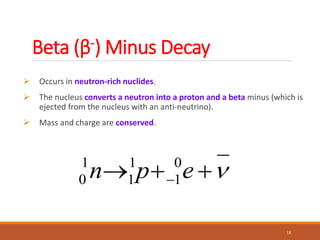
Beta (β-) Minus Decay
 Occurs in neutron-rich nuclides.
 The nucleus converts a neutron into a proton and a beta minus (which is
ejected from the nucleus with an anti-neutrino).
 Mass and charge are conserved.
18



  e
p
n 0
1
1
1
1
0
Beta (β-) Minus Decay
 For beta minus decays,
19

b 

 

0
1
1Y
X A
Z
A
Z

b 

 
0
1
90
39
90
38 Y
Sr
Beta (β-) Minus Decay
20
Parent
K-40
Beta Particle
Anti-neutrino
b
0
1


Daughter
Ca-40
Beta (β-) Minus Decay
 During radioactive decay energy is released
 Source of this energy is from the conversion of mass
 Since energy is conserved, energy equivalent of the parent must equal
energy equivalent of daughter, particles, and any energy released
 Energy is released as kinetic energy of beta minus particle and an anti-
neutrino
21
Beta (β-) Minus Decay
 For beta minus, energy of decay reaction (Q) is,
22
)
5
.
931
)(
(
1
amu
MeV
M
M
Q Y
X A
Z
A
Z 


Mass of beta minus particle is not included
since an additional electron is gained due to
increase of Z
Beta (β-) Minus Decay
 Calculate Q for β- decay of Co-60.
23

b 

 
0
1
60
28
60
27 Ni
Co
Mass of Co-60 is 59.933813 amu
Mass of Ni-60 is 59.930787 amu
)
amu
MeV
mu)(931.5
59.930787a
-
mu
59.933813a
(

Q
MeV
Q 819
.
2

Beta (β-) Minus Decay (Energies)
 The Q value for beta minus decay of Co-60, for example, is always the
same
 However, negatrons rarely are emitted with the same energies
 Their energies can range from 0 MeV to the calculated maximum, Emax
 The anti-neutrino carries energy difference between actual and
calculated values
24
Beta (β-) Minus Decay Energies
25
Energy
Max
E
3
1 Max
E
26
Co
60
27

b
Ni
60
28
99+%
0.013%
0.12%
1.173
0.83
1.332

Co-60 Decay Scheme
Q
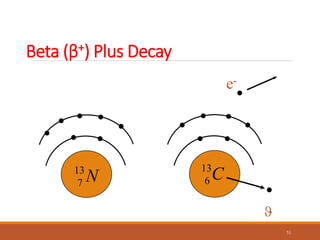
Beta (β+) Plus Decay
 Occurs in proton-rich nuclides
 The nucleus converts a proton into a neutron and a beta plus (which is
ejected from the nucleus with a neutrino)
 As with negatrons, the positron can have a range of energies from 0 to EMax
MeV
 Positron is the negatron’s anti-particle
 A positron and a negatron will annihilate one another and release two 0.511
MeV photons
27
Beta (β+) Plus Decay
 For beta plus decays,
28

b 

 
0
1
13
6
13
7 C
N

b 

 

0
1
1Y
X A
Z
A
Z



  e
n
p 0
1
1
0
1
1
Beta (β+) Plus Decay
29
Parent
F-18
Beta Particle
Neutrino
b
0
1


Daughter
O-18
Beta (β+) Plus Decay
 For beta plus, energy of decay reaction (Q) is,
30
)
5
.
931
)](
2
(
)
[( 0
1
1
amu
MeV
M
M
M
Q e
Y
X A
Z
A
Z 




Since the energy equivalent of two electron
masses is 1.022 MeV, the equation can be
rewritten as,
MeV
amu
MeV
M
M
Q Y
X A
Z
A
Z
022
.
1
)]
5
.
931
)(
[(
1




Beta (β+) Plus Decay
31
C
13
6
N
13
7
•
•
•
• •
•
•
•
•
•
•
•
•
•
•

+
e-
Beta (β+) Plus Decay
 Calculate Q for β+ decay of F-18.
32

b 

 
0
1
18
8
18
9 O
F
Mass of F-18 is 18.000937 amu
Mass of O-18 is 17.999160 amu
MeV
Q 022
.
1
)]
amu
MeV
mu)(931.5
17.999160a
-
amu
000937
.
18
[( 

MeV
Q 633
.
0

Electron Capture
 Proton-rich nuclides may also decay via orbital electron capture (EC)
 Usually an innermost K shell electron is captured and often referred to as
K-capture
 The electron and a proton are converted into a neutron and a neutrino is
emitted
 Electrons from higher orbitals will fill vacancy and usually emit
characteristic x-rays
33
Electron Capture
 For electron capture decays,
34



 Cr
Mn EC 53
24
53
25



 
 Y
e
X A
Z
A
Z 1
0
1



 n
e
p 1
0
0
1
1
1
Electron Capture
 For electron capture, energy of decay reaction (Q) is,
35
)
5
.
931
)(
(
1
amu
MeV
M
M
Q Y
X A
Z
A
Z 


Since the electron was absorbed into the
nucleus and not removed, there is no need to
account for electron mass
Auger Electrons
 When electrons change shells, x-rays are usually emitted
 In some instances, the excess energy is transferred to another orbital
electron, which is then ejected from the atom
 This ejected electron is known as an Auger electron
 Another orbital vacancy now exists and x-rays may be emitted if they are
filled
36
Auger Electrons
37
•
• •
• •
•
•
• •
•
Nuclear De-excitation
 Daughter nuclei from radioactive decays are often ‘born’ with excess energy
 Occasionally the excited nucleus will emit additional alphas or betas
 Usually the excited nucleus reaches ground state via nuclear de-excitation
 The excited nucleus and the final ground state nucleus have the same Z and A
and are called isomers
 If the excited state has a half-life >1 sec, it is said to be a metastable state
 The metastable state is denoted by the use of a lowercase ‘m’, such as Ba-
137m, Tc-99m
 The longest known excited state is Bi-210m with a half-life of 3.5 x 10⁶ years
 During de-excitation no nuclear transformation occurs, so no ‘new’ element
is formed
38
Nuclear De-excitation
 Internal Conversion
 The excess nuclear energy is transferred to an inner orbital (usually K or L) electron.
This electron is then ejected from the atom with a distinct energy and X-ray emission
may follow as electrons shift orbitals to fill vacancies.
 Gamma emission
 Most frequently the excess energy is relieved via the emission of one or more gamma
rays. Gammas have no mass or electric charge and if gammas are emitted by an
isomer in the metastable state, the emission is known as an isomeric transition (IT)
 Photon Energy (E) = hf , where h is Planck’s Constant (4.14 x 10⁻¹⁵ eV-sec), f is
frequency (sec-1)
39
Gamma Ray Radiation
40
Parent
Co-60
Gamma Rays
b
0
1

Daughter
Ni-60


Anti-neutrino
41
Co
60
27

b
Ni
60
28
99+%
0.013%
0.12%
1.173
0.83
1.332

Co-60 Decay Scheme
Q
Decay Schemes
 Vertical lines represent energy
 Horizontal lines indicate atomic number (Z)
 Beta minus points down to the right
 Alpha and EC point down to the left
 Beta plus points down to the left with a 1.022 MeV offset
 Parent half-lives are shown
42
Decay Schemes
Ground states are bold horizontal lines
Excited states are light horizontal lines
Isomeric states are medium horizontal lines
Total amount of energy for the reaction is shown (Q)
Abundances (probabilities) of transitions are shown
43
Radioactive Decay Series
44
Uranium Series
45
Neptunium Series
46
Thorium Series
47
Actinium Series
48
THANKS
GE-PP-22502-00 49

Decay Modes.pptx

  • 1.
    Advanced Medical Physics DecayModes, Radiation Properties DR. MUNIR AHMAD POSTDOC MEDICAL IMAGING PHD MEDICAL PHYSICS, UCL, UK
  • 2.
  • 3.
    Nuclear InStability Sea Stablenuclides Naturally occurring radioactive nuclides Other known nuclides
  • 4.
    a decay b decay 140 130 120 110 100 90 80 70 60 50 40 30 20 10 0 1020 30 40 50 60 70 80 90 Protons (Z) Neutrons (N) 184 74 W 107 47 Ag 56 26 Fe 20 10 Ne 209 83 Bi positron emission and/or electron capture       1.15 Z N       1.0 Z N       1 Z N       1.28 Z N       1.52 Z N       1.49 Z N Nuclear Stability Decay will occur in such a way as to return a nucleus to the band (line) of stability.
  • 5.
    Effects of RadioactiveEmissions on Proton and Neutrons Number of protons Number of protons Loss of e 0 1 - Loss of or electron capture e 0 1 Loss of He 4 2
  • 6.
    Uranium Radioactive Decay U-238 206 210 214 218 222 226 230 234 238 Mass number 8182 83 84 85 86 87 88 89 90 91 92 Atomic number Th-230 a Th-234 a Ra-226 a Rn-222 a Po-218 a Pb-206 a Pb-214 a Pb-210 a Pa-234 b Bi-214 b Po-214 b Bi-210 b Po-210 b U-234 b 4.5 x 10⁹ y 24 d 1.2 m 2.5 x 10⁵ y 8.0 x 10⁴ y 1600 y 3.8 d 3.0 m 27 m 160 ms 5.0 d 138 d stable
  • 7.
    Half-Lives of SomeIsotopes of Carbon Nuclide Half-Life Carbon-9 0.127 s Carbon-10 19.3 s Carbon-11 10.3 m Carbon-12 Stable Carbon-13 Stable Carbon-14 5715 y Carbon-15 2.45 s Carbon-16 0.75 s
  • 8.
    Nuclear Stability Analysis& Decay Modes  The repulsive electrostatic forces between the protons have an impact on nuclear stability.  The number of neutrons must increase more rapidly than the number of protons to provide ‘dilution’ and to add additional nuclear forces.  If the nuclear (attractive) and electrostatic (repulsive) forces do not balance, the atom will not be stable.  An unstable nucleus will eventually achieve stability by changing its nuclear configuration, changing neutrons to protons, or vice versa, and then ejecting the surplus mass or energy from the nucleus.  This emitted mass or energy is called radiation. 9
  • 9.
     When anatom transforms to become more stable it is said to disintegrate or decay.  This property of certain nuclides to spontaneously disintegrate and emit radiation is called radioactivity.  The time required for half of a sample of atoms to decay is known as the half-life  The atom before the decay is the parent and the resulting atom is called the daughter 10 Nuclear Stability Analysis & Decay Modes
  • 10.
  • 11.
    Alpha Decay  Alphasare large particles ejected by the heavier nuclides and is primarily limited to nuclides with Z > 82 where Source is mainly from fuel-related materials.  Alpha contains two protons and two neutrons (no electrons) and is, in effect, a helium nucleus, thus, the atomic number decreases by two and the mass number decreases by four 12 2 4 2 4 2      He Y X A Z A Z 2 4 2 206 82 210 84    He Pb Po
  • 12.
  • 13.
    Alpha Decay  Sincenothing else is emitted, all energy of decay goes to the alpha particle (except for a small amount towards recoil of nucleus).  Alphas, therefore, are mono-energetic or with discrete energy.  For alpha, energy of decay reaction (Q) is, 14 ) 5 . 931 )]( ( [ 4 2 4 2 amu MeV M M M Q He Y X A Z A Z     
  • 14.
    Alpha Decay  CalculateQ for the st decay of Rn-222. 15 2 4 2 218 84 222 86    He Po Rn Mass of Rn-222 is 222.017610 amu Mass of Po-218 is 218.009009 amu ) amu MeV u)](931.5 4.002603am 9amu (218.00900 - amu 017610 . 222 [   Q MeV Q 6 . 5 
  • 15.
    Assignment III The bindingenergy of 214 84 Po is 1.66601 GeV, the binding energy of 210 82 Pb (lead) is 1.64555 GeV and the binding energy of 4 2He is 28.296 MeV. The Q-value for the decay? 16
  • 16.
    Beta Decay  Betasare physically the same as electrons, but may be positively or negatively charged.  Negative beta is a beta minus or negatron.  Positive beta is a beta plus or positron.  Betas are ejected from the nucleus, not from the electron orbital  In all beta decays the atomic number changes by one while the atomic mass is unchanged. 17
  • 17.
    Beta (β-) MinusDecay  Occurs in neutron-rich nuclides.  The nucleus converts a neutron into a proton and a beta minus (which is ejected from the nucleus with an anti-neutrino).  Mass and charge are conserved. 18      e p n 0 1 1 1 1 0
  • 18.
    Beta (β-) MinusDecay  For beta minus decays, 19  b      0 1 1Y X A Z A Z  b     0 1 90 39 90 38 Y Sr
  • 19.
    Beta (β-) MinusDecay 20 Parent K-40 Beta Particle Anti-neutrino b 0 1   Daughter Ca-40
  • 20.
    Beta (β-) MinusDecay  During radioactive decay energy is released  Source of this energy is from the conversion of mass  Since energy is conserved, energy equivalent of the parent must equal energy equivalent of daughter, particles, and any energy released  Energy is released as kinetic energy of beta minus particle and an anti- neutrino 21
  • 21.
    Beta (β-) MinusDecay  For beta minus, energy of decay reaction (Q) is, 22 ) 5 . 931 )( ( 1 amu MeV M M Q Y X A Z A Z    Mass of beta minus particle is not included since an additional electron is gained due to increase of Z
  • 22.
    Beta (β-) MinusDecay  Calculate Q for β- decay of Co-60. 23  b     0 1 60 28 60 27 Ni Co Mass of Co-60 is 59.933813 amu Mass of Ni-60 is 59.930787 amu ) amu MeV mu)(931.5 59.930787a - mu 59.933813a (  Q MeV Q 819 . 2 
  • 23.
    Beta (β-) MinusDecay (Energies)  The Q value for beta minus decay of Co-60, for example, is always the same  However, negatrons rarely are emitted with the same energies  Their energies can range from 0 MeV to the calculated maximum, Emax  The anti-neutrino carries energy difference between actual and calculated values 24
  • 24.
    Beta (β-) MinusDecay Energies 25 Energy Max E 3 1 Max E
  • 25.
  • 26.
    Beta (β+) PlusDecay  Occurs in proton-rich nuclides  The nucleus converts a proton into a neutron and a beta plus (which is ejected from the nucleus with a neutrino)  As with negatrons, the positron can have a range of energies from 0 to EMax MeV  Positron is the negatron’s anti-particle  A positron and a negatron will annihilate one another and release two 0.511 MeV photons 27
  • 27.
    Beta (β+) PlusDecay  For beta plus decays, 28  b     0 1 13 6 13 7 C N  b      0 1 1Y X A Z A Z      e n p 0 1 1 0 1 1
  • 28.
    Beta (β+) PlusDecay 29 Parent F-18 Beta Particle Neutrino b 0 1   Daughter O-18
  • 29.
    Beta (β+) PlusDecay  For beta plus, energy of decay reaction (Q) is, 30 ) 5 . 931 )]( 2 ( ) [( 0 1 1 amu MeV M M M Q e Y X A Z A Z      Since the energy equivalent of two electron masses is 1.022 MeV, the equation can be rewritten as, MeV amu MeV M M Q Y X A Z A Z 022 . 1 )] 5 . 931 )( [( 1    
  • 30.
    Beta (β+) PlusDecay 31 C 13 6 N 13 7 • • • • • • • • • • • • • • •  + e-
  • 31.
    Beta (β+) PlusDecay  Calculate Q for β+ decay of F-18. 32  b     0 1 18 8 18 9 O F Mass of F-18 is 18.000937 amu Mass of O-18 is 17.999160 amu MeV Q 022 . 1 )] amu MeV mu)(931.5 17.999160a - amu 000937 . 18 [(   MeV Q 633 . 0 
  • 32.
    Electron Capture  Proton-richnuclides may also decay via orbital electron capture (EC)  Usually an innermost K shell electron is captured and often referred to as K-capture  The electron and a proton are converted into a neutron and a neutrino is emitted  Electrons from higher orbitals will fill vacancy and usually emit characteristic x-rays 33
  • 33.
    Electron Capture  Forelectron capture decays, 34     Cr Mn EC 53 24 53 25       Y e X A Z A Z 1 0 1     n e p 1 0 0 1 1 1
  • 34.
    Electron Capture  Forelectron capture, energy of decay reaction (Q) is, 35 ) 5 . 931 )( ( 1 amu MeV M M Q Y X A Z A Z    Since the electron was absorbed into the nucleus and not removed, there is no need to account for electron mass
  • 35.
    Auger Electrons  Whenelectrons change shells, x-rays are usually emitted  In some instances, the excess energy is transferred to another orbital electron, which is then ejected from the atom  This ejected electron is known as an Auger electron  Another orbital vacancy now exists and x-rays may be emitted if they are filled 36
  • 36.
    Auger Electrons 37 • • • •• • • • • •
  • 37.
    Nuclear De-excitation  Daughternuclei from radioactive decays are often ‘born’ with excess energy  Occasionally the excited nucleus will emit additional alphas or betas  Usually the excited nucleus reaches ground state via nuclear de-excitation  The excited nucleus and the final ground state nucleus have the same Z and A and are called isomers  If the excited state has a half-life >1 sec, it is said to be a metastable state  The metastable state is denoted by the use of a lowercase ‘m’, such as Ba- 137m, Tc-99m  The longest known excited state is Bi-210m with a half-life of 3.5 x 10⁶ years  During de-excitation no nuclear transformation occurs, so no ‘new’ element is formed 38
  • 38.
    Nuclear De-excitation  InternalConversion  The excess nuclear energy is transferred to an inner orbital (usually K or L) electron. This electron is then ejected from the atom with a distinct energy and X-ray emission may follow as electrons shift orbitals to fill vacancies.  Gamma emission  Most frequently the excess energy is relieved via the emission of one or more gamma rays. Gammas have no mass or electric charge and if gammas are emitted by an isomer in the metastable state, the emission is known as an isomeric transition (IT)  Photon Energy (E) = hf , where h is Planck’s Constant (4.14 x 10⁻¹⁵ eV-sec), f is frequency (sec-1) 39
  • 39.
    Gamma Ray Radiation 40 Parent Co-60 GammaRays b 0 1  Daughter Ni-60   Anti-neutrino
  • 40.
  • 41.
    Decay Schemes  Verticallines represent energy  Horizontal lines indicate atomic number (Z)  Beta minus points down to the right  Alpha and EC point down to the left  Beta plus points down to the left with a 1.022 MeV offset  Parent half-lives are shown 42
  • 42.
    Decay Schemes Ground statesare bold horizontal lines Excited states are light horizontal lines Isomeric states are medium horizontal lines Total amount of energy for the reaction is shown (Q) Abundances (probabilities) of transitions are shown 43
  • 43.
  • 44.
  • 45.
  • 46.
  • 47.
  • 48.