DYE LASER
Working principle
Major components
Construction
Advantages
Disadvantages
Applications
A laser which uses an organic dye as the lasing
medium, usually as a liquid solution. A dye can
usually be used for a much wider range of
wavelengths. These Lasers were discovered by
Sorokin and his colleagues.
Q-What is a Dye?
A dye is a colored substance which
imparts(applies) its color to the material it is
being applied.
Working Principle
 It works on the principle of population inversion.
 Q-What is Population Inversion?
 To achieve optical amplification it is necessary to
create a distribution of atoms such that the
population of the upper energy level is greater
than that of the lower energy level (i.e. N2 > N1).
This condition is known as population inversion.
Major Required Components
1. Active/Lasing Medium
2. Pumping Source
3. Resonator
Active Medium
 Active medium for dye laser is the organic dye.it is a
liquid material.
 Some of the Organic dyes are Rhodamine
6G (orange, 540–680 nm) also known as Xanthene
dye , Fluorescein (green, 530–
560 nm), Coumarin (blue 490–
620 nm), Stilbene (violet 410–
480 nm), Umbelliferone (blue, 450–
470 nm), Tetracene, malachite green, and others.
 Most Commonly used is Rhodamine 6G.
 The organic dye is dissolved in solvents like:
water,benzene,alcohol,ethanol.
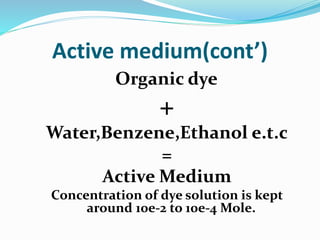
Active medium(cont’)
Organic dye
+
Water,Benzene,Ethanol e.t.c
=
Active Medium
Concentration of dye solution is kept
around 10e-2 to 10e-4 Mole.
Pumping Source/Excitation Lasers
Energy to excite the dye is supplied by a strong light
source that may be a flash lamp or other as listed
below.
Flash lamps and several types of lasers can be used to
optically pump dye lasers. A partial list of excitation
lasers include:
 Copper vapor lasers
 Diode lasers
 Excimer lasers
 Nd:YAG lasers (mainly second and third harmonics)
 Nitrogen lasers
 Ruby lasers
 Argon ion lasers in the CW regime
 Krypton ion lasers in the CW regime
Pumping Source/Excitation Lasers
 Here the pumping source is a mono-chromatic
laser(excimer laser).
 Q-what is a pumping source?
 To achieve Stimulated emission,we need more
atoms in higher energy state(E2).This
phenomenon is achieved by bombardment of
photons.So pumping source is actually a
source of Photons.
Resonator
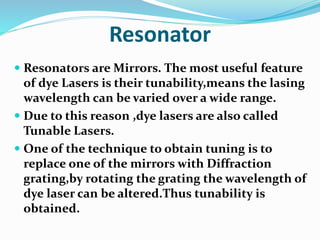
 Resonators are Mirrors. The most useful feature
of dye Lasers is their tunability,means the lasing
wavelength can be varied over a wide range.
 Due to this reason ,dye lasers are also called
Tunable Lasers.
 One of the technique to obtain tuning is to
replace one of the mirrors with Diffraction
grating,by rotating the grating the wavelength of
dye laser can be altered.Thus tunability is
obtained.
Construction
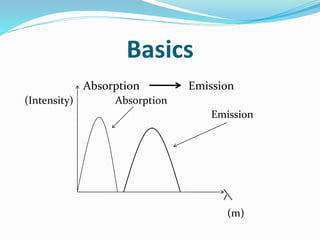
Basics
Absorption Emission
(Intensity) Absorption
Emission
(m)
Emission
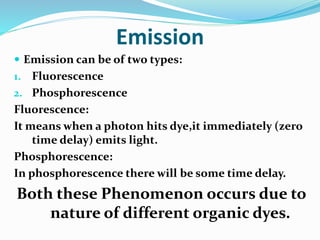
 Emission can be of two types:
1. Fluorescence
2. Phosphorescence
Fluorescence:
It means when a photon hits dye,it immediately (zero
time delay) emits light.
Phosphorescence:
In phosphorescence there will be some time delay.
Both these Phenomenon occurs due to
nature of different organic dyes.
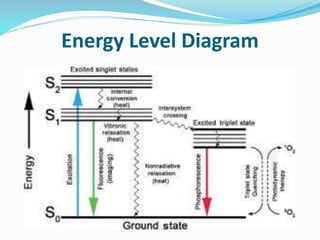
Energy Level Diagram
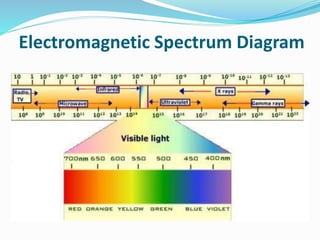
Electromagnetic Spectrum Diagram
Advantages
 Low cost Tuning possible with multiple means
 No degradation of the optical properties of the
organic dye.
 More robust(professional) and compact
systems.
Disadvantages
 limited lifetime.
 limited output power
Applications
 Dye lasers are used to spectroscopy,
holography and in Medical applications.
A recent application of dye laser was in
isotope separation.

Dye laser

  • 1.
    DYE LASER Working principle Majorcomponents Construction Advantages Disadvantages Applications
  • 2.
    A laser whichuses an organic dye as the lasing medium, usually as a liquid solution. A dye can usually be used for a much wider range of wavelengths. These Lasers were discovered by Sorokin and his colleagues. Q-What is a Dye? A dye is a colored substance which imparts(applies) its color to the material it is being applied.
  • 3.
    Working Principle  Itworks on the principle of population inversion.  Q-What is Population Inversion?  To achieve optical amplification it is necessary to create a distribution of atoms such that the population of the upper energy level is greater than that of the lower energy level (i.e. N2 > N1). This condition is known as population inversion.
  • 4.
    Major Required Components 1.Active/Lasing Medium 2. Pumping Source 3. Resonator
  • 5.
    Active Medium  Activemedium for dye laser is the organic dye.it is a liquid material.  Some of the Organic dyes are Rhodamine 6G (orange, 540–680 nm) also known as Xanthene dye , Fluorescein (green, 530– 560 nm), Coumarin (blue 490– 620 nm), Stilbene (violet 410– 480 nm), Umbelliferone (blue, 450– 470 nm), Tetracene, malachite green, and others.  Most Commonly used is Rhodamine 6G.  The organic dye is dissolved in solvents like: water,benzene,alcohol,ethanol.
  • 6.
    Active medium(cont’) Organic dye + Water,Benzene,Ethanole.t.c = Active Medium Concentration of dye solution is kept around 10e-2 to 10e-4 Mole.
  • 7.
    Pumping Source/Excitation Lasers Energyto excite the dye is supplied by a strong light source that may be a flash lamp or other as listed below. Flash lamps and several types of lasers can be used to optically pump dye lasers. A partial list of excitation lasers include:  Copper vapor lasers  Diode lasers  Excimer lasers  Nd:YAG lasers (mainly second and third harmonics)  Nitrogen lasers  Ruby lasers  Argon ion lasers in the CW regime  Krypton ion lasers in the CW regime
  • 8.
    Pumping Source/Excitation Lasers Here the pumping source is a mono-chromatic laser(excimer laser).  Q-what is a pumping source?  To achieve Stimulated emission,we need more atoms in higher energy state(E2).This phenomenon is achieved by bombardment of photons.So pumping source is actually a source of Photons.
  • 9.
    Resonator  Resonators areMirrors. The most useful feature of dye Lasers is their tunability,means the lasing wavelength can be varied over a wide range.  Due to this reason ,dye lasers are also called Tunable Lasers.  One of the technique to obtain tuning is to replace one of the mirrors with Diffraction grating,by rotating the grating the wavelength of dye laser can be altered.Thus tunability is obtained.
  • 10.
  • 11.
  • 12.
    Emission  Emission canbe of two types: 1. Fluorescence 2. Phosphorescence Fluorescence: It means when a photon hits dye,it immediately (zero time delay) emits light. Phosphorescence: In phosphorescence there will be some time delay. Both these Phenomenon occurs due to nature of different organic dyes.
  • 13.
  • 14.
  • 15.
    Advantages  Low costTuning possible with multiple means  No degradation of the optical properties of the organic dye.  More robust(professional) and compact systems.
  • 16.
  • 17.
    Applications  Dye lasersare used to spectroscopy, holography and in Medical applications. A recent application of dye laser was in isotope separation.