Real Time PCR
Ashikh Seethy
Senior Resident and PhD Scholar
Dept of Biochemistry
AIIMS- New Delhi
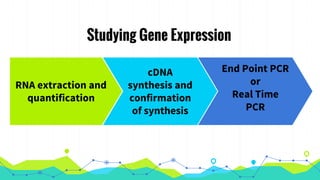
Studying Gene Expression
RNA extraction and
quantification
cDNA
synthesis and
confirmation
of synthesis
End Point PCR
or
Real Time
PCR
Overview:
◉ What is Real Time PCR?
◉ Why Real Time PCR?
◉ Chemistries used in Real Time PCR
◉ The process of Real Time PCR
◉ Absolute and relative quantification
◉ Melting curve
◉ Precautions
◉ Applications
What is Real Time PCR?
Why Real Time PCR?
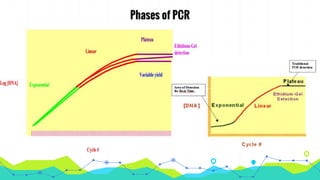
Phases of PCR
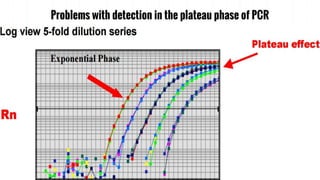
Problems with detection in the plateau phase of PCR
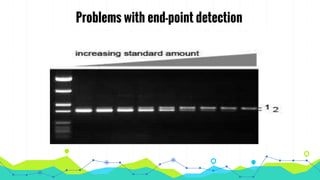
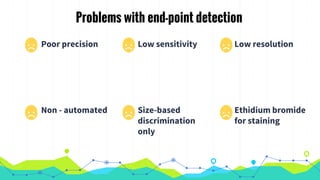
Problems with end-point detection
Poor precision Low sensitivity Low resolution
Non - automated Size-based
discrimination
only
Ethidium bromide
for staining
Alternative?
Real Time PCR
Real Time PCR uses fluorescence detecting thermocyclers to
amplify specific nucleic acid sequences and measure their
concentrations simultaneously
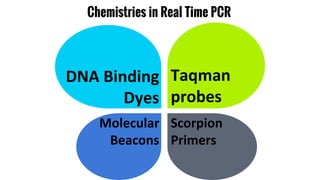
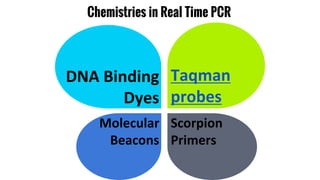
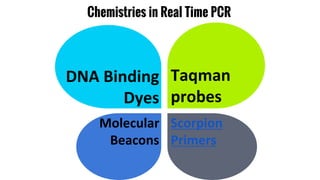
Chemistries in Real Time PCR
DNA Binding
Dyes
Taqman
probes
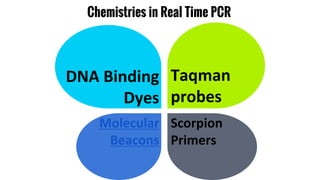
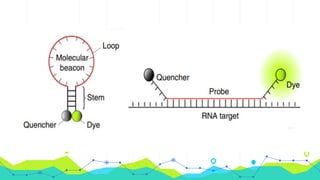
Molecular
Beacons
Scorpion
Primers
Chemistries in Real Time PCR
DNA Binding
Dyes
Taqman
probes
Molecular
Beacons
Scorpion
Primers
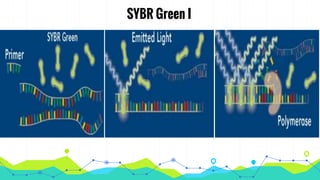
SYBR Green I
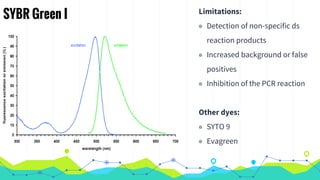
SYBR Green I Limitations:
◉ Detection of non-specific ds
reaction products
◉ Increased background or false
positives
◉ Inhibition of the PCR reaction
Other dyes:
◉ SYTO 9
◉ Evagreen
Chemistries in Real Time PCR
DNA Binding
Dyes
Taqman
probes
Molecular
Beacons
Scorpion
Primers
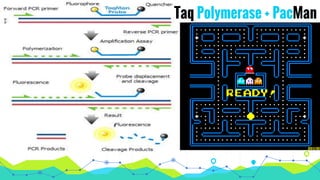
Taq Polymerase + PacManTaq Polymerase + PacMan
Chemistries in Real Time PCR
DNA Binding
Dyes
Taqman
probes
Molecular
Beacons
Scorpion
Primers
Chemistries in Real Time PCR
DNA Binding
Dyes
Taqman
probes
Molecular
Beacons
Scorpion
Primers
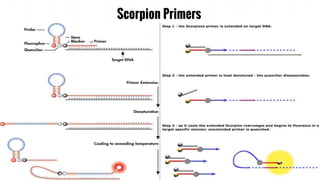
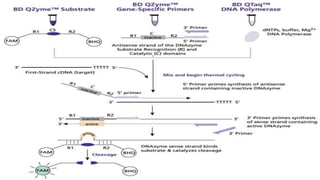
Scorpion Primers
The Process of Real Time PCR
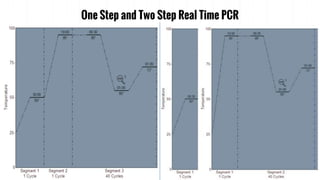
One Step and Two Step Real Time PCR
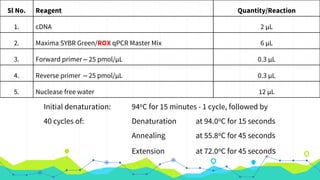
Initial denaturation: 94oC for 15 minutes - 1 cycle, followed by
40 cycles of: Denaturation at 94.0oC for 15 seconds
Annealing at 55.8oC for 45 seconds
Extension at 72.0oC for 45 seconds
Sl No. Reagent Quantity/Reaction
1. cDNA 2 µL
2. Maxima SYBR Green/ROX qPCR Master Mix 6 µL
3. Forward primer – 25 pmol/µL 0.3 µL
4. Reverse primer – 25 pmol/µL 0.3 µL
5. Nuclease free water 12 µL
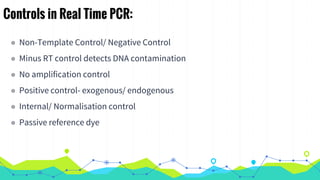
Controls in Real Time PCR:
◉ Non-Template Control/ Negative Control
◉ Minus RT control detects DNA contamination
◉ No amplification control
◉ Positive control- exogenous/ endogenous
◉ Internal/ Normalisation control
◉ Passive reference dye
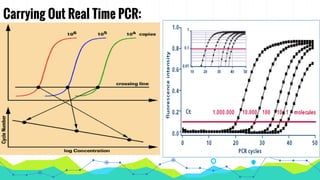
Carrying Out Real Time PCR:
Absolute and Relative Quantification
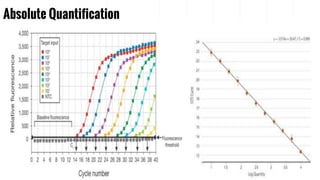
Absolute Quantification
Relative Quantification- Comparative CT method
◉ Relative concentration of the gene of interest (GOI) in unknown samples is
compared to a calibrator, or control sample
◉ Examples:
1. Drug treated cell lines and untreated cell lines
2. Patient samples and healthy controls
◉ Differences in Ct value between an unknown sample and control are expressed
as fold-changes relative to the control sample (ΔCt)
Relative Quantification- Comparative CT method
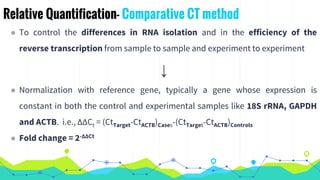
◉ To control the differences in RNA isolation and in the efficiency of the
reverse transcription from sample to sample and experiment to experiment
↓
◉ Normalization with reference gene, typically a gene whose expression is
constant in both the control and experimental samples like 18S rRNA, GAPDH
and ACTB. i.e., ΔΔCt = (CtTarget-CtACTB)Cases-(CtTarget-CtACTB)Controls
◉ Fold change = 2-ΔΔCt
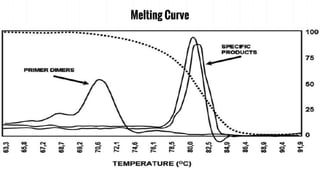
Melting Curve
Melting Curve
Precautions
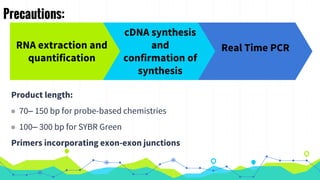
Precautions:
Product length:
◉ 70– 150 bp for probe-based chemistries
◉ 100– 300 bp for SYBR Green
Primers incorporating exon-exon junctions
RNA extraction and
quantification
cDNA synthesis
and
confirmation of
synthesis
Real Time PCR
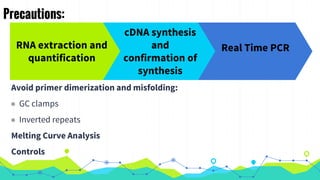
Precautions:
Avoid primer dimerization and misfolding:
◉ GC clamps
◉ Inverted repeats
Melting Curve Analysis
Controls
RNA extraction and
quantification
cDNA synthesis
and
confirmation of
synthesis
Real Time PCR
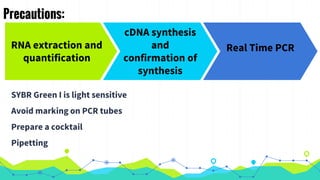
Precautions:
SYBR Green I is light sensitive
Avoid marking on PCR tubes
Prepare a cocktail
Pipetting
RNA extraction and
quantification
cDNA synthesis
and
confirmation of
synthesis
Real Time PCR
Applications of Real Time PCR
Applications
Viral Quantitation Quantitation of
Gene Expression
Array Verification
Pathogen detection Drug Therapy
Efficacy
Genotyping
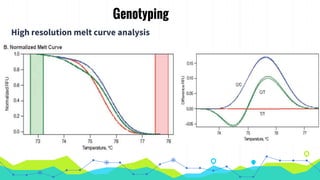
Genotyping
High resolution melt curve analysis
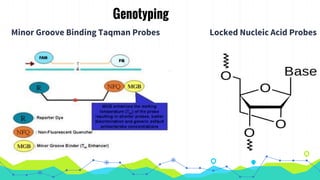
Genotyping
Minor Groove Binding Taqman Probes Locked Nucleic Acid Probes
THANKS!

Real Time PCR

  • 1.
    Real Time PCR AshikhSeethy Senior Resident and PhD Scholar Dept of Biochemistry AIIMS- New Delhi
  • 2.
    Studying Gene Expression RNAextraction and quantification cDNA synthesis and confirmation of synthesis End Point PCR or Real Time PCR
  • 3.
    Overview: ◉ What isReal Time PCR? ◉ Why Real Time PCR? ◉ Chemistries used in Real Time PCR ◉ The process of Real Time PCR ◉ Absolute and relative quantification ◉ Melting curve ◉ Precautions ◉ Applications
  • 4.
    What is RealTime PCR? Why Real Time PCR?
  • 5.
  • 6.
    Problems with detectionin the plateau phase of PCR
  • 7.
  • 8.
    Problems with end-pointdetection Poor precision Low sensitivity Low resolution Non - automated Size-based discrimination only Ethidium bromide for staining
  • 9.
    Alternative? Real Time PCR RealTime PCR uses fluorescence detecting thermocyclers to amplify specific nucleic acid sequences and measure their concentrations simultaneously
  • 10.
  • 11.
    Chemistries in RealTime PCR DNA Binding Dyes Taqman probes Molecular Beacons Scorpion Primers
  • 12.
    Chemistries in RealTime PCR DNA Binding Dyes Taqman probes Molecular Beacons Scorpion Primers
  • 13.
  • 14.
    SYBR Green ILimitations: ◉ Detection of non-specific ds reaction products ◉ Increased background or false positives ◉ Inhibition of the PCR reaction Other dyes: ◉ SYTO 9 ◉ Evagreen
  • 15.
    Chemistries in RealTime PCR DNA Binding Dyes Taqman probes Molecular Beacons Scorpion Primers
  • 16.
    Taq Polymerase +PacManTaq Polymerase + PacMan
  • 17.
    Chemistries in RealTime PCR DNA Binding Dyes Taqman probes Molecular Beacons Scorpion Primers
  • 19.
    Chemistries in RealTime PCR DNA Binding Dyes Taqman probes Molecular Beacons Scorpion Primers
  • 20.
  • 21.
    The Process ofReal Time PCR
  • 22.
    One Step andTwo Step Real Time PCR
  • 23.
    Initial denaturation: 94oCfor 15 minutes - 1 cycle, followed by 40 cycles of: Denaturation at 94.0oC for 15 seconds Annealing at 55.8oC for 45 seconds Extension at 72.0oC for 45 seconds Sl No. Reagent Quantity/Reaction 1. cDNA 2 µL 2. Maxima SYBR Green/ROX qPCR Master Mix 6 µL 3. Forward primer – 25 pmol/µL 0.3 µL 4. Reverse primer – 25 pmol/µL 0.3 µL 5. Nuclease free water 12 µL
  • 24.
    Controls in RealTime PCR: ◉ Non-Template Control/ Negative Control ◉ Minus RT control detects DNA contamination ◉ No amplification control ◉ Positive control- exogenous/ endogenous ◉ Internal/ Normalisation control ◉ Passive reference dye
  • 25.
  • 26.
    Absolute and RelativeQuantification
  • 27.
  • 28.
    Relative Quantification- ComparativeCT method ◉ Relative concentration of the gene of interest (GOI) in unknown samples is compared to a calibrator, or control sample ◉ Examples: 1. Drug treated cell lines and untreated cell lines 2. Patient samples and healthy controls ◉ Differences in Ct value between an unknown sample and control are expressed as fold-changes relative to the control sample (ΔCt)
  • 29.
    Relative Quantification- ComparativeCT method ◉ To control the differences in RNA isolation and in the efficiency of the reverse transcription from sample to sample and experiment to experiment ↓ ◉ Normalization with reference gene, typically a gene whose expression is constant in both the control and experimental samples like 18S rRNA, GAPDH and ACTB. i.e., ΔΔCt = (CtTarget-CtACTB)Cases-(CtTarget-CtACTB)Controls ◉ Fold change = 2-ΔΔCt
  • 30.
  • 31.
  • 32.
  • 33.
    Precautions: Product length: ◉ 70–150 bp for probe-based chemistries ◉ 100– 300 bp for SYBR Green Primers incorporating exon-exon junctions RNA extraction and quantification cDNA synthesis and confirmation of synthesis Real Time PCR
  • 34.
    Precautions: Avoid primer dimerizationand misfolding: ◉ GC clamps ◉ Inverted repeats Melting Curve Analysis Controls RNA extraction and quantification cDNA synthesis and confirmation of synthesis Real Time PCR
  • 35.
    Precautions: SYBR Green Iis light sensitive Avoid marking on PCR tubes Prepare a cocktail Pipetting RNA extraction and quantification cDNA synthesis and confirmation of synthesis Real Time PCR
  • 36.
  • 37.
    Applications Viral Quantitation Quantitationof Gene Expression Array Verification Pathogen detection Drug Therapy Efficacy Genotyping
  • 38.
  • 39.
    Genotyping Minor Groove BindingTaqman Probes Locked Nucleic Acid Probes
  • 41.

Editor's Notes

  • #15 absorbs blue light (λmax = 497 nm) and emits green light (λmax = 520 nm)
  • #17 Several different fluorophores (e.g. 6-carboxyfluorescein, acronym: FAM, or tetrachlorofluorescein, acronym: TET) and quenchers (e.g. tetramethylrhodamine, acronym: TAMRA) are available
  • #28 Concentration is measured by A260 and converted to the number of copies using the molecular weight of the DNA or RNA.