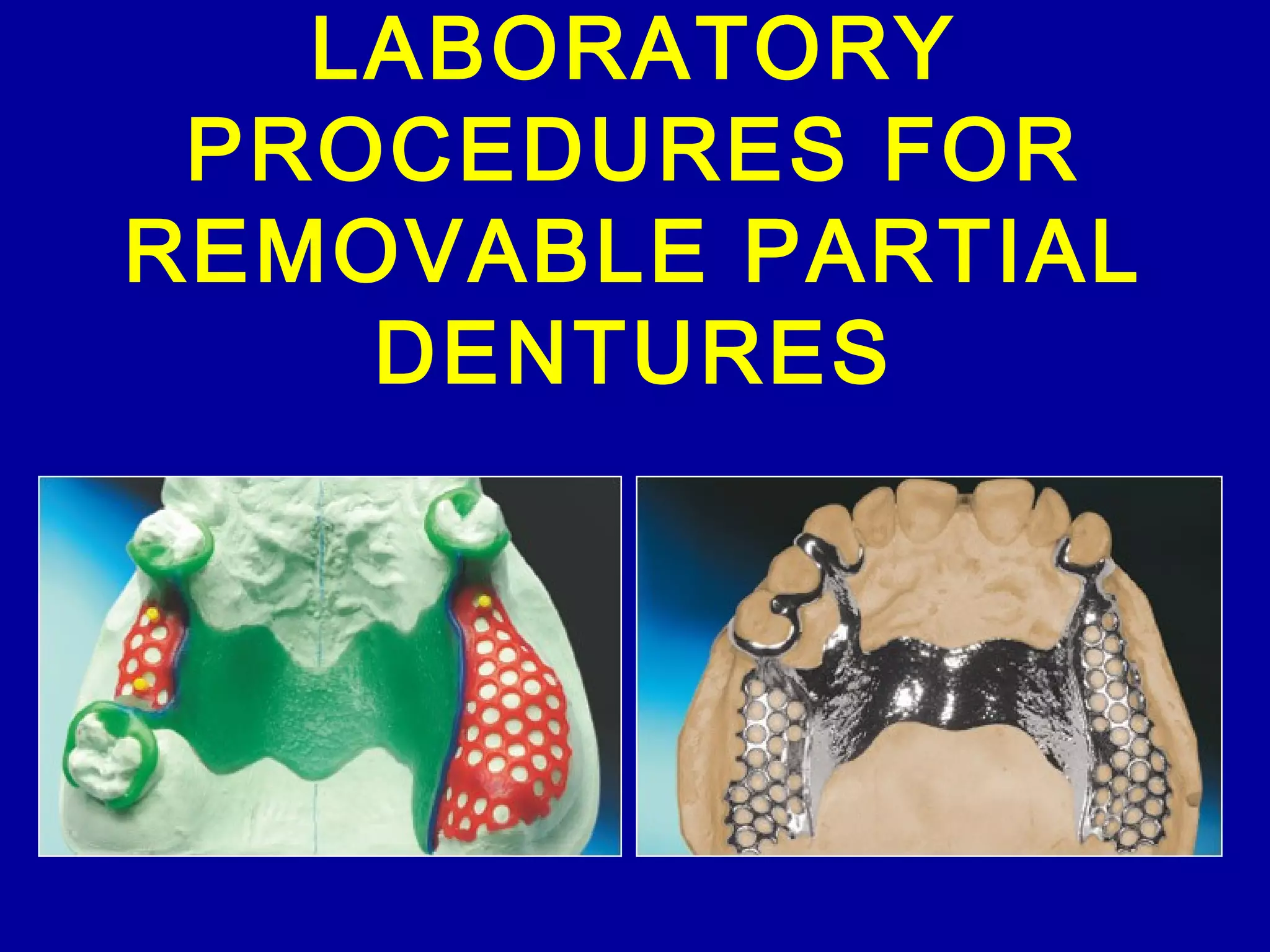
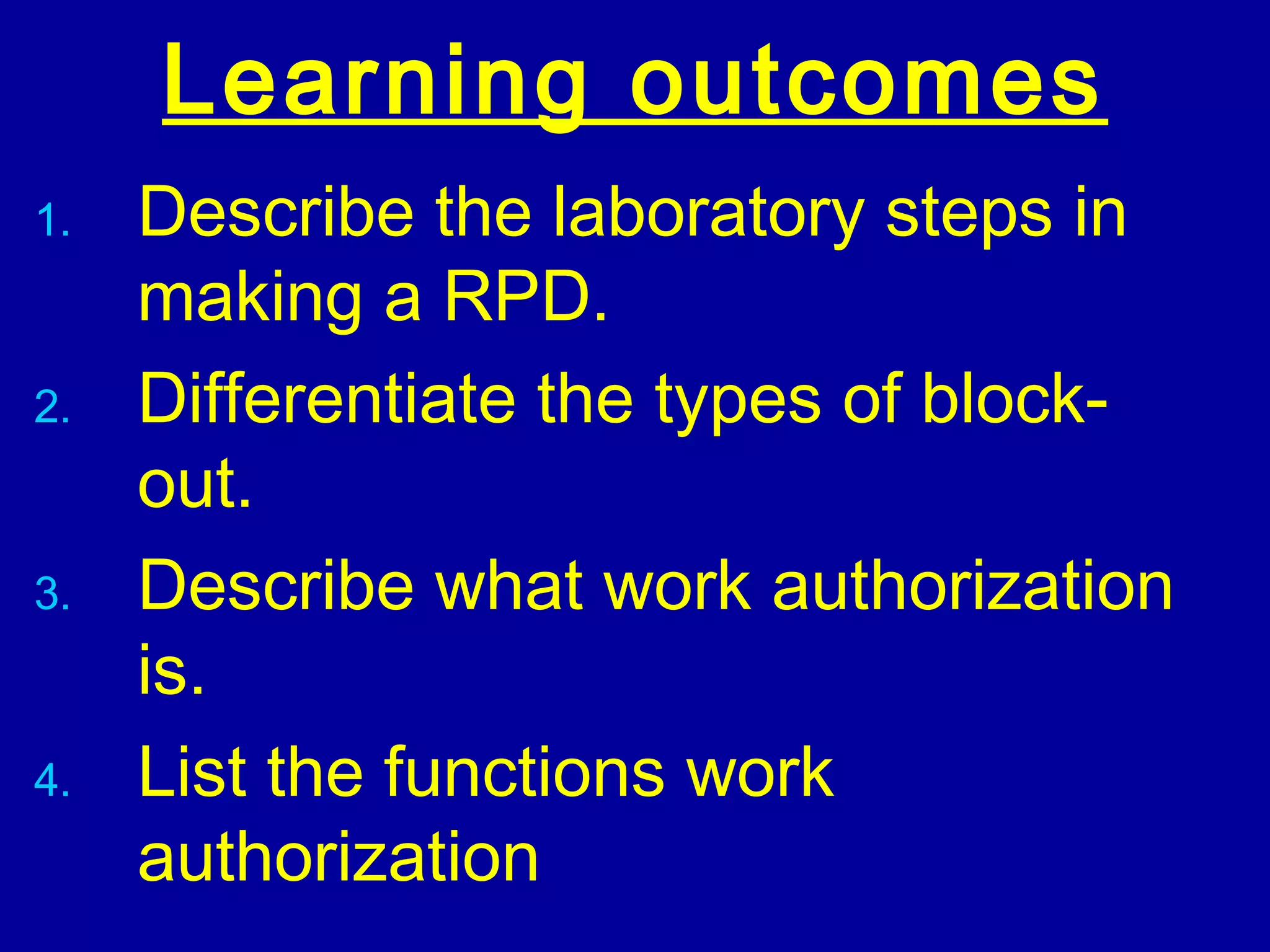
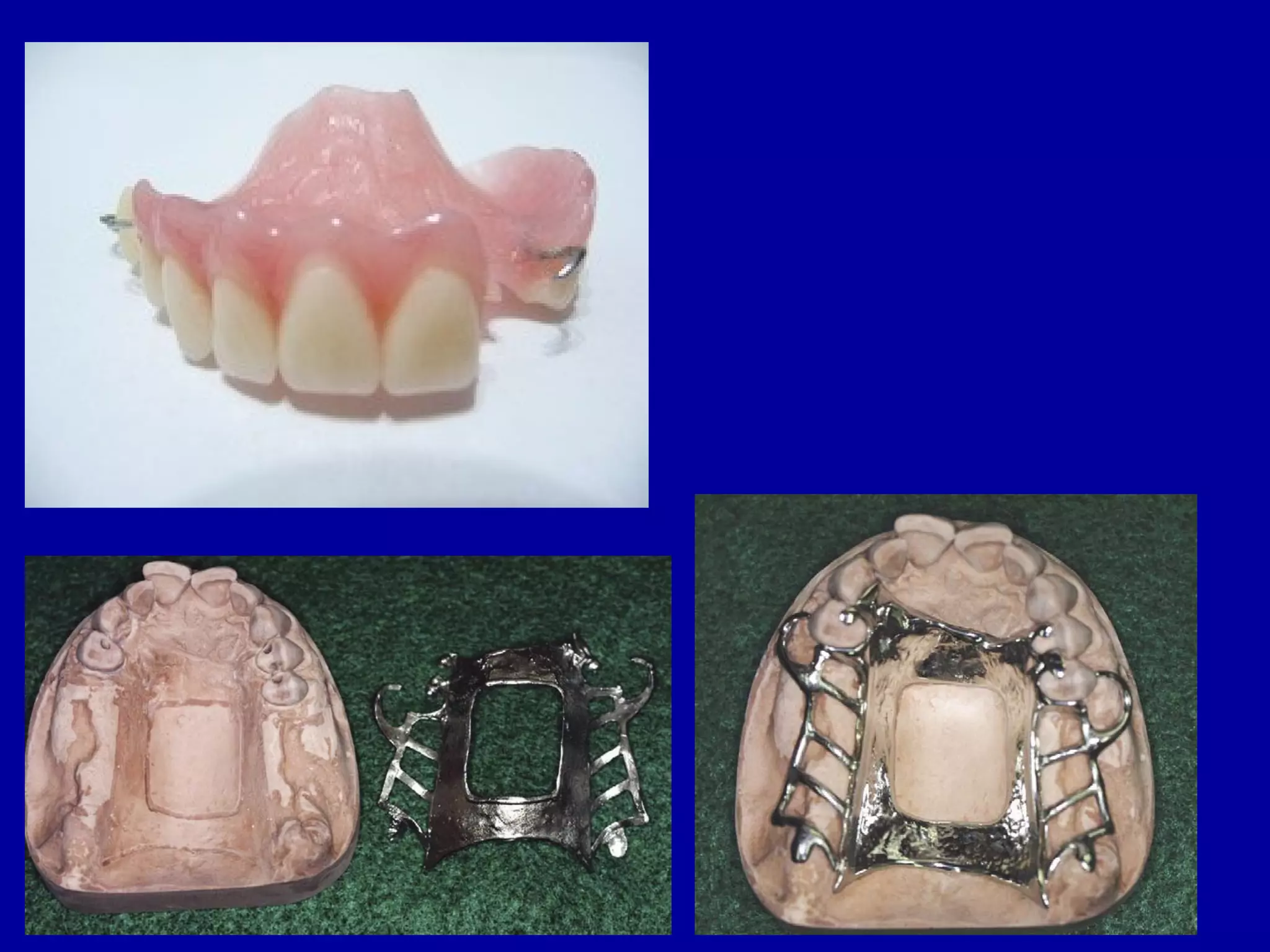
LABORATORY
PROCEDURES FOR
REMOVABLE PARTIAL
DENTURES
Learning outcomes
1. Describe the laboratory steps in
making a RPD.
2. Differentiate the types of block-
out.
3. Describe what work authorization
is.
4. List the functions work
authorization
Why we need to know lab
procedures????
 Knowledge of the laboratory
phase of partial denture
construction is essential for the
clinician, who must assume total
responsibility for the design and
the quality control of all aspects
of its construction.
 It is important to have an understanding of
the laboratory procedures involved.
 1. This enables the dentist to design a
RPD framework.
 2. Complete a laboratory work
authorization that tells a technician to
design and make the framework and
 3. Evaluate the quality of the framework.
STEPS IN MAKING A
REMOVABLE PARTIAL
DENTURE
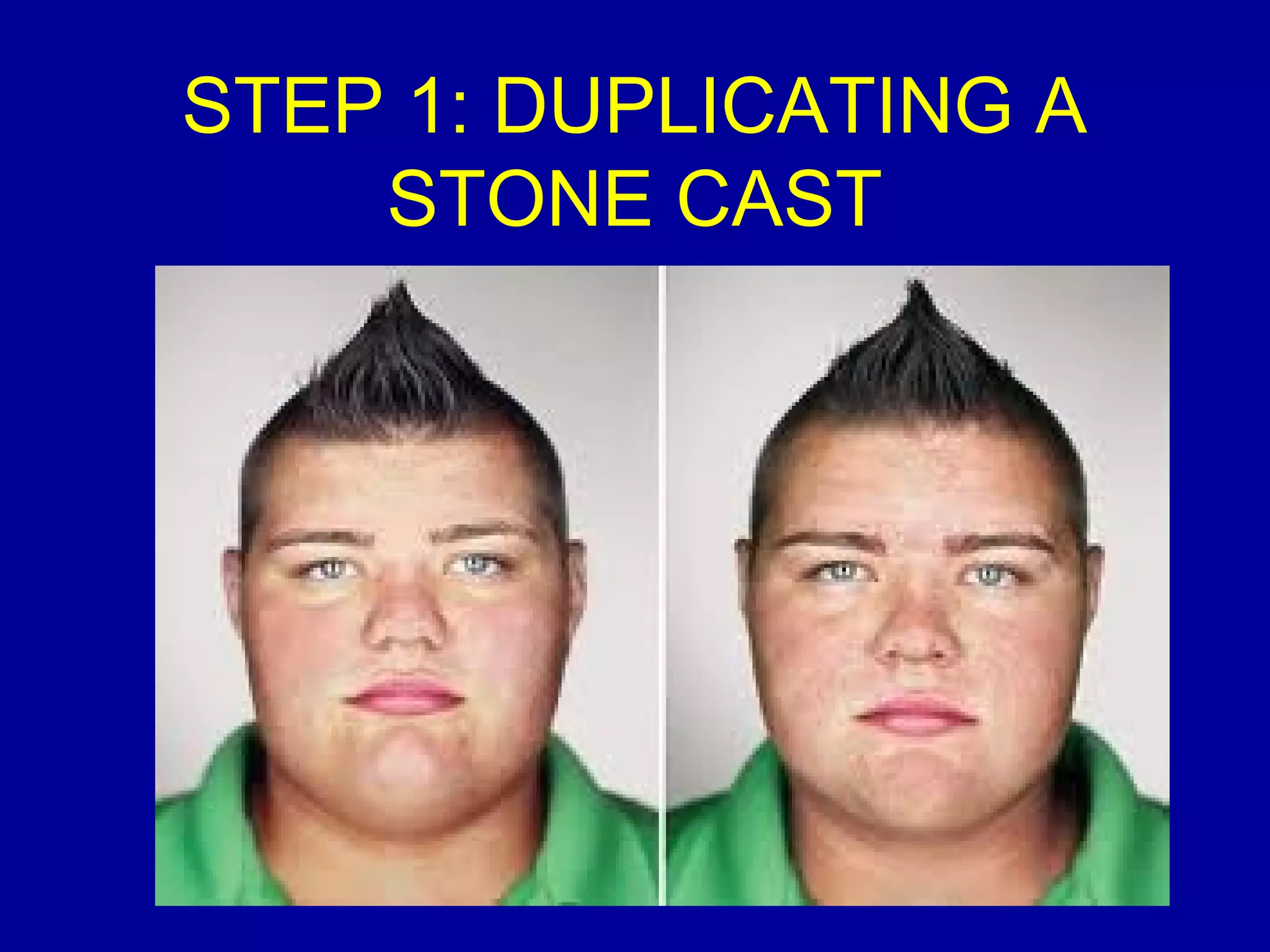
STEP 1: DUPLICATING A
STONE CAST
A stone cast may be duplicated
for many reasons:
i. Preservation of original casts
ii. Processing of interim prosthesis
iii. To check the fit of the framework
A stone cast may also be duplicated
with block-out of wax for:
Formation of investment
(refractory) cast for framework
fabrication
Duplicating Materials and
Flasks
 Duplicating materials are:
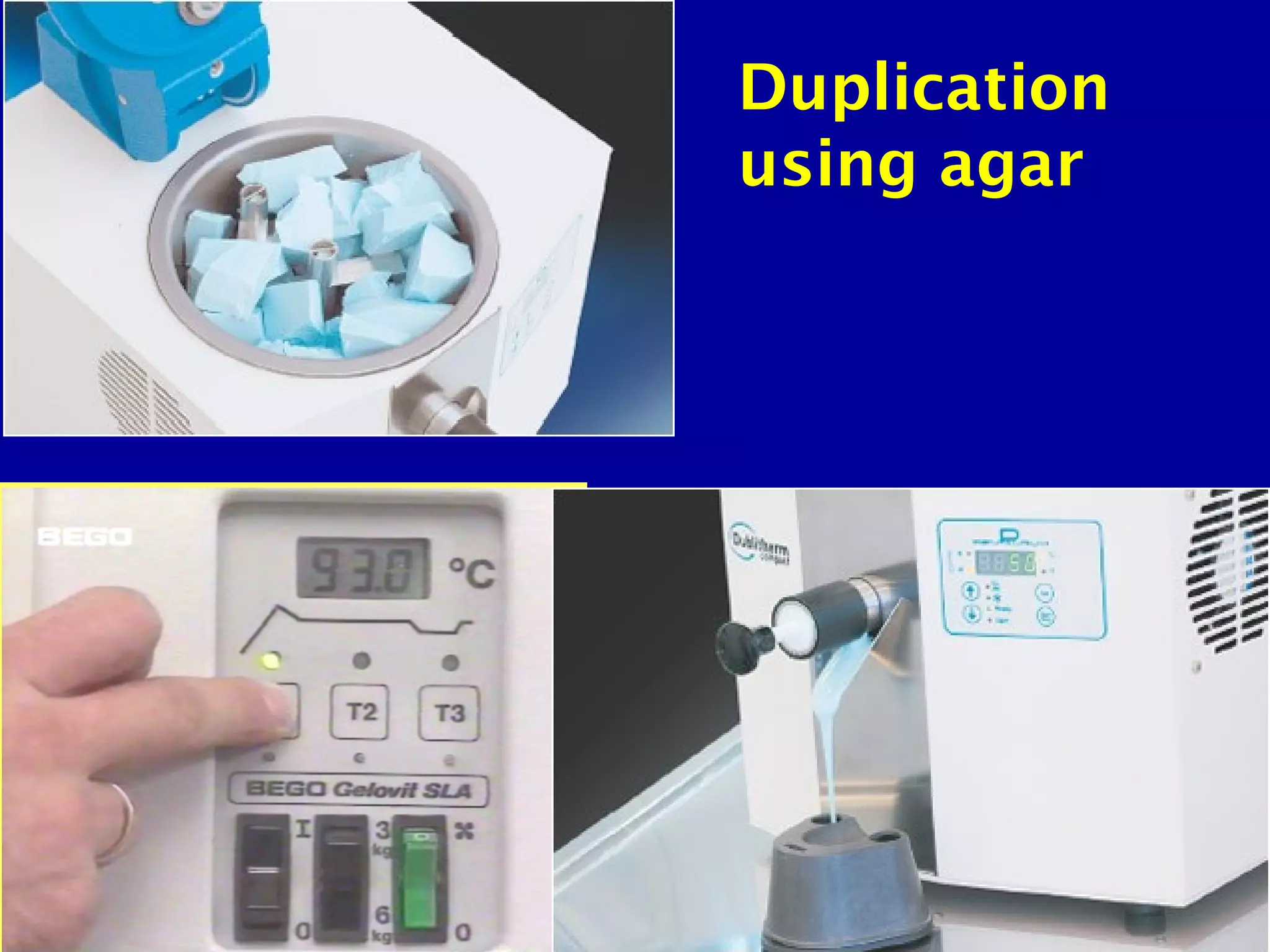
1. Colloidal (agar)
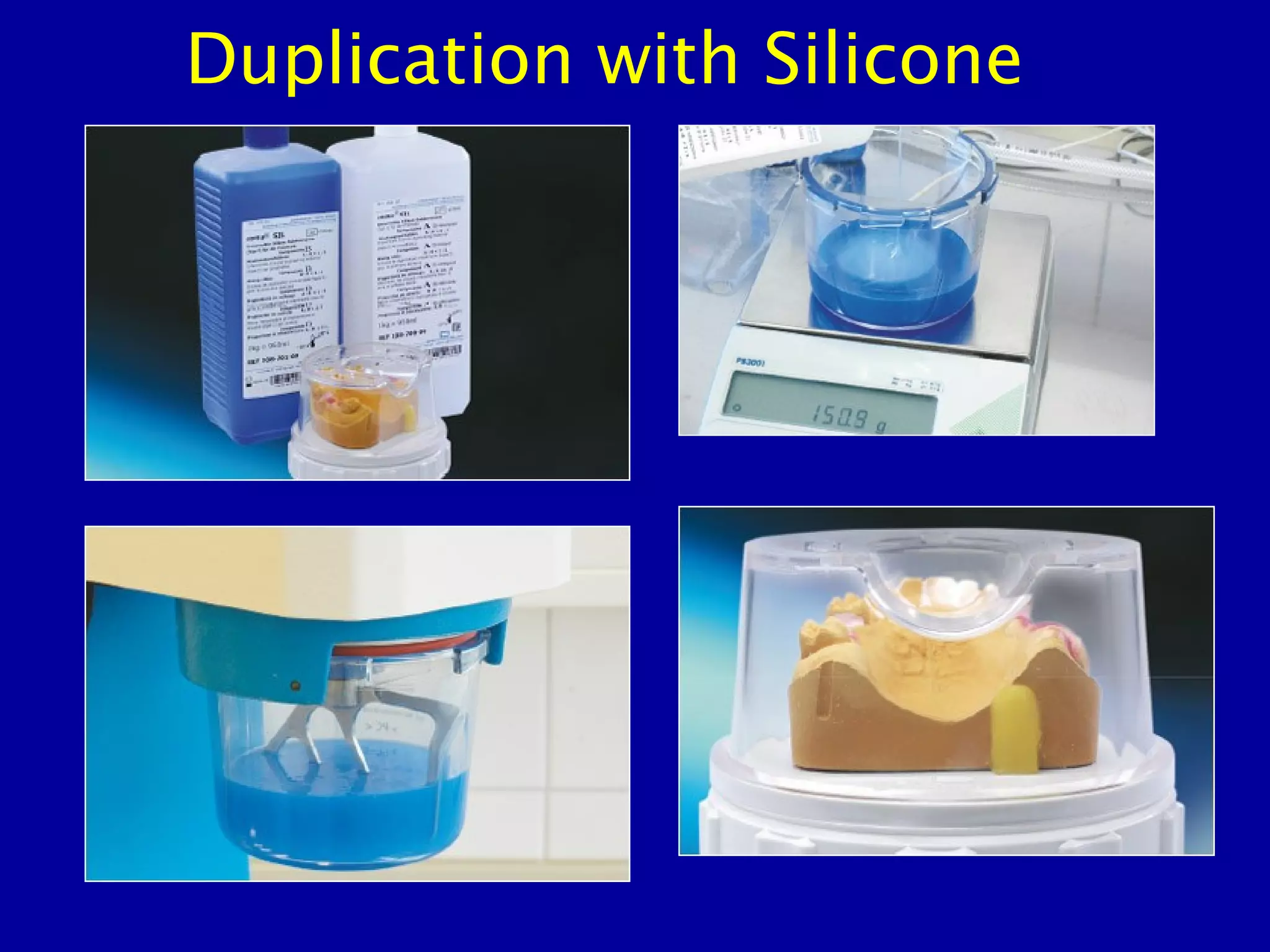
2. Silicone
 Colloidal materials are made fluid by
heating and return to gel while cooling.
The cast to be duplicated must be
placed in the bottom of a flask, called a
duplicating flask.
Duplicating Procedure:
i. Blockout on the master cast with
Ney blockout wax (can withstand high
temperature)
4 types of blockout are there:
 Paralleled Blockout,
 Shaped Blockout,
 Arbitrary Blockout, and
 Relief
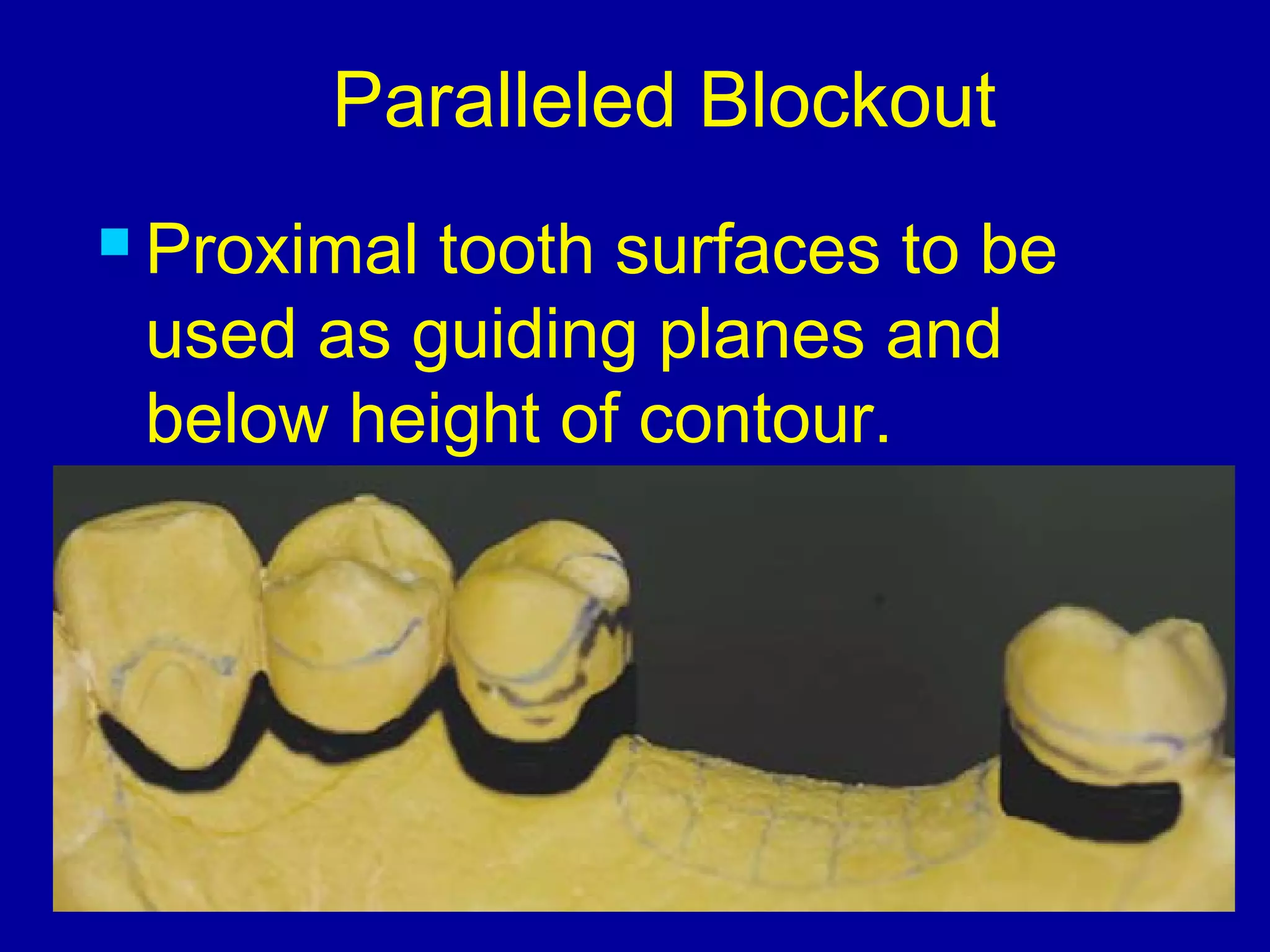
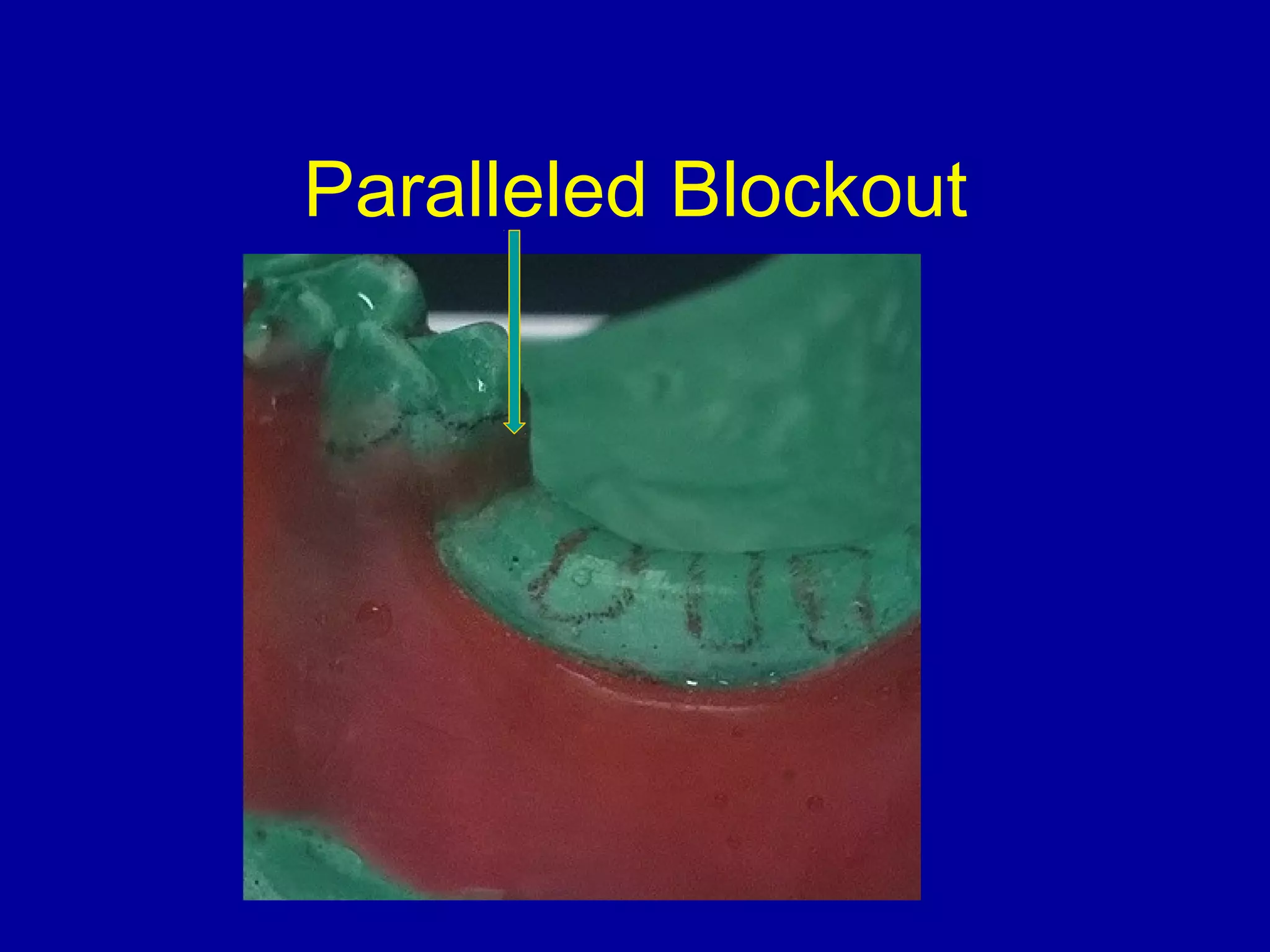
Paralleled Blockout
 Proximal tooth surfaces to be
used as guiding planes and
below height of contour.
Paralleled Blockout
Shaped Blockout
 On buccal and lingual surfaces to
locate wax patterns for clasp
arms.
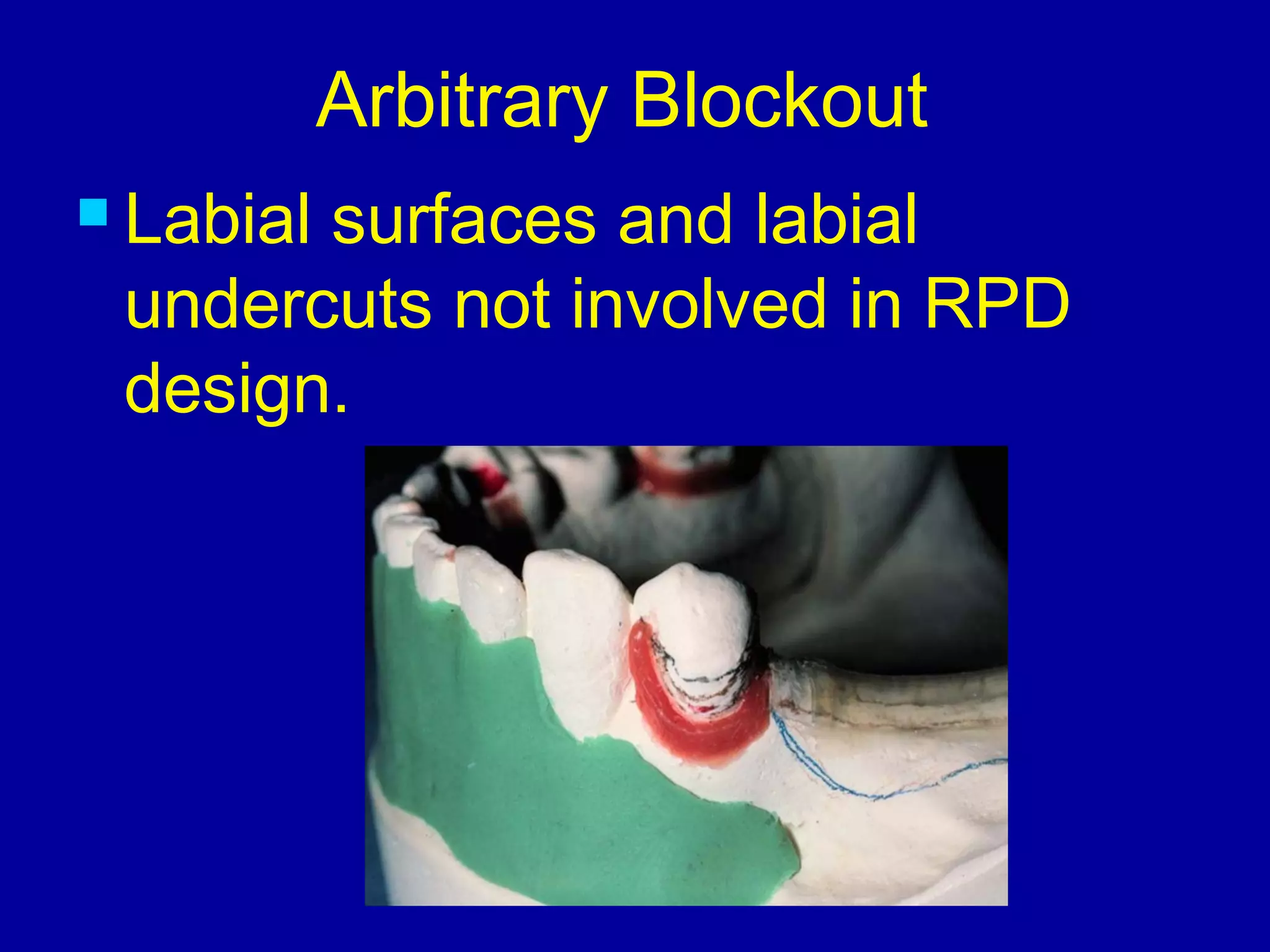
Arbitrary Blockout
 Labial surfaces and labial
undercuts not involved in RPD
design.
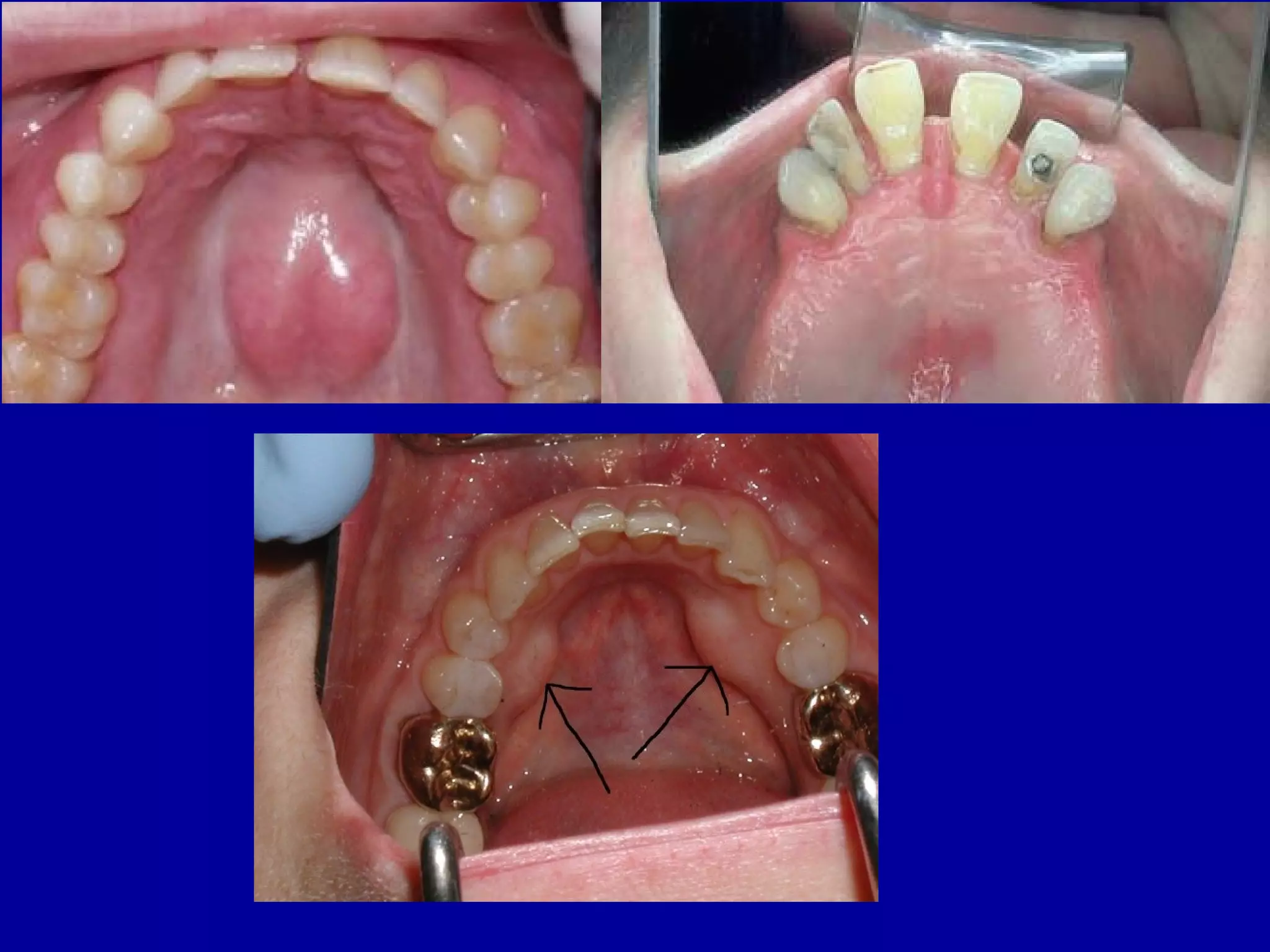
Relief
 Relief wax is placed in the edentulous
areas
 Beneath lingual bar connectors
 Areas in contact with thin tissues
Relief
ii. Attach cast to the bottom of the
flask so that it does not move
Duplication
using agar
Duplication with Silicone
Making refractory cast (investment
cast) - can withstand high temperature
Investment cast Dry the cast
Dip it in hardener Hardened refractory cast
STEP 2: WAXING THE
REMOVABLE PARTIAL DENTURE
FRAMEWORK
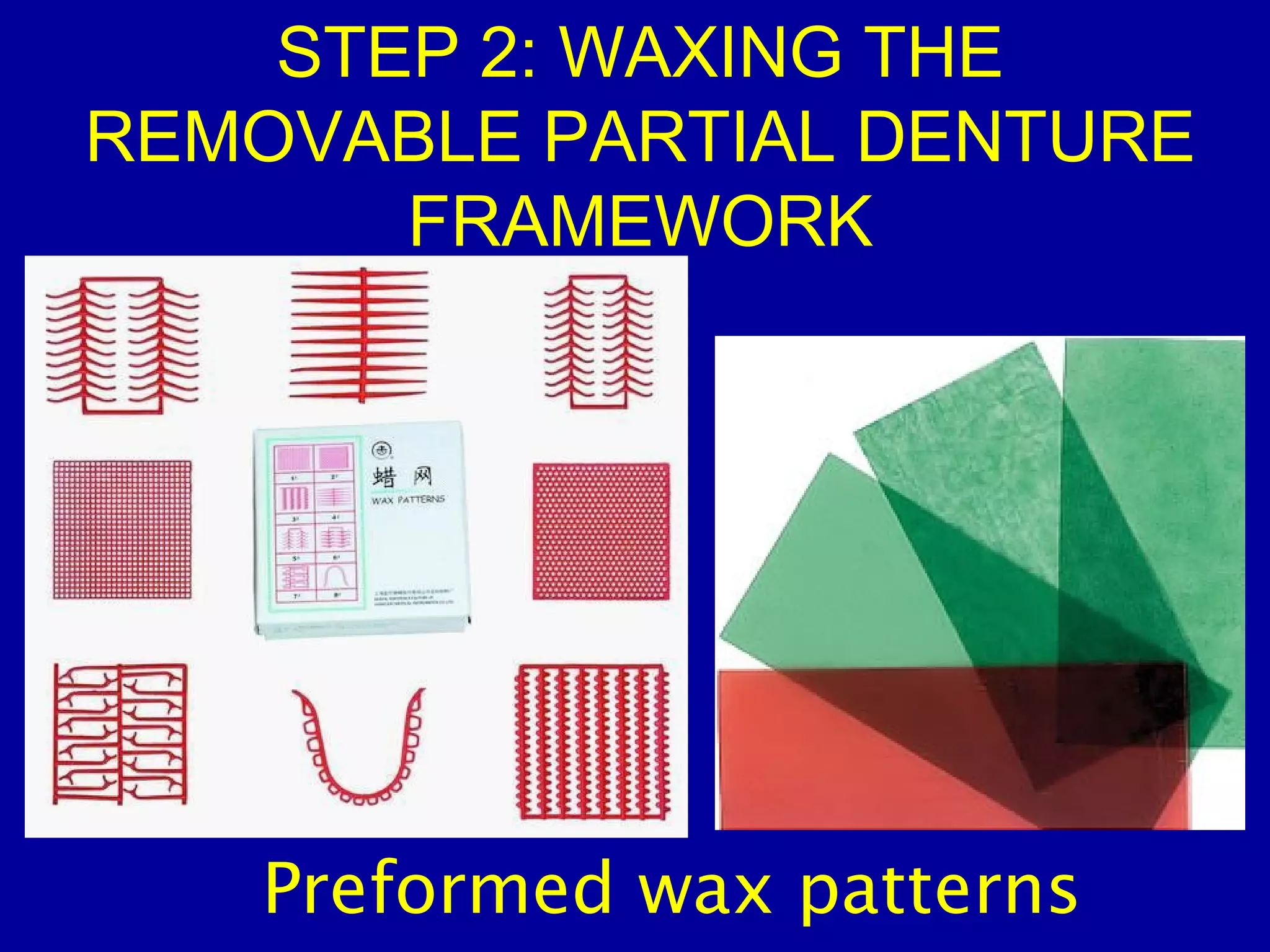
Preformed wax patterns
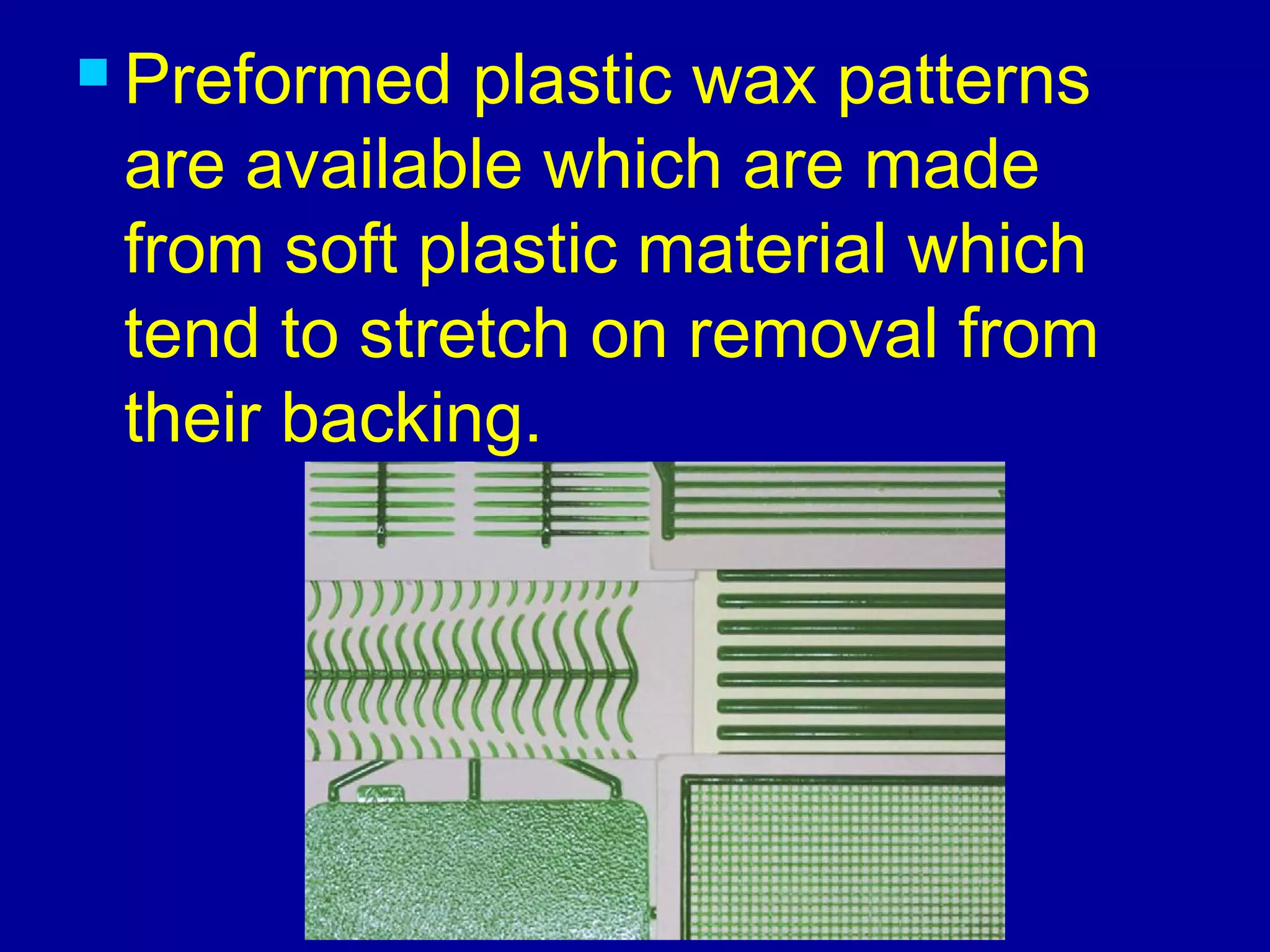
 Preformed plastic wax patterns
are available which are made
from soft plastic material which
tend to stretch on removal from
their backing.
Design Transfer: Before the actual
waxing can begin, the design must
once again be transferred on the
refractory cast (beading the
master cast helps in this
procedure).
Wrought wire: can be made at
the time of wax patterns or
soldered to the framework
STEP 3: SPRUING
..
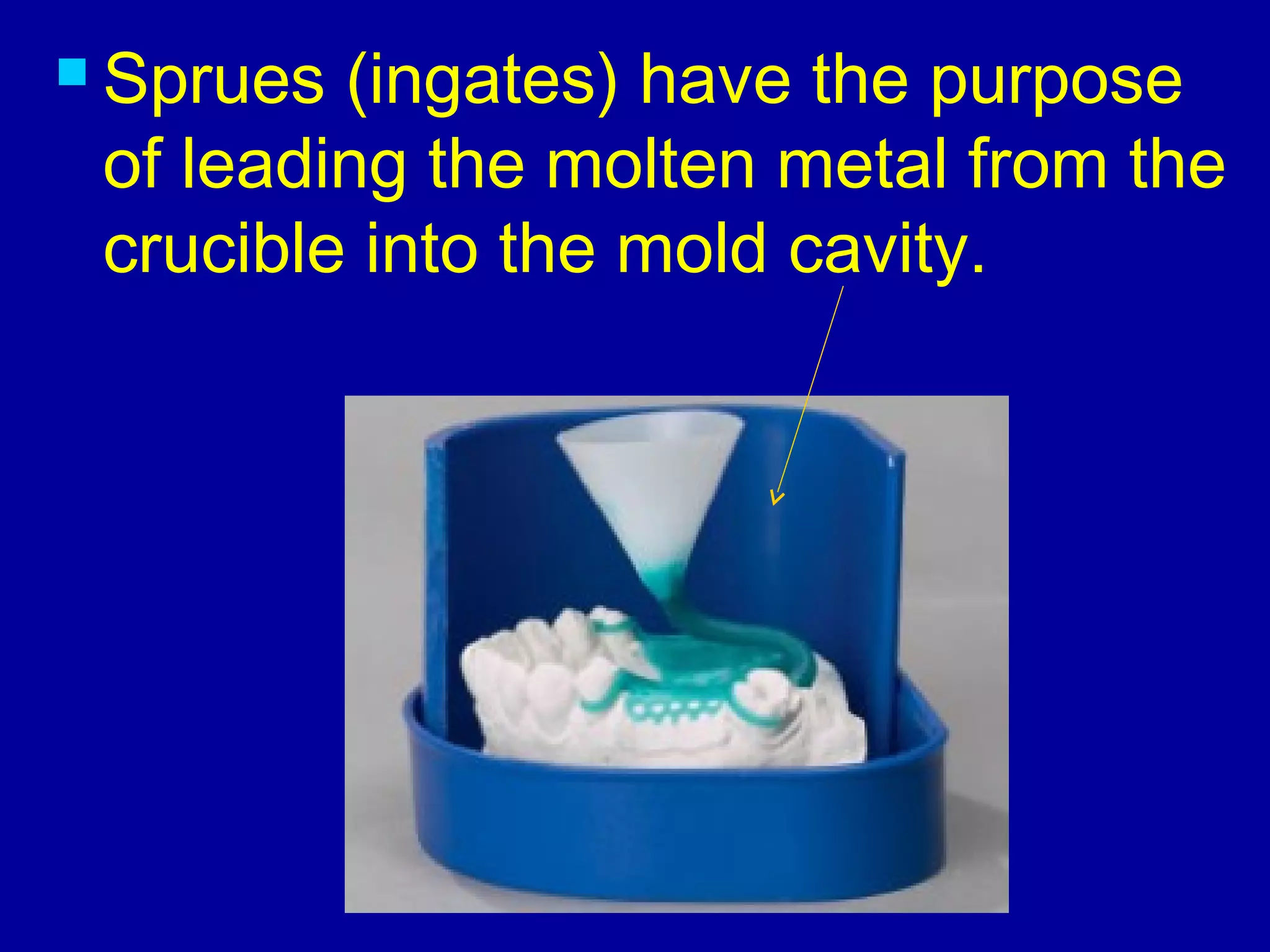
 Sprues (ingates) have the purpose
of leading the molten metal from the
crucible into the mold cavity.
.. For this purpose, they should be
large enough to accommodate
the entering molten metal and of
the proper shape to lead the
metal into the mold cavity as
quickly as possible.
..
 Sprues have the further purpose of
providing a reservoir of molten metal
from which the casting may draw during
solidification, thus preventing porosity
caused by shrinkage.
Thrad Dam in
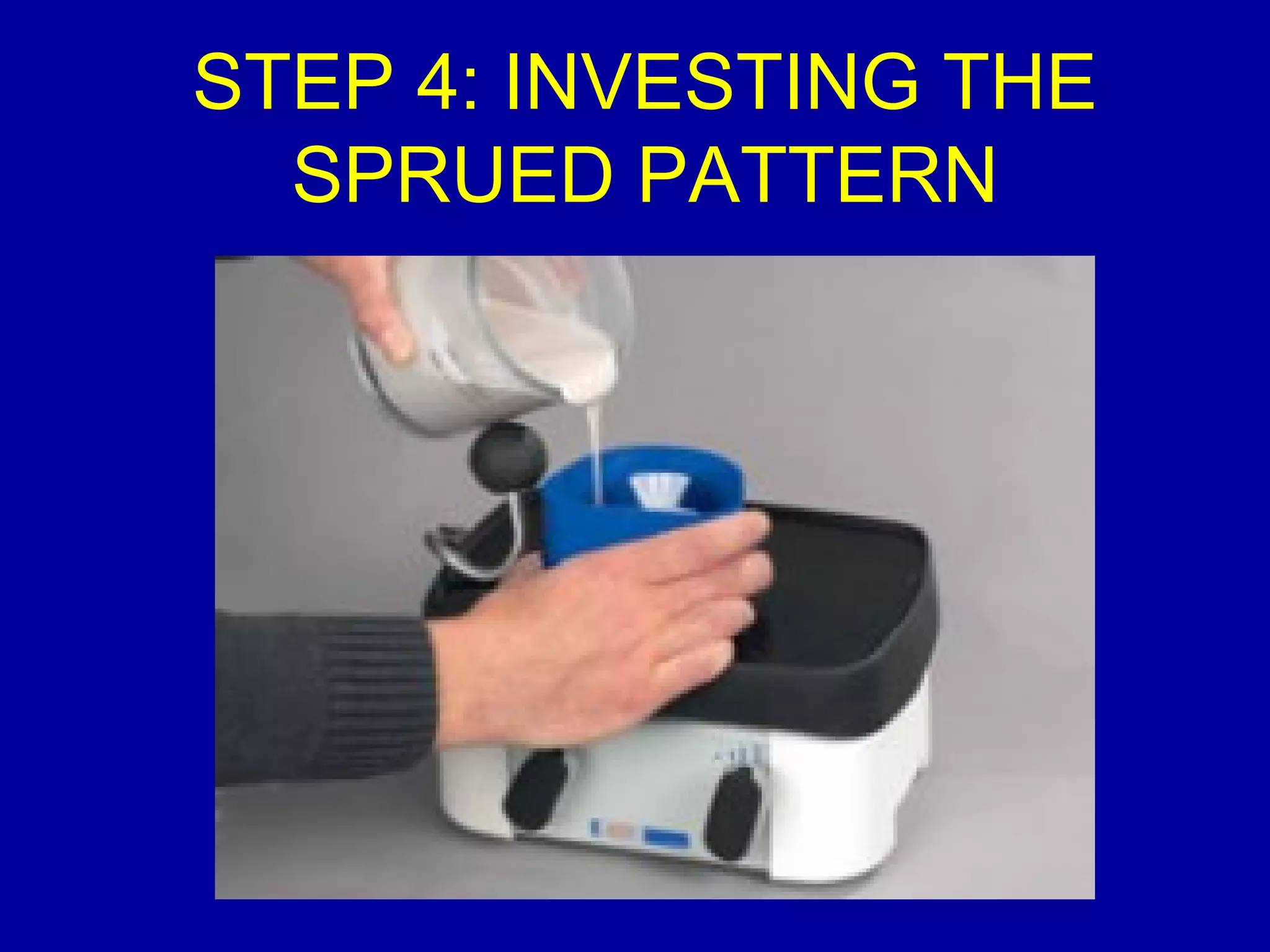
STEP 4: INVESTING THE
SPRUED PATTERN
..
 The investment for a removable
partial denture casting consists
of two parts: the investment cast
on which the pattern is formed,
..
 and the outer investment
surrounding the cast and
pattern. The outer investment is
confined within a metal ring or
silicone ring.
..
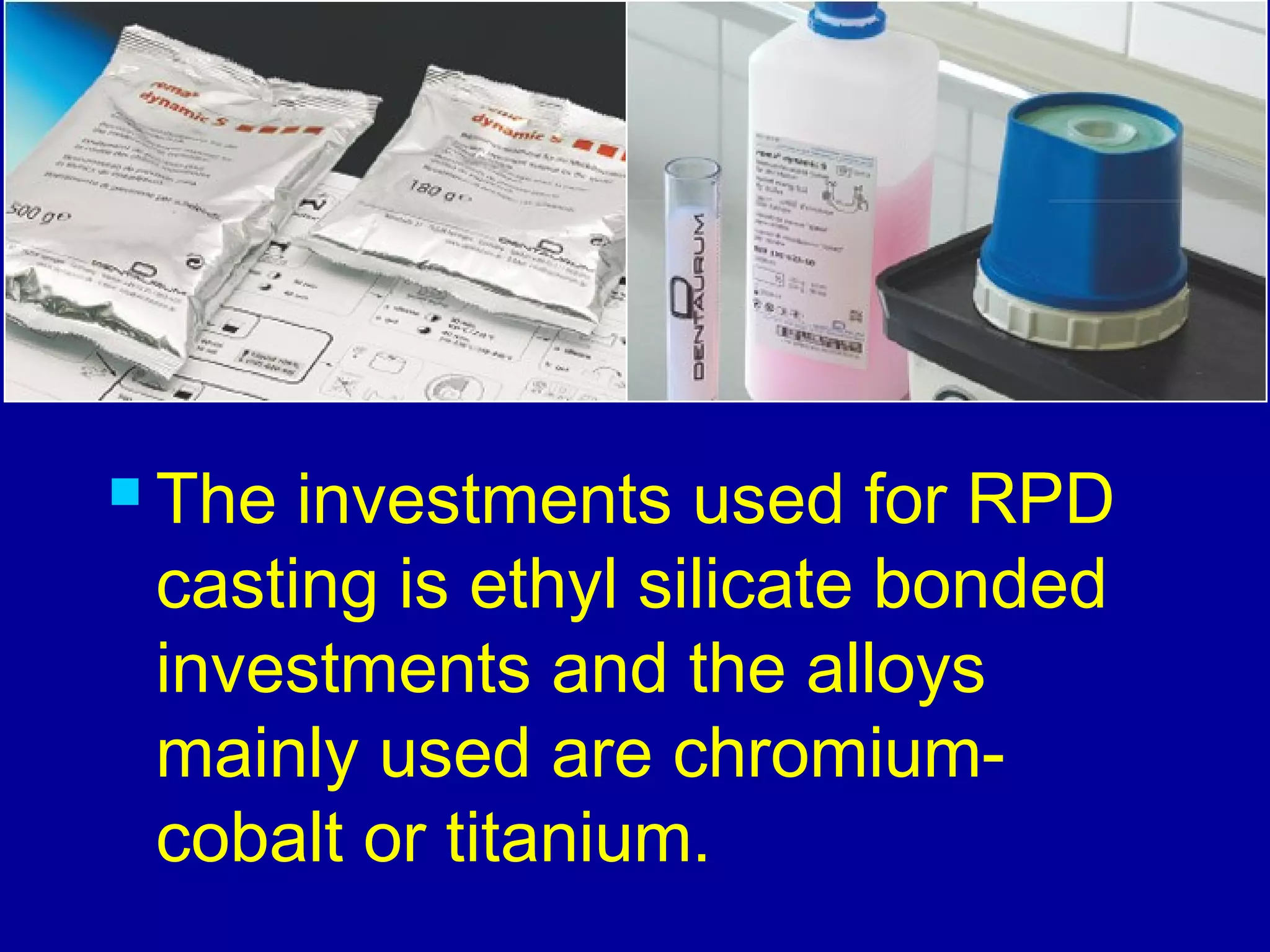
 The investments used for RPD
casting is ethyl silicate bonded
investments and the alloys
mainly used are chromium-
cobalt or titanium.
..
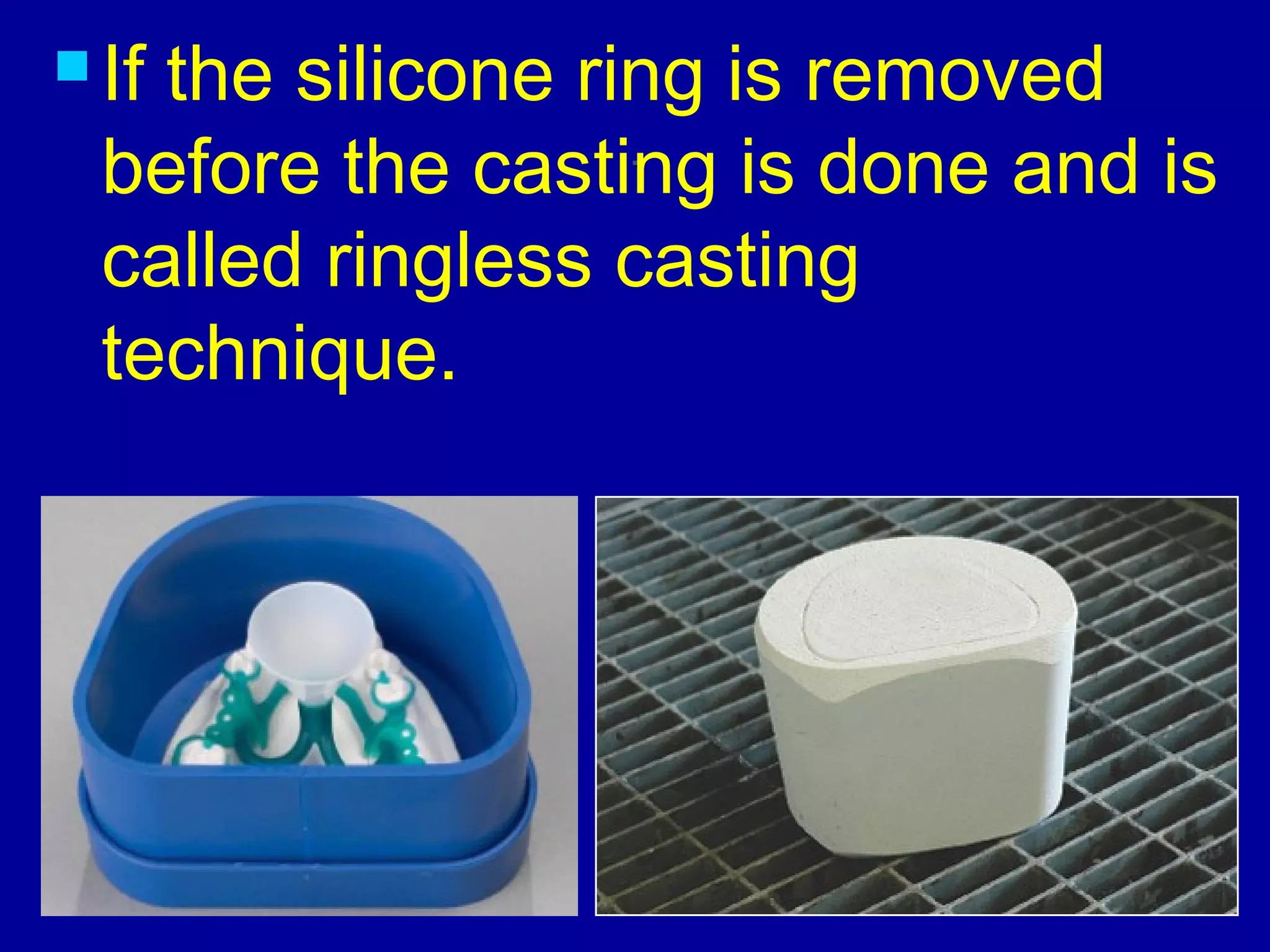
 If the silicone ring is removed
before the casting is done and is
called ringless casting
technique.
..
 If you use the metallic ring, it is
not removed.
STEP 5: BURNOUT
The burnout procedure serves three
purposes:
i. it drives off moisture in the mold;
ii. it vaporizes and thus eliminates the
pattern, leaving a cavity in the mold;
and
iii. it expands the mold to compensate
for contraction of the metal on cooling.
STEP 6: CASTING
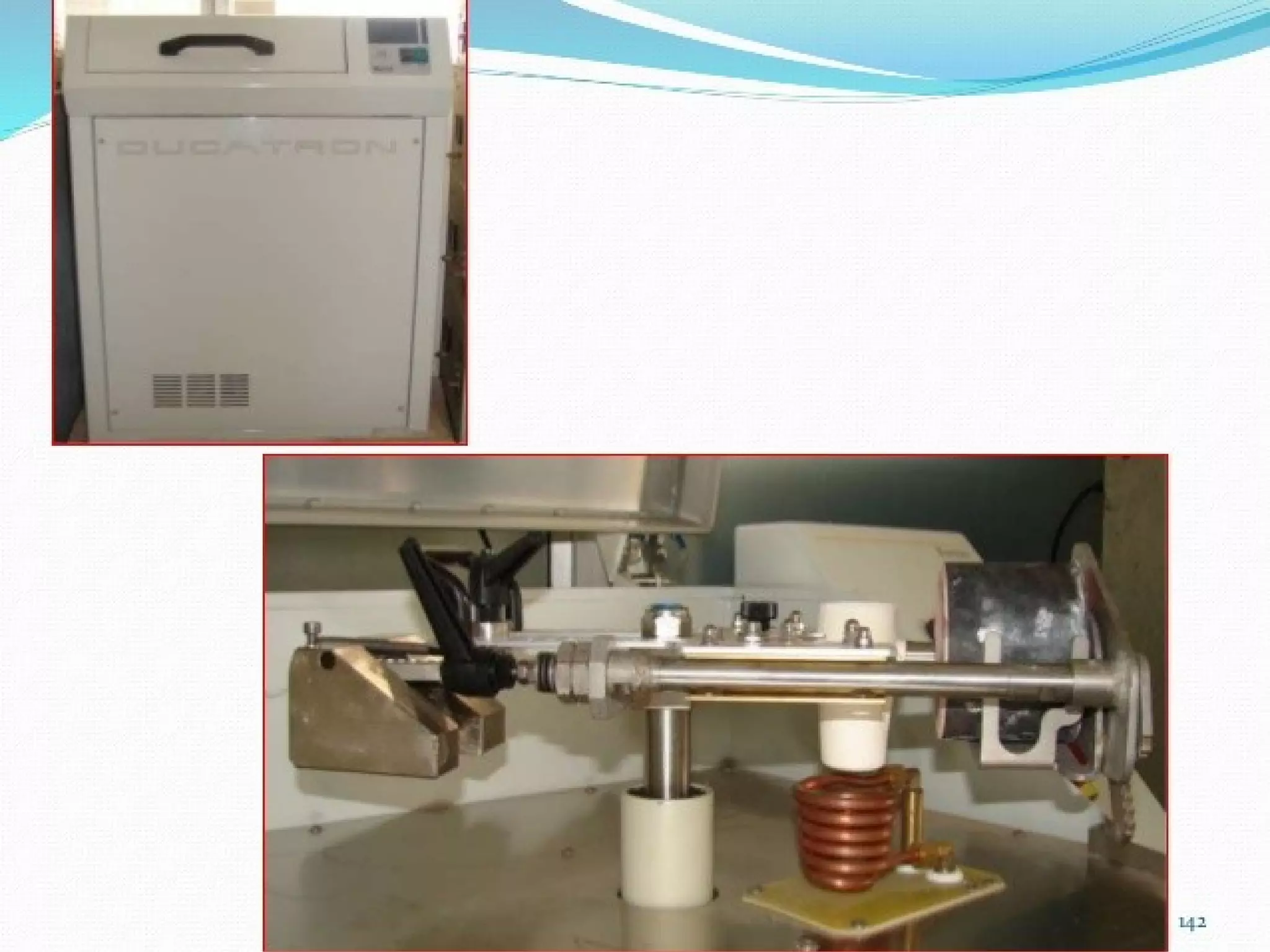
The metal is melted by an electric
muffle and the molten alloy is
forced into the mold cavity by
centrifugal force.
Dental laboratory casting[72
STEP 7: REMOVING THE
CASTING FROM THE
INVESTMENT (DIVESTING)
Once the alloy cools it is divested
and the remaining investment
material is sandblasted using
aluminum oxide.
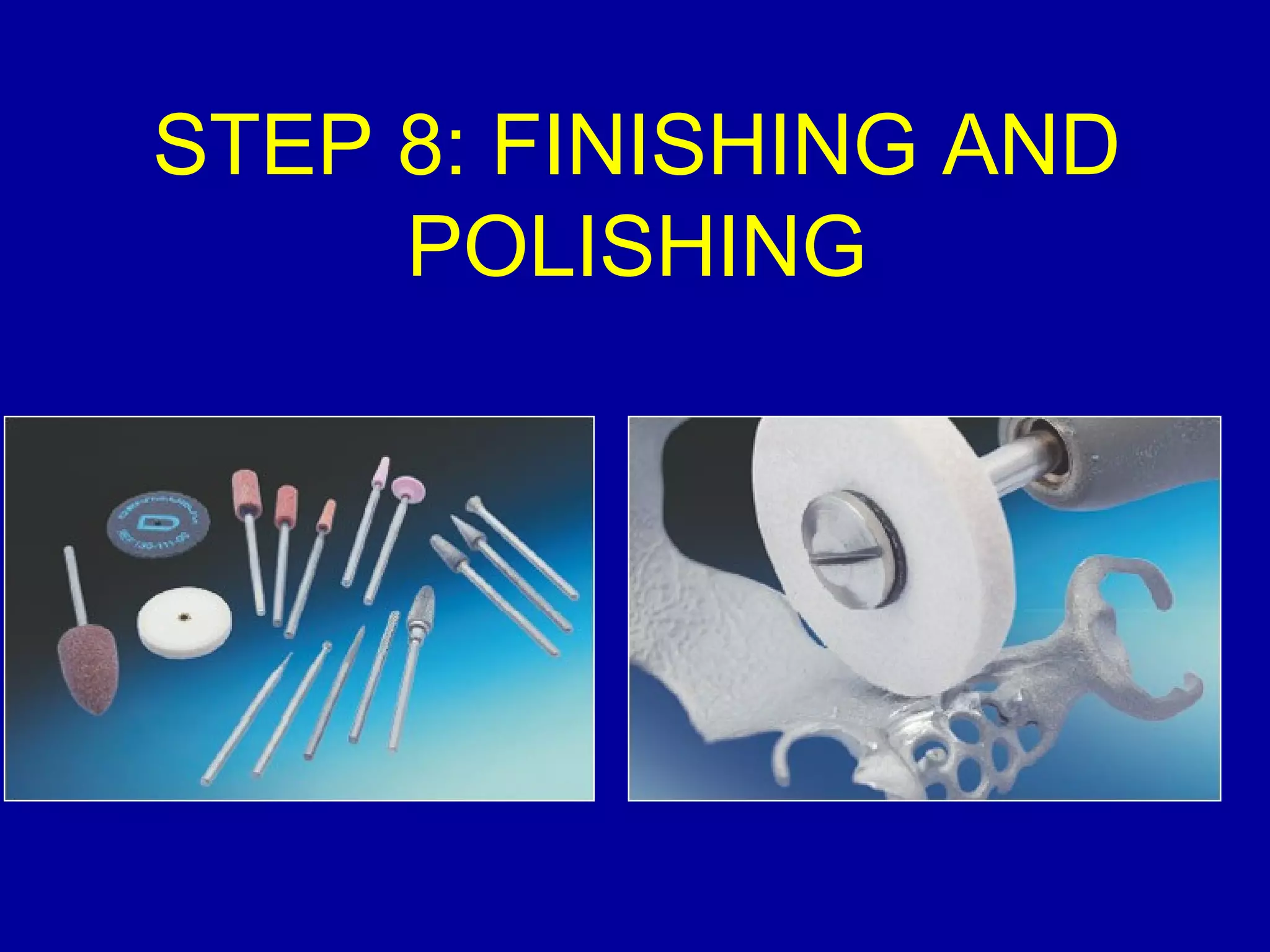
STEP 8: FINISHING AND
POLISHING
The following rules for finishing the casting
are important:
1. High speeds are preferable to low
speeds.
2. The wheels or points and the speed of
their rotation should do the cutting.
3. A definite sequence for finishing should
be adopted and followed for every
framework.
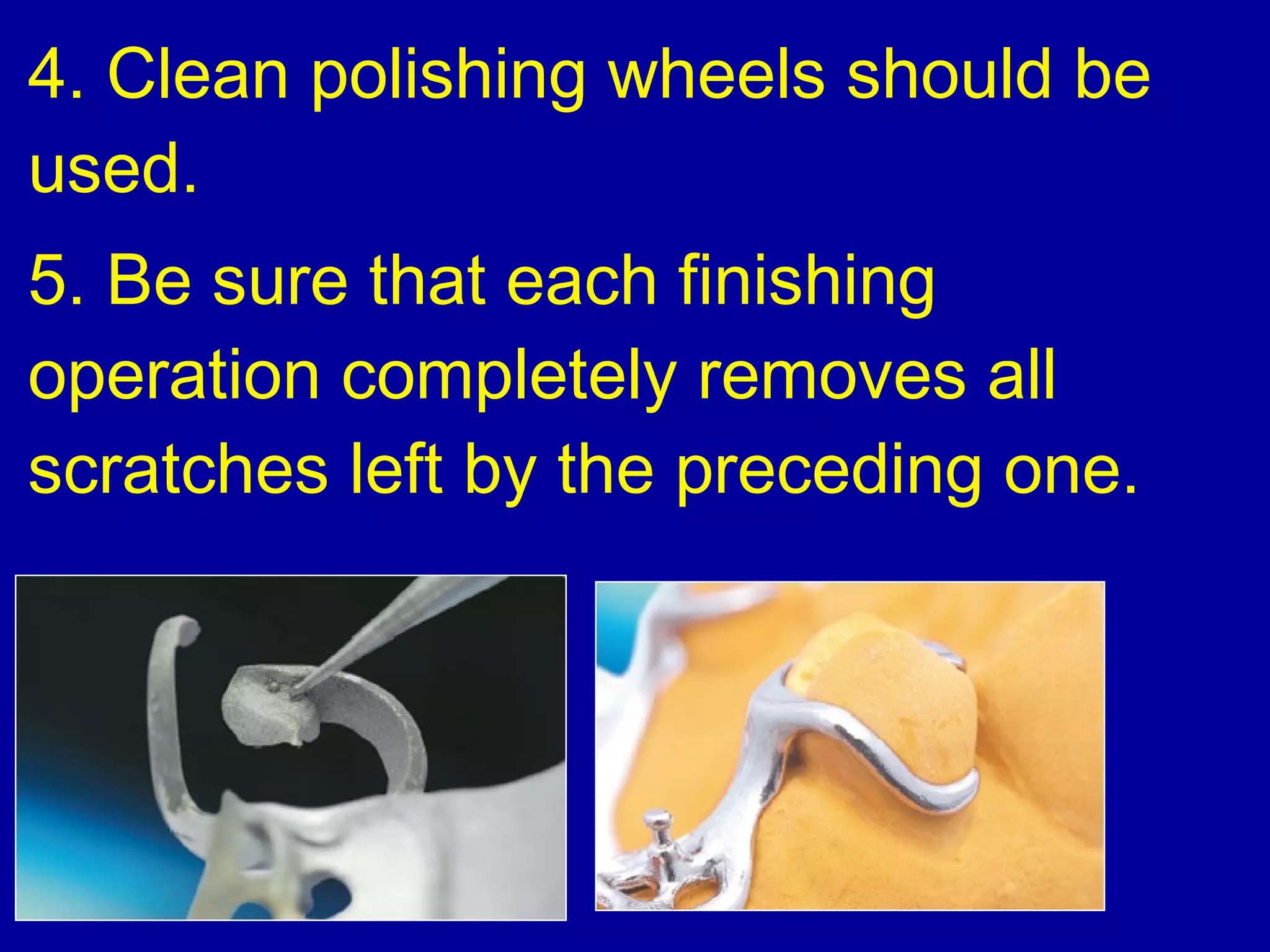
4. Clean polishing wheels should be
used.
5. Be sure that each finishing
operation completely removes all
scratches left by the preceding one.
Once the polishing with abrasives and
polishing agents are done then
electropolishing is done as a last step.
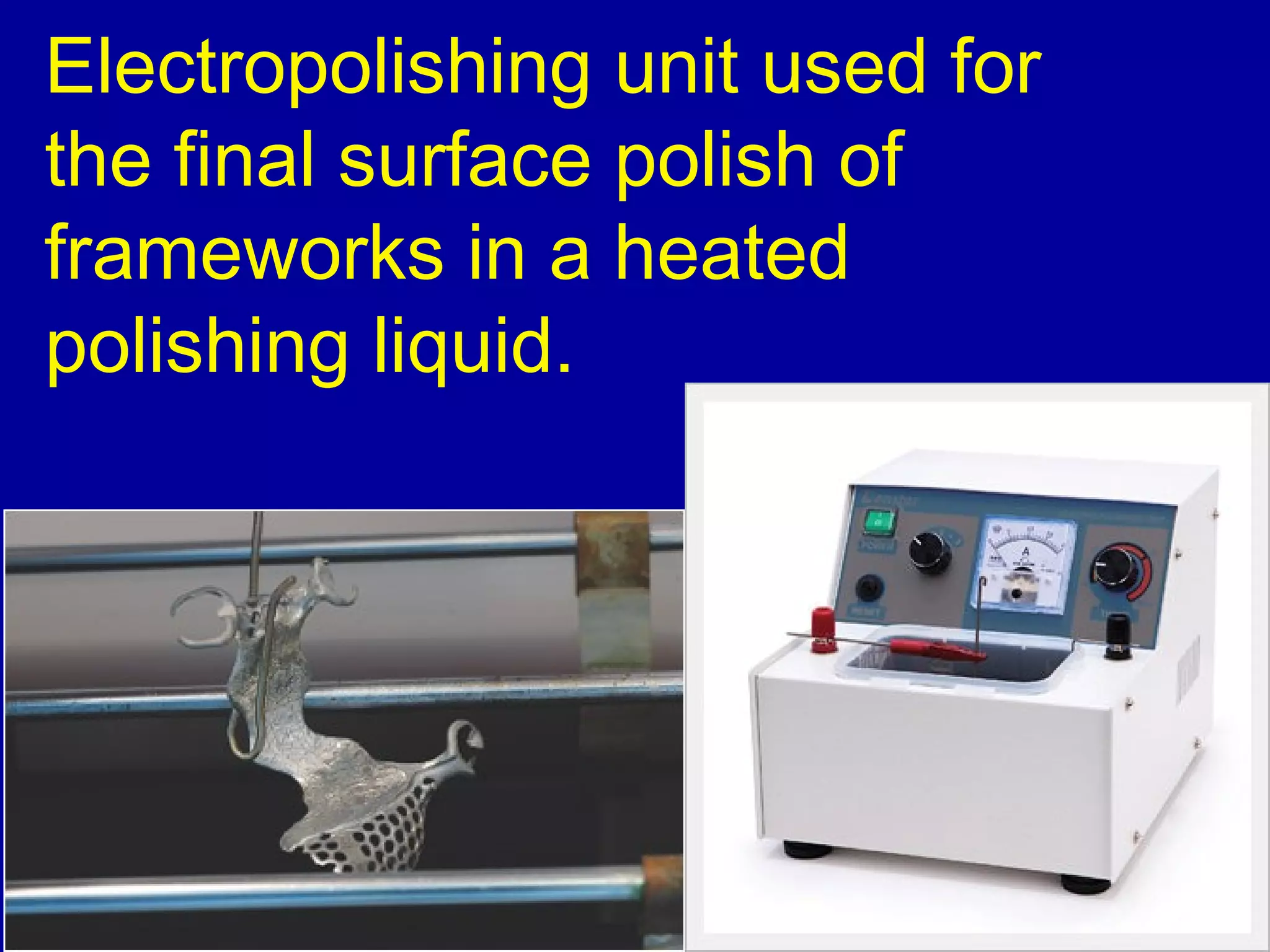
Electropolishing:The polishing occurs
in a bath of 85% orthophosphoric
acid, which is heated t o 49 °C
(120°F) t o 60 °C (140°F). The anode
is attached to the framework and is
immersed in the solution for 6
minutes.
Electropolishing unit used for
the final surface polish of
frameworks in a heated
polishing liquid.
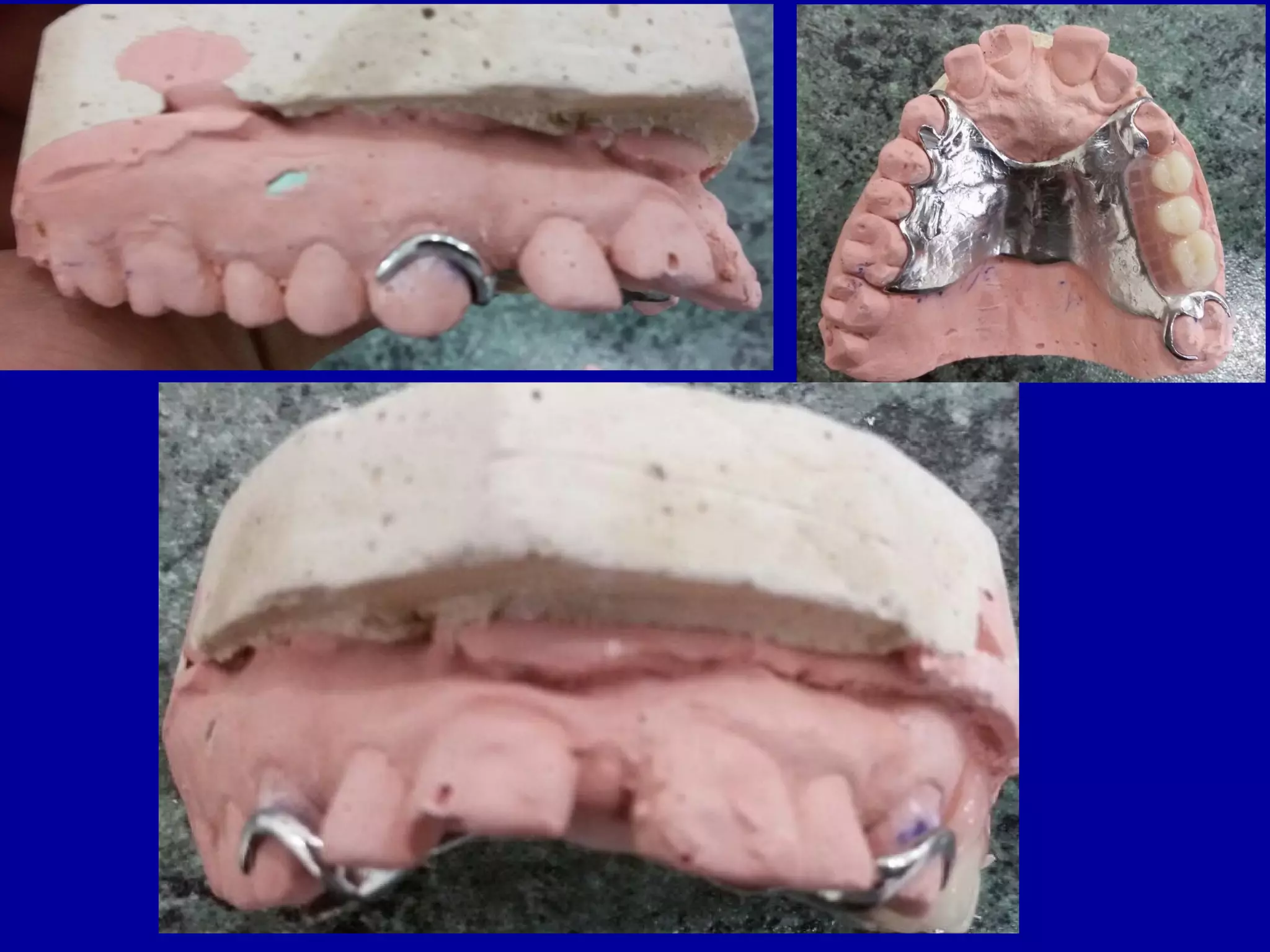
After electropolishing
 Try-in of framework is done in
patients mouth
http://www.remanium-
kompendium.de
Work Authorizations for
Removable Partial Dentures
Work Authorization
A work authorization contains
the written directions for
laboratory procedures to be
performed for fabrication of
dental restorations.
The responsibility of a dentist to
the public and to the dental
profession to safeguard the quality
of prosthodontic services is
controlled in part through
meaningful work authorizations.
 If work authorizations are
properly completed, they provide
a means for increased
professional quality assurance
and satisfaction in a removable
partial denture service.
Content
Information contained in a work
authorization should include the following:
1. the name and address of the dental
laboratory;
2. the name and address of the dentist
who initiates the work authorization;
3. the identification of the patient;
4. the date of work authorization;
5. the desired completion date of the
request;
6. specific instructions;
7. the signature of the dentist; and
8. the registered license number of
the dentist.
Function
The following four important functions
are performed by a work authorization:
1. It gives definite instructions for
laboratory procedures to be done and
implies an expectation of a level of
acceptable quality for the services
rendered.
2. It provides a means of protecting
the public from the illegal practice of
dentistry.
3. It is a protective legal document for
both the dentist and the dental
laboratory technician.
4. It completely delineates the
responsibilities of the dentist and the
dental laboratory technician.
Characteristics
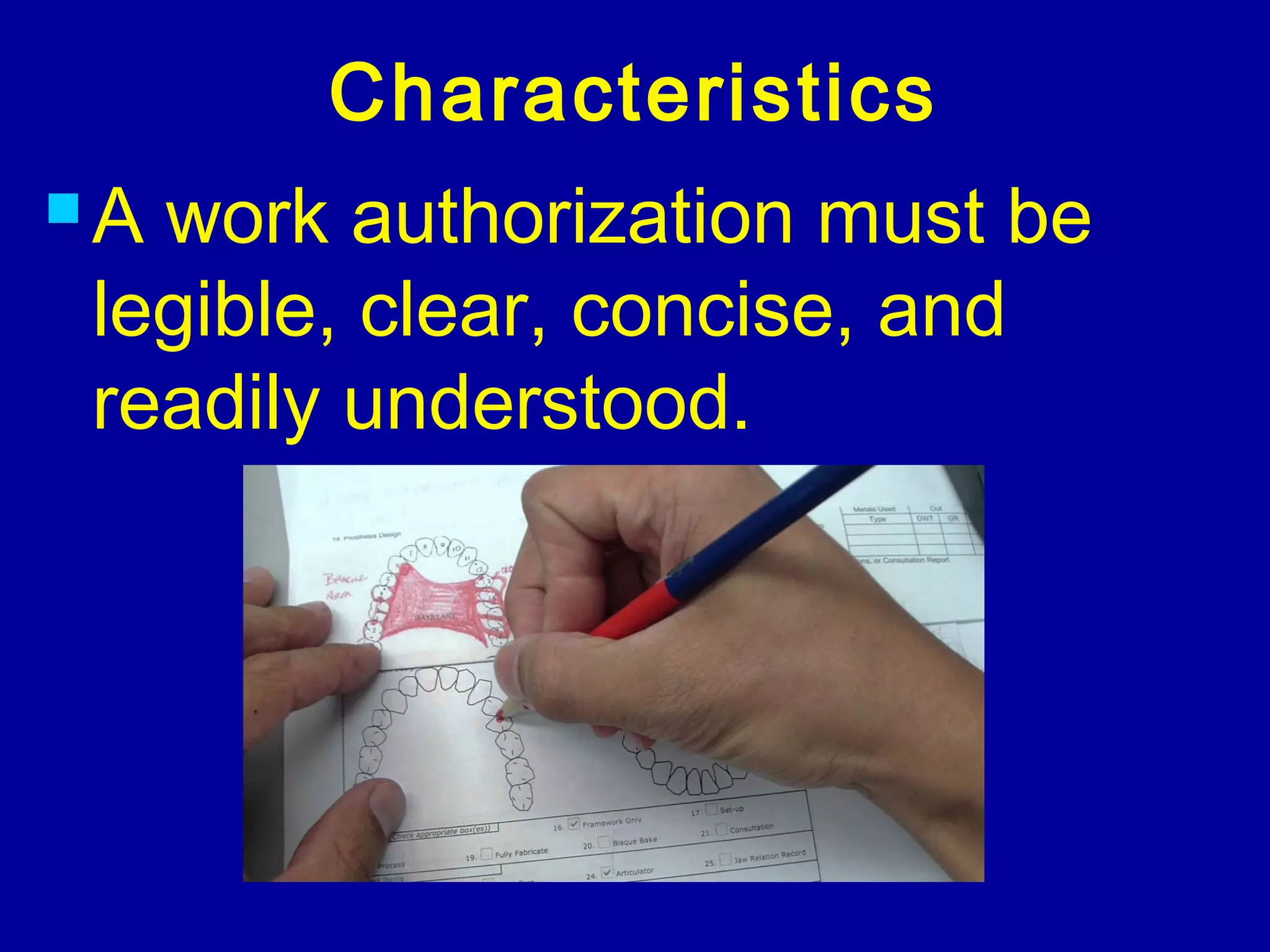
 A work authorization must be
legible, clear, concise, and
readily understood.
Questions?Questions?

27. rpd lab procedures

  • 2.
  • 3.
    Learning outcomes 1. Describethe laboratory steps in making a RPD. 2. Differentiate the types of block- out. 3. Describe what work authorization is. 4. List the functions work authorization
  • 4.
    Why we needto know lab procedures????
  • 5.
     Knowledge ofthe laboratory phase of partial denture construction is essential for the clinician, who must assume total responsibility for the design and the quality control of all aspects of its construction.
  • 6.
     It isimportant to have an understanding of the laboratory procedures involved.  1. This enables the dentist to design a RPD framework.  2. Complete a laboratory work authorization that tells a technician to design and make the framework and  3. Evaluate the quality of the framework.
  • 7.
    STEPS IN MAKINGA REMOVABLE PARTIAL DENTURE
  • 8.
    STEP 1: DUPLICATINGA STONE CAST
  • 9.
    A stone castmay be duplicated for many reasons: i. Preservation of original casts ii. Processing of interim prosthesis iii. To check the fit of the framework
  • 11.
    A stone castmay also be duplicated with block-out of wax for: Formation of investment (refractory) cast for framework fabrication
  • 12.
    Duplicating Materials and Flasks Duplicating materials are: 1. Colloidal (agar) 2. Silicone
  • 13.
     Colloidal materialsare made fluid by heating and return to gel while cooling. The cast to be duplicated must be placed in the bottom of a flask, called a duplicating flask.
  • 14.
    Duplicating Procedure: i. Blockouton the master cast with Ney blockout wax (can withstand high temperature)
  • 15.
    4 types ofblockout are there:  Paralleled Blockout,  Shaped Blockout,  Arbitrary Blockout, and  Relief
  • 16.
    Paralleled Blockout  Proximaltooth surfaces to be used as guiding planes and below height of contour.
  • 17.
  • 18.
    Shaped Blockout  Onbuccal and lingual surfaces to locate wax patterns for clasp arms.
  • 19.
    Arbitrary Blockout  Labialsurfaces and labial undercuts not involved in RPD design.
  • 20.
    Relief  Relief waxis placed in the edentulous areas  Beneath lingual bar connectors  Areas in contact with thin tissues
  • 21.
  • 23.
    ii. Attach castto the bottom of the flask so that it does not move
  • 24.
  • 26.
  • 28.
    Making refractory cast(investment cast) - can withstand high temperature
  • 29.
    Investment cast Drythe cast Dip it in hardener Hardened refractory cast
  • 30.
    STEP 2: WAXINGTHE REMOVABLE PARTIAL DENTURE FRAMEWORK Preformed wax patterns
  • 31.
     Preformed plasticwax patterns are available which are made from soft plastic material which tend to stretch on removal from their backing.
  • 32.
    Design Transfer: Beforethe actual waxing can begin, the design must once again be transferred on the refractory cast (beading the master cast helps in this procedure).
  • 34.
    Wrought wire: canbe made at the time of wax patterns or soldered to the framework
  • 35.
  • 36.
    ..  Sprues (ingates)have the purpose of leading the molten metal from the crucible into the mold cavity.
  • 37.
    .. For thispurpose, they should be large enough to accommodate the entering molten metal and of the proper shape to lead the metal into the mold cavity as quickly as possible.
  • 38.
    ..  Sprues havethe further purpose of providing a reservoir of molten metal from which the casting may draw during solidification, thus preventing porosity caused by shrinkage. Thrad Dam in
  • 40.
    STEP 4: INVESTINGTHE SPRUED PATTERN
  • 41.
    ..  The investmentfor a removable partial denture casting consists of two parts: the investment cast on which the pattern is formed,
  • 42.
    ..  and theouter investment surrounding the cast and pattern. The outer investment is confined within a metal ring or silicone ring.
  • 43.
    ..  The investmentsused for RPD casting is ethyl silicate bonded investments and the alloys mainly used are chromium- cobalt or titanium.
  • 44.
    ..  If thesilicone ring is removed before the casting is done and is called ringless casting technique.
  • 45.
    ..  If youuse the metallic ring, it is not removed.
  • 47.
  • 48.
    The burnout procedureserves three purposes: i. it drives off moisture in the mold; ii. it vaporizes and thus eliminates the pattern, leaving a cavity in the mold; and iii. it expands the mold to compensate for contraction of the metal on cooling.
  • 49.
  • 50.
    The metal ismelted by an electric muffle and the molten alloy is forced into the mold cavity by centrifugal force.
  • 53.
  • 54.
    STEP 7: REMOVINGTHE CASTING FROM THE INVESTMENT (DIVESTING)
  • 55.
    Once the alloycools it is divested and the remaining investment material is sandblasted using aluminum oxide.
  • 56.
    STEP 8: FINISHINGAND POLISHING
  • 57.
    The following rulesfor finishing the casting are important: 1. High speeds are preferable to low speeds. 2. The wheels or points and the speed of their rotation should do the cutting. 3. A definite sequence for finishing should be adopted and followed for every framework.
  • 58.
    4. Clean polishingwheels should be used. 5. Be sure that each finishing operation completely removes all scratches left by the preceding one.
  • 59.
    Once the polishingwith abrasives and polishing agents are done then electropolishing is done as a last step.
  • 60.
    Electropolishing:The polishing occurs ina bath of 85% orthophosphoric acid, which is heated t o 49 °C (120°F) t o 60 °C (140°F). The anode is attached to the framework and is immersed in the solution for 6 minutes.
  • 61.
    Electropolishing unit usedfor the final surface polish of frameworks in a heated polishing liquid.
  • 62.
    After electropolishing  Try-inof framework is done in patients mouth
  • 63.
  • 64.
  • 66.
    Work Authorization A workauthorization contains the written directions for laboratory procedures to be performed for fabrication of dental restorations.
  • 68.
    The responsibility ofa dentist to the public and to the dental profession to safeguard the quality of prosthodontic services is controlled in part through meaningful work authorizations.
  • 70.
     If workauthorizations are properly completed, they provide a means for increased professional quality assurance and satisfaction in a removable partial denture service.
  • 72.
    Content Information contained ina work authorization should include the following: 1. the name and address of the dental laboratory; 2. the name and address of the dentist who initiates the work authorization; 3. the identification of the patient; 4. the date of work authorization;
  • 73.
    5. the desiredcompletion date of the request; 6. specific instructions; 7. the signature of the dentist; and 8. the registered license number of the dentist.
  • 74.
    Function The following fourimportant functions are performed by a work authorization: 1. It gives definite instructions for laboratory procedures to be done and implies an expectation of a level of acceptable quality for the services rendered.
  • 75.
    2. It providesa means of protecting the public from the illegal practice of dentistry. 3. It is a protective legal document for both the dentist and the dental laboratory technician. 4. It completely delineates the responsibilities of the dentist and the dental laboratory technician.
  • 76.
    Characteristics  A workauthorization must be legible, clear, concise, and readily understood.
  • 77.

Editor's Notes

  • #17 They do require the use of the surveyor. Hard inlay wax may be used satisfactorily as a blockout material. It is easily applied and is easily trimmed with the surveyor blade. Trimming is facilitated by slightly warming the surveyor blade with an alcohol torch. Whereas it is true that any wax will melt more readily than a wax-clay mixture if the temperature of the duplicating material is too high, it should be presumed that the duplicating material will not be used at such an elevated temperature.
  • #19 They do require the use of the surveyor. Hard inlay wax may be used satisfactorily as a blockout material. It is easily applied and is easily trimmed with the surveyor blade. Trimming is facilitated by slightly warming the surveyor blade with an alcohol torch. Whereas it is true that any wax will melt more readily than a wax-clay mixture if the temperature of the duplicating material is too high, it should be presumed that the duplicating material will not be used at such an elevated temperature.
  • #20 They do require the use of the surveyor. Hard inlay wax may be used satisfactorily as a blockout material. It is easily applied and is easily trimmed with the surveyor blade. Trimming is facilitated by slightly warming the surveyor blade with an alcohol torch. Whereas it is true that any wax will melt more readily than a wax-clay mixture if the temperature of the duplicating material is too high, it should be presumed that the duplicating material will not be used at such an elevated temperature.
  • #21 They do require the use of the surveyor. Hard inlay wax may be used satisfactorily as a blockout material. It is easily applied and is easily trimmed with the surveyor blade. Trimming is facilitated by slightly warming the surveyor blade with an alcohol torch. Whereas it is true that any wax will melt more readily than a wax-clay mixture if the temperature of the duplicating material is too high, it should be presumed that the duplicating material will not be used at such an elevated temperature.
  • #61 positive terminal is the anode, the cathode is the negative terminal