REST AND REST
SEAT
1. Define a rest and list its functions.
2. Explain the different types of rests
for posterior and anterior teeth.
3. Describe the dimensions of all the
types of rests.
Components of a RPD
1. Major connectors
2. Minor connectors
3. Rests
4. Direct retainers
5. Indirect retainers
(CLASS I AND CLASS II ONLY)
6. Denture bases
7. Teeth
 Forces that are
applied to a
removable partial
denture must be
transferred to the
supporting teeth and
tissues in an
atraumatic fashion.
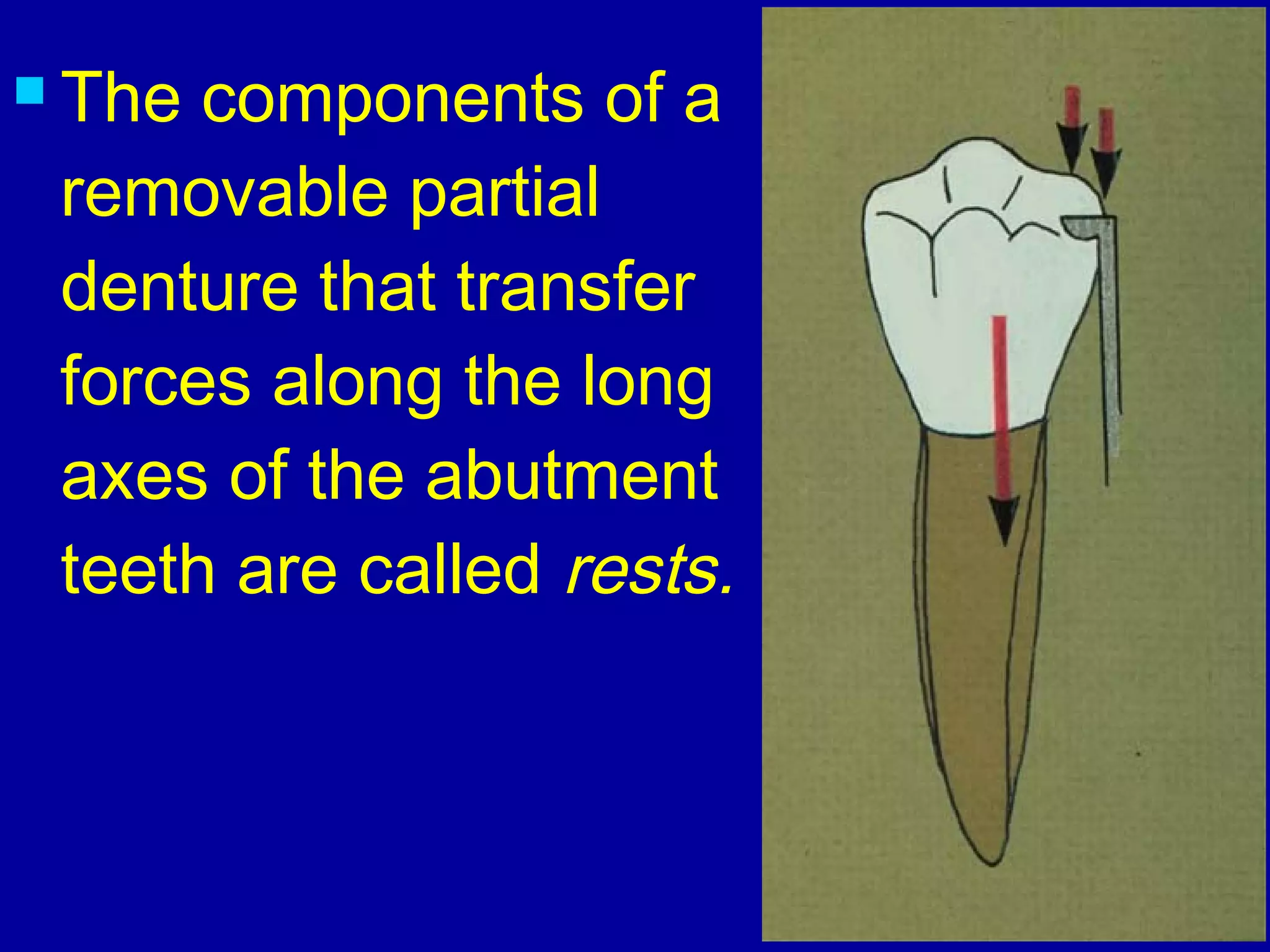
 The components of a
removable partial
denture that transfer
forces along the long
axes of the abutment
teeth are called rests.
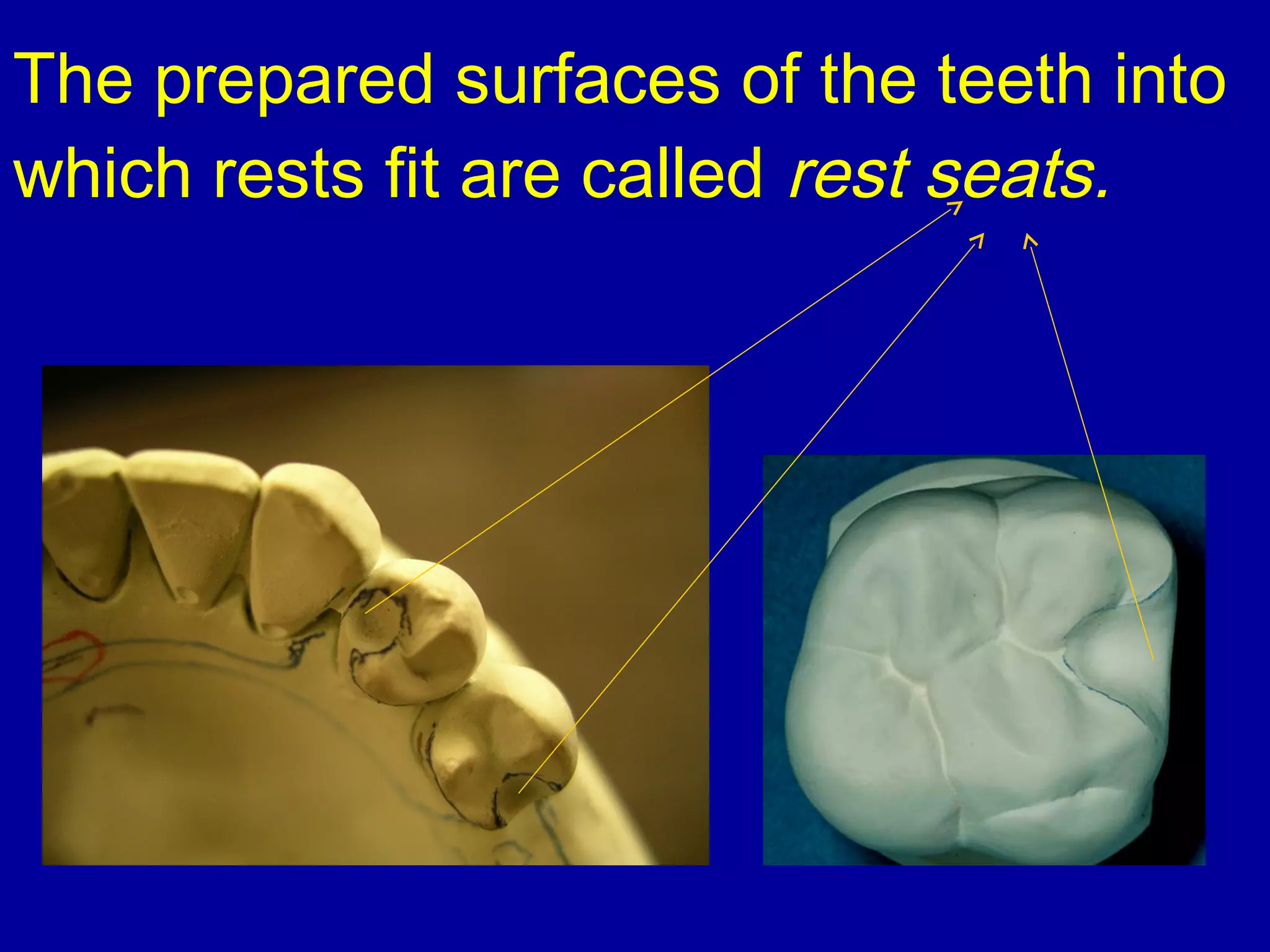
The prepared surfaces of the teeth into
which rests fit are called rest seats.
 The relationship between a rest and
a rest seat must be such that forces
transmitted from the prosthesis to
an abutment are directed apically
down the long axis of the tooth.
 In this manner, stress
can be absorbed by
the fibers of the
periodontal ligament
without damaging the
ligament or the
supporting bone.
 In the case of a tooth-supported
removable partial denture, all the
stresses are transferred to the
abutment teeth.
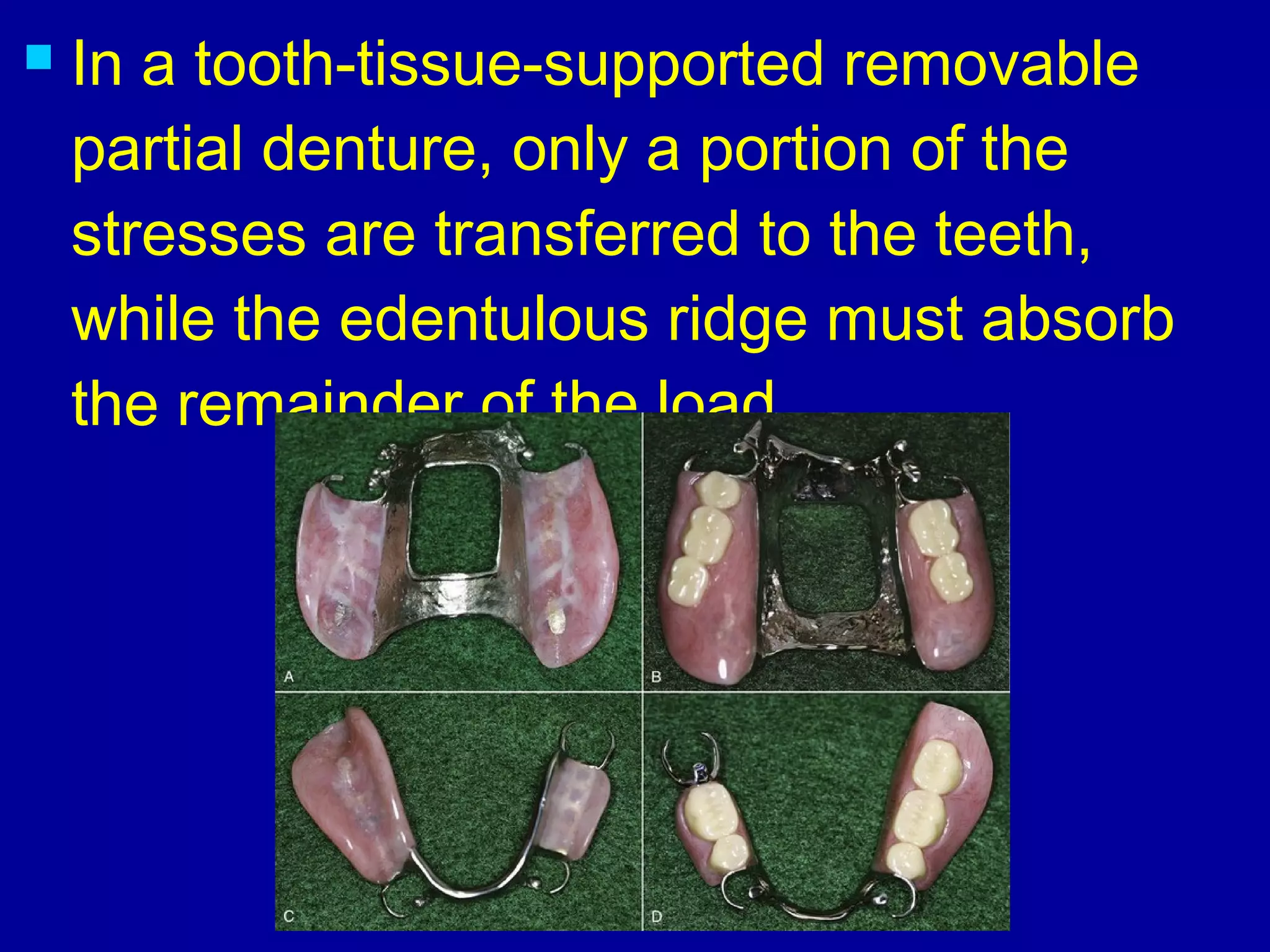
 In a tooth-tissue-supported removable
partial denture, only a portion of the
stresses are transferred to the teeth,
while the edentulous ridge must absorb
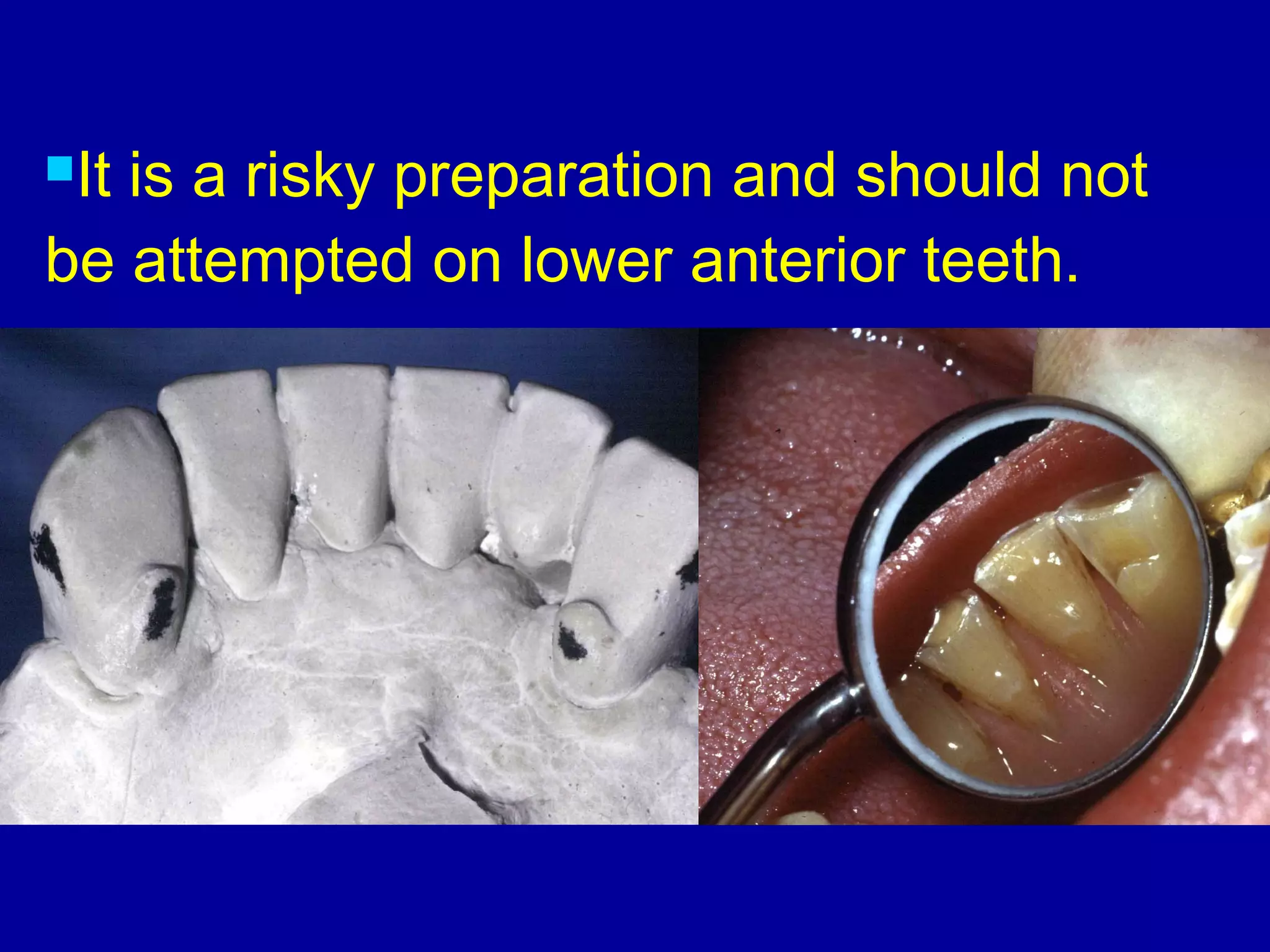
the remainder of the load.
 In addition to transferring forces, each
rest should serve as a vertical stop for
the prosthesis. Firm, positive contact
between a rest and rest seat minimizes
vertical displacement of the prosthesis
and prevents injury to the soft tissues.
 The primary purpose of the rest is to
provide vertical support for the
partial denture. In doing so, it also
does the following:
1. Maintains components in their
planned positions
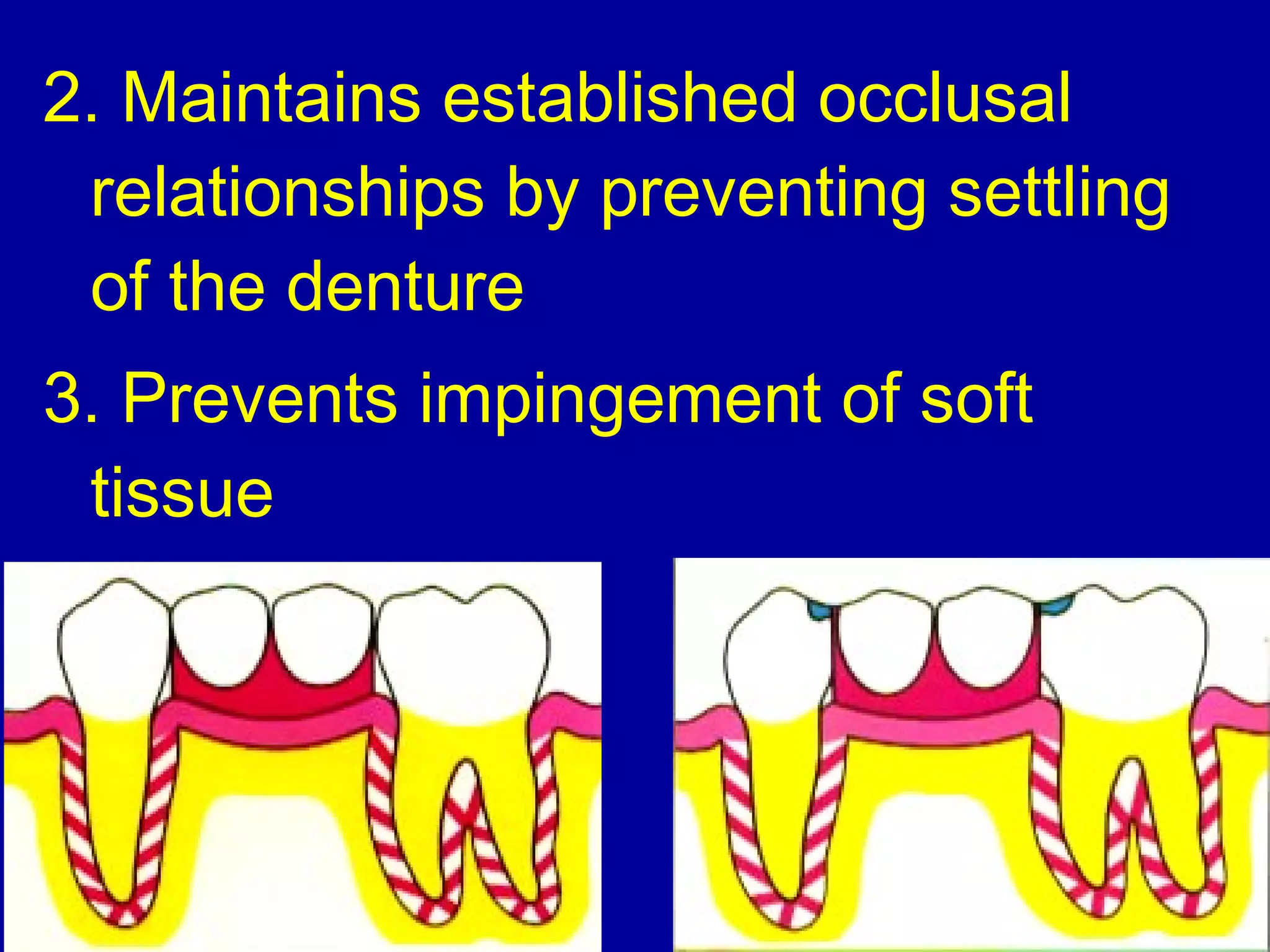
2. Maintains established occlusal
relationships by preventing settling
of the denture
3. Prevents impingement of soft
tissue
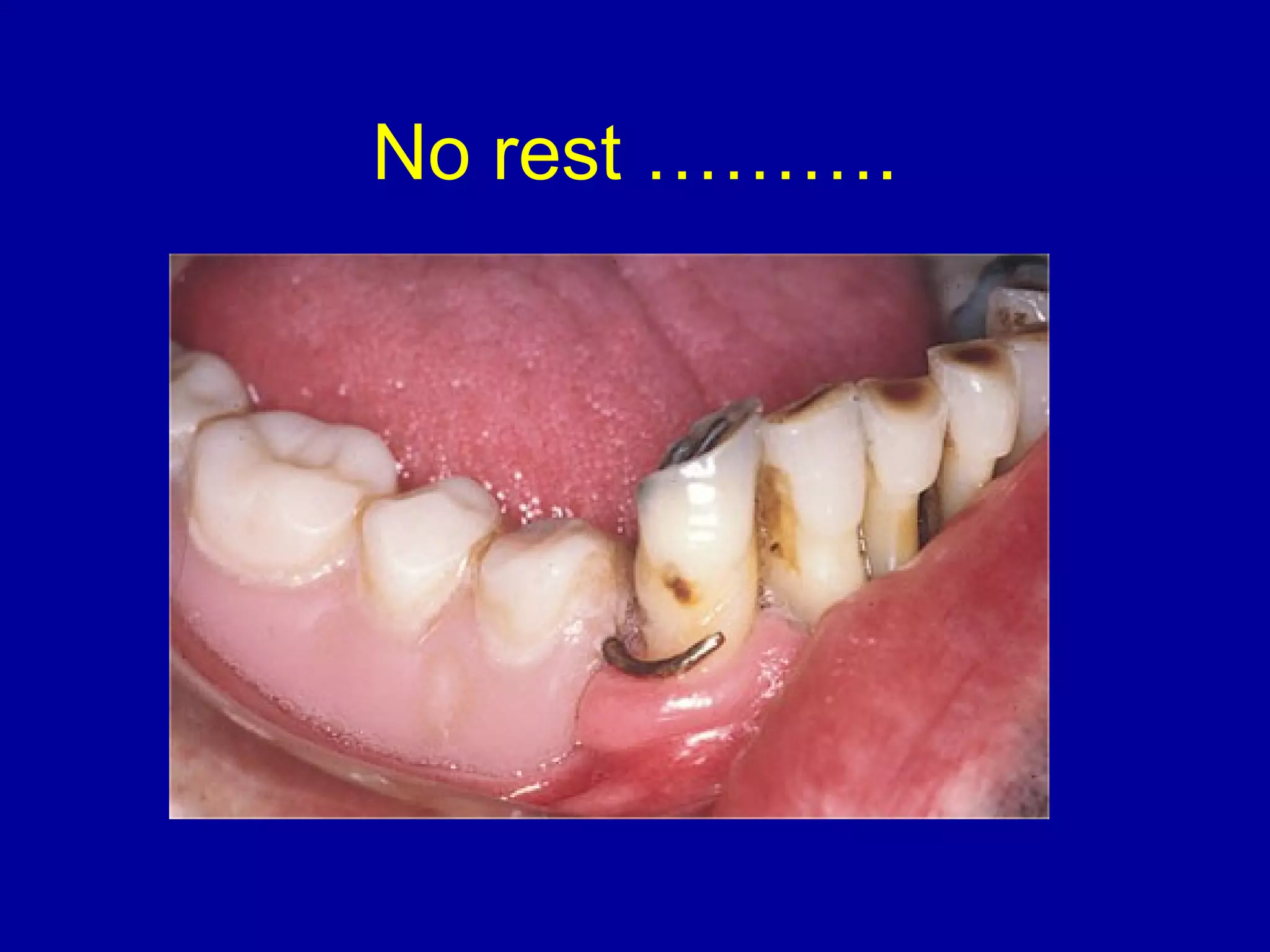
No rest ……….
impingement of soft
tissue
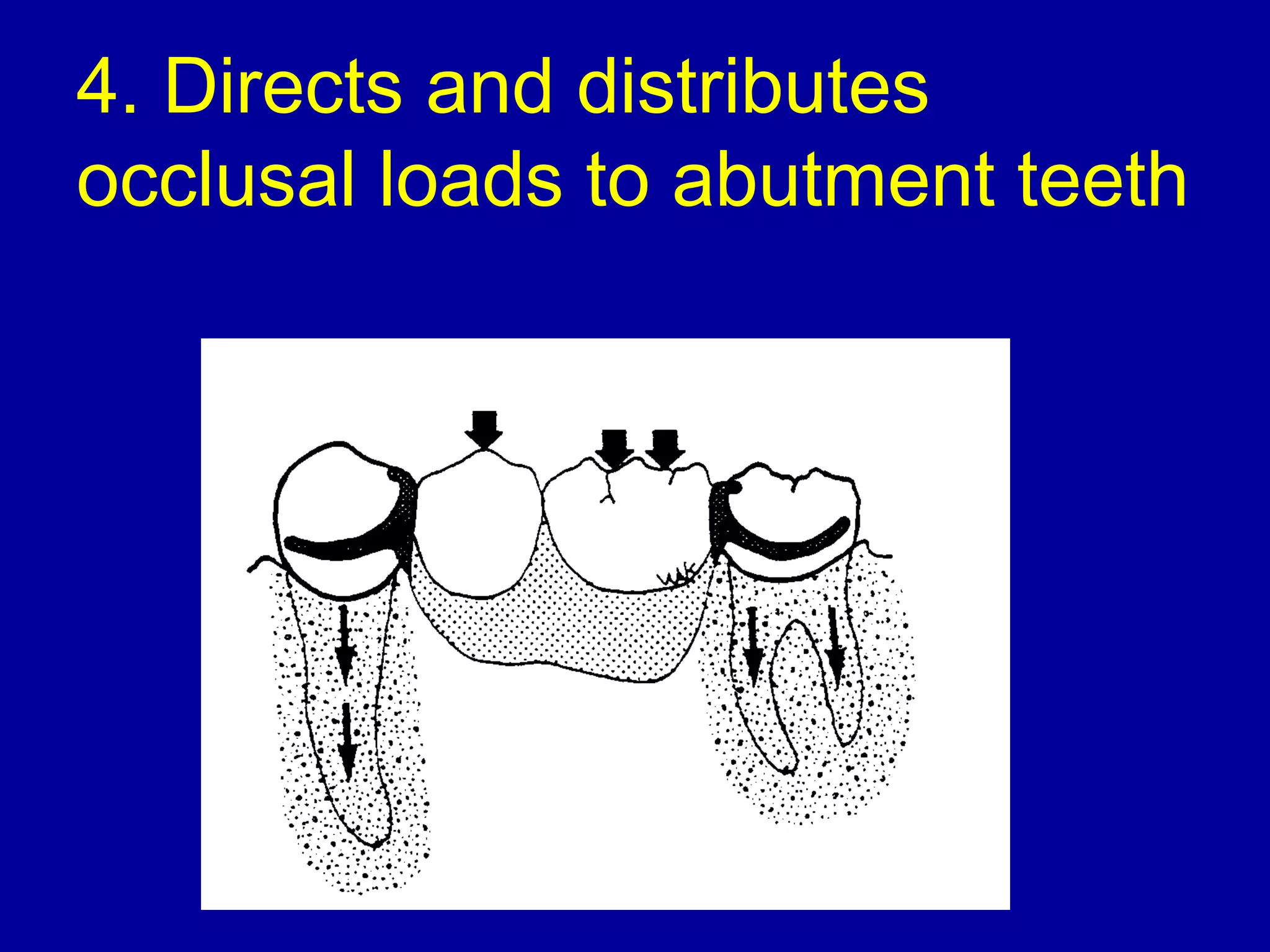
4. Directs and distributes
occlusal loads to abutment teeth
 A rest that is part of a retentive
clasp assembly is referred to
as a primary rest.
Reciprocal Arm
Occlusal Rest
Retentive ArmMinor connector
The functional elements of the
clasp
2020
Direct retainer
Retentive arm
Reciprocal arm
Occlusal
rest
Minor connector
2121
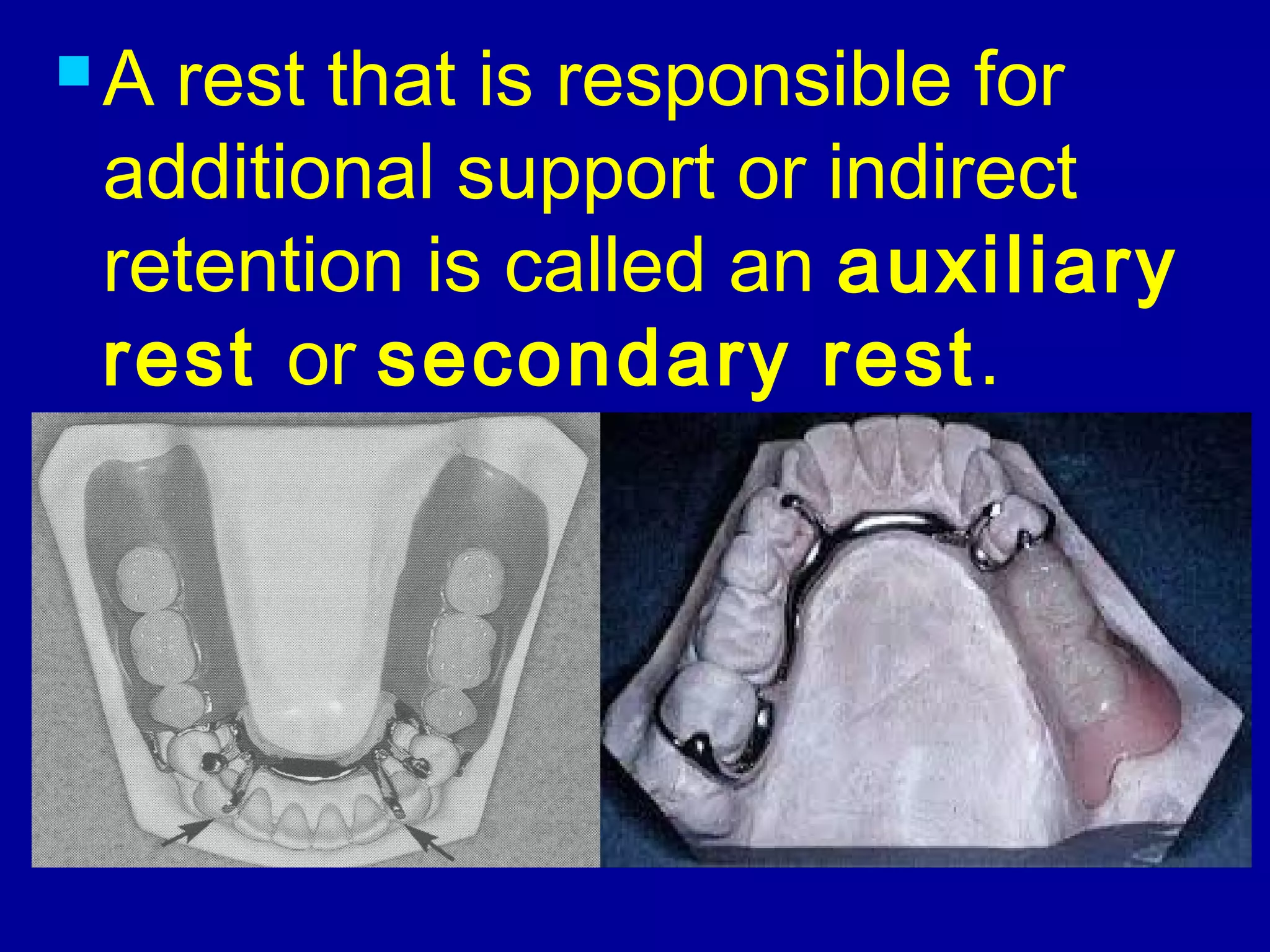
 A rest that is responsible for
additional support or indirect
retention is called an auxiliary
rest or secondary rest.
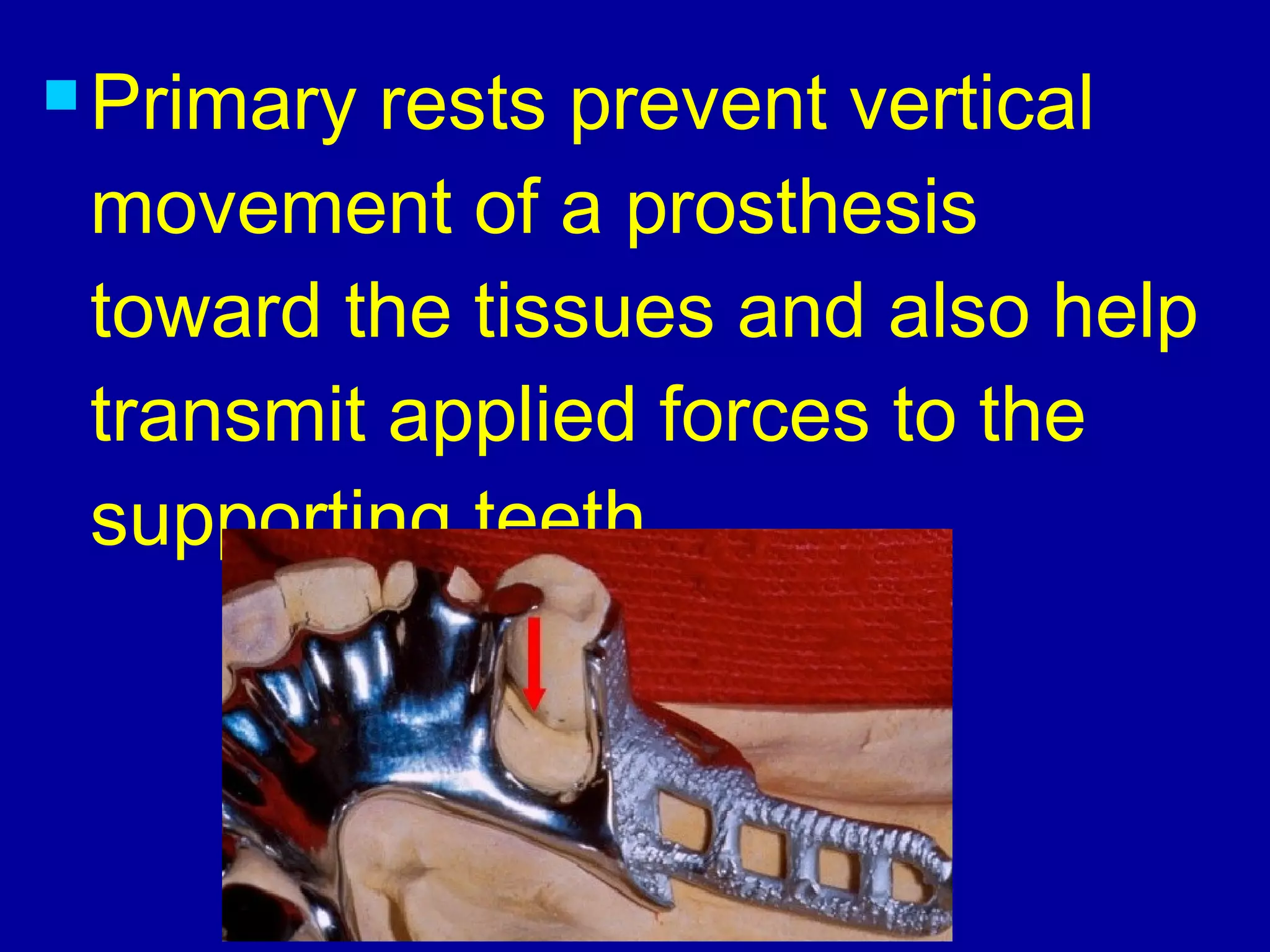
 Primary rests prevent vertical
movement of a prosthesis
toward the tissues and also help
transmit applied forces to the
supporting teeth.
 Rest seats should be shallow and
saucer shaped, and should function
as ball-and-socket joints. This
geometry permits dissipation of
potentially harmful lateral forces.
Saucer shaped
 Auxiliary or secondary rests are used
as indirect retainers in extension
base removable partial dentures
(Class I, Class II, and long-span
Class IV applications).
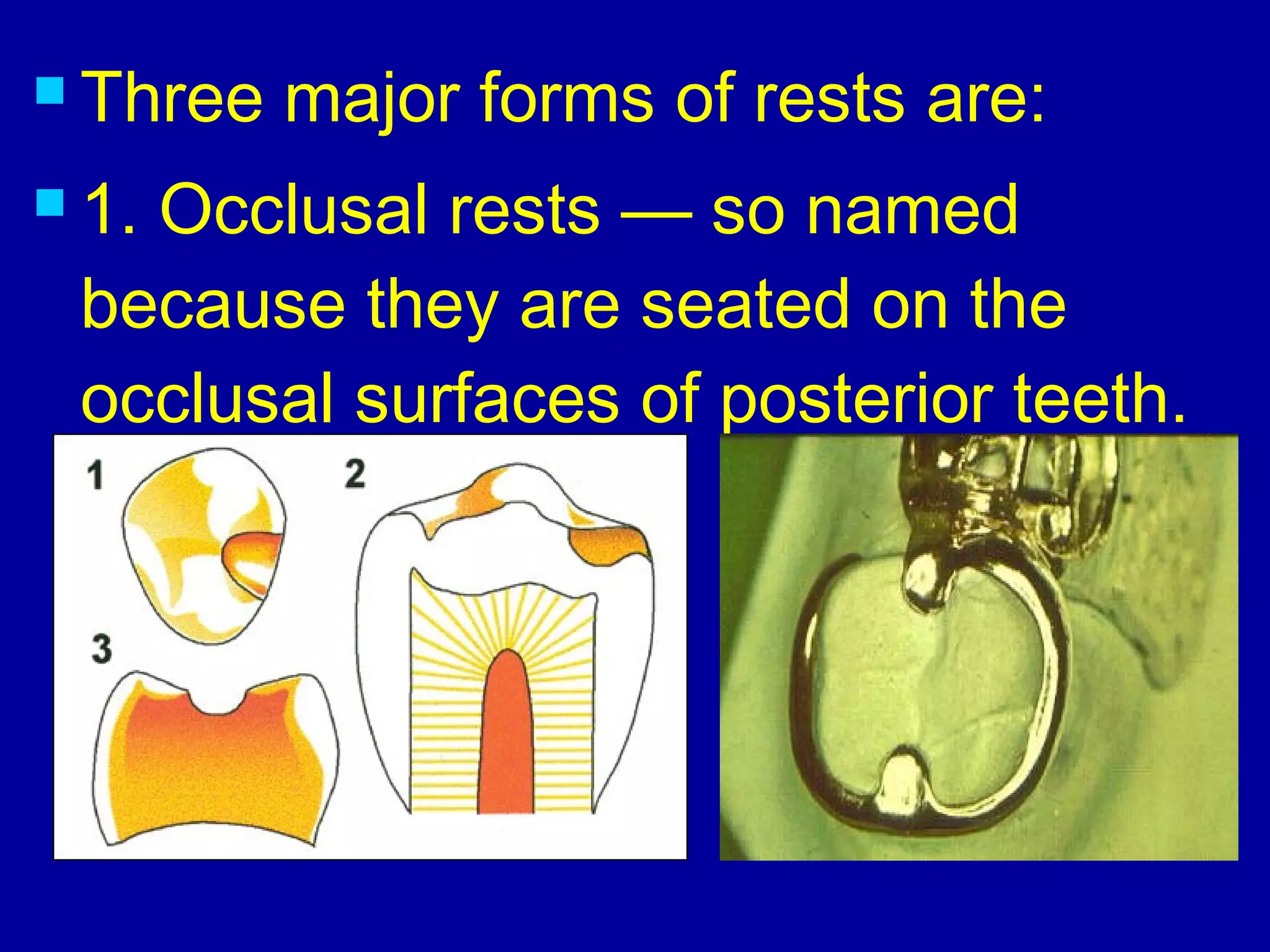
 Three major forms of rests are:
 1. Occlusal rests — so named
because they are seated on the
occlusal surfaces of posterior teeth.
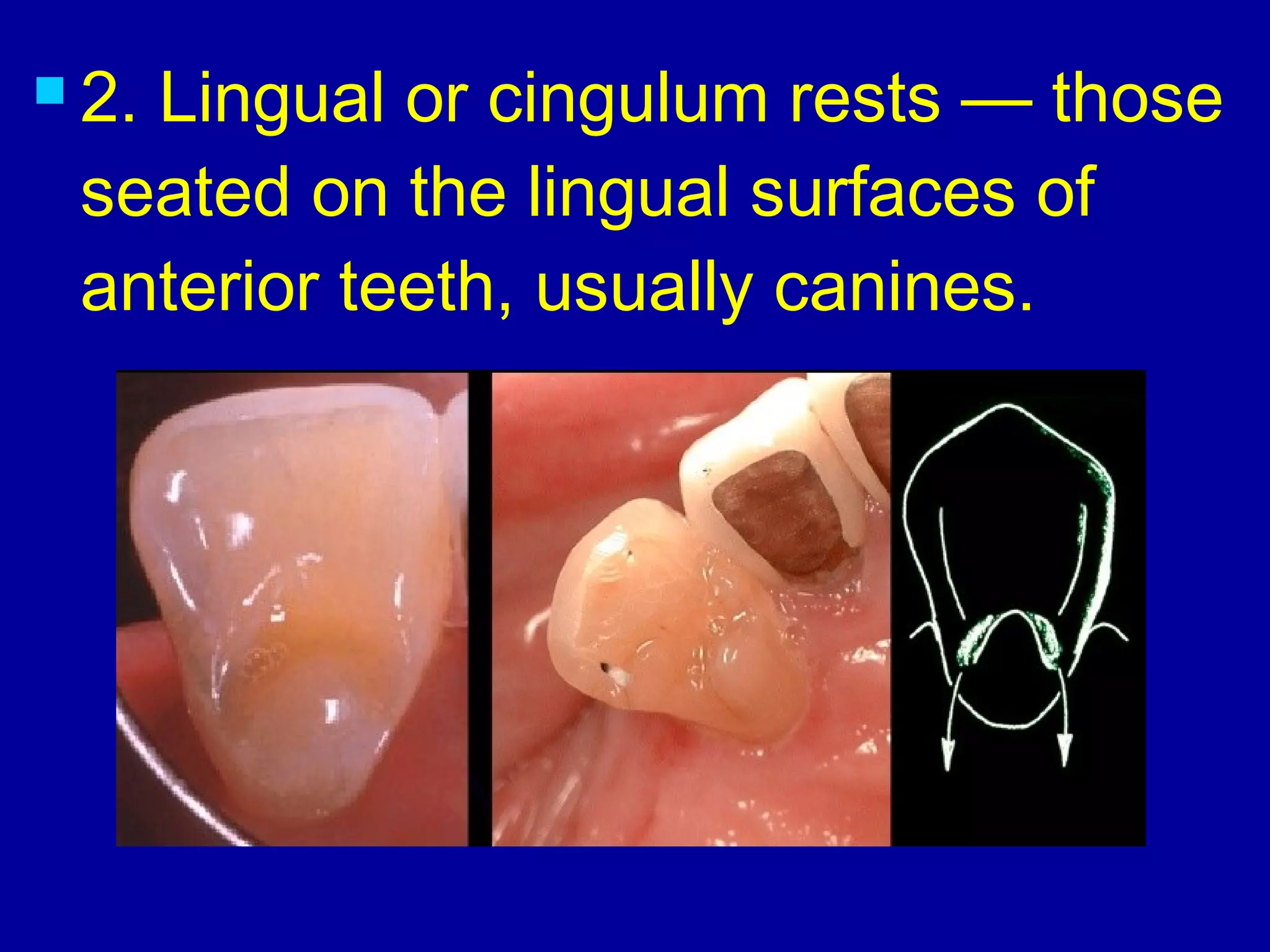
 2. Lingual or cingulum rests — those
seated on the lingual surfaces of
anterior teeth, usually canines.
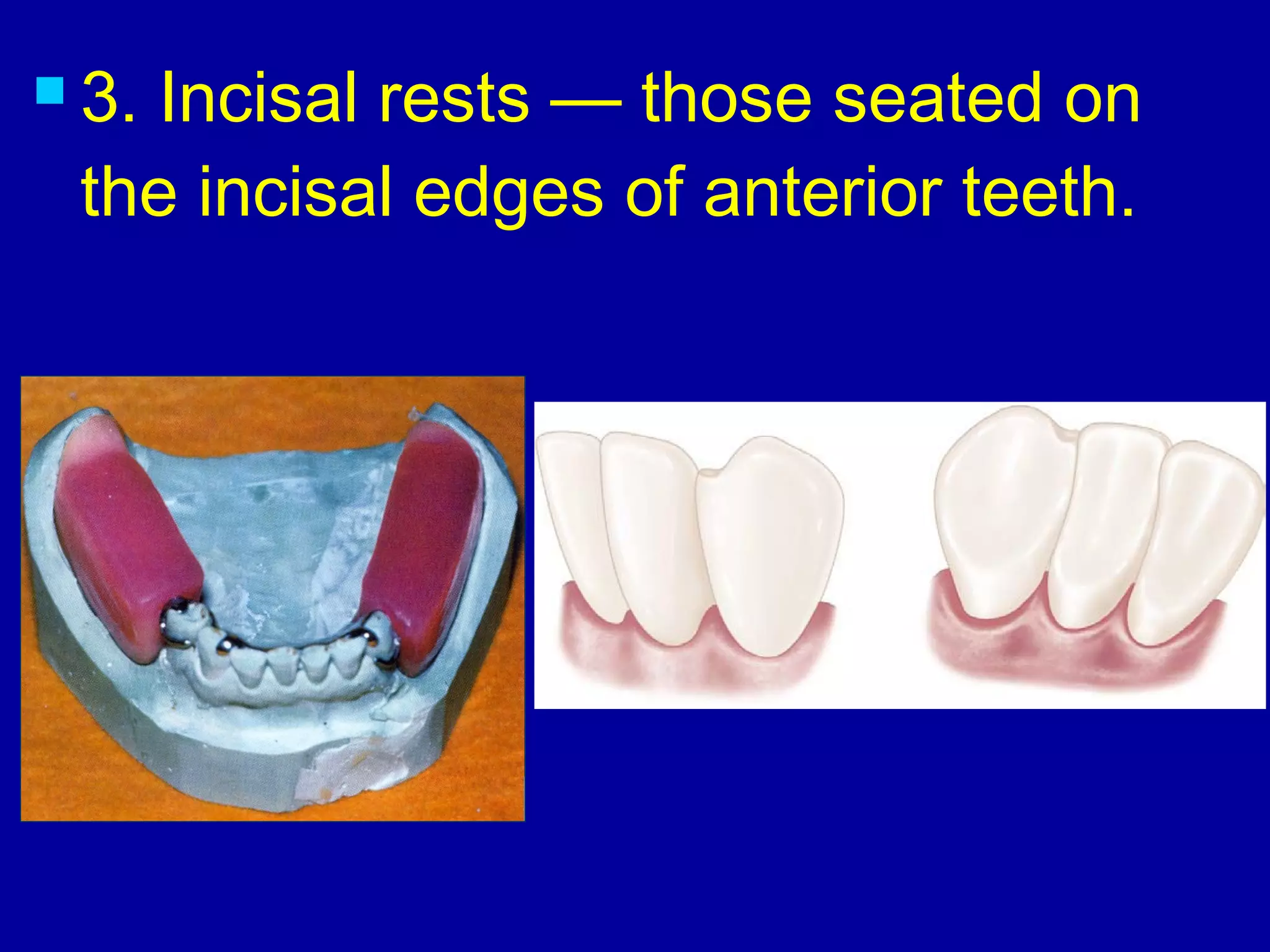
 3. Incisal rests — those seated on
the incisal edges of anterior teeth.
Occlusal Rests and Rest
Seats
 The outline form of an occlusal rest
seat should be triangular, with the
base of the triangle located at the
marginal ridge and the rounded apex
directed toward the centre of the
tooth.
 The rest seat should occupy one
third to one half the mesiodistal
diameter of the tooth
 and approximately one half the
buccolingual width of the tooth
measured from cusp tip to cusp tip.
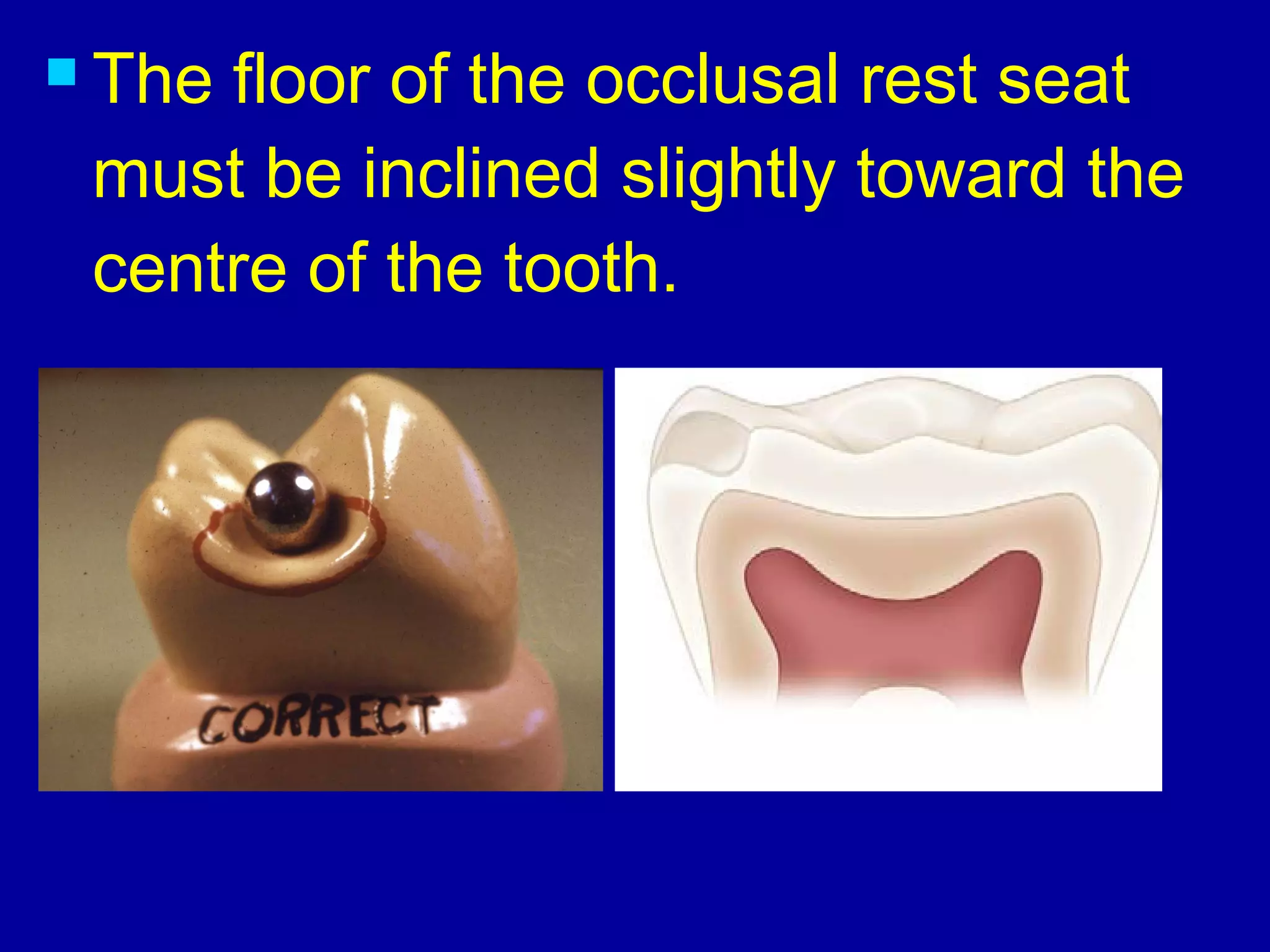
 The floor of the occlusal rest seat
must be inclined slightly toward the
centre of the tooth.
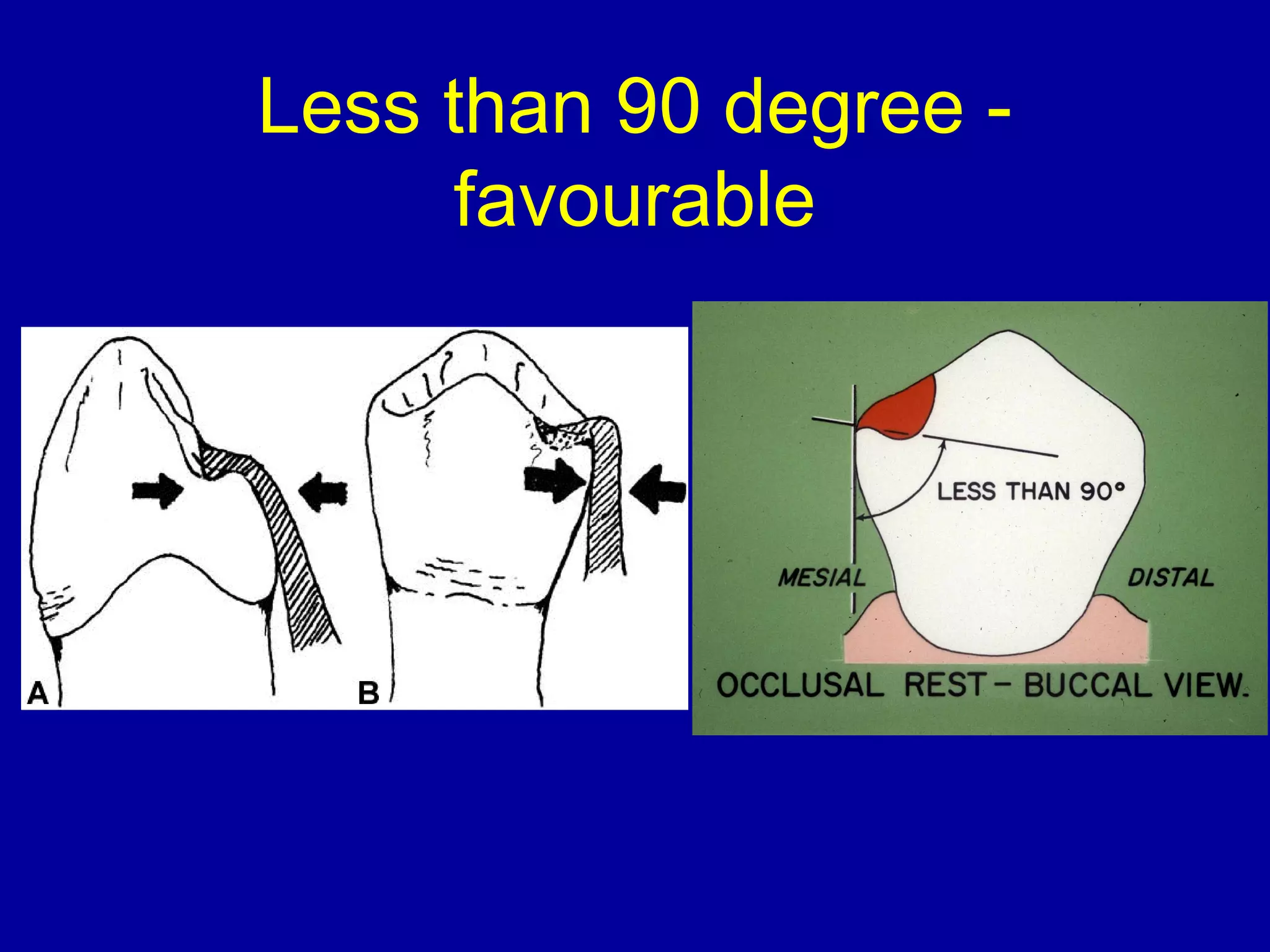
 The angle formed by a line dropped
down the proximal surface of the tooth
parallel to the long axis of the tooth
and the floor of the rest seat must be
less than 90 degrees
 so that the
transmitted occlusal
forces can be
directed along the
vertical axis of the
tooth.
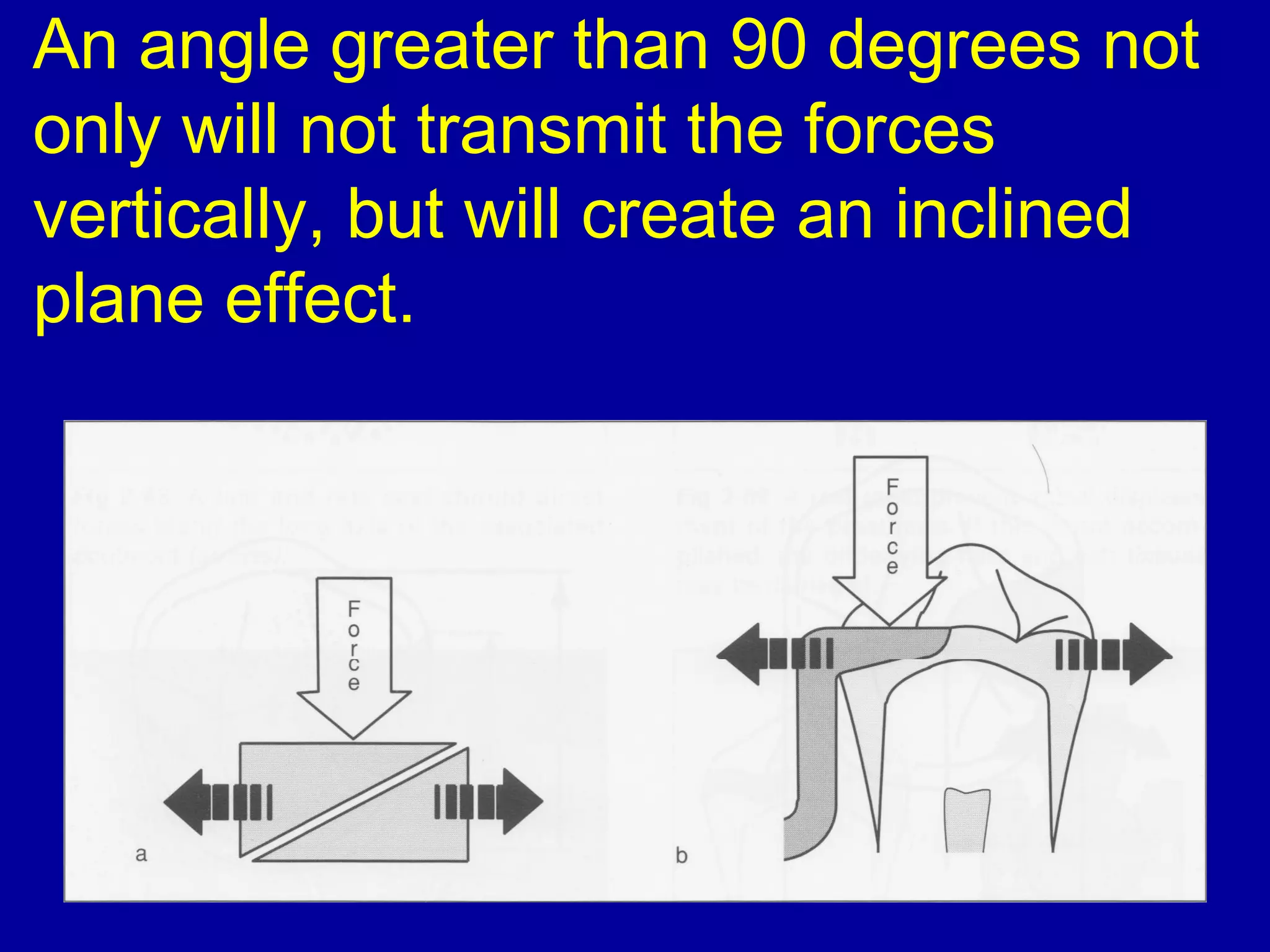
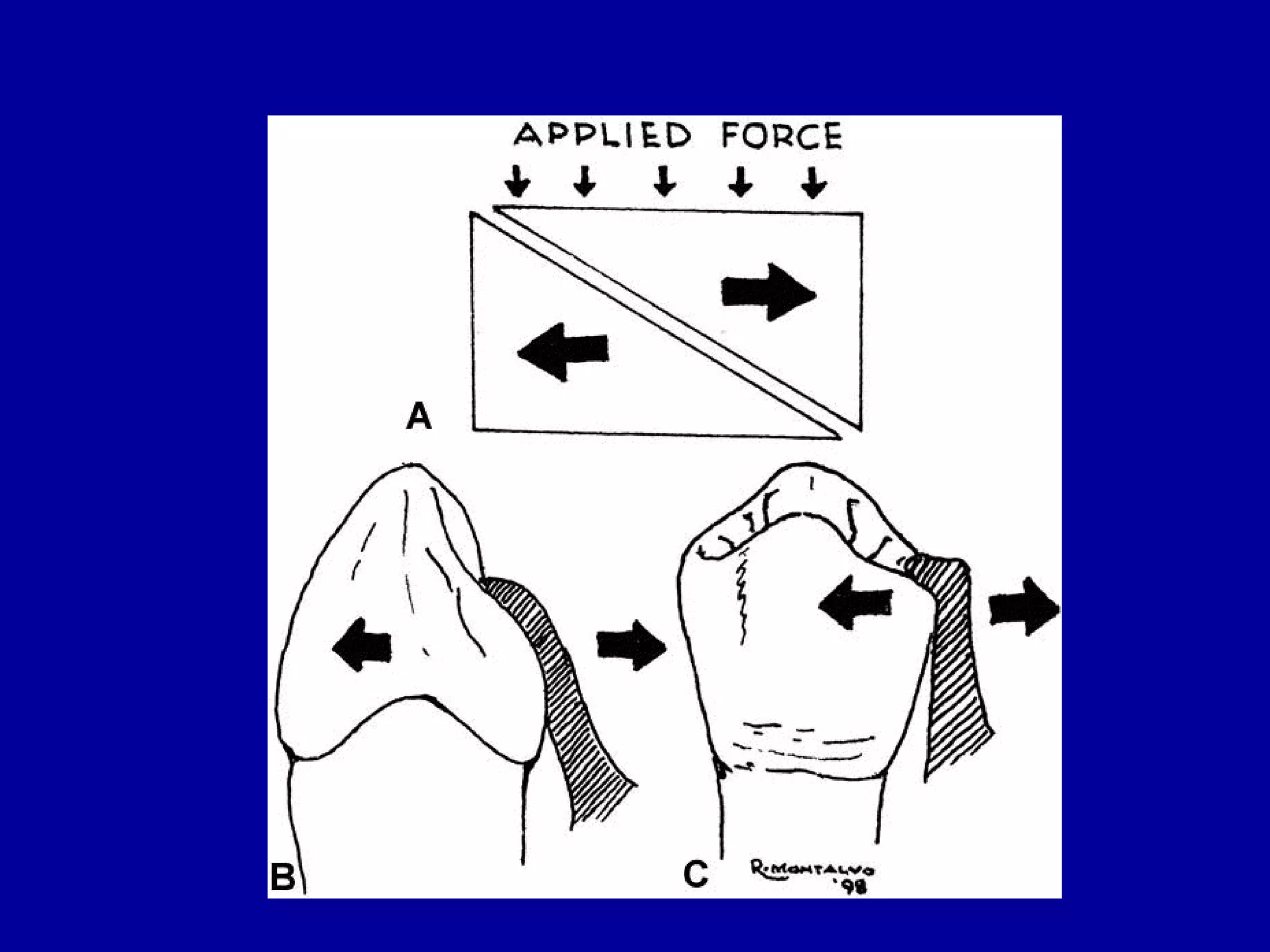
An angle greater than 90 degrees not
only will not transmit the forces
vertically, but will create an inclined
plane effect.
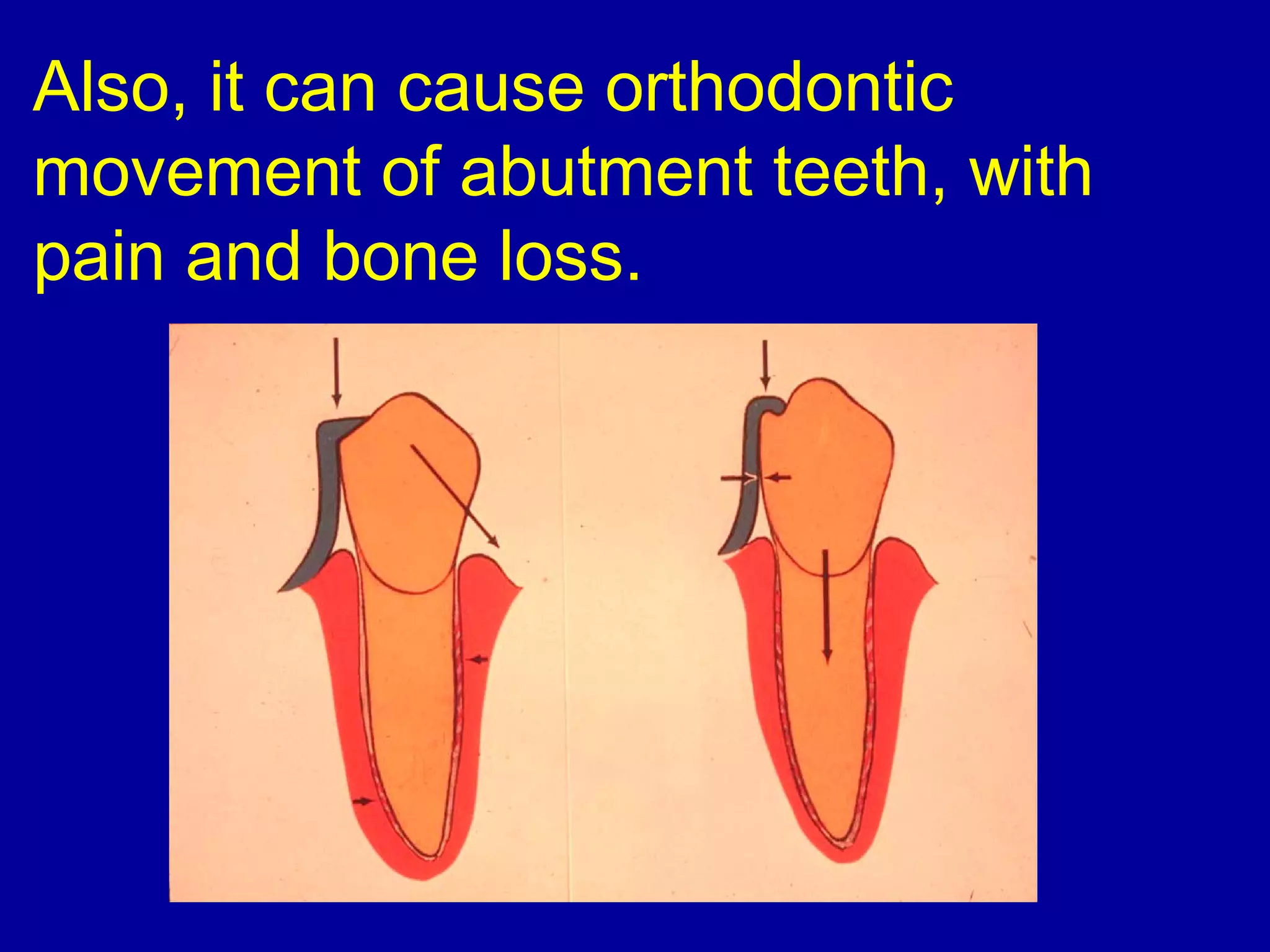
This inclined plane effect can produce
slippage of the prosthesis away from
the abutment teeth.
Also, it can cause orthodontic
movement of abutment teeth, with
pain and bone loss.
Less than 90 degree -
favourable
The deepest portion of an occlusal
rest should be located near the center
of the mesial or distal fossa. From this
point, the rest seat should rise gently
toward the marginal ridge.
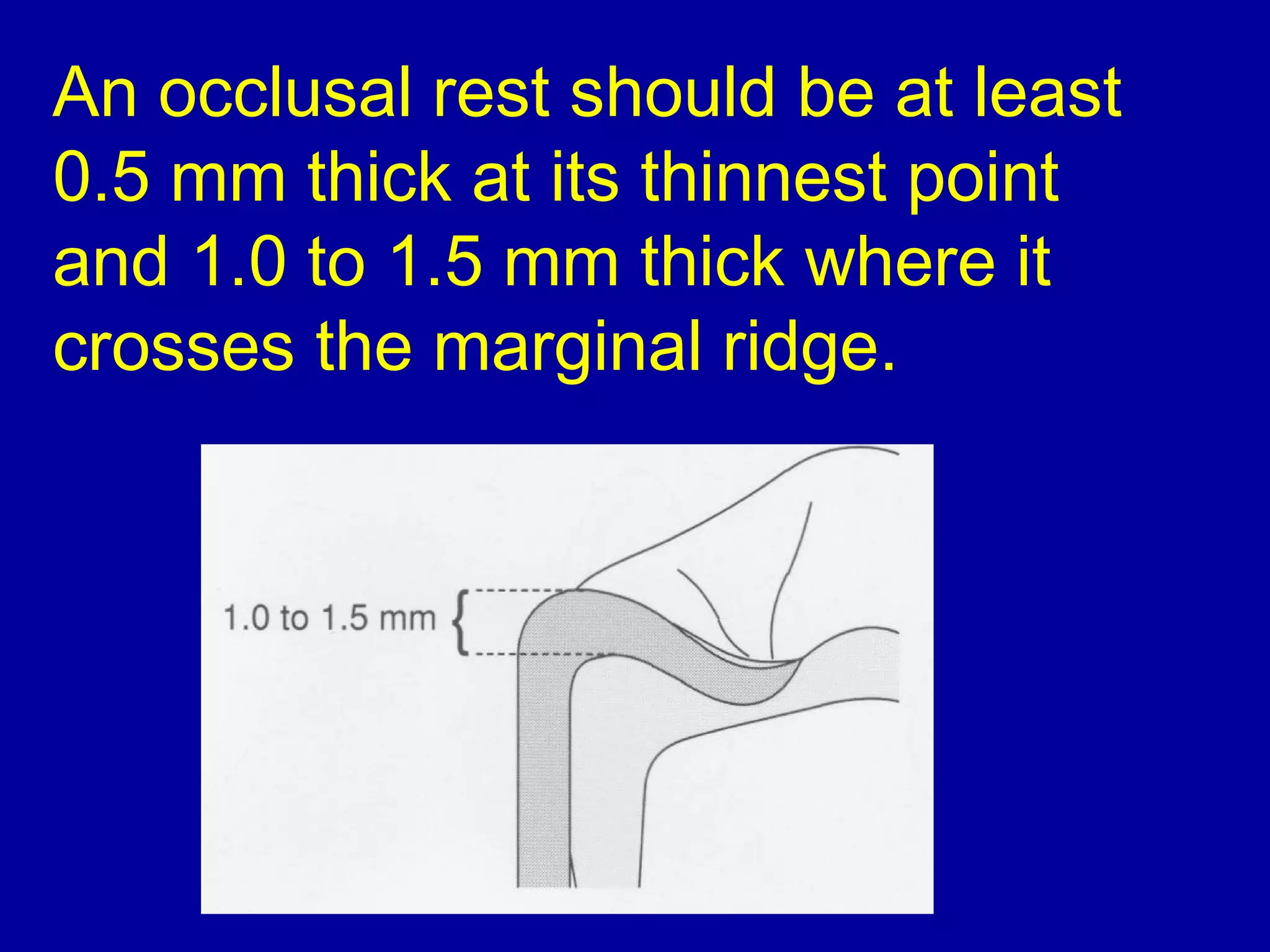
An occlusal rest should be at least
0.5 mm thick at its thinnest point
and 1.0 to 1.5 mm thick where it
crosses the marginal ridge.
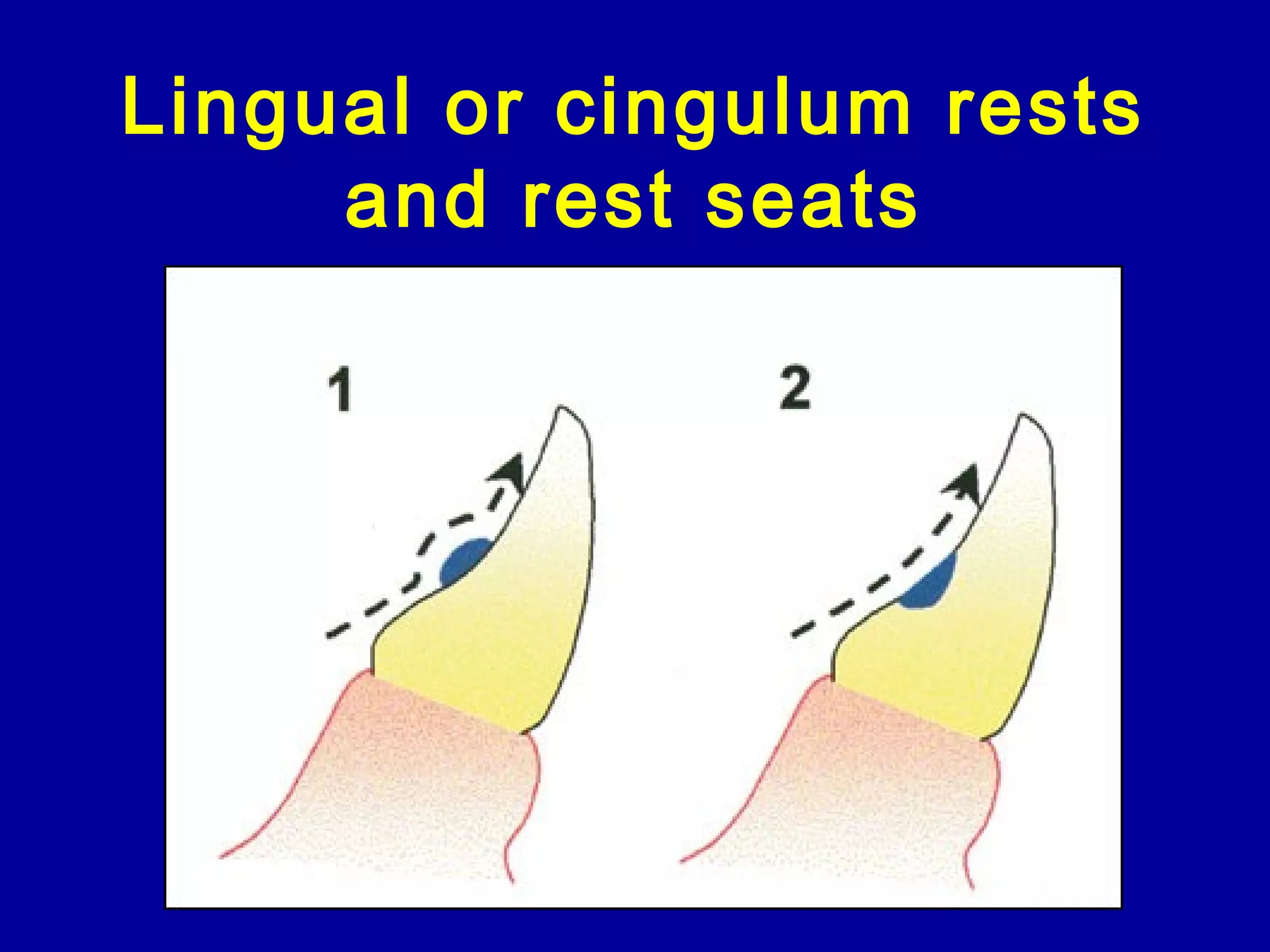
Lingual or cingulum rests
and rest seats
 Lingual or cingulum rests are used
primarily on maxillary canines. The
normal morphology of a maxillary canine
permits preparation of a satisfactory rest
seat with minimal tooth reduction.
 The form of a lingual rest seat should be
V shaped when viewed in cross section.
This geometry prevents migration of the
abutment away from the removable
partial denture framework.
The rest seat, from the lingual
aspect, takes the form of a broad
inverted V, maintaining the natural
contour sometimes seen in a
maxillary canine cingulum.
Dimensions: The
mesiodistal length of the
preparation should be a
minimum of 2.5 to 3 mm
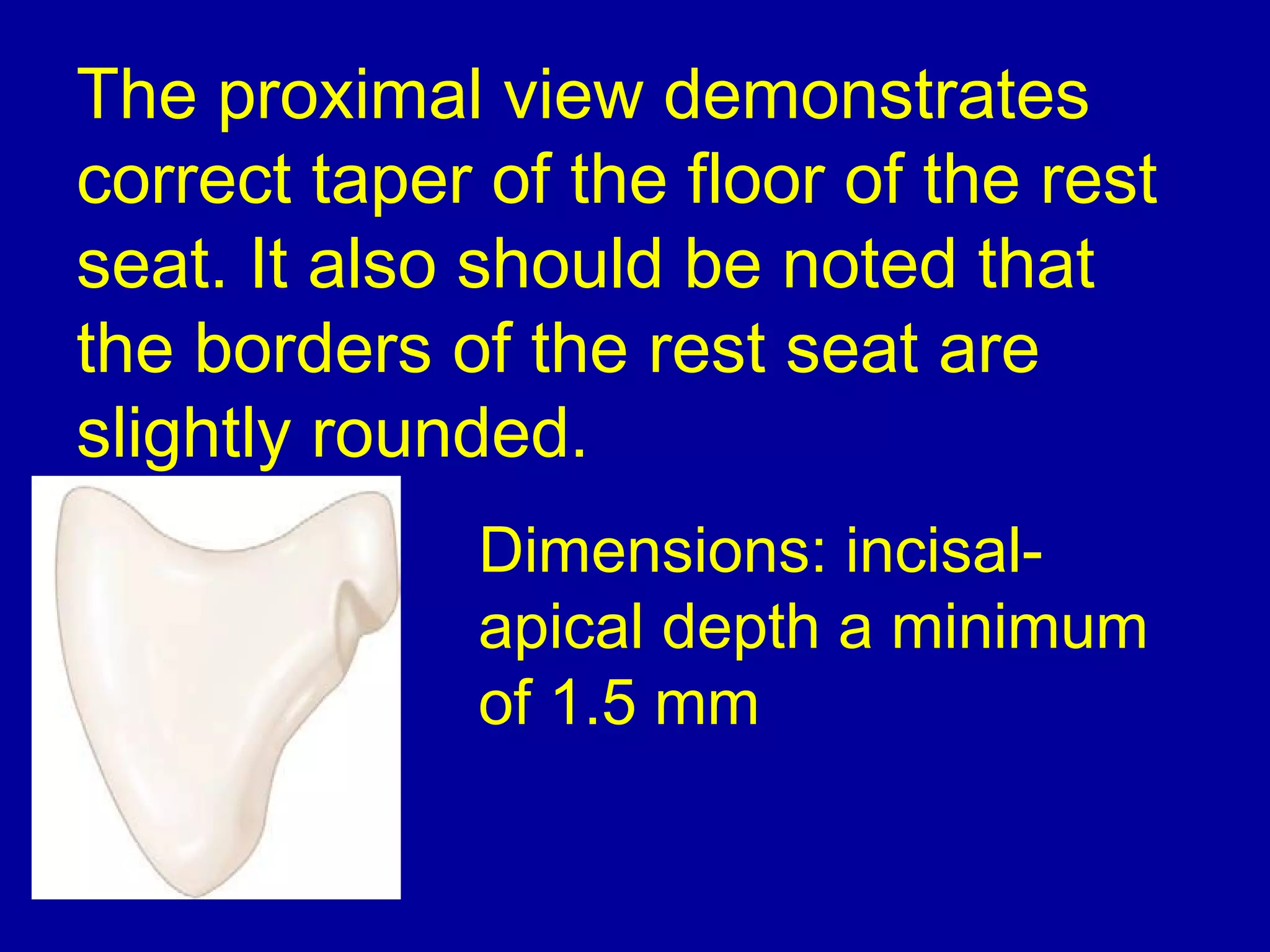
The proximal view demonstrates
correct taper of the floor of the rest
seat. It also should be noted that
the borders of the rest seat are
slightly rounded.
Dimensions: incisal-
apical depth a minimum
of 1.5 mm
From the incisal view, the rest seat
preparation is broadest at the most
lingual aspect of the canine. As the
preparation approaches the proximal
surface of the tooth, it is less broad
than at any other area.
Dimensions: labiolingual
width about 2 mm
LabialLingual
M D
2 mm
1.5 mm
2.5 mm
It is a risky preparation and should not
be attempted on lower anterior teeth.
Incisal rests and rest seats
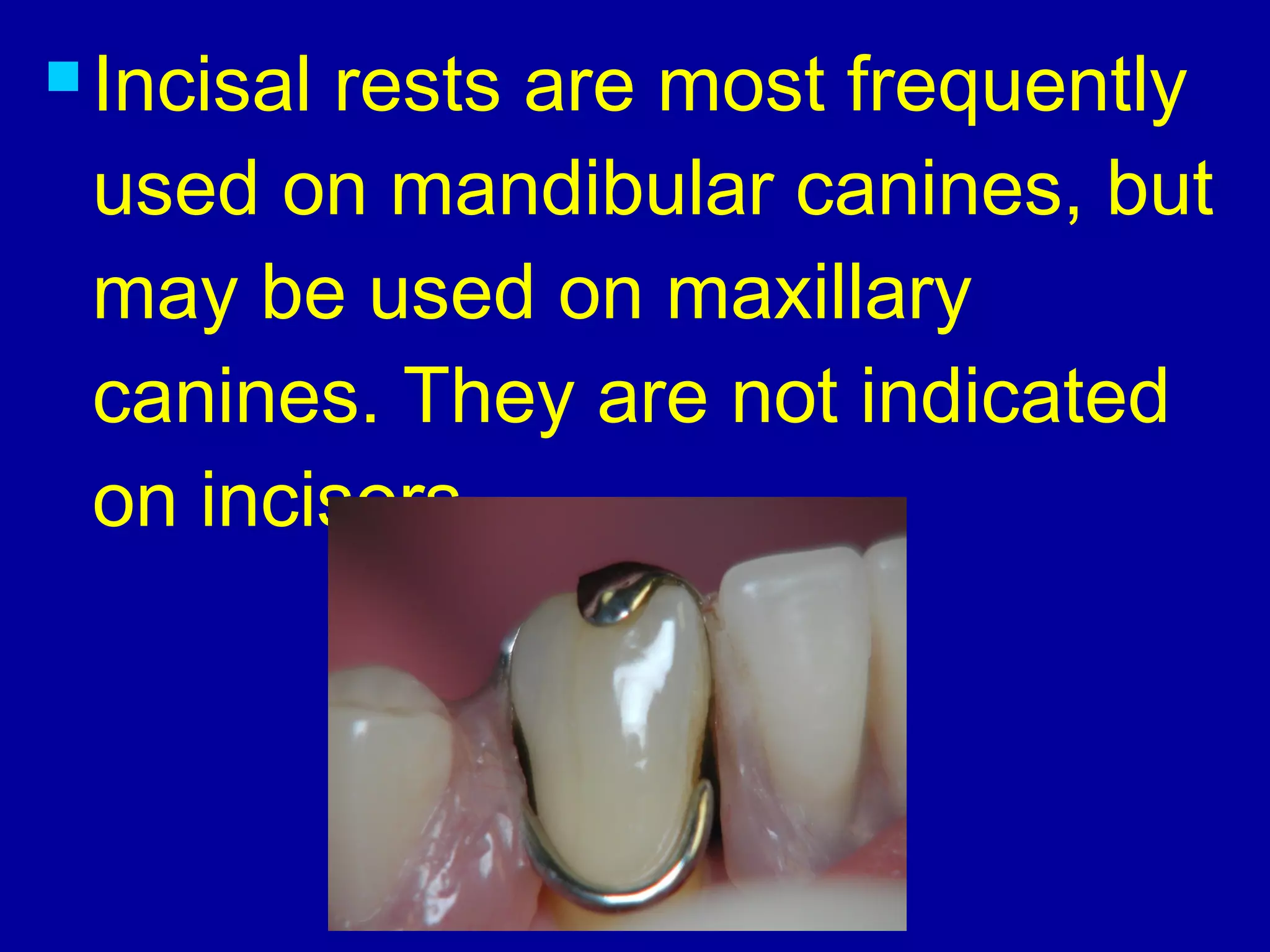
 Incisal rests are most frequently
used on mandibular canines, but
may be used on maxillary
canines. They are not indicated
on incisors.
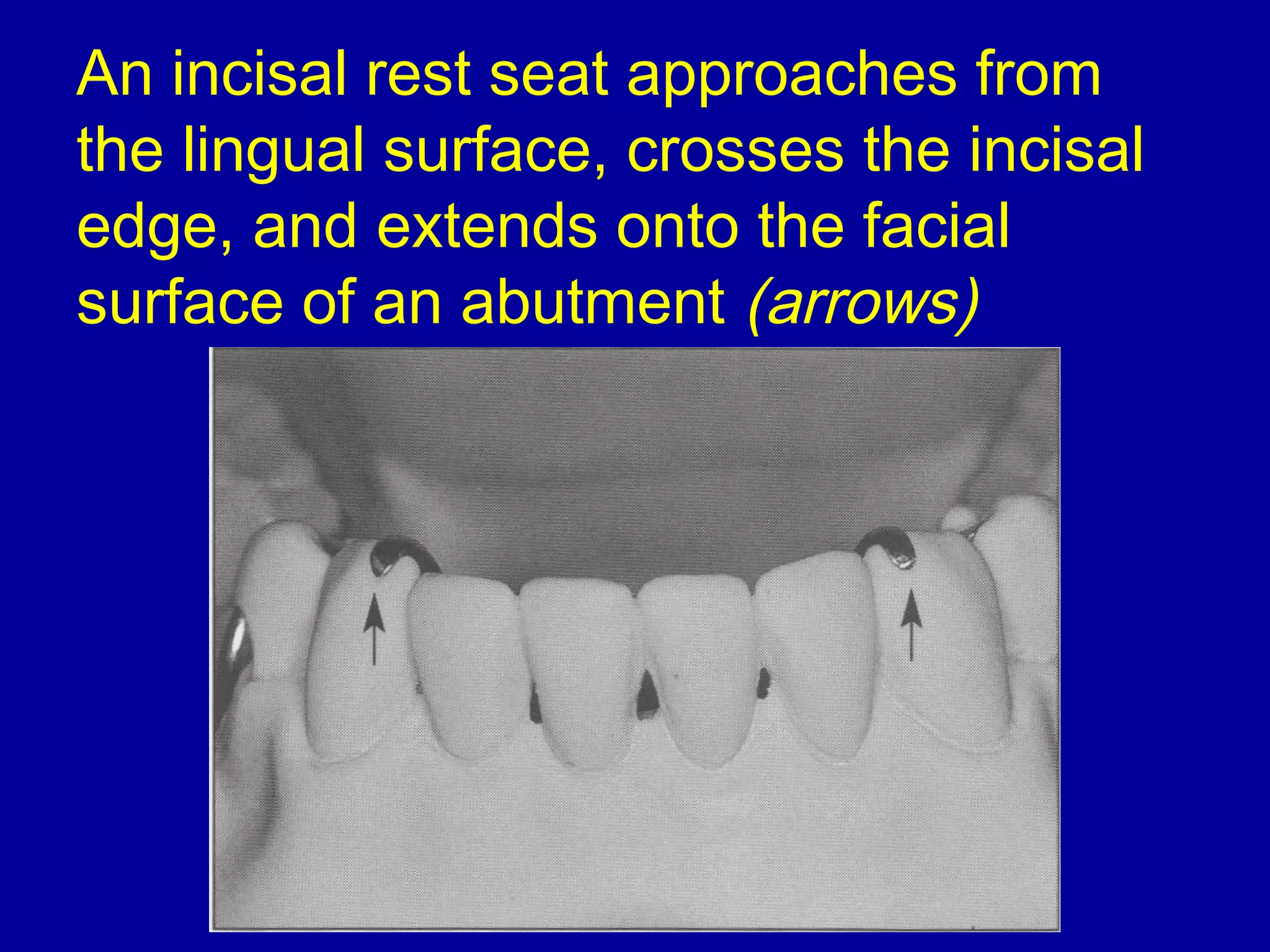
An incisal rest seat approaches from
the lingual surface, crosses the incisal
edge, and extends onto the facial
surface of an abutment (arrows)
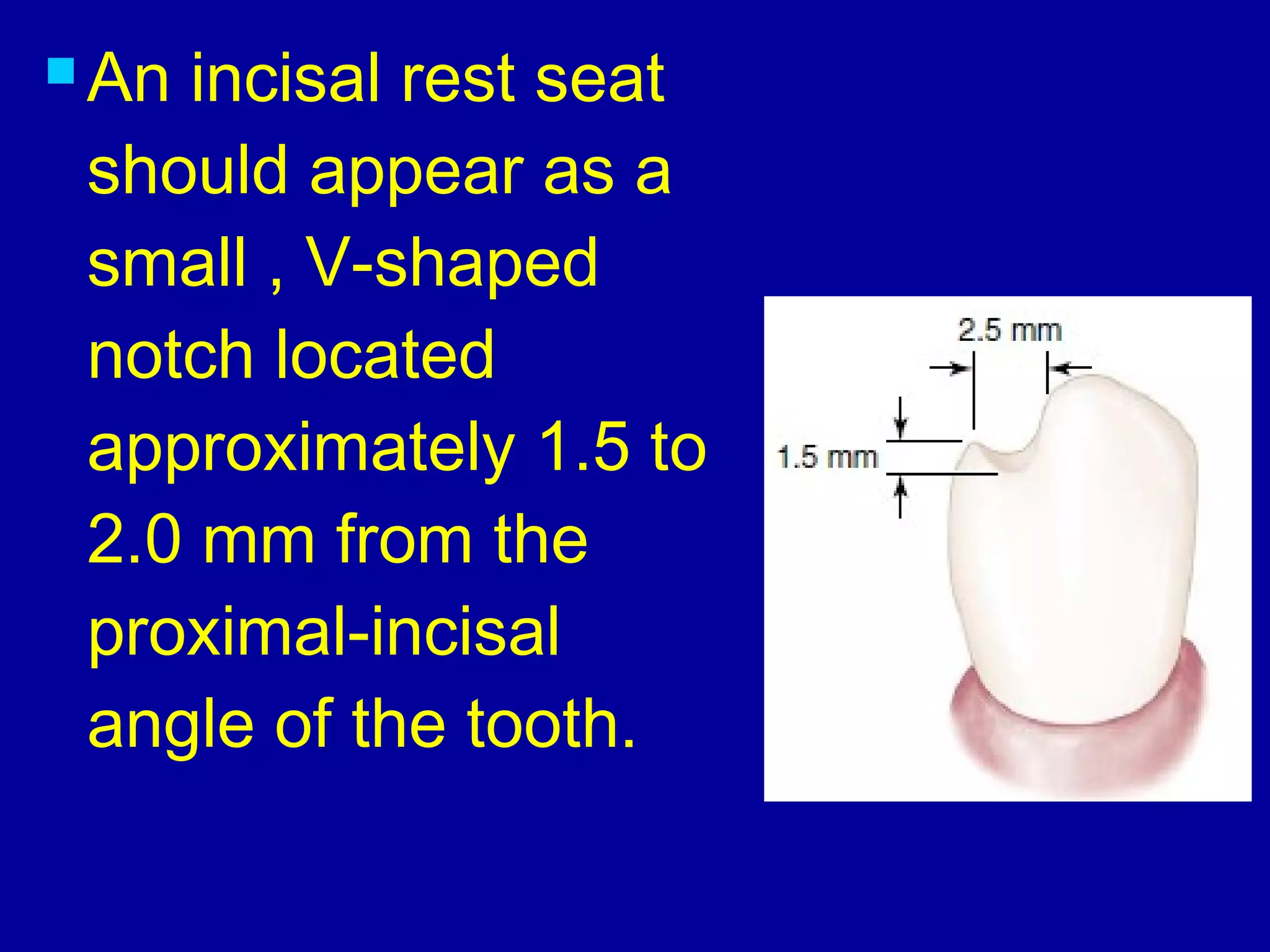
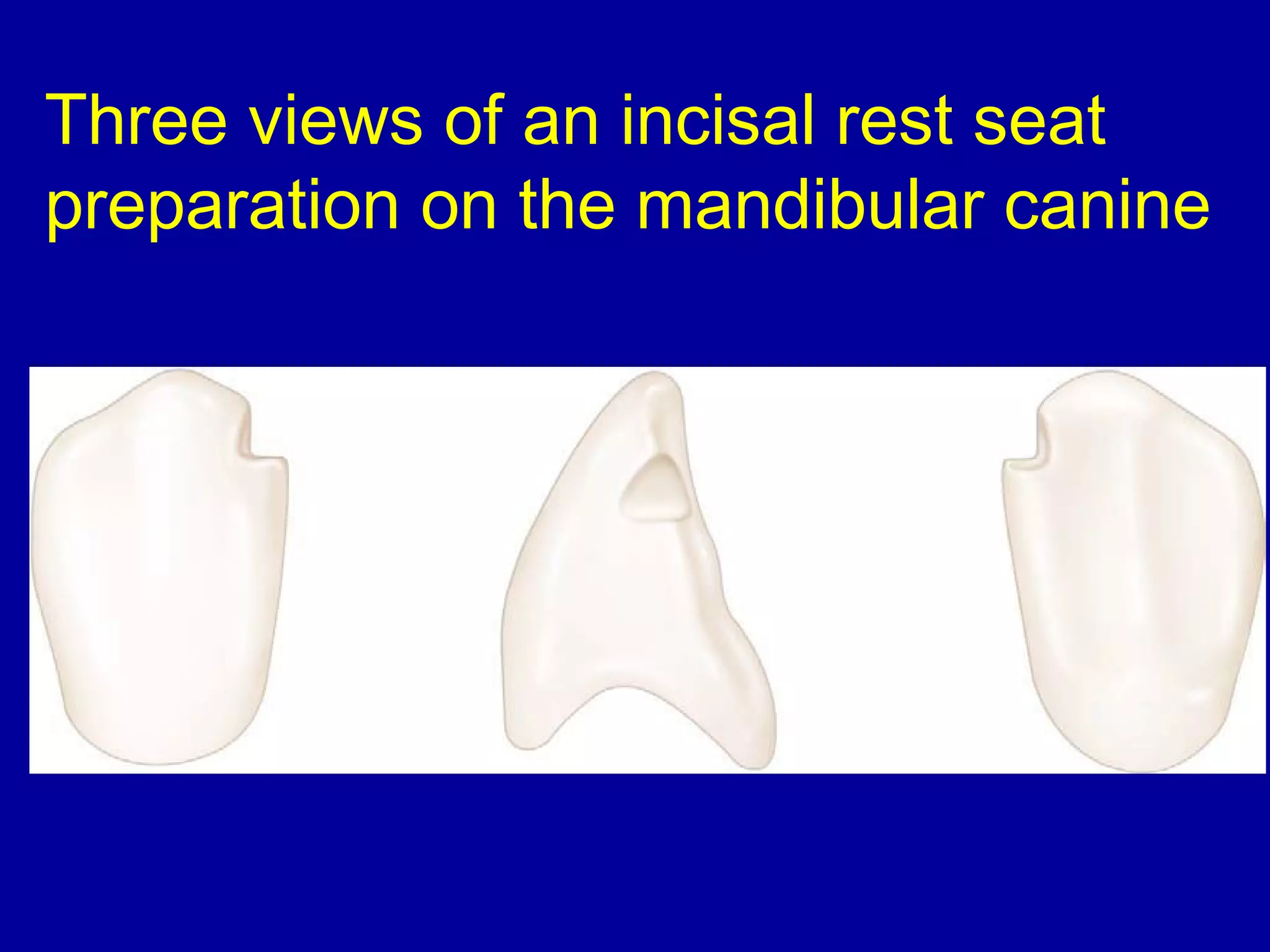
 An incisal rest seat
should appear as a
small , V-shaped
notch located
approximately 1.5 to
2.0 mm from the
proximal-incisal
angle of the tooth.
Three views of an incisal rest seat
preparation on the mandibular canine
Other types of rests
Extended Occlusal Rest
In Kennedy Class II, modification 1, and
Kennedy Class III situations in which the most
posterior abutment is a mesially tipped molar,
an extended occlusal rest should be designed
and prepared.
To minimize further tipping of the
abutment and to ensure that the forces
are directed down the long axis of the
abutment.

Interproximal Occlusal Rest
Seats
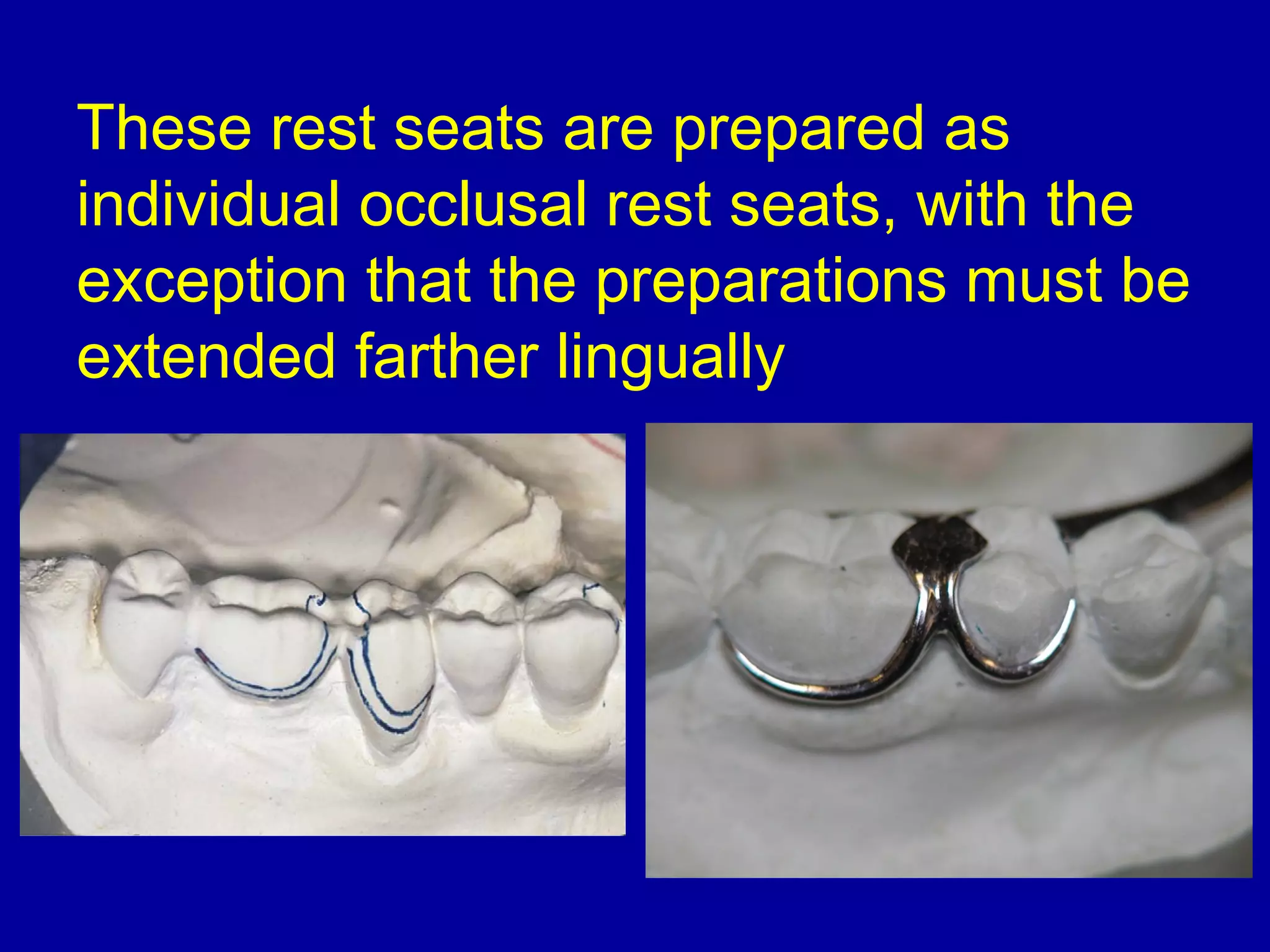
These rest seats are prepared as
individual occlusal rest seats, with the
exception that the preparations must be
extended farther lingually
Preparation of Rest Seats
• Keep in
enamel
• No anesthesia
Preparation of Rest Seats
• Occlusal Rest Seats
− Diamonds
• 8801- 014
• 38006 -135
− Medium round carbide
burs
• #2, #4
8801- 014
Preparation of Rest Seats
• Cingulum Rest Seats
& Guiding Planes
− Long, medium
diameter cylindrical
bur or diamond (e.g.
#57L; 8837K-014)
8837K-014
RPD QUESTIONS
http://dentistry.ouhsc.edu/rpdrevie
www.ffofr.org
www.removpros.dentistry.dal.ca
rest and rest seat

rest and rest seat

  • 2.
  • 3.
    1. Define arest and list its functions. 2. Explain the different types of rests for posterior and anterior teeth. 3. Describe the dimensions of all the types of rests.
  • 4.
    Components of aRPD 1. Major connectors 2. Minor connectors 3. Rests 4. Direct retainers 5. Indirect retainers (CLASS I AND CLASS II ONLY) 6. Denture bases 7. Teeth
  • 5.
     Forces thatare applied to a removable partial denture must be transferred to the supporting teeth and tissues in an atraumatic fashion.
  • 6.
     The componentsof a removable partial denture that transfer forces along the long axes of the abutment teeth are called rests.
  • 7.
    The prepared surfacesof the teeth into which rests fit are called rest seats.
  • 8.
     The relationshipbetween a rest and a rest seat must be such that forces transmitted from the prosthesis to an abutment are directed apically down the long axis of the tooth.
  • 9.
     In thismanner, stress can be absorbed by the fibers of the periodontal ligament without damaging the ligament or the supporting bone.
  • 10.
     In thecase of a tooth-supported removable partial denture, all the stresses are transferred to the abutment teeth.
  • 11.
     In atooth-tissue-supported removable partial denture, only a portion of the stresses are transferred to the teeth, while the edentulous ridge must absorb the remainder of the load.
  • 12.
     In additionto transferring forces, each rest should serve as a vertical stop for the prosthesis. Firm, positive contact between a rest and rest seat minimizes vertical displacement of the prosthesis and prevents injury to the soft tissues.
  • 14.
     The primarypurpose of the rest is to provide vertical support for the partial denture. In doing so, it also does the following: 1. Maintains components in their planned positions
  • 15.
    2. Maintains establishedocclusal relationships by preventing settling of the denture 3. Prevents impingement of soft tissue
  • 16.
  • 17.
  • 18.
    4. Directs anddistributes occlusal loads to abutment teeth
  • 19.
     A restthat is part of a retentive clasp assembly is referred to as a primary rest.
  • 20.
    Reciprocal Arm Occlusal Rest RetentiveArmMinor connector The functional elements of the clasp 2020
  • 21.
    Direct retainer Retentive arm Reciprocalarm Occlusal rest Minor connector 2121
  • 22.
     A restthat is responsible for additional support or indirect retention is called an auxiliary rest or secondary rest.
  • 23.
     Primary restsprevent vertical movement of a prosthesis toward the tissues and also help transmit applied forces to the supporting teeth.
  • 24.
     Rest seatsshould be shallow and saucer shaped, and should function as ball-and-socket joints. This geometry permits dissipation of potentially harmful lateral forces.
  • 25.
  • 26.
     Auxiliary orsecondary rests are used as indirect retainers in extension base removable partial dentures (Class I, Class II, and long-span Class IV applications).
  • 27.
     Three majorforms of rests are:  1. Occlusal rests — so named because they are seated on the occlusal surfaces of posterior teeth.
  • 28.
     2. Lingualor cingulum rests — those seated on the lingual surfaces of anterior teeth, usually canines.
  • 29.
     3. Incisalrests — those seated on the incisal edges of anterior teeth.
  • 30.
  • 31.
     The outlineform of an occlusal rest seat should be triangular, with the base of the triangle located at the marginal ridge and the rounded apex directed toward the centre of the tooth.
  • 32.
     The restseat should occupy one third to one half the mesiodistal diameter of the tooth
  • 33.
     and approximatelyone half the buccolingual width of the tooth measured from cusp tip to cusp tip.
  • 34.
     The floorof the occlusal rest seat must be inclined slightly toward the centre of the tooth.
  • 35.
     The angleformed by a line dropped down the proximal surface of the tooth parallel to the long axis of the tooth and the floor of the rest seat must be less than 90 degrees
  • 36.
     so thatthe transmitted occlusal forces can be directed along the vertical axis of the tooth.
  • 37.
    An angle greaterthan 90 degrees not only will not transmit the forces vertically, but will create an inclined plane effect.
  • 39.
    This inclined planeeffect can produce slippage of the prosthesis away from the abutment teeth.
  • 40.
    Also, it cancause orthodontic movement of abutment teeth, with pain and bone loss.
  • 42.
    Less than 90degree - favourable
  • 43.
    The deepest portionof an occlusal rest should be located near the center of the mesial or distal fossa. From this point, the rest seat should rise gently toward the marginal ridge.
  • 44.
    An occlusal restshould be at least 0.5 mm thick at its thinnest point and 1.0 to 1.5 mm thick where it crosses the marginal ridge.
  • 45.
    Lingual or cingulumrests and rest seats
  • 46.
     Lingual orcingulum rests are used primarily on maxillary canines. The normal morphology of a maxillary canine permits preparation of a satisfactory rest seat with minimal tooth reduction.
  • 47.
     The formof a lingual rest seat should be V shaped when viewed in cross section. This geometry prevents migration of the abutment away from the removable partial denture framework.
  • 48.
    The rest seat,from the lingual aspect, takes the form of a broad inverted V, maintaining the natural contour sometimes seen in a maxillary canine cingulum. Dimensions: The mesiodistal length of the preparation should be a minimum of 2.5 to 3 mm
  • 49.
    The proximal viewdemonstrates correct taper of the floor of the rest seat. It also should be noted that the borders of the rest seat are slightly rounded. Dimensions: incisal- apical depth a minimum of 1.5 mm
  • 50.
    From the incisalview, the rest seat preparation is broadest at the most lingual aspect of the canine. As the preparation approaches the proximal surface of the tooth, it is less broad than at any other area. Dimensions: labiolingual width about 2 mm
  • 51.
  • 52.
    It is arisky preparation and should not be attempted on lower anterior teeth.
  • 53.
  • 54.
     Incisal restsare most frequently used on mandibular canines, but may be used on maxillary canines. They are not indicated on incisors.
  • 55.
    An incisal restseat approaches from the lingual surface, crosses the incisal edge, and extends onto the facial surface of an abutment (arrows)
  • 56.
     An incisalrest seat should appear as a small , V-shaped notch located approximately 1.5 to 2.0 mm from the proximal-incisal angle of the tooth.
  • 57.
    Three views ofan incisal rest seat preparation on the mandibular canine
  • 58.
    Other types ofrests Extended Occlusal Rest In Kennedy Class II, modification 1, and Kennedy Class III situations in which the most posterior abutment is a mesially tipped molar, an extended occlusal rest should be designed and prepared.
  • 59.
    To minimize furthertipping of the abutment and to ensure that the forces are directed down the long axis of the abutment.
  • 60.
  • 61.
    These rest seatsare prepared as individual occlusal rest seats, with the exception that the preparations must be extended farther lingually
  • 62.
    Preparation of RestSeats • Keep in enamel • No anesthesia
  • 63.
    Preparation of RestSeats • Occlusal Rest Seats − Diamonds • 8801- 014 • 38006 -135 − Medium round carbide burs • #2, #4 8801- 014
  • 64.
    Preparation of RestSeats • Cingulum Rest Seats & Guiding Planes − Long, medium diameter cylindrical bur or diamond (e.g. #57L; 8837K-014) 8837K-014
  • 65.