AN INTRODUCTION TO
ARTICULATORS
Learning outcomes
1. Define an articulator.
2. List the uses and
requirements of articulators.
3. Explain the different types of
articulators and facebows.
4. Compare arcon and non
arcon articulators.
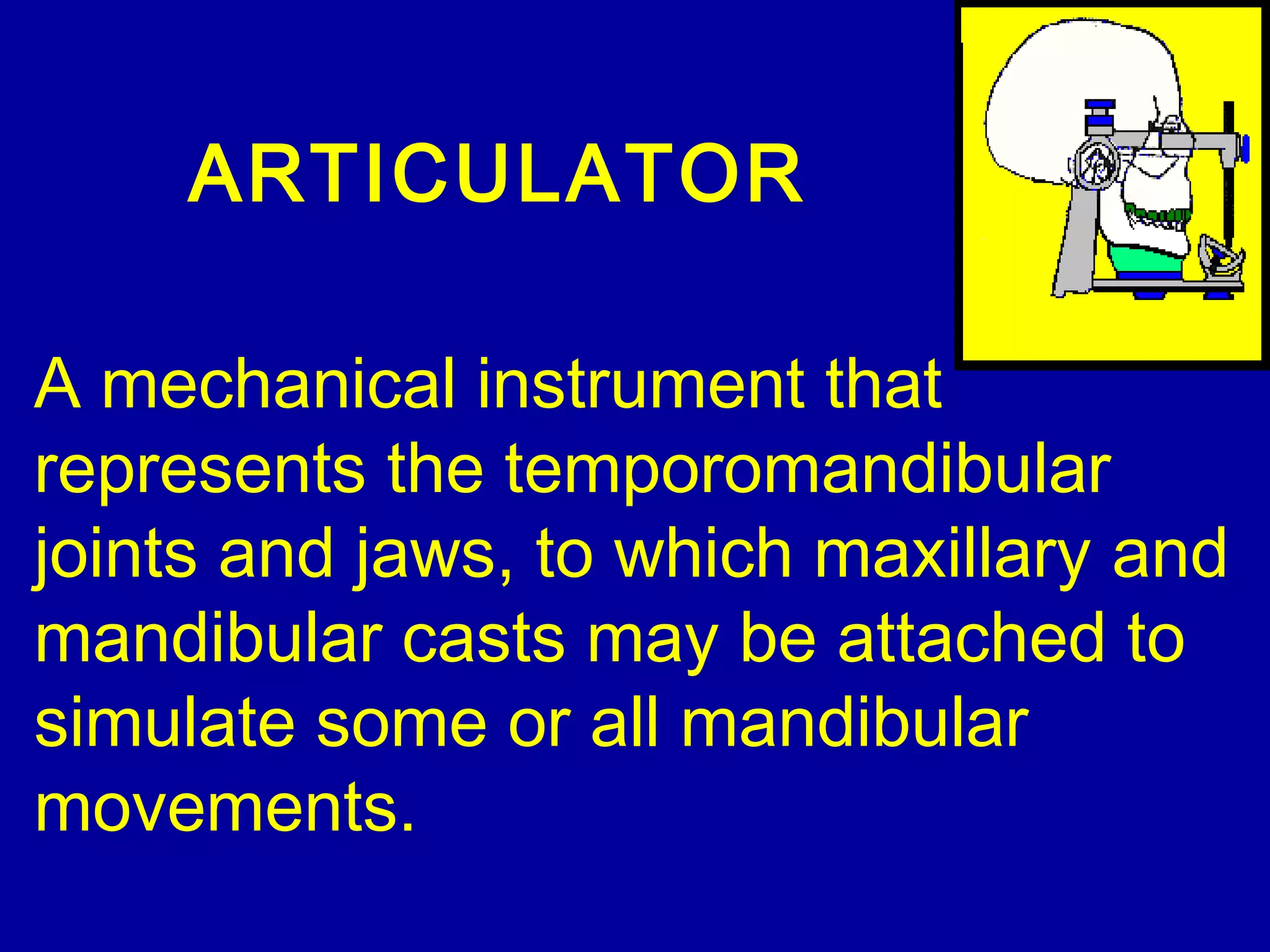
ARTICULATOR
A mechanical instrument that
represents the temporomandibular
joints and jaws, to which maxillary and
mandibular casts may be attached to
simulate some or all mandibular
movements.
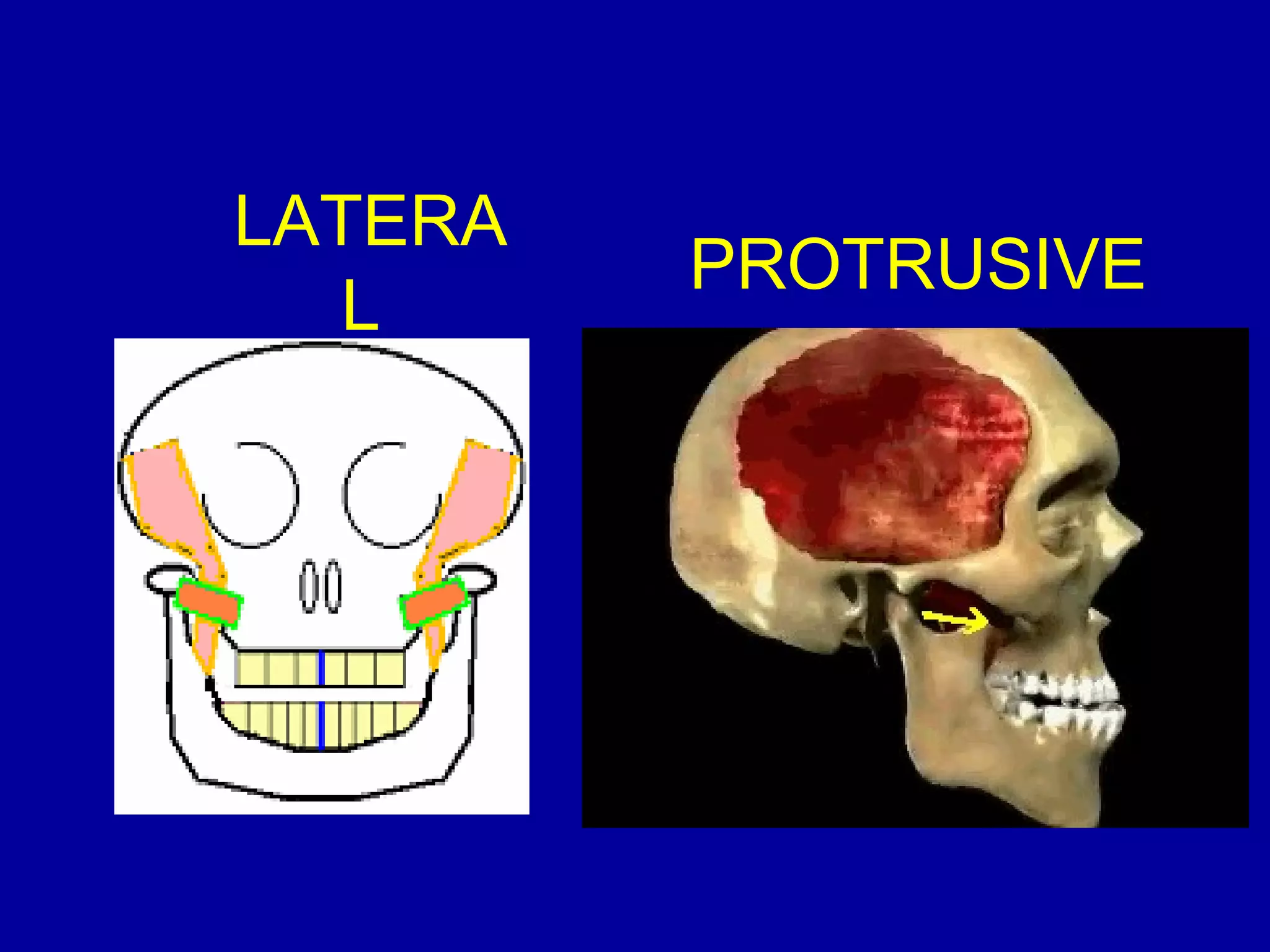
LATERA
L
PROTRUSIVE
 The articulator helps to maintain the
desired maxillomandibular
relationship of the casts during tooth
arrangement. Thus, it makes it
possible to arrange teeth in the
absence of the patient.
Uses of an Articulator
1. Mounting dental casts for
diagnosis, treatment planning and
patient presentation.
2. Arrangement of artificial teeth for
complete and removable partial
dentures.
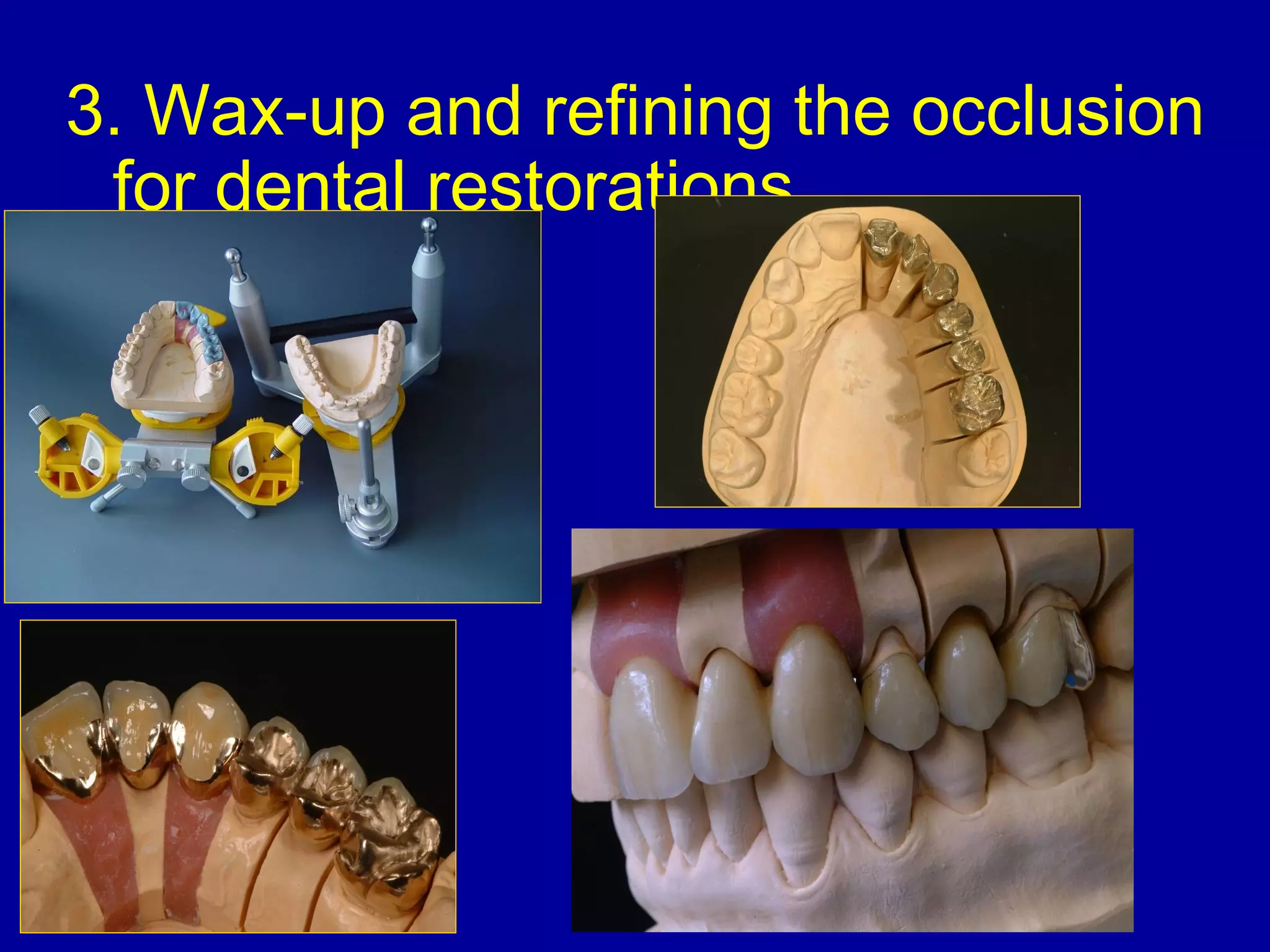
3. Wax-up and refining the occlusion
for dental restorations.
4. Articulators can be helpful in
studying of occlusion and
mandibular movements.
5. To aid in fabrication of dental
restorations and lost dental parts.
Requirements of an
Articulator
 The articulator should have the
following minimal requirements:
1. It should hold the casts in the correct
horizontal relationship and vertical
relationship.
2. It should provide positive anterior
vertical stop (the incisal pin).
3. It should accept a face bow
record.
4. It should open and close in a
hinge movement.
5. The moving parts should move
freely and be machined accurately.
6. The non-moving parts should be
of rigid construction.
7. It should allow protrusive and
lateral jaw motion.
Classification of articulators
 Class I Articulators
(Non-adjustable articulators)
 Class II Articulators
(Average-value articulators)
 Class III Articulators
(Semi-adjustable articulators)
 Class IV Articulators
(Fully-adjustable articulators)
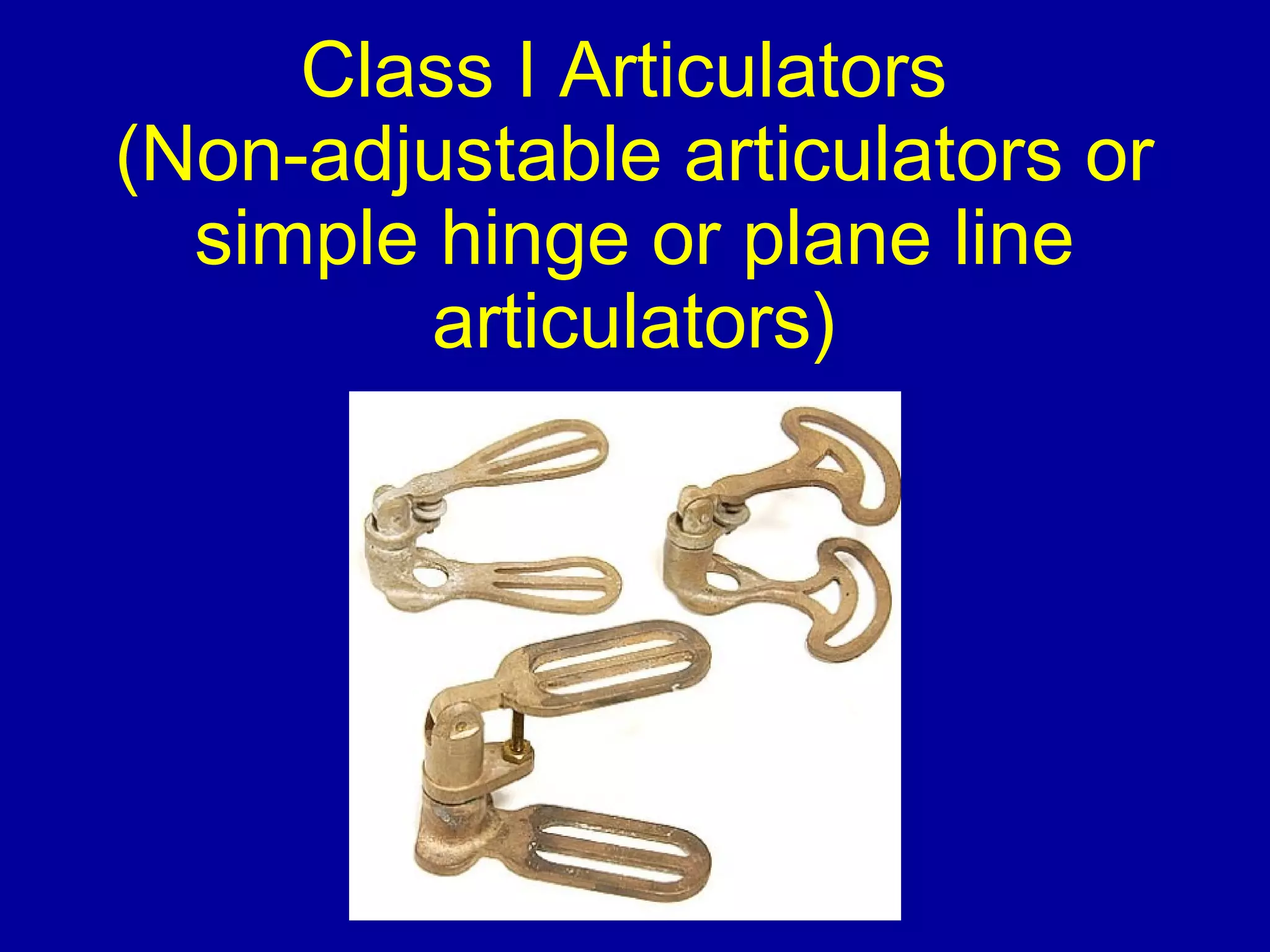
Class I Articulators
(Non-adjustable articulators or
simple hinge or plane line
articulators)
 A simple holding instrument
capable of accepting a single
static registration.
 Vertical motion is possible.
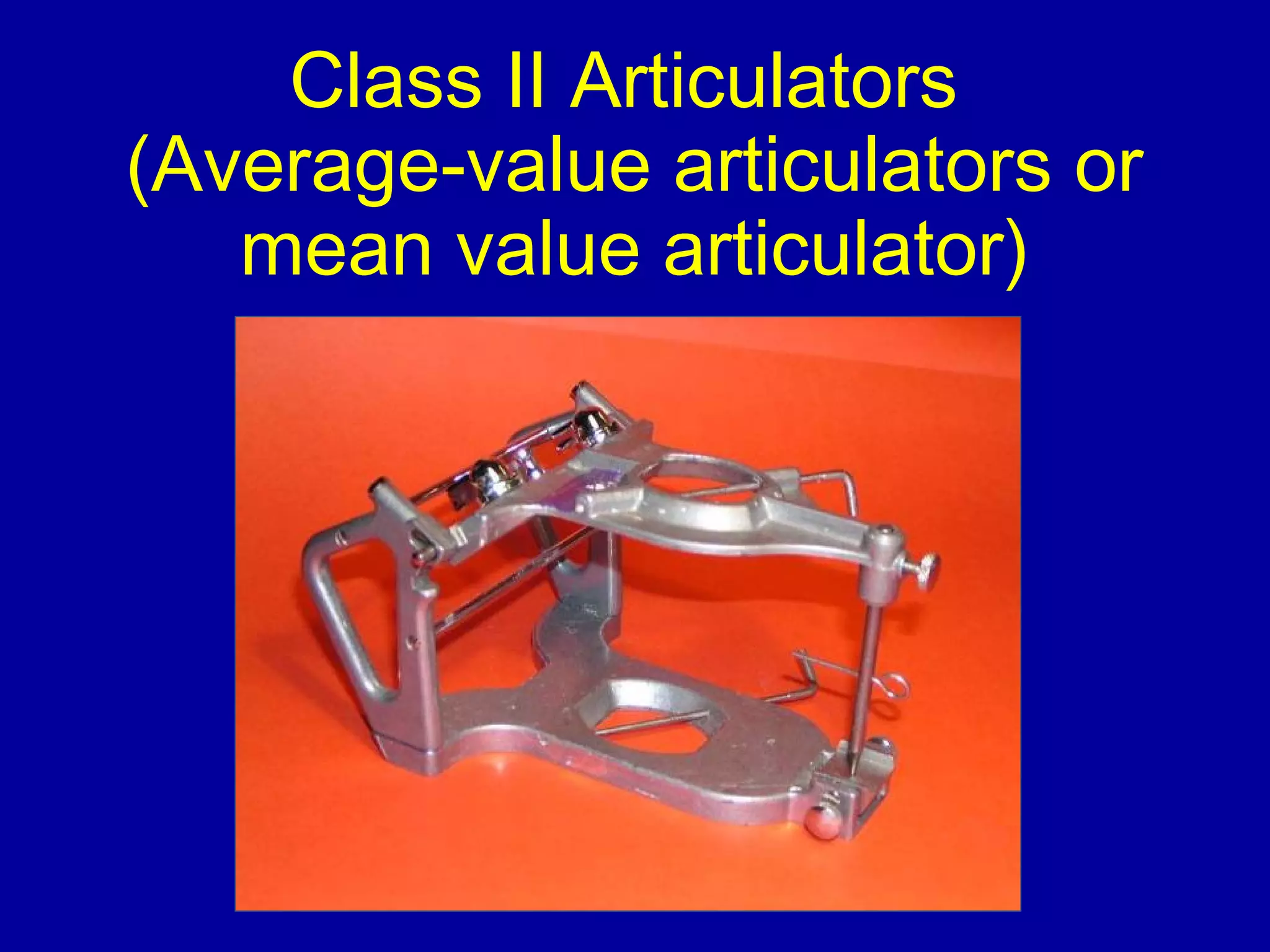
Class II Articulators
(Average-value articulators or
mean value articulator)
 Instrument that permit
horizontal as well as vertical
motion but do not orient the
motion to the
temporomandibular joints via a
face-bow transfer.
 It allows limited range of
protrusive and lateral movements
 It has fixed horizontal condylar
guidance of 30 degrees.
 It has fixed incisal guidance.
 It has fixed inter-condylar
distance.
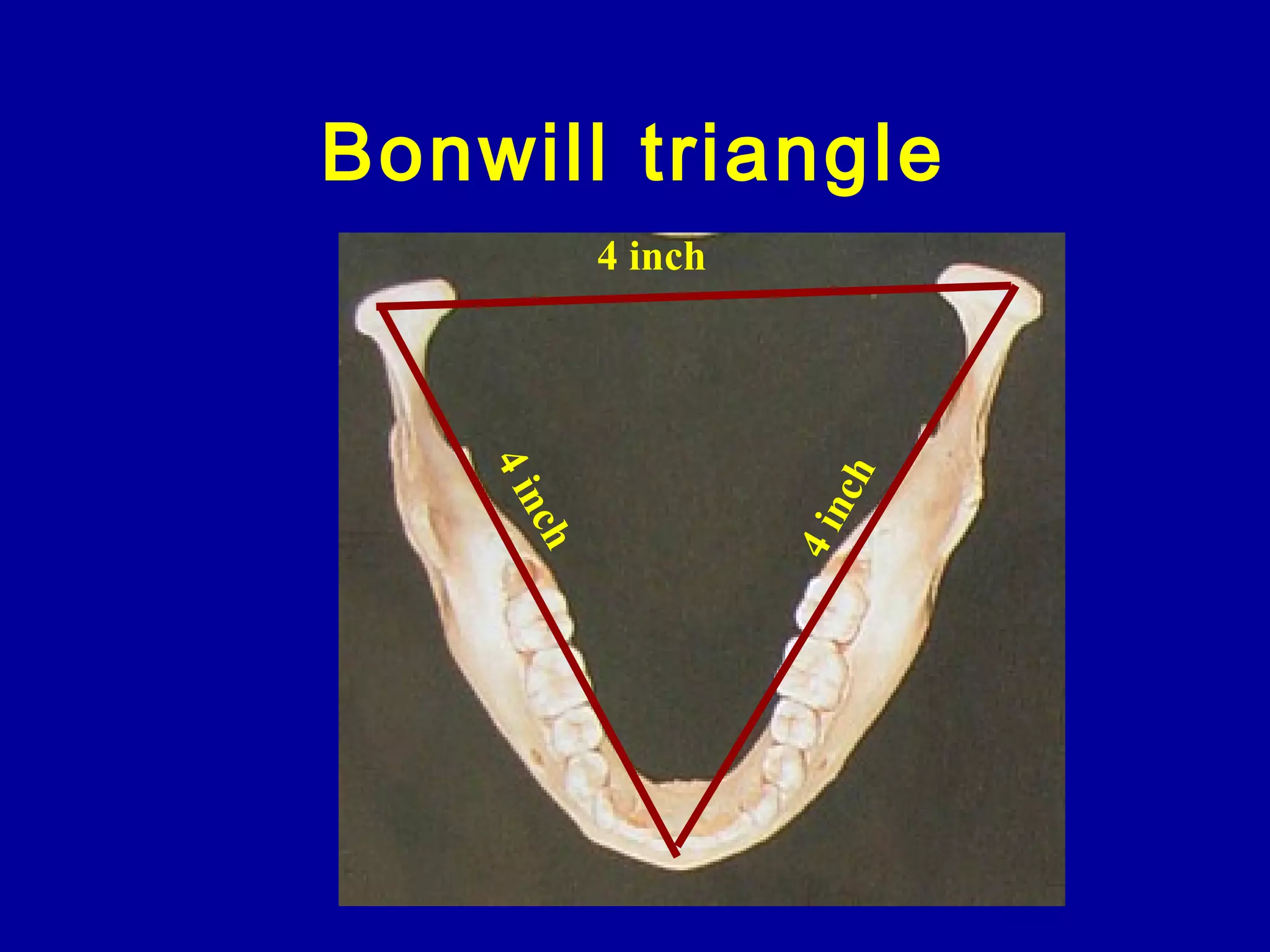
 Bonwill triangle [William Gibson
Arlington Bonwill, American dentist,
1833-1899]:
 eponym for a 4 inch equilateral
triangle bounded by lines connecting
the contact points of the mandibular
central incisor’s incisal edge (or the
mid-line of the mandibular residual
ridge) to each condyle (usually its mid
point) and from one condyle to the
other.
Bonwill triangle
4”
4”
BONWILL 1858
Bonwill's brass wire
anatomical articulator
Bonwill triangle
4inch
4inch
4 inch
Mean Value Articulator
100 mm
100 mm
100 mm
100 mm
4 inch
4inch
4inch
Class III Articulators
(Semi-adjustable articulators)
 An instrument that simulates
condylar pathways by using
averages or mechanical equivalents
for all or part of the motion;
 may be arcon or nonarcon
instruments.
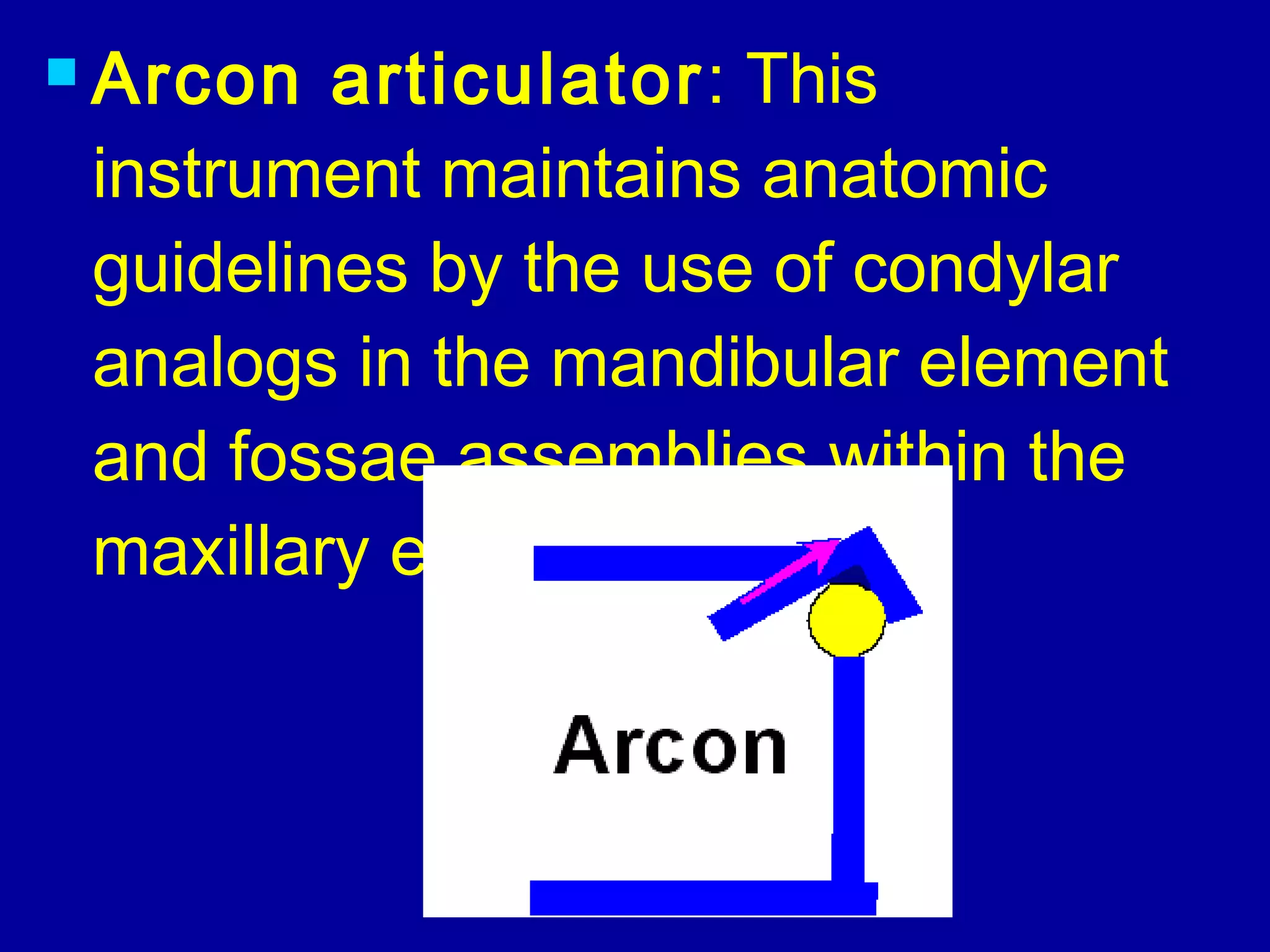
Arcon
The term ‘ARCON’ was derived by
Bergstrom from the words
ARticulator CONdyle.
 Arcon articulator: This
instrument maintains anatomic
guidelines by the use of condylar
analogs in the mandibular element
and fossae assemblies within the
maxillary element.
Eg: Hanau University series
Whipmix
condylar analogs
fossae
assemblies
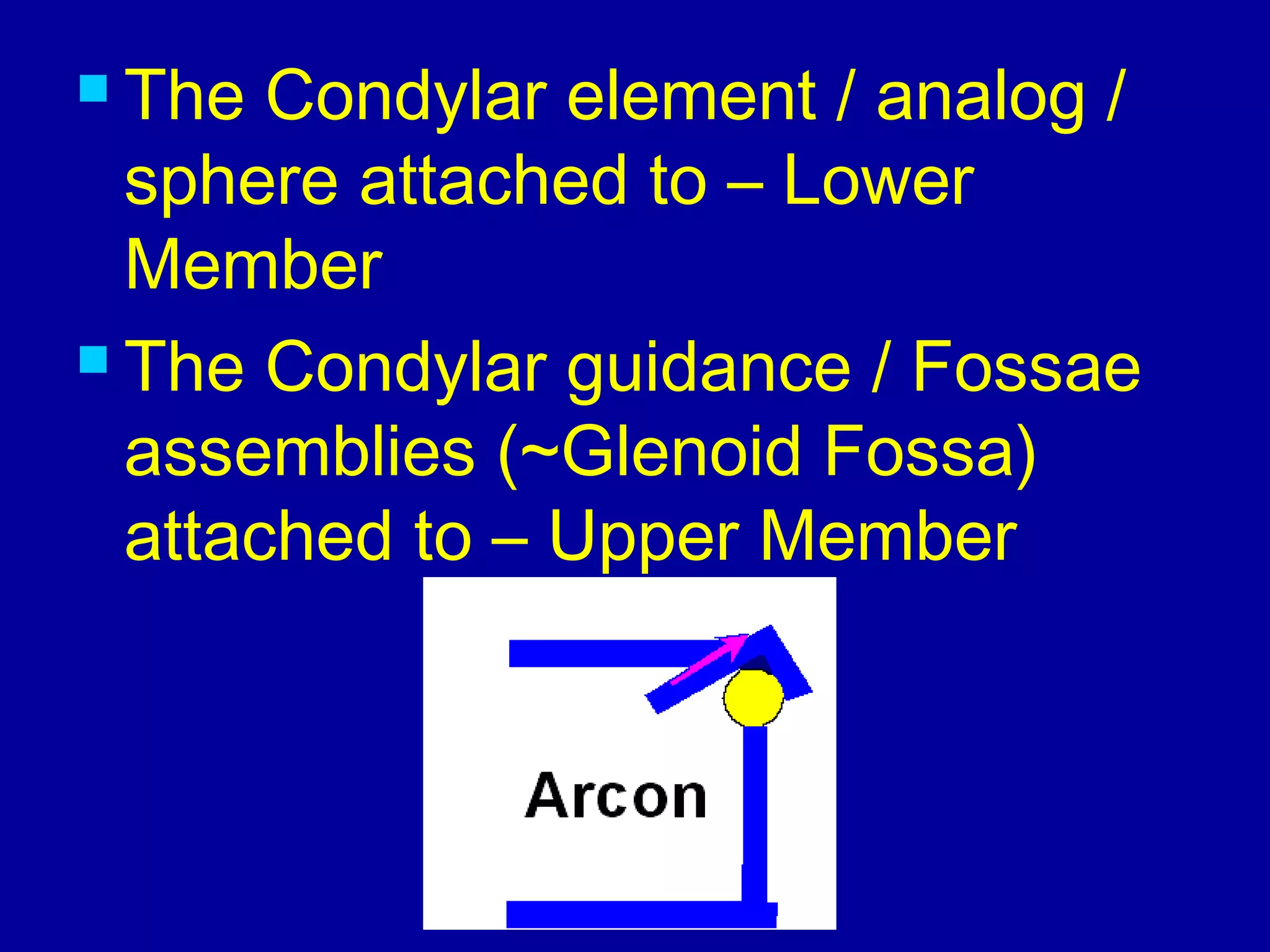
 The Condylar element / analog /
sphere attached to – Lower
Member
 The Condylar guidance / Fossae
assemblies (~Glenoid Fossa)
attached to – Upper Member
 Nonarcon articulator or
condylar articulators: an
articulator whose condylar path
components are part of the lower
member and whose condylar replica
components are part of the upper
member.
Eg: Hanau-H series
Dentatus
 This articulator is the reverse of
the TMJ
 The Condylar Element / analog /
sphere attached to – Upper
Member
 The Condylar Guidance / track/
Fossae assemblies (~Glenoid
Fossa) attached to – Lower
Member
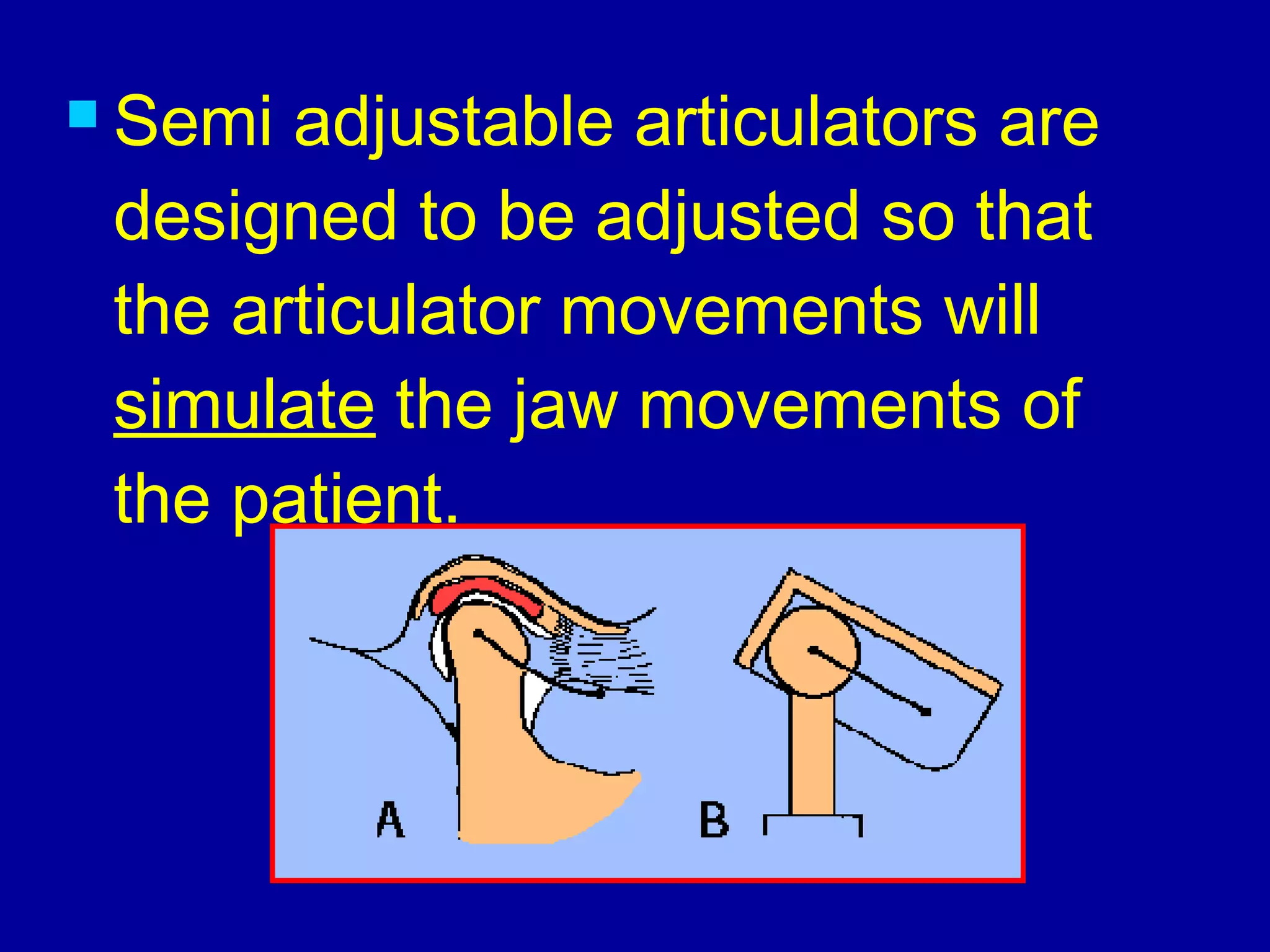
 Semi adjustable articulators are
designed to be adjusted so that
the articulator movements will
simulate the jaw movements of
the patient.
 The condyle travels a curved path in
mandibular movements.
 This is reproduced in semi-adjustable
articulators as a straight path.
 They have adjustable horizontal
condylar guides.
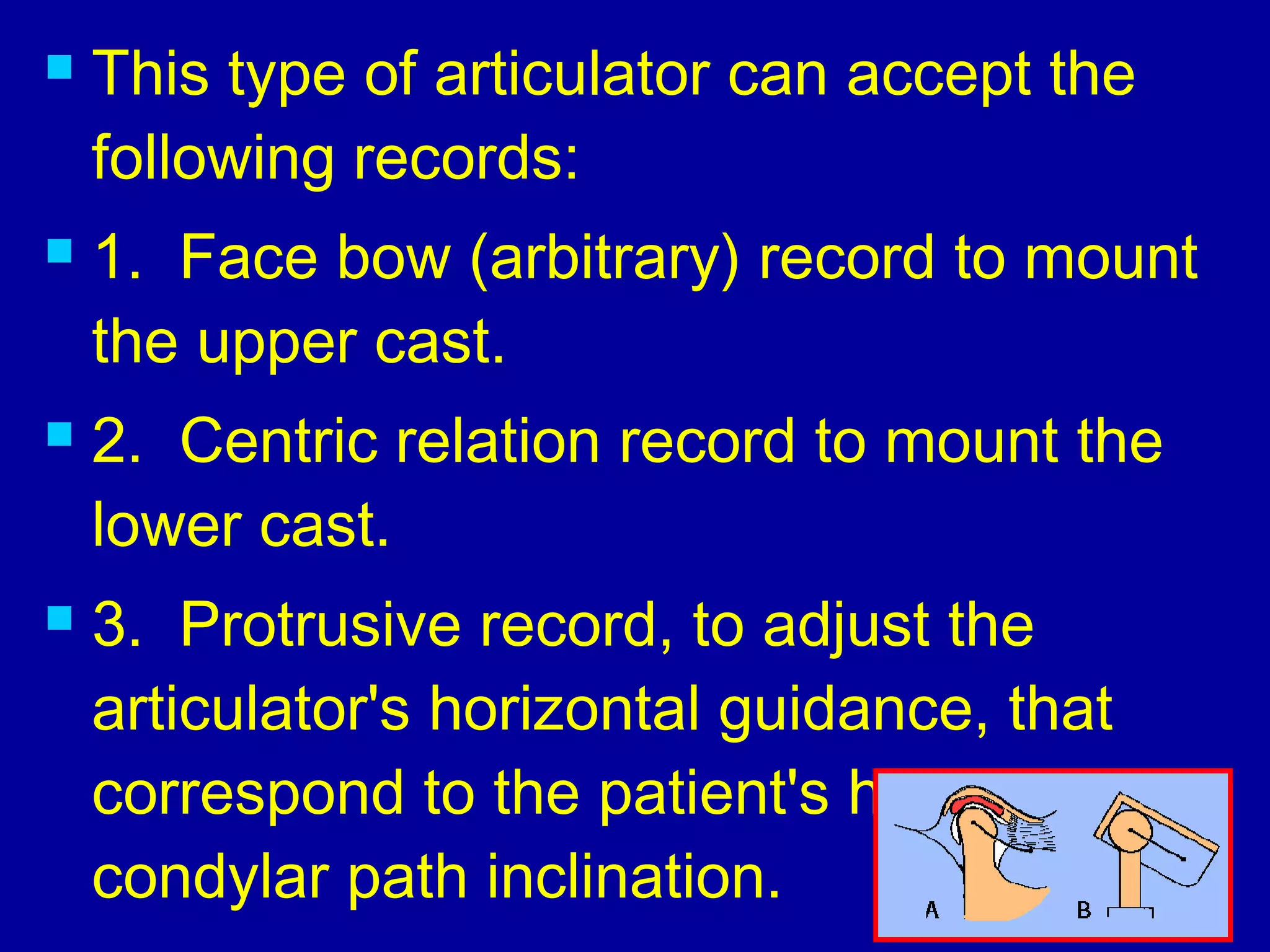
 This type of articulator can accept the
following records:
 1.  Face bow (arbitrary) record to mount
the upper cast.
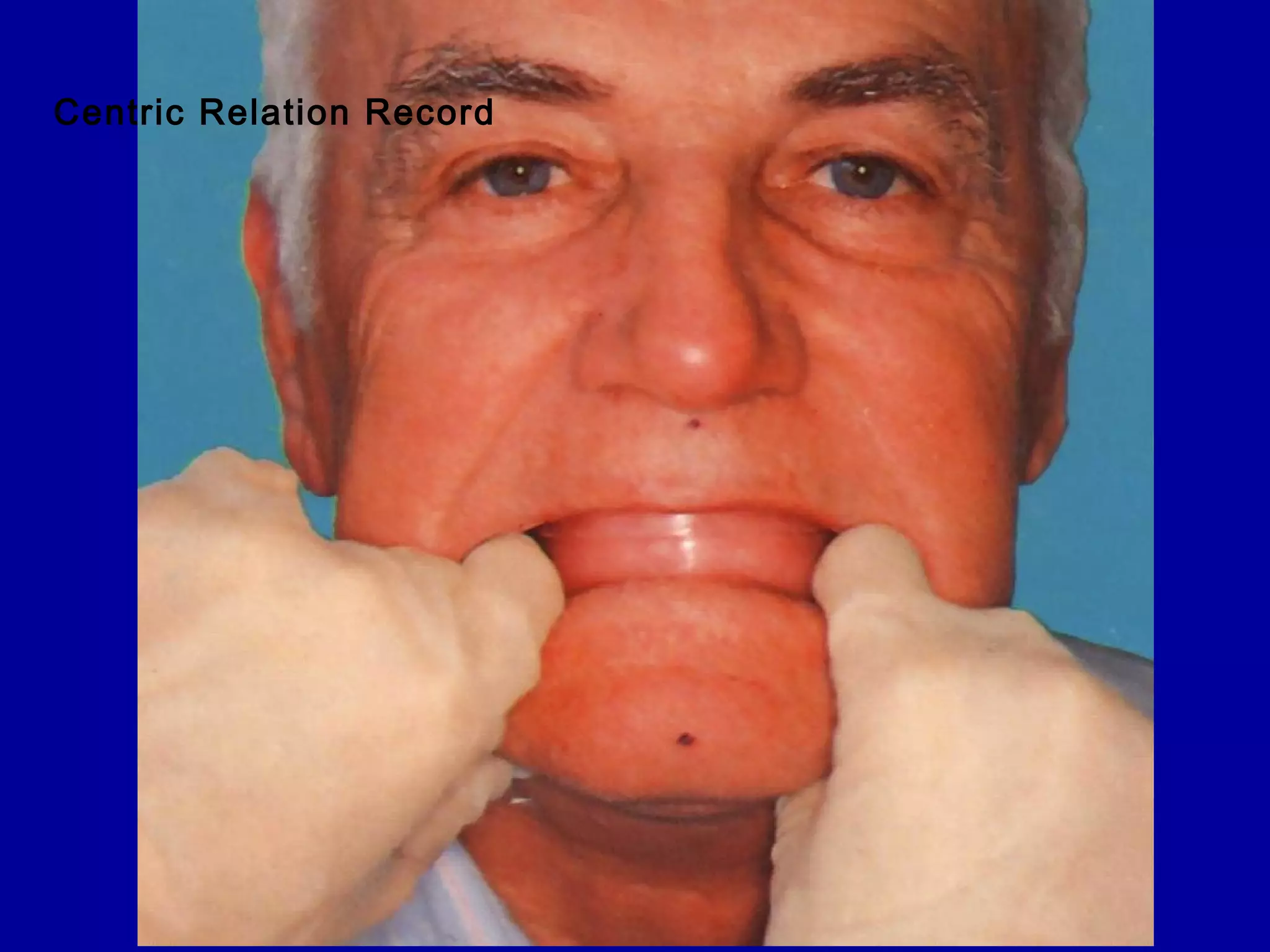
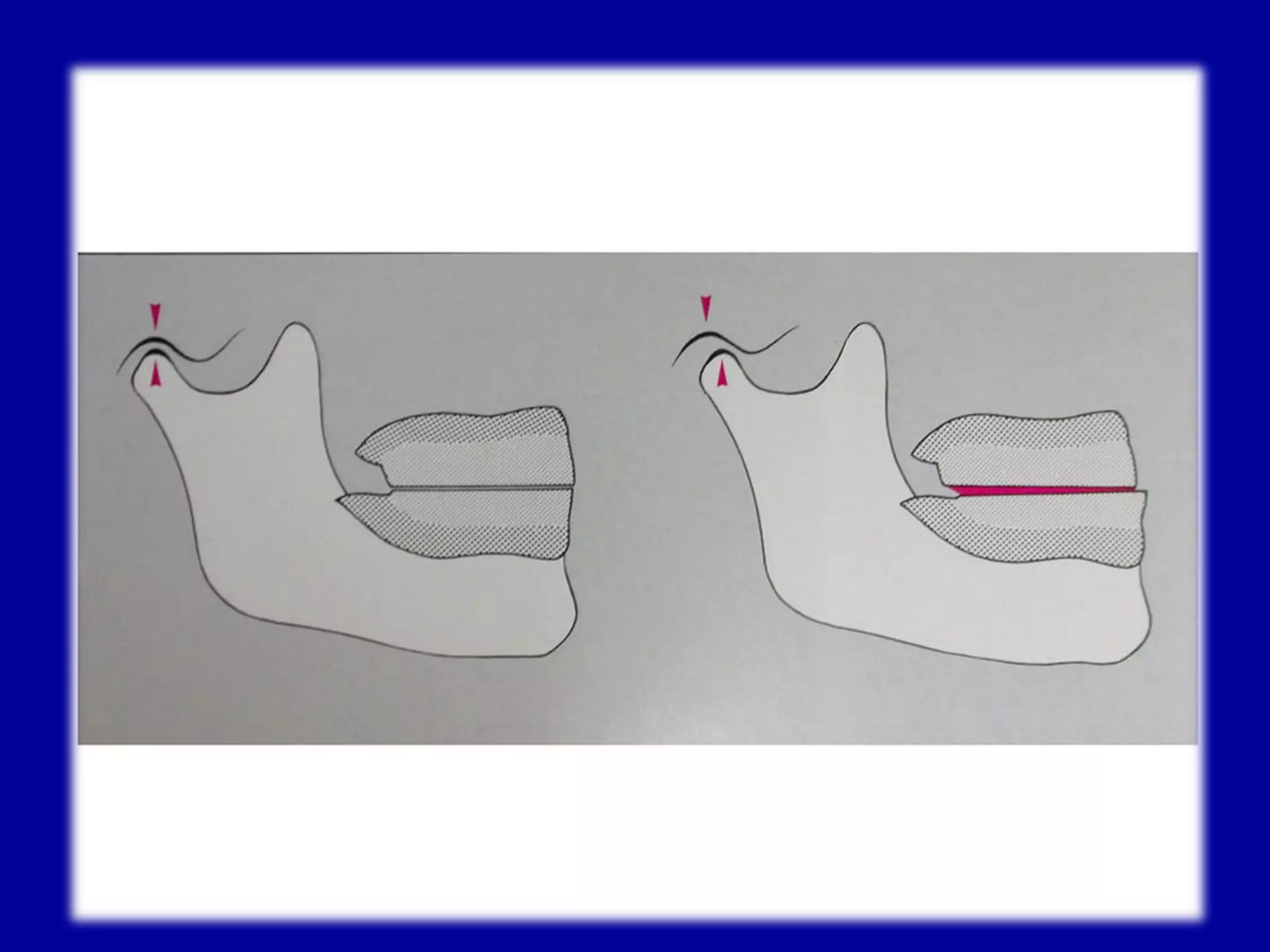
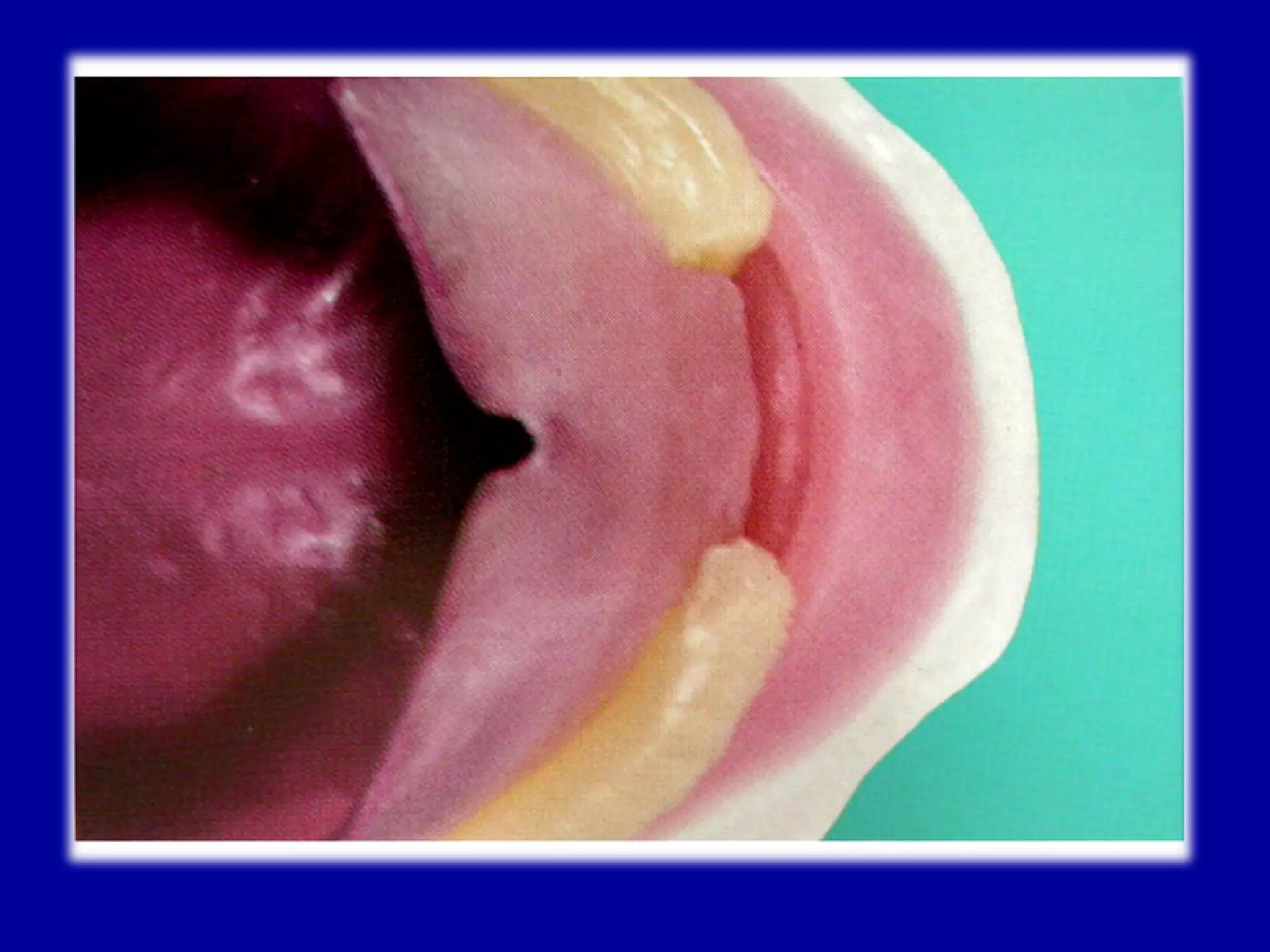
 2.  Centric relation record to mount the
lower cast.
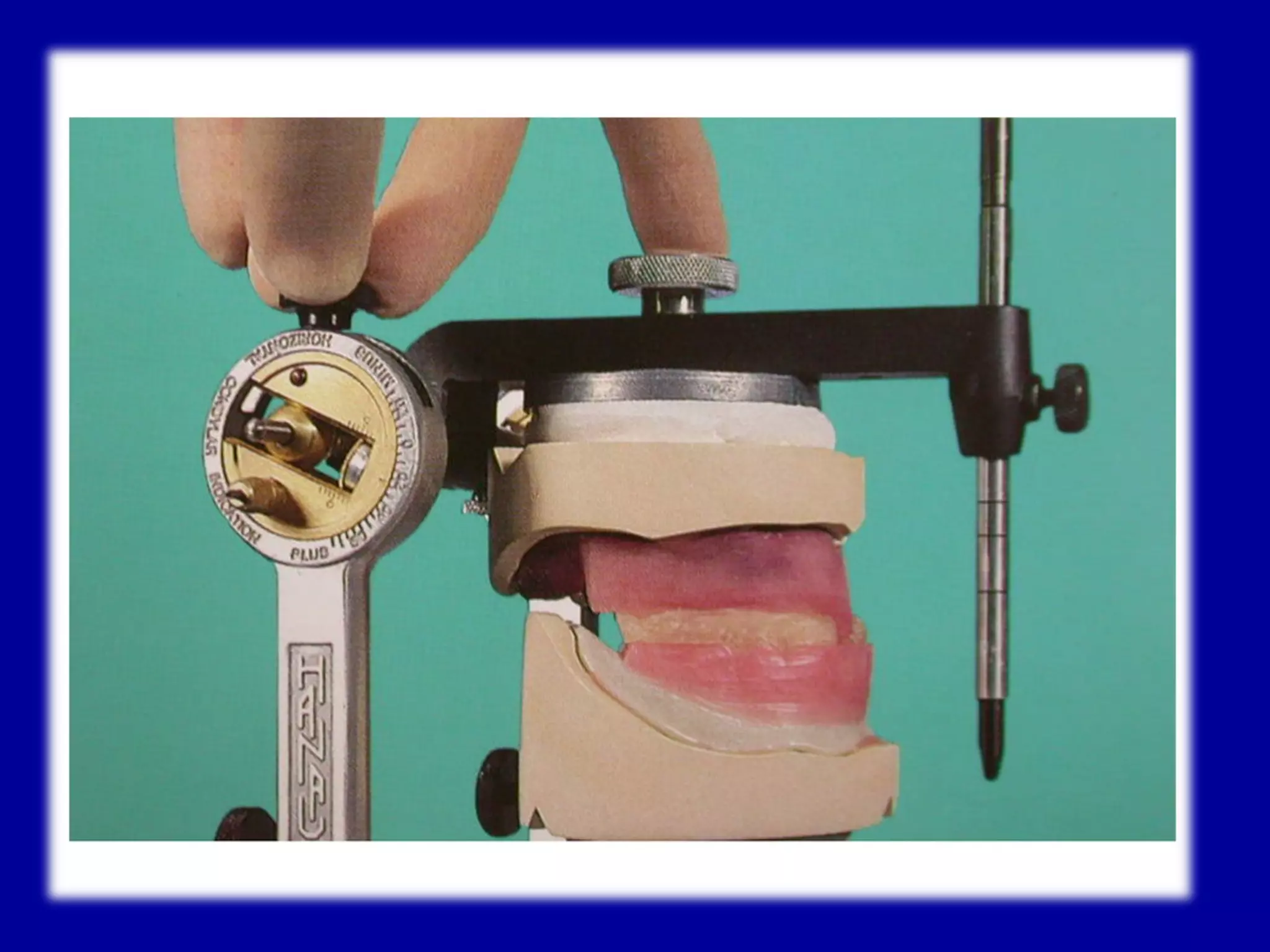
 3.  Protrusive record, to adjust the
articulator's horizontal guidance, that
correspond to the patient's horizontal
condylar path inclination.
Centric Relation Record
 The lateral condylar guidance is
adjusted according to the Hanau's
formula:
 L = H/8+12
 L: The lateral condylar inclination.
 H: The horizontal condylar
inclination.
L = H/8+12
4. They have a fixed intercondylar
distance of about 110 mm.
Class IV Articulators
(Fully-adjustable articulators)
 Fully adjustable articulators have a
complex condylar mechanism which
is adjustable in horizontal, sagittal
and frontal planes to replicate three
dimensional movement of
mandibular motion.
 Simulate mandibular movements
with high degree of accuracy.
 Used for complex fixed partial
denture construction, treating TMJ
problems and full mouth
reconstruction.
 All are arcon instruments
 Egs: Stuart articulator, Denar D4A
articulator
 This type of articulator can accept the
following records:
 1.  Face bow (Kinematic face bow)
record to mount the upper cast.
 2.  Centric relation record to mount the
lower cast.
 3.  Protrusive record, to adjust the
articulator's horizontal guidance, that
correspond to the patient's horizontal
condylar path inclination.
 4. Right and left relation records, to
adjust Bennett angle.
 5. They have an adjustable
intercondylar distance.
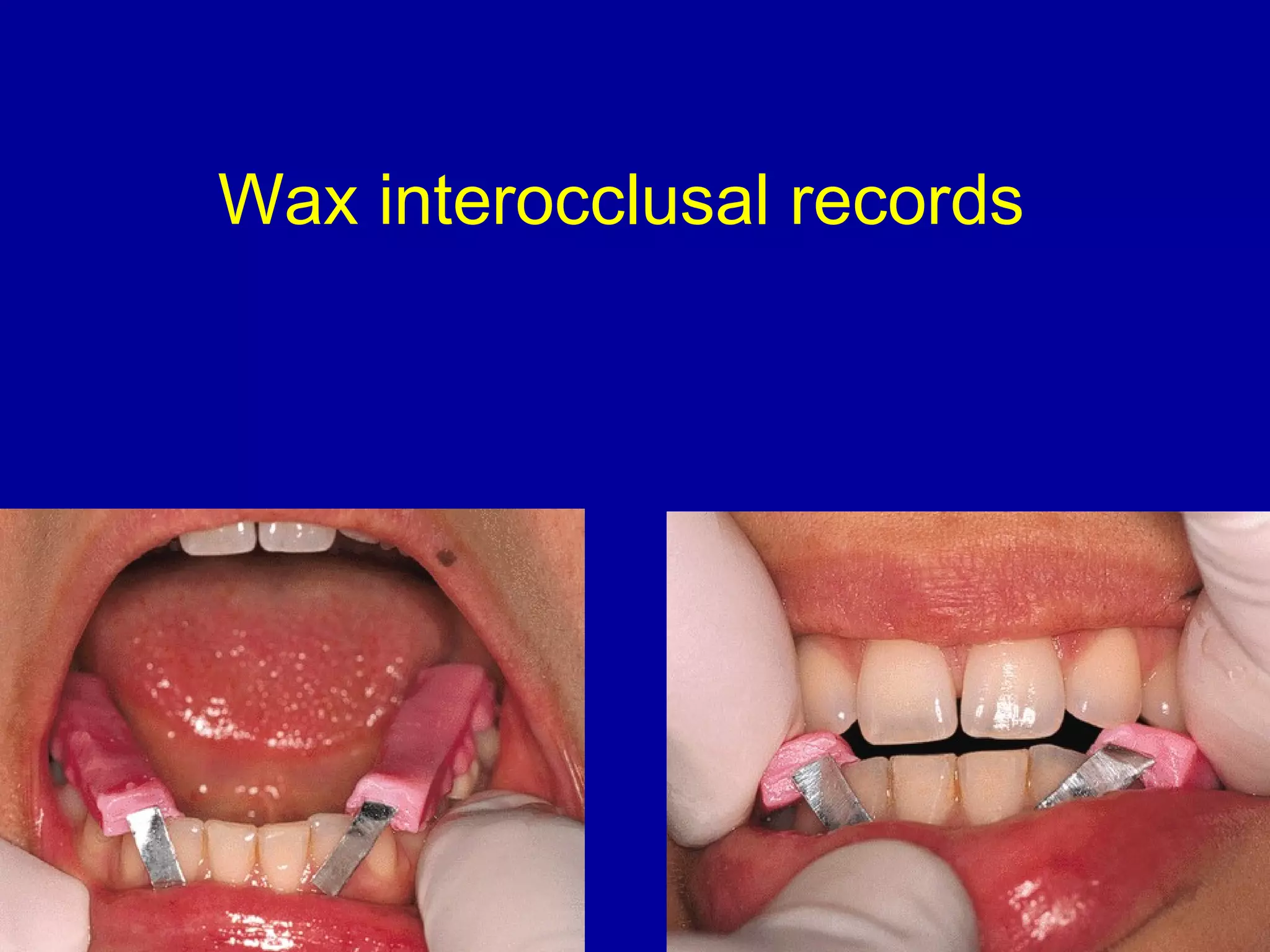
Wax interocclusal records
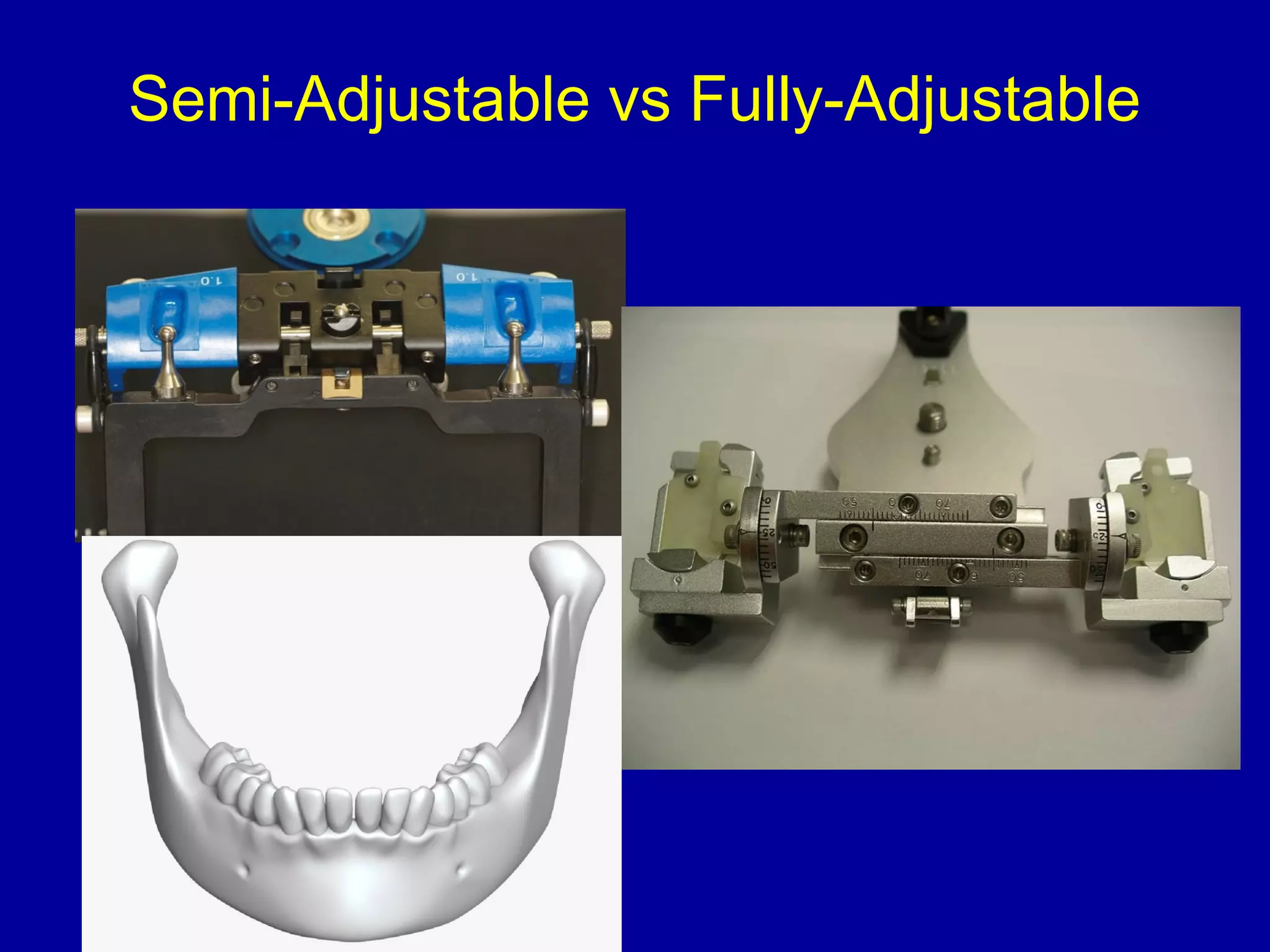
Semi-Adjustable vs Fully-Adjustable
BASIC PARTS OF A
HANAU ARTICULATOR
Upper member - Represents
the Maxilla
Lower member - Represents
the Mandible
Condylar Track - Represents
the Glenoid Fossa
Condylar Element - Represents
the Condyle
Vertical Rod (Incisal Pin)
Incisal guide table
Orbitale indicator (for face bow
Condylar guidance
Upper member
Mounting plate
Incisal pin
(Vertical rod)
Incisal guide
tableLower member
Condylar element
Mounting plate
NON-ARCON HANAU ARTICULATOR
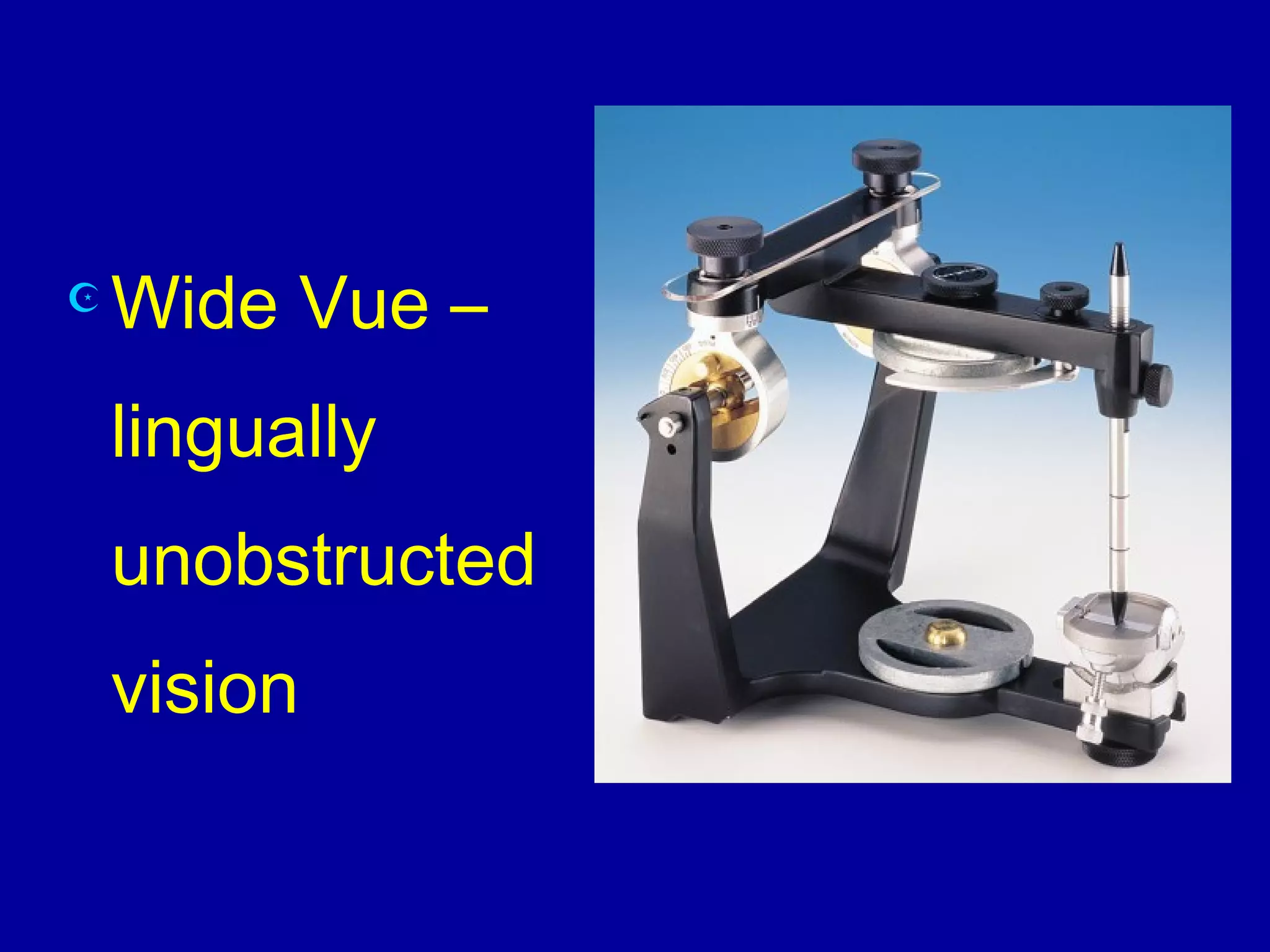
HANUA WIDE VUE
ARTICULATOR
 The HANAU™ Wide-Vue Articulators
are classified as semi-adjustable.
 They are of Arcon principle.
 Wide Vue –
lingually
unobstructed
vision
 The maxillary cast is oriented to the
upper member which represents the
maxilla by a face-bow record.
 The mandibular cast is oriented to the
lower member which represents the
mandible by a relating the lower cast
to the upper cast through a centric
interocclusal record.
 Adjustable Horizontal Condylar
Guidance (-20 degrees to +60
degrees)
 It is adjusted by a protrusive record.
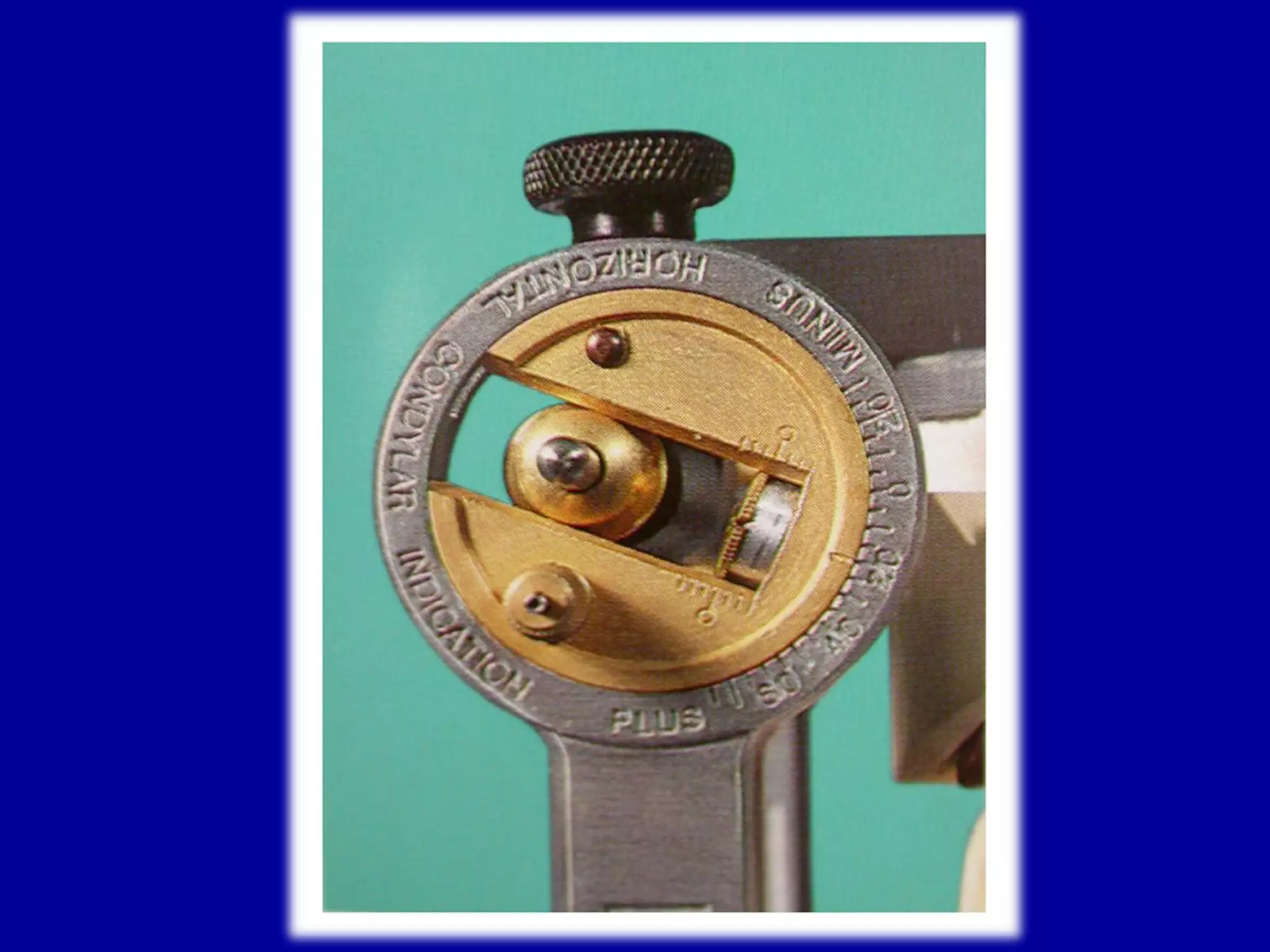
 Adjustable Bennett angle or lateral
condylar guidance (0 degrees to 30
degrees)
 Bennett angle (L) = H/8+12
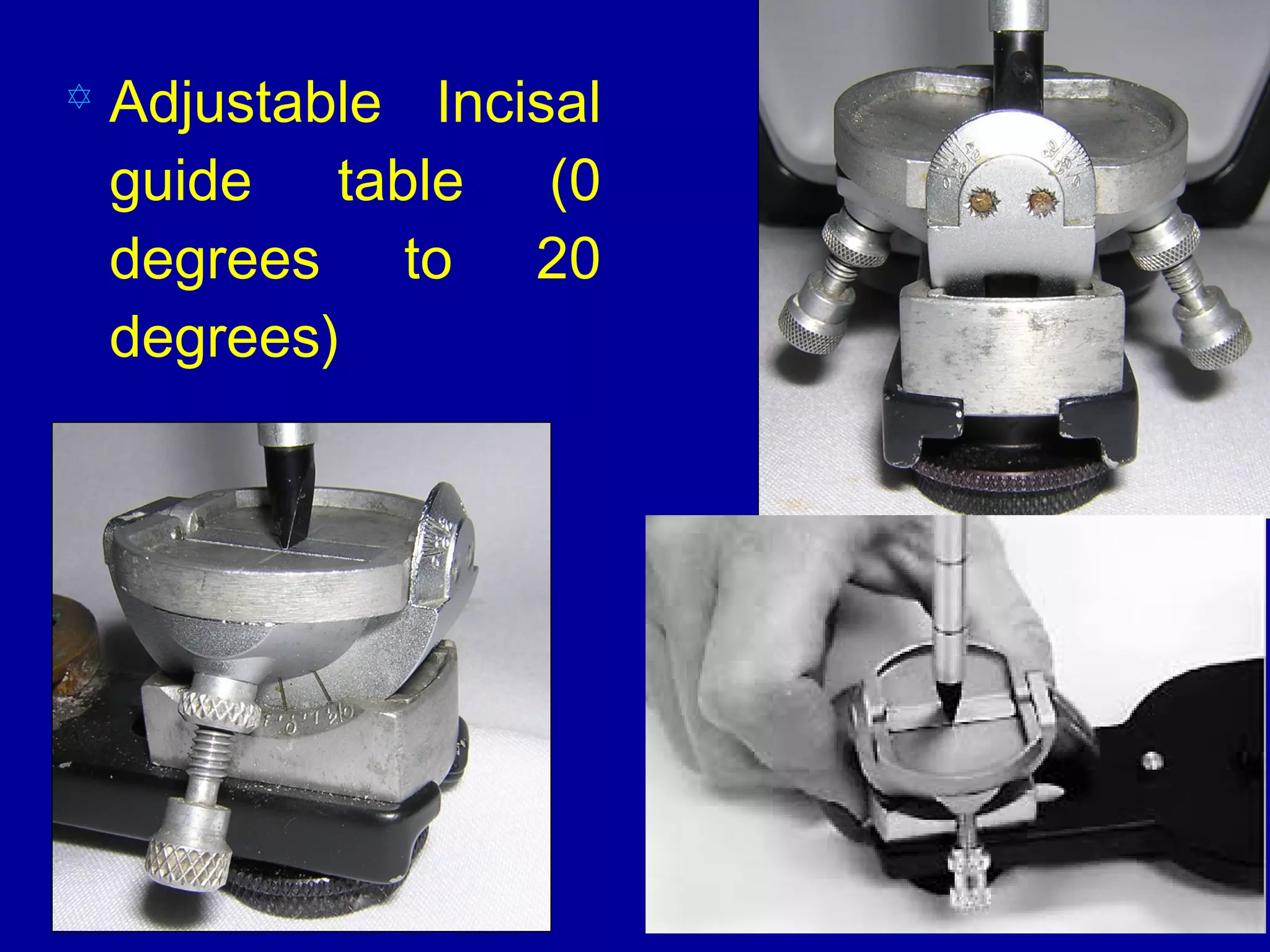
 Adjustable Incisal
guide table (0
degrees to 20
degrees)
adjustments
adjustments
 Orbitale
indicator
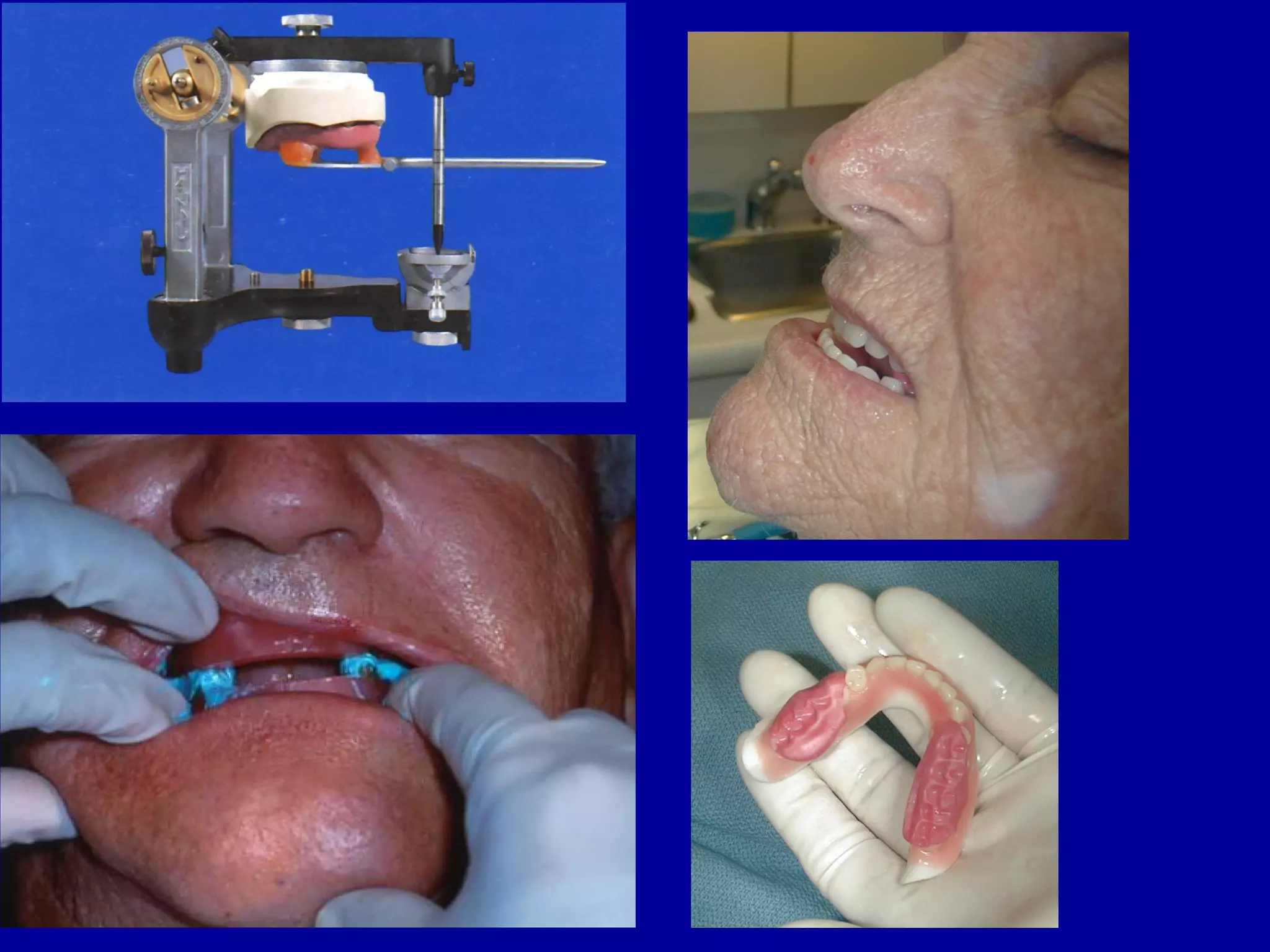
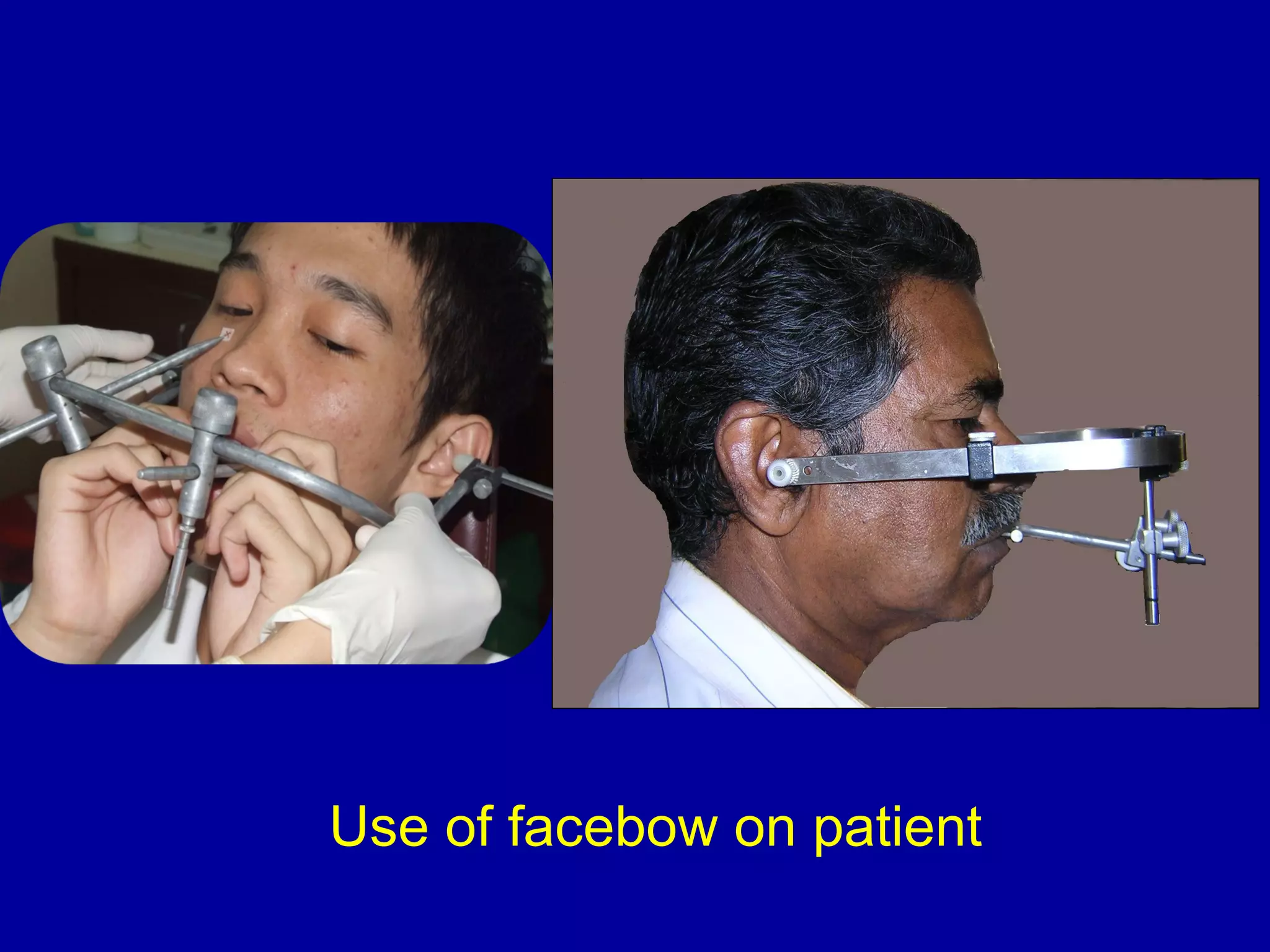
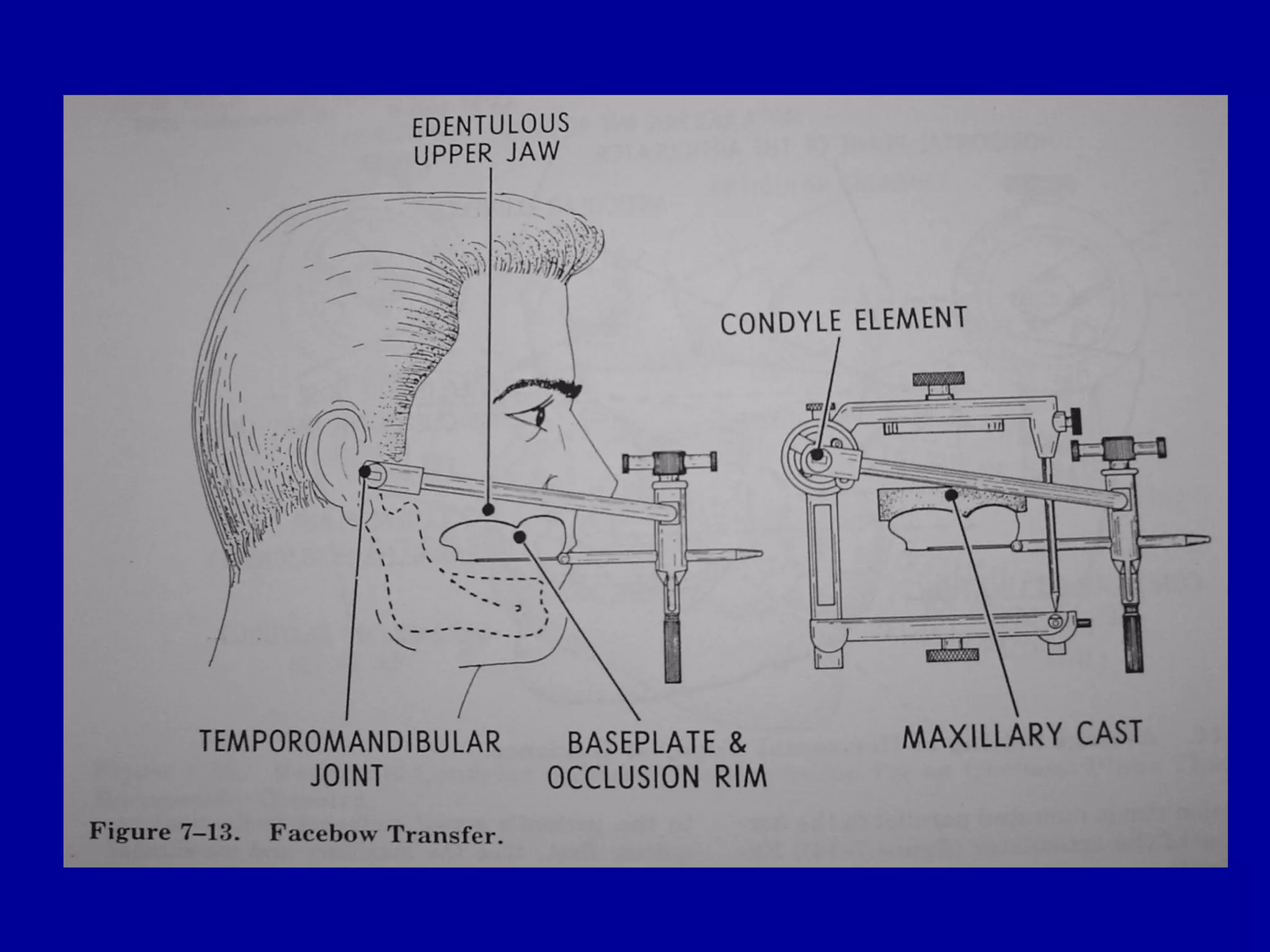
Use of facebow on patient
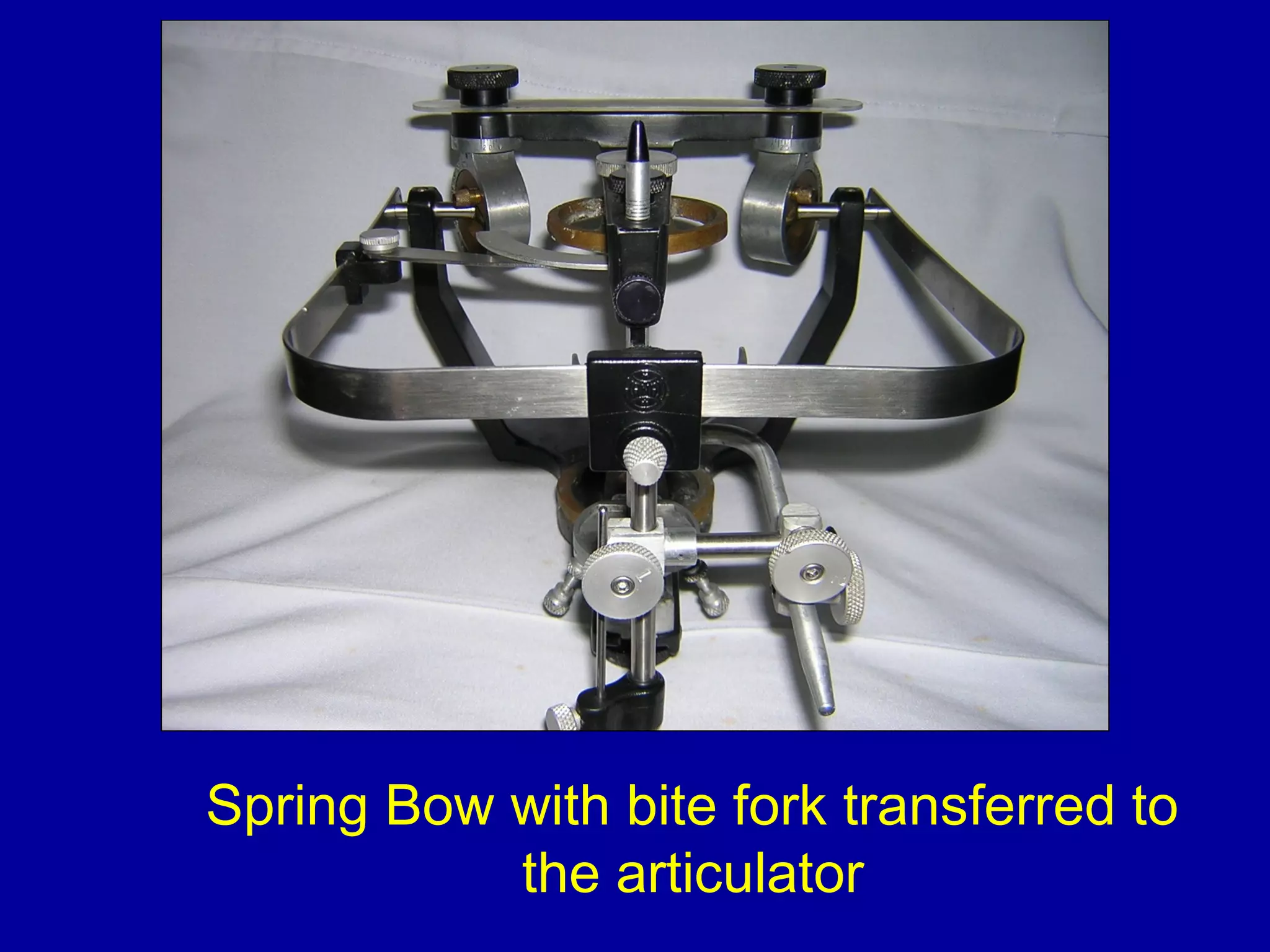
Spring Bow with bite fork transferred to
the articulator
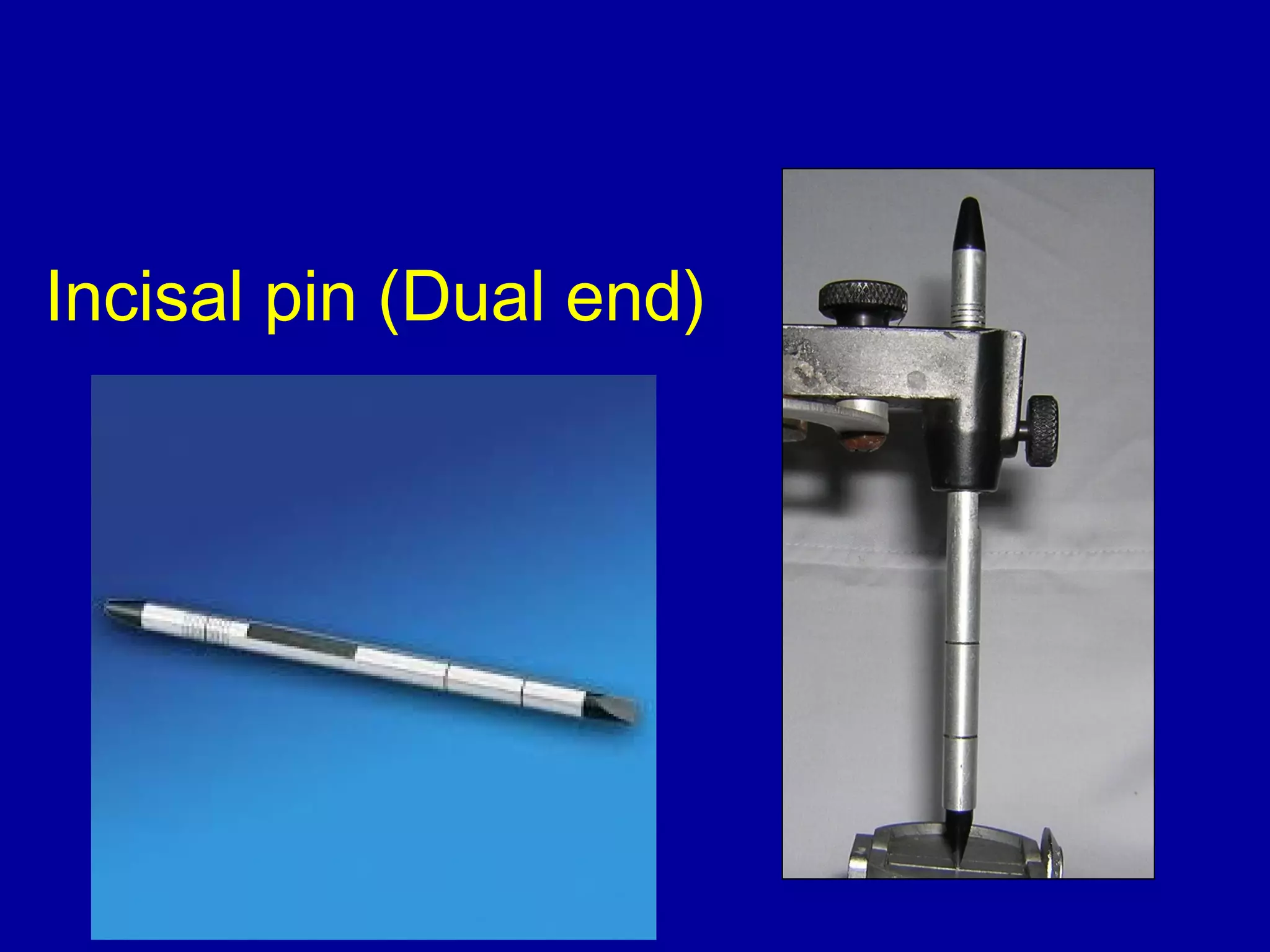
Incisal pin (Dual end)
Mounting plates
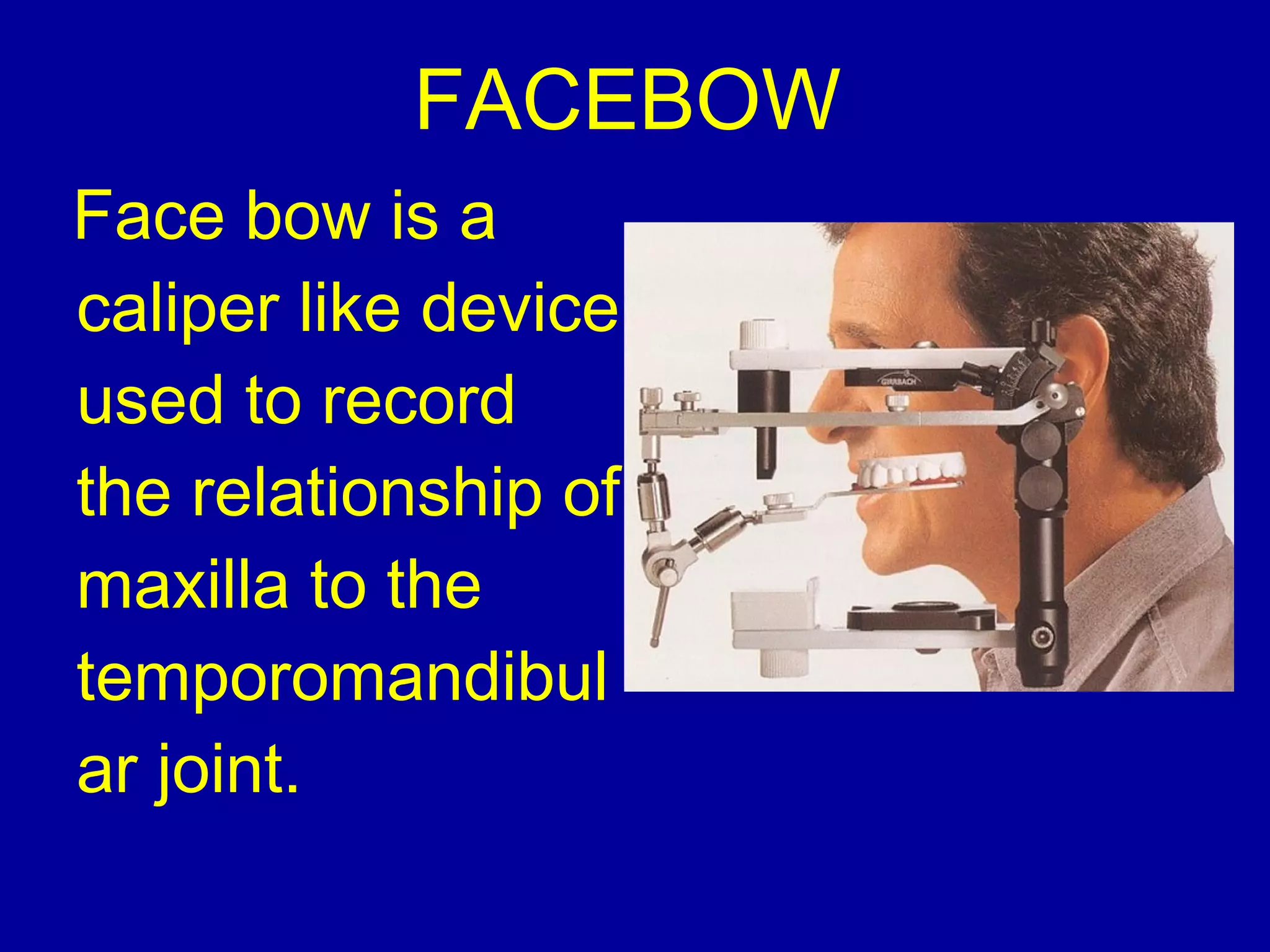
FACEBOW
Face bow is a
caliper like device
used to record
the relationship of
maxilla to the
temporomandibul
ar joint.
FACEBOW
CLASSIFICATION
Conventional face bow Ear piece face bow
Semi-adjustable articulators
Kinematic face bow -
Fully adjustable
articulators
ADVANTAGES OF THE FACE
BOW
 Reduces errors in occlusion.
 Permits more accurate
programming of the articulator.
 Supports the maxillary cast while
transferring on the articulator.
Questions

articulators

  • 2.
  • 3.
    Learning outcomes 1. Definean articulator. 2. List the uses and requirements of articulators. 3. Explain the different types of articulators and facebows. 4. Compare arcon and non arcon articulators.
  • 4.
    ARTICULATOR A mechanical instrumentthat represents the temporomandibular joints and jaws, to which maxillary and mandibular casts may be attached to simulate some or all mandibular movements.
  • 5.
  • 6.
     The articulatorhelps to maintain the desired maxillomandibular relationship of the casts during tooth arrangement. Thus, it makes it possible to arrange teeth in the absence of the patient.
  • 7.
    Uses of anArticulator 1. Mounting dental casts for diagnosis, treatment planning and patient presentation.
  • 8.
    2. Arrangement ofartificial teeth for complete and removable partial dentures.
  • 9.
    3. Wax-up andrefining the occlusion for dental restorations.
  • 10.
    4. Articulators canbe helpful in studying of occlusion and mandibular movements.
  • 11.
    5. To aidin fabrication of dental restorations and lost dental parts.
  • 12.
    Requirements of an Articulator The articulator should have the following minimal requirements: 1. It should hold the casts in the correct horizontal relationship and vertical relationship. 2. It should provide positive anterior vertical stop (the incisal pin).
  • 14.
    3. It shouldaccept a face bow record. 4. It should open and close in a hinge movement.
  • 15.
    5. The movingparts should move freely and be machined accurately. 6. The non-moving parts should be of rigid construction. 7. It should allow protrusive and lateral jaw motion.
  • 16.
    Classification of articulators Class I Articulators (Non-adjustable articulators)  Class II Articulators (Average-value articulators)  Class III Articulators (Semi-adjustable articulators)  Class IV Articulators (Fully-adjustable articulators)
  • 18.
    Class I Articulators (Non-adjustablearticulators or simple hinge or plane line articulators)
  • 19.
     A simpleholding instrument capable of accepting a single static registration.  Vertical motion is possible.
  • 20.
    Class II Articulators (Average-valuearticulators or mean value articulator)
  • 21.
     Instrument thatpermit horizontal as well as vertical motion but do not orient the motion to the temporomandibular joints via a face-bow transfer.
  • 22.
     It allowslimited range of protrusive and lateral movements  It has fixed horizontal condylar guidance of 30 degrees.  It has fixed incisal guidance.  It has fixed inter-condylar distance.
  • 23.
     Bonwill triangle[William Gibson Arlington Bonwill, American dentist, 1833-1899]:  eponym for a 4 inch equilateral triangle bounded by lines connecting the contact points of the mandibular central incisor’s incisal edge (or the mid-line of the mandibular residual ridge) to each condyle (usually its mid point) and from one condyle to the other.
  • 24.
  • 25.
  • 26.
  • 27.
    Mean Value Articulator 100mm 100 mm 100 mm 100 mm 4 inch 4inch 4inch
  • 28.
  • 29.
     An instrumentthat simulates condylar pathways by using averages or mechanical equivalents for all or part of the motion;  may be arcon or nonarcon instruments.
  • 30.
    Arcon The term ‘ARCON’was derived by Bergstrom from the words ARticulator CONdyle.
  • 31.
     Arcon articulator:This instrument maintains anatomic guidelines by the use of condylar analogs in the mandibular element and fossae assemblies within the maxillary element.
  • 32.
    Eg: Hanau Universityseries Whipmix condylar analogs fossae assemblies
  • 33.
     The Condylarelement / analog / sphere attached to – Lower Member  The Condylar guidance / Fossae assemblies (~Glenoid Fossa) attached to – Upper Member
  • 34.
     Nonarcon articulatoror condylar articulators: an articulator whose condylar path components are part of the lower member and whose condylar replica components are part of the upper member.
  • 35.
  • 36.
     This articulatoris the reverse of the TMJ  The Condylar Element / analog / sphere attached to – Upper Member  The Condylar Guidance / track/ Fossae assemblies (~Glenoid Fossa) attached to – Lower Member
  • 38.
     Semi adjustablearticulators are designed to be adjusted so that the articulator movements will simulate the jaw movements of the patient.
  • 39.
     The condyletravels a curved path in mandibular movements.  This is reproduced in semi-adjustable articulators as a straight path.
  • 40.
     They haveadjustable horizontal condylar guides.
  • 41.
     This typeof articulator can accept the following records:  1.  Face bow (arbitrary) record to mount the upper cast.  2.  Centric relation record to mount the lower cast.  3.  Protrusive record, to adjust the articulator's horizontal guidance, that correspond to the patient's horizontal condylar path inclination.
  • 43.
  • 48.
     The lateralcondylar guidance is adjusted according to the Hanau's formula:  L = H/8+12  L: The lateral condylar inclination.  H: The horizontal condylar inclination.
  • 49.
  • 50.
    4. They havea fixed intercondylar distance of about 110 mm.
  • 51.
  • 52.
     Fully adjustablearticulators have a complex condylar mechanism which is adjustable in horizontal, sagittal and frontal planes to replicate three dimensional movement of mandibular motion.
  • 53.
     Simulate mandibularmovements with high degree of accuracy.  Used for complex fixed partial denture construction, treating TMJ problems and full mouth reconstruction.  All are arcon instruments  Egs: Stuart articulator, Denar D4A articulator
  • 56.
     This typeof articulator can accept the following records:  1.  Face bow (Kinematic face bow) record to mount the upper cast.
  • 57.
     2.  Centric relationrecord to mount the lower cast.  3.  Protrusive record, to adjust the articulator's horizontal guidance, that correspond to the patient's horizontal condylar path inclination.
  • 58.
     4. Rightand left relation records, to adjust Bennett angle.  5. They have an adjustable intercondylar distance.
  • 60.
  • 61.
  • 62.
    BASIC PARTS OFA HANAU ARTICULATOR Upper member - Represents the Maxilla Lower member - Represents the Mandible Condylar Track - Represents the Glenoid Fossa Condylar Element - Represents the Condyle Vertical Rod (Incisal Pin) Incisal guide table Orbitale indicator (for face bow
  • 63.
    Condylar guidance Upper member Mountingplate Incisal pin (Vertical rod) Incisal guide tableLower member Condylar element Mounting plate NON-ARCON HANAU ARTICULATOR
  • 64.
  • 65.
     The HANAU™Wide-Vue Articulators are classified as semi-adjustable.  They are of Arcon principle.
  • 66.
     Wide Vue– lingually unobstructed vision
  • 67.
     The maxillarycast is oriented to the upper member which represents the maxilla by a face-bow record.
  • 68.
     The mandibularcast is oriented to the lower member which represents the mandible by a relating the lower cast to the upper cast through a centric interocclusal record.
  • 69.
     Adjustable HorizontalCondylar Guidance (-20 degrees to +60 degrees)  It is adjusted by a protrusive record.
  • 70.
     Adjustable Bennettangle or lateral condylar guidance (0 degrees to 30 degrees)  Bennett angle (L) = H/8+12
  • 71.
     Adjustable Incisal guidetable (0 degrees to 20 degrees) adjustments adjustments
  • 72.
  • 73.
    Use of facebowon patient
  • 74.
    Spring Bow withbite fork transferred to the articulator
  • 75.
  • 76.
  • 78.
  • 79.
    Face bow isa caliper like device used to record the relationship of maxilla to the temporomandibul ar joint. FACEBOW
  • 81.
  • 82.
    Conventional face bowEar piece face bow Semi-adjustable articulators Kinematic face bow - Fully adjustable articulators
  • 83.
    ADVANTAGES OF THEFACE BOW  Reduces errors in occlusion.  Permits more accurate programming of the articulator.  Supports the maxillary cast while transferring on the articulator.
  • 85.

Editor's Notes

  • #24 An eponym is a person, a place, or thing for whom or for which something is named, or believed to be named.
  • #52 denar