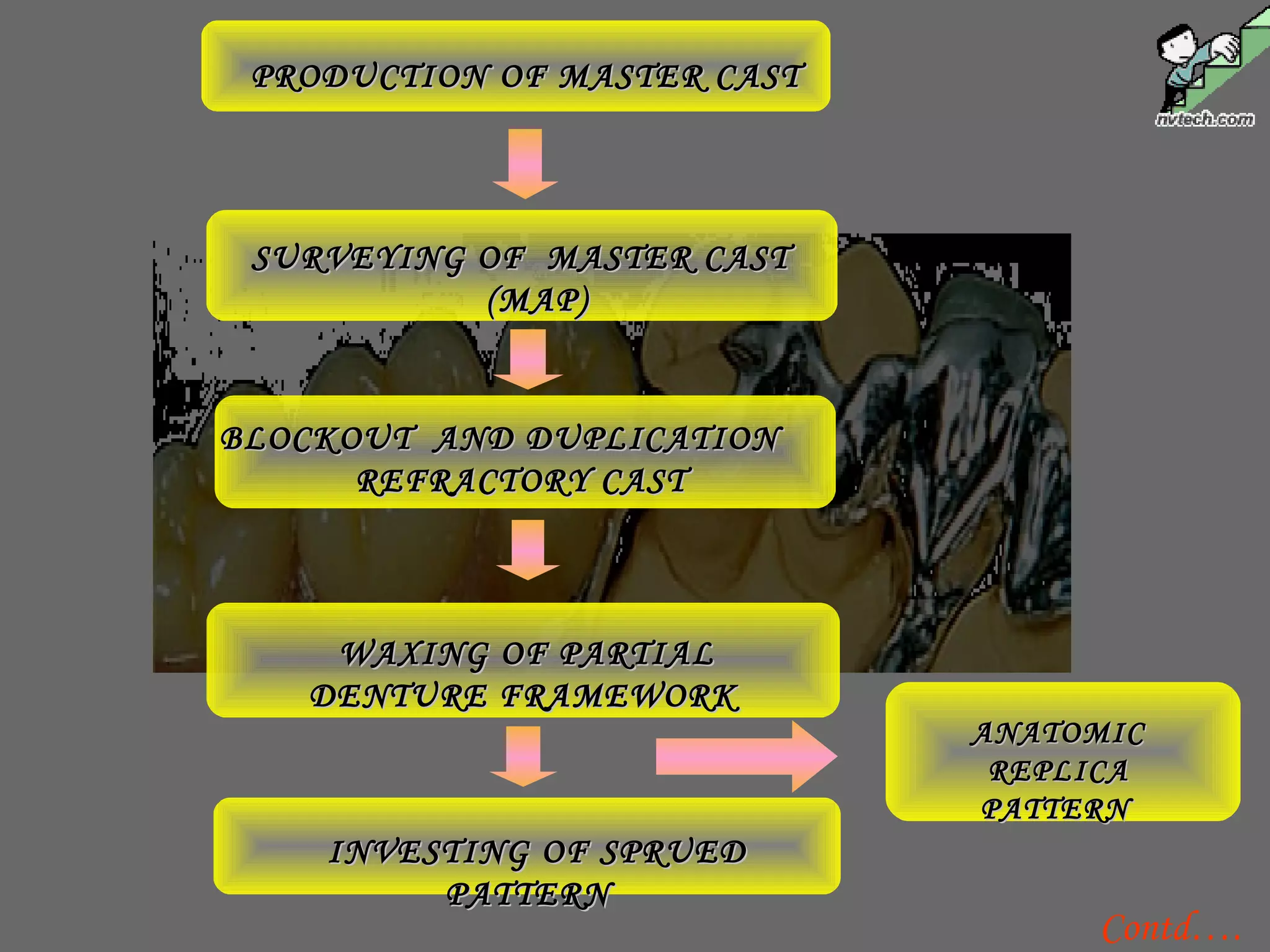

PRODUCTIONPRODUCTION OF MASTER CASTOF MASTER CAST
SURVEYING OF MASTER CASTSURVEYING OF MASTER CAST
(MAP)(MAP)
BLOCKOUT AND DUPLICATIONBLOCKOUT AND DUPLICATION
REFRACTORY CASTREFRACTORY CAST
WAXING OF PARTIALWAXING OF PARTIAL
DENTURE FRAMEWORKDENTURE FRAMEWORK
INVESTING OF SPRUEDINVESTING OF SPRUED
PATTERNPATTERN
ANATOMICANATOMIC
REPLICAREPLICA
PATTERNPATTERN
Contd….
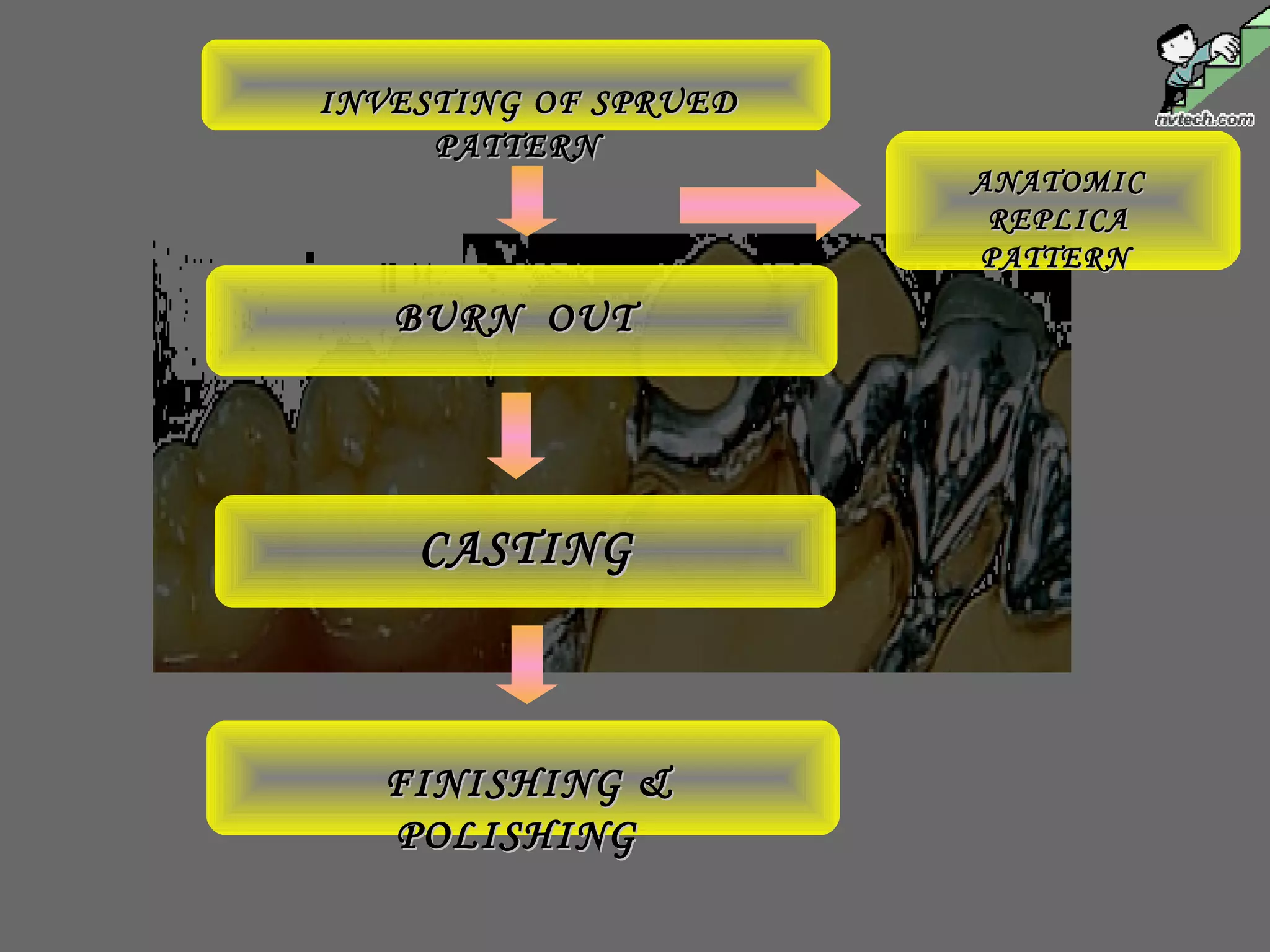
INVESTING OF SPRUEDINVESTING OF SPRUED
PATTERNPATTERN
BURN OUTBURN OUT
CASTINGCASTING
FINISHING &FINISHING &
POLISHINGPOLISHING
ANATOMICANATOMIC
REPLICAREPLICA
PATTERNPATTERN
STEP I : PRODUCTION OF MASTERSTEP I : PRODUCTION OF MASTER
CASTCAST
 Preliminary impressions are made in either Alginate, Agar or
Elastomeric materials
 Both Alginate and Agar should be poured immediately and
proper base should be formed
 Elastomeric impression can be beaded and boxed before pouring
to get cast ready for surveying
 Grind model, if necessary
Personally my preference is to use medium viscosity
elastomers for a cast partial impression
STEP II : SURVEYING & DESIGNING OF MASTERSTEP II : SURVEYING & DESIGNING OF MASTER
CASTCAST
Objective :
 “To select the most suitable path of placement
that satisfy the requirements of guiding planes,
retention, non-interferences & esthetics”
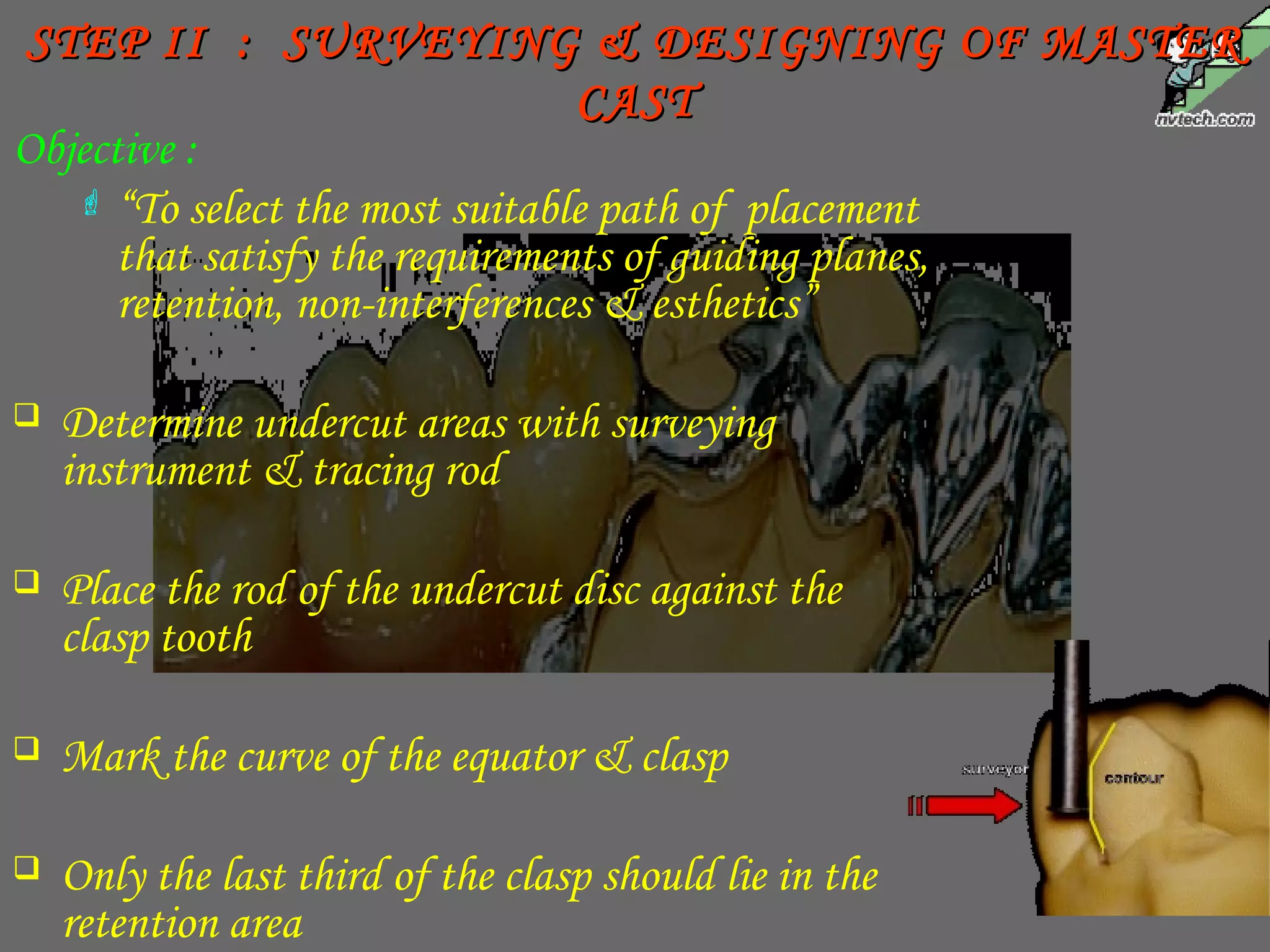
 Determine undercut areas with surveying
instrument & tracing rod
 Place the rod of the undercut disc against the
clasp tooth
 Mark the curve of the equator & clasp
 Only the last third of the clasp should lie in the
retention area
Contd….
ESTABLISHING MAPESTABLISHING MAP
Primary objective is to establish a position of
the cast that places teeth & associated tissues
in the “Most-Advantageous-Position’’
(MAP) for treatment with the partial denture
 Eye-Survey : tilting the cast
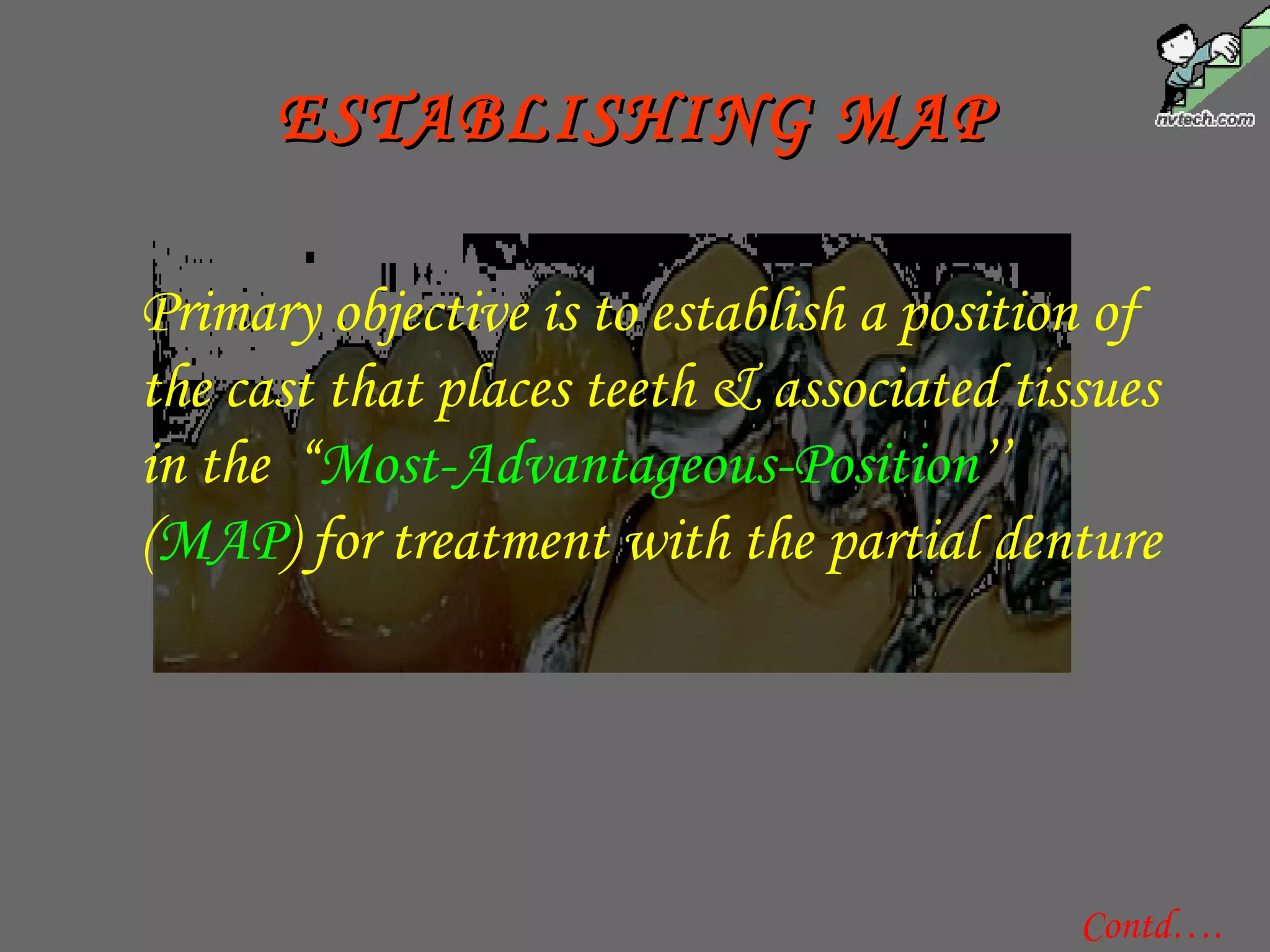
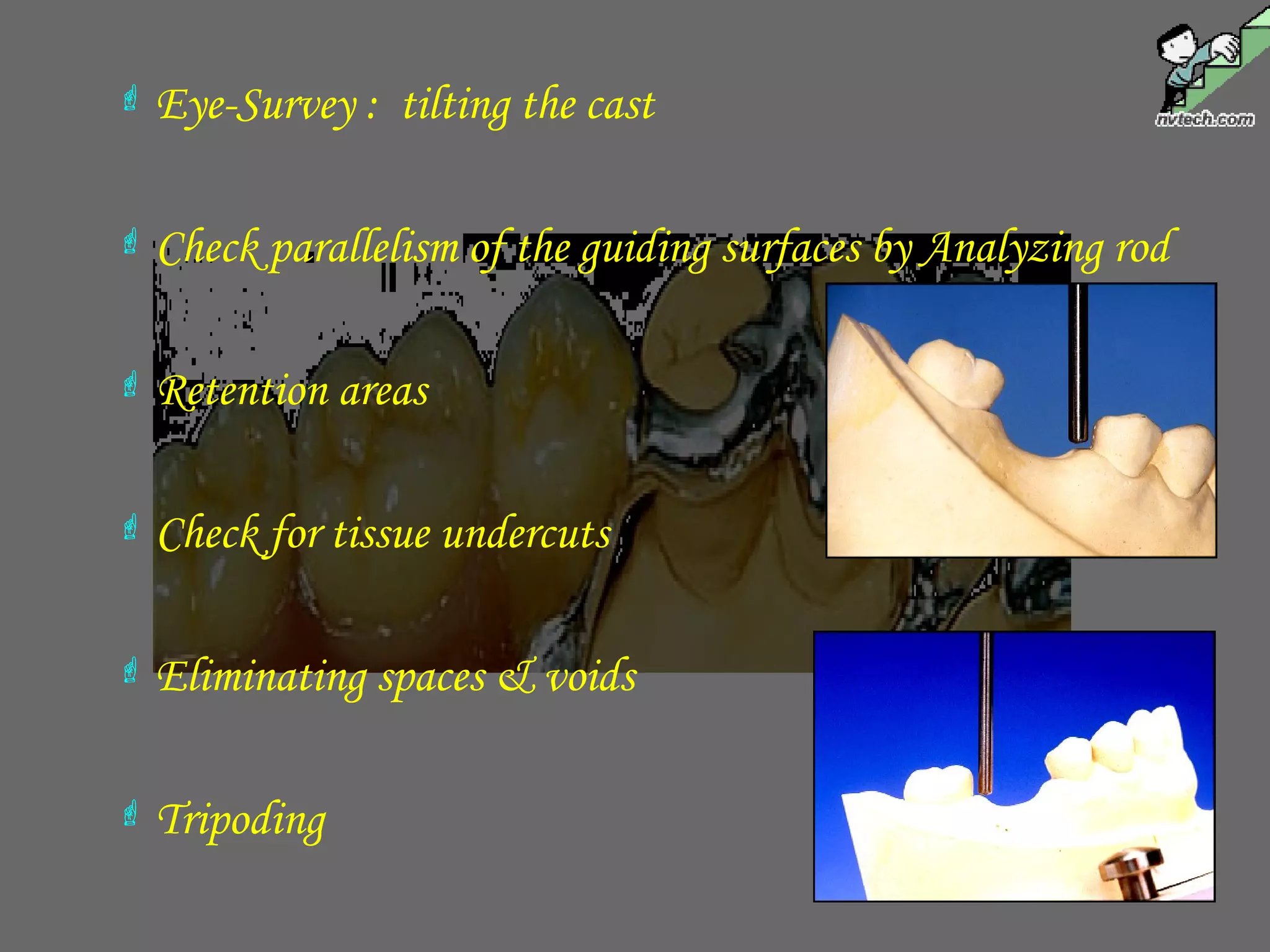
 Check parallelism of the guiding surfaces by Analyzing rod
 Retention areas
 Check for tissue undercuts
 Eliminating spaces & voids
 Tripoding
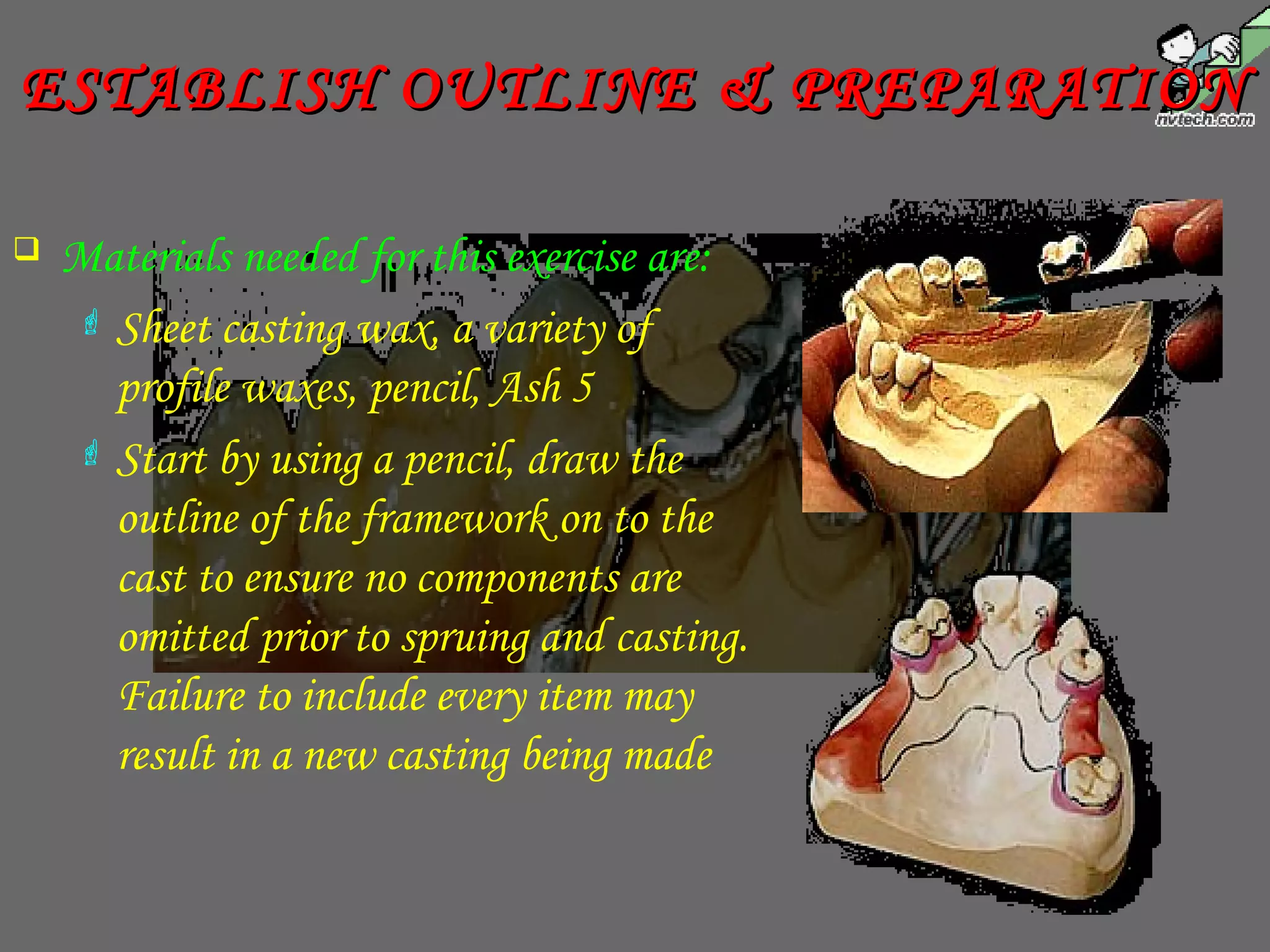
 Materials needed for this exercise are:
 Sheet casting wax, a variety of
profile waxes, pencil, Ash 5
 Start by using a pencil, draw the
outline of the framework on to the
cast to ensure no components are
omitted prior to spruing and casting.
Failure to include every item may
result in a new casting being made
ESTABLISH OUTLINE & PREPARATIONESTABLISH OUTLINE & PREPARATION
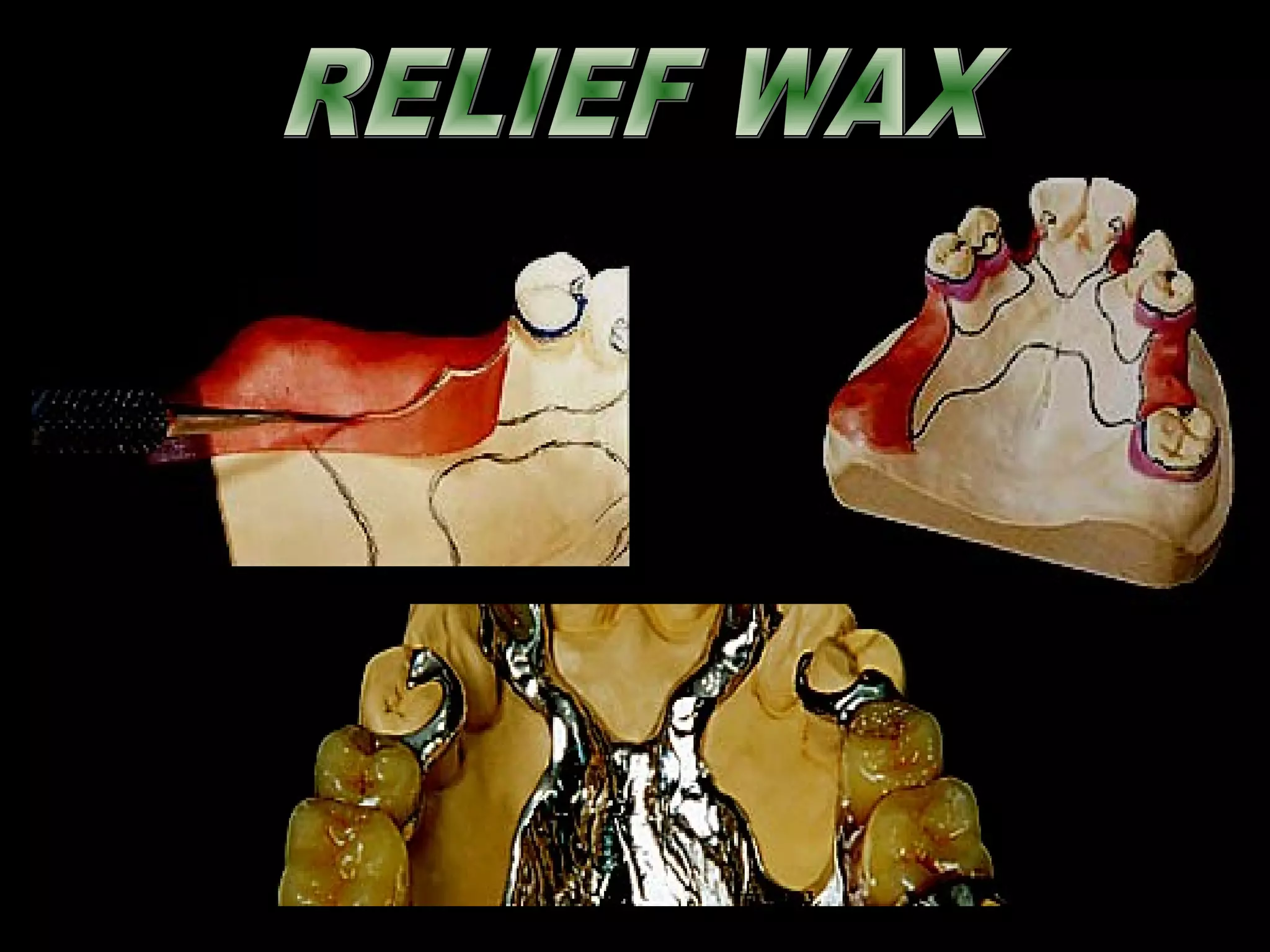
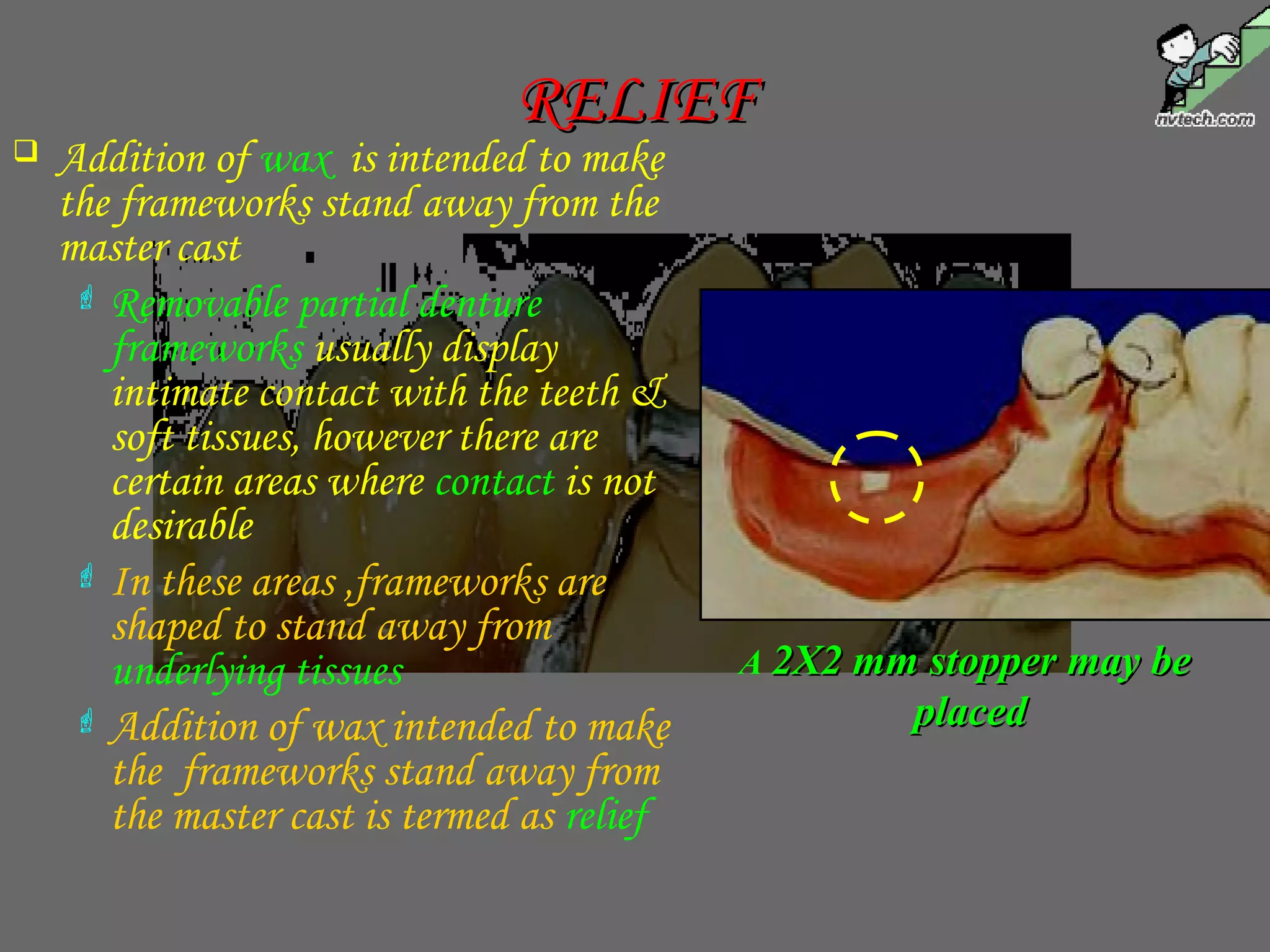
 Addition of wax is intended to make
the frameworks stand away from the
master cast
 Removable partial denture
frameworks usually display
intimate contact with the teeth &
soft tissues, however there are
certain areas where contact is not
desirable
 In these areas ,frameworks are
shaped to stand away from
underlying tissues
 Addition of wax intended to make
the frameworks stand away from
the master cast is termed as relief
A 2X2 mm stopper may be2X2 mm stopper may be
placedplaced
RELIEFRELIEF
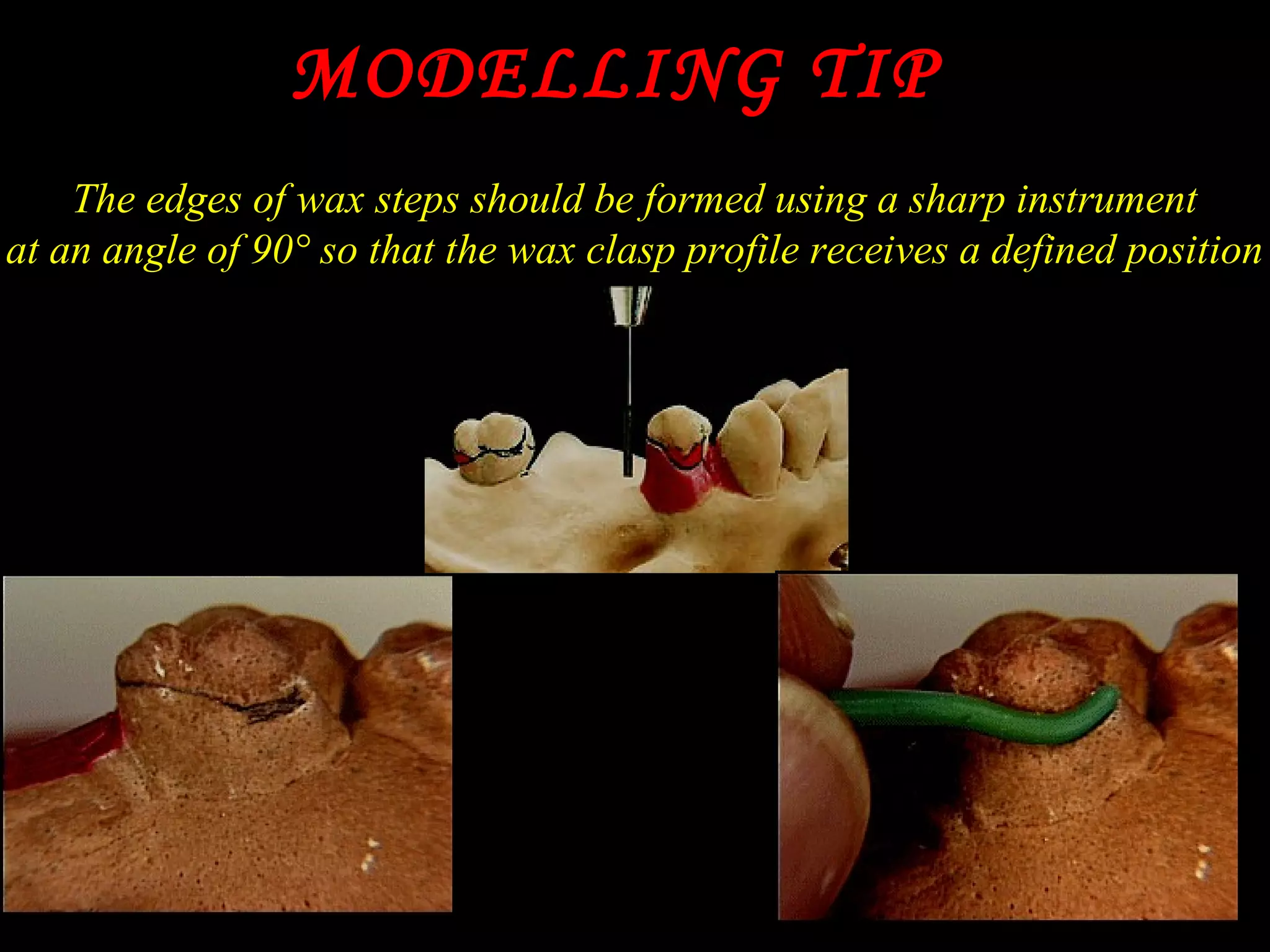
MODELLING TIPMODELLING TIP
The edges of wax steps should be formed using a sharp instrument
at an angle of 90° so that the wax clasp profile receives a defined position
WAX FOR PATTERN FABRICATIONWAX FOR PATTERN FABRICATION
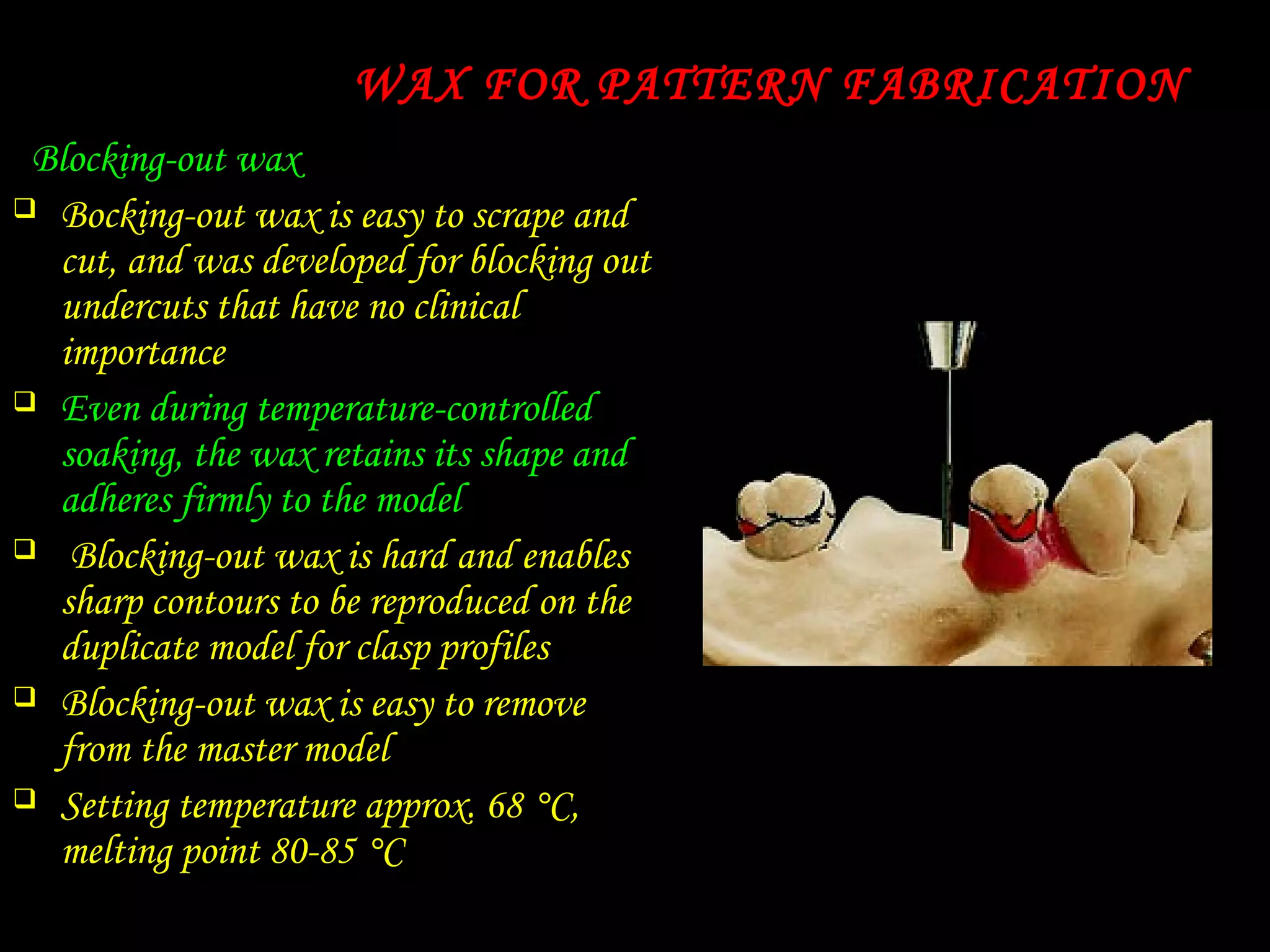
Blocking-out wax
 Bocking-out wax is easy to scrape and
cut, and was developed for blocking out
undercuts that have no clinical
importance
 Even during temperature-controlled
soaking, the wax retains its shape and
adheres firmly to the model
 Blocking-out wax is hard and enables
sharp contours to be reproduced on the
duplicate model for clasp profiles
 Blocking-out wax is easy to remove
from the master model
 Setting temperature approx. 68 °C,
melting point 80-85 °C
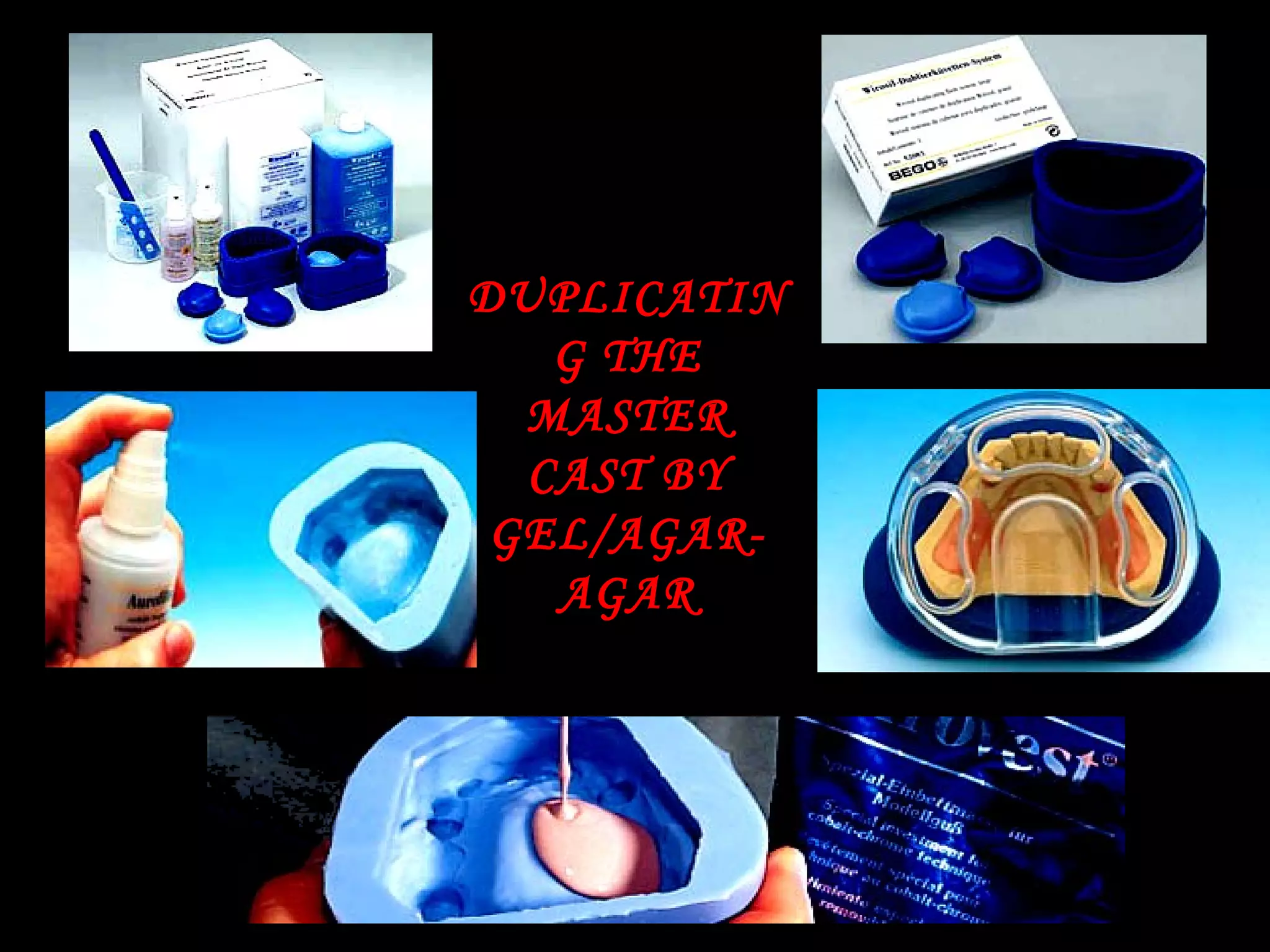
DUPLICATINDUPLICATIN
G THEG THE
MASTERMASTER
CAST BYCAST BY
GEL/AGAR-GEL/AGAR-
AGARAGAR
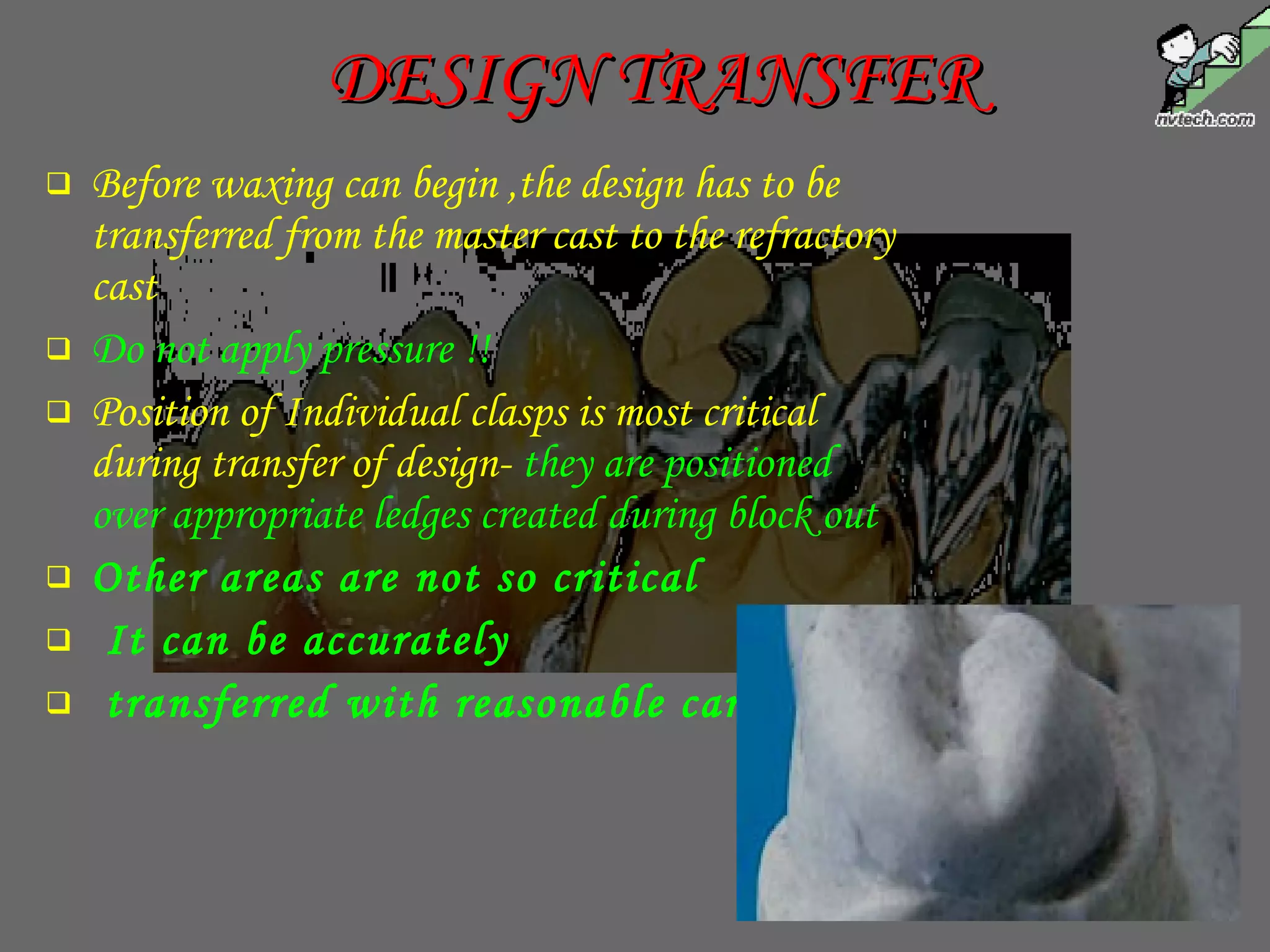
DESIGN TRANSFERDESIGN TRANSFER
 Before waxing can begin ,the design has to be
transferred from the master cast to the refractory
cast
 Do not apply pressure !!
 Position of Individual clasps is most critical
during transfer of design- they are positioned
over appropriate ledges created during block out
 Other areas are not so critical
 It can be accurately
 transferred with reasonable care
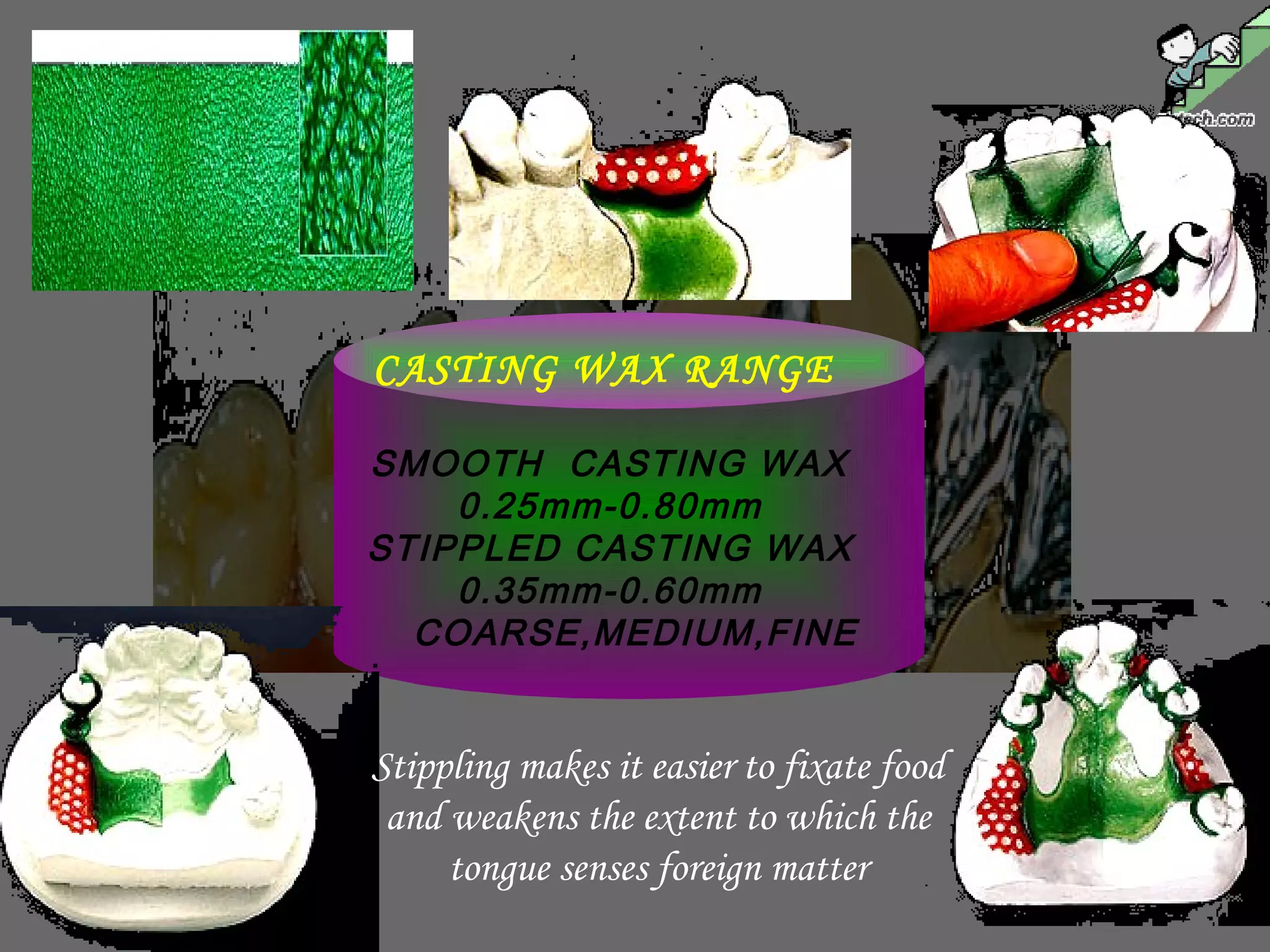
Stippling makes it easier to fixate food
and weakens the extent to which the
tongue senses foreign matter
CASTING WAX RANGE
SMOOTH CASTING WAX
0.25mm-0.80mm
STIPPLED CASTING WAX
0.35mm-0.60mm
COARSE,MEDIUM,FINE
 Waxes can be shaped in every thickness and profile, are
easy to fixate, and adhere well to the model
 The different profile shapes cover virtually every dental
indication
 Wax profile strips can be processed very well even at low
temperatures, thus having a positive influence on
contraction characteristics
 The recipe makes the wax profile stable under pressure,
and very little restoring force arises
 An assortment of the most commonly used profiles is
available in a practical box where they can be kept sorted
WAX PROFILE STRIPSWAX PROFILE STRIPS
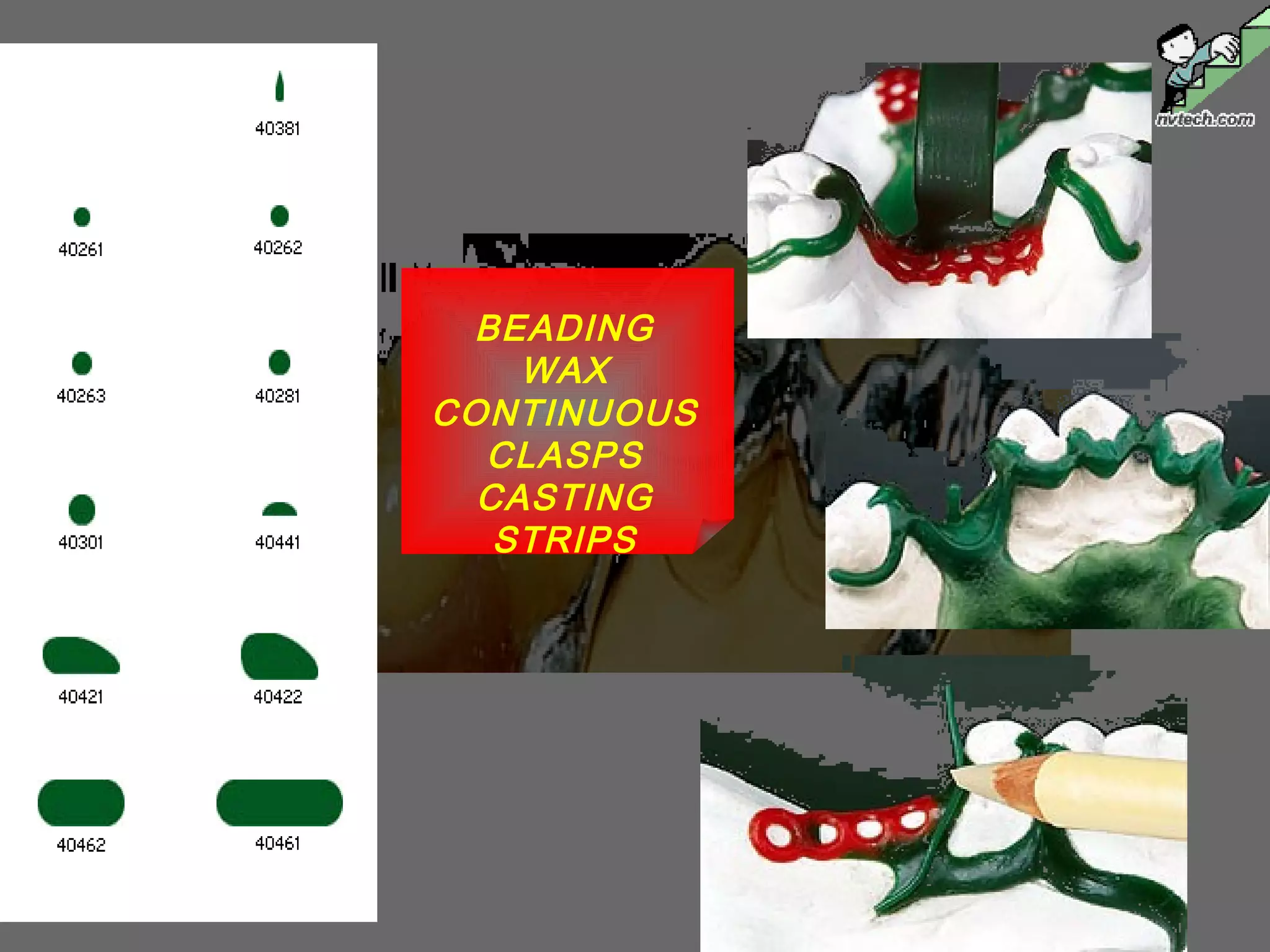
BEADING
WAX
CONTINUOUS
CLASPS
CASTING
STRIPS
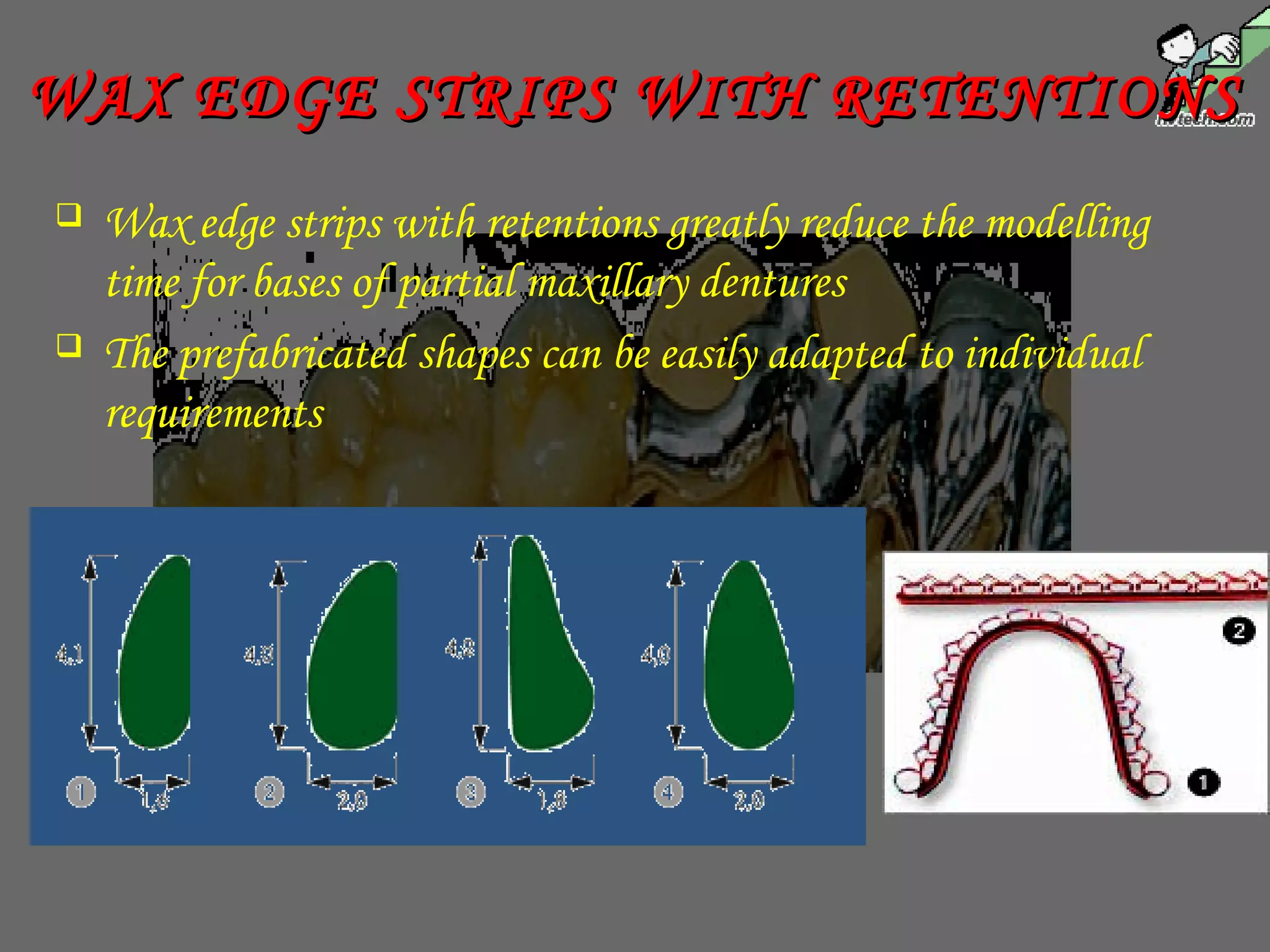
 Wax edge strips with retentions greatly reduce the modelling
time for bases of partial maxillary dentures
 The prefabricated shapes can be easily adapted to individual
requirements
WAX EDGE STRIPS WITH RETENTIONSWAX EDGE STRIPS WITH RETENTIONS
SPECIAL WAX BARSPECIAL WAX BAR
PROFILESPROFILES
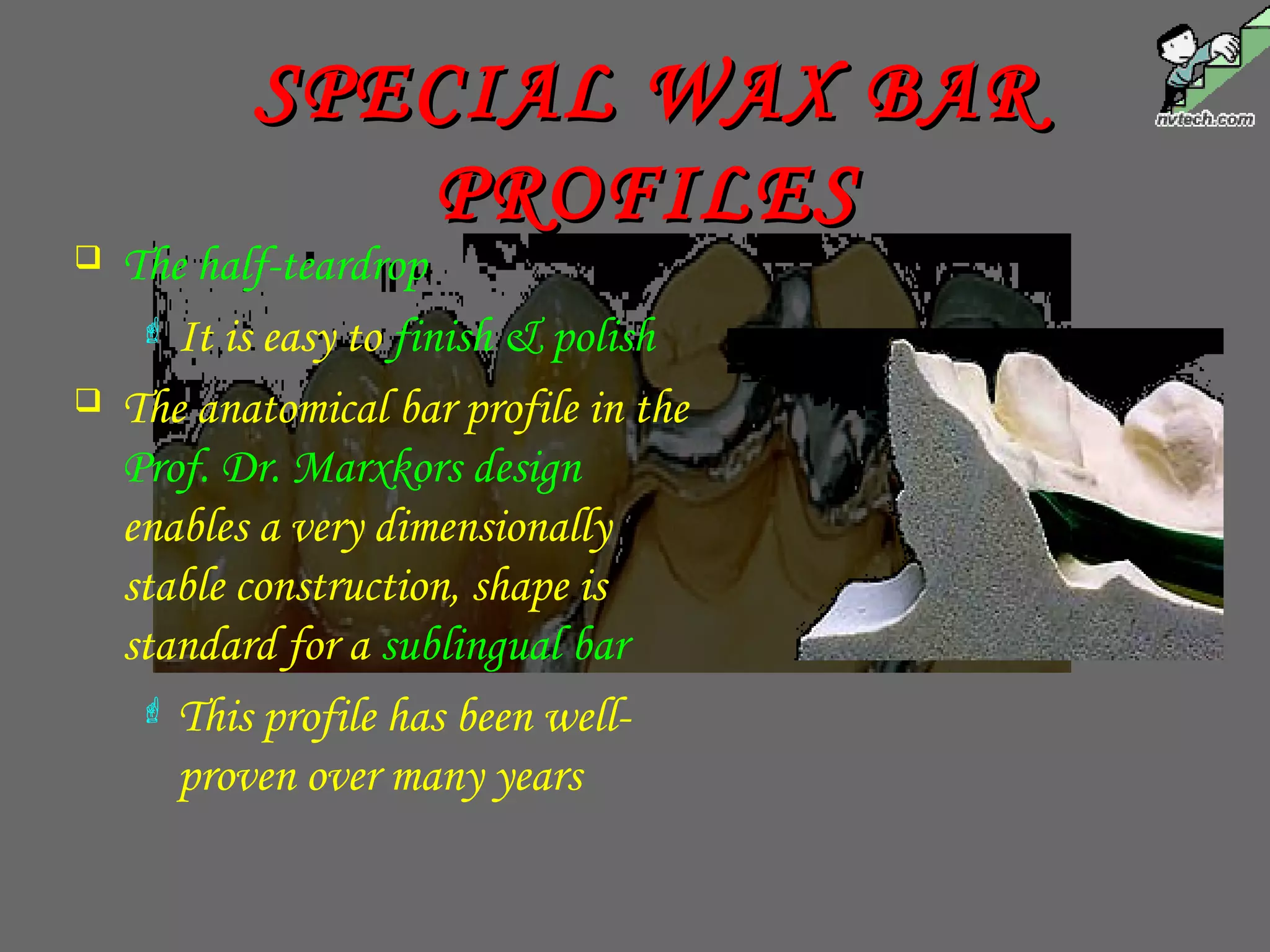
 The half-teardrop
 It is easy to finish & polish
 The anatomical bar profile in the
Prof. Dr. Marxkors design
enables a very dimensionally
stable construction, shape is
standard for a sublingual bar
 This profile has been well-
proven over many years
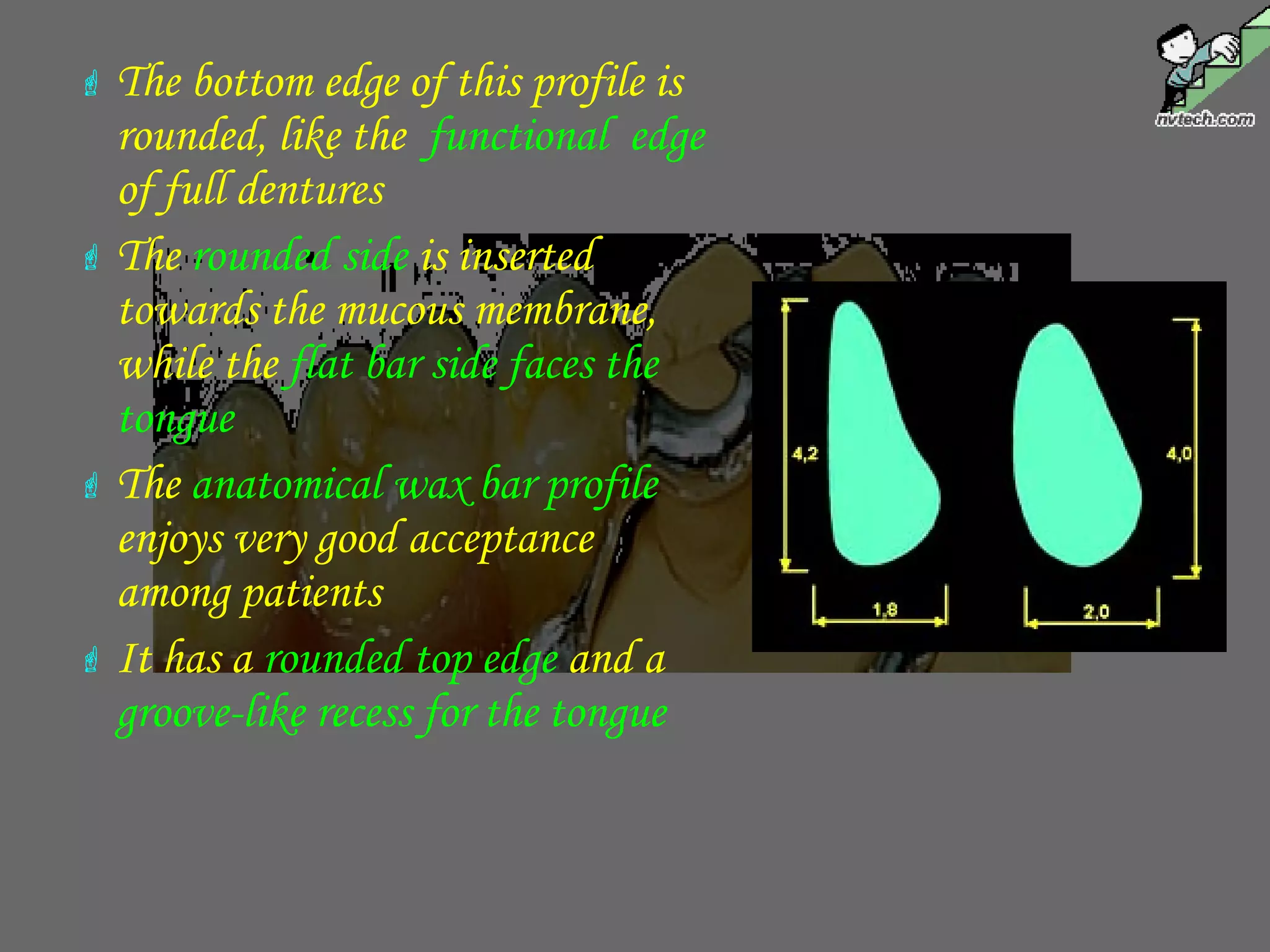
 The bottom edge of this profile is
rounded, like the functional edge
of full dentures
 The rounded side is inserted
towards the mucous membrane,
while the flat bar side faces the
tongue
 The anatomical wax bar profile
enjoys very good acceptance
among patients
 It has a rounded top edge and a
groove-like recess for the tongue
 Excellent restoration results can be achieved in both
mandibular and maxillary modelling
 Both partial and total dental prostheses can be
modelled easily and efficiently
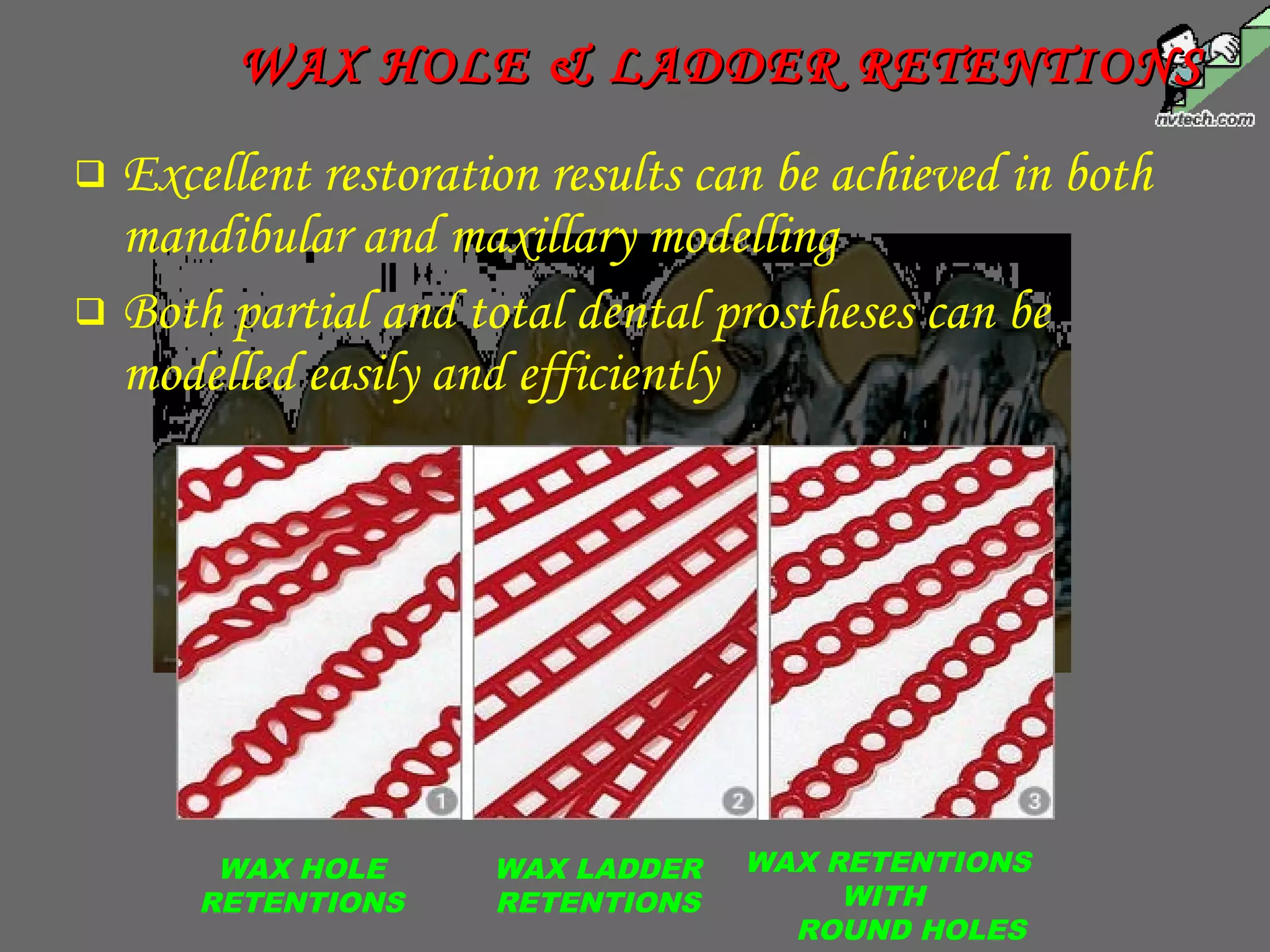
WAX HOLE & LADDER RETENTIONSWAX HOLE & LADDER RETENTIONS
WAX HOLE
RETENTIONS
WAX LADDER
RETENTIONS
WAX RETENTIONS
WITH
ROUND HOLES
WAX CLASPWAX CLASP
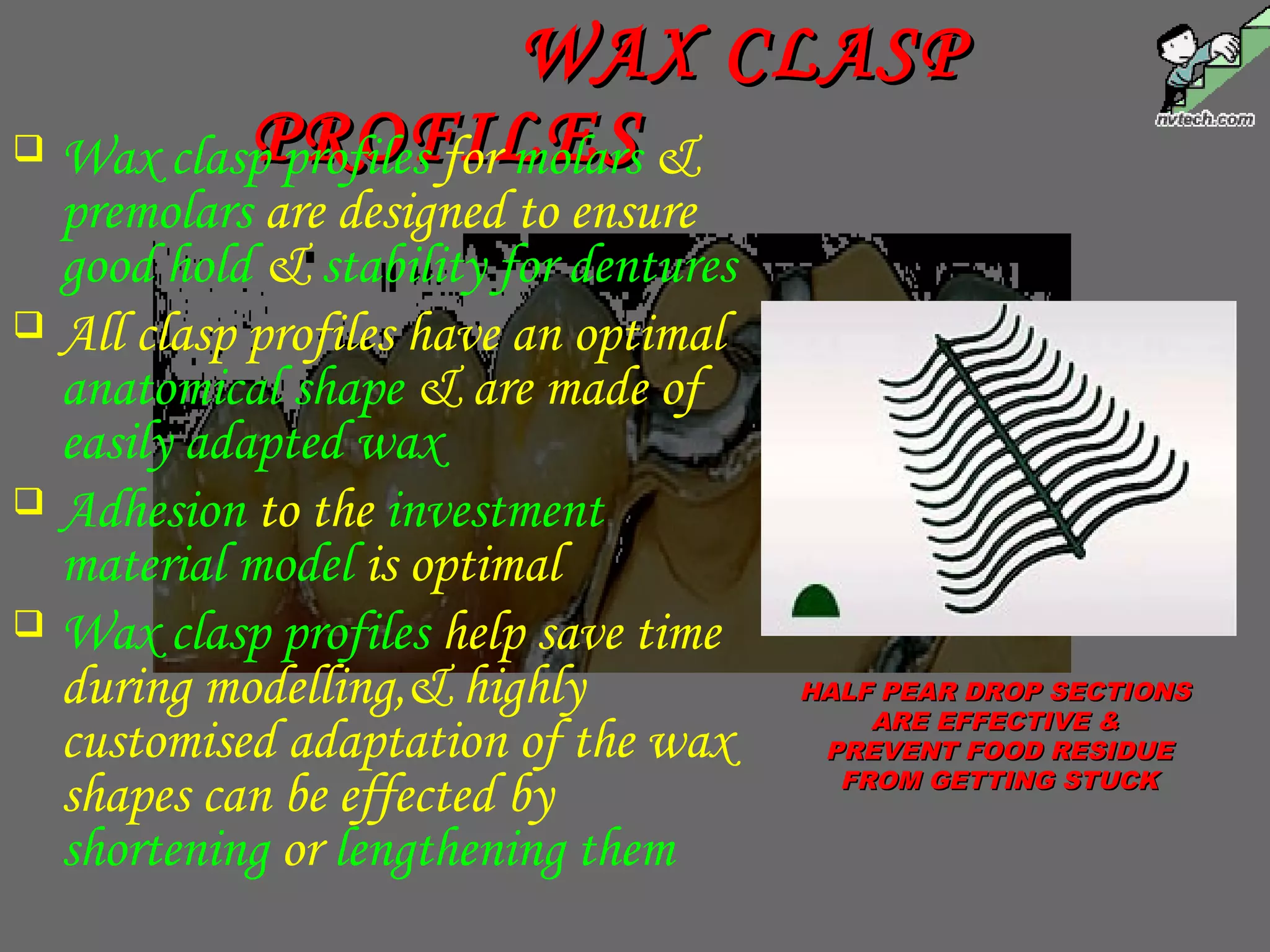
PROFILESPROFILES Wax clasp profiles for molars &
premolars are designed to ensure
good hold & stability for dentures
 All clasp profiles have an optimal
anatomical shape & are made of
easily adapted wax
 Adhesion to the investment
material model is optimal
 Wax clasp profiles help save time
during modelling,& highly
customised adaptation of the wax
shapes can be effected by
shortening or lengthening them
HALF PEAR DROP SECTIONSHALF PEAR DROP SECTIONS
ARE EFFECTIVE &ARE EFFECTIVE &
PREVENT FOOD RESIDUEPREVENT FOOD RESIDUE
FROM GETTING STUCKFROM GETTING STUCK
WAX CLASPWAX CLASP
PROFILESPROFILES
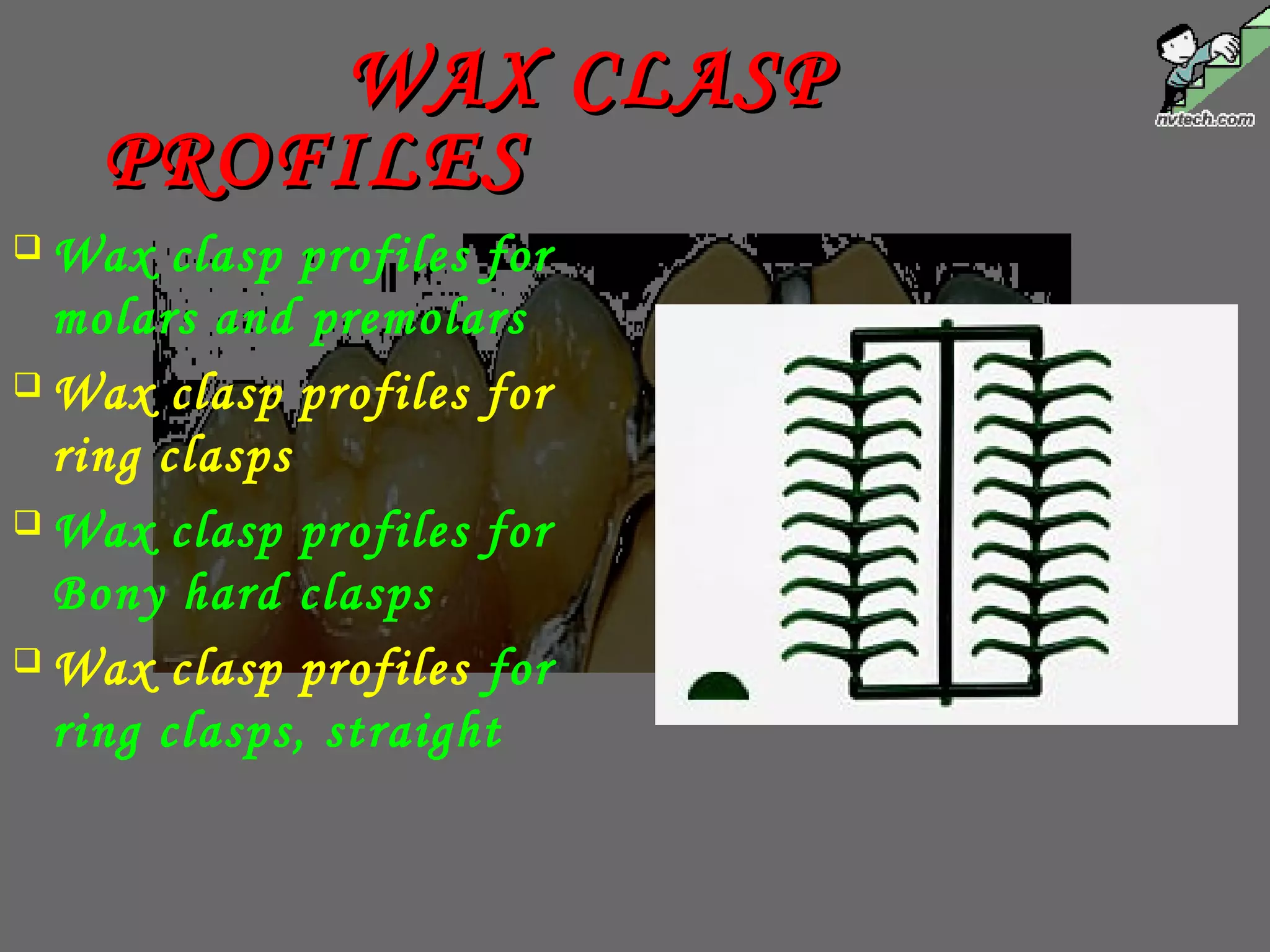
 Wax clasp profiles for
molars and premolars
 Wax clasp profiles for
ring clasps
 Wax clasp profiles for
Bony hard clasps
 Wax clasp profiles for
ring clasps, straight
WAX CLASP PROFILES FOR RINGWAX CLASP PROFILES FOR RING
CLASPSCLASPS
WAX CLASP PROFILES FORWAX CLASP PROFILES FOR
GINGIVALLY APPROACHINGGINGIVALLY APPROACHING
CLASPS
WAX CLASP PROFILES FORWAX CLASP PROFILES FOR
RING CLASPS, STRAIGHTRING CLASPS, STRAIGHT
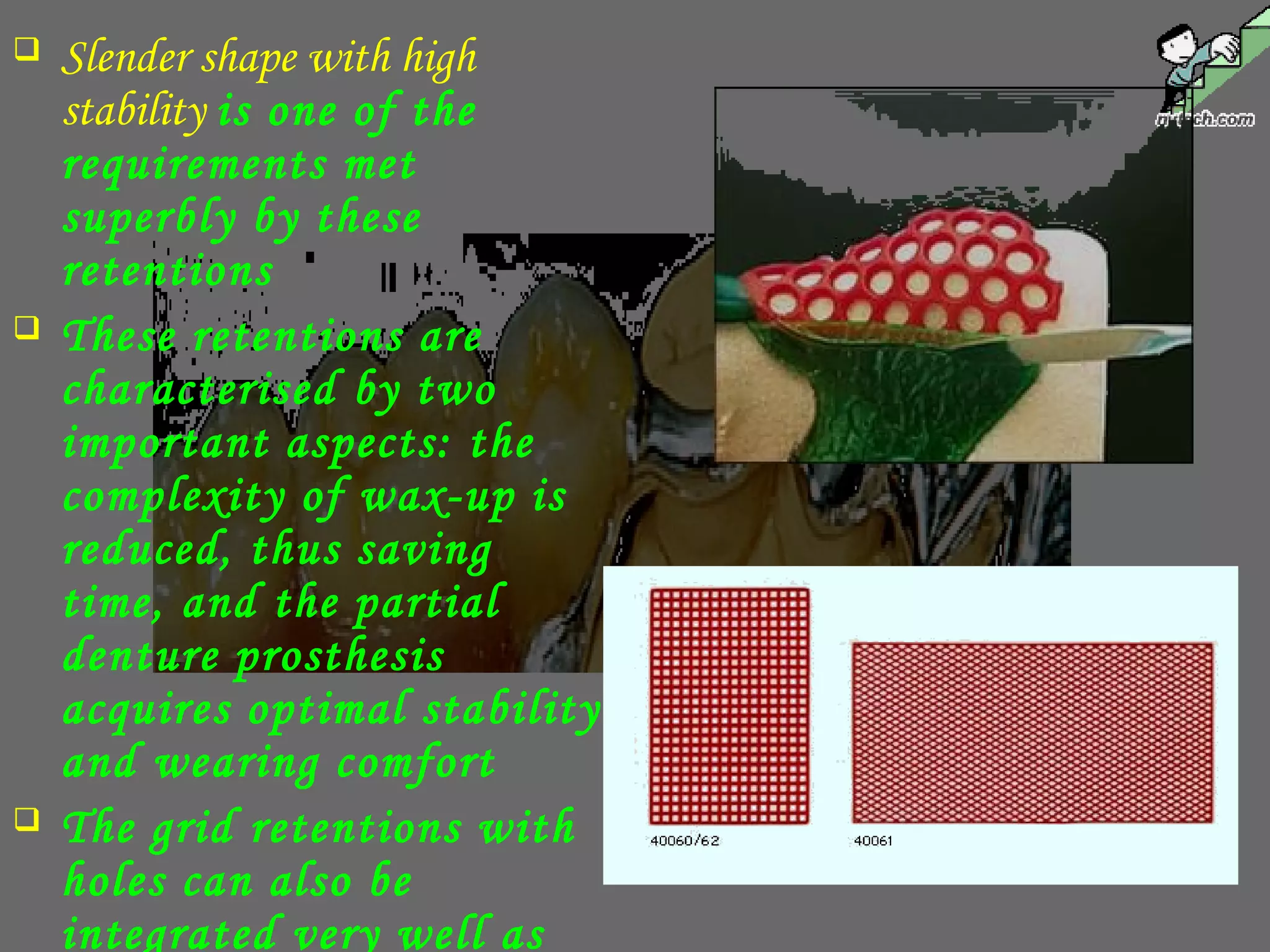
 Slender shape with high
stability is one of the
requirements met
superbly by these
retentions
 These retentions are
characterised by two
important aspects: the
complexity of wax-up is
reduced, thus saving
time, and the partial
denture prosthesis
acquires optimal stability
and wearing comfort
 The grid retentions with
holes can also be
integrated very well as
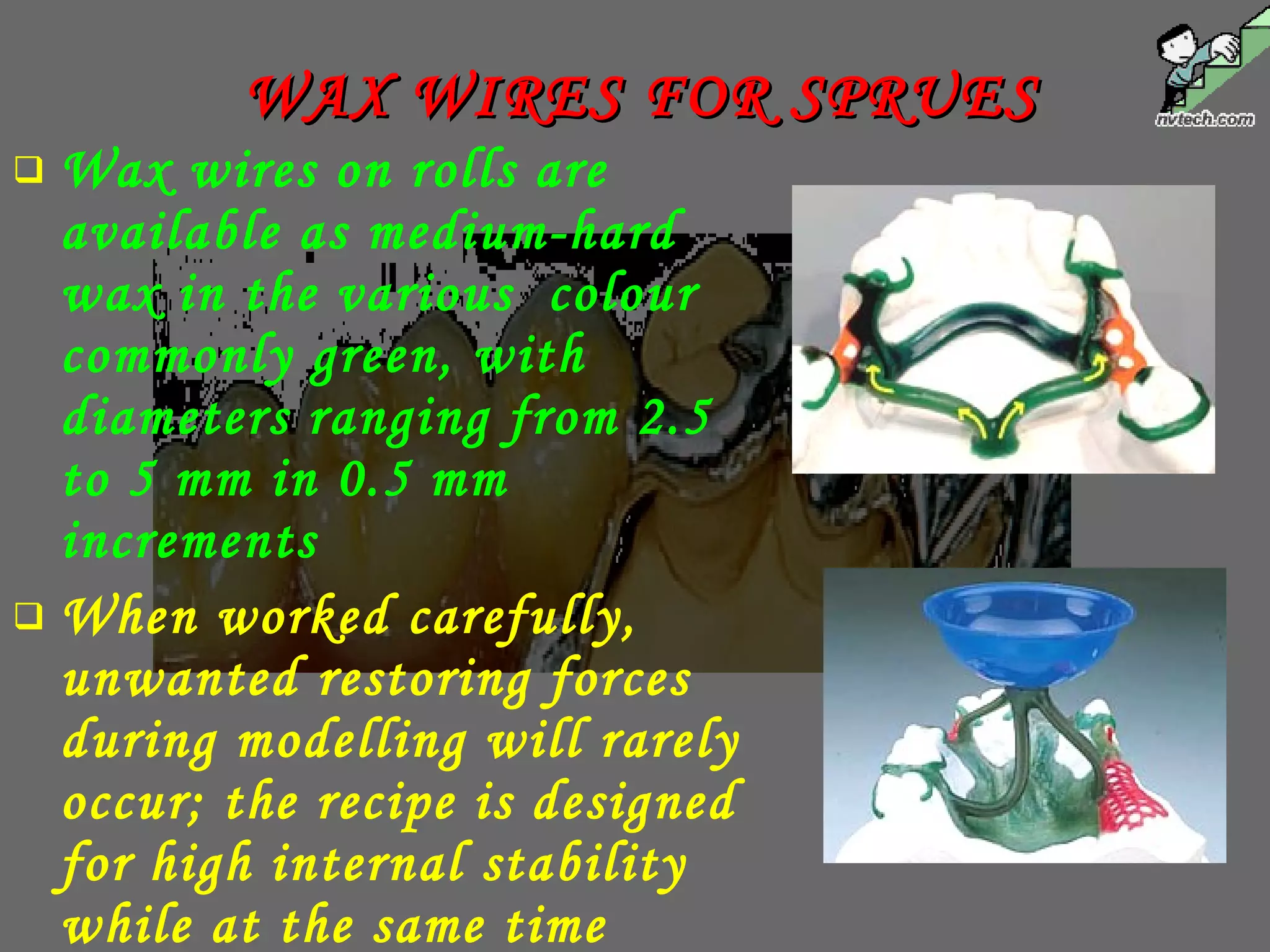
 Wax wires on rolls are
available as medium-hard
wax in the various colour
commonly green, with
diameters ranging from 2.5
to 5 mm in 0.5 mm
increments
 When worked carefully,
unwanted restoring forces
during modelling will rarely
occur; the recipe is designed
for high internal stability
while at the same time
WAX WIRES FOR SPRUESWAX WIRES FOR SPRUES
 Wax wire on
rolls is very
economical in
terms of
consumption,
because only the
amount actually
required needs to
be cut
Once the wax pattern for
framework is over the pattern is
sprued either by:
Overhead spruing
Base spruing
Spruing is followed by
investing-casting
Lab procedures/ dental education in india

Lab procedures/ dental education in india

  • 3.
    PRODUCTIONPRODUCTION OF MASTERCASTOF MASTER CAST SURVEYING OF MASTER CASTSURVEYING OF MASTER CAST (MAP)(MAP) BLOCKOUT AND DUPLICATIONBLOCKOUT AND DUPLICATION REFRACTORY CASTREFRACTORY CAST WAXING OF PARTIALWAXING OF PARTIAL DENTURE FRAMEWORKDENTURE FRAMEWORK INVESTING OF SPRUEDINVESTING OF SPRUED PATTERNPATTERN ANATOMICANATOMIC REPLICAREPLICA PATTERNPATTERN Contd….
  • 4.
    INVESTING OF SPRUEDINVESTINGOF SPRUED PATTERNPATTERN BURN OUTBURN OUT CASTINGCASTING FINISHING &FINISHING & POLISHINGPOLISHING ANATOMICANATOMIC REPLICAREPLICA PATTERNPATTERN
  • 5.
    STEP I :PRODUCTION OF MASTERSTEP I : PRODUCTION OF MASTER CASTCAST  Preliminary impressions are made in either Alginate, Agar or Elastomeric materials  Both Alginate and Agar should be poured immediately and proper base should be formed  Elastomeric impression can be beaded and boxed before pouring to get cast ready for surveying  Grind model, if necessary Personally my preference is to use medium viscosity elastomers for a cast partial impression
  • 6.
    STEP II :SURVEYING & DESIGNING OF MASTERSTEP II : SURVEYING & DESIGNING OF MASTER CASTCAST Objective :  “To select the most suitable path of placement that satisfy the requirements of guiding planes, retention, non-interferences & esthetics”  Determine undercut areas with surveying instrument & tracing rod  Place the rod of the undercut disc against the clasp tooth  Mark the curve of the equator & clasp  Only the last third of the clasp should lie in the retention area
  • 7.
    Contd…. ESTABLISHING MAPESTABLISHING MAP Primaryobjective is to establish a position of the cast that places teeth & associated tissues in the “Most-Advantageous-Position’’ (MAP) for treatment with the partial denture
  • 8.
     Eye-Survey :tilting the cast  Check parallelism of the guiding surfaces by Analyzing rod  Retention areas  Check for tissue undercuts  Eliminating spaces & voids  Tripoding
  • 9.
     Materials neededfor this exercise are:  Sheet casting wax, a variety of profile waxes, pencil, Ash 5  Start by using a pencil, draw the outline of the framework on to the cast to ensure no components are omitted prior to spruing and casting. Failure to include every item may result in a new casting being made ESTABLISH OUTLINE & PREPARATIONESTABLISH OUTLINE & PREPARATION
  • 11.
     Addition ofwax is intended to make the frameworks stand away from the master cast  Removable partial denture frameworks usually display intimate contact with the teeth & soft tissues, however there are certain areas where contact is not desirable  In these areas ,frameworks are shaped to stand away from underlying tissues  Addition of wax intended to make the frameworks stand away from the master cast is termed as relief A 2X2 mm stopper may be2X2 mm stopper may be placedplaced RELIEFRELIEF
  • 12.
    MODELLING TIPMODELLING TIP Theedges of wax steps should be formed using a sharp instrument at an angle of 90° so that the wax clasp profile receives a defined position
  • 13.
    WAX FOR PATTERNFABRICATIONWAX FOR PATTERN FABRICATION Blocking-out wax  Bocking-out wax is easy to scrape and cut, and was developed for blocking out undercuts that have no clinical importance  Even during temperature-controlled soaking, the wax retains its shape and adheres firmly to the model  Blocking-out wax is hard and enables sharp contours to be reproduced on the duplicate model for clasp profiles  Blocking-out wax is easy to remove from the master model  Setting temperature approx. 68 °C, melting point 80-85 °C
  • 14.
    DUPLICATINDUPLICATIN G THEG THE MASTERMASTER CASTBYCAST BY GEL/AGAR-GEL/AGAR- AGARAGAR
  • 15.
    DESIGN TRANSFERDESIGN TRANSFER Before waxing can begin ,the design has to be transferred from the master cast to the refractory cast  Do not apply pressure !!  Position of Individual clasps is most critical during transfer of design- they are positioned over appropriate ledges created during block out  Other areas are not so critical  It can be accurately  transferred with reasonable care
  • 16.
    Stippling makes iteasier to fixate food and weakens the extent to which the tongue senses foreign matter CASTING WAX RANGE SMOOTH CASTING WAX 0.25mm-0.80mm STIPPLED CASTING WAX 0.35mm-0.60mm COARSE,MEDIUM,FINE
  • 17.
     Waxes canbe shaped in every thickness and profile, are easy to fixate, and adhere well to the model  The different profile shapes cover virtually every dental indication  Wax profile strips can be processed very well even at low temperatures, thus having a positive influence on contraction characteristics  The recipe makes the wax profile stable under pressure, and very little restoring force arises  An assortment of the most commonly used profiles is available in a practical box where they can be kept sorted WAX PROFILE STRIPSWAX PROFILE STRIPS
  • 18.
  • 19.
     Wax edgestrips with retentions greatly reduce the modelling time for bases of partial maxillary dentures  The prefabricated shapes can be easily adapted to individual requirements WAX EDGE STRIPS WITH RETENTIONSWAX EDGE STRIPS WITH RETENTIONS
  • 20.
    SPECIAL WAX BARSPECIALWAX BAR PROFILESPROFILES  The half-teardrop  It is easy to finish & polish  The anatomical bar profile in the Prof. Dr. Marxkors design enables a very dimensionally stable construction, shape is standard for a sublingual bar  This profile has been well- proven over many years
  • 21.
     The bottomedge of this profile is rounded, like the functional edge of full dentures  The rounded side is inserted towards the mucous membrane, while the flat bar side faces the tongue  The anatomical wax bar profile enjoys very good acceptance among patients  It has a rounded top edge and a groove-like recess for the tongue
  • 22.
     Excellent restorationresults can be achieved in both mandibular and maxillary modelling  Both partial and total dental prostheses can be modelled easily and efficiently WAX HOLE & LADDER RETENTIONSWAX HOLE & LADDER RETENTIONS WAX HOLE RETENTIONS WAX LADDER RETENTIONS WAX RETENTIONS WITH ROUND HOLES
  • 23.
    WAX CLASPWAX CLASP PROFILESPROFILESWax clasp profiles for molars & premolars are designed to ensure good hold & stability for dentures  All clasp profiles have an optimal anatomical shape & are made of easily adapted wax  Adhesion to the investment material model is optimal  Wax clasp profiles help save time during modelling,& highly customised adaptation of the wax shapes can be effected by shortening or lengthening them HALF PEAR DROP SECTIONSHALF PEAR DROP SECTIONS ARE EFFECTIVE &ARE EFFECTIVE & PREVENT FOOD RESIDUEPREVENT FOOD RESIDUE FROM GETTING STUCKFROM GETTING STUCK
  • 24.
    WAX CLASPWAX CLASP PROFILESPROFILES Wax clasp profiles for molars and premolars  Wax clasp profiles for ring clasps  Wax clasp profiles for Bony hard clasps  Wax clasp profiles for ring clasps, straight
  • 25.
    WAX CLASP PROFILESFOR RINGWAX CLASP PROFILES FOR RING CLASPSCLASPS WAX CLASP PROFILES FORWAX CLASP PROFILES FOR GINGIVALLY APPROACHINGGINGIVALLY APPROACHING CLASPS WAX CLASP PROFILES FORWAX CLASP PROFILES FOR RING CLASPS, STRAIGHTRING CLASPS, STRAIGHT
  • 26.
     Slender shapewith high stability is one of the requirements met superbly by these retentions  These retentions are characterised by two important aspects: the complexity of wax-up is reduced, thus saving time, and the partial denture prosthesis acquires optimal stability and wearing comfort  The grid retentions with holes can also be integrated very well as
  • 27.
     Wax wireson rolls are available as medium-hard wax in the various colour commonly green, with diameters ranging from 2.5 to 5 mm in 0.5 mm increments  When worked carefully, unwanted restoring forces during modelling will rarely occur; the recipe is designed for high internal stability while at the same time WAX WIRES FOR SPRUESWAX WIRES FOR SPRUES
  • 28.
     Wax wireon rolls is very economical in terms of consumption, because only the amount actually required needs to be cut
  • 29.
    Once the waxpattern for framework is over the pattern is sprued either by: Overhead spruing Base spruing Spruing is followed by investing-casting