Gypsum Products
Dr. Mohammed Shammas
1. Discuss the differences between dental
plaster, stone, and improved stone.
2. Explain the meaning of initial and final
setting times.
3. Give examples of how to increase and
decrease the setting times of gypsum
products.
4. Discuss wet and dry strength as it relates
to gypsum products.
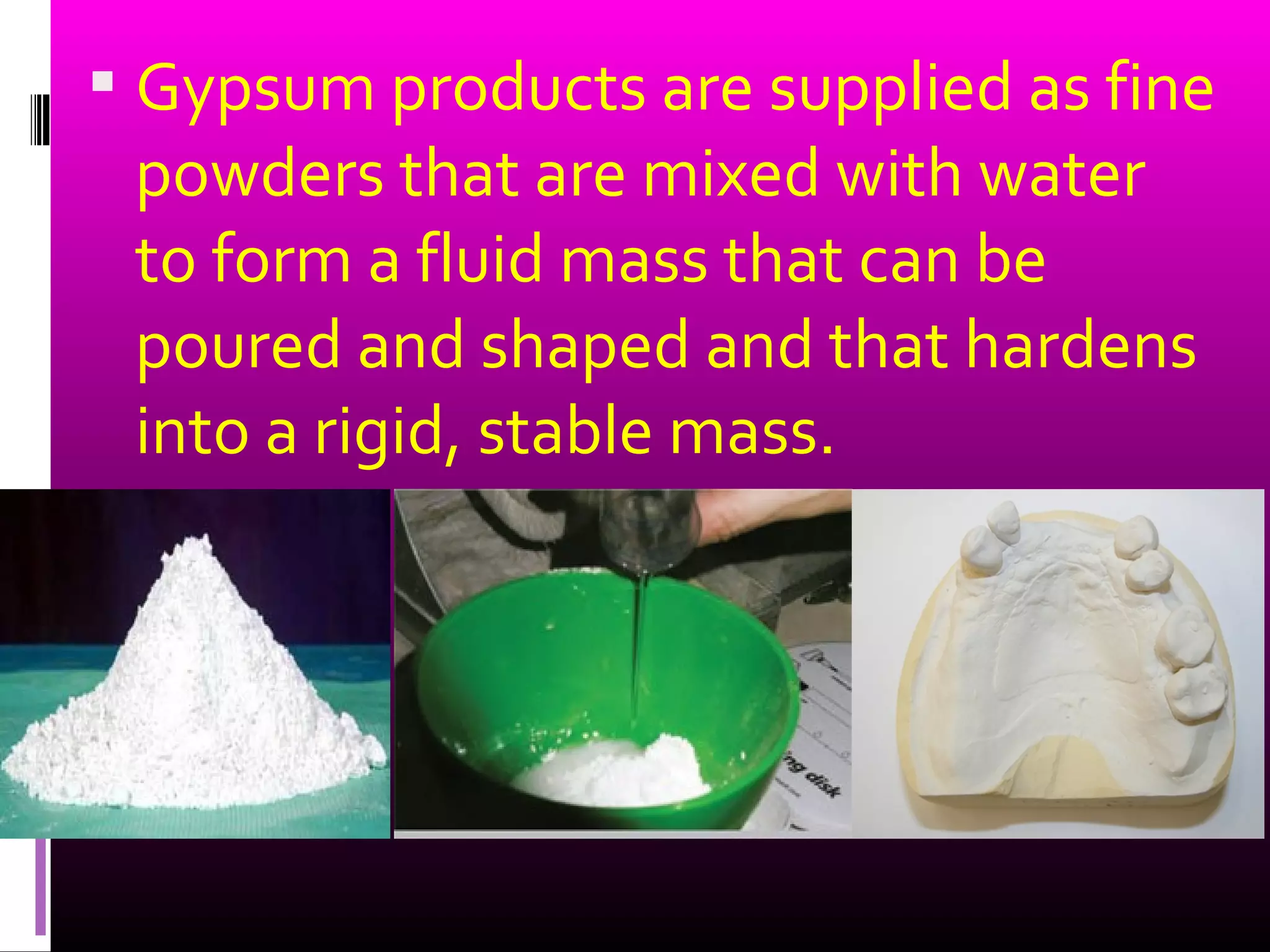
 Gypsum products are supplied as fine
powders that are mixed with water
to form a fluid mass that can be
poured and shaped and that hardens
into a rigid, stable mass.
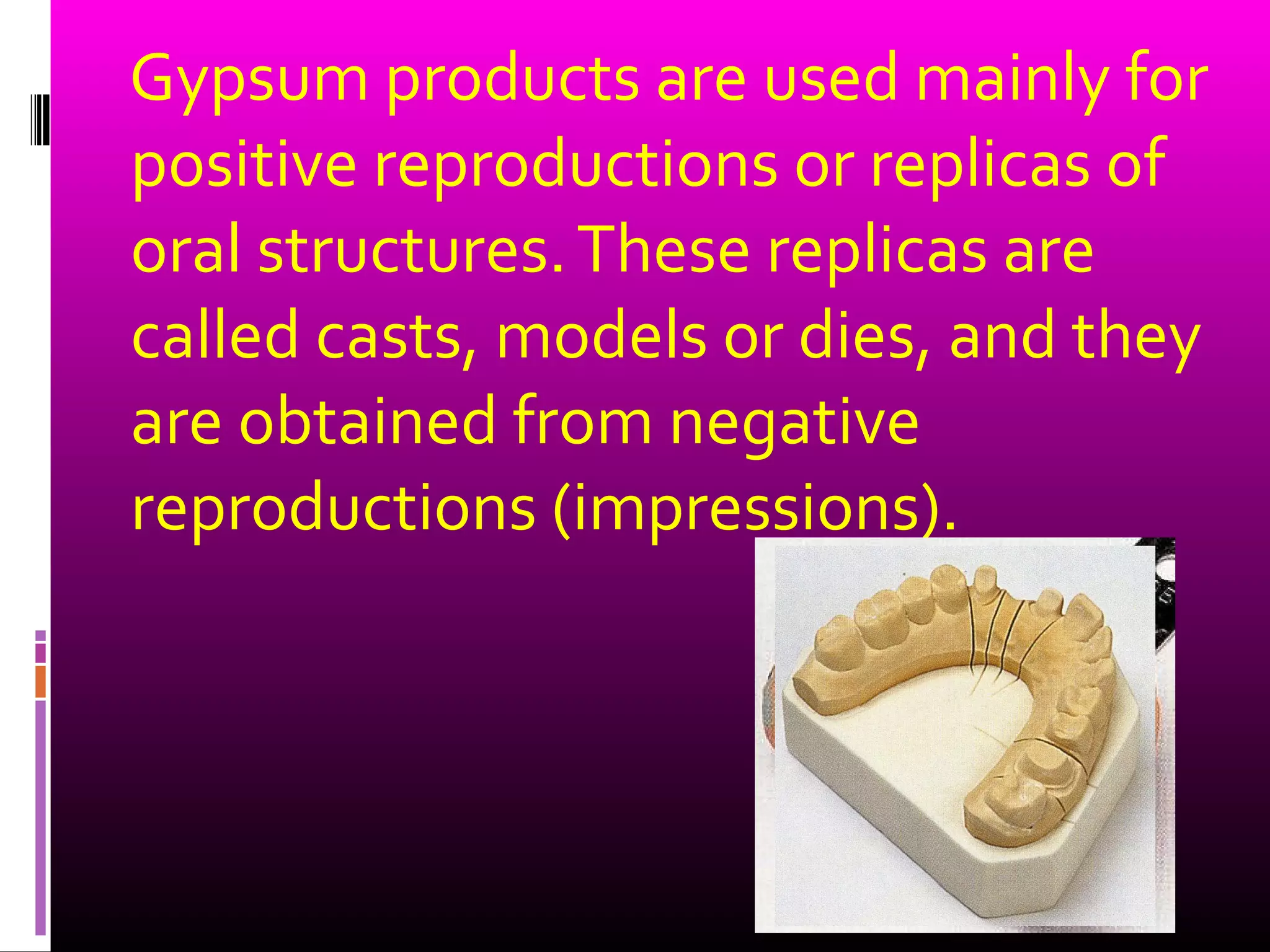
Gypsum products are used mainly for
positive reproductions or replicas of
oral structures.These replicas are
called casts, models or dies, and they
are obtained from negative
reproductions (impressions).
 Model—is used to plan treatment
and to observe treatment
progress.
 Cast—A cast is a replica on which a
restoration/prosthesis is fabricated. A
cast is more accurate than a study
model.
 Die—A reproduction of a prepared
tooth.
of gypsum
 Gypsum products are made from gypsum
rock, which is a mineral found in various
parts of the world. Gypsum rock is mined,
ground into a fine powder, and then
processed by heating to form a variety of
products.
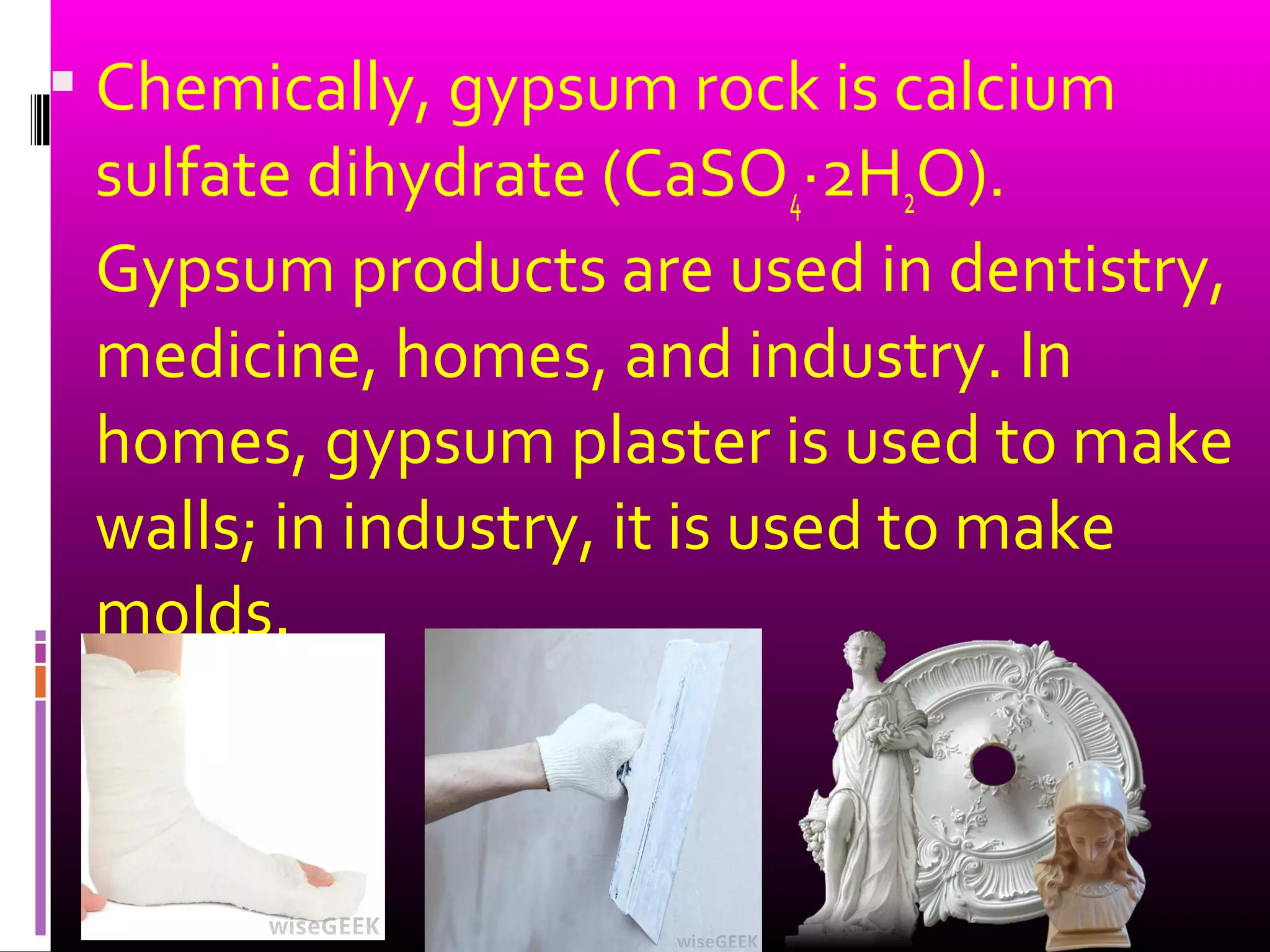
 Chemically, gypsum rock is calcium
sulfate dihydrate (CaSO4·2H2O).
Gypsum products are used in dentistry,
medicine, homes, and industry. In
homes, gypsum plaster is used to make
walls; in industry, it is used to make
molds.
 Three types of gypsum products will
be discussed: plaster, stone, and
high-strength or improved stone.
Chemically, all three are calcium
sulfate hemihydrate.
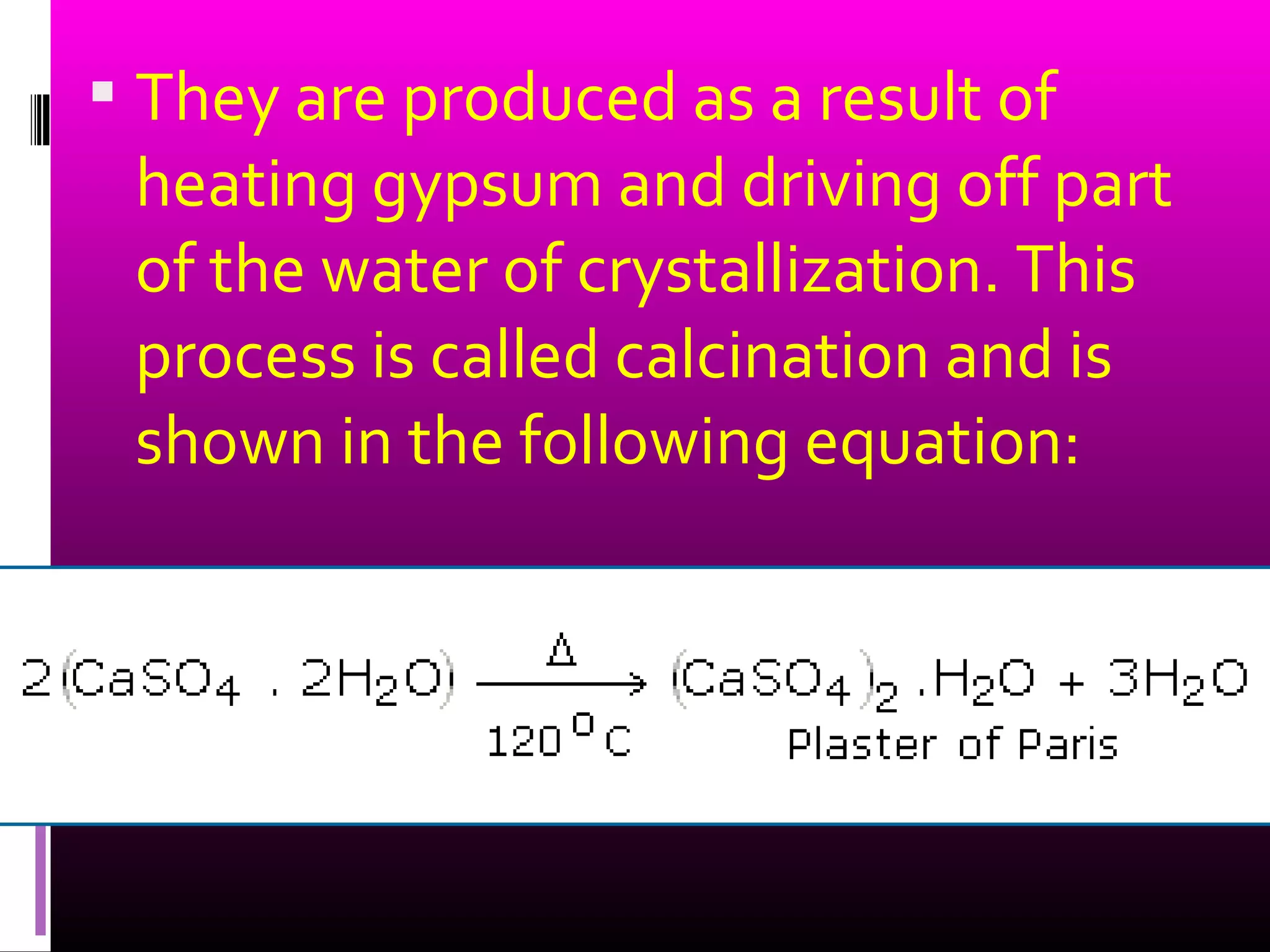
 They are produced as a result of
heating gypsum and driving off part
of the water of crystallization. This
process is called calcination and is
shown in the following equation:
 Calcination—The process of heating a
solid material to drive off chemically
combined components such as water
and carbon dioxide.
A. Dental Plaster
 Gypsum + Heat (open kettle at
110/120˚C) = Beta Calcium Sulfate
Hemihydrate
Characteristics
 Irregular Shaped Crystals
 Very porous
 Random shaped
TYPE I GYPSUM = IMPRESSION PLASTER
TYPE II GYPSUM = MODEL PLASTER
2 Forms of Plaster:
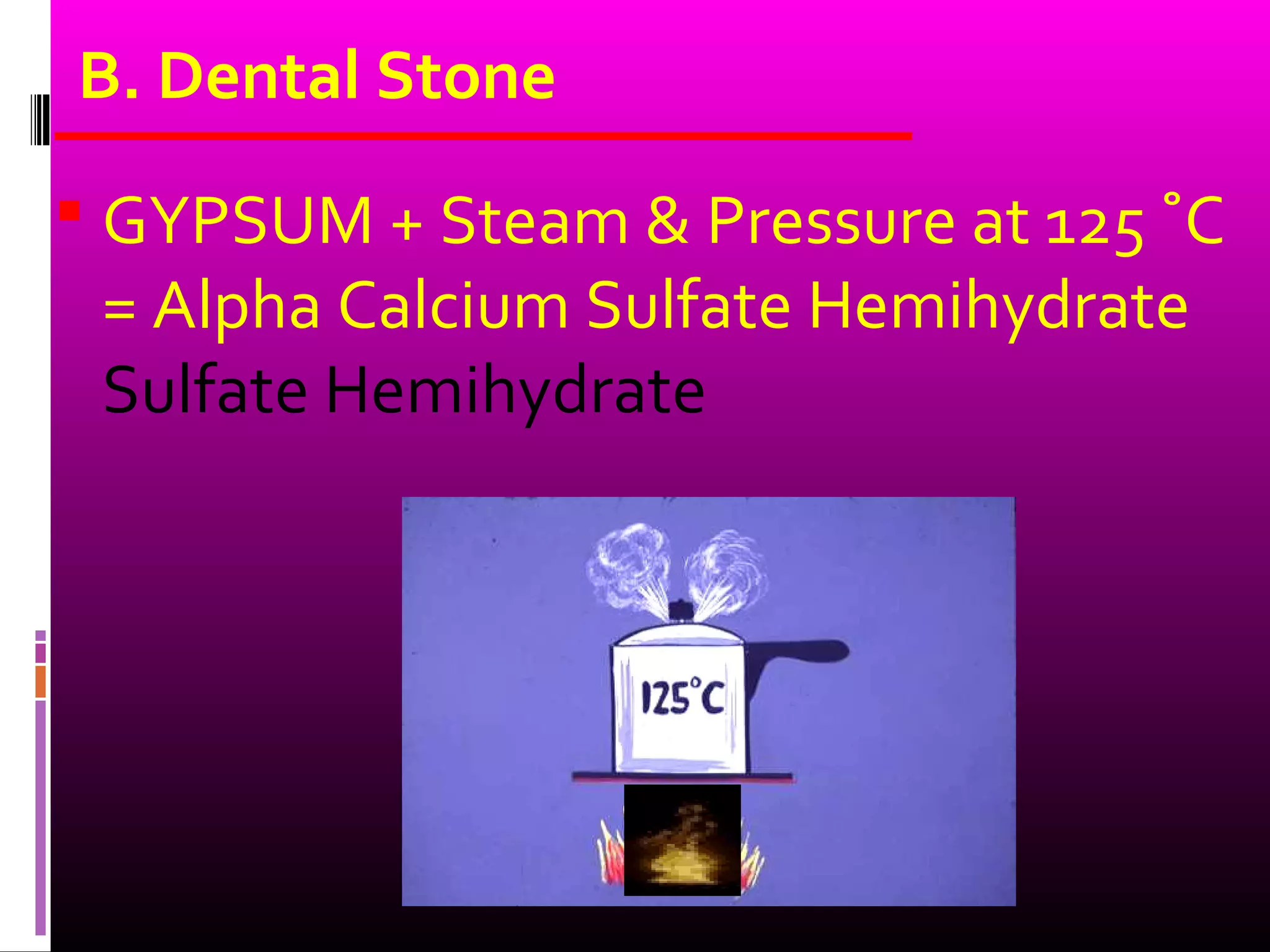
B. Dental Stone
 GYPSUM + Steam & Pressure at 125 ˚C
= Alpha Calcium Sulfate Hemihydrate
Sulfate Hemihydrate
Characteristics
 More Uniform shaped crystals
 More dense than Plaster
 Larger crystals
 Smoother Particles
TYPE III GYPSUM = Dental Stone
C. Improved Stone
 GYPSUM + 30% Calcium Chloride
Solution at 100 ˚C = Alpha Calcium
Sulfate Hemihydrate
Characteristics
 Very dense crystals
 Cubic or rectangular crystals
 Large crystals
TYPE IV GYPSUM = DENTAL STONE HIGH STRENGTH
TYPE V GYPSUM = DENTAL STONE HIGH STRENGTH,
HIGH EXPANSION
2 Forms :
Dental Plaster Dental Stone
Improved
Stone
ADA Specification No. 25 classifies
five types of gypsum products
Type I IMPRESSION PLASTER
Type II MODEL PLASTER
Type III DENTAL STONE
Type IV DENTAL STONE, HIGH
STRENGTH
Type V DENTAL STONE, HIGH
STRENGTH, HIGH
EXPANSION
 When any of the three types of
calcium sulfate hemihydrate is
mixed with water, the
hemihydrate is changed back to
dihydrate by the process of
hydration. Heat is liberated.
CaSO4.½ H2O + 1 ½ H2O →
CaSO4 .2H2O + heat
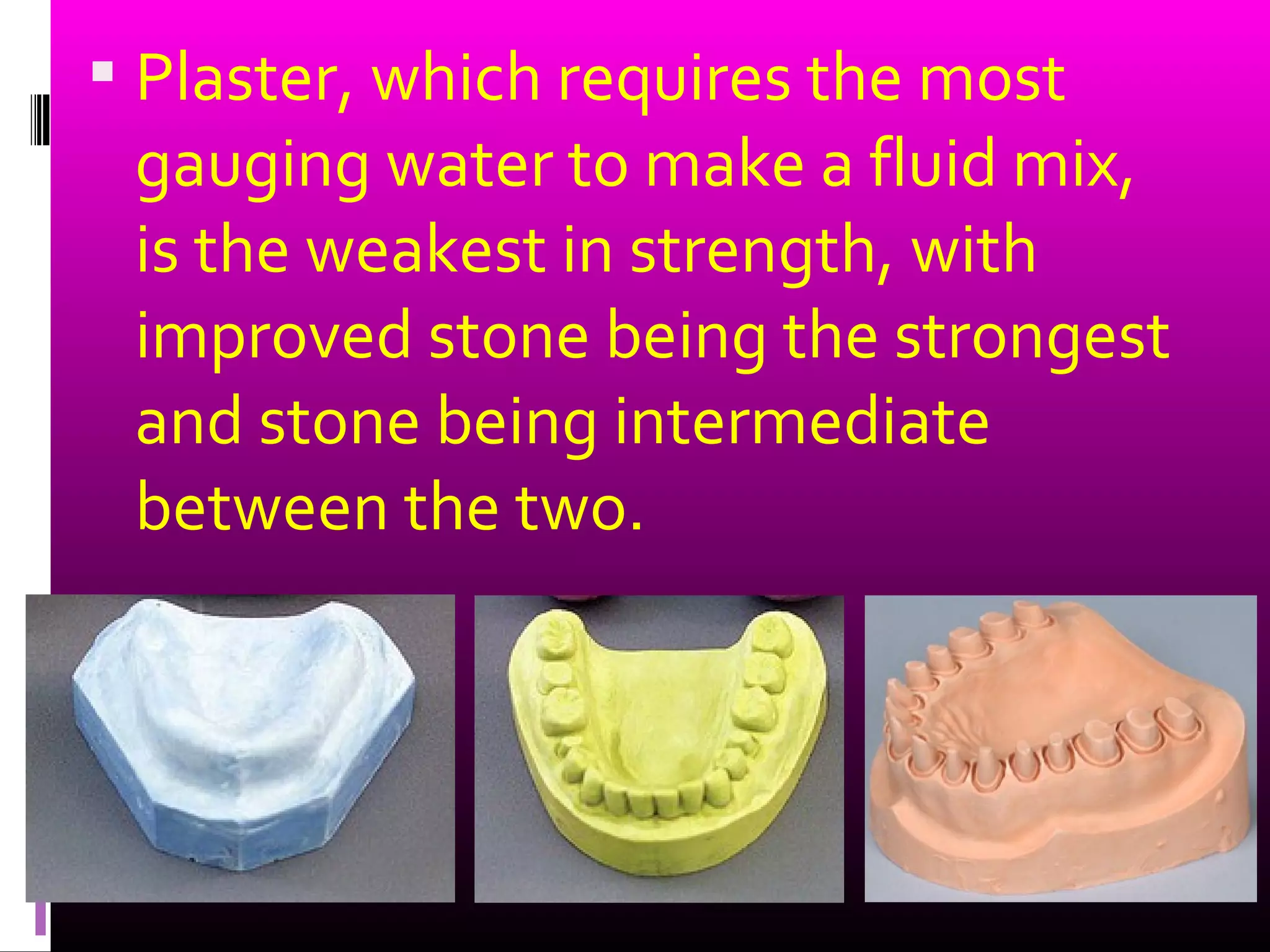
Water/Powder Ratio
 The proportion of water to powder
used to make a workable mix of a
particular gypsum product is called
the water/powder ratio.
 For the average mix for plaster, 45–50
ml/100 g (0.45–0.50)
 For the average mix for stone, 28–30
ml/100 g (0.28–0.30)
 For the average mix for improved
stone, 19–24 ml/100 g (0.19–0.24)
Setting Time
1. Working Time or Initial Setting
Time Working time or initial setting time is
the length of time from the start of
the mix until the setting mass reaches
a semihard stage. It represents the
available time for manipulating the
product, and it indicates partial
progress of the setting reaction.
2. Final Setting Time
 Final setting time represents the
length of time from the start of the
mix until the setting mass becomes
rigid and can be separated from the
impression. The final setting time
indicates the major completion of
the setting reaction.
Measurement of setting time
 Setting times are
usually measured
with a surface
penetration test.
Gillmore needles are
commonly used for
this measurement .
 When the surface of the setting
product has developed sufficient
strength to support the weight of
the ¼-lb needle and of the 1-lb
needle, the initial setting time and
the final setting time,
respectively, have occurred. In
other words, each designated
setting time is reached when its
respective needle no longer
makes an indentation in the
gypsum specimen.
 Loss of surface gloss can be used as
a determination of the initial setting
or working time; it is typically 5 to 7
minutes.
 A time of 30 to 45 minutes for the
final set.
Variation in Setting Times
1. Increased Setting Time (A
Slower-Setting Product)
 Decreased mixing
 Higher water/powder ratio (creates a
thinner mix)
 Addition of certain chemicals called
retarders. A commonly used retarder
is borax
2. Decreased Setting Time
(A Faster-Setting Product)
Increased mixing (the longer the mixing
time, the shorter the setting time)
Lower water/powder ratio (creates a
thicker mix)
Addition of certain chemicals called
accelerators. A commonly used
accelerator is potassium sulfate
Setting Expansion
 Hygroscopic setting expansion—The
expansion that occurs when gypsum
sets while immersed in water.
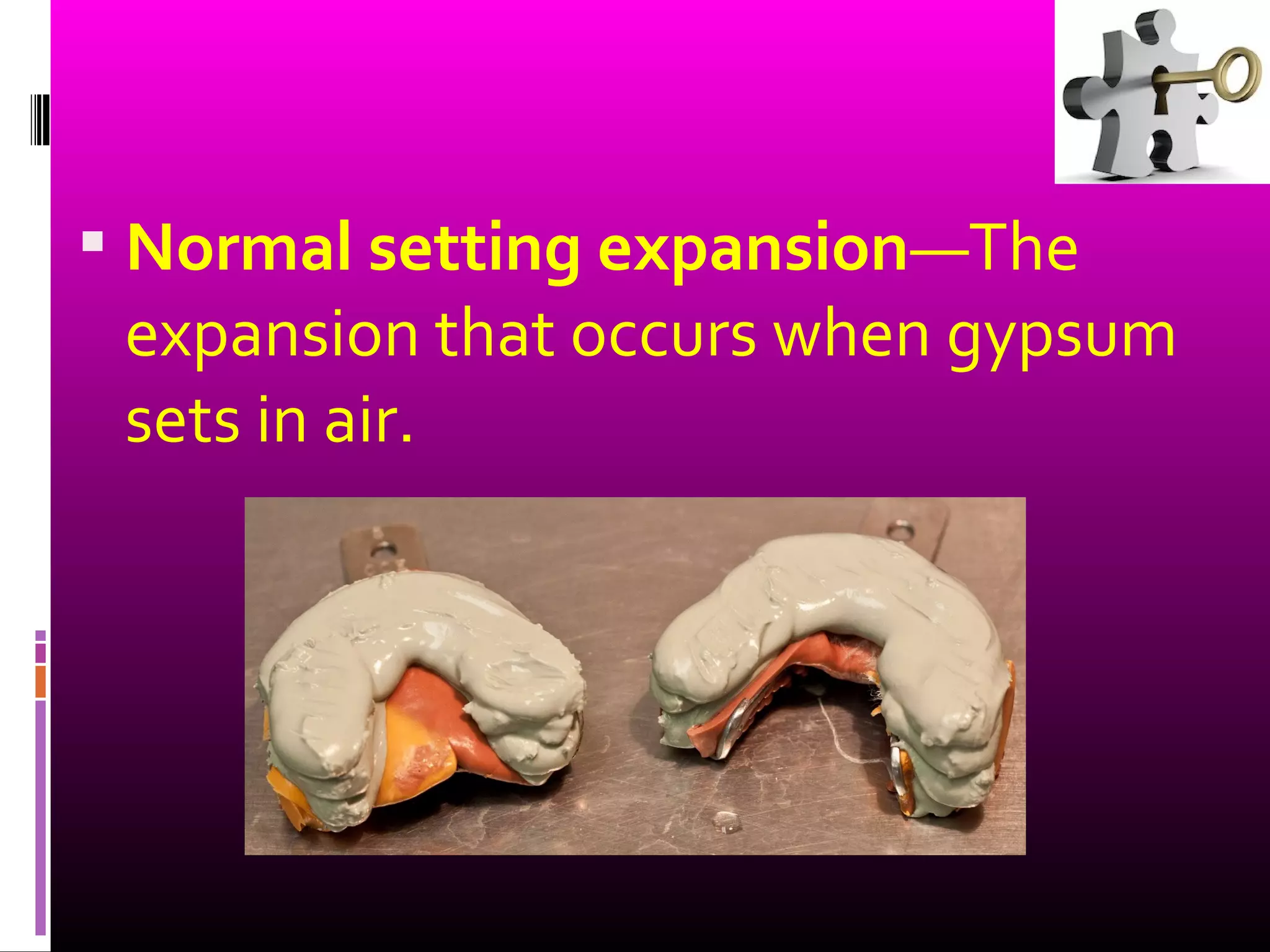
 Normal setting expansion—The
expansion that occurs when gypsum
sets in air.
 All gypsum products expand
normally on setting.
 Plaster expands the most, at 0.2%
to 0.3%.
 Stone expands 0.08% to 0.10%.
 High-strength stone expands the
least, at 0.05% to 0.07%.
 If gypsum materials are immersed in or
come in contact with water during the
setting process, the setting expansion
increases. This is called hygroscopic
expansion, and it can be used to
increase the setting expansion of
casting investments. Although small,
hygroscopic expansion is approximately
twice as great as the normal setting
expansion.
Strength
 The strength of the gypsum
product is usually measured in
terms of crushing or compressive
strength.
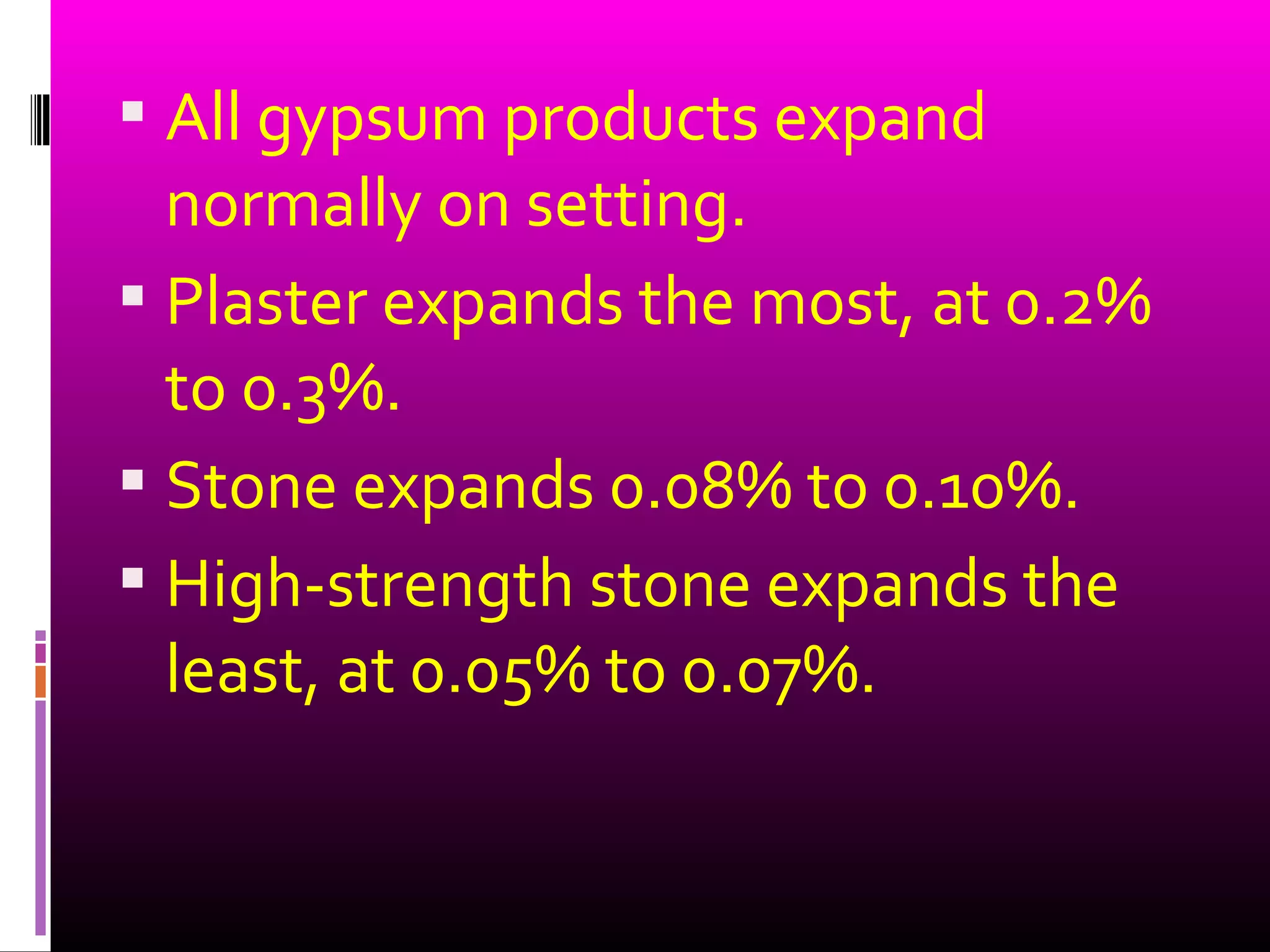
 Plaster, which requires the most
gauging water to make a fluid mix,
is the weakest in strength, with
improved stone being the strongest
and stone being intermediate
between the two.
One-Hour Compressive Strengths and
Water/Powder Ratios of Gypsum Products
Type of
Gypsum
Minimum 1-Hour
Compressive
strength in
Mpa
Water/Powder
Ratio
Plaster (Type II) 9 45–50 ml/100 g
(0.45–0.50)
Dental stone
(Type III)
21 28–30 ml/100 g
(0.28–0.30)
Dental stone,
high-strength
(Type IV)
34 19–24 ml/100 g
(0.19–0.24)
Two types of strength are recognized:
wet strength (green strength) and dry
strength.
 The wet strength is the strength that is
determined when water in excess of
that required for hydration of the
hemihydrate remains in the test
specimen. When such excess water is
removed by drying, the strength
obtained is the dry strength.
 The dry strength may be two or more
times as high as the wet strength.
Factors Affecting Strength
 The strength of gypsum products
depends on the water/powder ratio;
thicker mixes will increase the strength
within limits, and thinner mixes will
decrease the strength.
 Follow the manufacturer's
recommended water/powder ratio for
optimum strength and consistency
properties.
Surface Hardness
 The greatest surface hardness
occurs when the product reaches
its dry strength.
 Casts and dies should be allowed
to set for 1 to 2 hours, or
preferably overnight or longer,
before beginning subsequent
laboratory procedures.
Dimensional Stability
 Gypsum is slightly soluble in water.
 If the cast is soaked in water for
prolonged periods of time, the
surface may be dissolved away.
 The safest way to soak a cast is to
place it in a water bath containing
particles of gypsum to provide a
saturated solution of calcium sulfate
at all times.
Technique of Use
 The technical use of
gypsum products is
relatively simple, requiring
only a mixing bowl, mixing
spatula, room-
temperature water, and
gypsum product.
 The water and powder
must be proportioned
accurately for optimum
properties to be obtained.
 The method of mixing is to add
the measured water into the
mixing bowl first, followed by
gradual addition of the powder.
 Hand mixing is usually done in a flexible plastic or
rubber bowl with a stiff-bladed spatula to
combine the powder and water. The mix should
be smooth, homogeneous, workable, and free of
air bubbles.
 Use of a dental vibrator will reduce bubbles in the
mix. A smooth, homogeneous mix should be
obtained in approximately 1 minute.
 Often, mixing is done
mechanically with a
vacuum mixing. This
provides a gypsum mix
that is free of air bubbles
and is homogeneous in
consistency.
 They are used when the
elimination of voids and
surface bubbles is
 When filling the impression, the
gypsum mixture needs to flow slowly
“ahead of itself” to prevent the
entrapment of air. This is usually
accomplished with a dental vibrator.
 The dental stone model should be left
undisturbed for 45 to 60 min until the
material has set completely. The
gypsum model is now separated from
the impression.
ANY QUESTIONS

Gypsum products

  • 2.
  • 3.
    1. Discuss thedifferences between dental plaster, stone, and improved stone. 2. Explain the meaning of initial and final setting times. 3. Give examples of how to increase and decrease the setting times of gypsum products. 4. Discuss wet and dry strength as it relates to gypsum products.
  • 5.
     Gypsum productsare supplied as fine powders that are mixed with water to form a fluid mass that can be poured and shaped and that hardens into a rigid, stable mass.
  • 6.
    Gypsum products areused mainly for positive reproductions or replicas of oral structures.These replicas are called casts, models or dies, and they are obtained from negative reproductions (impressions).
  • 8.
     Model—is usedto plan treatment and to observe treatment progress.
  • 9.
     Cast—A castis a replica on which a restoration/prosthesis is fabricated. A cast is more accurate than a study model.
  • 10.
     Die—A reproductionof a prepared tooth.
  • 12.
  • 13.
     Gypsum productsare made from gypsum rock, which is a mineral found in various parts of the world. Gypsum rock is mined, ground into a fine powder, and then processed by heating to form a variety of products.
  • 14.
     Chemically, gypsumrock is calcium sulfate dihydrate (CaSO4·2H2O). Gypsum products are used in dentistry, medicine, homes, and industry. In homes, gypsum plaster is used to make walls; in industry, it is used to make molds.
  • 17.
     Three typesof gypsum products will be discussed: plaster, stone, and high-strength or improved stone. Chemically, all three are calcium sulfate hemihydrate.
  • 18.
     They areproduced as a result of heating gypsum and driving off part of the water of crystallization. This process is called calcination and is shown in the following equation:
  • 19.
     Calcination—The processof heating a solid material to drive off chemically combined components such as water and carbon dioxide.
  • 20.
    A. Dental Plaster Gypsum + Heat (open kettle at 110/120˚C) = Beta Calcium Sulfate Hemihydrate
  • 21.
    Characteristics  Irregular ShapedCrystals  Very porous  Random shaped TYPE I GYPSUM = IMPRESSION PLASTER TYPE II GYPSUM = MODEL PLASTER 2 Forms of Plaster:
  • 22.
    B. Dental Stone GYPSUM + Steam & Pressure at 125 ˚C = Alpha Calcium Sulfate Hemihydrate Sulfate Hemihydrate
  • 23.
    Characteristics  More Uniformshaped crystals  More dense than Plaster  Larger crystals  Smoother Particles TYPE III GYPSUM = Dental Stone
  • 24.
    C. Improved Stone GYPSUM + 30% Calcium Chloride Solution at 100 ˚C = Alpha Calcium Sulfate Hemihydrate
  • 25.
    Characteristics  Very densecrystals  Cubic or rectangular crystals  Large crystals TYPE IV GYPSUM = DENTAL STONE HIGH STRENGTH TYPE V GYPSUM = DENTAL STONE HIGH STRENGTH, HIGH EXPANSION 2 Forms :
  • 26.
    Dental Plaster DentalStone Improved Stone
  • 27.
    ADA Specification No.25 classifies five types of gypsum products Type I IMPRESSION PLASTER Type II MODEL PLASTER Type III DENTAL STONE Type IV DENTAL STONE, HIGH STRENGTH Type V DENTAL STONE, HIGH STRENGTH, HIGH EXPANSION
  • 31.
     When anyof the three types of calcium sulfate hemihydrate is mixed with water, the hemihydrate is changed back to dihydrate by the process of hydration. Heat is liberated. CaSO4.½ H2O + 1 ½ H2O → CaSO4 .2H2O + heat
  • 32.
  • 33.
     The proportionof water to powder used to make a workable mix of a particular gypsum product is called the water/powder ratio.  For the average mix for plaster, 45–50 ml/100 g (0.45–0.50)  For the average mix for stone, 28–30 ml/100 g (0.28–0.30)  For the average mix for improved stone, 19–24 ml/100 g (0.19–0.24)
  • 34.
  • 35.
    1. Working Timeor Initial Setting Time Working time or initial setting time is the length of time from the start of the mix until the setting mass reaches a semihard stage. It represents the available time for manipulating the product, and it indicates partial progress of the setting reaction.
  • 36.
    2. Final SettingTime  Final setting time represents the length of time from the start of the mix until the setting mass becomes rigid and can be separated from the impression. The final setting time indicates the major completion of the setting reaction.
  • 37.
    Measurement of settingtime  Setting times are usually measured with a surface penetration test. Gillmore needles are commonly used for this measurement .
  • 38.
     When thesurface of the setting product has developed sufficient strength to support the weight of the ¼-lb needle and of the 1-lb needle, the initial setting time and the final setting time, respectively, have occurred. In other words, each designated setting time is reached when its respective needle no longer makes an indentation in the gypsum specimen.
  • 39.
     Loss ofsurface gloss can be used as a determination of the initial setting or working time; it is typically 5 to 7 minutes.  A time of 30 to 45 minutes for the final set.
  • 40.
    Variation in SettingTimes 1. Increased Setting Time (A Slower-Setting Product)  Decreased mixing  Higher water/powder ratio (creates a thinner mix)  Addition of certain chemicals called retarders. A commonly used retarder is borax
  • 41.
    2. Decreased SettingTime (A Faster-Setting Product) Increased mixing (the longer the mixing time, the shorter the setting time) Lower water/powder ratio (creates a thicker mix) Addition of certain chemicals called accelerators. A commonly used accelerator is potassium sulfate
  • 42.
  • 43.
     Hygroscopic settingexpansion—The expansion that occurs when gypsum sets while immersed in water.
  • 44.
     Normal settingexpansion—The expansion that occurs when gypsum sets in air.
  • 45.
     All gypsumproducts expand normally on setting.  Plaster expands the most, at 0.2% to 0.3%.  Stone expands 0.08% to 0.10%.  High-strength stone expands the least, at 0.05% to 0.07%.
  • 46.
     If gypsummaterials are immersed in or come in contact with water during the setting process, the setting expansion increases. This is called hygroscopic expansion, and it can be used to increase the setting expansion of casting investments. Although small, hygroscopic expansion is approximately twice as great as the normal setting expansion.
  • 47.
  • 48.
     The strengthof the gypsum product is usually measured in terms of crushing or compressive strength.
  • 49.
     Plaster, whichrequires the most gauging water to make a fluid mix, is the weakest in strength, with improved stone being the strongest and stone being intermediate between the two.
  • 50.
    One-Hour Compressive Strengthsand Water/Powder Ratios of Gypsum Products Type of Gypsum Minimum 1-Hour Compressive strength in Mpa Water/Powder Ratio Plaster (Type II) 9 45–50 ml/100 g (0.45–0.50) Dental stone (Type III) 21 28–30 ml/100 g (0.28–0.30) Dental stone, high-strength (Type IV) 34 19–24 ml/100 g (0.19–0.24)
  • 51.
    Two types ofstrength are recognized: wet strength (green strength) and dry strength.
  • 52.
     The wetstrength is the strength that is determined when water in excess of that required for hydration of the hemihydrate remains in the test specimen. When such excess water is removed by drying, the strength obtained is the dry strength.  The dry strength may be two or more times as high as the wet strength.
  • 53.
    Factors Affecting Strength The strength of gypsum products depends on the water/powder ratio; thicker mixes will increase the strength within limits, and thinner mixes will decrease the strength.  Follow the manufacturer's recommended water/powder ratio for optimum strength and consistency properties.
  • 54.
  • 55.
     The greatestsurface hardness occurs when the product reaches its dry strength.  Casts and dies should be allowed to set for 1 to 2 hours, or preferably overnight or longer, before beginning subsequent laboratory procedures.
  • 56.
  • 57.
     Gypsum isslightly soluble in water.  If the cast is soaked in water for prolonged periods of time, the surface may be dissolved away.  The safest way to soak a cast is to place it in a water bath containing particles of gypsum to provide a saturated solution of calcium sulfate at all times.
  • 58.
  • 59.
     The technicaluse of gypsum products is relatively simple, requiring only a mixing bowl, mixing spatula, room- temperature water, and gypsum product.  The water and powder must be proportioned accurately for optimum properties to be obtained.
  • 60.
     The methodof mixing is to add the measured water into the mixing bowl first, followed by gradual addition of the powder.
  • 61.
     Hand mixingis usually done in a flexible plastic or rubber bowl with a stiff-bladed spatula to combine the powder and water. The mix should be smooth, homogeneous, workable, and free of air bubbles.  Use of a dental vibrator will reduce bubbles in the mix. A smooth, homogeneous mix should be obtained in approximately 1 minute.
  • 62.
     Often, mixingis done mechanically with a vacuum mixing. This provides a gypsum mix that is free of air bubbles and is homogeneous in consistency.  They are used when the elimination of voids and surface bubbles is
  • 74.
     When fillingthe impression, the gypsum mixture needs to flow slowly “ahead of itself” to prevent the entrapment of air. This is usually accomplished with a dental vibrator.
  • 75.
     The dentalstone model should be left undisturbed for 45 to 60 min until the material has set completely. The gypsum model is now separated from the impression.
  • 76.

Editor's Notes

  • #19 water of crystallization or water of hydration or crystallization water is water that occurs inside crystals. Water is often necessary for the formation of crystals.[1]In some contexts, water of crystallization is the total weight of water in a substance at a given temperature and is mostly present in a definite (stoichiometric) ratio. Classically, "water of crystallization" refers to water that is found in the crystalline framework of a metal complex or a salt, which is not directly bonded to the metal cation