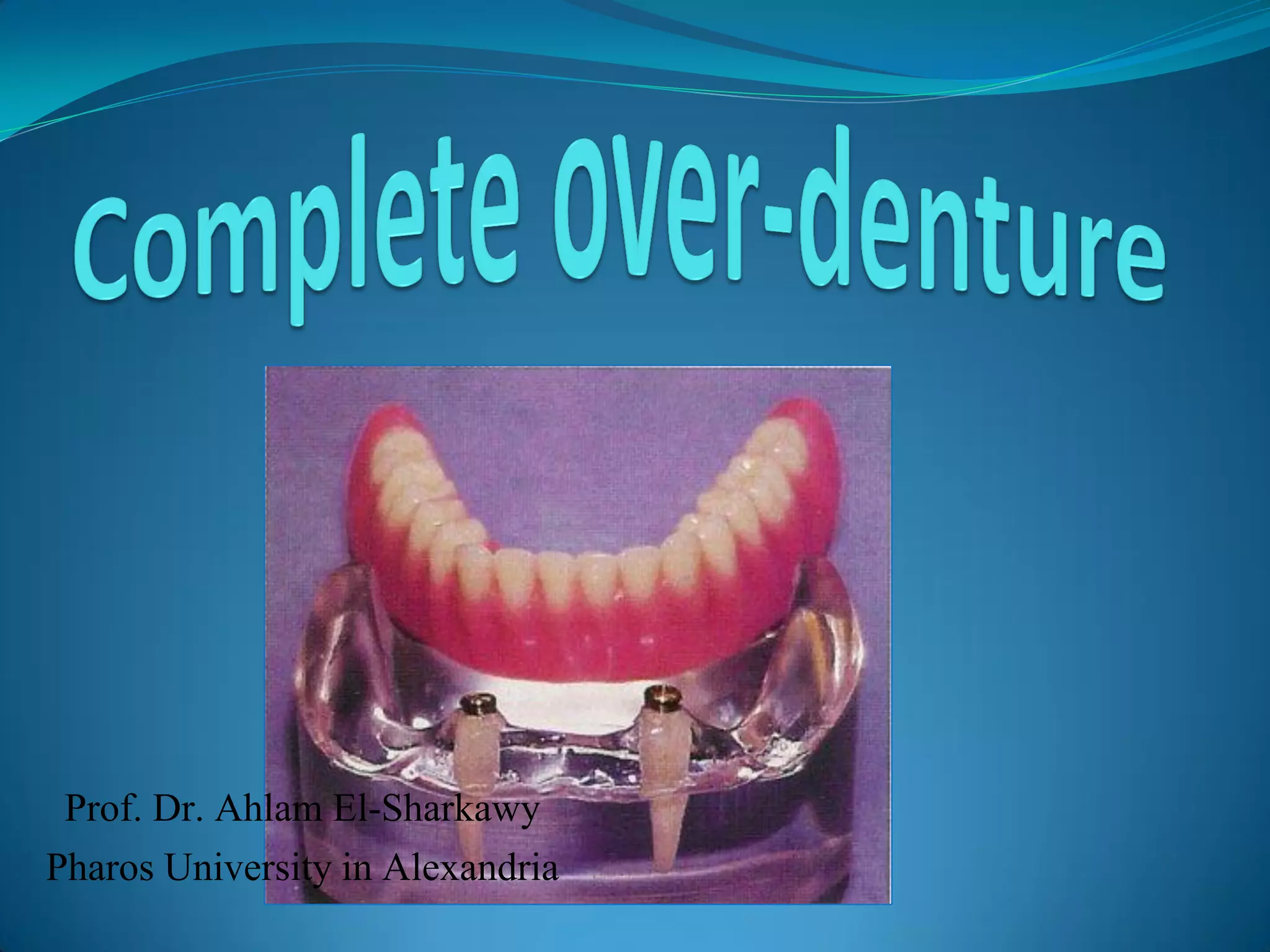
Prof. Dr. Ahlam El-Sharkawy
Pharos University in Alexandria
Introduction
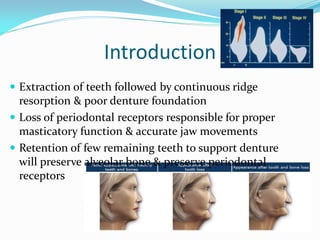
 Extraction of teeth followed by continuous ridge
resorption & poor denture foundation
 Loss of periodontal receptors responsible for proper
masticatory function & accurate jaw movements
 Retention of few remaining teeth to support denture
will preserve alveolar bone & preserve periodontal
receptors
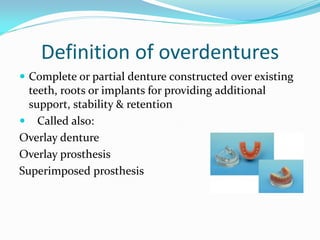
Definition of overdentures
 Complete or partial denture constructed over existing
teeth, roots or implants for providing additional
support, stability & retention
 Called also:
Overlay denture
Overlay prosthesis
Superimposed prosthesis
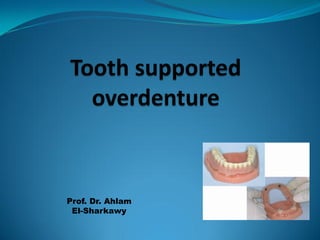
Types 0f over-Dentures.
 -Tooth supported over-dentures.
- Implant supported over- denture.
Prof. Dr. Ahlam
El-Sharkawy
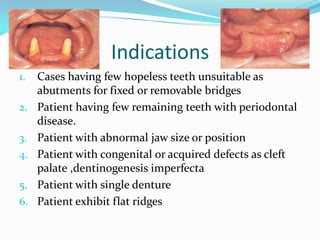
Indications
1. Cases having few hopeless teeth unsuitable as
abutments for fixed or removable bridges
2. Patient having few remaining teeth with periodontal
disease.
3. Patient with abnormal jaw size or position
4. Patient with congenital or acquired defects as cleft
palate ,dentinogenesis imperfecta
5. Patient with single denture
6. Patient exhibit flat ridges
Contra-indications
1. Mentally or physically handicapped
2. Patient can’t be motivated to develop good oral
hygiene
3. Inadequate intermaxillary space
4. Teeth with grade III mobility or insufficient zone of
attached gingiva
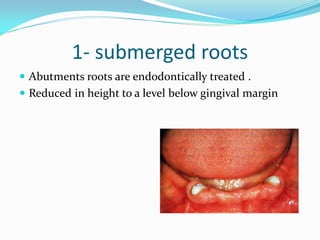
1- submerged roots
 Abutments roots are endodontically treated .
 Reduced in height to a level below gingival margin
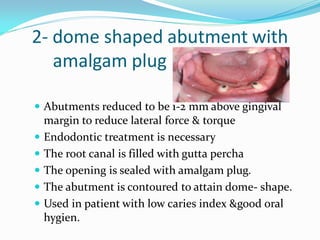
2- dome shaped abutment with
amalgam plug mmmmmm
 Abutments reduced to be 1-2 mm above gingival
margin to reduce lateral force & torque
 Endodontic treatment is necessary
 The root canal is filled with gutta percha
 The opening is sealed with amalgam plug.
 The abutment is contoured to attain dome- shape.
 Used in patient with low caries index &good oral
hygien.
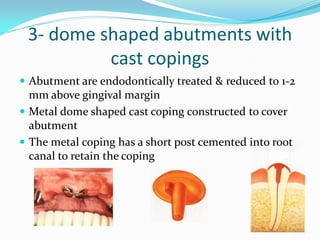
3- dome shaped abutments with
cast copings
 Abutment are endodontically treated & reduced to 1-2
mm above gingival margin
 Metal dome shaped cast coping constructed to cover
abutment
 The metal coping has a short post cemented into root
canal to retain the coping
4- abutments with telescopic
crowns
 Abutment teeth are either vital or endodontically
treated & contoured to tapered configuration
 Tapered metal copings constructed &cemented over
abutments
 Denture constructed with metal crowns having
veneered facings
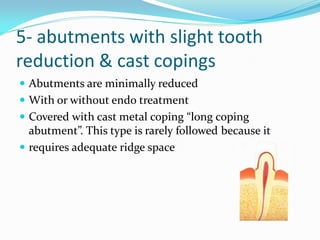
5- abutments with slight tooth
reduction & cast copings
 Abutments are minimally reduced
 With or without endo treatment
 Covered with cast metal coping “long coping
abutment”. This type is rarely followed because it
 requires adequate ridge space
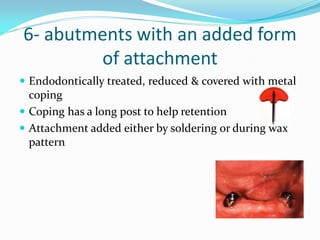
 Endodontically treated, reduced & covered with metal
coping
 Coping has a long post to help retention
 Attachment added either by soldering or during wax
pattern
6- abutments with an added form
of attachment
Types of tooth supported Over-dentures
1. Immediate over-denture
2. Interim over-denture
3. Definitive over-denture
4. Attachment retained over-denture
Immediate overdenture
 Constructed prior to preparation of abutment teeth &
ready for insertion after preparation& reduction
 It enhances patient’s ability & adaptability to wear
dentures
Interim overdenture
 Used for patients in transition or preparation phase
until permanent overdenture constructed
 Patient old partial denture can be modified & used by
extending the denture & add new artificial teeth using
self cure acrylic resin
Definitive over-denture
 Conventional complete over-denture constructed over
1 or more abutment teeth
 Could be made entirely of acrylic resin or in
conjunction with metal bases
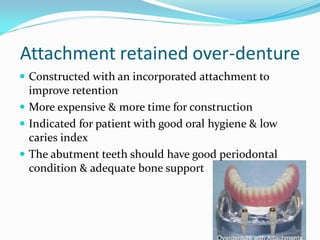
Attachment retained over-denture
 Constructed with an incorporated attachment to
improve retention
 More expensive & more time for construction
 Indicated for patient with good oral hygiene & low
caries index
 The abutment teeth should have good periodontal
condition & adequate bone support
Types of Attachments
a) Rigid attachment
Doesn’t allow movement of denture base
Provide adequate retention
May induce more torque on abutment
b) Resilient attachment
Allows some control of movements.
Induces less torque on abutments.
Over-Denture Attachment
could be in the form of:
 1- Stud Attachments.
 2- Bar attachments.
 3 Magnetic Attachments.
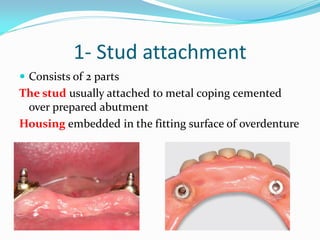
1- Stud attachment
 Consists of 2 parts
The stud usually attached to metal coping cemented
over prepared abutment
Housing embedded in the fitting surface of overdenture
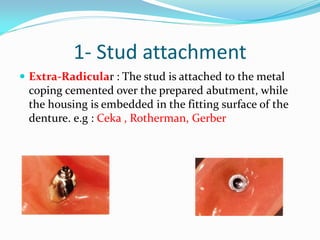
1- Stud attachment
 Extra-Radicular : The stud is attached to the metal
coping cemented over the prepared abutment, while
the housing is embedded in the fitting surface of the
denture. e.g : Ceka , Rotherman, Gerber
1- Stud attachment
B- Intra-Radicular: The stud is attached to the fitting
surface of the denture and the housing is incorporated
in the abutment. e.g : Zest Anchor
 eg
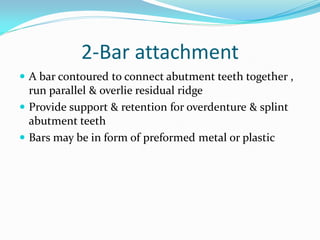
2-Bar attachment
 A bar contoured to connect abutment teeth together ,
run parallel & overlie residual ridge
 Provide support & retention for overdenture & splint
abutment teeth
 Bars may be in form of preformed metal or plastic
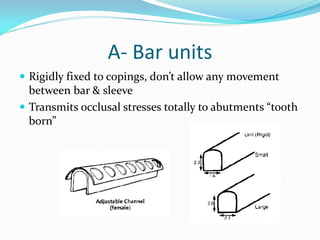
A- Bar units
 Rigidly fixed to copings, don’t allow any movement
between bar & sleeve
 Transmits occlusal stresses totally to abutments “tooth
born”
B- Bar joints
 Resilient attachments allowing movement between
bar & sleeve
 Support provided by both residual ridge & abutment
teeth “tooth tissue born”
3- magnetic attachments
 Small, strong mini magnets
 One of poles cemented in a prepared cavity in
endodontically treated abutment & the other attached
to denture base

Complete overdenture(3)

  • 1.
    Prof. Dr. AhlamEl-Sharkawy Pharos University in Alexandria
  • 2.
    Introduction  Extraction ofteeth followed by continuous ridge resorption & poor denture foundation  Loss of periodontal receptors responsible for proper masticatory function & accurate jaw movements  Retention of few remaining teeth to support denture will preserve alveolar bone & preserve periodontal receptors
  • 3.
    Definition of overdentures Complete or partial denture constructed over existing teeth, roots or implants for providing additional support, stability & retention  Called also: Overlay denture Overlay prosthesis Superimposed prosthesis
  • 4.
    Types 0f over-Dentures. -Tooth supported over-dentures. - Implant supported over- denture.
  • 5.
  • 6.
    Indications 1. Cases havingfew hopeless teeth unsuitable as abutments for fixed or removable bridges 2. Patient having few remaining teeth with periodontal disease. 3. Patient with abnormal jaw size or position 4. Patient with congenital or acquired defects as cleft palate ,dentinogenesis imperfecta 5. Patient with single denture 6. Patient exhibit flat ridges
  • 7.
    Contra-indications 1. Mentally orphysically handicapped 2. Patient can’t be motivated to develop good oral hygiene 3. Inadequate intermaxillary space 4. Teeth with grade III mobility or insufficient zone of attached gingiva
  • 9.
    1- submerged roots Abutments roots are endodontically treated .  Reduced in height to a level below gingival margin
  • 10.
    2- dome shapedabutment with amalgam plug mmmmmm  Abutments reduced to be 1-2 mm above gingival margin to reduce lateral force & torque  Endodontic treatment is necessary  The root canal is filled with gutta percha  The opening is sealed with amalgam plug.  The abutment is contoured to attain dome- shape.  Used in patient with low caries index &good oral hygien.
  • 11.
    3- dome shapedabutments with cast copings  Abutment are endodontically treated & reduced to 1-2 mm above gingival margin  Metal dome shaped cast coping constructed to cover abutment  The metal coping has a short post cemented into root canal to retain the coping
  • 12.
    4- abutments withtelescopic crowns  Abutment teeth are either vital or endodontically treated & contoured to tapered configuration  Tapered metal copings constructed &cemented over abutments  Denture constructed with metal crowns having veneered facings
  • 13.
    5- abutments withslight tooth reduction & cast copings  Abutments are minimally reduced  With or without endo treatment  Covered with cast metal coping “long coping abutment”. This type is rarely followed because it  requires adequate ridge space
  • 14.
     Endodontically treated,reduced & covered with metal coping  Coping has a long post to help retention  Attachment added either by soldering or during wax pattern 6- abutments with an added form of attachment
  • 15.
    Types of toothsupported Over-dentures 1. Immediate over-denture 2. Interim over-denture 3. Definitive over-denture 4. Attachment retained over-denture
  • 16.
    Immediate overdenture  Constructedprior to preparation of abutment teeth & ready for insertion after preparation& reduction  It enhances patient’s ability & adaptability to wear dentures
  • 17.
    Interim overdenture  Usedfor patients in transition or preparation phase until permanent overdenture constructed  Patient old partial denture can be modified & used by extending the denture & add new artificial teeth using self cure acrylic resin
  • 18.
    Definitive over-denture  Conventionalcomplete over-denture constructed over 1 or more abutment teeth  Could be made entirely of acrylic resin or in conjunction with metal bases
  • 19.
    Attachment retained over-denture Constructed with an incorporated attachment to improve retention  More expensive & more time for construction  Indicated for patient with good oral hygiene & low caries index  The abutment teeth should have good periodontal condition & adequate bone support
  • 20.
    Types of Attachments a)Rigid attachment Doesn’t allow movement of denture base Provide adequate retention May induce more torque on abutment b) Resilient attachment Allows some control of movements. Induces less torque on abutments.
  • 21.
    Over-Denture Attachment could bein the form of:  1- Stud Attachments.  2- Bar attachments.  3 Magnetic Attachments.
  • 22.
    1- Stud attachment Consists of 2 parts The stud usually attached to metal coping cemented over prepared abutment Housing embedded in the fitting surface of overdenture
  • 23.
    1- Stud attachment Extra-Radicular : The stud is attached to the metal coping cemented over the prepared abutment, while the housing is embedded in the fitting surface of the denture. e.g : Ceka , Rotherman, Gerber
  • 24.
    1- Stud attachment B-Intra-Radicular: The stud is attached to the fitting surface of the denture and the housing is incorporated in the abutment. e.g : Zest Anchor  eg
  • 25.
    2-Bar attachment  Abar contoured to connect abutment teeth together , run parallel & overlie residual ridge  Provide support & retention for overdenture & splint abutment teeth  Bars may be in form of preformed metal or plastic
  • 26.
    A- Bar units Rigidly fixed to copings, don’t allow any movement between bar & sleeve  Transmits occlusal stresses totally to abutments “tooth born”
  • 27.
    B- Bar joints Resilient attachments allowing movement between bar & sleeve  Support provided by both residual ridge & abutment teeth “tooth tissue born”
  • 28.
    3- magnetic attachments Small, strong mini magnets  One of poles cemented in a prepared cavity in endodontically treated abutment & the other attached to denture base