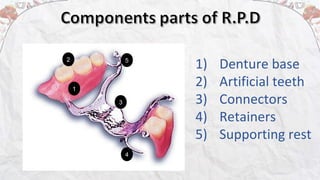
1) Denture base
2) Artificial teeth
3) Connectors
4) Retainers
5) Supporting rest
1
2
3
4
5
Rest:Rest:
extensions of a Partial Denture, Placed in Rest Seats,
Which are prepared on either the Occlusal, Lingual
surfaces or Incisal edges of the teeth, providing Support
to the Partial Denture
Rest seat:Rest seat:
portion of a tooth prepared to receive a rest
Functions Of The RestsFunctions Of The Rests
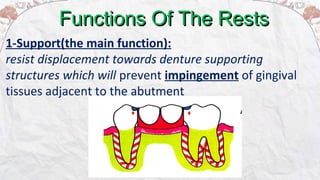
1-Support(the main function):
resist displacement towards denture supporting
structures which will prevent impingement of gingival
tissues adjacent to the abutment
2-maintain the components of the dentures in their
positions and prevents spreading of clasp arm
3-Distributing the Occlusal Load
4-May Act As Indirect Retention
4-Direct food away from tooth
contact and embrasure area
5-improve the existing occlusion
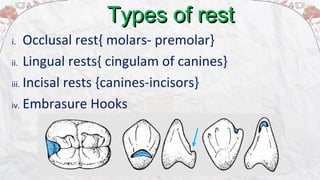
Types of restTypes of rest
i. Occlusal rest{ molars- premolar}
ii. Lingual rests{ cingulam of canines}
iii. Incisal rests {canines-incisors}
iv. Embrasure Hooks
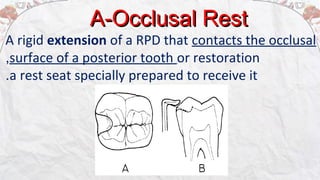
A rigid extension of a RPD that contacts the occlusal
surface of a posterior tooth or restoration,
a rest seat specially prepared to receive it.
A-Occlusal RestA-Occlusal Rest
Types of occlusalTypes of occlusal restrest
A- conventional
B-other forms: 1. Box-shaped O.R.
2. Extended O.R.
3. Onlay O.R.
4. Inter proximal O.R.
5. Embrasures O.R.
6. Internal O.R.
Partial denture
without occlusal
rest is called gum
stripper
Requirements of Rest SeatRequirements of Rest Seat
PreparationPreparation
1- Should be rounded triangular
outline form, the base of the triangle
at the marginal ridge and its rounded
apex is towards the center of the
tooth
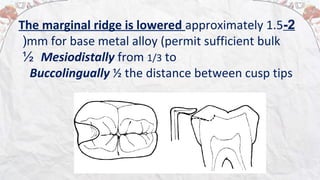
2-The marginal ridge is lowered approximately 1.5
mm for base metal alloy (permit sufficient bulk(
Mesiodistally from 1/3 to½
Buccolingually ½ the distance between cusp tips
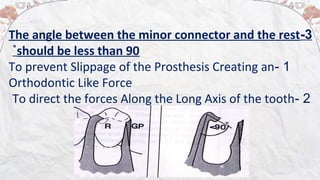
3-The angle between the minor connector and the rest
should be less than 90˚
1-To prevent Slippage of the Prosthesis Creating an
Orthodontic Like Force
2-To direct the forces Along the Long Axis of the tooth
4-the rest seat may be papered in either
saucer shape or box shape
Saucer shape(spoon) used more than box in cases of :
•free end saddle
•bounded cases having weak abutments
5-Rest seats are prepared in sound enamel, or in
crowns and inlays
Fluride gel applied to abutment
Requirements of occlusal RestRequirements of occlusal Rest::
1.Should have sufficient thickness
of metal to prevent breakage
especially over the marginal ridge.
2.It should fit the rest seat
accurately with beveled margins,
preventing food stagnation or
impaction.
3.It must not raise the vertical dimensions of occlusion
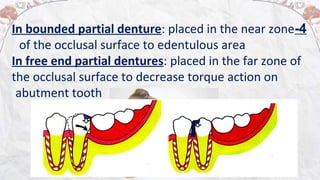
4-In bounded partial denture: placed in the near zone
of the occlusal surface to edentulous area
In free end partial dentures: placed in the far zone of
the occlusal surface to decrease torque action on
abutment tooth
use of amalgam
restoration to
support an occlusal
rest is less due to
its tendency to
creep and flow
under pressure
B-other formsB-other forms
1-Box shape1-Box shapeIndication
a cast gold restorations
a strong periodontally healthy abutment a
Advantage
1.If made deep it will provide guide surfaces to
control the path of insertion of the dentures
2.Prevent lateral movement of denture
3.Provide increased denture retention
2-Tipped molar2-Tipped molar
(Mesially inclined mandibular molar)
•The rest should be designed to prevent further tipping,
It must direct forces down the long axis of the tooth by
either of one of these ways :
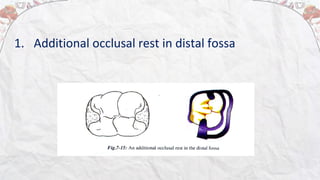
1. Additional occlusal rest in distal fossa
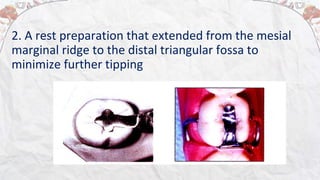
2. A rest preparation that extended from the mesial
marginal ridge to the distal triangular fossa to
minimize further tipping
box shaped
less used in
bounded
cases
33--onlayonlay
•An enlarged occlusal rest covering the entire occlusal
surface and extending buccally and lingually
•Retained by mechanical or adhesive means .
Functions:
1-support ( resist tissue award force(
2-improvement of occlusion by increasing the reduced
vertical dimension ( correction of occlusion bite(
3-minimize lateral component of the force
4-splinting ( in case of periodontally weak teeth(
Advantages:
1-direct the force along the long axis
2-promote RPD stability
3-minimize tipping of tooth
3-restore occlusal plane
3-interproximal O.R.3-interproximal O.R.
•They are prepared as individual occlusal rest seats ,
except that the preparations must be extended
further lingually than the ordinarily accomplished .
• used to avoid interproximal wedging , additionally
will shunt food away from contact points
Preparation:
1-should avoid weakening or eliminating contact points
2-provide adequate bulk for strength.
3-occlusion should not be altered
Onlay Cast in
gold or chrome
cobalt
44--EmbrasureEmbrasure restrest
Two simple circle clasps joined together fashioned on
the two abutment teeth.
Functions:
1-bridge gap between teeth
2-prevent food impaction between the space teeth
55--Internal restInternal rest
Indicated for bounded partial denture that totally
tooth supported
Advantage:
1-support come from floor of the rest
2-Lateral stabilization from parallel wall
3-Retention from lingual clasp
4-esthetics( buccal clasp(
II- Lingual RestsII- Lingual Rests::
A- Cingulum Rest ( inverted V Rest(.
B- Ball Rest.
C- Canine Ledge.
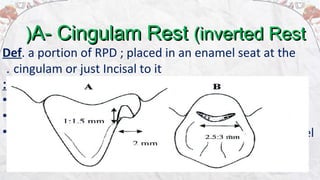
A- Cingulam RestA- Cingulam Rest (inverted Rest(inverted Rest((
Def. a portion of RPD ; placed in an enamel seat at the
cingulam or just Incisal to it.
Indication:
•no posterior tooth to place an occlusal rest .
•commonly used on the maxillary canines
•Rarely on lower anterior; due to less thickness of enamel
**the most satisfactory
preparation is that placed on a
prepared seat in a cast
restoration.
**when preparing a cingulam
rest in a cast restoration ; the
rest seat should be planned and
done on the wax pattern before
casting the restoration.
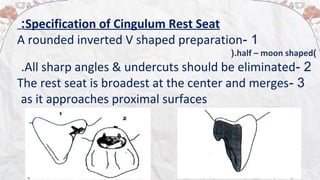
Specification of Cingulum Rest Seat:
1-A rounded inverted V shaped preparation
)half – moon shaped(.
2-All sharp angles & undercuts should be eliminated.
3-The rest seat is broadest at the center and merges
as it approaches proximal surfaces
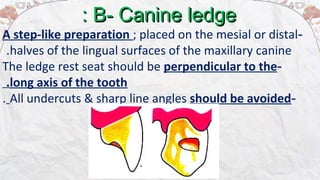
B- Canine ledgeB- Canine ledge::
-A step-like preparation ; placed on the mesial or distal
halves of the lingual surfaces of the maxillary canine.
-The ledge rest seat should be perpendicular to the
long axis of the tooth.
-All undercuts & sharp line angles should be avoided.
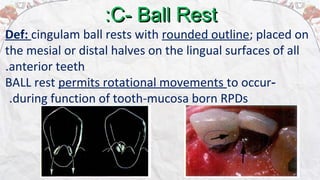
C- Ball RestC- Ball Rest::
Def: cingulam ball rests with rounded outline; placed on
the mesial or distal halves on the lingual surfaces of all
anterior teeth.
-BALL rest permits rotational movements to occur
during function of tooth-mucosa born RPDs.
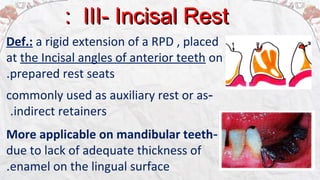
III- Incisal RestIII- Incisal Rest::
Def.: a rigid extension of a RPD , placed
at the Incisal angles of anterior teeth on
prepared rest seats.
-commonly used as auxiliary rest or as
indirect retainers.
-More applicable on mandibular teeth
due to lack of adequate thickness of
enamel on the lingual surface.
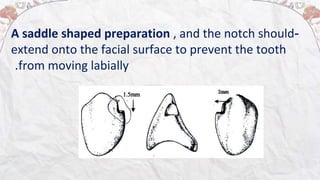
-A saddle shaped preparation , and the notch should
extend onto the facial surface to prevent the tooth
from moving labially.
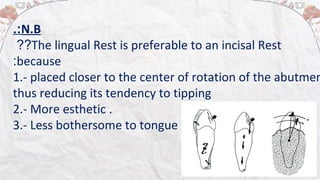
N.B.:
The lingual Rest is preferable to an incisal Rest??
because:
1.- placed closer to the center of rotation of the abutmen
thus reducing its tendency to tipping
2.- More esthetic .
3.- Less bothersome to tongue .
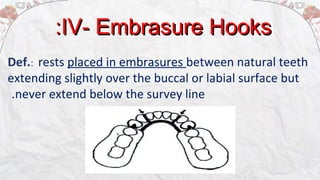
IV- Embrasure HooksIV- Embrasure Hooks::
Def.: rests placed in embrasures between natural teeth
extending slightly over the buccal or labial surface but
never extend below the survey line.
Advantages:
-provide support.
-splinting of natural teeth.
-resistance to lateral and antero-posterior movement.
-may act as indirect retainer.
Disadvantages:
-poor esthetics.
-wedging action on teeth.
preferred site for a
rest , is the occlusal
surface of a molar
If anterior tooth , a
canine is preferred over
an incisor
In absence of canine ,
multiple lingual rests are
prepared on anterior
teeth.
e.Mostafa e.gom3a khalood fatoo7 khalifa adh

Rest and Rest Seat preparation..removable partial denture

  • 2.
    1) Denture base 2)Artificial teeth 3) Connectors 4) Retainers 5) Supporting rest 1 2 3 4 5
  • 4.
    Rest:Rest: extensions of aPartial Denture, Placed in Rest Seats, Which are prepared on either the Occlusal, Lingual surfaces or Incisal edges of the teeth, providing Support to the Partial Denture
  • 5.
    Rest seat:Rest seat: portionof a tooth prepared to receive a rest
  • 6.
    Functions Of TheRestsFunctions Of The Rests 1-Support(the main function): resist displacement towards denture supporting structures which will prevent impingement of gingival tissues adjacent to the abutment
  • 7.
    2-maintain the componentsof the dentures in their positions and prevents spreading of clasp arm
  • 8.
    3-Distributing the OcclusalLoad 4-May Act As Indirect Retention
  • 9.
    4-Direct food awayfrom tooth contact and embrasure area
  • 10.
  • 11.
    Types of restTypesof rest i. Occlusal rest{ molars- premolar} ii. Lingual rests{ cingulam of canines} iii. Incisal rests {canines-incisors} iv. Embrasure Hooks
  • 12.
    A rigid extensionof a RPD that contacts the occlusal surface of a posterior tooth or restoration, a rest seat specially prepared to receive it. A-Occlusal RestA-Occlusal Rest
  • 13.
    Types of occlusalTypesof occlusal restrest A- conventional B-other forms: 1. Box-shaped O.R. 2. Extended O.R. 3. Onlay O.R. 4. Inter proximal O.R. 5. Embrasures O.R. 6. Internal O.R.
  • 14.
  • 15.
    Requirements of RestSeatRequirements of Rest Seat PreparationPreparation 1- Should be rounded triangular outline form, the base of the triangle at the marginal ridge and its rounded apex is towards the center of the tooth
  • 16.
    2-The marginal ridgeis lowered approximately 1.5 mm for base metal alloy (permit sufficient bulk( Mesiodistally from 1/3 to½ Buccolingually ½ the distance between cusp tips
  • 17.
    3-The angle betweenthe minor connector and the rest should be less than 90˚ 1-To prevent Slippage of the Prosthesis Creating an Orthodontic Like Force 2-To direct the forces Along the Long Axis of the tooth
  • 18.
    4-the rest seatmay be papered in either saucer shape or box shape Saucer shape(spoon) used more than box in cases of : •free end saddle •bounded cases having weak abutments
  • 19.
    5-Rest seats areprepared in sound enamel, or in crowns and inlays Fluride gel applied to abutment
  • 20.
    Requirements of occlusalRestRequirements of occlusal Rest:: 1.Should have sufficient thickness of metal to prevent breakage especially over the marginal ridge. 2.It should fit the rest seat accurately with beveled margins, preventing food stagnation or impaction.
  • 21.
    3.It must notraise the vertical dimensions of occlusion
  • 22.
    4-In bounded partialdenture: placed in the near zone of the occlusal surface to edentulous area In free end partial dentures: placed in the far zone of the occlusal surface to decrease torque action on abutment tooth
  • 23.
    use of amalgam restorationto support an occlusal rest is less due to its tendency to creep and flow under pressure
  • 24.
    B-other formsB-other forms 1-Boxshape1-Box shapeIndication a cast gold restorations a strong periodontally healthy abutment a
  • 25.
    Advantage 1.If made deepit will provide guide surfaces to control the path of insertion of the dentures 2.Prevent lateral movement of denture 3.Provide increased denture retention
  • 26.
    2-Tipped molar2-Tipped molar (Mesiallyinclined mandibular molar) •The rest should be designed to prevent further tipping, It must direct forces down the long axis of the tooth by either of one of these ways :
  • 27.
    1. Additional occlusalrest in distal fossa
  • 28.
    2. A restpreparation that extended from the mesial marginal ridge to the distal triangular fossa to minimize further tipping
  • 29.
    box shaped less usedin bounded cases
  • 30.
    33--onlayonlay •An enlarged occlusalrest covering the entire occlusal surface and extending buccally and lingually •Retained by mechanical or adhesive means .
  • 31.
    Functions: 1-support ( resisttissue award force( 2-improvement of occlusion by increasing the reduced vertical dimension ( correction of occlusion bite( 3-minimize lateral component of the force 4-splinting ( in case of periodontally weak teeth(
  • 32.
    Advantages: 1-direct the forcealong the long axis 2-promote RPD stability 3-minimize tipping of tooth 3-restore occlusal plane
  • 33.
    3-interproximal O.R.3-interproximal O.R. •Theyare prepared as individual occlusal rest seats , except that the preparations must be extended further lingually than the ordinarily accomplished . • used to avoid interproximal wedging , additionally will shunt food away from contact points
  • 34.
    Preparation: 1-should avoid weakeningor eliminating contact points 2-provide adequate bulk for strength. 3-occlusion should not be altered
  • 35.
    Onlay Cast in goldor chrome cobalt
  • 36.
    44--EmbrasureEmbrasure restrest Two simplecircle clasps joined together fashioned on the two abutment teeth.
  • 37.
    Functions: 1-bridge gap betweenteeth 2-prevent food impaction between the space teeth
  • 38.
    55--Internal restInternal rest Indicatedfor bounded partial denture that totally tooth supported
  • 39.
    Advantage: 1-support come fromfloor of the rest 2-Lateral stabilization from parallel wall 3-Retention from lingual clasp 4-esthetics( buccal clasp(
  • 41.
    II- Lingual RestsII-Lingual Rests:: A- Cingulum Rest ( inverted V Rest(. B- Ball Rest. C- Canine Ledge.
  • 42.
    A- Cingulam RestA-Cingulam Rest (inverted Rest(inverted Rest(( Def. a portion of RPD ; placed in an enamel seat at the cingulam or just Incisal to it. Indication: •no posterior tooth to place an occlusal rest . •commonly used on the maxillary canines •Rarely on lower anterior; due to less thickness of enamel
  • 43.
    **the most satisfactory preparationis that placed on a prepared seat in a cast restoration. **when preparing a cingulam rest in a cast restoration ; the rest seat should be planned and done on the wax pattern before casting the restoration.
  • 44.
    Specification of CingulumRest Seat: 1-A rounded inverted V shaped preparation )half – moon shaped(. 2-All sharp angles & undercuts should be eliminated. 3-The rest seat is broadest at the center and merges as it approaches proximal surfaces
  • 45.
    B- Canine ledgeB-Canine ledge:: -A step-like preparation ; placed on the mesial or distal halves of the lingual surfaces of the maxillary canine. -The ledge rest seat should be perpendicular to the long axis of the tooth. -All undercuts & sharp line angles should be avoided.
  • 46.
    C- Ball RestC-Ball Rest:: Def: cingulam ball rests with rounded outline; placed on the mesial or distal halves on the lingual surfaces of all anterior teeth. -BALL rest permits rotational movements to occur during function of tooth-mucosa born RPDs.
  • 47.
    III- Incisal RestIII-Incisal Rest:: Def.: a rigid extension of a RPD , placed at the Incisal angles of anterior teeth on prepared rest seats. -commonly used as auxiliary rest or as indirect retainers. -More applicable on mandibular teeth due to lack of adequate thickness of enamel on the lingual surface.
  • 48.
    -A saddle shapedpreparation , and the notch should extend onto the facial surface to prevent the tooth from moving labially.
  • 49.
    N.B.: The lingual Restis preferable to an incisal Rest?? because: 1.- placed closer to the center of rotation of the abutmen thus reducing its tendency to tipping 2.- More esthetic . 3.- Less bothersome to tongue .
  • 50.
    IV- Embrasure HooksIV-Embrasure Hooks:: Def.: rests placed in embrasures between natural teeth extending slightly over the buccal or labial surface but never extend below the survey line.
  • 51.
    Advantages: -provide support. -splinting ofnatural teeth. -resistance to lateral and antero-posterior movement. -may act as indirect retainer. Disadvantages: -poor esthetics. -wedging action on teeth.
  • 52.
    preferred site fora rest , is the occlusal surface of a molar If anterior tooth , a canine is preferred over an incisor In absence of canine , multiple lingual rests are prepared on anterior teeth.
  • 53.
    e.Mostafa e.gom3a khaloodfatoo7 khalifa adh