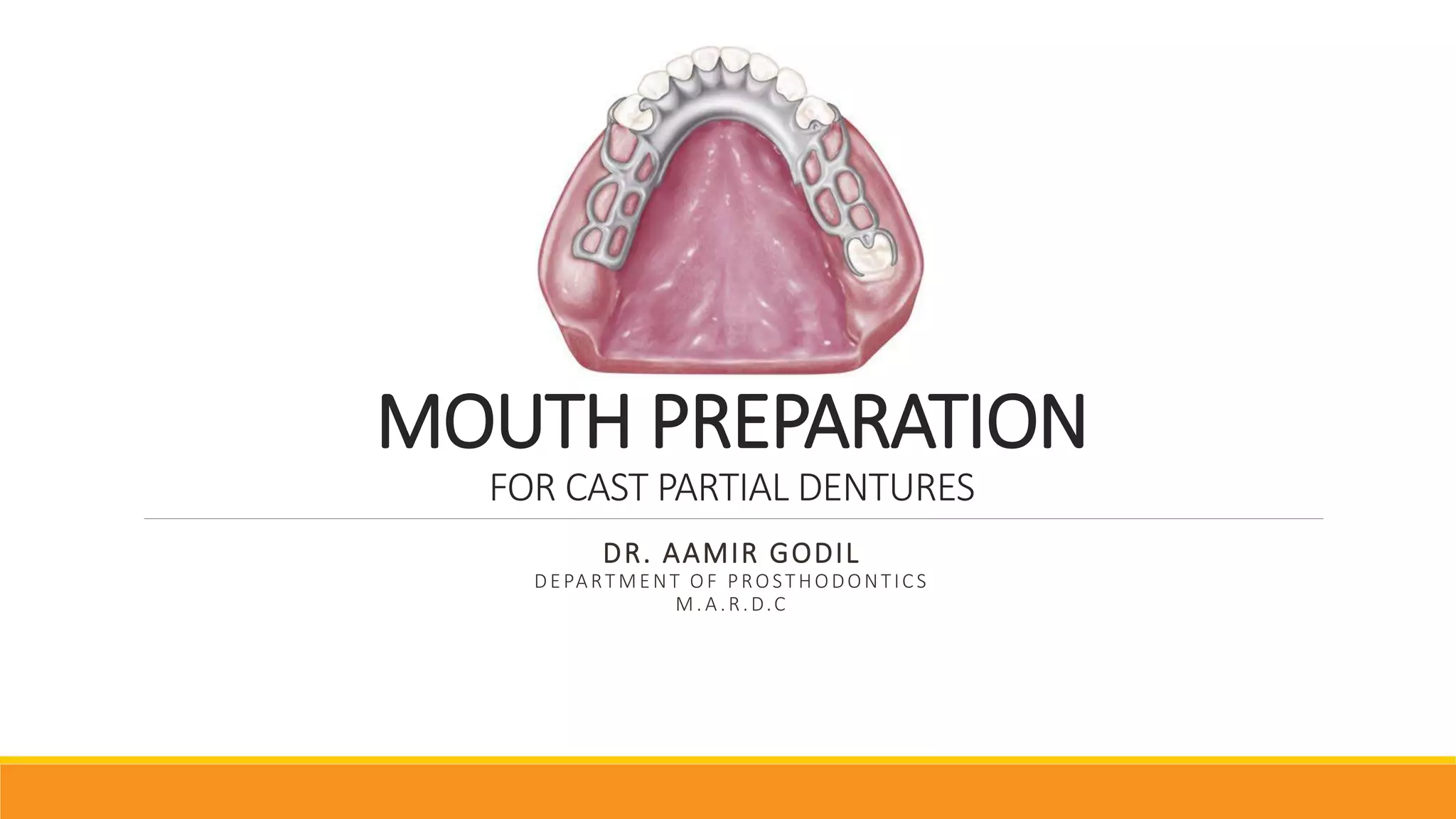
MOUTH PREPARATION
FOR CAST PARTIAL DENTURES
DR. AAMIR GODIL
DEPARTMENT OF PROSTHODONTICS
M. A .R.D.C
CONTENTS
•Pre-prosthetic considerations
•Preparation of guide planes
•Preparation of rest seats
•Modification of tooth contours
•Surveyed crowns
• Summary
OVERVIEW
• Mouth preparation contributes to the philosophy that the prescribed prosthesis not only must replace what is
missing but also must preserve the remaining tissues and structures that will enhance the removable partial
denture.
• In general, mouth preparation includes procedures that address conditions that put comfortable prosthetic
function at risk and include tooth alteration that are required to for proper tooth stabilization and support of the
prosthesis.
• Naturally, mouth preparation must be accomplished before the impression procedures are performed that will
produce the master cast on which the removable partial denture will be fabricated.
• Oral surgical and periodontal procedures should precede abutment tooth preparation and should be completed far
enough in advance to allow the necessary healing period.
PRE-PROSTHETIC CONSIDERATIONS
Pre-Prosthetic Considerations in Partially
Edentulous Mouths:
• Extractions
• Impacted Teeth
• Malposed Teeth
• Cysts and Odontogenic Tumors
• Exostoses and Tori
• Hyperplastic Tissue
• Muscle Attachments and Frena
• Bony Spines and Knife-Edge Ridges
• Polyps, Papillomas, and Traumatic Hemangiomas
• Hyperkeratoses, Erythroplasia, and Ulcerations
• Dentofacial Deformity
• Dental Implants
• Augmentation of Alveolar Bone
Periodontal Preparation:
• Objectives of Periodontal Therapy
• Periodontal Diagnosis and Treatment Planning
• Initial Disease Control Therapy (Phase 1)
• Definitive Periodontal Surgery (Phase 2)
• Recall Maintenance (Phase 3)
• Advantages of Periodontal Therapy
Optimization of the Foundation for Fitting and
Function of the Prosthesis:
• Conditioning of Abused and Irritated Tissues
• Use of Tissue Conditioning Materials
• Abutment Restorations
• Contouring Wax Patterns
• Rest Seats
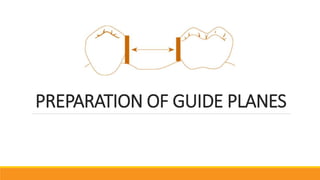
PREPARATION OF GUIDE PLANES
GUIDE PLANES
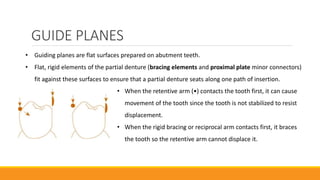
• When the retentive arm (•) contacts the tooth first, it can cause
movement of the tooth since the tooth is not stabilized to resist
displacement.
• When the rigid bracing or reciprocal arm contacts first, it braces
the tooth so the retentive arm cannot displace it.
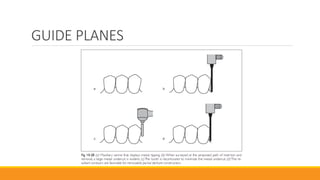
• Guiding planes are flat surfaces prepared on abutment teeth.
• Flat, rigid elements of the partial denture (bracing elements and proximal plate minor connectors)
fit against these surfaces to ensure that a partial denture seats along one path of insertion.
GUIDE PLANES
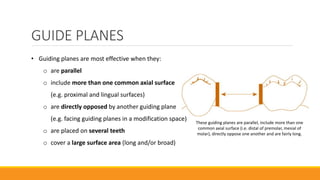
• Guiding planes are most effective when they:
o are parallel
o include more than one common axial surface
(e.g. proximal and lingual surfaces)
o are directly opposed by another guiding plane
(e.g. facing guiding planes in a modification space)
o are placed on several teeth
o cover a large surface area (long and/or broad)
These guiding planes are parallel, include more than one
common axial surface (i.e. distal of premolar, mesial of
molar), directly oppose one another and are fairly long.
GUIDE PLANES
GUIDE PLANES
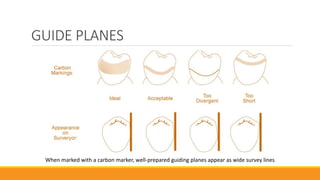
When marked with a carbon marker, well-prepared guiding planes appear as wide survey lines
GUIDE PLANES
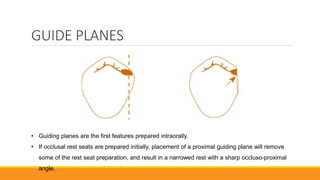
• Guiding planes are the first features prepared intraorally.
• If occlusal rest seats are prepared initially, placement of a proximal guiding plane will remove
some of the rest seat preparation, and result in a narrowed rest with a sharp occluso-proximal
angle.
GUIDE PLANES
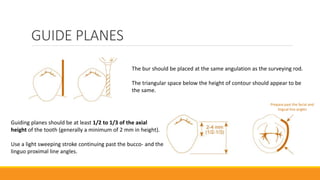
The bur should be placed at the same angulation as the surveying rod.
The triangular space below the height of contour should appear to be
the same.
Prepare past the facial and
lingual line angles
Guiding planes should be at least 1/2 to 1/3 of the axial
height of the tooth (generally a minimum of 2 mm in height).
Use a light sweeping stroke continuing past the bucco- and the
linguo proximal line angles.
GUIDE PLANES
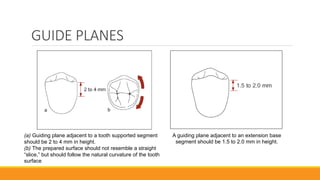
A guiding plane adjacent to an extension base
segment should be 1.5 to 2.0 mm in height.
(a) Guiding plane adjacent to a tooth supported segment
should be 2 to 4 mm in height.
(b) The prepared surface should not resemble a straight
“slice,” but should follow the natural curvature of the tooth
surface
GUIDE PLANES
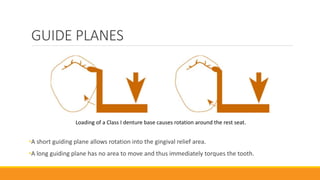
•A short guiding plane allows rotation into the gingival relief area.
•A long guiding plane has no area to move and thus immediately torques the tooth.
Loading of a Class I denture base causes rotation around the rest seat.
LINGUAL GUIDE PLANES
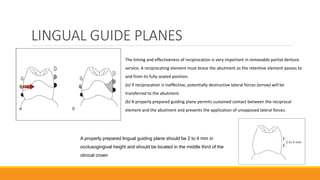
The timing and effectiveness of reciprocation is very important in removable partial denture
service. A reciprocating element must brace the abutment as the retentive element passes to
and from its fully seated position.
(a) If reciprocation is ineffective, potentially destructive lateral forces (arrow) will be
transferred to the abutment.
(b) A properly prepared guiding plane permits sustained contact between the reciprocal
element and the abutment and prevents the application of unopposed lateral forces.
A properly prepared lingual guiding plane should be 2 to 4 mm in
occlusogingival height and should be located in the middle third of the
clinical crown
PREPARATION OF REST SEATS
OCCLUSAL REST SEATS
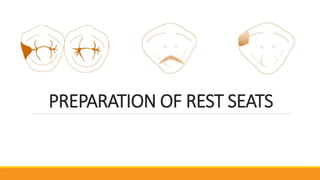
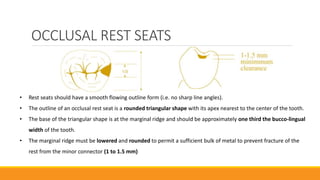
• Rest seats should have a smooth flowing outline form (i.e. no sharp line angles).
• The outline of an occlusal rest seat is a rounded triangular shape with its apex nearest to the center of the tooth.
• The base of the triangular shape is at the marginal ridge and should be approximately one third the bucco-lingual
width of the tooth.
• The marginal ridge must be lowered and rounded to permit a sufficient bulk of metal to prevent fracture of the
rest from the minor connector (1 to 1.5 mm)
OCCLUSAL REST SEATS
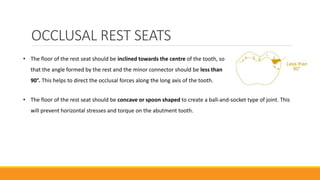
• The floor of the rest seat should be inclined towards the centre of the tooth, so
that the angle formed by the rest and the minor connector should be less than
90°. This helps to direct the occlusal forces along the long axis of the tooth.
• The floor of the rest seat should be concave or spoon shaped to create a ball-and-socket type of joint. This
will prevent horizontal stresses and torque on the abutment tooth.
OCCLUSAL REST SEATS
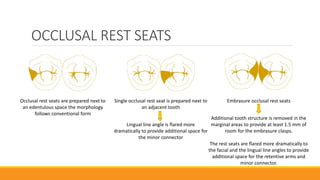
Occlusal rest seats are prepared next to
an edentulous space the morphology
follows conventional form
Single occlusal rest seat is prepared next to
an adjacent tooth
Embrasure occlusal rest seats
Lingual line angle is flared more
dramatically to provide additional space for
the minor connector
Additional tooth structure is removed in the
marginal areas to provide at least 1.5 mm of
room for the embrasure clasps.
The rest seats are flared more dramatically to
the facial and the lingual line angles to provide
additional space for the retentive arms and
minor connector.
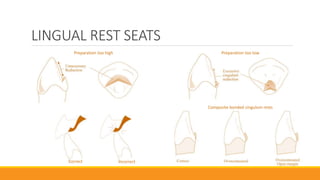
LINGUAL REST SEATS
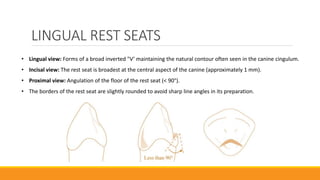
• Lingual view: Forms of a broad inverted "V’ maintaining the natural contour often seen in the canine cingulum.
• Incisal view: The rest seat is broadest at the central aspect of the canine (approximately 1 mm).
• Proximal view: Angulation of the floor of the rest seat (< 90°).
• The borders of the rest seat are slightly rounded to avoid sharp line angles in its preparation.
LINGUAL REST SEATS
Preparation too high Preparation too low
Correct Incorrect
Composite bonded cingulum rests
INCISAL RESTS
• An incisal rest seat is usually placed on the mesio- or disto-incisal angle of the incisor teeth with the
deepest portion towards the center of the tooth. It is predominantly used as an auxiliary rest or an
indirect retainer.
• It is usually used on the mandibular incisor where the lower lip can cover, as much as possible, the
metal of the rest that shows at the incisal edge.
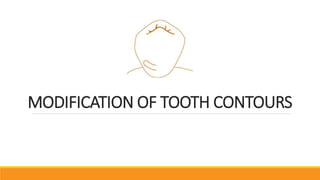
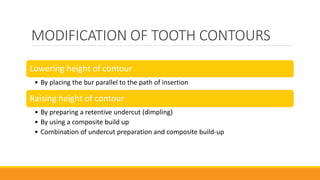
MODIFICATION OF TOOTH CONTOURS
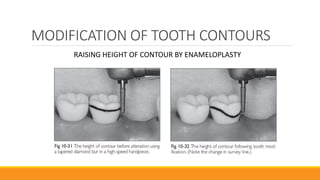
Lowering height of contour
• By placing the bur parallel to the path of insertion
Raising height of contour
• By preparing a retentive undercut (dimpling)
• By using a composite build up
• Combination of undercut preparation and composite build-up
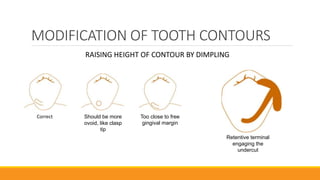
MODIFICATION OF TOOTH CONTOURS
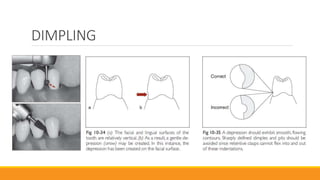
RAISING HEIGHT OF CONTOUR BY DIMPLING
Correct Should be more
ovoid, like clasp
tip
Too close to free
gingival margin
Retentive terminal
engaging the
undercut
DIMPLING
MODIFICATION OF TOOTH CONTOURS
RAISING HEIGHT OF CONTOUR BY ENAMELOPLASTY
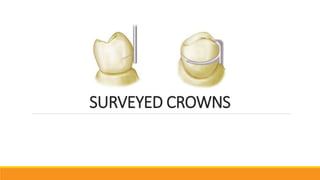
SURVEYED CROWNS
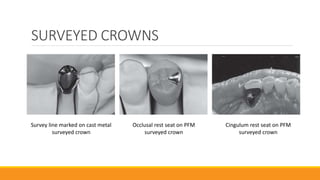
SURVEYED CROWNS
Survey line marked on cast metal
surveyed crown
Occlusal rest seat on PFM
surveyed crown
Cingulum rest seat on PFM
surveyed crown
SUMMARY
EXAM ORIENTED QUESTIONS
I) SHORT ANSWER QUESTIONS:
1. Pre-prosthetic mouth preparation for cast partial dentures
2. Mouth preparation in CPD
3. Guide planes
4. Occlusal rest seats
5. Cingulum and incisal rests and rest seats
THANK YOU

MOUTH PREPARATION IN CAST PARTIAL DENTURES

  • 1.
    MOUTH PREPARATION FOR CASTPARTIAL DENTURES DR. AAMIR GODIL DEPARTMENT OF PROSTHODONTICS M. A .R.D.C
  • 2.
    CONTENTS •Pre-prosthetic considerations •Preparation ofguide planes •Preparation of rest seats •Modification of tooth contours •Surveyed crowns • Summary
  • 3.
    OVERVIEW • Mouth preparationcontributes to the philosophy that the prescribed prosthesis not only must replace what is missing but also must preserve the remaining tissues and structures that will enhance the removable partial denture. • In general, mouth preparation includes procedures that address conditions that put comfortable prosthetic function at risk and include tooth alteration that are required to for proper tooth stabilization and support of the prosthesis. • Naturally, mouth preparation must be accomplished before the impression procedures are performed that will produce the master cast on which the removable partial denture will be fabricated. • Oral surgical and periodontal procedures should precede abutment tooth preparation and should be completed far enough in advance to allow the necessary healing period.
  • 4.
    PRE-PROSTHETIC CONSIDERATIONS Pre-Prosthetic Considerationsin Partially Edentulous Mouths: • Extractions • Impacted Teeth • Malposed Teeth • Cysts and Odontogenic Tumors • Exostoses and Tori • Hyperplastic Tissue • Muscle Attachments and Frena • Bony Spines and Knife-Edge Ridges • Polyps, Papillomas, and Traumatic Hemangiomas • Hyperkeratoses, Erythroplasia, and Ulcerations • Dentofacial Deformity • Dental Implants • Augmentation of Alveolar Bone Periodontal Preparation: • Objectives of Periodontal Therapy • Periodontal Diagnosis and Treatment Planning • Initial Disease Control Therapy (Phase 1) • Definitive Periodontal Surgery (Phase 2) • Recall Maintenance (Phase 3) • Advantages of Periodontal Therapy Optimization of the Foundation for Fitting and Function of the Prosthesis: • Conditioning of Abused and Irritated Tissues • Use of Tissue Conditioning Materials • Abutment Restorations • Contouring Wax Patterns • Rest Seats
  • 5.
  • 6.
    GUIDE PLANES • Whenthe retentive arm (•) contacts the tooth first, it can cause movement of the tooth since the tooth is not stabilized to resist displacement. • When the rigid bracing or reciprocal arm contacts first, it braces the tooth so the retentive arm cannot displace it. • Guiding planes are flat surfaces prepared on abutment teeth. • Flat, rigid elements of the partial denture (bracing elements and proximal plate minor connectors) fit against these surfaces to ensure that a partial denture seats along one path of insertion.
  • 7.
    GUIDE PLANES • Guidingplanes are most effective when they: o are parallel o include more than one common axial surface (e.g. proximal and lingual surfaces) o are directly opposed by another guiding plane (e.g. facing guiding planes in a modification space) o are placed on several teeth o cover a large surface area (long and/or broad) These guiding planes are parallel, include more than one common axial surface (i.e. distal of premolar, mesial of molar), directly oppose one another and are fairly long.
  • 8.
  • 9.
    GUIDE PLANES When markedwith a carbon marker, well-prepared guiding planes appear as wide survey lines
  • 10.
    GUIDE PLANES • Guidingplanes are the first features prepared intraorally. • If occlusal rest seats are prepared initially, placement of a proximal guiding plane will remove some of the rest seat preparation, and result in a narrowed rest with a sharp occluso-proximal angle.
  • 11.
    GUIDE PLANES The burshould be placed at the same angulation as the surveying rod. The triangular space below the height of contour should appear to be the same. Prepare past the facial and lingual line angles Guiding planes should be at least 1/2 to 1/3 of the axial height of the tooth (generally a minimum of 2 mm in height). Use a light sweeping stroke continuing past the bucco- and the linguo proximal line angles.
  • 12.
    GUIDE PLANES A guidingplane adjacent to an extension base segment should be 1.5 to 2.0 mm in height. (a) Guiding plane adjacent to a tooth supported segment should be 2 to 4 mm in height. (b) The prepared surface should not resemble a straight “slice,” but should follow the natural curvature of the tooth surface
  • 13.
    GUIDE PLANES •A shortguiding plane allows rotation into the gingival relief area. •A long guiding plane has no area to move and thus immediately torques the tooth. Loading of a Class I denture base causes rotation around the rest seat.
  • 14.
    LINGUAL GUIDE PLANES Thetiming and effectiveness of reciprocation is very important in removable partial denture service. A reciprocating element must brace the abutment as the retentive element passes to and from its fully seated position. (a) If reciprocation is ineffective, potentially destructive lateral forces (arrow) will be transferred to the abutment. (b) A properly prepared guiding plane permits sustained contact between the reciprocal element and the abutment and prevents the application of unopposed lateral forces. A properly prepared lingual guiding plane should be 2 to 4 mm in occlusogingival height and should be located in the middle third of the clinical crown
  • 15.
  • 16.
    OCCLUSAL REST SEATS •Rest seats should have a smooth flowing outline form (i.e. no sharp line angles). • The outline of an occlusal rest seat is a rounded triangular shape with its apex nearest to the center of the tooth. • The base of the triangular shape is at the marginal ridge and should be approximately one third the bucco-lingual width of the tooth. • The marginal ridge must be lowered and rounded to permit a sufficient bulk of metal to prevent fracture of the rest from the minor connector (1 to 1.5 mm)
  • 17.
    OCCLUSAL REST SEATS •The floor of the rest seat should be inclined towards the centre of the tooth, so that the angle formed by the rest and the minor connector should be less than 90°. This helps to direct the occlusal forces along the long axis of the tooth. • The floor of the rest seat should be concave or spoon shaped to create a ball-and-socket type of joint. This will prevent horizontal stresses and torque on the abutment tooth.
  • 18.
    OCCLUSAL REST SEATS Occlusalrest seats are prepared next to an edentulous space the morphology follows conventional form Single occlusal rest seat is prepared next to an adjacent tooth Embrasure occlusal rest seats Lingual line angle is flared more dramatically to provide additional space for the minor connector Additional tooth structure is removed in the marginal areas to provide at least 1.5 mm of room for the embrasure clasps. The rest seats are flared more dramatically to the facial and the lingual line angles to provide additional space for the retentive arms and minor connector.
  • 19.
    LINGUAL REST SEATS •Lingual view: Forms of a broad inverted "V’ maintaining the natural contour often seen in the canine cingulum. • Incisal view: The rest seat is broadest at the central aspect of the canine (approximately 1 mm). • Proximal view: Angulation of the floor of the rest seat (< 90°). • The borders of the rest seat are slightly rounded to avoid sharp line angles in its preparation.
  • 20.
    LINGUAL REST SEATS Preparationtoo high Preparation too low Correct Incorrect Composite bonded cingulum rests
  • 21.
    INCISAL RESTS • Anincisal rest seat is usually placed on the mesio- or disto-incisal angle of the incisor teeth with the deepest portion towards the center of the tooth. It is predominantly used as an auxiliary rest or an indirect retainer. • It is usually used on the mandibular incisor where the lower lip can cover, as much as possible, the metal of the rest that shows at the incisal edge.
  • 22.
  • 23.
    MODIFICATION OF TOOTHCONTOURS Lowering height of contour • By placing the bur parallel to the path of insertion Raising height of contour • By preparing a retentive undercut (dimpling) • By using a composite build up • Combination of undercut preparation and composite build-up
  • 24.
    MODIFICATION OF TOOTHCONTOURS RAISING HEIGHT OF CONTOUR BY DIMPLING Correct Should be more ovoid, like clasp tip Too close to free gingival margin Retentive terminal engaging the undercut
  • 25.
  • 26.
    MODIFICATION OF TOOTHCONTOURS RAISING HEIGHT OF CONTOUR BY ENAMELOPLASTY
  • 27.
  • 28.
    SURVEYED CROWNS Survey linemarked on cast metal surveyed crown Occlusal rest seat on PFM surveyed crown Cingulum rest seat on PFM surveyed crown
  • 29.
  • 30.
    EXAM ORIENTED QUESTIONS I)SHORT ANSWER QUESTIONS: 1. Pre-prosthetic mouth preparation for cast partial dentures 2. Mouth preparation in CPD 3. Guide planes 4. Occlusal rest seats 5. Cingulum and incisal rests and rest seats
  • 31.