Topic 2.5 - Cell Division
2.5.1 Outline the stages in the cell cycle including interphase (G1, S, and G2), mitosis and
cytokinesis.
2.5.2 State that tumours (cancers) are the result of uncontrolled cell division and that these can
occur in any organ.
2.5.3 State that interphase is an active period in the life of a cell when many metabolic reactions
occur, including protein synthesis, DNA replication and an increase in the number of mitochondria
and/or chloroplasts.
2.5.4 Describe the events that occur in the four phases of mitosis (prophase, metaphase, anaphase
and telophase).
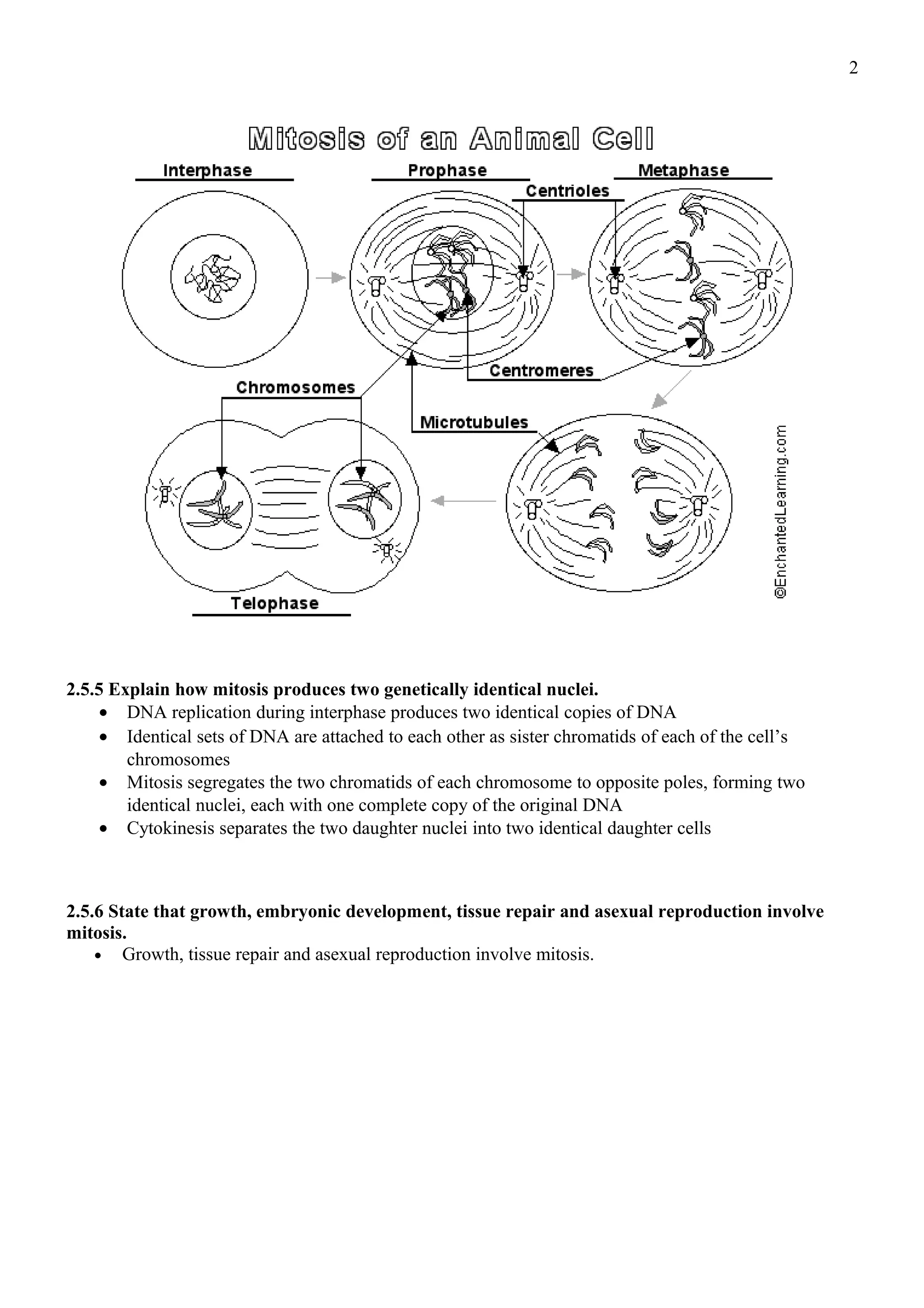
Prophase:
• Chromatin fibres condense by supercoiling, becoming visible as
chromosomes.
• The chromosomes appear as two identical sister chromatids joined at the
centromere.
• Centrioles move to opposite poles
• The spindle (made of microtubules) begins to form in the cytoplasm.
• The nuclear membrane breaks
Metaphase:
• Chromosomes move to the equator
• Spindle microtubules attach to chromosome centromeres
Anaphase:
• Centromeres split as spindle microtubules pull chromatids to opposite poles (after
centromeres split, sister chromatids are known as sister chromosomes)
• Sister chromosomes move to opposite poles as microtubules shorten
Telophase:
• Sister chromosomes have arrived at poles
• Spindle disappears
• Centrioles replicate
• Nuclear membrane reforms
• Chromosomes decondense, becoming chromatin
1
2.5.5 Explain how mitosis produces two genetically identical nuclei.
• DNA replication during interphase produces two identical copies of DNA
• Identical sets of DNA are attached to each other as sister chromatids of each of the cell’s
chromosomes
• Mitosis segregates the two chromatids of each chromosome to opposite poles, forming two
identical nuclei, each with one complete copy of the original DNA
• Cytokinesis separates the two daughter nuclei into two identical daughter cells
2.5.6 State that growth, embryonic development, tissue repair and asexual reproduction involve
mitosis.
• Growth, tissue repair and asexual reproduction involve mitosis.
2

2.5 cell division notes

  • 1.
    Topic 2.5 -Cell Division 2.5.1 Outline the stages in the cell cycle including interphase (G1, S, and G2), mitosis and cytokinesis. 2.5.2 State that tumours (cancers) are the result of uncontrolled cell division and that these can occur in any organ. 2.5.3 State that interphase is an active period in the life of a cell when many metabolic reactions occur, including protein synthesis, DNA replication and an increase in the number of mitochondria and/or chloroplasts. 2.5.4 Describe the events that occur in the four phases of mitosis (prophase, metaphase, anaphase and telophase). Prophase: • Chromatin fibres condense by supercoiling, becoming visible as chromosomes. • The chromosomes appear as two identical sister chromatids joined at the centromere. • Centrioles move to opposite poles • The spindle (made of microtubules) begins to form in the cytoplasm. • The nuclear membrane breaks Metaphase: • Chromosomes move to the equator • Spindle microtubules attach to chromosome centromeres Anaphase: • Centromeres split as spindle microtubules pull chromatids to opposite poles (after centromeres split, sister chromatids are known as sister chromosomes) • Sister chromosomes move to opposite poles as microtubules shorten Telophase: • Sister chromosomes have arrived at poles • Spindle disappears • Centrioles replicate • Nuclear membrane reforms • Chromosomes decondense, becoming chromatin 1
  • 2.
    2.5.5 Explain howmitosis produces two genetically identical nuclei. • DNA replication during interphase produces two identical copies of DNA • Identical sets of DNA are attached to each other as sister chromatids of each of the cell’s chromosomes • Mitosis segregates the two chromatids of each chromosome to opposite poles, forming two identical nuclei, each with one complete copy of the original DNA • Cytokinesis separates the two daughter nuclei into two identical daughter cells 2.5.6 State that growth, embryonic development, tissue repair and asexual reproduction involve mitosis. • Growth, tissue repair and asexual reproduction involve mitosis. 2