Topic 4.3 - Theoretical Genetics
4.3.1. Define genotype, phenotype, dominant allele, recessive allele, codominant alleles, locus,
homozygous, heterozygous, carrier and test cross.
• The genotype is the alleles possessed by an organism.
• The phenotype is the characteristics of an organism.
• A dominant allele is an allele that has the same effect on the phenotype whether it is present in
the homozygous or heterozygous state.
• A recessive allele is an allele that only has an effect on the phenotype when present in the
homozygous state.
• Codominant alleles are pairs of alleles that both affect the phenotype when present in the
heterozygous state.
• A locus is the particular position on homologous chromosomes of a gene.
• Homozygous means having two identical alleles of a gene.
• Heterozygous is when you have two different alleles of a gene.
• A carrier is an individual that has one copy of a recessive allele that causes a genetic disease in
individuals that are homozygous for this allele.
• A test cross is testing a suspected heterozygote by crossing it with a known homozygous
recessive.
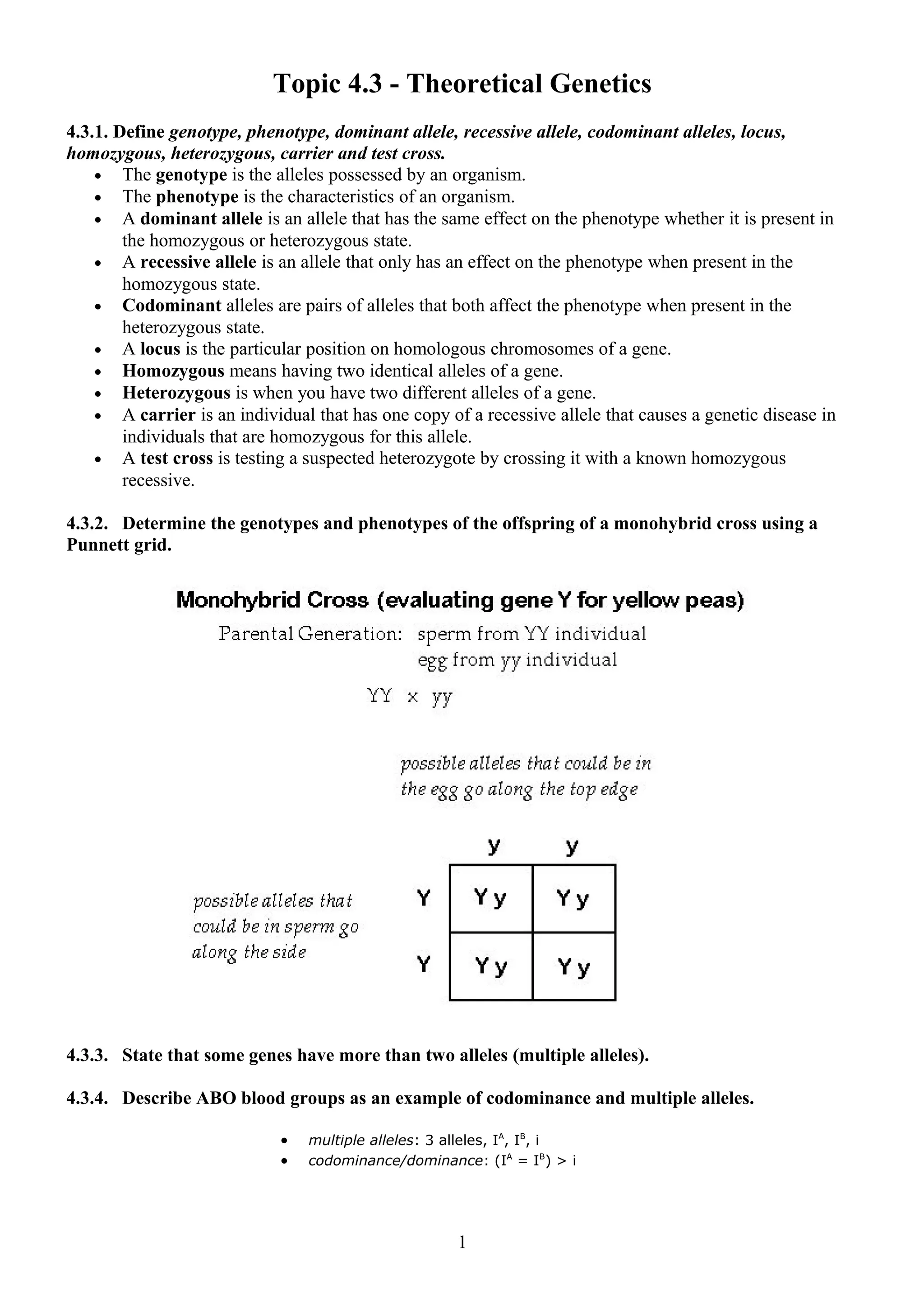
4.3.2. Determine the genotypes and phenotypes of the offspring of a monohybrid cross using a
Punnett grid.
4.3.3. State that some genes have more than two alleles (multiple alleles).
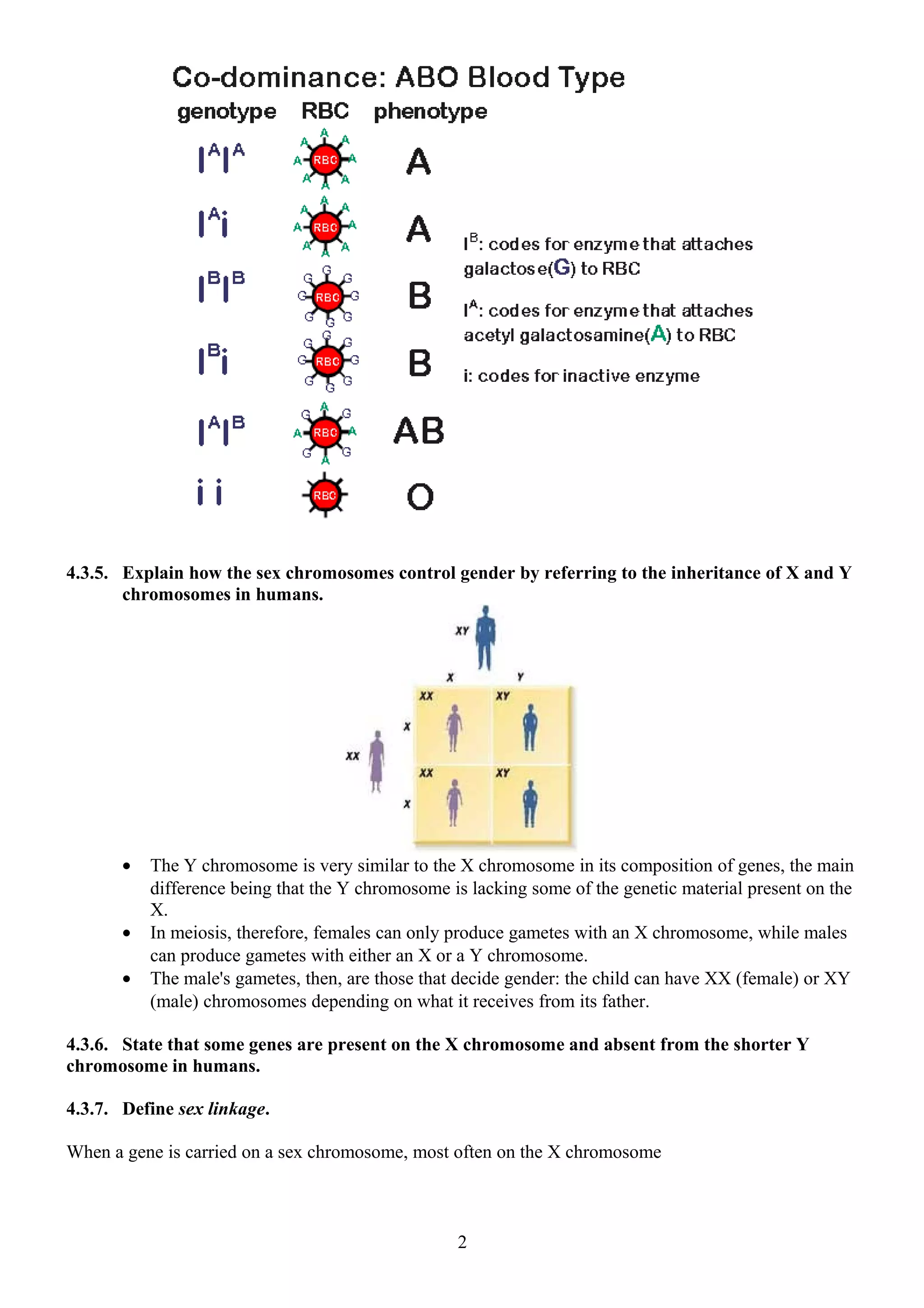
4.3.4. Describe ABO blood groups as an example of codominance and multiple alleles.
• multiple alleles: 3 alleles, IA
, IB
, i
• codominance/dominance: (IA
= IB
) > i
1
4.3.5. Explain how the sex chromosomes control gender by referring to the inheritance of X and Y
chromosomes in humans.
• The Y chromosome is very similar to the X chromosome in its composition of genes, the main
difference being that the Y chromosome is lacking some of the genetic material present on the
X.
• In meiosis, therefore, females can only produce gametes with an X chromosome, while males
can produce gametes with either an X or a Y chromosome.
• The male's gametes, then, are those that decide gender: the child can have XX (female) or XY
(male) chromosomes depending on what it receives from its father.
4.3.6. State that some genes are present on the X chromosome and absent from the shorter Y
chromosome in humans.
4.3.7. Define sex linkage.
When a gene is carried on a sex chromosome, most often on the X chromosome
2
4.3.8. Describe the inheritance of colour blindness and haemophilia as examples of sex linkage.
Color-blindness and hemophilia are probably the most common examples of sex-linked traits in humans.
Both are due to a recessive sex-linked allele on the X chromosome. For this reason, they are often more
common in males than females.
• red/green color blindness: XB
,Xb
• hemophilia: XH
,Xh
4.3.9. State that a human female can be homozygous or heterozygous with respect to sex-linked
genes.
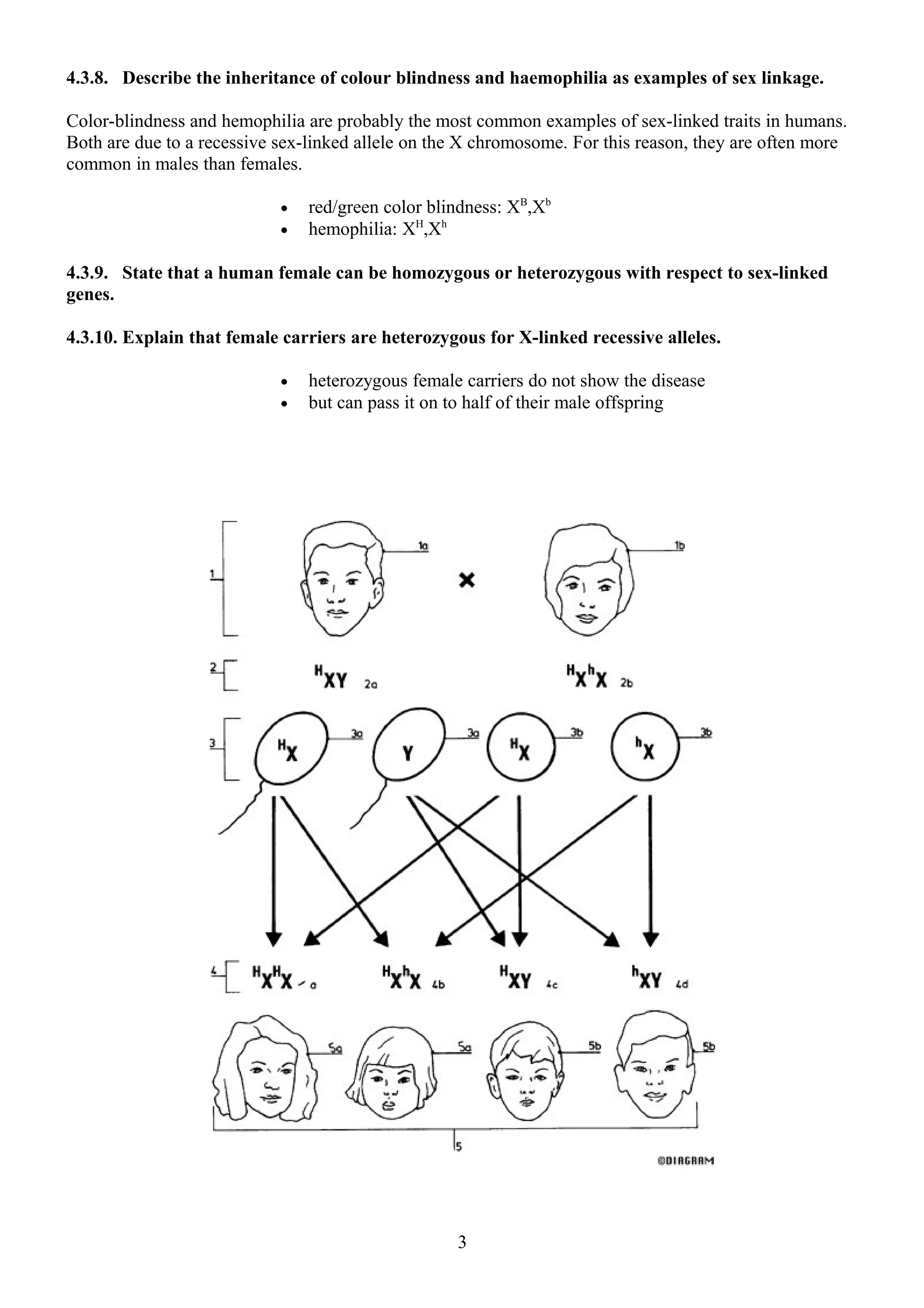
4.3.10. Explain that female carriers are heterozygous for X-linked recessive alleles.
• heterozygous female carriers do not show the disease
• but can pass it on to half of their male offspring
3
4.3.11. Predict the genotypic and phenotypic ratios of offspring of monohybrid crosses involving
any of the above patterns of inheritance.
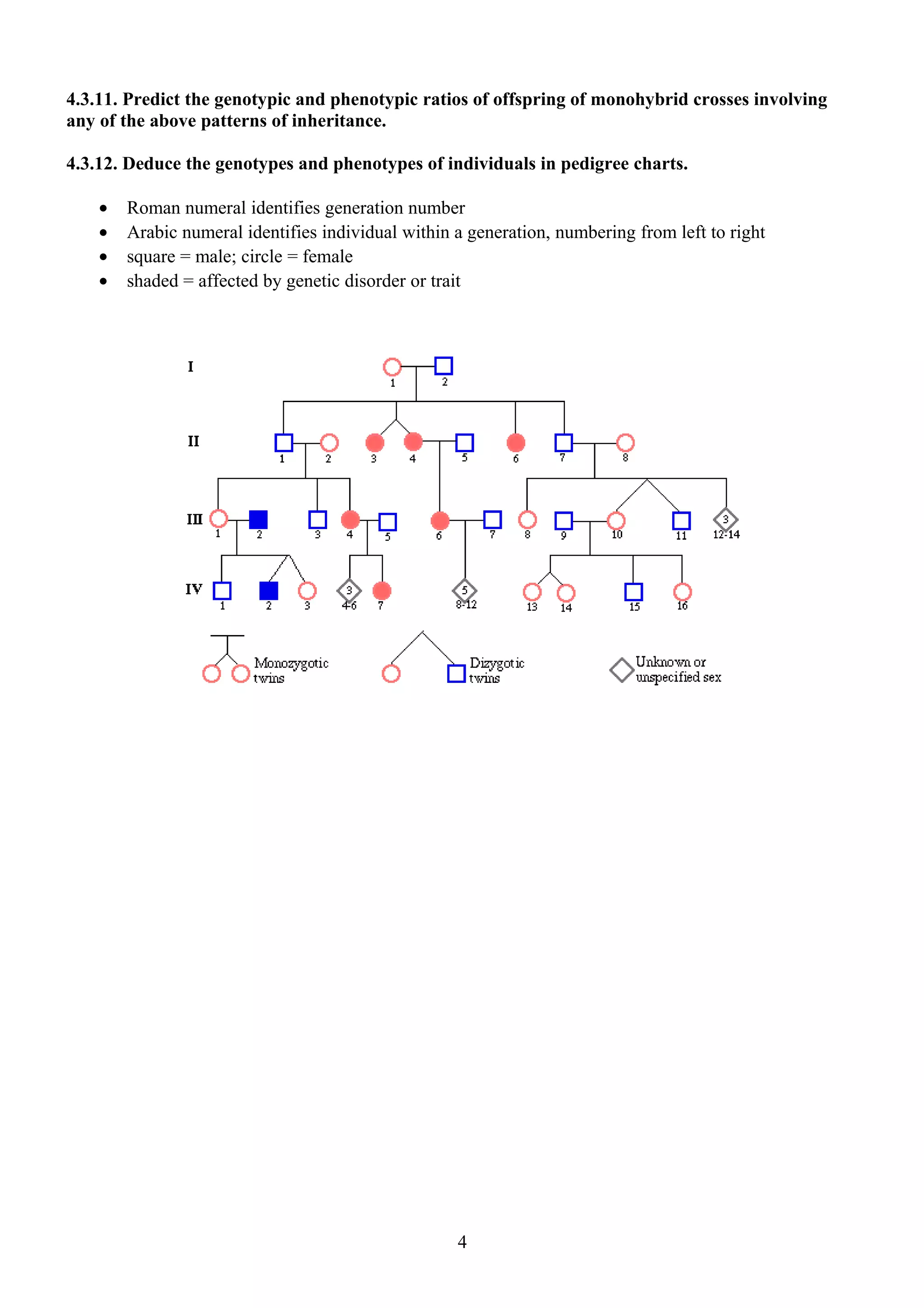
4.3.12. Deduce the genotypes and phenotypes of individuals in pedigree charts.
• Roman numeral identifies generation number
• Arabic numeral identifies individual within a generation, numbering from left to right
• square = male; circle = female
• shaded = affected by genetic disorder or trait
4

4.3 theoretical genetics notes

  • 1.
    Topic 4.3 -Theoretical Genetics 4.3.1. Define genotype, phenotype, dominant allele, recessive allele, codominant alleles, locus, homozygous, heterozygous, carrier and test cross. • The genotype is the alleles possessed by an organism. • The phenotype is the characteristics of an organism. • A dominant allele is an allele that has the same effect on the phenotype whether it is present in the homozygous or heterozygous state. • A recessive allele is an allele that only has an effect on the phenotype when present in the homozygous state. • Codominant alleles are pairs of alleles that both affect the phenotype when present in the heterozygous state. • A locus is the particular position on homologous chromosomes of a gene. • Homozygous means having two identical alleles of a gene. • Heterozygous is when you have two different alleles of a gene. • A carrier is an individual that has one copy of a recessive allele that causes a genetic disease in individuals that are homozygous for this allele. • A test cross is testing a suspected heterozygote by crossing it with a known homozygous recessive. 4.3.2. Determine the genotypes and phenotypes of the offspring of a monohybrid cross using a Punnett grid. 4.3.3. State that some genes have more than two alleles (multiple alleles). 4.3.4. Describe ABO blood groups as an example of codominance and multiple alleles. • multiple alleles: 3 alleles, IA , IB , i • codominance/dominance: (IA = IB ) > i 1
  • 2.
    4.3.5. Explain howthe sex chromosomes control gender by referring to the inheritance of X and Y chromosomes in humans. • The Y chromosome is very similar to the X chromosome in its composition of genes, the main difference being that the Y chromosome is lacking some of the genetic material present on the X. • In meiosis, therefore, females can only produce gametes with an X chromosome, while males can produce gametes with either an X or a Y chromosome. • The male's gametes, then, are those that decide gender: the child can have XX (female) or XY (male) chromosomes depending on what it receives from its father. 4.3.6. State that some genes are present on the X chromosome and absent from the shorter Y chromosome in humans. 4.3.7. Define sex linkage. When a gene is carried on a sex chromosome, most often on the X chromosome 2
  • 3.
    4.3.8. Describe theinheritance of colour blindness and haemophilia as examples of sex linkage. Color-blindness and hemophilia are probably the most common examples of sex-linked traits in humans. Both are due to a recessive sex-linked allele on the X chromosome. For this reason, they are often more common in males than females. • red/green color blindness: XB ,Xb • hemophilia: XH ,Xh 4.3.9. State that a human female can be homozygous or heterozygous with respect to sex-linked genes. 4.3.10. Explain that female carriers are heterozygous for X-linked recessive alleles. • heterozygous female carriers do not show the disease • but can pass it on to half of their male offspring 3
  • 4.
    4.3.11. Predict thegenotypic and phenotypic ratios of offspring of monohybrid crosses involving any of the above patterns of inheritance. 4.3.12. Deduce the genotypes and phenotypes of individuals in pedigree charts. • Roman numeral identifies generation number • Arabic numeral identifies individual within a generation, numbering from left to right • square = male; circle = female • shaded = affected by genetic disorder or trait 4