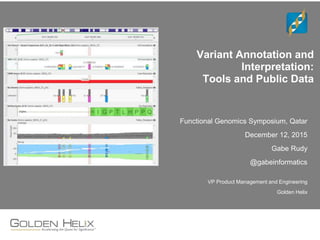

Variant Annotation and
Interpretation:
Tools and Public Data
Functional Genomics Symposium, Qatar
December 12, 2015
Gabe Rudy
@gabeinformatics
VP Product Management and Engineering
Golden Helix
My Background
 Golden Helix
- Founded in 1998
- Genetic association software
- Analytic services
- Over ten-thousand users worldwide
- Over 800 customer citations in journals
 Products I Build with My Team
- SNP & Variation Suite (SVS) - Research
- VarSeq – Clinical & NGS Research
- GenomeBrowse (Free!) - All
 What I Do (Coding, Bioinformatics)
- Build tools, build pipelines of tools
- Blog
- Participate in GA4GH, HGVS Discussions,
NCBI EVAC
Topics
• ACMG Guidelines for Variant Interpretation
• Necessity of visualization
• Public data and tools for annotations
• Accurate gene annotations, choice of “clinical transcripts”
• Variant representation, “left-shifting” and HGVS nomenclature
• Warehousing variants
ACMG Guidlines
 Five-tier terminology system:
- “pathogenic,” “likely pathogenic,” “uncertain significance,” “likely
benign,” and “benign”
- Mendelian and mitochondrial variants
- Variant assessment guidelines as combined from 11 labs
- Report variant with condition and inheritance pattern
- c.1521_1523delCTT (p.Phe508del),
pathogenic, cystic fibrosis, autosomal recessive
- Likely pathogenic, likely benign mean 90% certainty
- Provide genomic coordinates (g.)
- Transcript selection up to lab to define "clinically relevant"
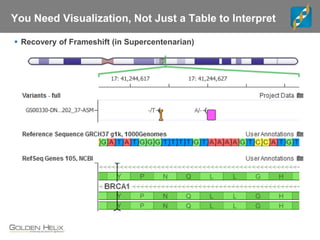
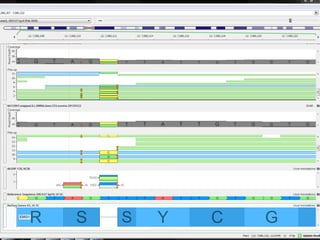
You Need Visualization, Not Just a Table to Interpret
 Recovery of Frameshift (in Supercentenarian)
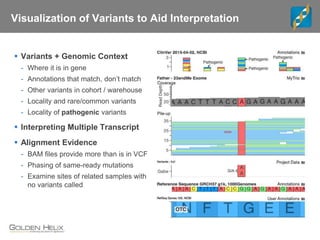
Visualization of Variants to Aid Interpretation
 Variants + Genomic Context
- Where it is in gene
- Annotations that match, don’t match
- Other variants in cohort / warehouse
- Locality and rare/common variants
- Locality of pathogenic variants
 Interpreting Multiple Transcript
 Alignment Evidence
- BAM files provide more than is in VCF
- Phasing of same-ready mutations
- Examine sites of related samples with
no variants called
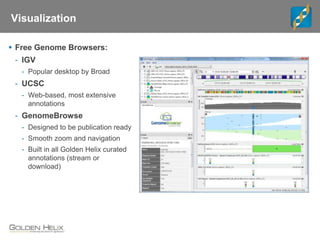
Visualization
 Free Genome Browsers:
- IGV
- Popular desktop by Broad
- UCSC
- Web-based, most extensive
annotations
- GenomeBrowse
- Designed to be publication ready
- Smooth zoom and navigation
- Built in all Golden Helix curated
annotations (stream or
download)
Annotation with Public Data
 Pop databases
- Don't assume “population” == healthy controls
- ExAC, EVS, 1kG, dbSNP
 Disease databases:
- OMIM, ClinVar, HGMD
 In-Silico Prediction
- Whether missense change is damaging
- 65–80% accurate when examining known disease variants
- Expect over-sensitive, but can be a low-pass filter to call "likely benign”
- Expect correlation between tools as often using similar underlying pieces of evidence.
- Splicing: predicting effect on splicing on genes
 RefSeqGenes and Human Reference
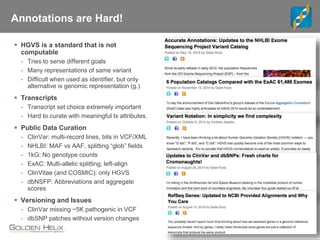
Annotations are Hard!
 HGVS is a standard that is not
computable
- Tries to serve different goals
- Many representations of same variant
- Difficult when used as identifier, but only
alternative is genomic representation (g.)
 Transcripts
- Transcript set choice extremely important
- Hard to curate with meaningful tx attributes.
 Public Data Curation
- ClinVar: multi-record lines, bits in VCF/XML
- NHLBI: MAF vs AAF, splitting “glob” fields
- 1kG: No genotype counts
- ExAC: Multi-allelic splitting, left-align
- ClinVitae (and COSMIC): only HGVS
- dbNSFP: Abbreviations and aggregate
scores
 Versioning and Issues
- ClinVar missing ~5K pathogenic in VCF
- dbSNP patches without version changes
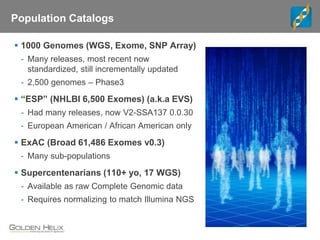
Population Catalogs
 1000 Genomes (WGS, Exome, SNP Array)
- Many releases, most recent now
standardized, still incrementally updated
- 2,500 genomes – Phase3
 “ESP” (NHLBI 6,500 Exomes) (a.k.a EVS)
- Had many releases, now V2-SSA137 0.0.30
- European American / African American only
 ExAC (Broad 61,486 Exomes v0.3)
- Many sub-populations
 Supercentenarians (110+ yo, 17 WGS)
- Available as raw Complete Genomic data
- Requires normalizing to match Illumina NGS
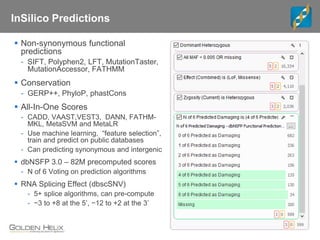
InSilico Predictions
 Non-synonymous functional
predictions
- SIFT, Polyphen2, LFT, MutationTaster,
MutationAccessor, FATHMM
 Conservation
- GERP++, PhyloP, phastCons
 All-In-One Scores
- CADD, VAAST,VEST3, DANN, FATHM-
MKL, MetaSVM and MetaLR
- Use machine learning, “feature selection”,
train and predict on public databases
- Can predicting synonymous and intergenic
 dbNSFP 3.0 – 82M precomputed scores
- N of 6 Voting on prediction algorithms
 RNA Splicing Effect (dbscSNV)
- 5+ splice algorithms, can pre-compute
- −3 to +8 at the 5’, −12 to +2 at the 3’
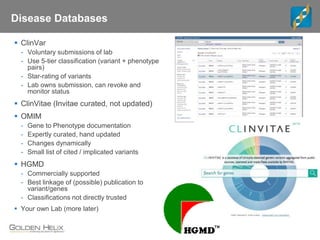
Disease Databases
 ClinVar
- Voluntary submissions of lab
- Use 5-tier classification (variant + phenotype
pairs)
- Star-rating of variants
- Lab owns submission, can revoke and
monitor status
 ClinVitae (Invitae curated, not updated)
 OMIM
- Gene to Phenotype documentation
- Expertly curated, hand updated
- Changes dynamically
- Small list of cited / implicated variants
 HGMD
- Commercially supported
- Best linkage of (possible) publication to
variant/genes
- Classifications not directly trusted
 Your own Lab (more later)
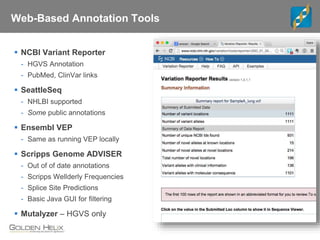
Web-Based Annotation Tools
 NCBI Variant Reporter
- HGVS Annotation
- PubMed, ClinVar links
 SeattleSeq
- NHLBI supported
- Some public annotations
 Ensembl VEP
- Same as running VEP locally
 Scripps Genome ADVISER
- Out of of date annotations
- Scripps Wellderly Frequencies
- Splice Site Predictions
- Basic Java GUI for filtering
 Mutalyzer – HGVS only
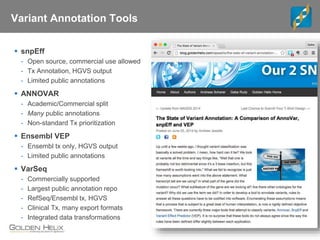
Variant Annotation Tools
 snpEff
- Open source, commercial use allowed
- Tx Annotation, HGVS output
- Limited public annotations
 ANNOVAR
- Academic/Commercial split
- Many public annotations
- Non-standard Tx prioritization
 Ensembl VEP
- Ensembl tx only, HGVS output
- Limited public annotations
 VarSeq
- Commercially supported
- Largest public annotation repo
- RefSeq/Ensembl tx, HGVS
- Clinical Tx, many export formats
- Integrated data transformations
Reference Sequence and Transcripts
 RefSeqGenes – mRNA sequence archive, with mappings to genomes
- Provided mappings to Locus Reference Gene (LRG) database
- Use genome mappings by NCBI (through genome annotation builds). NOT UCSC
- “Clinically Relevant” metric:
- LRG if available
- Longest if tied
 Ensembl – defined directly against the human genome
- More inclusive of genes discovered with high-throughput methods
- Gencode subset – similar to RefSeqGenes in size / definition
 Each have unique Accessions and Version Numbers
- Newer releases GRCh38
- GRCh37 mappings not being updated (unfortunately)
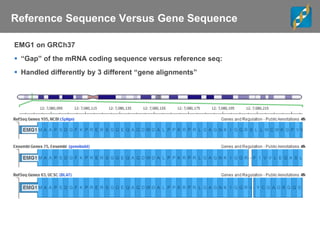
Reference Sequence Versus Gene Sequence
EMG1 on GRCh37
 “Gap” of the mRNA coding sequence versus reference seq:
 Handled differently by 3 different “gene alignments”
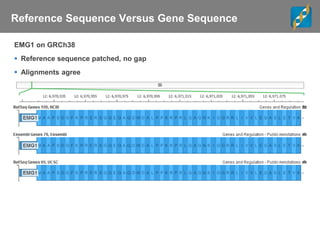
Reference Sequence Versus Gene Sequence
EMG1 on GRCh38
 Reference sequence patched, no gap
 Alignments agree
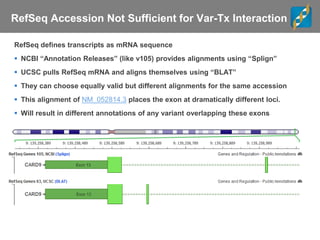
RefSeq Accession Not Sufficient for Var-Tx Interaction
RefSeq defines transcripts as mRNA sequence
 NCBI “Annotation Releases” (like v105) provides alignments using “Splign”
 UCSC pulls RefSeq mRNA and aligns themselves using “BLAT”
 They can choose equally valid but different alignments for the same accession
 This alignment of NM_052814.3 places the exon at dramatically different loci.
 Will result in different annotations of any variant overlapping these exons
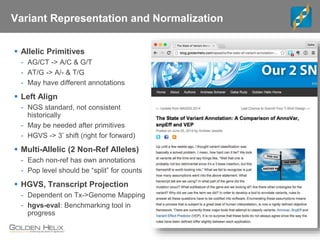
Variant Representation and Normalization
 Allelic Primitives
- AG/CT -> A/C & G/T
- AT/G -> A/- & T/G
- May have different annotations
 Left Align
- NGS standard, not consistent
historically
- May be needed after primitives
- HGVS -> 3’ shift (right for forward)
 Multi-Allelic (2 Non-Ref Alleles)
- Each non-ref has own annotations
- Pop level should be “split” for counts
 HGVS, Transcript Projection
- Dependent on Tx->Genome Mapping
- hgvs-eval: Benchmarking tool in
progress
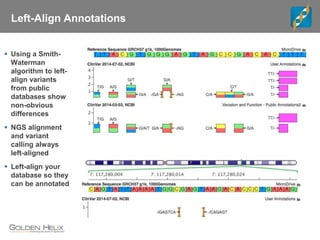
Left-Align Annotations
 Using a Smith-
Waterman
algorithm to left-
align variants
from public
databases show
non-obvious
differences
 NGS alignment
and variant
calling always
left-aligned
 Left-align your
database so they
can be annotated
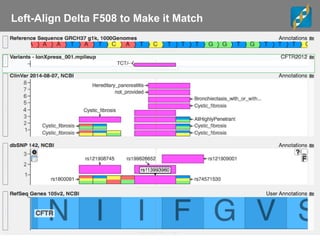
Left-Align Delta F508 to Make it Match
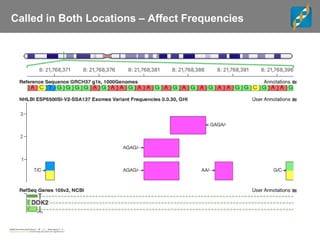
Called in Both Locations – Affect Frequencies
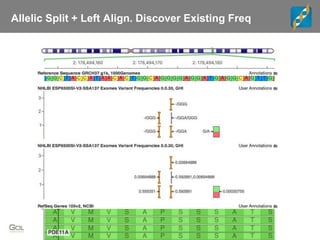
Allelic Split + Left Align. Discover Existing Freq
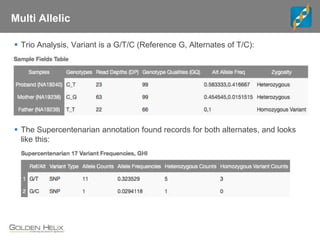
Multi Allelic
 The Supercentenarian annotation found records for both alternates, and looks
like this:
 Trio Analysis, Variant is a G/T/C (Reference G, Alternates of T/C):
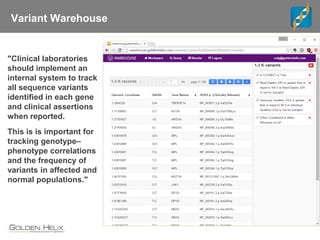
Variant Warehouse
"Clinical laboratories
should implement an
internal system to track
all sequence variants
identified in each gene
and clinical assertions
when reported.
This is is important for
tracking genotype–
phenotype correlations
and the frequency of
variants in affected and
normal populations."
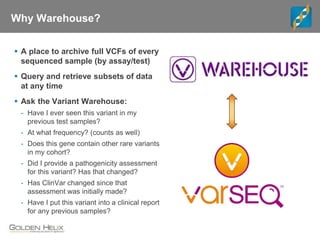
Why Warehouse?
 A place to archive full VCFs of every
sequenced sample (by assay/test)
 Query and retrieve subsets of data
at any time
 Ask the Variant Warehouse:
- Have I ever seen this variant in my
previous test samples?
- At what frequency? (counts as well)
- Does this gene contain other rare variants
in my cohort?
- Did I provide a pathogenicity assessment
for this variant? Has that changed?
- Has ClinVar changed since that
assessment was initially made?
- Have I put this variant into a clinical report
for any previous samples?
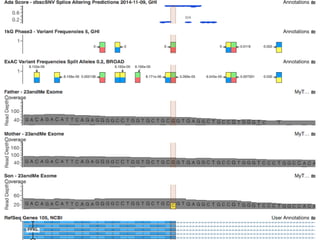
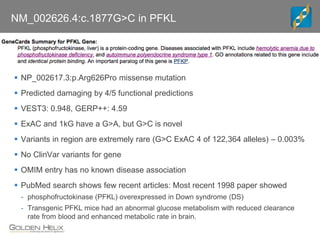
NM_002626.4:c.1877G>C in PFKL
 NP_002617.3:p.Arg626Pro missense mutation
 Predicted damaging by 4/5 functional predictions
 VEST3: 0.948, GERP++: 4.59
 ExAC and 1kG have a G>A, but G>C is novel
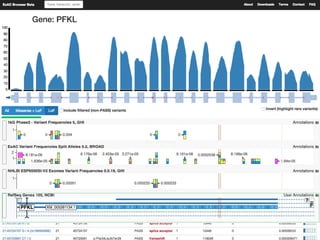
 Variants in region are extremely rare (G>C ExAC 4 of 122,364 alleles) – 0.003%
 No ClinVar variants for gene
 OMIM entry has no known disease association
 PubMed search shows few recent articles: Most recent 1998 paper showed
- phosphofructokinase (PFKL) overexpressed in Down syndrome (DS)
- Transgenic PFKL mice had an abnormal glucose metabolism with reduced clearance
rate from blood and enhanced metabolic rate in brain.
 d
 d
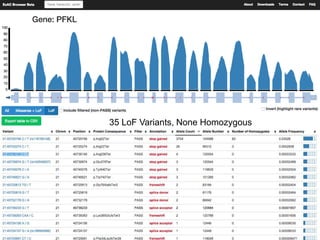
35 LoF Variants, None Homozygous
Questions?

2015 functional genomics variant annotation and interpretation- tools and public data

  • 1.
    Variant Annotation and Interpretation: Toolsand Public Data Functional Genomics Symposium, Qatar December 12, 2015 Gabe Rudy @gabeinformatics VP Product Management and Engineering Golden Helix
  • 2.
    My Background  GoldenHelix - Founded in 1998 - Genetic association software - Analytic services - Over ten-thousand users worldwide - Over 800 customer citations in journals  Products I Build with My Team - SNP & Variation Suite (SVS) - Research - VarSeq – Clinical & NGS Research - GenomeBrowse (Free!) - All  What I Do (Coding, Bioinformatics) - Build tools, build pipelines of tools - Blog - Participate in GA4GH, HGVS Discussions, NCBI EVAC
  • 3.
    Topics • ACMG Guidelinesfor Variant Interpretation • Necessity of visualization • Public data and tools for annotations • Accurate gene annotations, choice of “clinical transcripts” • Variant representation, “left-shifting” and HGVS nomenclature • Warehousing variants
  • 4.
    ACMG Guidlines  Five-tierterminology system: - “pathogenic,” “likely pathogenic,” “uncertain significance,” “likely benign,” and “benign” - Mendelian and mitochondrial variants - Variant assessment guidelines as combined from 11 labs - Report variant with condition and inheritance pattern - c.1521_1523delCTT (p.Phe508del), pathogenic, cystic fibrosis, autosomal recessive - Likely pathogenic, likely benign mean 90% certainty - Provide genomic coordinates (g.) - Transcript selection up to lab to define "clinically relevant"
  • 5.
    You Need Visualization,Not Just a Table to Interpret  Recovery of Frameshift (in Supercentenarian)
  • 6.
    Visualization of Variantsto Aid Interpretation  Variants + Genomic Context - Where it is in gene - Annotations that match, don’t match - Other variants in cohort / warehouse - Locality and rare/common variants - Locality of pathogenic variants  Interpreting Multiple Transcript  Alignment Evidence - BAM files provide more than is in VCF - Phasing of same-ready mutations - Examine sites of related samples with no variants called
  • 7.
    Visualization  Free GenomeBrowsers: - IGV - Popular desktop by Broad - UCSC - Web-based, most extensive annotations - GenomeBrowse - Designed to be publication ready - Smooth zoom and navigation - Built in all Golden Helix curated annotations (stream or download)
  • 8.
    Annotation with PublicData  Pop databases - Don't assume “population” == healthy controls - ExAC, EVS, 1kG, dbSNP  Disease databases: - OMIM, ClinVar, HGMD  In-Silico Prediction - Whether missense change is damaging - 65–80% accurate when examining known disease variants - Expect over-sensitive, but can be a low-pass filter to call "likely benign” - Expect correlation between tools as often using similar underlying pieces of evidence. - Splicing: predicting effect on splicing on genes  RefSeqGenes and Human Reference
  • 9.
    Annotations are Hard! HGVS is a standard that is not computable - Tries to serve different goals - Many representations of same variant - Difficult when used as identifier, but only alternative is genomic representation (g.)  Transcripts - Transcript set choice extremely important - Hard to curate with meaningful tx attributes.  Public Data Curation - ClinVar: multi-record lines, bits in VCF/XML - NHLBI: MAF vs AAF, splitting “glob” fields - 1kG: No genotype counts - ExAC: Multi-allelic splitting, left-align - ClinVitae (and COSMIC): only HGVS - dbNSFP: Abbreviations and aggregate scores  Versioning and Issues - ClinVar missing ~5K pathogenic in VCF - dbSNP patches without version changes
  • 10.
    Population Catalogs  1000Genomes (WGS, Exome, SNP Array) - Many releases, most recent now standardized, still incrementally updated - 2,500 genomes – Phase3  “ESP” (NHLBI 6,500 Exomes) (a.k.a EVS) - Had many releases, now V2-SSA137 0.0.30 - European American / African American only  ExAC (Broad 61,486 Exomes v0.3) - Many sub-populations  Supercentenarians (110+ yo, 17 WGS) - Available as raw Complete Genomic data - Requires normalizing to match Illumina NGS
  • 11.
    InSilico Predictions  Non-synonymousfunctional predictions - SIFT, Polyphen2, LFT, MutationTaster, MutationAccessor, FATHMM  Conservation - GERP++, PhyloP, phastCons  All-In-One Scores - CADD, VAAST,VEST3, DANN, FATHM- MKL, MetaSVM and MetaLR - Use machine learning, “feature selection”, train and predict on public databases - Can predicting synonymous and intergenic  dbNSFP 3.0 – 82M precomputed scores - N of 6 Voting on prediction algorithms  RNA Splicing Effect (dbscSNV) - 5+ splice algorithms, can pre-compute - −3 to +8 at the 5’, −12 to +2 at the 3’
  • 12.
    Disease Databases  ClinVar -Voluntary submissions of lab - Use 5-tier classification (variant + phenotype pairs) - Star-rating of variants - Lab owns submission, can revoke and monitor status  ClinVitae (Invitae curated, not updated)  OMIM - Gene to Phenotype documentation - Expertly curated, hand updated - Changes dynamically - Small list of cited / implicated variants  HGMD - Commercially supported - Best linkage of (possible) publication to variant/genes - Classifications not directly trusted  Your own Lab (more later)
  • 13.
    Web-Based Annotation Tools NCBI Variant Reporter - HGVS Annotation - PubMed, ClinVar links  SeattleSeq - NHLBI supported - Some public annotations  Ensembl VEP - Same as running VEP locally  Scripps Genome ADVISER - Out of of date annotations - Scripps Wellderly Frequencies - Splice Site Predictions - Basic Java GUI for filtering  Mutalyzer – HGVS only
  • 14.
    Variant Annotation Tools snpEff - Open source, commercial use allowed - Tx Annotation, HGVS output - Limited public annotations  ANNOVAR - Academic/Commercial split - Many public annotations - Non-standard Tx prioritization  Ensembl VEP - Ensembl tx only, HGVS output - Limited public annotations  VarSeq - Commercially supported - Largest public annotation repo - RefSeq/Ensembl tx, HGVS - Clinical Tx, many export formats - Integrated data transformations
  • 15.
  • 16.
     RefSeqGenes –mRNA sequence archive, with mappings to genomes - Provided mappings to Locus Reference Gene (LRG) database - Use genome mappings by NCBI (through genome annotation builds). NOT UCSC - “Clinically Relevant” metric: - LRG if available - Longest if tied  Ensembl – defined directly against the human genome - More inclusive of genes discovered with high-throughput methods - Gencode subset – similar to RefSeqGenes in size / definition  Each have unique Accessions and Version Numbers - Newer releases GRCh38 - GRCh37 mappings not being updated (unfortunately)
  • 17.
    Reference Sequence VersusGene Sequence EMG1 on GRCh37  “Gap” of the mRNA coding sequence versus reference seq:  Handled differently by 3 different “gene alignments”
  • 18.
    Reference Sequence VersusGene Sequence EMG1 on GRCh38  Reference sequence patched, no gap  Alignments agree
  • 20.
    RefSeq Accession NotSufficient for Var-Tx Interaction RefSeq defines transcripts as mRNA sequence  NCBI “Annotation Releases” (like v105) provides alignments using “Splign”  UCSC pulls RefSeq mRNA and aligns themselves using “BLAT”  They can choose equally valid but different alignments for the same accession  This alignment of NM_052814.3 places the exon at dramatically different loci.  Will result in different annotations of any variant overlapping these exons
  • 21.
    Variant Representation andNormalization  Allelic Primitives - AG/CT -> A/C & G/T - AT/G -> A/- & T/G - May have different annotations  Left Align - NGS standard, not consistent historically - May be needed after primitives - HGVS -> 3’ shift (right for forward)  Multi-Allelic (2 Non-Ref Alleles) - Each non-ref has own annotations - Pop level should be “split” for counts  HGVS, Transcript Projection - Dependent on Tx->Genome Mapping - hgvs-eval: Benchmarking tool in progress
  • 22.
    Left-Align Annotations  Usinga Smith- Waterman algorithm to left- align variants from public databases show non-obvious differences  NGS alignment and variant calling always left-aligned  Left-align your database so they can be annotated
  • 23.
    Left-Align Delta F508to Make it Match
  • 24.
    Called in BothLocations – Affect Frequencies
  • 25.
    Allelic Split +Left Align. Discover Existing Freq
  • 26.
    Multi Allelic  TheSupercentenarian annotation found records for both alternates, and looks like this:  Trio Analysis, Variant is a G/T/C (Reference G, Alternates of T/C):
  • 27.
    Variant Warehouse "Clinical laboratories shouldimplement an internal system to track all sequence variants identified in each gene and clinical assertions when reported. This is is important for tracking genotype– phenotype correlations and the frequency of variants in affected and normal populations."
  • 28.
    Why Warehouse?  Aplace to archive full VCFs of every sequenced sample (by assay/test)  Query and retrieve subsets of data at any time  Ask the Variant Warehouse: - Have I ever seen this variant in my previous test samples? - At what frequency? (counts as well) - Does this gene contain other rare variants in my cohort? - Did I provide a pathogenicity assessment for this variant? Has that changed? - Has ClinVar changed since that assessment was initially made? - Have I put this variant into a clinical report for any previous samples?
  • 30.
    NM_002626.4:c.1877G>C in PFKL NP_002617.3:p.Arg626Pro missense mutation  Predicted damaging by 4/5 functional predictions  VEST3: 0.948, GERP++: 4.59  ExAC and 1kG have a G>A, but G>C is novel  Variants in region are extremely rare (G>C ExAC 4 of 122,364 alleles) – 0.003%  No ClinVar variants for gene  OMIM entry has no known disease association  PubMed search shows few recent articles: Most recent 1998 paper showed - phosphofructokinase (PFKL) overexpressed in Down syndrome (DS) - Transgenic PFKL mice had an abnormal glucose metabolism with reduced clearance rate from blood and enhanced metabolic rate in brain.
  • 31.
  • 32.
     d 35 LoFVariants, None Homozygous
  • 33.