Presented by:
SK.ABDUL MUQSITH,
BAD/2023-06, Ph. D. 1st
year,
Genetics and Plant Breeding
Submitted to:
Dr. K. Radhika,
Professor and Head,
Genetics and Plant Breeding
Acharya N. G. Ranga Agricultural University
Agricultural College, Bapatla.
Doctoral Seminar - I
GPB-691
Genome Wide Association Studies
2
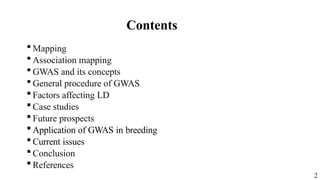
Contents
 Mapping
 Association mapping
 GWAS and its concepts
 General procedure of GWAS
 Factors affecting LD
 Case studies
 Future prospects
 Application of GWAS in breeding
 Current issues
 Conclusion
 References
3
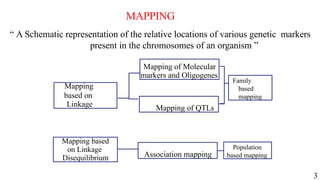
MAPPING
“ A Schematic representation of the relative locations of various genetic markers
present in the chromosomes of an organism ”
Mapping
based on
Linkage
Mapping based
on Linkage
Disequilibrium
Mapping of Molecular
markers and Oligogenes
Mapping of QTLs
Association mapping
Population
based mapping
Family
based
mapping
4
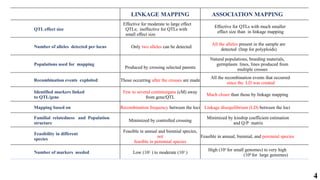
LINKAGE MAPPING ASSOCIATION MAPPING
QTL effect size
Effective for moderate to large effect
QTLs; ineffective for QTLs with
small effect size
Effective for QTLs with much smaller
effect size than in linkage mapping
Number of alleles detected per locus Only two alleles can be detected
All the alleles present in the sample are
detected (Imp for polyploids)
Populations used for mapping
Produced by crossing selected parents
Natural populations, breeding materials,
germplasm lines, lines produced from
multiple crosses
Recombination events exploited Those occurring after the crosses are made
All the recombination events that occurred
since the LD was created
Identified markers linked
to QTL/gene
Few to several centimorgans (cM) away
from gene/QTL
Much closer than those by linkage mapping
Mapping based on Recombination frequency between the loci Linkage disequilibrium (LD) between the loci
Familial relatedness and Population
structure
Minimized by controlled crossing
Minimized by kinship coefficient estimation
and Q/P matrix
Feasibility in different
species
Feasible in annual and biennial species,
not
feasible in perennial species
Feasible in annual, biennial, and perennial species
Number of markers needed Low (102 ) to moderate (103 )
High (105 for small genomes) to very high
(109 for large genomes)
5
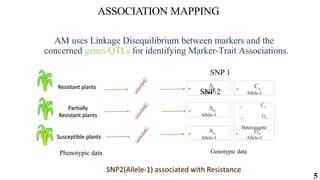
ASSOCIATION MAPPING
AM uses Linkage Disequilibrium between markers and the
concerned genes/QTLs for identifying Marker-Trait Associations.
SNP 1
SNP 2
A
Allele-1
A
Allele-1
C
Allele-1
G
Allele-2
Phenotypic data Genotypic data
A
Allele-1
C
G
Heterozygote
6
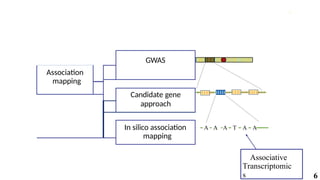
GWAS
Association
mapping
Candidate gene
approach
In silico association
mapping
A A A T A A
Associative
Transcriptomic
s
7
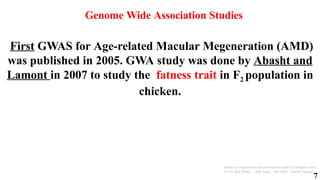
Genome Wide Association Studies
Advances in genome-wide association studies of complex traits
in rice Qin Wang1 · Jiali Tang1 · Bin Han2 · Xuehui Huang1
First GWAS for Age-related Macular Megeneration (AMD)
was published in 2005. GWA study was done by Abasht and
Lamont in 2007 to study the fatness trait in F2 population in
chicken.
8
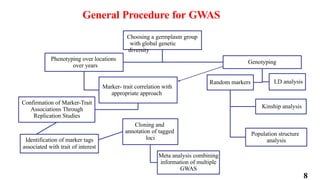
General Procedure for GWAS
Choosing a germplasm group
with global genetic
diversity
Phenotyping over locations
over years
Marker- trait correlation with
appropriate approach
Confirmation of Marker-Trait
Associations Through
Replication Studies
Identification of marker tags
associated with trait of interest
Cloning and
annotation of tagged
loci
Meta analysis combining
information of multiple
GWAS
Genotyping
Random markers
Population structure
analysis
Kinship analysis
LD analysis
9
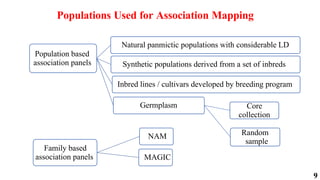
Populations Used for Association Mapping
Population based
association panels
Natural panmictic populations with considerable LD
Synthetic populations derived from a set of inbreds
Inbred lines / cultivars developed by breeding program
Germplasm Core
collection
Random
sample
Family based
association panels
NAM
MAGIC
10
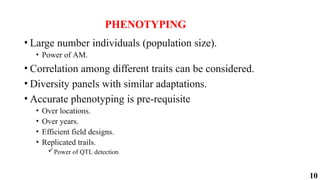
PHENOTYPING
• Large number individuals (population size).
• Power of AM.
• Correlation among different traits can be considered.
• Diversity panels with similar adaptations.
• Accurate phenotyping is pre-requisite
• Over locations.
• Over years.
• Efficient field designs.
• Replicated trails.
Power of QTL detection
11
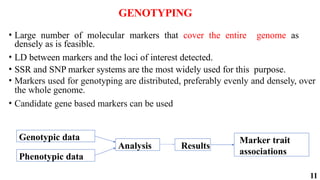
GENOTYPING
• Large number of molecular markers that cover the entire genome as
densely as is feasible.
• LD between markers and the loci of interest detected.
• SSR and SNP marker systems are the most widely used for this purpose.
• Markers used for genotyping are distributed, preferably evenly and densely, over
the whole genome.
• Candidate gene based markers can be used
Genotypic data
Phenotypic data
Analysis Results
Marker trait
associations
12
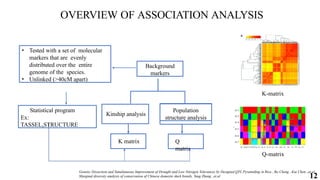
Population
structure analysis
Kinship analysis
Background
markers
K matrix Q
matrix
OVERVIEW OF ASSOCIATION ANALYSIS
• Tested with a set of molecular
markers that are evenly
distributed over the entire
genome of the species.
• Unlinked (>40cM apart)
Statistical program
Ex:
TASSEL,STRUCTURE
K-matrix
Q-matrix
Genetic Dissection and Simultaneous Improvement of Drought and Low Nitrogen Tolerances by Designed QTL Pyramiding in Rice , Bo Cheng , Kai Chen .,et.al.
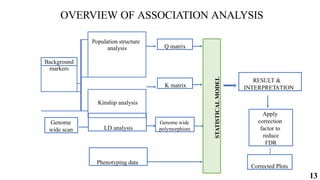
Marginal diversity analysis of conservation of Chinese domestic duck breeds, Yang Zhang .,et.al
13
Population structure
analysis
Background
markers
Kinship analysis
LD analysis
Genome
wide scan
Q matrix
Genome wide
polymorphism
K matrix
STATISTICAL
MODEL
RESULT &
INTERPRETATION
Apply
correction
factor to
reduce
FDR
Corrected Plots
OVERVIEW OF ASSOCIATION ANALYSIS
Phenotyping data
14
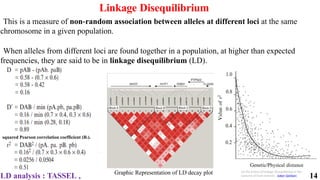
Linkage Disequilibrium
This is a measure of non random association between alleles at different loci
‐ at the same
chromosome in a given population.
When alleles from different loci are found together in a population, at higher than expected
frequencies, they are said to be in linkage disequilibrium (LD).
Graphic Representation of LD decay plot On the Extent of Linkage Disequilibrium in the
Genome of Farm Animals , Saber Qanbari
LD analysis : TASSEL ,
squared Pearson correlation coefficient (R2).
15
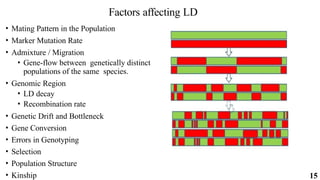
Factors affecting LD
• Mating Pattern in the Population
• Marker Mutation Rate
• Admixture / Migration
• Gene-flow between genetically distinct
populations of the same species.
• Genomic Region
• LD decay
• Recombination rate
• Genetic Drift and Bottleneck
• Gene Conversion
• Errors in Genotyping
• Selection
• Population Structure
• Kinship
16
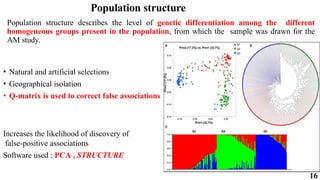
Population structure
Population structure describes the level of genetic differentiation among the different
homogeneous groups present in the population, from which the sample was drawn for the
AM study.
• Natural and artificial selections
• Geographical isolation
• Q-matrix is used to correct false associations
Increases the likelihood of discovery of
false-positive associations
Software used : PCA , STRUCTURE
17
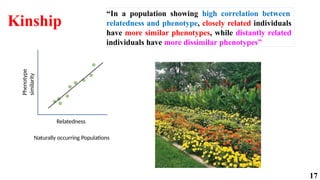
Kinship
Relatedness
Naturally occurring Populations
Phenotype
similarity
“In a population showing high correlation between
relatedness and phenotype, closely related individuals
have more similar phenotypes, while distantly related
individuals have more dissimilar phenotypes”
18
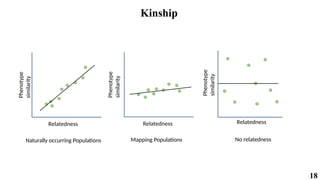
Kinship
Relatedness
Phenotype
similarity
No relatedness
Relatedness
Phenotype
similarity
Naturally occurring Populations
Relatedness
Phenotype
similarity
Mapping Populations
19
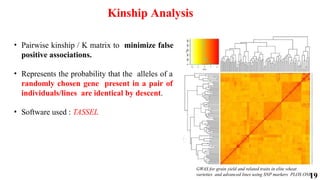
Kinship Analysis
• Pairwise kinship / K matrix to minimize false
positive associations.
• Represents the probability that the alleles of a
randomly chosen gene present in a pair of
individuals/lines are identical by descent.
• Software used : TASSEL
GWAS for grain yield and related traits in elite wheat
varieties and advanced lines using SNP markers PLOS ONE
20
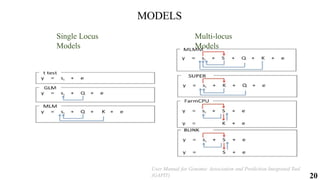
MODELS
User Manual for Genomic Association and Prediction Integrated Tool
(GAPIT)
Single Locus
Models
Multi-locus
Models
21
Significance tests
The presence of marker-trait association will be inferred even when
there is no marker-trait association False associations (Type I error)
Classical approach Based on P value Most
commonly used
Bayesian approach Based on probability theory

22
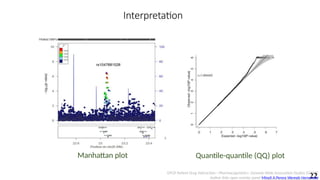
Interpretation
Manhattan plot Quantile-quantile (QQ) plot
GPCR Patient Drug Interaction—Pharmacogenetics: Genome-Wide Association Studies (GWAS)
Author links open overlay panel Minoli A.Perera Wenndy Hernandez
23
Case study 1
24
25
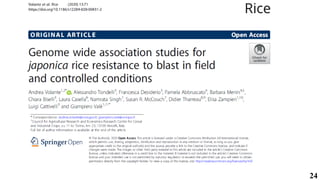
A Genome Wide Association Study (GWAS) for rice blast resistance was undertaken using
a panel of 311 temperate/tropical japonica and indica accessions adapted to temperate
conditions and genotyped with 37,423 SNP markers.
The panel was evaluated for blast resistance in field, under the pressure of the natural
blast population, and in growth chamber, using a mixture of three different fungal strains.
26
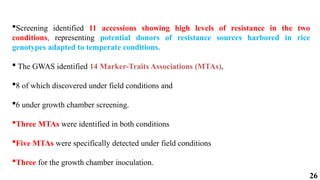
Screening identified 11 accessions showing high levels of resistance in the two
conditions, representing potential donors of resistance sources harbored in rice
genotypes adapted to temperate conditions.
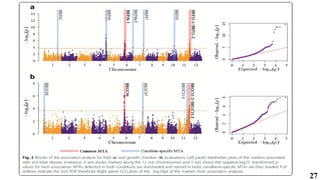
 The GWAS identified 14 Marker-Traits Associations (MTAs),
8 of which discovered under field conditions and
6 under growth chamber screening.
Three MTAs were identified in both conditions
Five MTAs were specifically detected under field conditions
Three for the growth chamber inoculation.
27
28
Identified 14 MTAs for blast resistance using both field and growth chamber
screenings.
A total of 11 accessions showing high levels of resistance in both conditions were
discovered.
Combinations of loci conferring blast resistance were identified in rice accessions
adapted to temperate conditions, thus allowing the genetic dissection of affordable
resistances present in the panel.
The obtained information will provide useful bases for both resistance breeding and
further characterization of the highlighted resistance loci.
For three MTAs, indicated as BRF10, BRF11–2 and BRGC11–3, no obvious candidate
genes or positional relationships with blast resistance QTLs were identified, raising the
possibility that they represent new sources of blast resistance.
Results & Conclusions:
29
Case study 2
30
31
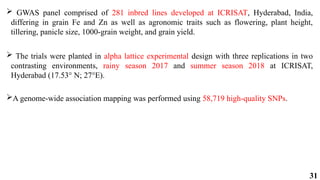
 GWAS panel comprised of 281 inbred lines developed at ICRISAT, Hyderabad, India,
differing in grain Fe and Zn as well as agronomic traits such as flowering, plant height,
tillering, panicle size, 1000-grain weight, and grain yield.
 The trials were planted in alpha lattice experimental design with three replications in two
contrasting environments, rainy season 2017 and summer season 2018 at ICRISAT,
Hyderabad (17.53° N; 27°E).
A genome-wide association mapping was performed using 58,719 high-quality SNPs.
32
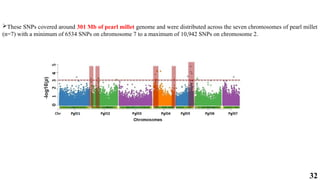
These SNPs covered around 301 Mb of pearl millet genome and were distributed across the seven chromosomes of pearl millet
(n=7) with a minimum of 6534 SNPs on chromosome 7 to a maximum of 10,942 SNPs on chromosome 2.
33
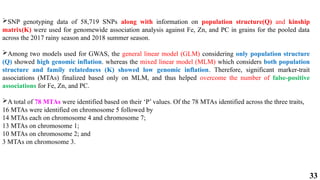
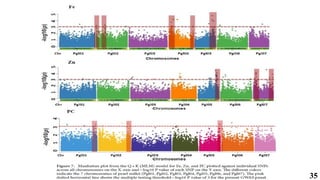
SNP genotyping data of 58,719 SNPs along with information on population structure(Q) and kinship
matrix(K) were used for genomewide association analysis against Fe, Zn, and PC in grains for the pooled data
across the 2017 rainy season and 2018 summer season.
Among two models used for GWAS, the general linear model (GLM) considering only population structure
(Q) showed high genomic inflation. whereas the mixed linear model (MLM) which considers both population
structure and family relatedness (K) showed low genomic inflation. Therefore, significant marker-trait
associations (MTAs) finalized based only on MLM, and thus helped overcome the number of false-positive
associations for Fe, Zn, and PC.
A total of 78 MTAs were identified based on their ‘P’ values. Of the 78 MTAs identified across the three traits,
16 MTAs were identified on chromosome 5 followed by
14 MTAs each on chromosome 4 and chromosome 7;
13 MTAs on chromosome 1;
10 MTAs on chromosome 2; and
3 MTAs on chromosome 3.
34
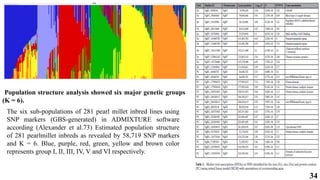
The six sub-populations of 281 pearl millet inbred lines using
SNP markers (GBS-generated) in ADMIXTURE software
according (Alexander et al.73) Estimated population structure
of 281 pearlmillet inbreds as revealed by 58,719 SNP markers
and K = 6. Blue, purple, red, green, yellow and brown color
represents group I, II, III, IV, V and VI respectively.
Population structure analysis showed six major genetic groups
(K = 6).
35
Results
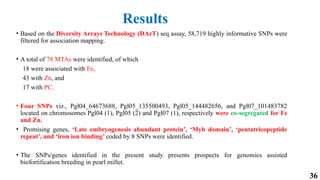
• Based on the Diversity Arrays Technology (DArT) seq assay, 58,719 highly informative SNPs were
filtered for association mapping.
• A total of 78 MTAs were identified, of which
18 were associated with Fe,
43 with Zn, and
17 with PC.
• Four SNPs viz., Pgl04_64673688, Pgl05_135500493, Pgl05_144482656, and Pgl07_101483782
located on chromosomes Pgl04 (1), Pgl05 (2) and Pgl07 (1), respectively were co-segregated for Fe
and Zn.
• Promising genes, ‘Late embryogenesis abundant protein’, ‘Myb domain’, ‘pentatricopeptide
repeat’, and ‘iron ion binding’ coded by 8 SNPs were identified.
• The SNPs/genes identified in the present study presents prospects for genomics assisted
biofortification breeding in pearl millet.
36
37
Recent Researches
38
Application of GWAS in breeding
Genetic improvement of inbred lines
To design hybrid crosses
Marker assisted selection
Genomic selection for highly
complex traits
GWAS and the CRISPRCas9 system speeds up selective
breeding Relevant to the study of low-frequency and rare
Easily shared and publicly available data facilitates novel
discoveries
39
Current issues
Missing Heritability issue
Refinements in experimental design and statistical analyses
Structural variations
Epistasis
Accurate
phenotyping
Rare marker alleles to be used
Multiple testing
Cannot detect ultra-rare mutations
40
Future prospects
WGS is the gold standard in GWAS
Effectiveness of MAS based on GWAS data for highly complex traits
Functional AM or Functional GWAS
Complex QTL–QTL interactions and G×E interactions
Integration of molecular marker data , eQTL and GWAS
Genetic studies on exotic germplasm accessions
In-depth annotation of genetic variants
41
CONCLUSION
42
References
Abdukarimov Ibrokhim Y. Abdurakhmonov and Abdusattor Application of Association Mapping to
Understanding the Genetic Diversity of Plant Germplasm Resources [Journal] // International Journal of Plant
Genomics. - 2008.
Andrea Volante Alessandro Tondelli Francesca Desiderio , Pamela Abbruscato, Barbara Menin
Genome wide association studies for japonica rice resistance to blast in field and controlled conditions
[Journal]. - [s.l.] : Rice, 2020.
B.D.singh and A.K.Singh Marker-Assisted Plant Breeding: Principles and practices [Book]. - New Delhi
Heidelberg New York Dordrecht London : Springer , 2015. - pp. 185-255.
Kenji Yano et.al. GWAS with principal component analysis identifies a gene comprehensively
controlling rice architecture [Journal]. - [s.l.] : PNAS, 2019.
Leila Nayyeriprasad Ghasim Ali garoosi , Asadollah Ahmadikhah Genome-Wide Association Study
(GWAS) to Identify Salt-Tolerance QTLs Carrying Novel Candidate Genes in Rice During Early Vegetative
Stage [Journal]. - [s.l.] : Rice, 2021.
43
References
Molecular Plant Shanghai Editorial Office Genome-wide Association Studies in Rice: How to Solve the Low
Power Problems? [Journal] Cell Press. - 2018.
Peter M. Visscher 1,2,Matthew A. Brown,1 Mark I. McCarthy,3,4 and Jian Yang5 Five Years of GWAS
Discovery [Journal] The American Journal of Human Genetics. - 2012.
Peter M. Visscher 1,2,Naomi R. Wray,1,2 Qian Zhang,1 Pamela Sklar,3 Mark I. McCarthy,4,5,6 10 Years of
GWAS Discovery: Biology, Function, and Translation [Journal] The American Journal of Human Genetics. - 2017.
Samuel Crowell1 Pavel Korniliev2 Alexandre Falca˜o3, Abdelbagi Ismail4, Glenn Gregorio5, Jason
Mezey2 Genome-wide association and high-resolution phenotyping link Oryza sativa panicle traits to numerous
trait-specific QTL clusters [Journal] nature COMMUNICATINS. - 2016.
Wang1 Qin [et al.] Advances in genome-wide association studies of complex traits in rice [Journal] //
Theoritical and Applied Genetics. - 2019.
Xuehui Huang1 2,10, Xinghua Wei3,10, Tao Sang4,10, Qiang Zhao1,2,10, Qi Feng1,10, Yan Zhao1,
Canyang Li1, Genome-wide association studies of 14 agronomic traits in rice landraces [Journal] // nature
genetics. - 2010. - Vol. 42. - pp. 961-967.
Genome-Wide Association Studies ( GWAS ) for Crop Improvement

Genome-Wide Association Studies ( GWAS ) for Crop Improvement

  • 1.
    Presented by: SK.ABDUL MUQSITH, BAD/2023-06,Ph. D. 1st year, Genetics and Plant Breeding Submitted to: Dr. K. Radhika, Professor and Head, Genetics and Plant Breeding Acharya N. G. Ranga Agricultural University Agricultural College, Bapatla. Doctoral Seminar - I GPB-691 Genome Wide Association Studies
  • 2.
    2 Contents  Mapping  Associationmapping  GWAS and its concepts  General procedure of GWAS  Factors affecting LD  Case studies  Future prospects  Application of GWAS in breeding  Current issues  Conclusion  References
  • 3.
    3 MAPPING “ A Schematicrepresentation of the relative locations of various genetic markers present in the chromosomes of an organism ” Mapping based on Linkage Mapping based on Linkage Disequilibrium Mapping of Molecular markers and Oligogenes Mapping of QTLs Association mapping Population based mapping Family based mapping
  • 4.
    4 LINKAGE MAPPING ASSOCIATIONMAPPING QTL effect size Effective for moderate to large effect QTLs; ineffective for QTLs with small effect size Effective for QTLs with much smaller effect size than in linkage mapping Number of alleles detected per locus Only two alleles can be detected All the alleles present in the sample are detected (Imp for polyploids) Populations used for mapping Produced by crossing selected parents Natural populations, breeding materials, germplasm lines, lines produced from multiple crosses Recombination events exploited Those occurring after the crosses are made All the recombination events that occurred since the LD was created Identified markers linked to QTL/gene Few to several centimorgans (cM) away from gene/QTL Much closer than those by linkage mapping Mapping based on Recombination frequency between the loci Linkage disequilibrium (LD) between the loci Familial relatedness and Population structure Minimized by controlled crossing Minimized by kinship coefficient estimation and Q/P matrix Feasibility in different species Feasible in annual and biennial species, not feasible in perennial species Feasible in annual, biennial, and perennial species Number of markers needed Low (102 ) to moderate (103 ) High (105 for small genomes) to very high (109 for large genomes)
  • 5.
    5 ASSOCIATION MAPPING AM usesLinkage Disequilibrium between markers and the concerned genes/QTLs for identifying Marker-Trait Associations. SNP 1 SNP 2 A Allele-1 A Allele-1 C Allele-1 G Allele-2 Phenotypic data Genotypic data A Allele-1 C G Heterozygote
  • 6.
    6 GWAS Association mapping Candidate gene approach In silicoassociation mapping A A A T A A Associative Transcriptomic s
  • 7.
    7 Genome Wide AssociationStudies Advances in genome-wide association studies of complex traits in rice Qin Wang1 · Jiali Tang1 · Bin Han2 · Xuehui Huang1 First GWAS for Age-related Macular Megeneration (AMD) was published in 2005. GWA study was done by Abasht and Lamont in 2007 to study the fatness trait in F2 population in chicken.
  • 8.
    8 General Procedure forGWAS Choosing a germplasm group with global genetic diversity Phenotyping over locations over years Marker- trait correlation with appropriate approach Confirmation of Marker-Trait Associations Through Replication Studies Identification of marker tags associated with trait of interest Cloning and annotation of tagged loci Meta analysis combining information of multiple GWAS Genotyping Random markers Population structure analysis Kinship analysis LD analysis
  • 9.
    9 Populations Used forAssociation Mapping Population based association panels Natural panmictic populations with considerable LD Synthetic populations derived from a set of inbreds Inbred lines / cultivars developed by breeding program Germplasm Core collection Random sample Family based association panels NAM MAGIC
  • 10.
    10 PHENOTYPING • Large numberindividuals (population size). • Power of AM. • Correlation among different traits can be considered. • Diversity panels with similar adaptations. • Accurate phenotyping is pre-requisite • Over locations. • Over years. • Efficient field designs. • Replicated trails. Power of QTL detection
  • 11.
    11 GENOTYPING • Large numberof molecular markers that cover the entire genome as densely as is feasible. • LD between markers and the loci of interest detected. • SSR and SNP marker systems are the most widely used for this purpose. • Markers used for genotyping are distributed, preferably evenly and densely, over the whole genome. • Candidate gene based markers can be used Genotypic data Phenotypic data Analysis Results Marker trait associations
  • 12.
    12 Population structure analysis Kinship analysis Background markers Kmatrix Q matrix OVERVIEW OF ASSOCIATION ANALYSIS • Tested with a set of molecular markers that are evenly distributed over the entire genome of the species. • Unlinked (>40cM apart) Statistical program Ex: TASSEL,STRUCTURE K-matrix Q-matrix Genetic Dissection and Simultaneous Improvement of Drought and Low Nitrogen Tolerances by Designed QTL Pyramiding in Rice , Bo Cheng , Kai Chen .,et.al. Marginal diversity analysis of conservation of Chinese domestic duck breeds, Yang Zhang .,et.al
  • 13.
    13 Population structure analysis Background markers Kinship analysis LDanalysis Genome wide scan Q matrix Genome wide polymorphism K matrix STATISTICAL MODEL RESULT & INTERPRETATION Apply correction factor to reduce FDR Corrected Plots OVERVIEW OF ASSOCIATION ANALYSIS Phenotyping data
  • 14.
    14 Linkage Disequilibrium This isa measure of non random association between alleles at different loci ‐ at the same chromosome in a given population. When alleles from different loci are found together in a population, at higher than expected frequencies, they are said to be in linkage disequilibrium (LD). Graphic Representation of LD decay plot On the Extent of Linkage Disequilibrium in the Genome of Farm Animals , Saber Qanbari LD analysis : TASSEL , squared Pearson correlation coefficient (R2).
  • 15.
    15 Factors affecting LD •Mating Pattern in the Population • Marker Mutation Rate • Admixture / Migration • Gene-flow between genetically distinct populations of the same species. • Genomic Region • LD decay • Recombination rate • Genetic Drift and Bottleneck • Gene Conversion • Errors in Genotyping • Selection • Population Structure • Kinship
  • 16.
    16 Population structure Population structuredescribes the level of genetic differentiation among the different homogeneous groups present in the population, from which the sample was drawn for the AM study. • Natural and artificial selections • Geographical isolation • Q-matrix is used to correct false associations Increases the likelihood of discovery of false-positive associations Software used : PCA , STRUCTURE
  • 17.
    17 Kinship Relatedness Naturally occurring Populations Phenotype similarity “Ina population showing high correlation between relatedness and phenotype, closely related individuals have more similar phenotypes, while distantly related individuals have more dissimilar phenotypes”
  • 18.
  • 19.
    19 Kinship Analysis • Pairwisekinship / K matrix to minimize false positive associations. • Represents the probability that the alleles of a randomly chosen gene present in a pair of individuals/lines are identical by descent. • Software used : TASSEL GWAS for grain yield and related traits in elite wheat varieties and advanced lines using SNP markers PLOS ONE
  • 20.
    20 MODELS User Manual forGenomic Association and Prediction Integrated Tool (GAPIT) Single Locus Models Multi-locus Models
  • 21.
    21 Significance tests The presenceof marker-trait association will be inferred even when there is no marker-trait association False associations (Type I error) Classical approach Based on P value Most commonly used Bayesian approach Based on probability theory 
  • 22.
    22 Interpretation Manhattan plot Quantile-quantile(QQ) plot GPCR Patient Drug Interaction—Pharmacogenetics: Genome-Wide Association Studies (GWAS) Author links open overlay panel Minoli A.Perera Wenndy Hernandez
  • 23.
  • 24.
  • 25.
    25 A Genome WideAssociation Study (GWAS) for rice blast resistance was undertaken using a panel of 311 temperate/tropical japonica and indica accessions adapted to temperate conditions and genotyped with 37,423 SNP markers. The panel was evaluated for blast resistance in field, under the pressure of the natural blast population, and in growth chamber, using a mixture of three different fungal strains.
  • 26.
    26 Screening identified 11accessions showing high levels of resistance in the two conditions, representing potential donors of resistance sources harbored in rice genotypes adapted to temperate conditions.  The GWAS identified 14 Marker-Traits Associations (MTAs), 8 of which discovered under field conditions and 6 under growth chamber screening. Three MTAs were identified in both conditions Five MTAs were specifically detected under field conditions Three for the growth chamber inoculation.
  • 27.
  • 28.
    28 Identified 14 MTAsfor blast resistance using both field and growth chamber screenings. A total of 11 accessions showing high levels of resistance in both conditions were discovered. Combinations of loci conferring blast resistance were identified in rice accessions adapted to temperate conditions, thus allowing the genetic dissection of affordable resistances present in the panel. The obtained information will provide useful bases for both resistance breeding and further characterization of the highlighted resistance loci. For three MTAs, indicated as BRF10, BRF11–2 and BRGC11–3, no obvious candidate genes or positional relationships with blast resistance QTLs were identified, raising the possibility that they represent new sources of blast resistance. Results & Conclusions:
  • 29.
  • 30.
  • 31.
    31  GWAS panelcomprised of 281 inbred lines developed at ICRISAT, Hyderabad, India, differing in grain Fe and Zn as well as agronomic traits such as flowering, plant height, tillering, panicle size, 1000-grain weight, and grain yield.  The trials were planted in alpha lattice experimental design with three replications in two contrasting environments, rainy season 2017 and summer season 2018 at ICRISAT, Hyderabad (17.53° N; 27°E). A genome-wide association mapping was performed using 58,719 high-quality SNPs.
  • 32.
    32 These SNPs coveredaround 301 Mb of pearl millet genome and were distributed across the seven chromosomes of pearl millet (n=7) with a minimum of 6534 SNPs on chromosome 7 to a maximum of 10,942 SNPs on chromosome 2.
  • 33.
    33 SNP genotyping dataof 58,719 SNPs along with information on population structure(Q) and kinship matrix(K) were used for genomewide association analysis against Fe, Zn, and PC in grains for the pooled data across the 2017 rainy season and 2018 summer season. Among two models used for GWAS, the general linear model (GLM) considering only population structure (Q) showed high genomic inflation. whereas the mixed linear model (MLM) which considers both population structure and family relatedness (K) showed low genomic inflation. Therefore, significant marker-trait associations (MTAs) finalized based only on MLM, and thus helped overcome the number of false-positive associations for Fe, Zn, and PC. A total of 78 MTAs were identified based on their ‘P’ values. Of the 78 MTAs identified across the three traits, 16 MTAs were identified on chromosome 5 followed by 14 MTAs each on chromosome 4 and chromosome 7; 13 MTAs on chromosome 1; 10 MTAs on chromosome 2; and 3 MTAs on chromosome 3.
  • 34.
    34 The six sub-populationsof 281 pearl millet inbred lines using SNP markers (GBS-generated) in ADMIXTURE software according (Alexander et al.73) Estimated population structure of 281 pearlmillet inbreds as revealed by 58,719 SNP markers and K = 6. Blue, purple, red, green, yellow and brown color represents group I, II, III, IV, V and VI respectively. Population structure analysis showed six major genetic groups (K = 6).
  • 35.
  • 36.
    Results • Based onthe Diversity Arrays Technology (DArT) seq assay, 58,719 highly informative SNPs were filtered for association mapping. • A total of 78 MTAs were identified, of which 18 were associated with Fe, 43 with Zn, and 17 with PC. • Four SNPs viz., Pgl04_64673688, Pgl05_135500493, Pgl05_144482656, and Pgl07_101483782 located on chromosomes Pgl04 (1), Pgl05 (2) and Pgl07 (1), respectively were co-segregated for Fe and Zn. • Promising genes, ‘Late embryogenesis abundant protein’, ‘Myb domain’, ‘pentatricopeptide repeat’, and ‘iron ion binding’ coded by 8 SNPs were identified. • The SNPs/genes identified in the present study presents prospects for genomics assisted biofortification breeding in pearl millet. 36
  • 37.
  • 38.
    38 Application of GWASin breeding Genetic improvement of inbred lines To design hybrid crosses Marker assisted selection Genomic selection for highly complex traits GWAS and the CRISPRCas9 system speeds up selective breeding Relevant to the study of low-frequency and rare Easily shared and publicly available data facilitates novel discoveries
  • 39.
    39 Current issues Missing Heritabilityissue Refinements in experimental design and statistical analyses Structural variations Epistasis Accurate phenotyping Rare marker alleles to be used Multiple testing Cannot detect ultra-rare mutations
  • 40.
    40 Future prospects WGS isthe gold standard in GWAS Effectiveness of MAS based on GWAS data for highly complex traits Functional AM or Functional GWAS Complex QTL–QTL interactions and G×E interactions Integration of molecular marker data , eQTL and GWAS Genetic studies on exotic germplasm accessions In-depth annotation of genetic variants
  • 41.
  • 42.
    42 References Abdukarimov Ibrokhim Y.Abdurakhmonov and Abdusattor Application of Association Mapping to Understanding the Genetic Diversity of Plant Germplasm Resources [Journal] // International Journal of Plant Genomics. - 2008. Andrea Volante Alessandro Tondelli Francesca Desiderio , Pamela Abbruscato, Barbara Menin Genome wide association studies for japonica rice resistance to blast in field and controlled conditions [Journal]. - [s.l.] : Rice, 2020. B.D.singh and A.K.Singh Marker-Assisted Plant Breeding: Principles and practices [Book]. - New Delhi Heidelberg New York Dordrecht London : Springer , 2015. - pp. 185-255. Kenji Yano et.al. GWAS with principal component analysis identifies a gene comprehensively controlling rice architecture [Journal]. - [s.l.] : PNAS, 2019. Leila Nayyeriprasad Ghasim Ali garoosi , Asadollah Ahmadikhah Genome-Wide Association Study (GWAS) to Identify Salt-Tolerance QTLs Carrying Novel Candidate Genes in Rice During Early Vegetative Stage [Journal]. - [s.l.] : Rice, 2021.
  • 43.
    43 References Molecular Plant ShanghaiEditorial Office Genome-wide Association Studies in Rice: How to Solve the Low Power Problems? [Journal] Cell Press. - 2018. Peter M. Visscher 1,2,Matthew A. Brown,1 Mark I. McCarthy,3,4 and Jian Yang5 Five Years of GWAS Discovery [Journal] The American Journal of Human Genetics. - 2012. Peter M. Visscher 1,2,Naomi R. Wray,1,2 Qian Zhang,1 Pamela Sklar,3 Mark I. McCarthy,4,5,6 10 Years of GWAS Discovery: Biology, Function, and Translation [Journal] The American Journal of Human Genetics. - 2017. Samuel Crowell1 Pavel Korniliev2 Alexandre Falca˜o3, Abdelbagi Ismail4, Glenn Gregorio5, Jason Mezey2 Genome-wide association and high-resolution phenotyping link Oryza sativa panicle traits to numerous trait-specific QTL clusters [Journal] nature COMMUNICATINS. - 2016. Wang1 Qin [et al.] Advances in genome-wide association studies of complex traits in rice [Journal] // Theoritical and Applied Genetics. - 2019. Xuehui Huang1 2,10, Xinghua Wei3,10, Tao Sang4,10, Qiang Zhao1,2,10, Qi Feng1,10, Yan Zhao1, Canyang Li1, Genome-wide association studies of 14 agronomic traits in rice landraces [Journal] // nature genetics. - 2010. - Vol. 42. - pp. 961-967.