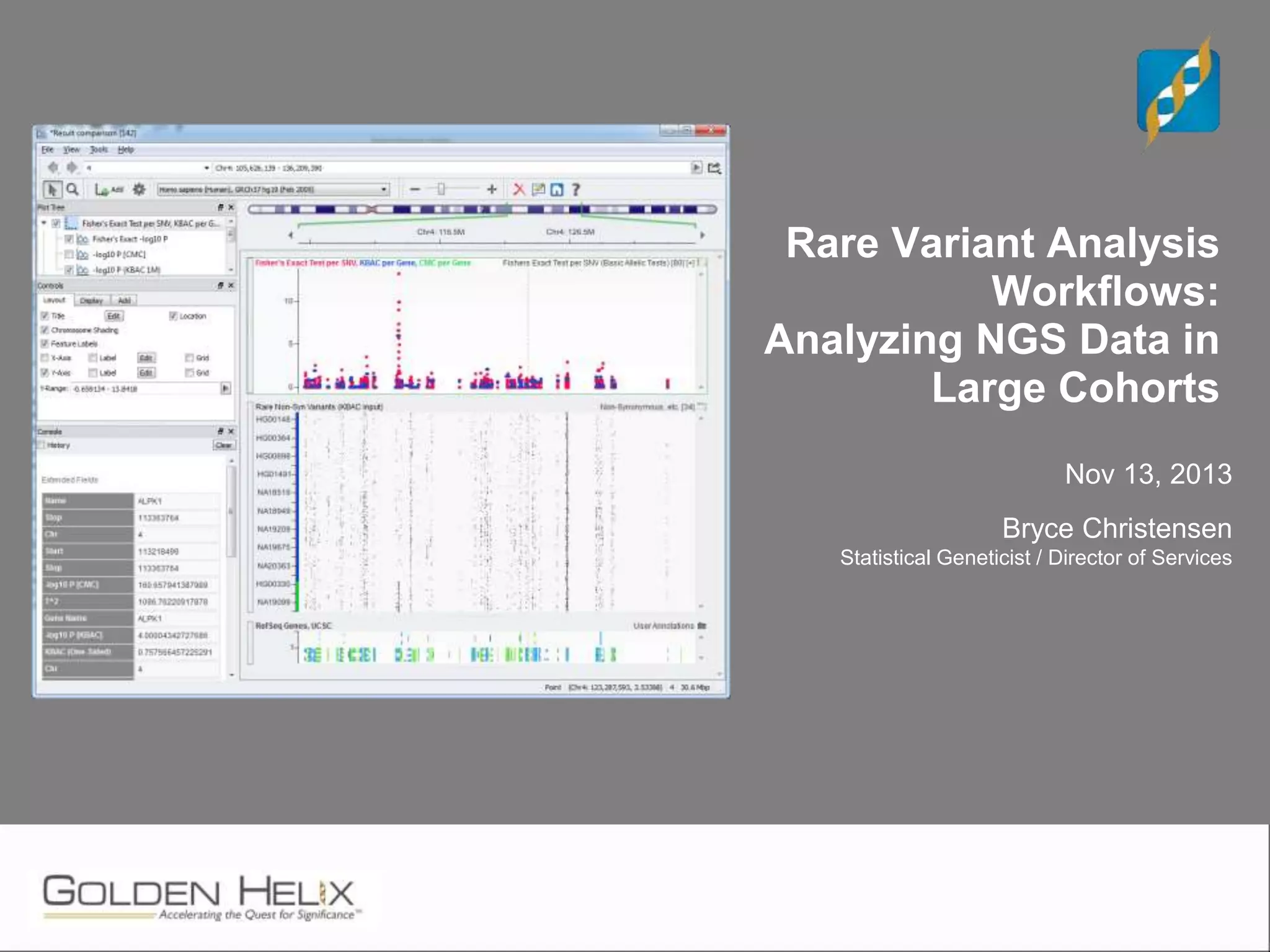


Rare Variant Analysis
Workflows:
Analyzing NGS Data in
Large Cohorts
Nov 13, 2013
Bryce Christensen
Statistical Geneticist / Director of Services
Rare Variant Analysis
Workflows:
Analyzing NGS Data in
Large Cohorts
Nov 13, 2013
Bryce Christensen
Statistical Geneticist / Director of Services
Use the Questions pane in
your GoToWebinar window
Questions during
the presentation
Golden Helix
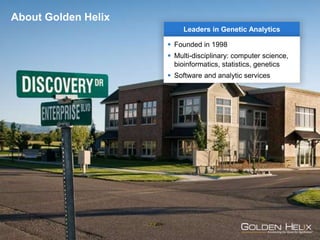
Leaders in Genetic Analytics
 Founded in 1998
 Multi-disciplinary: computer science,
bioinformatics, statistics, genetics
 Software and analytic services
About Golden Helix
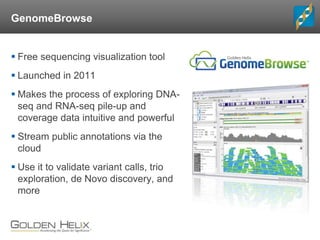
GenomeBrowse
 Free sequencing visualization tool
 Launched in 2011
 Makes the process of exploring DNA-
seq and RNA-seq pile-up and
coverage data intuitive and powerful
 Stream public annotations via the
cloud
 Use it to validate variant calls, trio
exploration, de Novo discovery, and
more
Core
Features
Packages
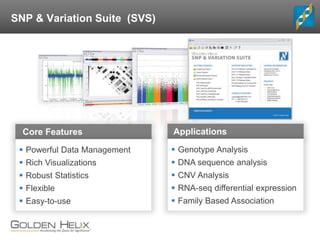
Core Features
 Powerful Data Management
 Rich Visualizations
 Robust Statistics
 Flexible
 Easy-to-use
Applications
 Genotype Analysis
 DNA sequence analysis
 CNV Analysis
 RNA-seq differential expression
 Family Based Association
SNP & Variation Suite (SVS)
Merging of Two Great Products
Previous Webcast Recording Available
Agenda
Brief review of upstream and QC considerations
NGS workflow design in SVS
2
3
4
Overview of RV analysis approaches
Define the problem: What is rare variant (RV) analysis?1
Interactive software demo5
What about exome chips?6
GenomeBrowse SVS 8: Exploratory tools, Analysis workflows
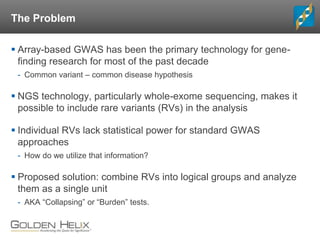
The Problem
 Array-based GWAS has been the primary technology for gene-
finding research for most of the past decade
- Common variant – common disease hypothesis
 NGS technology, particularly whole-exome sequencing, makes it
possible to include rare variants (RVs) in the analysis
 Individual RVs lack statistical power for standard GWAS
approaches
- How do we utilize that information?
 Proposed solution: combine RVs into logical groups and analyze
them as a single unit
- AKA “Collapsing” or “Burden” tests.
From the Vault:
January 2011 Slide on RV Analysis
What have we learned
since then?
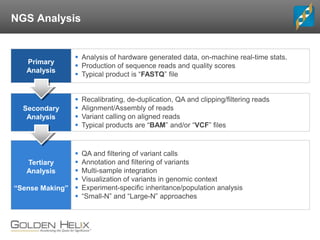
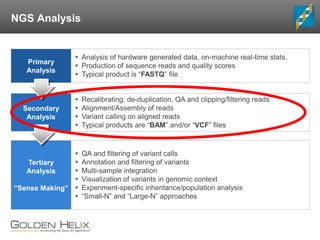
NGS Analysis
Primary
Analysis
Secondary
Analysis
Tertiary
Analysis
“Sense Making”
 Analysis of hardware generated data, on-machine real-time stats.
 Production of sequence reads and quality scores
 Typical product is “FASTQ” file
 Recalibrating, de-duplication, QA and clipping/filtering reads
 Alignment/Assembly of reads
 Variant calling on aligned reads
 Typical products are “BAM” and/or “VCF” files
 QA and filtering of variant calls
 Annotation and filtering of variants
 Multi-sample integration
 Visualization of variants in genomic context
 Experiment-specific inheritance/population analysis
 “Small-N” and “Large-N” approaches
NGS Analysis
Primary
Analysis
Secondary
Analysis
Tertiary
Analysis
“Sense Making”
 Analysis of hardware generated data, on-machine real-time stats.
 Production of sequence reads and quality scores
 Typical product is “FASTQ” file
 Recalibrating, de-duplication, QA and clipping/filtering reads
 Alignment/Assembly of reads
 Variant calling on aligned reads
 Typical products are “BAM” and/or “VCF” files
 QA and filtering of variant calls
 Annotation and filtering of variants
 Multi-sample integration
 Visualization of variants in genomic context
 Experiment-specific inheritance/population analysis
 “Small-N” and “Large-N” approaches
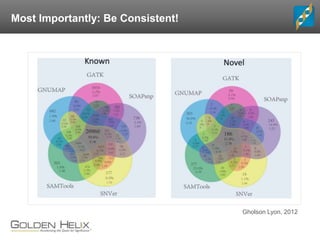
Most Importantly: Be Consistent!
Gholson Lyon, 2012
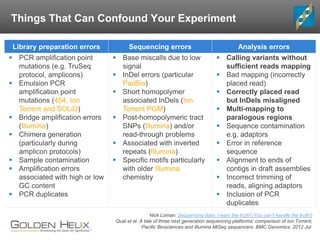
Things That Can Confound Your Experiment
Library preparation errors Sequencing errors Analysis errors
 PCR amplification point
mutations (e.g. TruSeq
protocol, amplicons)
 Emulsion PCR
amplification point
mutations (454, Ion
Torrent and SOLiD)
 Bridge amplification errors
(Illumina)
 Chimera generation
(particularly during
amplicon protocols)
 Sample contamination
 Amplification errors
associated with high or low
GC content
 PCR duplicates
 Base miscalls due to low
signal
 InDel errors (particular
PacBio)
 Short homopolymer
associated InDels (Ion
Torrent PGM)
 Post-homopolymeric tract
SNPs (Illumina) and/or
read-through problems
 Associated with inverted
repeats (Illumina)
 Specific motifs particularly
with older Illumina
chemistry
 Calling variants without
sufficient reads mapping
 Bad mapping (incorrectly
placed read)
 Correctly placed read
but InDels misaligned
 Multi-mapping to
paralogous regions
 Sequence contamination
e.g. adaptors
 Error in reference
sequence
 Alignment to ends of
contigs in draft assemblies
 Incorrect trimming of
reads, aligning adaptors
 Inclusion of PCR
duplicates
Nick Loman: Sequencing data: I want the truth! (You can’t handle the truth!)
Qual et al. A tale of three next generation sequencing platforms: comparison of Ion Torrent,
Pacific Biosciences and Illumina MiSeq sequencers. BMC Genomics. 2012 Jul
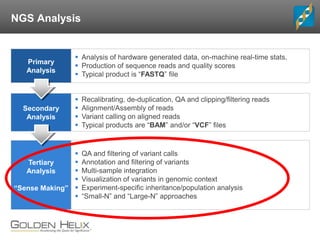
NGS Analysis
Primary
Analysis
Secondary
Analysis
Tertiary
Analysis
“Sense Making”
 Analysis of hardware generated data, on-machine real-time stats.
 Production of sequence reads and quality scores
 Typical product is “FASTQ” file
 Recalibrating, de-duplication, QA and clipping/filtering reads
 Alignment/Assembly of reads
 Variant calling on aligned reads
 Typical products are “BAM” and/or “VCF” files
 QA and filtering of variant calls
 Annotation and filtering of variants
 Multi-sample integration
 Visualization of variants in genomic context
 Experiment-specific inheritance/population analysis
 “Small-N” and “Large-N” approaches
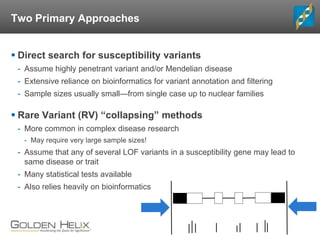
Two Primary Approaches
 Direct search for susceptibility variants
- Assume highly penetrant variant and/or Mendelian disease
- Extensive reliance on bioinformatics for variant annotation and filtering
- Sample sizes usually small—from single case up to nuclear families
 Rare Variant (RV) “collapsing” methods
- More common in complex disease research
- May require very large sample sizes!
- Assume that any of several LOF variants in a susceptibility gene may lead to
same disease or trait
- Many statistical tests available
- Also relies heavily on bioinformatics
Families of Collapsing Tests
 Burden Tests
- Combine minor alleles across multiple variant sites…
- Without weighting (CMC, CAST, CMAT)
- With fixed weights based on allele frequency (WSS, RWAS)
- With data-adaptive weights (Lin/Tang, KBAC)
- With data-adaptive thresholds (Step-Up, VT)
- With extensions to allow for effects in either direction (Ionita-Laza/Lange, C-alpha)
 Kernel Tests
- Allow for individual variant effects in either direction and permit covariate
adjustment based on kernel regression
- Kwee et al., AJHG, 2008
- SKAT
- SKAT-O
Credit: Schaid et al., Genet Epi, 2013
CMC: Combined Multivariate and Collapsing
 Multivariate test: simultaneous test for association of common
and rare variants in gene
 Flexibility in variant frequency bin definition
 Testing methods include Hotelling T2 and Regression
 Regression method allows for covariate correction
 Li and Leal, AJHG, 2008
KBAC: Kernel Based Adaptive Clustering
 Per-gene tests models the risk associated with multi-locus
genotypes at a per-gene level
 Adaptive weighting procedure that gives higher weights to
genotypes with higher sample risks
- Meant to attain good balance between classification accuracy and the number of
estimated parameters
 SVS implementation includes option for 1- or 2-tailed test
- But most powerful when all variants in gene have unidirectional effect
 Permutation testing or regression options
- Regression allows for covariate correction
 Liu and Leal, PLoS Genetics, 2010
NGS Analysis Workflow Development in SVS
 SVS is very flexible in workflow design.
 SVS includes a broad range of tools for data manipulation and
variant annotation and visualization that can be used together to
guide us on an interactive exploration of the data.
 We begin by defining the final goal and the steps needed to help us
reach that goal:
- Are we looking for a very rare, non-synonymous variant that causes a dominant
Mendelian trait?
- Are we looking for a gene with excess rare variation in cases vs controls?
 Once we know what we are looking for, we can identify the
available annotation sources that will help us answer the question.
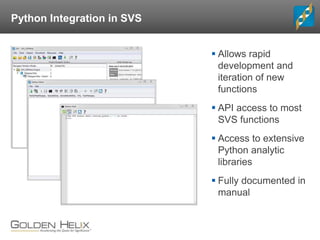
Python Integration in SVS
 Allows rapid
development and
iteration of new
functions
 API access to most
SVS functions
 Access to extensive
Python analytic
libraries
 Fully documented in
manual
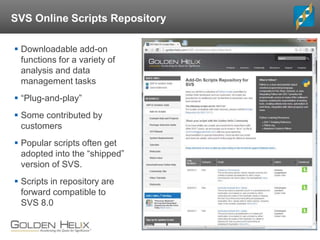
SVS Online Scripts Repository
 Downloadable add-on
functions for a variety of
analysis and data
management tasks
 “Plug-and-play”
 Some contributed by
customers
 Popular scripts often get
adopted into the “shipped”
version of SVS.
 Scripts in repository are
forward compatible to
SVS 8.0
Today’s Featured Scripts
 Activate Variants by Genotype Count Threshold
- Identify variants that occur with a specified frequency in one or several groups
 Filter by Marker Map Field
- Variant-level “INFO” fields from VCF files are imported to the SVS marker map
- This script allows you to filter markers based on those variables
 Many more useful scripts to take a look at:
- Add Annotation Data to Marker Map from Spreadsheet
- Nonparametric association tests
- Import Unsorted VCF Files
- Build Variant Spreadsheet
- Many, many more
Interactive Demonstration
 GenomeBrowse
- Exploring multi-sample VCF files in our free genome viewer software
 SVS 8.0
- Exploratory analysis workflow
- Using downloaded scripts
- Using basic analysis tools to create advanced workflows
- Simulate the development of a burden test
- RV association testing workflow
- KBAC
- CMC
- Data visualization
SVS Demo
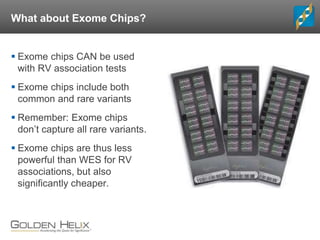
What about Exome Chips?
 Exome chips CAN be used
with RV association tests
 Exome chips include both
common and rare variants
 Remember: Exome chips
don’t capture all rare variants.
 Exome chips are thus less
powerful than WES for RV
associations, but also
significantly cheaper.
A Note about Exome Chips
 Exome chips are not GWAS chips
- GWAS chips focus on common SNPs, have uniform spacing, minimal LD and
are designed to capture population variability
- Exome chips include rare variants and the content is anything but uniform
 Most GWAS functions can be used with exome chips, but
require some workflow adjustments
- Gender checking
- IBD estimation
- Principal components
 Not unlike other chips with custom/targeted content
- Cardio-MetaboChip
- ImmunoChip
Questions or
more info:
 info@goldenhelix.com
 Request a copy of SVS at
www.goldenhelix.com
 Download GenomeBrowse
for free at
www.GenomeBrowse.com
Use the Questions pane in
your GoToWebinar window
Any Questions?

Rare Variant Analysis Workflows: Analyzing NGS Data in Large Cohorts

  • 1.
    Rare Variant Analysis Workflows: AnalyzingNGS Data in Large Cohorts Nov 13, 2013 Bryce Christensen Statistical Geneticist / Director of Services
  • 2.
    Rare Variant Analysis Workflows: AnalyzingNGS Data in Large Cohorts Nov 13, 2013 Bryce Christensen Statistical Geneticist / Director of Services
  • 3.
    Use the Questionspane in your GoToWebinar window Questions during the presentation
  • 4.
    Golden Helix Leaders inGenetic Analytics  Founded in 1998  Multi-disciplinary: computer science, bioinformatics, statistics, genetics  Software and analytic services About Golden Helix
  • 5.
    GenomeBrowse  Free sequencingvisualization tool  Launched in 2011  Makes the process of exploring DNA- seq and RNA-seq pile-up and coverage data intuitive and powerful  Stream public annotations via the cloud  Use it to validate variant calls, trio exploration, de Novo discovery, and more
  • 6.
    Core Features Packages Core Features  PowerfulData Management  Rich Visualizations  Robust Statistics  Flexible  Easy-to-use Applications  Genotype Analysis  DNA sequence analysis  CNV Analysis  RNA-seq differential expression  Family Based Association SNP & Variation Suite (SVS)
  • 7.
    Merging of TwoGreat Products
  • 8.
  • 9.
    Agenda Brief review ofupstream and QC considerations NGS workflow design in SVS 2 3 4 Overview of RV analysis approaches Define the problem: What is rare variant (RV) analysis?1 Interactive software demo5 What about exome chips?6 GenomeBrowse SVS 8: Exploratory tools, Analysis workflows
  • 10.
    The Problem  Array-basedGWAS has been the primary technology for gene- finding research for most of the past decade - Common variant – common disease hypothesis  NGS technology, particularly whole-exome sequencing, makes it possible to include rare variants (RVs) in the analysis  Individual RVs lack statistical power for standard GWAS approaches - How do we utilize that information?  Proposed solution: combine RVs into logical groups and analyze them as a single unit - AKA “Collapsing” or “Burden” tests.
  • 11.
    From the Vault: January2011 Slide on RV Analysis What have we learned since then?
  • 12.
    NGS Analysis Primary Analysis Secondary Analysis Tertiary Analysis “Sense Making” Analysis of hardware generated data, on-machine real-time stats.  Production of sequence reads and quality scores  Typical product is “FASTQ” file  Recalibrating, de-duplication, QA and clipping/filtering reads  Alignment/Assembly of reads  Variant calling on aligned reads  Typical products are “BAM” and/or “VCF” files  QA and filtering of variant calls  Annotation and filtering of variants  Multi-sample integration  Visualization of variants in genomic context  Experiment-specific inheritance/population analysis  “Small-N” and “Large-N” approaches
  • 13.
    NGS Analysis Primary Analysis Secondary Analysis Tertiary Analysis “Sense Making” Analysis of hardware generated data, on-machine real-time stats.  Production of sequence reads and quality scores  Typical product is “FASTQ” file  Recalibrating, de-duplication, QA and clipping/filtering reads  Alignment/Assembly of reads  Variant calling on aligned reads  Typical products are “BAM” and/or “VCF” files  QA and filtering of variant calls  Annotation and filtering of variants  Multi-sample integration  Visualization of variants in genomic context  Experiment-specific inheritance/population analysis  “Small-N” and “Large-N” approaches
  • 14.
    Most Importantly: BeConsistent! Gholson Lyon, 2012
  • 15.
    Things That CanConfound Your Experiment Library preparation errors Sequencing errors Analysis errors  PCR amplification point mutations (e.g. TruSeq protocol, amplicons)  Emulsion PCR amplification point mutations (454, Ion Torrent and SOLiD)  Bridge amplification errors (Illumina)  Chimera generation (particularly during amplicon protocols)  Sample contamination  Amplification errors associated with high or low GC content  PCR duplicates  Base miscalls due to low signal  InDel errors (particular PacBio)  Short homopolymer associated InDels (Ion Torrent PGM)  Post-homopolymeric tract SNPs (Illumina) and/or read-through problems  Associated with inverted repeats (Illumina)  Specific motifs particularly with older Illumina chemistry  Calling variants without sufficient reads mapping  Bad mapping (incorrectly placed read)  Correctly placed read but InDels misaligned  Multi-mapping to paralogous regions  Sequence contamination e.g. adaptors  Error in reference sequence  Alignment to ends of contigs in draft assemblies  Incorrect trimming of reads, aligning adaptors  Inclusion of PCR duplicates Nick Loman: Sequencing data: I want the truth! (You can’t handle the truth!) Qual et al. A tale of three next generation sequencing platforms: comparison of Ion Torrent, Pacific Biosciences and Illumina MiSeq sequencers. BMC Genomics. 2012 Jul
  • 16.
    NGS Analysis Primary Analysis Secondary Analysis Tertiary Analysis “Sense Making” Analysis of hardware generated data, on-machine real-time stats.  Production of sequence reads and quality scores  Typical product is “FASTQ” file  Recalibrating, de-duplication, QA and clipping/filtering reads  Alignment/Assembly of reads  Variant calling on aligned reads  Typical products are “BAM” and/or “VCF” files  QA and filtering of variant calls  Annotation and filtering of variants  Multi-sample integration  Visualization of variants in genomic context  Experiment-specific inheritance/population analysis  “Small-N” and “Large-N” approaches
  • 17.
    Two Primary Approaches Direct search for susceptibility variants - Assume highly penetrant variant and/or Mendelian disease - Extensive reliance on bioinformatics for variant annotation and filtering - Sample sizes usually small—from single case up to nuclear families  Rare Variant (RV) “collapsing” methods - More common in complex disease research - May require very large sample sizes! - Assume that any of several LOF variants in a susceptibility gene may lead to same disease or trait - Many statistical tests available - Also relies heavily on bioinformatics
  • 18.
    Families of CollapsingTests  Burden Tests - Combine minor alleles across multiple variant sites… - Without weighting (CMC, CAST, CMAT) - With fixed weights based on allele frequency (WSS, RWAS) - With data-adaptive weights (Lin/Tang, KBAC) - With data-adaptive thresholds (Step-Up, VT) - With extensions to allow for effects in either direction (Ionita-Laza/Lange, C-alpha)  Kernel Tests - Allow for individual variant effects in either direction and permit covariate adjustment based on kernel regression - Kwee et al., AJHG, 2008 - SKAT - SKAT-O Credit: Schaid et al., Genet Epi, 2013
  • 19.
    CMC: Combined Multivariateand Collapsing  Multivariate test: simultaneous test for association of common and rare variants in gene  Flexibility in variant frequency bin definition  Testing methods include Hotelling T2 and Regression  Regression method allows for covariate correction  Li and Leal, AJHG, 2008
  • 20.
    KBAC: Kernel BasedAdaptive Clustering  Per-gene tests models the risk associated with multi-locus genotypes at a per-gene level  Adaptive weighting procedure that gives higher weights to genotypes with higher sample risks - Meant to attain good balance between classification accuracy and the number of estimated parameters  SVS implementation includes option for 1- or 2-tailed test - But most powerful when all variants in gene have unidirectional effect  Permutation testing or regression options - Regression allows for covariate correction  Liu and Leal, PLoS Genetics, 2010
  • 21.
    NGS Analysis WorkflowDevelopment in SVS  SVS is very flexible in workflow design.  SVS includes a broad range of tools for data manipulation and variant annotation and visualization that can be used together to guide us on an interactive exploration of the data.  We begin by defining the final goal and the steps needed to help us reach that goal: - Are we looking for a very rare, non-synonymous variant that causes a dominant Mendelian trait? - Are we looking for a gene with excess rare variation in cases vs controls?  Once we know what we are looking for, we can identify the available annotation sources that will help us answer the question.
  • 22.
    Python Integration inSVS  Allows rapid development and iteration of new functions  API access to most SVS functions  Access to extensive Python analytic libraries  Fully documented in manual
  • 23.
    SVS Online ScriptsRepository  Downloadable add-on functions for a variety of analysis and data management tasks  “Plug-and-play”  Some contributed by customers  Popular scripts often get adopted into the “shipped” version of SVS.  Scripts in repository are forward compatible to SVS 8.0
  • 24.
    Today’s Featured Scripts Activate Variants by Genotype Count Threshold - Identify variants that occur with a specified frequency in one or several groups  Filter by Marker Map Field - Variant-level “INFO” fields from VCF files are imported to the SVS marker map - This script allows you to filter markers based on those variables  Many more useful scripts to take a look at: - Add Annotation Data to Marker Map from Spreadsheet - Nonparametric association tests - Import Unsorted VCF Files - Build Variant Spreadsheet - Many, many more
  • 25.
    Interactive Demonstration  GenomeBrowse -Exploring multi-sample VCF files in our free genome viewer software  SVS 8.0 - Exploratory analysis workflow - Using downloaded scripts - Using basic analysis tools to create advanced workflows - Simulate the development of a burden test - RV association testing workflow - KBAC - CMC - Data visualization
  • 26.
  • 27.
    What about ExomeChips?  Exome chips CAN be used with RV association tests  Exome chips include both common and rare variants  Remember: Exome chips don’t capture all rare variants.  Exome chips are thus less powerful than WES for RV associations, but also significantly cheaper.
  • 28.
    A Note aboutExome Chips  Exome chips are not GWAS chips - GWAS chips focus on common SNPs, have uniform spacing, minimal LD and are designed to capture population variability - Exome chips include rare variants and the content is anything but uniform  Most GWAS functions can be used with exome chips, but require some workflow adjustments - Gender checking - IBD estimation - Principal components  Not unlike other chips with custom/targeted content - Cardio-MetaboChip - ImmunoChip
  • 29.
    Questions or more info: info@goldenhelix.com  Request a copy of SVS at www.goldenhelix.com  Download GenomeBrowse for free at www.GenomeBrowse.com
  • 30.
    Use the Questionspane in your GoToWebinar window Any Questions?