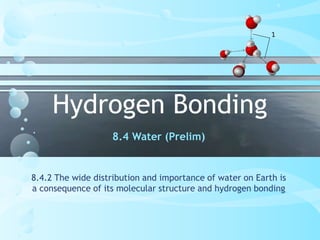
Hydrogen Bonding8.4 Water (Prelim)8.4.2 The wide distribution and importance of water on Earth is a consequence of its molecular structure and hydrogen bonding
Syllabus PointsStage 6 preliminary unit on Water.describe hydrogen bonding between moleculesplan and perform an investigation to identify and describe the effect of anti-freeze or salt on the boiling point of water
Explanations..
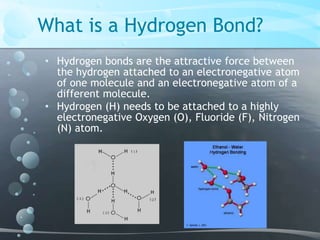
What is a Hydrogen Bond?Hydrogen bonds are the attractive force between the hydrogen attached to an electronegative atom of one molecule and an electronegative atom of a different molecule. Hydrogen (H) needs to be attached to a highly electronegative Oxygen (O), Fluoride (F), Nitrogen (N) atom.
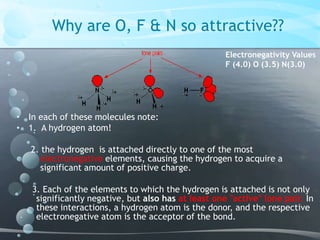
   Why are O, F & N so attractive??In each of these molecules note:1.  A hydrogen atom! 2. the hydrogen  is attached directly to one of the most electronegative elements, causing the hydrogen to acquire a significant amount of positive charge.   3. Each of the elements to which the hydrogen is attached is not only significantly negative, but also has at least one "active" lone pair. In these interactions, a hydrogen atom is the donor, and the respective electronegative atom is the acceptor of the bond.Electronegativity ValuesF (4.0) O (3.5) N(3.0)
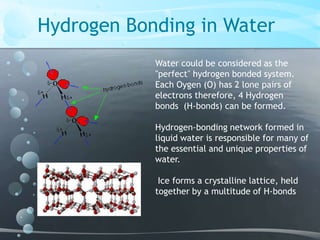
Hydrogen Bonding in WaterWater could be considered as the "perfect" hydrogen bonded system. Each Oygen (O) has 2 lone pairs of electrons therefore, 4 Hydrogen bonds  (H-bonds) can be formed.Hydrogen-bonding network formed in liquid water is responsible for many of the essential and unique properties of water. Ice forms a crystalline lattice, held together by a multitude of H-bonds
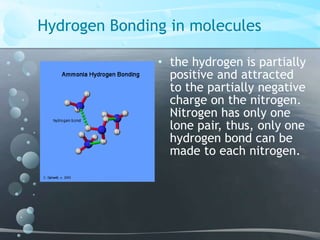
Hydrogen Bonding in moleculesthe hydrogen is partially positive and attracted to the partially negative charge on the nitrogen. Nitrogen has only one lone pair, thus, only one hydrogen bond can be made to each nitrogen.
Activity
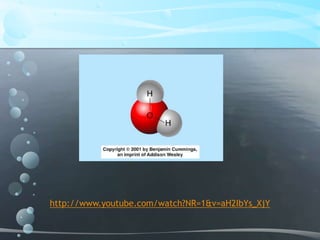
http://www.youtube.com/watch?NR=1&v=aH2IbYs_XjY
ExperimentPlan and perform an investigation to identify and describe the effect of anti-freeze (ethylene glycol) or salt on the boiling point of water
How would you plan this experiment?Plan and perform an investigation to identify and describe the effect of anti-freeze (ethylene glycol) or salt on the boiling point of water
What safety steps need to be taken?
What is your hypothesis?
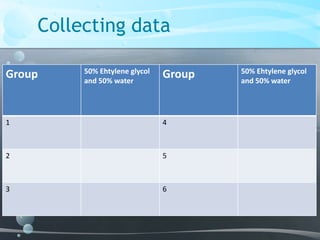
Collecting data
What can be concluded?
Blog Site: hydrogenbonding2y.blogspot.comQuestions?

Hydrogen bonding

  • 1.
    Hydrogen Bonding8.4 Water(Prelim)8.4.2 The wide distribution and importance of water on Earth is a consequence of its molecular structure and hydrogen bonding
  • 2.
    Syllabus PointsStage 6preliminary unit on Water.describe hydrogen bonding between moleculesplan and perform an investigation to identify and describe the effect of anti-freeze or salt on the boiling point of water
  • 3.
  • 4.
    What is aHydrogen Bond?Hydrogen bonds are the attractive force between the hydrogen attached to an electronegative atom of one molecule and an electronegative atom of a different molecule. Hydrogen (H) needs to be attached to a highly electronegative Oxygen (O), Fluoride (F), Nitrogen (N) atom.
  • 5.
    Why are O, F & N so attractive??In each of these molecules note:1. A hydrogen atom! 2. the hydrogen is attached directly to one of the most electronegative elements, causing the hydrogen to acquire a significant amount of positive charge. 3. Each of the elements to which the hydrogen is attached is not only significantly negative, but also has at least one "active" lone pair. In these interactions, a hydrogen atom is the donor, and the respective electronegative atom is the acceptor of the bond.Electronegativity ValuesF (4.0) O (3.5) N(3.0)
  • 6.
    Hydrogen Bonding inWaterWater could be considered as the "perfect" hydrogen bonded system. Each Oygen (O) has 2 lone pairs of electrons therefore, 4 Hydrogen bonds (H-bonds) can be formed.Hydrogen-bonding network formed in liquid water is responsible for many of the essential and unique properties of water. Ice forms a crystalline lattice, held together by a multitude of H-bonds
  • 7.
    Hydrogen Bonding inmoleculesthe hydrogen is partially positive and attracted to the partially negative charge on the nitrogen. Nitrogen has only one lone pair, thus, only one hydrogen bond can be made to each nitrogen.
  • 8.
  • 9.
  • 10.
    ExperimentPlan and performan investigation to identify and describe the effect of anti-freeze (ethylene glycol) or salt on the boiling point of water
  • 11.
    How would youplan this experiment?Plan and perform an investigation to identify and describe the effect of anti-freeze (ethylene glycol) or salt on the boiling point of water
  • 12.
    What safety stepsneed to be taken?
  • 13.
    What is yourhypothesis?
  • 14.
  • 15.
    What can beconcluded?
  • 16.