IB Chemistry Power Points

                                Topic 15
                               Energetics
www.pedagogics.ca


                       LECTURE
               Standard Enthalpies
                    Born-Haber Cycle
Much taken from

ENTHALPY
 CHANGES


             Great thanks to
JONATHAN HOPTON & KNOCKHARDY PUBLISHING
     www.knockhardy.org.uk/sci.htm
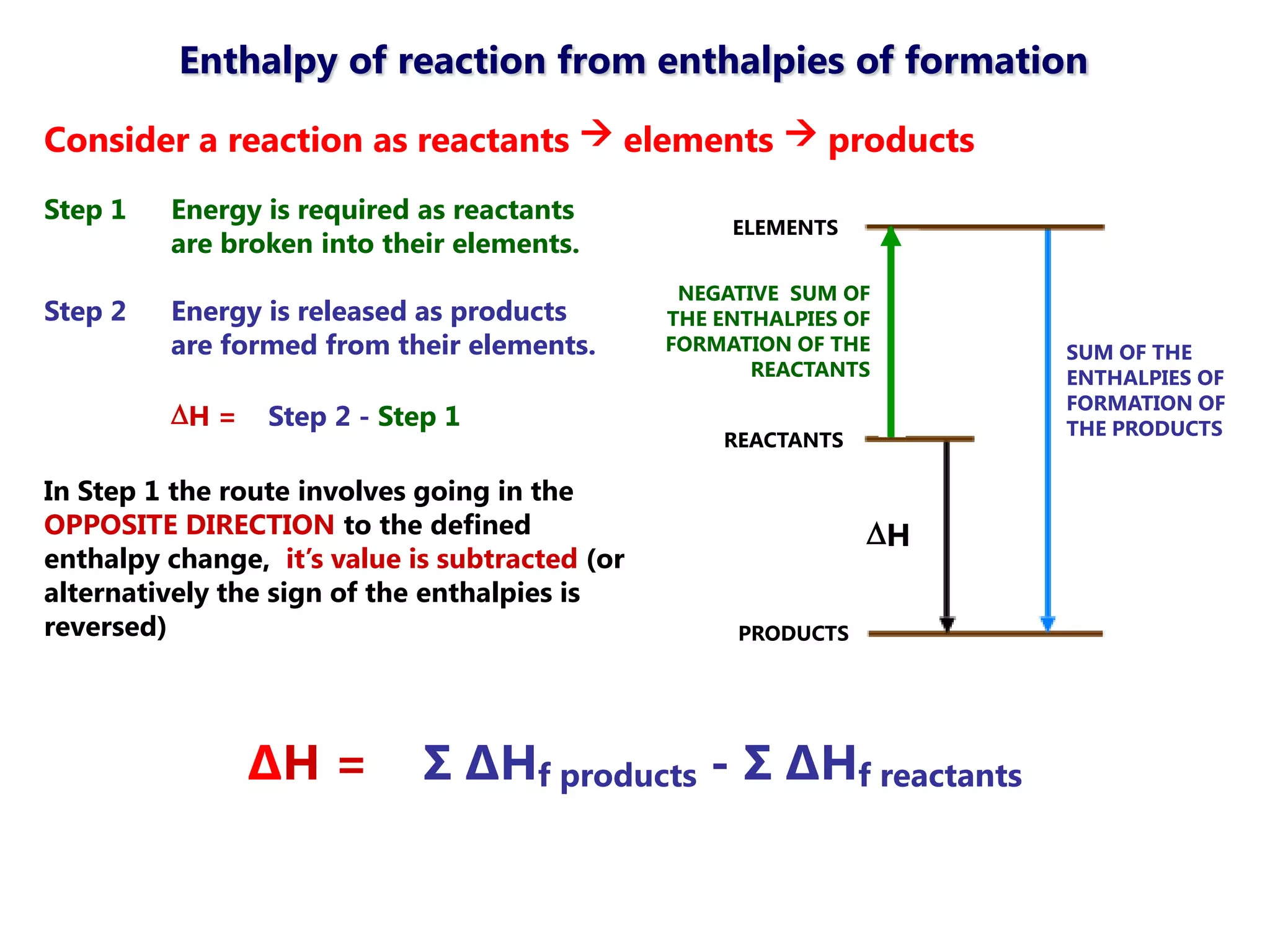
Enthalpy of reaction from enthalpies of formation

Consider a reaction as reactants  elements  products
Step 1   Energy is required as reactants
                                                     ELEMENTS
         are broken into their elements.
                                                 NEGATIVE SUM OF
Step 2   Energy is released as products         THE ENTHALPIES OF
         are formed from their elements.        FORMATION OF THE      SUM OF THE
                                                       REACTANTS      ENTHALPIES OF
                                                                      FORMATION OF
         H =    Step 2 - Step 1                                      THE PRODUCTS
                                                    REACTANTS

In Step 1 the route involves going in the
OPPOSITE DIRECTION to the defined                                H
enthalpy change, it’s value is subtracted (or
alternatively the sign of the enthalpies is
reversed)                                             PRODUCTS


                ΔH =         Σ ΔHf products - Σ ΔHf reactants
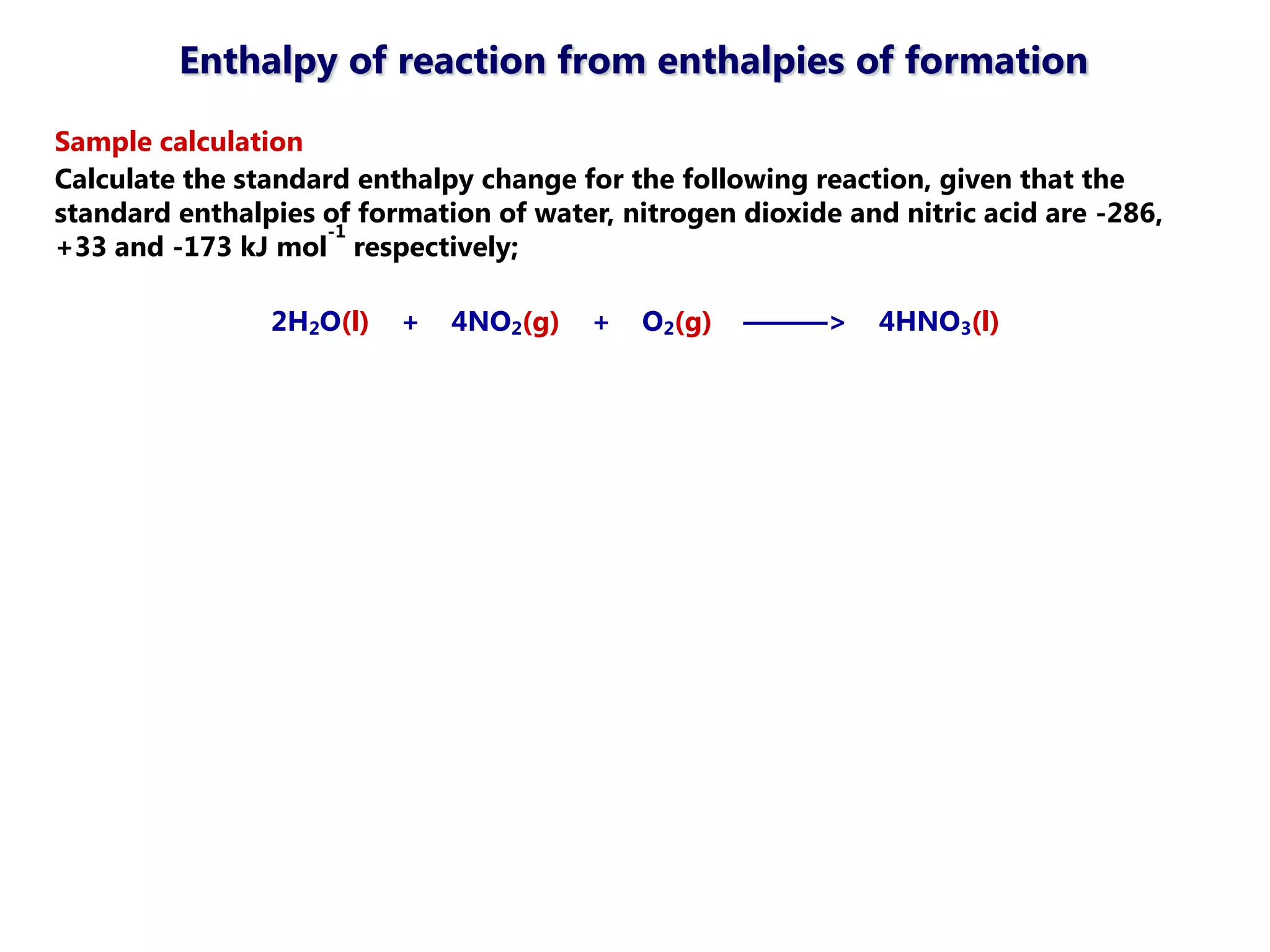
Enthalpy of reaction from enthalpies of formation

Sample calculation
Calculate the standard enthalpy change for the following reaction, given that the
standard enthalpies of formation of water, nitrogen dioxide and nitric acid are -286,
                     -1
+33 and -173 kJ mol respectively;

                2H2O(l)   +   4NO2(g)    +   O2(g)   ———>      4HNO3(l)
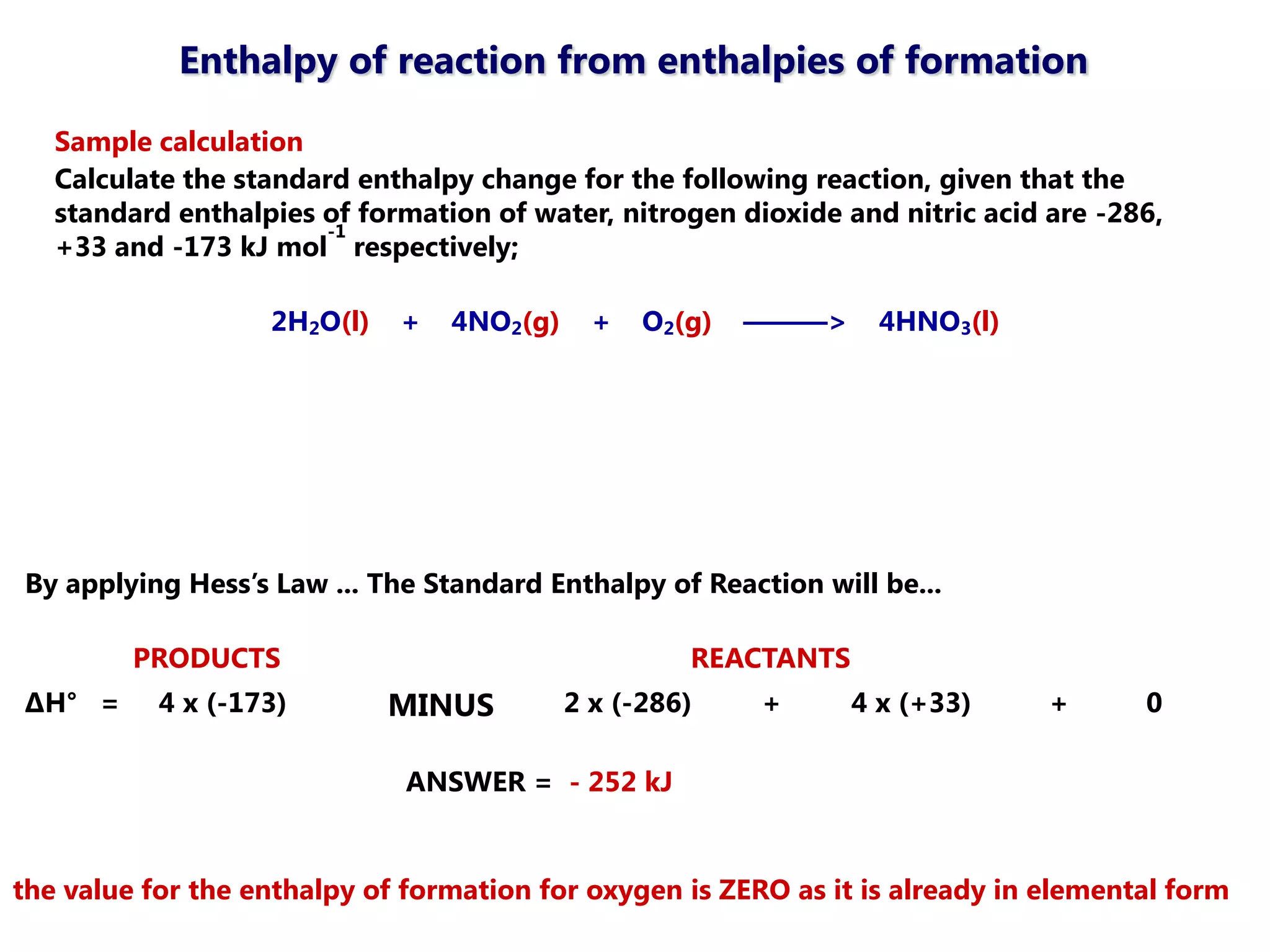
Enthalpy of reaction from enthalpies of formation

   Sample calculation
   Calculate the standard enthalpy change for the following reaction, given that the
   standard enthalpies of formation of water, nitrogen dioxide and nitric acid are -286,
                        -1
   +33 and -173 kJ mol respectively;

                   2H2O(l)   +   4NO2(g)     +   O2(g)   ———>     4HNO3(l)


By applying Hess’s Law ... The Standard Enthalpy of Reaction will be...

         PRODUCTS                                   REACTANTS
ΔH° =      4 x (-173)        MINUS         2 x (-286)    +      4 x (+33)      +      0

                              ANSWER = - 252 kJ


the value for the enthalpy of formation for oxygen is ZERO as it is already in elemental form
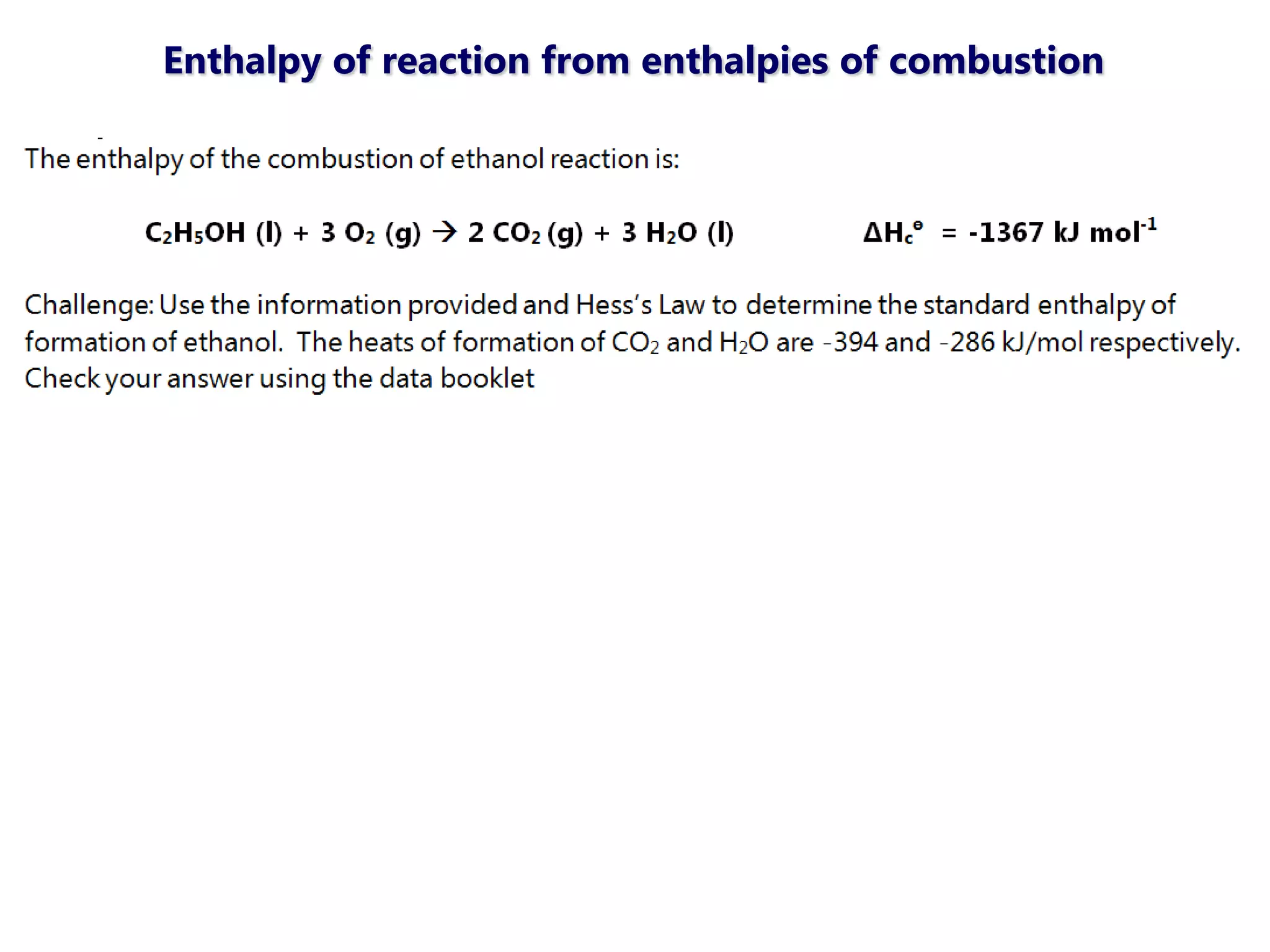
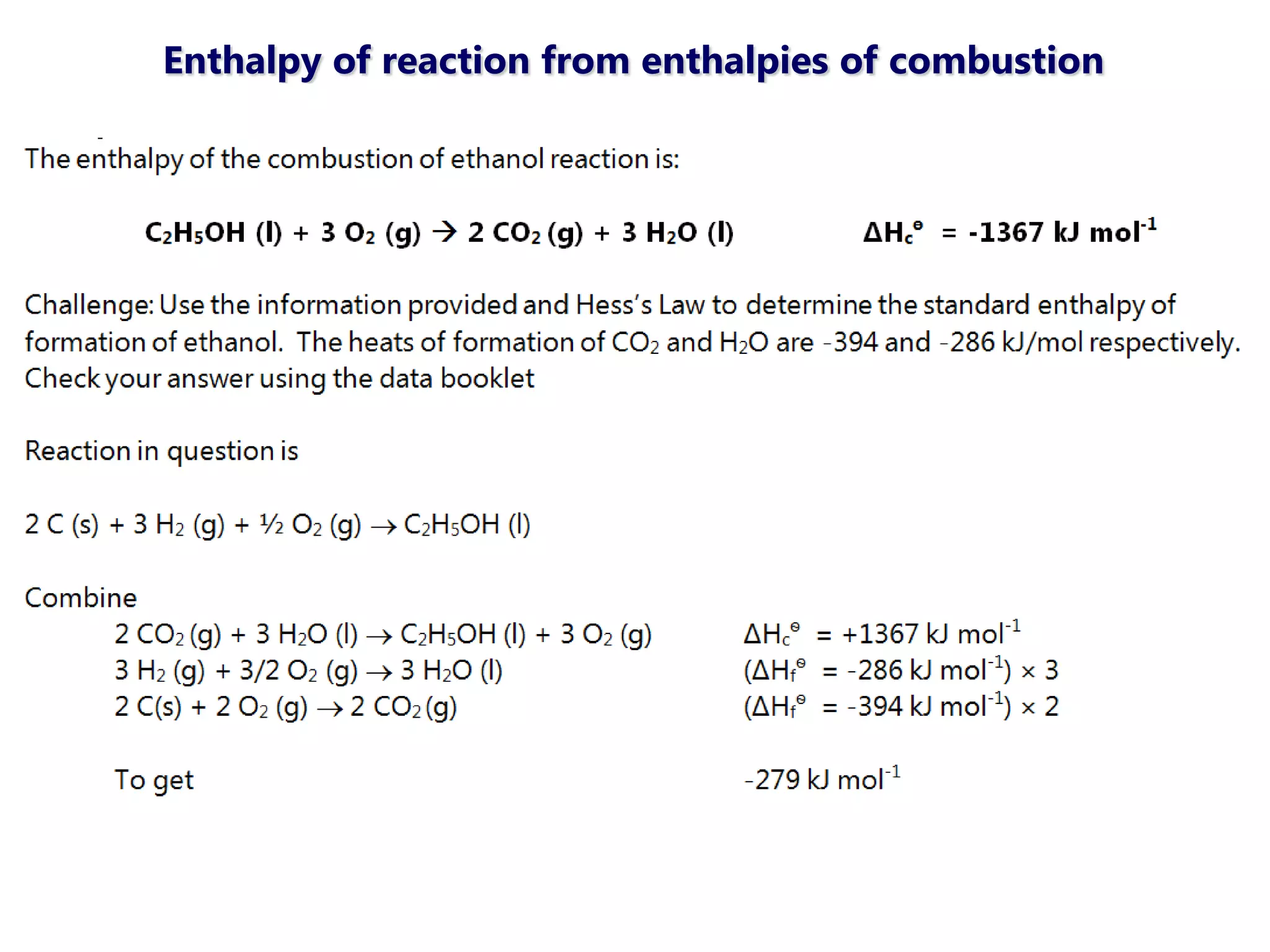
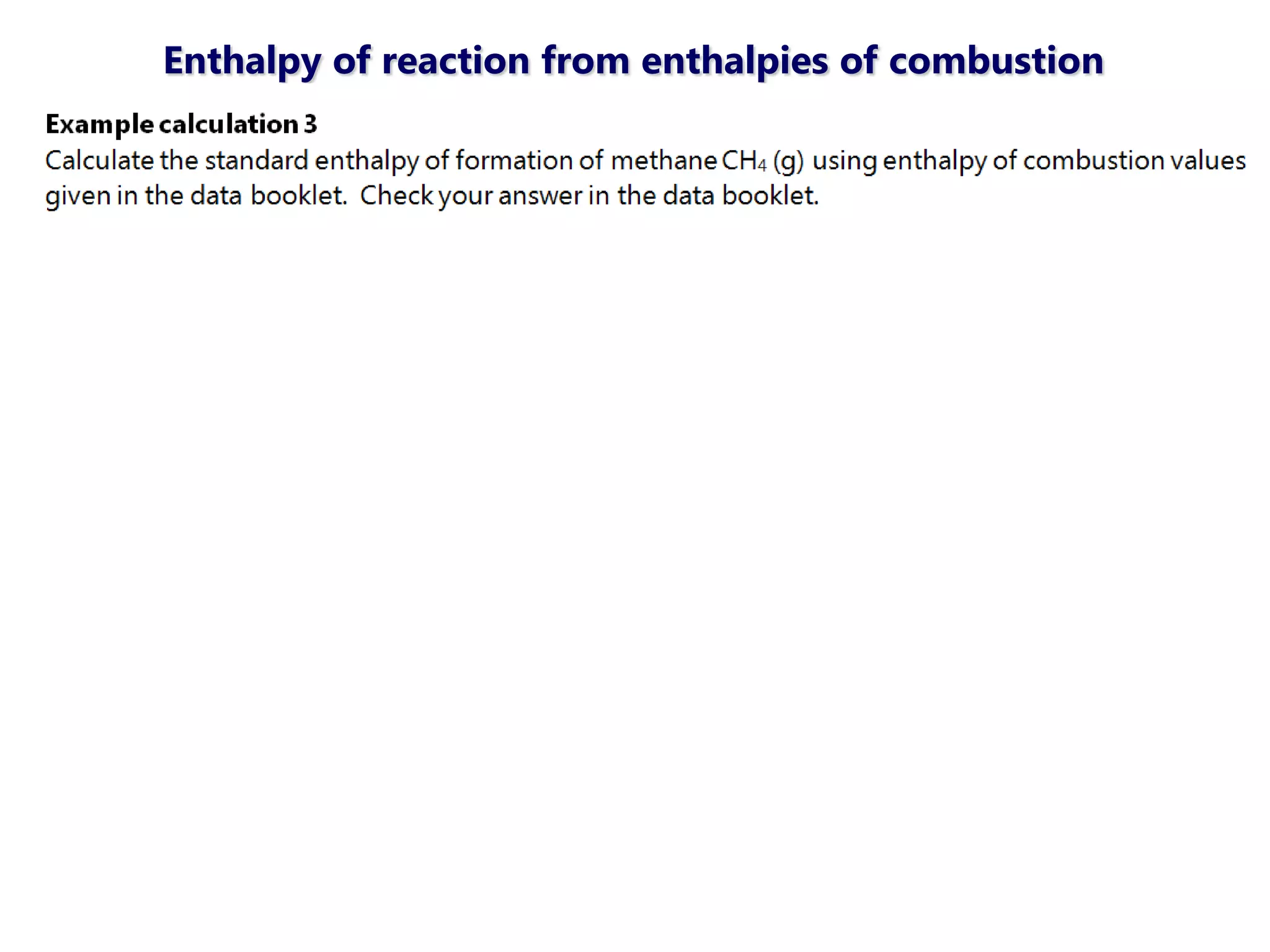
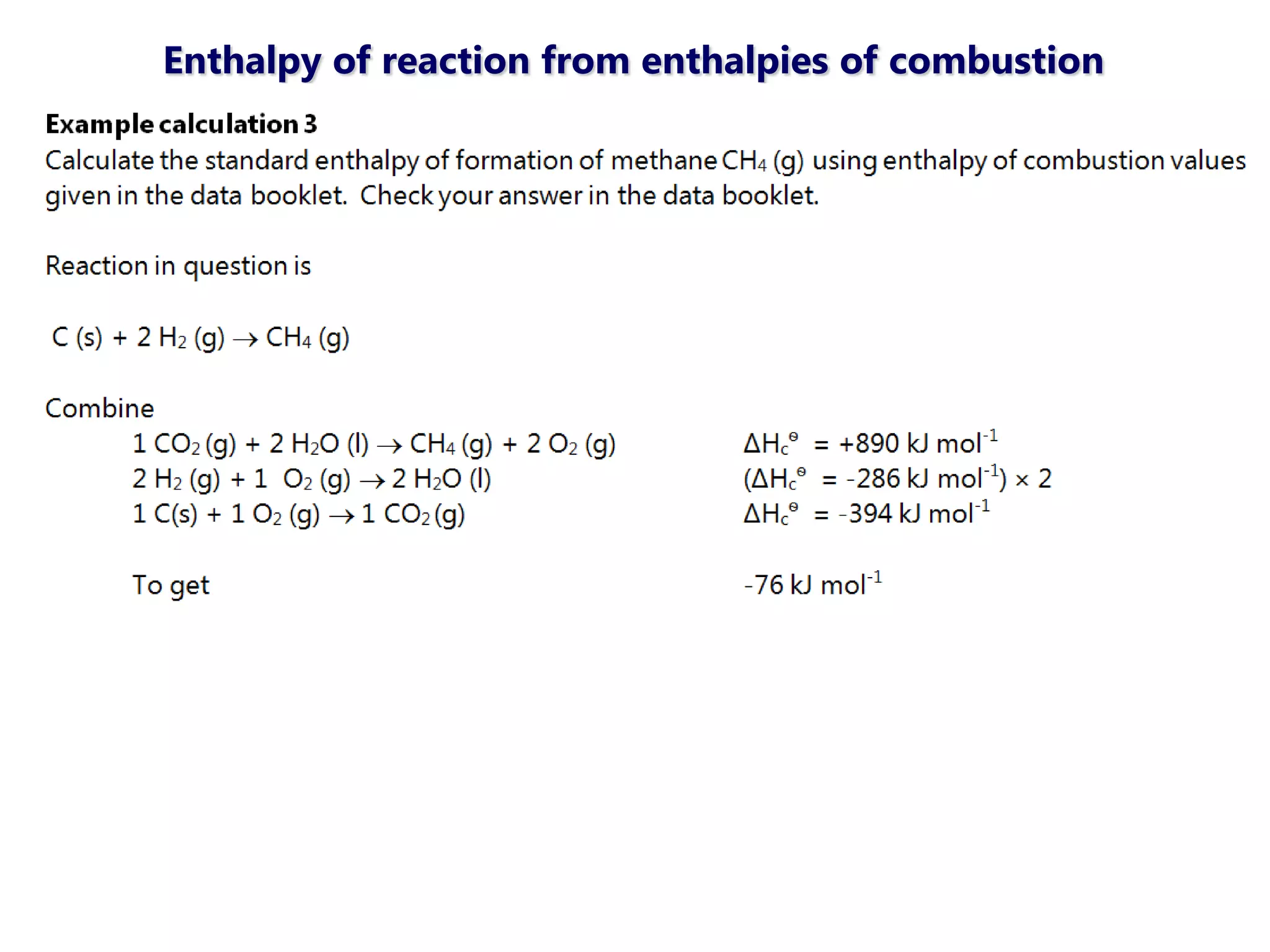
Enthalpy of reaction from enthalpies of combustion
The Born–Haber cycle
Background Information (from Wikipedia)

“The Born–Haber cycle is an approach to analyzing
reaction energies. It was named after and developed by the
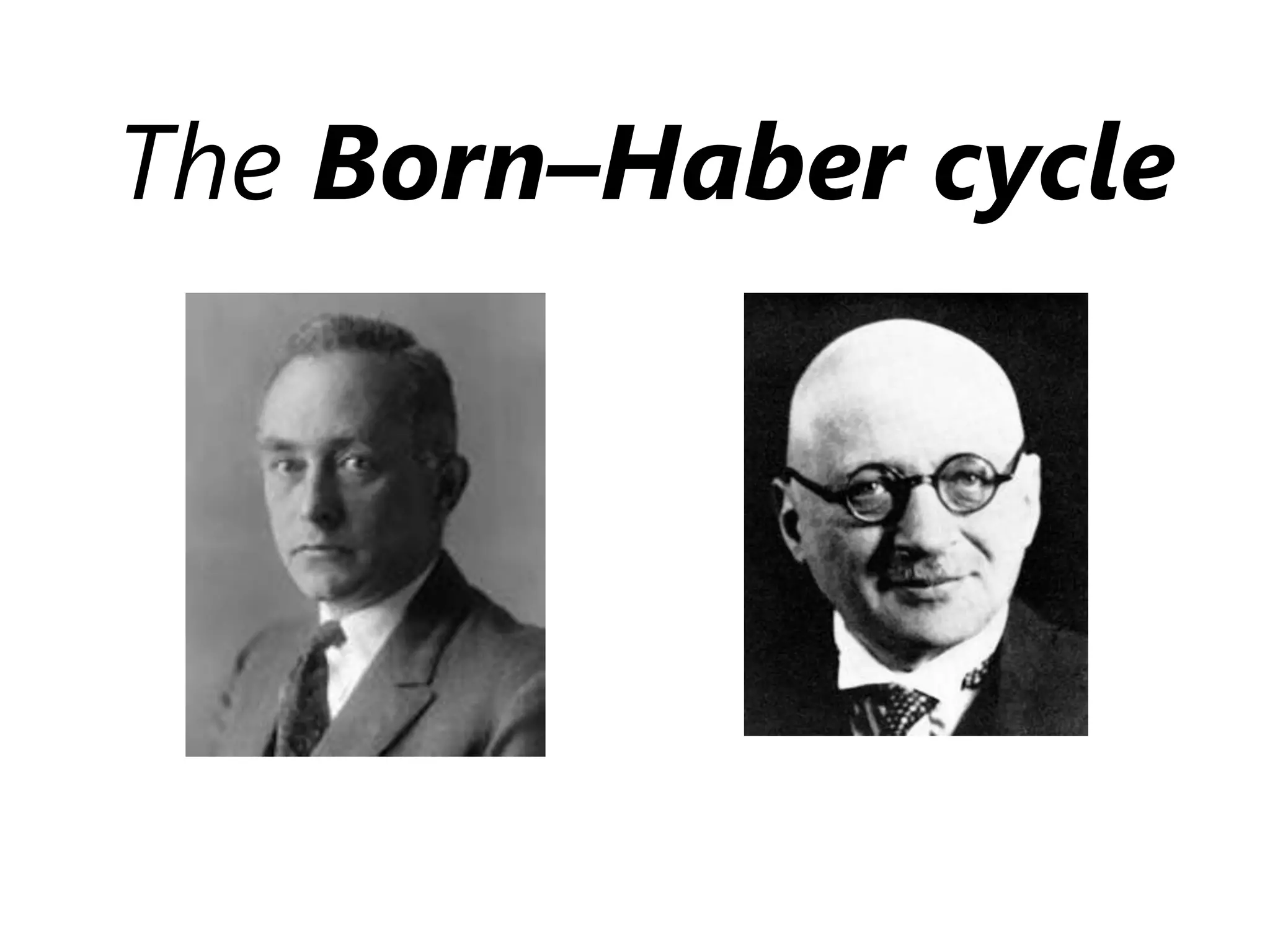
two German scientists Max Born and Fritz Haber.

The Born–Haber cycle involves the formation of an ionic
compound from the reaction of a metal (often a Group I or Group
II element) with a non-metal. Born–Haber cycles are used primarily
as a means of calculating lattice energies (or more precisely
           [1]
enthalpies ) which cannot otherwise be measured directly.
The lattice enthalpy is the enthalpy change involved in formation
of the ionic compound from gaseous ions. Some chemists define it
as the energy to break the ionic compound into gaseous ions. The
former definition is invariably exothermic and the latter is
endothermic.”
Background Information (from Wikipedia) continued

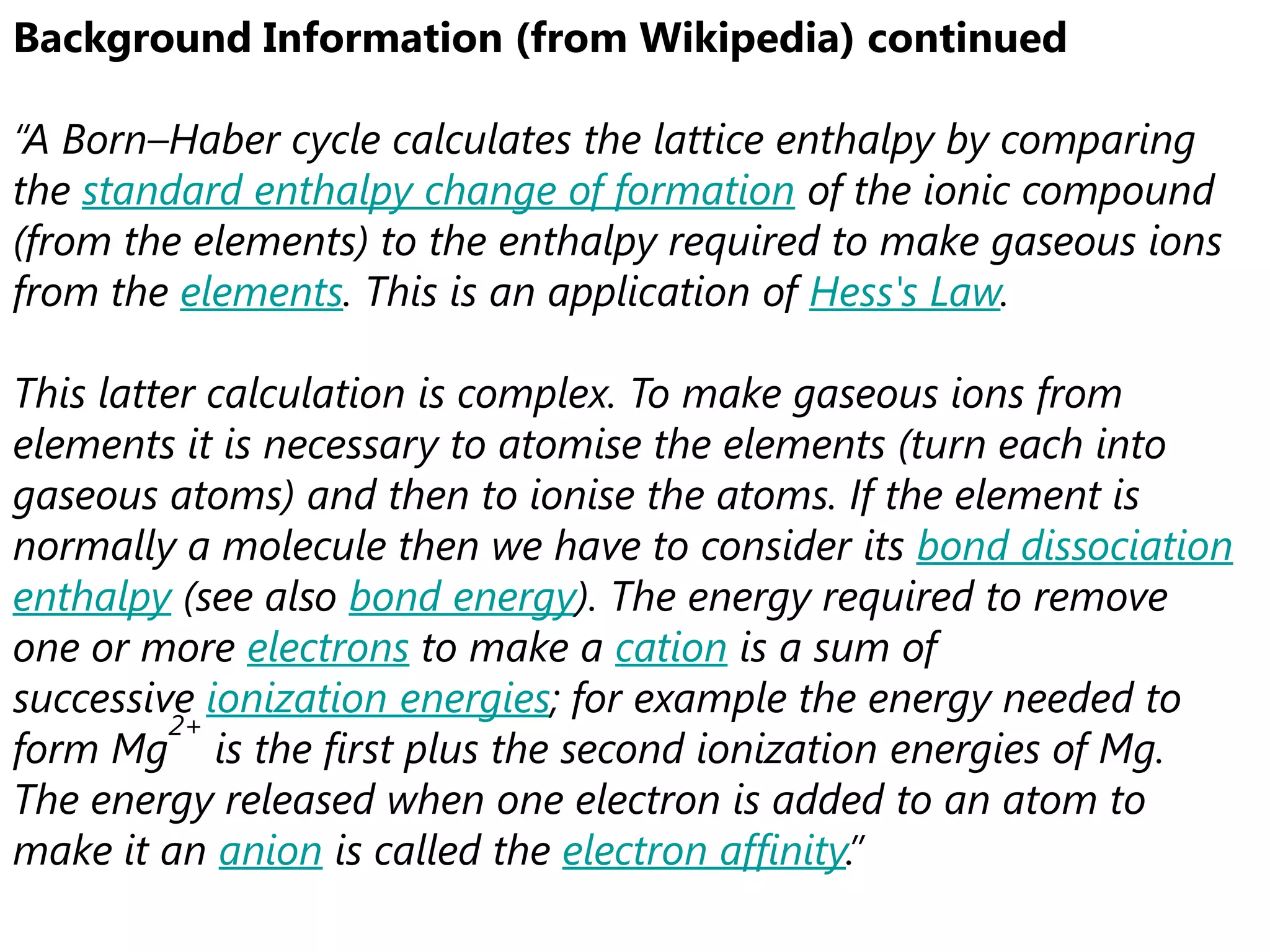
“A Born–Haber cycle calculates the lattice enthalpy by comparing
the standard enthalpy change of formation of the ionic compound
(from the elements) to the enthalpy required to make gaseous ions
from the elements. This is an application of Hess's Law.

This latter calculation is complex. To make gaseous ions from
elements it is necessary to atomise the elements (turn each into
gaseous atoms) and then to ionise the atoms. If the element is
normally a molecule then we have to consider its bond dissociation
enthalpy (see also bond energy). The energy required to remove
one or more electrons to make a cation is a sum of
successive ionization energies; for example the energy needed to
         2+
form Mg is the first plus the second ionization energies of Mg.
The energy released when one electron is added to an atom to
make it an anion is called the electron affinity.”
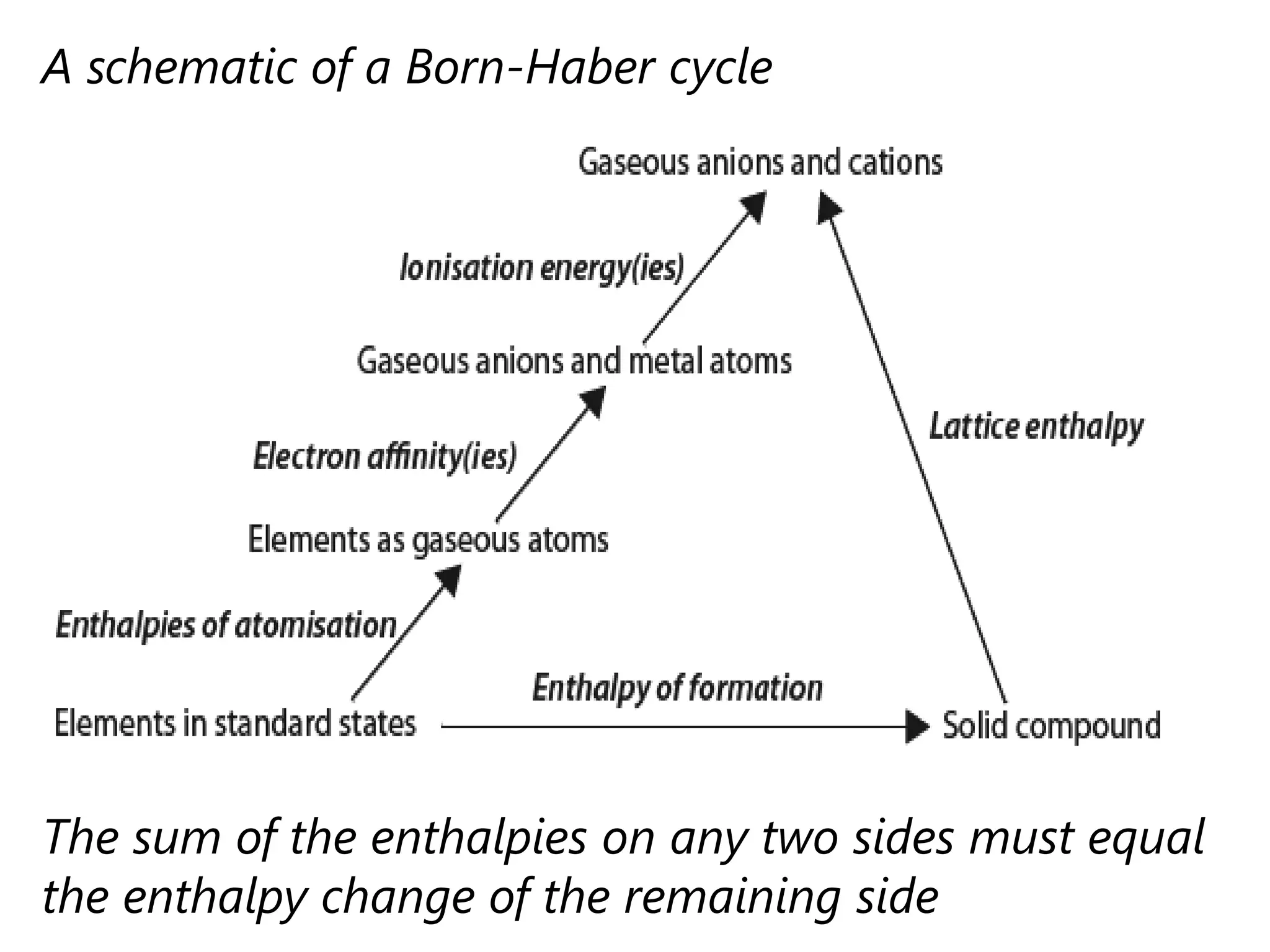
A schematic of a Born-Haber cycle


The sum of the enthalpies on any two sides must equal
the enthalpy change of the remaining side
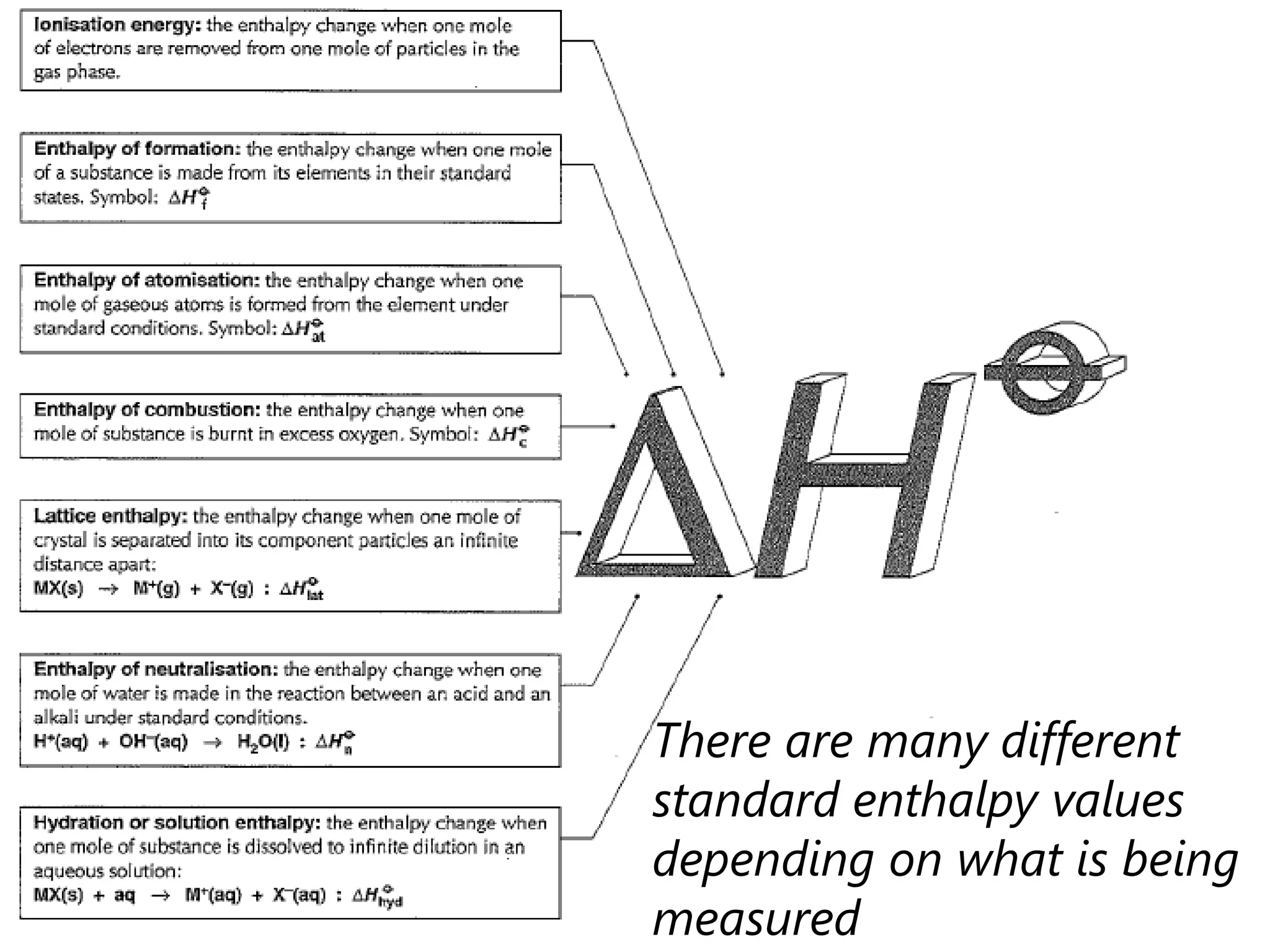
There are many different
standard enthalpy values
depending on what is being
measured
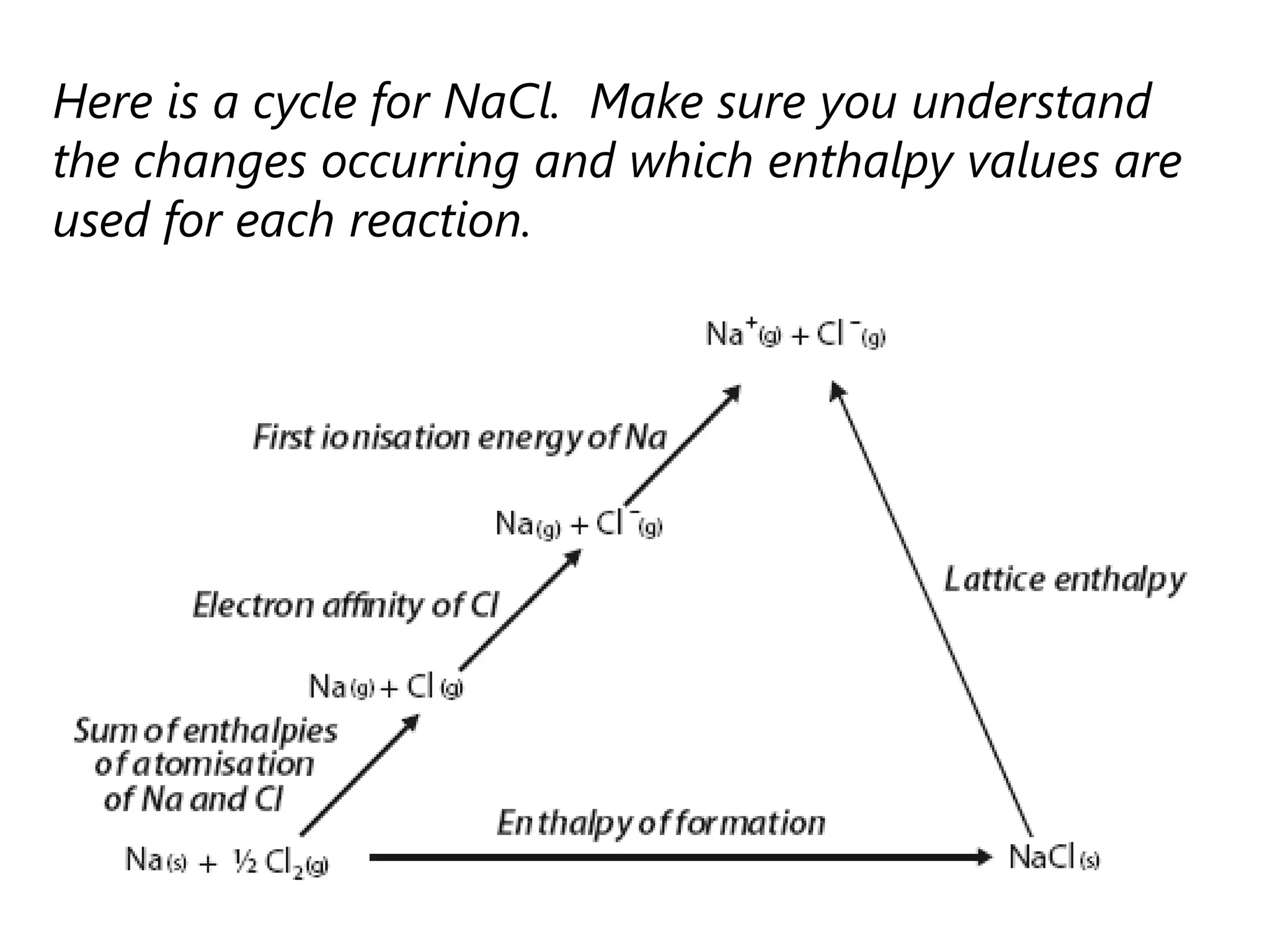
Here is a cycle for NaCl. Make sure you understand
the changes occurring and which enthalpy values are
used for each reaction.
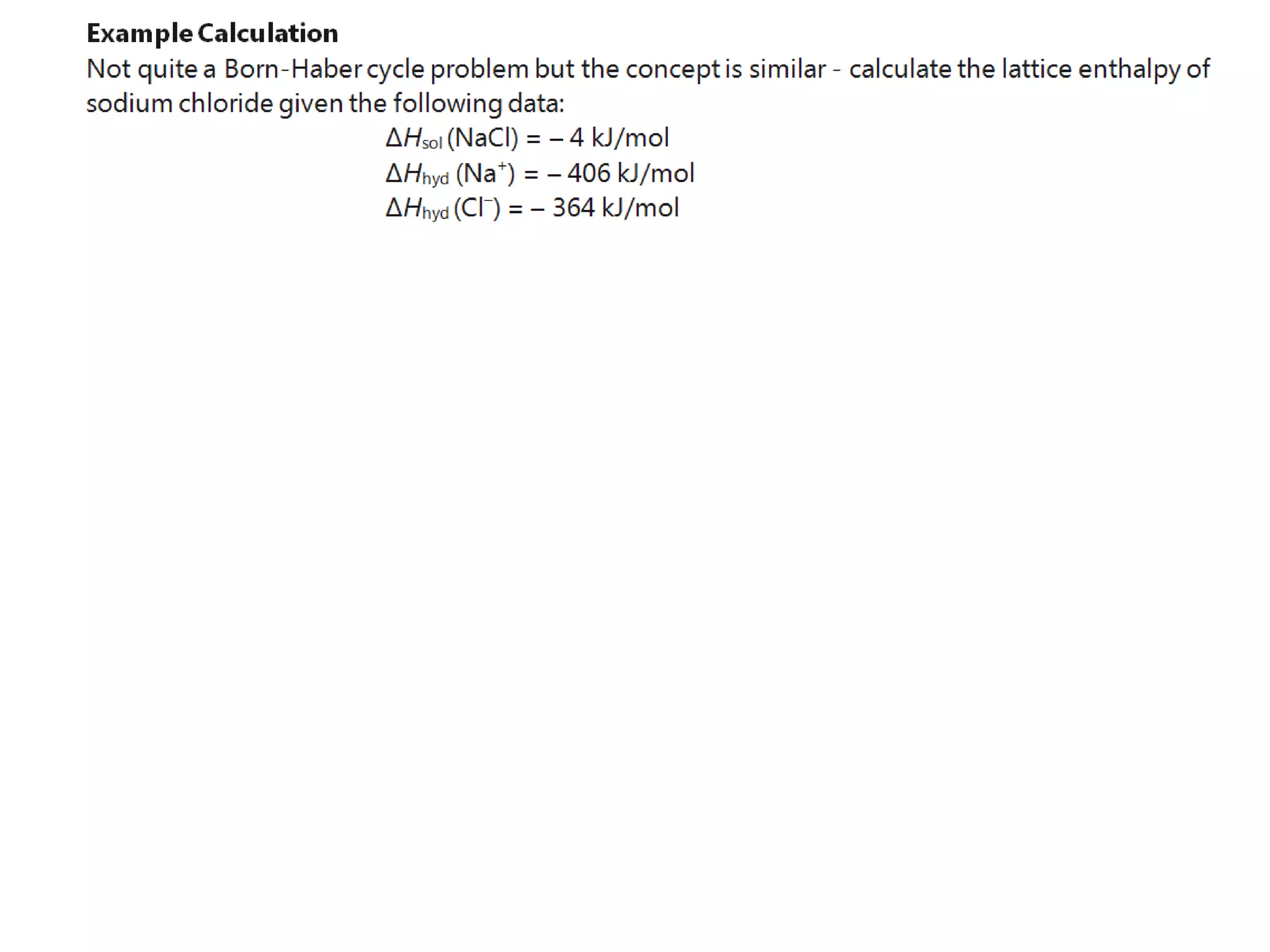
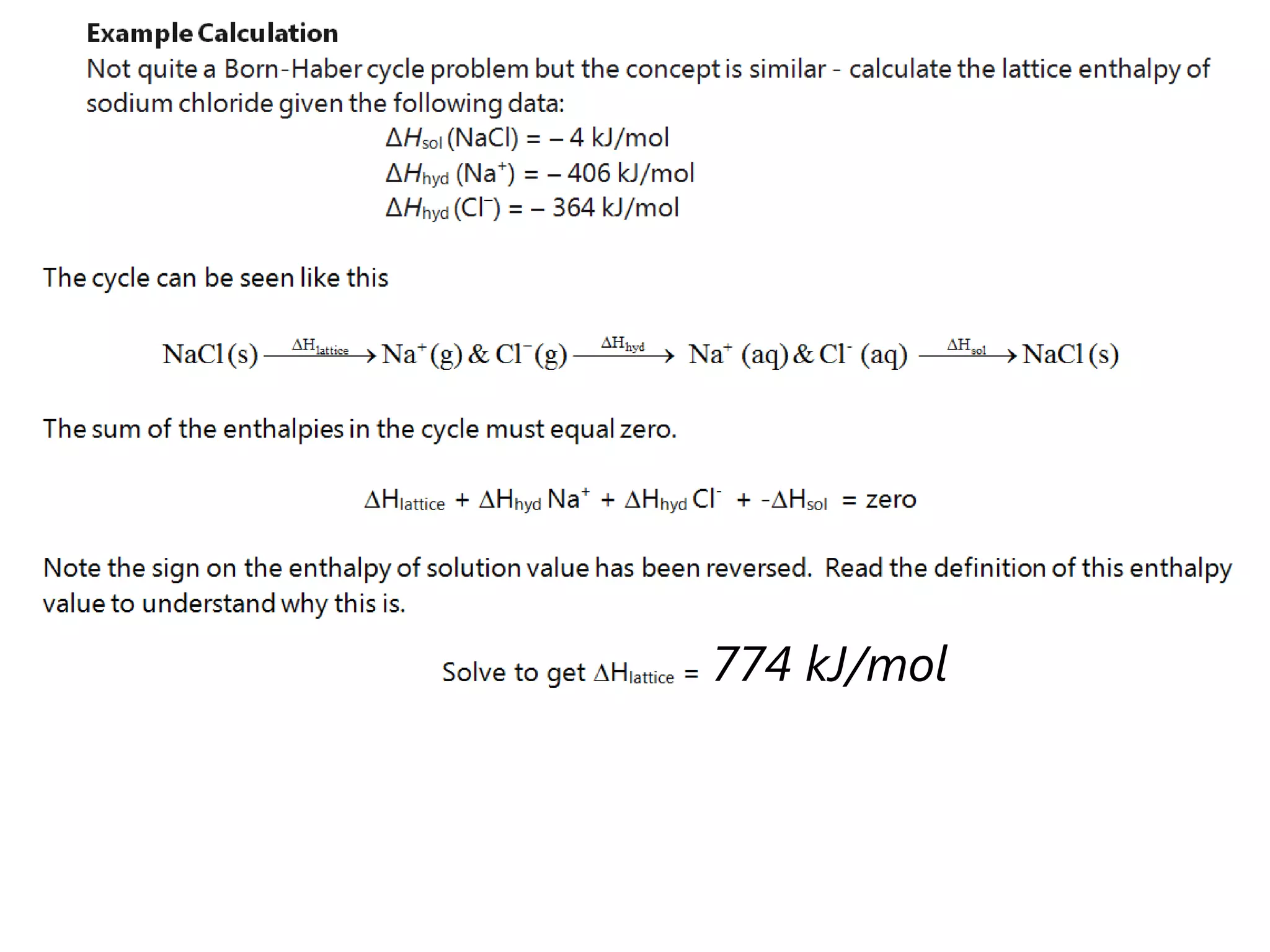
774 kJ/mol
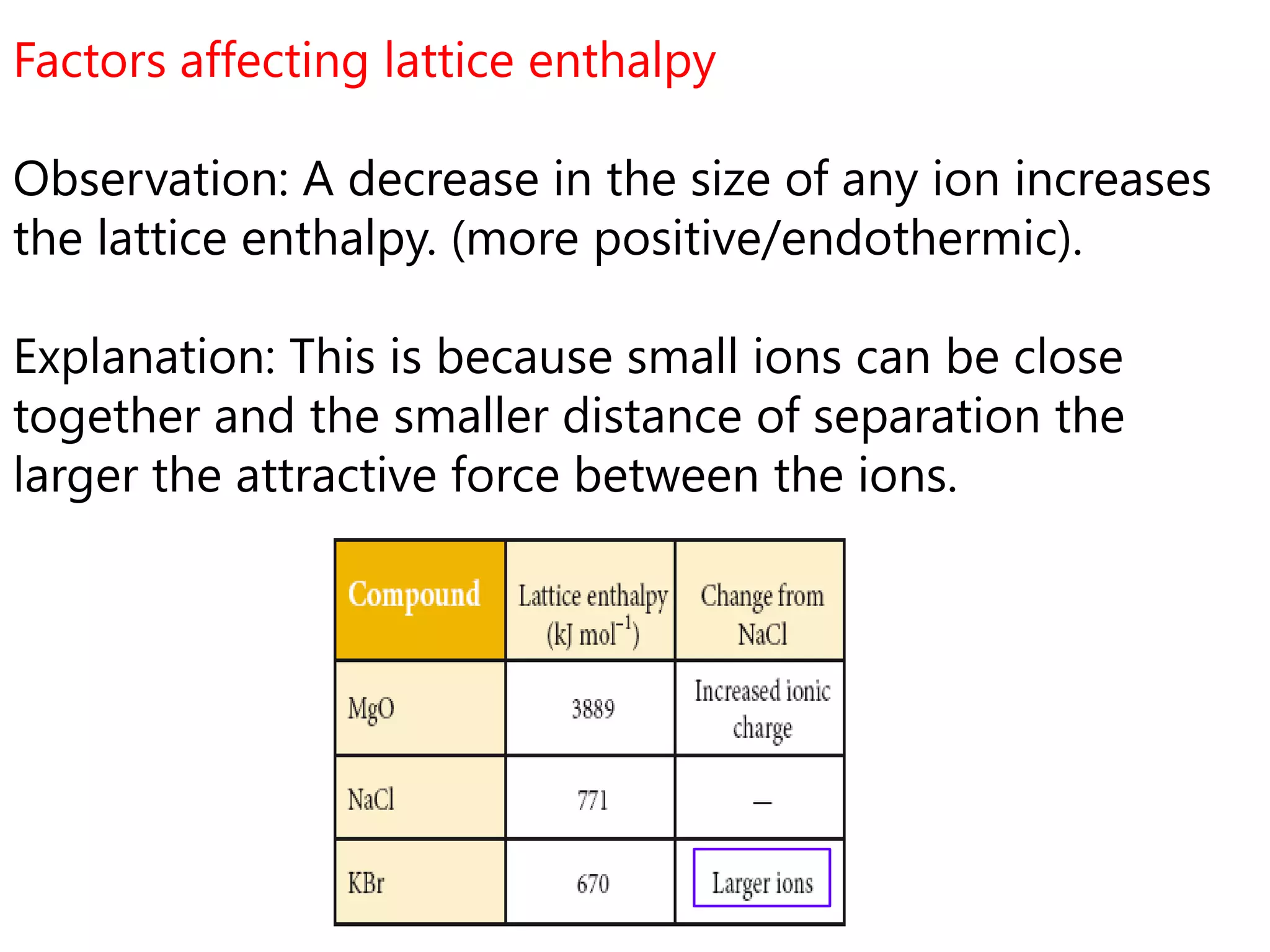
Factors affecting lattice enthalpy

Observation: A decrease in the size of any ion increases
the lattice enthalpy. (more positive/endothermic).

Explanation: This is because small ions can be close
together and the smaller distance of separation the
larger the attractive force between the ions.
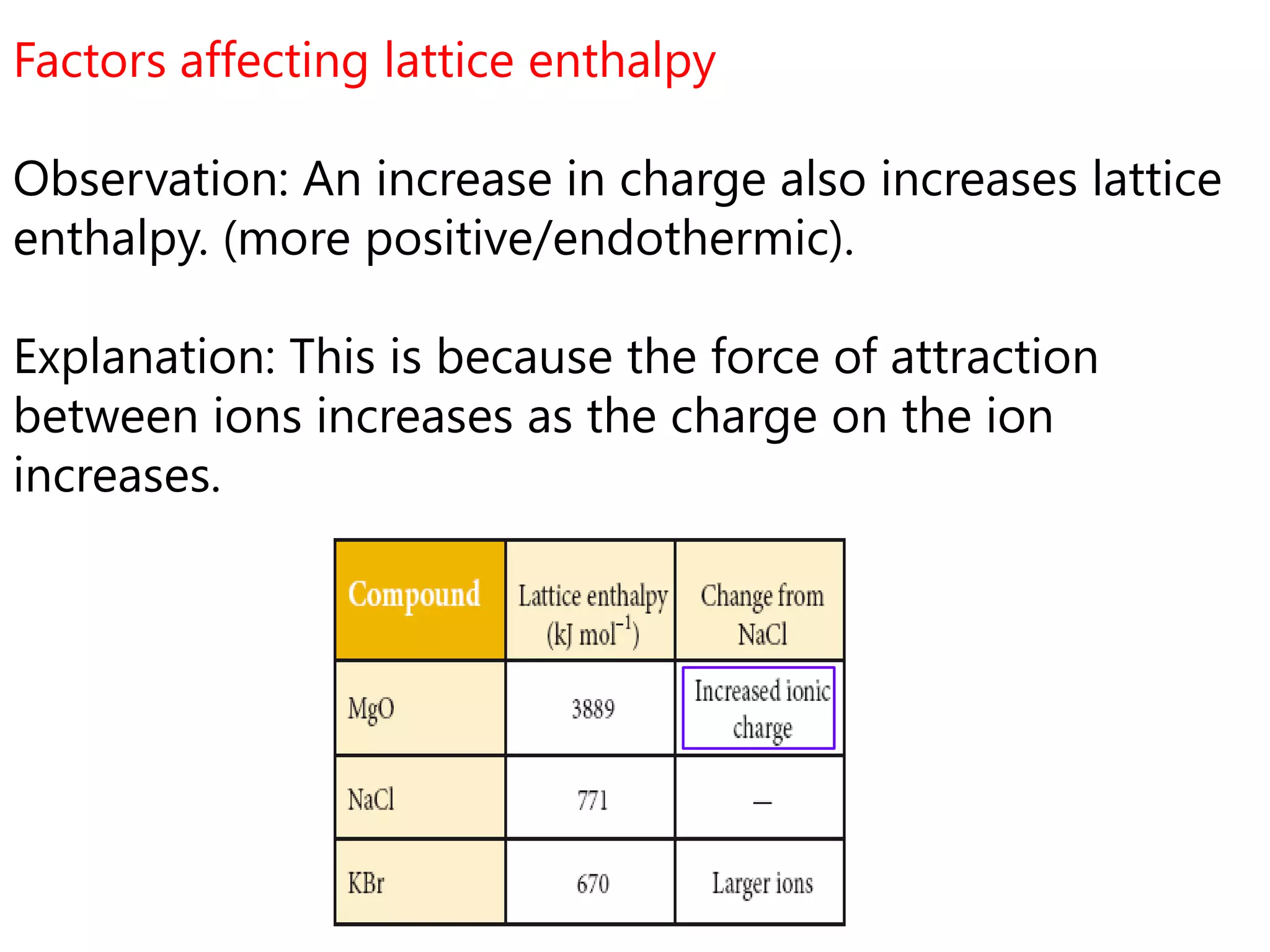
Factors affecting lattice enthalpy

Observation: An increase in charge also increases lattice
enthalpy. (more positive/endothermic).

Explanation: This is because the force of attraction
between ions increases as the charge on the ion
increases.
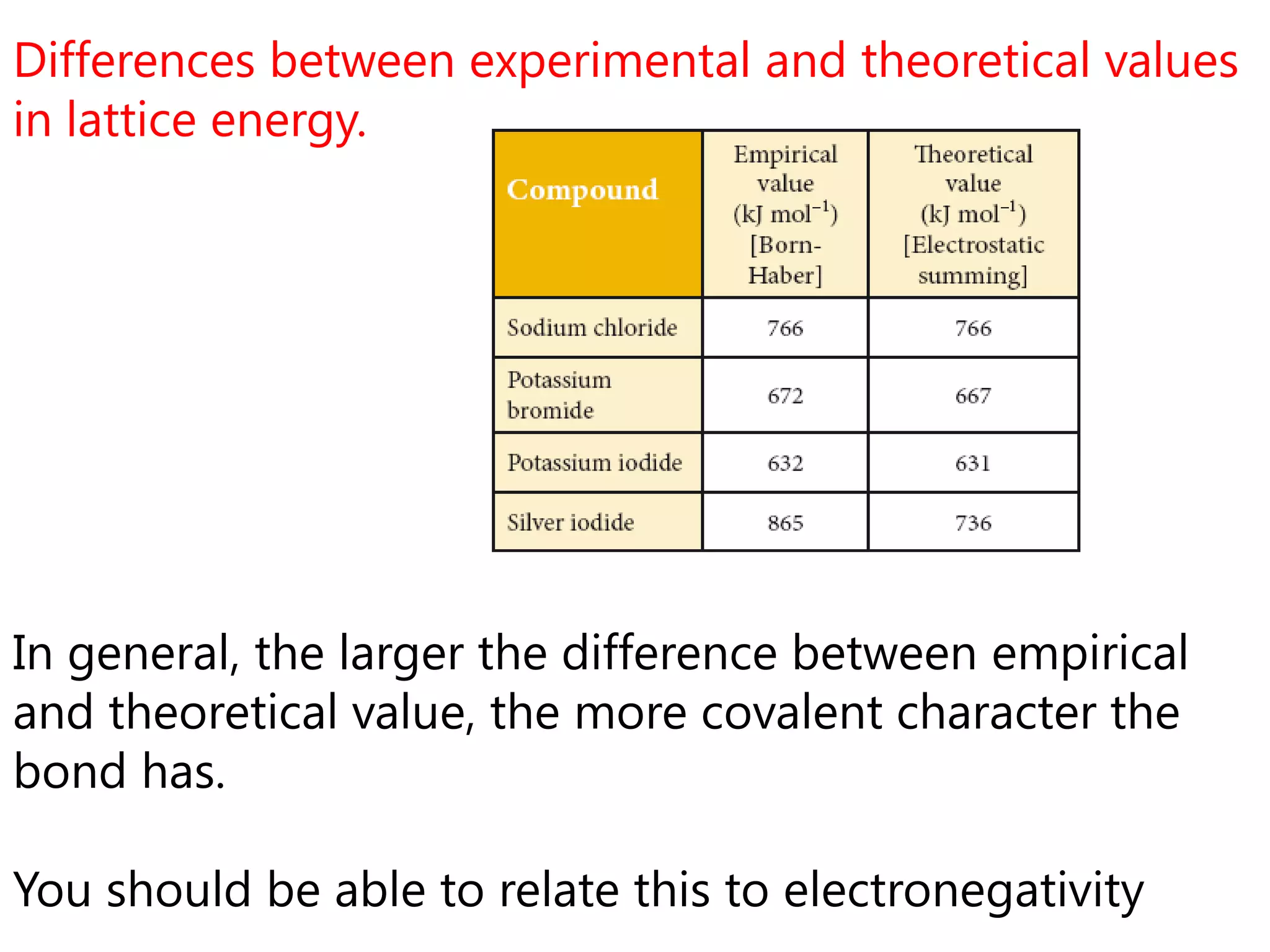
Differences between experimental and theoretical values
in lattice energy.


In general, the larger the difference between empirical
and theoretical value, the more covalent character the
bond has.

You should be able to relate this to electronegativity

2012 15 1 and 15 2

  • 1.
    IB Chemistry PowerPoints Topic 15 Energetics www.pedagogics.ca LECTURE Standard Enthalpies Born-Haber Cycle
  • 2.
    Much taken from ENTHALPY CHANGES Great thanks to JONATHAN HOPTON & KNOCKHARDY PUBLISHING www.knockhardy.org.uk/sci.htm
  • 3.
    Enthalpy of reactionfrom enthalpies of formation Consider a reaction as reactants  elements  products Step 1 Energy is required as reactants ELEMENTS are broken into their elements. NEGATIVE SUM OF Step 2 Energy is released as products THE ENTHALPIES OF are formed from their elements. FORMATION OF THE SUM OF THE REACTANTS ENTHALPIES OF FORMATION OF H = Step 2 - Step 1 THE PRODUCTS REACTANTS In Step 1 the route involves going in the OPPOSITE DIRECTION to the defined H enthalpy change, it’s value is subtracted (or alternatively the sign of the enthalpies is reversed) PRODUCTS ΔH = Σ ΔHf products - Σ ΔHf reactants
  • 4.
    Enthalpy of reactionfrom enthalpies of formation Sample calculation Calculate the standard enthalpy change for the following reaction, given that the standard enthalpies of formation of water, nitrogen dioxide and nitric acid are -286, -1 +33 and -173 kJ mol respectively; 2H2O(l) + 4NO2(g) + O2(g) ———> 4HNO3(l)
  • 5.
    Enthalpy of reactionfrom enthalpies of formation Sample calculation Calculate the standard enthalpy change for the following reaction, given that the standard enthalpies of formation of water, nitrogen dioxide and nitric acid are -286, -1 +33 and -173 kJ mol respectively; 2H2O(l) + 4NO2(g) + O2(g) ———> 4HNO3(l) By applying Hess’s Law ... The Standard Enthalpy of Reaction will be... PRODUCTS REACTANTS ΔH° = 4 x (-173) MINUS 2 x (-286) + 4 x (+33) + 0 ANSWER = - 252 kJ the value for the enthalpy of formation for oxygen is ZERO as it is already in elemental form
  • 6.
    Enthalpy of reactionfrom enthalpies of combustion
  • 7.
    Enthalpy of reactionfrom enthalpies of combustion
  • 8.
    Enthalpy of reactionfrom enthalpies of combustion
  • 9.
    Enthalpy of reactionfrom enthalpies of combustion
  • 10.
  • 11.
    Background Information (fromWikipedia) “The Born–Haber cycle is an approach to analyzing reaction energies. It was named after and developed by the two German scientists Max Born and Fritz Haber. The Born–Haber cycle involves the formation of an ionic compound from the reaction of a metal (often a Group I or Group II element) with a non-metal. Born–Haber cycles are used primarily as a means of calculating lattice energies (or more precisely [1] enthalpies ) which cannot otherwise be measured directly. The lattice enthalpy is the enthalpy change involved in formation of the ionic compound from gaseous ions. Some chemists define it as the energy to break the ionic compound into gaseous ions. The former definition is invariably exothermic and the latter is endothermic.”
  • 12.
    Background Information (fromWikipedia) continued “A Born–Haber cycle calculates the lattice enthalpy by comparing the standard enthalpy change of formation of the ionic compound (from the elements) to the enthalpy required to make gaseous ions from the elements. This is an application of Hess's Law. This latter calculation is complex. To make gaseous ions from elements it is necessary to atomise the elements (turn each into gaseous atoms) and then to ionise the atoms. If the element is normally a molecule then we have to consider its bond dissociation enthalpy (see also bond energy). The energy required to remove one or more electrons to make a cation is a sum of successive ionization energies; for example the energy needed to 2+ form Mg is the first plus the second ionization energies of Mg. The energy released when one electron is added to an atom to make it an anion is called the electron affinity.”
  • 13.
    A schematic ofa Born-Haber cycle The sum of the enthalpies on any two sides must equal the enthalpy change of the remaining side
  • 14.
    There are manydifferent standard enthalpy values depending on what is being measured
  • 15.
    Here is acycle for NaCl. Make sure you understand the changes occurring and which enthalpy values are used for each reaction.
  • 17.
  • 18.
    Factors affecting latticeenthalpy Observation: A decrease in the size of any ion increases the lattice enthalpy. (more positive/endothermic). Explanation: This is because small ions can be close together and the smaller distance of separation the larger the attractive force between the ions.
  • 19.
    Factors affecting latticeenthalpy Observation: An increase in charge also increases lattice enthalpy. (more positive/endothermic). Explanation: This is because the force of attraction between ions increases as the charge on the ion increases.
  • 20.
    Differences between experimentaland theoretical values in lattice energy. In general, the larger the difference between empirical and theoretical value, the more covalent character the bond has. You should be able to relate this to electronegativity